March 26

What was advertised in a colonial American newspaper 250 years ago today?
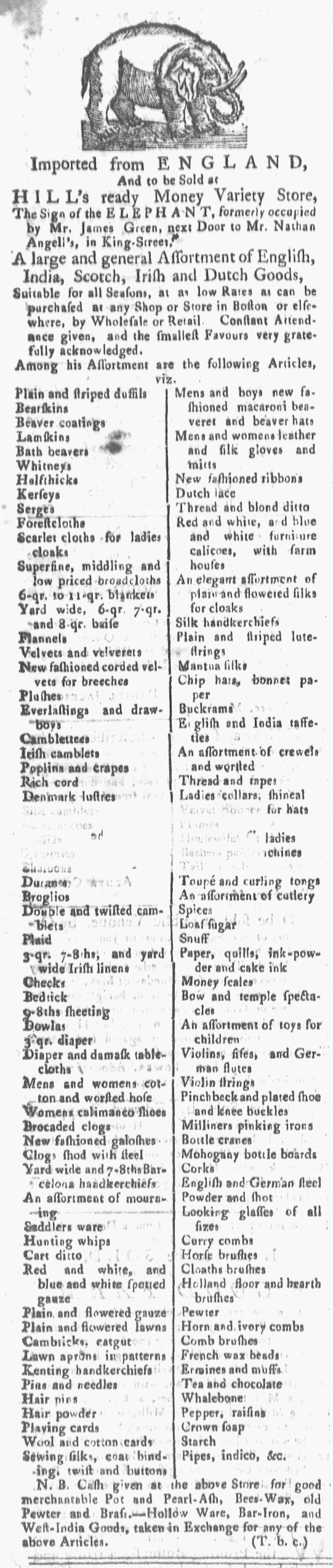
Providence Gazette (March 26, 1774).

“The Sign of the ELEPHANT.”

The advertising campaign for “HILL’s ready Money Variety Store” at the “Sign of the Elephant” in Providence went through stages in the winter and spring of 1774.  An initial advertisement in the January 22 edition of the Providence Gazette promoted a “compleat Assortment of English, Scotch and India GOODS,” listing about a dozen items available at the store.  It also promised “every other Article usually imported, too many to be enumerated in this Week’s Paper.”  That suggested that a portion of the advertisement had been omitted but would appear in a subsequent issue.

The initial advertisement ran for three weeks before a much longer version replaced it on February 12.  That notice almost filled an entire column since it extensively “enumerated” Hill’s inventory, everything from “Scarlet cloths for ladies cloaks” and “New fashioned corded velvets for breeches” to “Mens and boys new fashioned macaroni beaveret and beaver hats” and “Velvet ribbons for hats” to “Looking glasses of all sizes” and “An assortment of toys for children.”  The compositor divided the advertisement into two columns, listing one item per line to make it easier for readers to peruse and identify items of interest.  That advertisement ran for six consecutive weeks.

On March 26, Hill placed a new version.  The inventory remained the same, but it featured a new introduction and, most significantly, a woodcut depicting an elephant.  Hill intensified his effort to associate a logo with his business, presenting readers of the Providence Gazette with an image of an elephant to make his “Variety Store” even more memorable.  Except for the device that appeared in the masthead each week, it was the only image that appeared in that edition of the Providence Gazette.  With the addition of the woodcut, Hill’s advertisement filled an entire column in the newspaper.  Yet the image may have been the more powerful marketing strategy than the list that demonstrated choices for consumers.  By selecting an elephant, Hill emphasized goods, especially textiles, imported from India.  Most likely, none of the colonizers in Providence had ever glimpsed that exotic creature in real life.  Primitive as the woodcut might seem to modern eyes, it may have been one of the few visual depictions of an elephant that readers of the Providence Gazette ever encountered.  The novelty served an importance purpose in Hill’s marketing efforts.
February 12

What was advertised in a colonial American newspaper 250 years ago today?

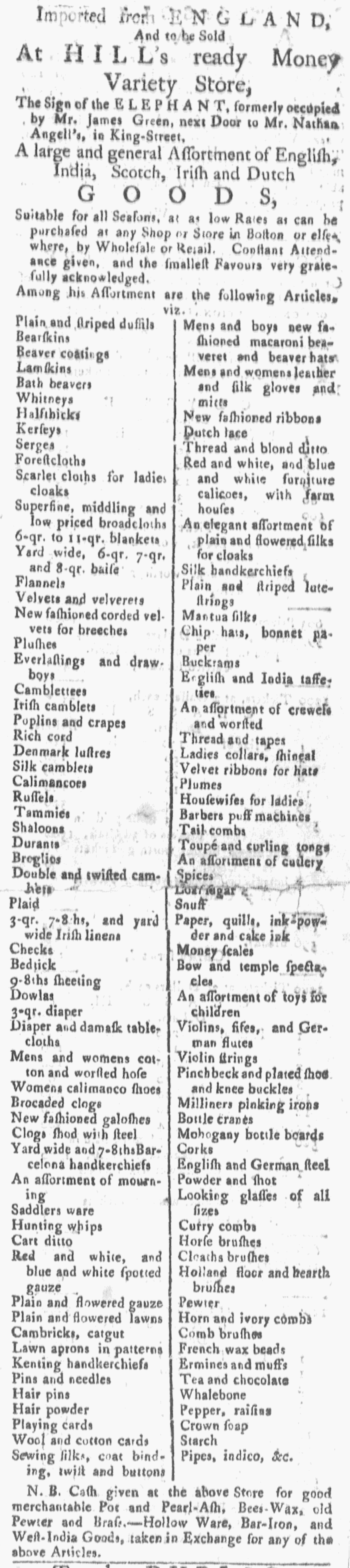
Providence Gazette (February 12, 1774).

“As low Rates as can be purchased at any Shop or Store in Boston or elsewhere.”

When the proprietor of “HILL’s Variety Store” took to the pages of the Providence Gazette near the end of January 1774, his advertisement promoted a “compleat Assortment of English, Scotch and India Goods,” listed about a dozen items, and promised “every other Article usually imported, too many to be enumerated in this Week’s Paper.”  That final note suggested that either the printer had truncated the advertisement due to space constraints or the advertiser had not yet compiled a more complete inventory to insert in the public prints.  It may very well have been the latter, considering that three weeks passed before a more extensive advertisement appeared in the Providence Gazette.

And more extensive it certainly was!  That advertisement filled nearly an entire column in the February 12 edition.  The merchant devoted most of that space to a catalog of “English, India, Scotch, Irish and Dutch GOODS,” demonstrating the range of choices available to consumers.  Divided into two columns with only one item per line, making it easier for readers to navigate than the dense paragraphs of text in some advertisements, this notice included many kinds of textiles and accessories, “Womens calamanco shoes,” “Mens and boys new fashioned macaroni beaveret and beaver hats,” “Mens and womens leather and silk gloves and mitts,” “Pinchbeck and plated shoe and knee buckles,” “Violins, fifes, and German flutes,” and even an “assortment of toys for children.”  Prospective customers could expect to discover much more at “HILL’s ready Money and Variety Store.”  (The variation on the name suggested that they would need to pay at the time of sale rather than purchase on credit, but a note at the end of the advertisements indicated “Hollow Ware, Bar-Iron, and West-India Goods, taken in Exchange for any of the above Articles.”)  The list of goods began with a clarification that “Among his Assortment are the following Articles,” while the catalog concluded with “&c.” (an abbreviation for et cetera) to signal that even more was available at the store.

Yet such appeals to consumer choice were not the only marketing strategies deployed by the merchant.  A preamble to his inventory reported that he sold his goods both wholesale and retail “at as low Rates as can be purchased at any Shop or Store in Boston or elsewhere.”  He realized that he did not compete solely with local merchants and shopkeepers but also with their counterparts in Boston, Newport, New York, and other towns.  He did not want shopkeepers in the countryside turning to importers in other ports to supply their inventory.  Such wholesale purchases could amount to significant revenue.  At the same time, he did not ignore consumers interested in retail purchases.  The merchant stated that “the smallest Favours” or purchases would be “gratefully acknowledged.”  Between the selection and the prices, he hoped prospective customers would come to the “Sign of the ELEPHANT” in King Street to acquire goods they needed to supplement inventories at their own shops or that they wanted for their own use.

January 22

What was advertised in a colonial American newspaper 250 years ago today?

Providence Gazette (January 22, 1774).

“Every other Article usually imported, too many to be enumerated in this Week’s Paper.”

The proprietor of “HILL’s Variety Store” at “the Sign of the ELEPHANT” advertised a “compleat Assortment of English, Scotch and India GOODS” in the January 22, 1774, edition of the Providence Gazette.  To incite interest in his wares, Hill proclaimed that he set prices “as low as can be purchased at any Shop or Store in Boston,” provided that customers paid cash rather than buying on credit.  Boston was a larger port that welcomed a greater number of vessels carrying imported goods, but that did not mean that shoppers there benefitted from better bargains than Hill made available in Providence.  The shopkeeper also listed several items, including several textiles, “new-fashioned Galloshes,” and “low-priced scarlet Broadcloths for Ladies Cloaks,” and promised “every other Article usually imported, too many to be enumerated in this Week’s Paper.”

That suggested that perhaps the printer, John Carter, abbreviated an advertisement received in the printing office due to lack of space.  Though that happened rarely, printers sometimes exercised such editorial discretion, especially when merchants and shopkeeper submitted their notices just before the newspaper went to press.  Alternately, Hill may not have prepared a longer advertisement intended for the January 22 edition but instead wanted to alert local consumers that his “Variety Store” was open for business, planning to compose an advertisement with a more complete inventory in time for the next issue.  On January 29, however, a slightly revised notice ran in the Providence Gazette.  The list of merchandise now concluded: “with every other Article usually imported, Wholesale and Retail.”  The same copy appeared on February 5.

It was not until February 12 that a longer advertisement ran in the Providence Gazette.  That one featured a far greater number of items, divided into two columns, that extended nearly an entire column.  In addition to listing dozens of items, it revised the name of the business to “HILL’s ready Money Variety Store,” underscoring that the proprietor did not allow credit.  The sequence of these advertisements suggests that it was not lack of space that resulted in the note about “too many [items] to be enumerated in this Week’s Paper” the first time the notice ran.  Hill may have had grand designs for updating his advertisement soon after it first appeared, but did not do so.  Once he submitted the copy, however, the longer advertisement ran for six consecutive weeks before he updated it once again on March 26, that time adding a woodcut depicting an elephant to match the sign that marked the location of the “ready Money Variety Store.”  The Adverts 250 Project will feature that advertisement in a future entry.

May 16

What was advertised in a colonial American newspaper 250 years ago today?

Providence Gazette (May 16, 1772).

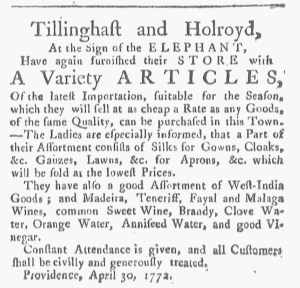
“They will sell at as cheap a Raste as any Goods … can be purchased in this Town.”

Nathaniel Jacobs advised prospective customers that he stocked a “compleat Assortment of European and East-India GOODS” that he “sold at the lowest Prices” at his shop on the west side of the Great Bridge in Providence.  Other merchants and shopkeepers who also placed notices in the May 16, 1772, edition of the Providence Gazette placed even greater emphasis on the bargains they offered.

At their shop at the Sign of the Elephant, for instance, Tillinghast and Holroyd stocked a “Variety [of] ARTICLES … which they will sell at as cheap a Rate as any Goods, of the same Quality, can be purchased in this Town.”  In other words, their competitors did not have lower prices.  To underscore the point, they made an additional appeal to female consumers.  “The Ladies are especially informed,” Tillinghast and Holroyd declared, “that a Part of their Assortment consists of Silks for Gowns, Cloaks, &c. Gauzes, Lawns, &c. for Aprons, &c. which will be sold at the lowest Prices.”  According to the advertisement, women could acquire these goods without paying extravagant prices.

Jones and Allen also emphasized low prices in their lengthy notice that listed scores of “ENGLISH and INDIA GOODS” recently imported.  The headline for their advertisement proclaimed, “The greatest Pennyworths,” alerting prospective customers to bargain prices.  Not considering that sufficient to entice customers into their shop at the Sign of the Golden Ball, they concluded with a note that they “think it needless to say any thing more to the public, than that they deal for ready money, and are determined to be undersold by no retailer in Providence.”  Jones and Allen encouraged comparison shopping, confident that customers would ultimately buy their goods.

Thurber and Cahoon made similar promises concerning their “compleat Assortment of English and India GOODS” at the Sign of the Bunch of Grapes.  They suggested that they already had a reputation for good deals at their store, stating that they were “determined to sell at their usual low Prices.”  In addition, they challenged consumers to make their own assessments, confiding that they “doubt not but all, who will call and examine for themselves, will be convinced [their prices] are as low, if not lower, than are sold by any Person, or Persons, whatever.”  Their advertisement advanced yet another claim to setting the best prices in town.

Tillinghast and Holroyd, Jones and Allen, and Thurber and Cahoon did not merely tell prospective customers that they offered low prices.  They did not make offhand appeals to price.  Instead, they crafted short narratives about the bargains at their shops, pledging consumers would not find better deals elsewhere.  They believed that such narratives would entice customers to visit their shops even if they encountered low prices in other stores.

November 24

What was advertised in a colonial American newspaper 250 years ago today?

Providence Gazette (November 24, 1770).

Many other articles not enumerated.”

Consumer choice was a key element of Nicholas Tillinghast and William Holroyd’s advertisement in the November 24, 1770, edition of the Providence Gazette.  The partners informed the public that they stocked “a Variety of Articles, both of wet and dry Goods,” at their new shop at the Sign of the Elephant.  To help prospective buyers imagine the choices available to them, Tillinghast and Holroyd provided a list of some of their many wares, naming everything from “WOOLLEN and linen cloths” to “best French brandy.”  They placed special emphasis on “an assortment of stationary ware,” cataloging “writing paper by the ream, account books of different sizes, ink cake, red and black ink powder, wafer, quills and pens ready made, ink stands, sand boxes, pounce boxes, [and] pencils.”  In addition to all of those accessories, Tillinghast and Holroyd carried “many other articles not enumerated.”  While the list helped prospective customers imagine some of the wares available at the Sign of the Elephant, promising even more items than would fit in the advertisement challenged them to consider what else they might encounter when visiting the shop.

Purveyors of goods often deployed these marketing strategies in newspaper advertisements in the second half of the eighteenth century.  Elsewhere in the same issue of the Providence Gazette, Clark and Nightingale promoted a “COMPLEAT Assortment of ENGLISH and INDIA GOODS” at their store at the Sign of the Fish and Frying Pan.  Other advertisers provided lists of merchandise, though all of them were short in comparison to what appeared in newspapers published in Boston, New York, and Philadelphia.  Still, merchants and shopkeepers in Providence attempted to entice prospective customers by presenting them many choices intended to incite demand.  Many advertisers throughout the colonies concluded their lists with one or more “&c.” (the abbreviation for et cetera commonly used in the eighteenth century) to indicate that consumers would discover many other goods when visiting their shops.  Tillinghast and Holroyd deployed a variation, “many other articles not enumerated,” that delivered the same message.  Along with price and quality, consumer choice was among the most common marketing strategies in eighteenth-century newspaper advertisements.  Merchants and shopkeepers invited consumers to be make a pastime of shopping by considering the many choices available and contemplating the power they possessed in making selections for themselves.

September 10

What was advertised in a colonial American newspaper 250 years ago today?

Sep 10 - 9:10:1768 Providence Gazette
Providence Gazette (September 10, 1768).

“The Sign of the Elephant.”

Richard Jackson and John Updike informed prospective customers that their shop was located at “the Sign of the Elephant, opposite John Angell’s, Esq,” in an advertisement in the September 10, 1768, edition of the Providence Gazette. Elsewhere on the same page, Clark and Nightingale also used the combination of shop sign and landmarks to denote their location: “At the Sign of the Fish and Frying-Pan, opposite Oliver Arnold’s, Esq; near the Court-House.” Sarah Goddard and John Carter, printers of the Providence Gazette, did not list their location in either of the advertisements they inserted in the issue, but the colophon stated that “the Sign of Shakespear’s Head” adorned their printing office. Joseph Russell and William Russell also did not indicate their location in their advertisements in the September 10 issue, but these prominent merchants regularly ran other advertisements that told readers to seek them out at “the Sign of the Golden Eagle, near the Court-House.” Collectively, these advertisers paint a portrait of some of the sights colonists would have seen as they traversed the streets of Providence in the late 1760s.

Jackson and Updike marketed many of the same goods as Clark and Nightingale. Both sets of partners led their advertisements with “English and India Goods” before providing more complete accountings of their various sorts of merchandise. In selecting the visual images to identify and, in effect, brand their shops, however, they opted for different strategies. Jackson and Updike chose an elephant, an exotic beast unlikely to have been glimpsed by the vast majority of residents of Providence. Known only to most colonists through texts and perhaps a limited number of woodcuts and engravings in circulation in the Atlantic world, the elephant conjured images of the faraway origins of the “India Goods,” including textiles, sold at Jackson and Updike’s shop. Associating their wares with the elephant linked the merchant-shopkeepers to extensive networks of exchange that reached to the other side of the globe. Clark and Nightingale, on the other hand, advanced a much more utilitarian and familiar image. Neither the fish nor frying pan required imagination on the part of readers or passersby who saw their sign, but the image did communicate that the partners competently and efficiently outfitted their customers with the necessities. Their choice of logo emphasized the practical aspects of their merchandise.

Unfortunately, very few eighteenth-century shop signs have survived. The descriptions in newspapers advertisements do not indicate whether Jackson and Updike’s elephant or any of the other signs were carved or painted, but they do testify to their presence in colonial towns and cities. They also suggest that merchants, shopkeepers, and artisans not only displayed signs to assist prospective customers navigating the streets but also sometimes adopted images intended to convey messages about their wares.

November 30

GUEST CURATOR: Nicholas Sears

What was advertised in a colonial American newspaper 250 years ago this week?

nov-30-11291766-providence-gazette
Providence Gazette (November 29, 1766).

“JUST IMPORTED … silk and worsted mitts … silk knee straps … sewing silk of all coulours.”

James Green’s advertisement was full of different types of clothes, clothing accessories, and types of fabric to make clothes, including cotton, velvet, linen, and silk. What caught my attention was the amount of silk clothing and accessories that came over from England. It caused me to ask, “Why were there so many items made of silk coming from England?” I was curious whether the English imported clothing made with silk themselves and then shipped it to the colonies or if they made it themselves.

I read Gerald B. Hertz’s article discussing “The English Silk Industryin the Eighteenth Century.”[1] According to Hertz, England had its own silk weavers, comprised mainly of Flemish refugees in the early seventeenth century. It was not until 1685 when Huguenots, a Protestant group from France, started to emigrate to England that the amount of silk produced rose. Even with the silk industry rising, there was still a large amount of silk being imported from other countries. To combat this, England continued to pass laws that prohibited the importing of manufactured silk items from 1765 to 1826. In 1780 the annual import of raw silk rose to 200,000 pounds and later to 500,000 pounds after 1800.[2] England also tried to produce raw silk in their American colonies, specifically Georgia, but abandoned that plan after 1742.

The amount of silk items shipped to the English colonies rose during the consumer revolution, which in turn helped the economy of England.

**********

ADDITIONAL COMMENTARY: Carl Robert Keyes

According to his advertisement, James Green’s shop was located “at the Sign of the Elephant, opposite JOHN ANGEL’s, Esq.” Eighteenth-century shop signs often incorporated animals and birds of various sorts. In choosing the elephant as the device to identify his business, Green prompted potential customers to associate the goods he stocked with exotic and faraway places. The elephant conjured images of some of the lands where raw silk was produced and acquired by European merchants in the eighteenth century.

Nick notes two overlapping streams of silk production that eventually entered colonial markets. The first, raw silk, was a necessary resource for producing the second, manufactured silk goods. Nick focuses primarily on the English silk industry as it pertained to the production of manufactured goods that were then exported for colonists to purchase, often listed alongside the myriad of other goods increasingly on offer by merchants and shopkeepers as part of the consumer revolution.

To produce manufactured silk goods for export, the English silk industry needed raw silk. What were their sources in the eighteenth century? Hertz provides answers to that question as well. In the early eighteenth century, “Turkey and the Levant were most important,” Hertz explains.[3] The English silk industry used Turkish silk to produce silk stockings, damasks (figured woven fabrics with a pattern visible on both sides, typically used for table linen and upholstery), and galloons (narrow ornamental strips of fabric, typically a silk braid or piece of lace, used to trim clothing or finish upholstery). According to Hertz, “The Turkey Company’s most valued import was sherbaffee, fine raw silk from Persia.”[4] The English silk industry also obtained unwrought silk from Italy and India and elsewhere in the east. Over time, raw silk from India and China became one of the East India Company’s most important imports. As Nick notes, the English silk industry stood to benefit when colonists experimented with silk cultivation in Georgia when the colony was founded, but their efforts were largely unsuccessful and the endeavor concluded fairly quickly.

As a result, the raw silk transformed into manufactured goods continued to come primarily from places on the other side of the globe, like Turkey and India. In choosing the elephant to identify his shop, James Green evoked images of trade and exchange that were not merely transatlantic but global. Many of the items listed in his advertisement, including tea and spices as well as silk, came from places far beyond England and continental Europe. The “Sign of the Elephant” did more than identify Green’s shop. It also encouraged consumers to attribute meaning and value to the goods they purchased. Visiting a local shop could be as fun or adventurous as browsing through the markets in faraway places most colonists only encountered in stories and their imaginations.

**********

[1] Gerald B. Hertz, “The English Silk Industry in the Eighteenth Century,” English Historical Review 24, no. 96 (October 1909): 710-626.

[2] Hertz, “English Silk Industry,” 712.

[3] Hertz, “English Silk Industry,” 711.

[4] Hertz, “English Silk Industry,” 711.