January 10

What was advertised in a revolutionary American newspaper 250 years ago today?
Pennsylvania Gazette (January 10, 1776).

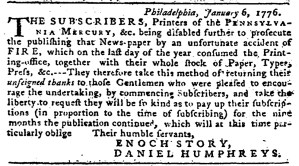
“Disabled further to prosecute the publishing that News-paper by an unfortunate accident of FIRE.”

As the imperial crisis intensified, Enoch Story and Daniel Humphreys launched the Pennsylvania Mercury (quickly renamed Story and Humphreys’s Pennsylvania Mercury) on April 7, 1775.  That newspaper joined two others founded earlier in the year, the Pennsylvania Evening Post on January 24 and the Pennsylvania Ledger on January 28, as well as Dunlap’s Pennsylvania Packet, the Pennsylvania Gazette, the Pennsylvania Journal, and the Wochentliche Pennsylvanische Staatsbote.  During the first four months of 1775, Philadelphia surpassed Boston in terms of the number of newspapers printed there.  With the outbreak of hostilities at Lexington and Concord on April 19 and the ensuing siege of Boston, several of Boston’s newspapers ceased publication or relocated to other towns.

Yet Boston was not the only major port city that saw one of its newspapers cease publication during the first year of the Revolutionary War.  Story and Humphreys’s Pennsylvania Mercury lasted less than a year, though disruptions caused by the war did not lead to its demise.  Unfortunately, “an unfortunate accident of FIRE … consumed the Printing-office, together with their whole Stock of Paper, Types, Press,” and other equipment on December 31.  The situation did not leave any possibility for the partners to recover and eventually resume publication.  “[B]eing disabled further to prosecute the publishing [of] that News-paper,” they announced in an advertisement in the Pennsylvania Gazette, they instead expressed “their unfeigned thanks” to the subscribers who had supported the venture and requested that they “will be so kind as to pay up their subscriptions (in proportion to the time of subscribing) for the nine months the publication continued.”  In other words, they expected customers to make prorated payments based on the number of issues they received.  Humphreys eventually tried again, but not until after the Revolutionary War.  On August 20, 1784, he commenced publishing a new Pennsylvania Mercury.

Even with the loss of Story and Humphreys’s Pennsylvania Mercury, Philadelphia still had more newspapers than any other city or town in the colonies.  As the war continued, not all of them survived.  Some closed permanently while others moved to other towns or suspended publication during the British occupation of Philadelphia.  Yet, as the “unfortunate accident of FIRE” at Story and Humphreys’s printing office demonstrated, disruptions caused by the war were not the only dangers that forced newspapers to fold.
October 13

What was advertised in a revolutionary American newspaper 250 years ago today?

Story and Humphreys’s Pennsylvania Mercury (October 13, 1775).

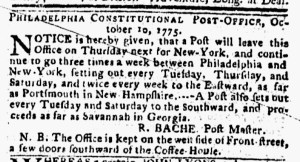
“PHILADELPHIA CONSTITUTIONAL POST-OFFICE.”

At the same time that Mary Katharine Goddard, postmaster and printer of the Maryland Journal, advertised the Baltimore branch of the Constitutional Post Office in the fall of 1775, Richard Bache ran a notice for the “PHILADELPHIA CONSTITUTONAL POST-OFFICE” in the October 13 edition of Story and Humphreys’s Pennsylvania Mercury. Although Bache was not the printer of that newspaper, his advertisement received a privileged place similar to the one that Goddard’s notice enjoyed in her newspaper.  It appeared first among the advertisements that readers encountered when they perused the newspaper from start to finish, immediately below the “SHIP NEWS” and list of “ARRIVALS” in Philadelphia.  A double line did separate news from advertising, yet this item delivered news relevant to the imperial crisis that had become a war with the battles at Lexington and Concord the previous spring.  Over the summer, the Second Continental Congress established the Constitutional Post Office as an alternative to the imperial post office.  Enoch Story and Daniel Humphreys, the printers of the newspaper that carried Bache’s advertisement, apparently considered it in their best interest to increase the likelihood readers would take note of the information about the Constitutional Post Office by placing the notice right after the news.

Compared to Goddard’s advertisement, Bache’s notice gave readers a much more expansive glimpse of the scope of the enterprise.  Rather than simply stating which days the post arrived and departed, Bache reported that the Constitutional Post carried letters and newspapers “as far as Portsmouth in New-Hampshire” to the north and “as far as Savannah in Georgia” to the south.  The system linked the thirteen colonies.  On Tuesdays, Thursdays, and Saturdays, a rider set out for New York from Philadelphia.  On Tuesdays and Saturdays, another rider headed “to the Southward” to Baltimore, arriving there, according to Goddard’s advertisement, on Mondays and Thursdays.  This new system did more than move mail.  “Establishing a new post office,” Joseph M. Adelman argues, “placed the levers of information circulation in the hands of Americans.  …  Forming a ‘continental’ post office that could properly embody an intercolonial union and its resistance to imperial tyranny was crucial to Patriot mobilization at the height of the imperial crisis.”  Furthermore, “Patriot printers and their radical friends” played an integral role in establishing the new postal system.[1]  No wonder that Story and Humphreys placed Bache’s advertisement about the “PHILADELPHIA CONTSITUTIONAL POST-OFFICE” right after the “SHIP NEWS.”

**********

[1] Joseph M. Adelman, “‘A Constitutional Conveyance of Intelligence, Public and Private’: The Post Office, the Business of Printing, and the American Revolution,” Enterprise and Society 11, no. 4 (December 2010): 747-748.

September 29

What was advertised in a revolutionary American newspaper 250 years ago today?

Story and Humphreys’s Pennsylvania Mercury (September 29, 1775).

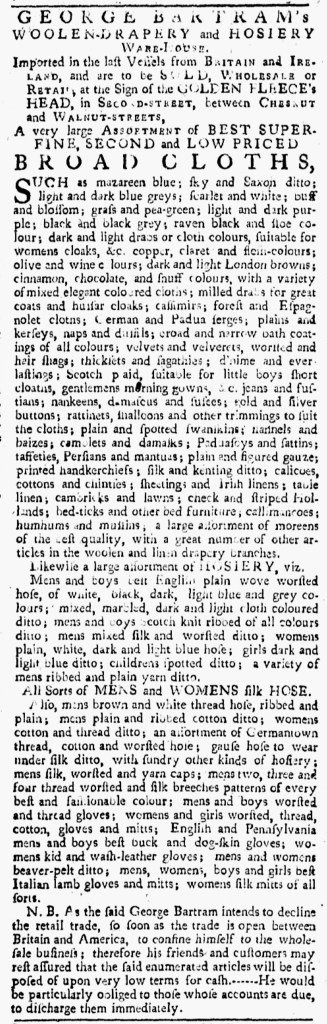
“George Bartram intends to decline the retail trade, so soon as the trade is open between Britain and America.”

As September 1775 came to a close, George Bartram advertised a “very large ASSORTMENT of BEST SUPERFINE, SECOND and LOW PRICED BROADCLOTHS” and “a large assort of HOSIERY” available at his “WOOLEN-DRAPERY and HOSIERY WARE-HOUSE … at the Sign of the GOLDEN FLEECE’s HEAD” in Philadelphia.  He listed dozens of different kinds of textiles and hose for men, women, and children as well as an array of gloves and mittens.  Bartram stated that he imported that merchandise “in the last Vessels from BRITAIN and IRELAND,” but he may have meant the last ships to arrive before the Continental Association went into effect nearly ten months earlier.  After all, he acknowledged in a nota bene that the colonies were not trading with Britain at the time he placed his advertisement.

That nota bene also included a clarification about Bartram’s plans for his business.  In March, he had advertised that he was “resolved to decline his Retail Trade” and would “sell his Stock of Goods on Hand at the very lowest Rates.”  A headline proclaimed, “Now SELLING OFF.”  That gave the impression that Bartram was holding a going out of business, yet his subsequent advertisement suggests that was not his intention at all.  Instead, he planned to shift his emphasis.  “[S]o soon as the trade is open between Britain and America,” he would “decline the retail trade … to confine himself to the wholesale business.”  His “WOOLEN-DRAPERY and HOSIERY WARE-HOUSE” would not close after all, but that did not mean that customers could not find bargains when they visited the familiar Sign of the Golden Fleece’s Head.  For the moment, Bartram continued to serve retail customers, assuring them that “the said enumerated articles will be disposed of upon very low terms.”

Bartram did not know when trade with Britain would resume.  He placed his previous advertisement before hostilities broke out at Lexington and Concord.  He attempted to earn his livelihood as he navigated current events, not knowing when the conflict would end, hoping that good deals would convince customers to continue shopping at his “WOOLEN-DRAPERY and HOSIERY WARE-HOUSE” even as they kept their eyes on news arriving from Boston.

September 22

What was advertised in a revolutionary American newspaper 250 years ago today?

Story and Humphreys’s Pennsylvania Mercury (September 22, 1775).

“Determined to SELL OFF his large Assortment of GOODS remarkably Cheap.”

The pages of American newspapers had a different appearance after the Continental Association went into effect on December 1, 1774.  While adherence to prior nonimportation agreements had been scattered, this one attracted much greater compliance.  As a result, the advertisements that featured lengthy lists of imported merchandise to be sold by local merchants and shopkeepers appeared in the public prints less often, but they did not disappear completely.  Notices that listed a few dozen items continued to appear in some newspapers.

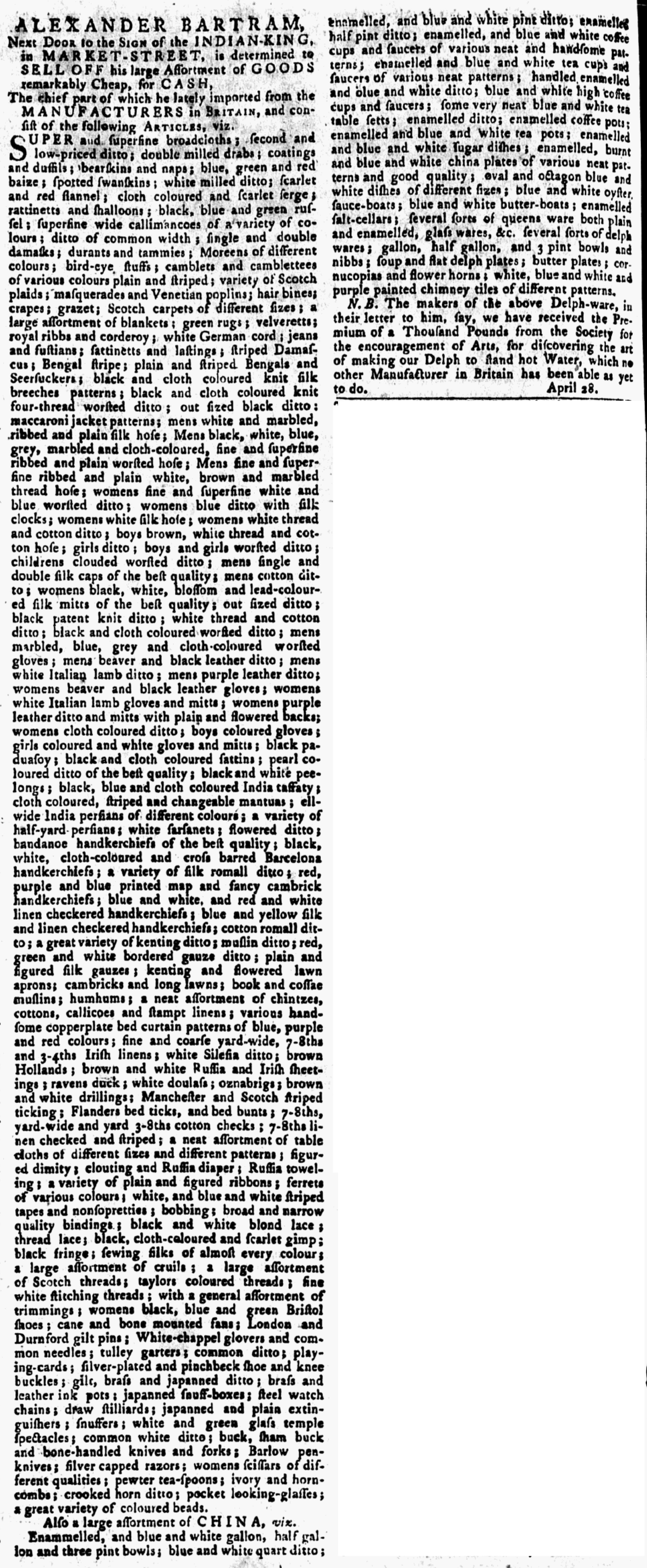
Even so, Alexander Bartram’s advertisement for goods “lately imported from the MANUFACTURERS in BRITAIN” seemed extraordinary because of its length.  It did not fill only a portion of a column in Story and Humphreys’s Pennsylvania Mercury; instead, it extended an entire column and overflowed into another column.  It cataloged dozens of items available at his shop “Next Door to the SIGN of the INDIAN-KING, in MARKET-STREET” in Philadelphia.  Dated April 28, Bartram’s advertisement first appeared in the newspaper on that day in 1775 and then again in the supplement the following week.  The shopkeeper declared his intention to “SELL OFF his large Assortment of GOODS remarkably Cheap.”  He apparently acquired his wares prior to December 1, though he did not make a point of asserting that was the case.  The boycott presented an opportunity to clear his shelves of older merchandise since he would not have to compete with new arrivals.

Five months later, his advertisement ran in Story and Humphreys’s Pennsylvania Mercury once again.  The compositor had not broken down the type in that time.  With the Continental Association still in effect, Bartram saw another opportunity to clear the shelves in his shop … but how many of the items listed in his advertisement remained after his prior attempts to sell them “remarkably Cheap” over the summer?  That likely mattered little to Bartram, especially if he believed that such an extensive list would get customers looking for bargains through the doors.  A month later, he took to the Pennsylvania Journal with a much shorter advertisement that promoted a “General assortment of MERCHANDIZE, suitable for the season.”  Dated October 25 and scheduled to run for six weeks, that notice advised that Bartram “proposes to leave the city in a short time.”  If he already planned to depart Philadelphia at the time he republished his lengthy advertisement in late September, he may have considered it worth the expense of taking up so much column space if it might result in significant sales to liquidate his merchandise.

September 1

What was advertised in a revolutionary American newspaper 250 years ago today?

Story and Humphreys’s Pennsylvania Mercury (September 1, 1775).

“ALL sorts of PLANES, suitable for carpenters.”

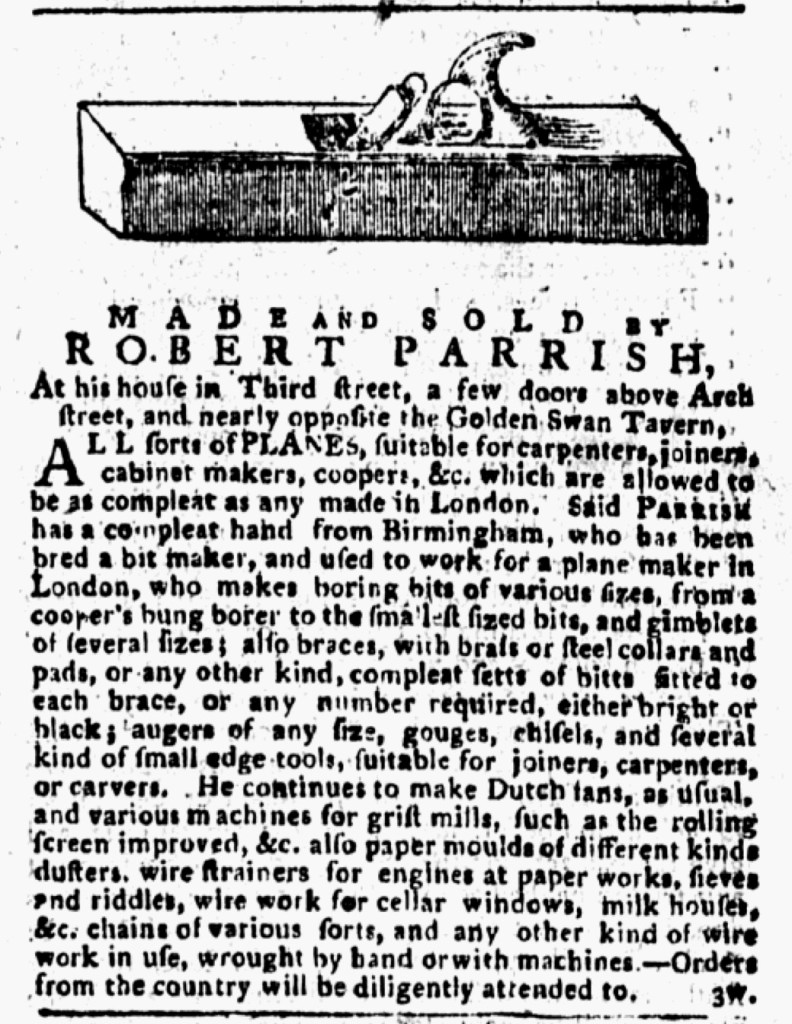
When Robert Parrish published an advertisement adorned with a woodcut depicting a carpenter’s plane in the August 26, 1775, edition of the Pennsylvania Ledger, it was the first of several appearances that image would make in newspapers printed in Philadelphia over the course of eight weeks.  It next appeared in Story and Humphreys’s Pennsylvania Mercuryon September 1 as part of an advertisement with identical copy.  Perhaps Parrish had clipped his advertisement from the Pennsylvania Ledger and delivered it to Story and Humphreys’s printing office along with the woodcut that he retrieved from the Pennsylvania Ledger.

Having commissioned only one woodcut constrained Parrish’s schedule for publishing his advertisements.  Story and Humphreys’s Pennsylvania Mercury came out on Fridays and the Pennsylvania Mercury on Saturdays.  That did not leave enough time to transfer the woodcut back and forth between the two printing offices and have the compositors in each include them in the new issues when they set the type and laid them out.  Compositors, after all, sought to streamline that process as much as possible.  To that end, the initial insertion of Parrish’s advertisement in the Pennsylvania Ledgerincluded a dateline, “Philadelphia, August 25, 1775,” above the woodcut, but the compositor did not include it with subsequent insertions (even though advertisements often ran with their original dates for weeks or months).  It was much easier to retain the copy for the main body of the advertisement without worrying about a header that ran above the woodcut.

Parrish’s advertisement first ran in the Pennsylvania Ledger on a Saturday (in the first week of his advertising campaign) and then in Story and Humphreys’s Pennsylvania Mercury the following Friday (in the second week of his advertising campaign).  It did not appear in the Pennsylvania Ledger the next day.  Instead, it ran in that newspaper a week later (in the third week of his advertising campaign).  In the fourth week, the woodcut returned to Story and Humphreys’s printing office and Parrish’s advertisement appeared in their newspaper once again on September 15.  It did not run in either newspaper the following week but instead found its way to yet another newspaper, the Pennsylvania Journal published on Wednesday, September 27.  That allowed enough time to get the woodcut back to the Pennsylvania Ledger for its September 30 edition (during the sixth week of Parrish’s advertising campaign).  Parrish returned to alternating between the two original newspapers during the next two weeks.  His advertisement with the woodcut went back to Story and Humphreys’s Pennsylvania Mercury for the October 6 issue and then ran in the Pennsylvania Ledger on October 14.

Investing in a woodcut increased the chances that prospective customers would take note of an advertisement, but Parrish and other advertisers had limits to how much they would spend.  He apparently considered it worth it to commission a single woodcut but not more than one.  Instead, he arranged to transfer that woodcut from printing office to printing office to printing office over the course of many weeks.

June 23

What was advertised in a revolutionary American newspapers 250 years ago today?

Story and Humphreys’s Pennsylvania Mercury (June 23, 1775).

“Just PUBLISHED … THE IMPENETRABLE SECRET … to be SOLD by STORY and HUMPHREYS.”

The June 23, 1775, edition of Story and Humphreys’s Pennsylvania Mercury included the first advertisement for a new edition of The Impenetrable Secret, a book or pamphlet “Just PUBLISHED and PRINTED with TYPES, PAPER, and INK, MANUFACTURED in this PROVINCE.”  The advertisement suggested that Enoch Story and Daniel Humphreys, the printers of the newspaper, also published The Impenetrable Secret, though that may not have been the case.  Printers often included the phrase “just published and sold by” in advertisements, but they expected readers to separate “just published” from “sold by.”  In other words, printers sometimes acted as booksellers who sold books and pamphlets “just published” by other printers.  Story and Humphreys could have printed The Impenetrable Secret, though Isaiah Thomas declared in his History of Printing in America (1810) that “[t]heir chief employment was a newspaper, which they published but a few months when their printing house and materials were burnt, and their partnership was in consequence dissolved.”[1]

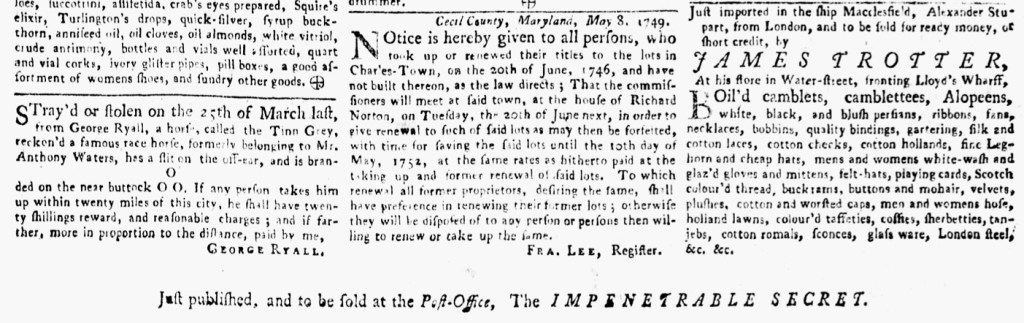
Still, no other newspaper carried advertisements for The Impenetrable Secret, suggesting that Story and Humphreys were indeed the publishers and advertised a product from their own press in their newspaper.  They also advertised “Blank Bonds” and “Bills of Exchange” that they presumably printed.  Whether a book or pamphlet, The Impenetrable Secret may have been one of the few projects that they pursued beyond their newspaper during their brief partnership.  No copy of the work survives, making it impossible to examine the imprint.  In American Bibliography, Charles Evans lists The Impenetrable Secret and assigns it an imprint that resembles the advertisement: “Philadelphia: Printed and sold by Story and Humphreys, 1775.”  He indicates that the entry in American Bibliography originated with the advertisement.  He also notes that The Impenetrable Secret was “First printed by B. Franklin and D. Hall, in 1749.”[2]  Unfortunately, there are no extant copies of that edition either.  The entry in American Bibliography merely states, “Philadelphia: Printed by B. Franklin, and D. Hall. 1749.”[3]  That entry likely came from an advertisement that first appeared in the margin at the bottom of the third page of the May 18, 1749, edition of the Pennsylvania Gazette: “Just published, and to be sold at the Post-Office, The IMPENETRABLE SECRET.”  That advertisement ran many times over the next several months before The Impenetrable Secret eventually appeared in the January 16, 1750, issue at the end of a lengthy advertisement that described the contents of several books for sale at the printing office.  Each of those items was numbered, with the list followed by a note that “likewise may be had, The Impenetrable Secret, with the Key.”  Was it some sort of puzzle or riddle?  Franklin and Hall and, later, Story and Humphreys expected that prospective customers already knew the answer and did not give an explanation.  For now, the contents of The Impenetrable Secret remain an impenetrable secret, but perhaps a lost and forgotten copy of either Franklin and Hall’s edition or Story and Humphrey’s edition might someday be found.

Pennsylvania Gazette (May 18, 1749).

**********

[1] Isaiah Thomas, The History of Printing in America: With a Biography of Printers and an Account of Newspapers (1810; New York: Weathervane Books, 1970), 402.

[2] See entry 14126 in Charles Evans, American Bibliography: A Chronological Dictionary of All, Books, Pamphlets, and Periodical Publications Printed in the United States of America From the Genesis of Printing in 1639 Down to and Including the Year 1820 with Bibliographical and Biographical Notes.

[3] See entry 6334 in Evans, American Bibliography.

June 2

What was advertised in a revolutionary American newspaper 250 years ago today?

Story and Humphreys’s Pennsylvania Mercury (June 2 1775).

“Imported last summer and fall from London [and] Bristol … A VERY large and general assortment of Ironmongery [and] Cutlery.”

James Bringhurst advertised a variety of items available at “his Ware-house on the Bank, below Walnut-street,” in Philadelphia in the summer of 1775.  He stocked a “VERY large and general assortment of Ironmongery [and] Cutlery” that included “knives and forks with or without cases, roasting jacks, bake ovens, preserving pans with covers, sauce pans with ditto, teakettles, skillets, pots, kettles, [and] frying pans.”  He also carried “most sorts of tradesmens tools” along with “compleat Furniture both for house and ship building.”  In addition, his inventory included “sundry other articles too numerous to insert” in a newspaper advertisement.  Bringhurst’s “Ware-house” was an eighteenth-century precursor of a superstore that sold housewares to consumers and equipment and supplies to builders.

Before he gave or his location or presented his list of merchandise, Bringhurst noted when and where he received the goods he sold.  Many merchants and shopkeepers did so in the 1760s and 1770s yet doing so had a new kind of significance once the Continental Association went into effect on December 1, 1774.  The First Continental Congress devised the Continental Association, a nonimportation agreement, in response to the Coercive Acts, hoping to leverage the commercial boycott into political reform.  Colonizers who signed the Continental Association vowed to abide by it until Parliament repealed the Coercive Acts and other legislation that infringed on their rights that had been passed since the end of the Seven Years War.

Bringhurst sent an important signal to prospective customers and the entire community when he specified that his wares had been “Imported last summer and fall from London, Bristol,” and other English ports.  Under other circumstances, wholesalers and retailers would have been unlikely to acknowledge that they sold items that had been on the shelves or in the warehouse for so long; instead, they usually emphasized that they had just the received the newest goods and the newest fashions.  In this case, however, peddling merchandise that had been around for the better part of a year was a virtue.  Bringhurst abided by the Continental Association … and his customers could shop in good conscience knowing that they did so as well.

May 5

What was advertised in a revolutionary American newspaper 250 years ago today?

Story and Humphreys’s Pennsylvania Mercury (May 5, 1775).

“Specimens of our work may be seen at the printing offices of Alexander Purdie … and the Printers of this paper.”

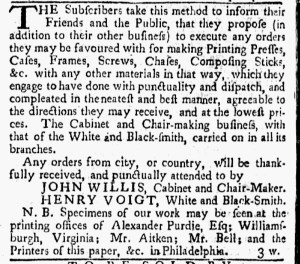
John Willis, a “Cabinet and Chair-Maker,” and Henry Voigt,” a “White and Black-Smith,” launched a new endeavor in the spring of 1775.  They took to the pages of Story and Humphreys’s Pennsylvania Mercury to advise “their Friends and the Public,” especially those in the printing trade, that they would “execute any orders they may be favoured with for making Printing Presses, Cases, Frames, Screws, Chases, Composing Sticks,” and other equipment.

Willis and Voight did not rely solely on their advertisement to market the printing equipment they produced.  They also bolstered their reputations by encouraging prospective customers to examine “Specimens” of their work “at the printing offices of Alexander Purdie, Esq; Williamsburgh, Virginia; Mr. Aitken; Mr. Bell; and the Printers of this paper, &c. in Philadelphia.”  Purdie commenced publishing his Virginia Gazette earlier in the year after dissolving his partnership with William Dixon.  Having started as a bookseller and bookbinder, Robert Aitken opened a printing office in 1774 and launched the Pennsylvania Magazine in January 1775.  Robert Bell, on the other hand, had several years of experience as a bookseller, printer, and publisher, one who advertised his projects widely in newspapers throughout the colonies.  Enoch Story and Daniel Humphreys, “the Printers of this paper,” had been publishing their newspaper for only a month when it carried Willis and Voight’s advertisement.  Both newcomers and veterans in the trade had turned to Willis and Voight to produce equipment they needed to operate their printing shops.

Although their names did not appear in the imprints of any books or pamphlets or in the colophons of any newspapers, Willis and Voight made their own contributions to the dissemination of news and information as the imperial crisis became a war for independence.  They did not refer to current events in their advertisement, but the timing suggests that they saw new opportunities when they heard about the battles at Lexington and Concord.  The cabinetmaker and the blacksmith likely anticipated an expanding market for the equipment necessary for printing the news, prompting them to advertise services “in addition to their other business.”

April 14

Who was the subject of an advertisement in a colonial American newspaper 250 years ago today?

Story and Humphreys’s Pennsylvania Mercury (April 14, 1775).

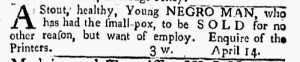
“A Stout, healthy, Young NEGRO MAN … to be SOLD … Enquire of the Printers.”

On April 14, 1775, Enoch Story and Daniel Humphreys published “VOL. I.  NUMB. 2,” the second issue of their new newspaper.  They updated the title in the masthead from The Pennsylvania Mercury; and the Universal Advertiser to Story and Humphreys’s Pennsylvania Mercury, and Universal Advertiser.  The colophon running across the bottom of the final page remained the same, advising readers that they “gratefully received” subscriptions, advertisements, articles, and “Letters of Intelligence” at their printing office in Norris’s Alley in Philadelphia.  Their first issue featured a significant number of advertisements.  The second issue contained even more.  Advertisers were willing to take a chance with this new newspaper, apparently believing that its circulation justified the investment in purchasing space to disseminate their notices.

Among the advertisements that ran for the first time in the second issue of Story and Humphreys’s Pennsylvania Mercury, one offered “A Stout, healthy, Young NEGRO MAN, who has had the small-pox, to be SOLD for no other reason, but want of employ.”  It advised interested parties to “Enquire of the Printers” to learn more.  The notice was dated “April 14” and had a notation, “3 w,” that let the compositor know to include it in three issues.  Last week, Story and Humphreys’s Pennsylvania Mercury made its first appearance in the Adverts 250 Project to examine the advertisements in it (or its second appearance when counting subscription proposals that ran in another newspaper).  Today, the Adverts 250 Project features that newspaper once again because it is making its first appearance in the Slavery Adverts 250 Project.

Yet Story and Humphreys did not merely publish an advertisement that offered an enslaved man for sale.  They published an “Enquire of the Printers” advertisement that made them active participants in the sale.  They may have facilitated an introduction, or they may have negotiated on behalf of the advertiser.  The notice does not reveal the extent of their involvement, but it does indicate that they were involved beyond publishing the advertisement and earning revenue for doing so.  As Jordan E. Taylor documents, American printers acted as slave brokers in thousands of advertisements in newspapers published throughout the colonies and, later, states in the eighteenth century.[1]  Participating in the slave trade was part of the business model for operating a viable newspaper.  Taylor could not identify any printers who refused to run advertisements that offered enslaved people for sale as a matter of principle; the financial incentives were too strong to ignore.  Story and Humphreys very quickly incorporated perpetuating slavery into the practices for their press, both as printers who disseminated advertisements offering enslaved people for sale and as printers who served as slave brokers via “Enquire of the Printers” advertisements.

**********

[1] Jordan E. Taylor, “Enquire of the Printer: Newspaper Advertising and the Moral Economy of the North American Slave Trade, 1704-1807,” Early American Studies: An Interdisciplinary Journal 18, no. 3 (Summer 2020): 287-323.