September 14

What was advertised in a revolutionary American newspaper 250 years ago today?
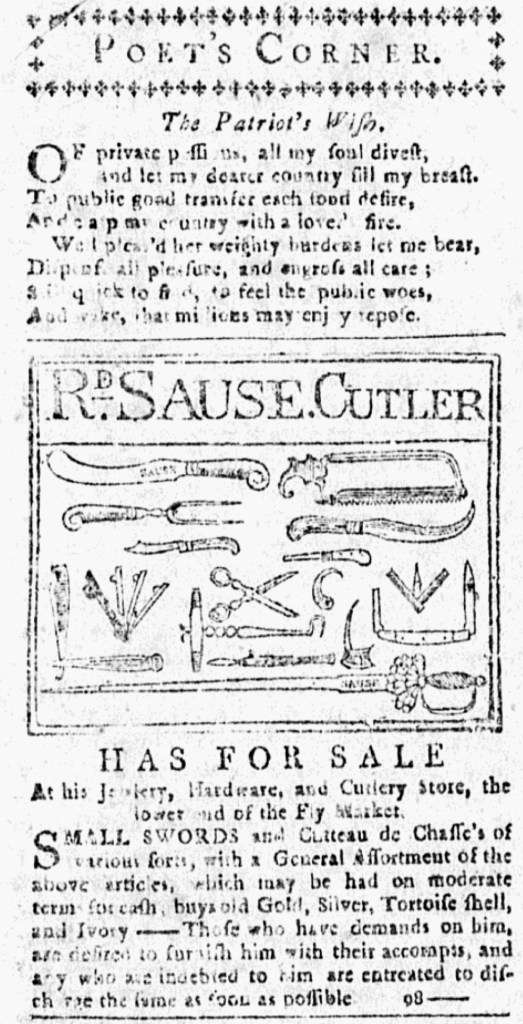
New-York Journal (September 14, 1775).

“SMALL SWORDS … of various sorts.”

Richard Sause’s advertisement for “SMALL SWORDS” and other items available at his “Jewelery, Hardware, and Cutlery Store” became a familiar sight for readers of the New-York Journal in the summer of 1775.  The woodcut depicting a shop sign with Sause’s name and an array of cutlery, including a sword, made his notice even easier to spot.

On September 14, his notice happened to appear near the top of the left column on the final page of the newspaper, immediately below a regular feature called “POET’S CORNER.”  For that issue, John Holt, the printer, selected a short poem, “The Patriot’s Wish.”

OF private passions, all my soul divest,
and let my dearer country fill my breast,
To public good transfer each fond desire,
And clasp my country with a lover’s fire.
Well pleas’d her weighty burdens let me bear
Dispense all pleasure, and engross all care;
[ ] quick to [ ], to feel the public woes,
And wake, that millions may enjoy repose.

The strained verses were heartfelt even if not especially graceful or elegant.  Perhaps a reader submitted the poem as their way of contributing to the struggle that colonizers endured throughout the imperial crisis and then intensified with the outbreak of hostilities at Lexington and Concord the previous spring.  Sause aimed to make his own contribution by supplying “SMALL SWORDS and Cutteau de Chasse’s,” a type of sword, to the gentlemen of New York who prepared for the possibility that they would have to join the fight.  Although Sause’s advertisement appeared below “The Patriot’s Wish” almost certainly by coincidence, the cutler may have been pleased with the happy accident.  After all, the poem primed readers to think about their duty and to contemplate how to make their own contributions to the cause.  For many, that could have included outfitting themselves with weapons and other military equipment.

September 2

What was advertised in a revolutionary American newspaper 250 years ago today?

Constitutional Gazette (September 2, 1775).

“A collection of the most elegant swords ever before made in America.”

John Anderson’s call for advertisers to insert notices in the Constitutional Gazette yielded more results.  He touted the circulation of his new newspaper in the August 23, 1775, edition, asserting that the “Public will easily perceive the advantage of advertising in the Constitutional Gazette.”  Three days later, Abraham Delanoy ran an advertisement for pickled lobsters and fried oysters, adorning it with the woodcut depicting a lobster trap and an oyster cage that accompanied his advertisements in other newspapers.  Like printers of other newspapers, Anderson also inserted several advertisements that promoted the goods and services available at his printing office.

For the September 2 edition, other advertisers submitted notices.  Roger Haddock and William Malcolm described the contents of a chest stolen from onboard the Thistle on August 30 and offered a reward for apprehending the thief and returning the missing items.  Peter Garson and Caleb Hall advertised a house and land at “Peek’s-Kill, on the post-road, within three quarters of a mile of a convenient landing” that they considered “suitable for a merchant, trader, or mechanick.”  In collaboration with Mrs. Joyce and other local printers, Anderson once again hawked “JOYCE’s Grand American Balsam,” a patent medicine that alleviated a variety of disorders.  He also continued advertising a pamphlet, “Self defensive WAR lawful.”

In addition, Charles Oliver Bruff, a goldsmith and jeweler with experience advertising in other newspapers, placed an advertisement for “SWORDS.”  Although Delanoy republished copy from his previous advertisements, Bruff generated new copy for his advertisement in the Constitutional Gazette.  “Those Gentlemen who are forming themselves into Companies in Defence of their LIBERTIES,” he proclaimed, “that are not provided with SWORDS, May be suited therewith by applying to Charles Oliver Bruff.”  Such an appeal kept with the tone of Anderson’s Constitutional Gazette.  Bruff presented several options for the pommel, including William Pitt’s head with the motto “Magna Charta and Freedom” and John Wilkes’s head and the motto “Wilkes and Liberty.”  Both men had been vocal advocates of American rights in Britain.  Bruff was not the first advertiser in the colonies to honor Pitt and Wilkes with commemorative items.  The goldsmith and jeweler declared that he stocked “the most elegant swords ever made in America, all manufactured by said BRUFF.”  His advertisement fit the times now that hostilities had commenced in Massachusetts and George Washington took command of the Continental Army laying siege to Boston.  As Anderson sought to expand advertising in the Constitutional Gazette, Bruff’s advertisement for swords addressed to gentlemen defending “their LIBERTIES” complemented his own advertisement for John Carmichael’s sermon, “Self defensive WAR lawful.”

May 29

What was advertised in a revolutionary American newspaper 250 years ago today?

New-York Gazette and Weekly Mercury (May 29, 1775).

“Small swords silver mounted … and broad swords as gentlemen may fancy.”

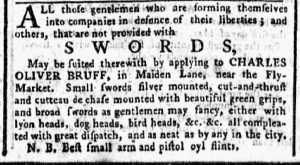
Charles Oliver Bruff, a goldsmith and jeweler who kept a shop at the “sign of the tea-pot, tankard, and ear-ring,” placed a familiar advertisement in the May 29, 1775, edition of the New-York Gazette and Weekly Mercury.  By then it had appeared several times, likely drawing the attention of readers because a woodcut depicting several items made by Bruff adorned the advertisement.  It showed a looking class, a ring, a buckle, and an earning.  It also featured a coat of arms, a sample of the “arms, crests, cyphers, heads and fancies” that he engraved.  The goldsmith and jeweler also declared that he ornamented his wares with “emblems of liberty” for customers who wished to make political statements with their rings, brooches, and other accessories.

New-York Gazette and Weekly Mercury (May 29, 1775).

In the wake of current events, including the battles at Lexington and Concord and the ongoing siege of Boston, Bruff decided to insert a second advertisement in the New-York Gazette and Weekly Mercury.  He placed it for the purpose of promoting “SWORDS” to “ALL those gentlemen who are forming themselves into companies in defence of their liberties.”  He offered “[s]mall swords silver mounted, cut-and thrust and cutteau de chase mounted with beautiful green grips, and broad swords as gentlemen may fancy,” decorating them with “lyon heads, dogs heads, bird heads,” and other figures.  Bruff encouraged his genteel clients to contemplate how they could be fashionable as they mobilized in support of the American cause.  The latest news out of Massachusetts presented a marketing opportunity for the goldsmith and jeweler.  Kate Haulman has documented how military service during the Revolutionary War allowed men, especially officers, to embrace sartorial splendors.[1]  Yet those in uniform were not alone in embracing what Haulman terms “the military mode, where fashion and politics merged.”[2]  The purveyors of garments, textiles, and accoutrements, including tailors, shopkeepers, and jewelers, welcomed such business at a time that demonstrating patriotism otherwise called for abstaining from consumption so often considered luxurious and unnecessary.  Bruff saw a new avenue for attracting clients and adjusting his marketing efforts accordingly.

**********

[1] Kate Haulman, “Fashion and the Culture Wars of Revolutionary Philadelphia,” William and Mary Quarterly, 3rd ser., 62, no. 4 (October 2005), 644-49.

[2] Haulman, “Fashion and the Culture Wars,” 644.

October 26

What was advertised in a colonial American newspaper 250 years ago today?

Supplement to the New-York Gazette and Weekly Mercury (October 26, 1772).

“JAMES RIVINGTON Takes Leave to exhibit a second Advertisement of Articles just imported in the Rose.”

Bookseller and shopkeeper James Rivington placed two advertisements in the New-York Gazette and Weekly Mercuryafter receiving new inventory via the Rose in the fall of 1772.  In the first, he listed dozens of titles, including “Grotius on War and Peace,” “a new Edition of Salmon’s Geographical Grammar,” and “the whole Works of the inimitable Painter Hogarth, in one Volume, with all the Plates he published.”  In addition, he stocked “a fine Assortment of venerable Law Books,” “a fine Assortment of Classicks,” and magazines published in London.  Like so many other newspaper notices placed by booksellers, Rivington’s advertisement served as a book catalog adapted to a different format.

Rivington devoted his second advertisement to other merchandise, stating that he “Takes Leave to exhibit” an additional entry in the public prints to advise prospective customers about “Articles just imported in the Rose, Capt. Miller, different from his literary Exhibition of this Day.”  That advertisement featured a variety of items and marketing strategies.  In a single paragraph, it had sections for musical instruments, patent medicines, clothing, and swords for “Those Gentlemen who propose to take the Field.”

Rather than merely list the patent medicines, Rivington inserted testimonials to assure consumers they were authentic: “Turlington’s Balsam: We certify that the Balsam advertised and sold by Mr. James Rivington, is the genuine sort purchased from us, made from the Receipt left by Mr. Turlington, to us, MARY WRAY, MARY TAPP.”  Similarly, prospective customers interested in “Anderson’s Scots Pills” did not need to worry about counterfeits.  Another testimonial stated, “I do certify that the Scot’s Pills sold by Mr. Rivington of New-York, are genuine, INGLIS.”  The layout of the advertisement did not call particular attention to these testimonials, but readers expecting a list of merchandise likely noted that Rivington departed from the usual format.

Rivington also devised a section about “elegant small Swords of all kinds.”  He listed several varieties, including “Cutteaus De Chase, Seymaters, Light Infantry, Cut and Thrust, &c.”  He concluded with the common abbreviation for et cetera to suggest that he carried even more swords.  To entice customers to examine the swords, he proclaimed that they were “the most beautiful … that ever were offered to Sale in this City.”  Rivington anticipated that customers interested in “superfine ribb’d Worsted Stockings for the wear of Gentlemen, of the best and newest Fashions” in another section of the advertisement would desire attractive swords that enhanced their attire.

A newspaper advertisement did not provide sufficient space for Rivington to tout all of his wares.  He concluded with a note that he “has many more Articles, of which a Catalogue is printing.”  Did that catalog provide commentary about any of those goods, whether blurbs about the clothing, swords, and musical instruments or additional testimonials about the patent medicines?  In a third advertisement in the supplement that accompanied the October 26, 1772, edition of the New-York Gazette and Weekly Mercury, Rivington included a testimonial about the “PATENT SHOT” he sold.  With more space available in a catalog, he may have elaborated on some of his merchandise in greater detail.