November 6

What was advertised in a colonial American newspaper 250 years ago this week?

Postscript to the Virginia Gazette [Purdie and Dixon] (November 3, 1774).

“It has been thought necessary, for the publick Good, to enter into several particular Resolves.”

As the imperial crisis intensified in the fall of 1774, the distinction between news items and advertisements in colonial newspapers became blurry with greater frequency.  Such was the case with letter-advertisements expressing regret for signing “an Address to the late Governor Hutchinson, on his leaving this Province” in several newspapers in Massachusetts.  Another instance appeared in the Virginia Gazette, published by Alexander Purdie and John Dixon in Williamsburg.  On November 3, they distributed a two-page Postscript to accompany the standard four-page issue.  That supplement included nothing but advertising except, perhaps, the first item in the first column on the first page.  With a dateline that read, “EDENTON, NORTH CAROLINA, October 25, 1774,” it featured the petition signed by fifty-one women at the Edenton Tea Party and listed their names in two columns.

Those women expressed their support for resolutions protesting the Tea Act of 1773 passed by the North Carolina Provincial Congress in August.  They proclaimed, “AS we cannot be indifferent on any Occasion that appears nearly to affect the Peace and Happiness of our Country, and as it has been thought necessary, for the publick Good, to enter into several particular Resolves, by a Meeting of Members deputed from the whole Province, it is a Duty which we owe, not only to our near and dear Connections, who have concurred in them, but to ourselves, who are essentially interested in their Welfare, to do every Thing as far as lines in our Power to testify our sincere Adherence to the same; and we do therefore accordingly subscribe this Paper, as a Witness of our fixed Intention and solemn Determination to do so.” In a single sentence, the women of Edenton declared their position on current events and pledged to participate in politics through the decisions they made about consumption.  They added their voices to those who adopted nonimportation agreements.

Why did their petition appear in an advertising supplement?  Had the women involved in the Edenton Tea Party sent their petition to Purdie and Dixon to feature in the Virginia Gazette?  Probably not, but they may have submitted it to the printer of the North-Carolina Gazette in New Bern.  The few extant issues of that newspaper have not been digitized for greater accessibility, making it difficult to determine if the petition appeared in that newspaper and then Purdie and Dixon reprinted it.  After all, colonial printers constantly reprinted items from other newspapers.  The printers in Williamsburg could have received an issue of the North-Carolina Gazette with the petition from the Edenton Tea Party after they printed the November 3 edition of the Virginia Gazette but did not wish to wait a week to disseminate it in the next issue.  Take into consideration as well that news, especially “Extracts from the Votes and Proceedings of the AMERICAN CONTINENTAL CONGRESS,” filled much of the newspaper, crowding out advertisements.  The printers had reason to produce an advertising supplement, yet they may have also wished to highlight the petition signed by patriotic women in Edenton.  The “Extracts” started with an overview of the Continental Association, a nonimportation agreement, as the first news item.  The women’s petition ran as the first item in the Postscript, mirroring the placement of the Continental Association and demonstrating the commitment already expressed for such measures even before the First Continental Congress formally adopted them.  At a glance, it looked like another advertisement among those in the Postscript, yet it delivered important news to readers.

October 13

What was advertised in a colonial American newspaper 250 years ago today?
Rivington’s New-York Gazetteer (October 13, 1774).

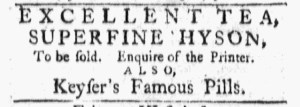
“EXCELLENT TEA, SUPERFINE HYSON.”

Advertisements for tea did not disappear from American newspapers immediately following the Boston Tea Party, nor did they disappear in anticipation of nonimportation agreements enacted in protest of the Coercive Acts that Parliament passed in response.  In Tea: Consumption, Politics, and Revolution, 1773-1776, James R. Fichter notes, “Printers Isaiah Thomas (Patriot) and James Rivington (Loyalist) used their newspapers to advertise their own tea.”[1]  Rivington did so in the October 13, 1774, edition of Rivington’s New-York Gazetteer, offering both “EXCELLENT TEA, SUPERFINE HYSON,” and “Keyser’s Famous Pills,” one of the most famous patent medicines of the era.

Yet that was not only advertisement for tea in that issue.  In the next column, Abraham Duryee provided an extensive list of imported merchandise that concluded with a familiar list: “sugar, tea, coffee, corks, &c. &c. &c.”  On the next page, tavernkeeper Edward Bardin once again inserted his advertisement that promoted “TEA and COFFEE every afternoon” among the amenities available at his establishment.  In the two-page supplement, filled entirely with advertisements, William Parsons included “Green Tea” among the wares in stock at his store.  Peter Elting sold “best Hyson and Bohea tea” along with other groceries.  Fichter reports that Rivington’s New-York Gazetteer “carried tea ads until early 1775, reaching colonies where local tea advertising had already ended.”[2]  Colonial newspapers tended to circulate across regions, including Rivington’s New-York Gazetteer; or, the Connecticut, Hudson’s Rivers, New-Jersey, and Quebec Weekly Advertiser.

Rivington’s editorial stance as well as the advertisements for tea in his newspaper caught the attention of Patriots in New York and beyond.  They often burned Rivington’s New-York Gazetteer, both along with tea and separately.  Furthermore, Fichter identifies “[c]ommittees in at least twenty communities from Rhode Island to South Carolina called for boycotts of his Gazetteer” and “also pressed Rivington’s advertisers” by “urg[ing] ‘Friends of America’ to avoid Rivington and his advertisers.”[3]  Even as tea became the subject of news coverage and editorials and advertisements for tea no longer appeared in some colonial newspapers, other continued to publish advertisements for tea for more than a year after the Boston Tea Party.  The commodity was hotly contested, even as Patriots attempted to impose a boycott of the problematic beverage.

**********

[1] James R. Fichter, Tea: Consumption, Politics, and Revolution, 1773-1776 (Ithaca: Cornell University Press, 2023), 144.

[2] Fichter, Tea, 154.

[3] Fichter, Tea, 208.

September 12

What was advertised in a colonial American newspaper 250 years ago today?

Connecticut Courant (September 12, 1774).

“A SERMON preached … after the Report arrived that People at Boston had destroyed a large Quantity of TEA.”

The September 12, 1774, edition of the Connecticut Courant carried relatively few advertisements.  News and editorials, especially concerning the imperial crisis that increasingly consumed public discourse, crowded out most of the notices that appeared the previous week.  Ebenezer Watson, the printer, however, did find space to include an advertisement for “A SERMON preached” by Israel Holly “at Suffield, Dec. 27, 1773, the next Sabbath after the Report arrived that the People at Boston had destroyed a large Quantity of TEA belonging to the East-India Company, rather than submit to Parliament Acts which they looked upon unconstitutional, tyrannical, and tending to enslave America.”  Watson proclaimed that he had “Just Published” the sermon and offered it for sale.

Even though Holly delivered the sermon eight months earlier, it was especially timely in September 1774 as colonizers received word of the Quebec Act.  Watson initially advertised the sermon in the September 6 edition, immediately below the notice for Considerations on the Measures Carrying On with Respect to the British Colonies in North-America.  He devoted most of the second and a portion of the third page to “an authentic Copy OF the ACT OF PARLIAMENT, For making more effectual Provision for the Government of the Province of QUEBEC, in NORTH-AMERICA.”  Colonizers found several aspects of that legislation troubling, including the free practice of Catholicism by the residents of the territory won from the French in the Seven Years War.  As relayed in the Connecticut Courant, the Quebec Act provided that “His Majesty’s Subject’s professing the Religion of the Church of Rome, of an in the said Province of Quebec, may have, hold and enjoy the free Exercise of the Religion of the Church of Rome … and that the Clergy of the said Church may hold, receive, and enjoy their accustomed Dues and Rights,” such as collecting tithes, “with respect to such Persons only as shall, profess the said Religion.”  Protestants in New England and elsewhere in the colonies did not appreciate those provisions.

How was the Quebec Act connected to a minister preaching in support of the Boston Tea Party?  In a review of James P. Byrd’s Sacred Scripture, Sacred War: The Bible and the American Revolution, Mark A. Noll explains that Holly’s “word of warning to New England reflected the deeply engrained anti-Catholic biblicism that had become standard in the British Empire over the course of previous decades.”  According to the minister’s line of reasoning, “[i]f New England did not repent of its own tyrannies … the expansion of British despotism could soon lead to more ‘arbitrary government’ and even ‘popery.’”[1]  The Quebec Act seemed to fulfill the prediction that Holly made in December 1773, helping to explain why the minister and the printer took the sermon to press when they did.

**********

[1] Mark A. Noll, “The Holy Book in a Holy War,” Reviews in American History 42, no. 2 (December 2014): 612.

August 14

What was advertised in a colonial American newspaper 250 years ago this week?

Rivington’s New-York Gazetteer (August 11, 1774).

“TEA and COFFEE every afternoon.”

Amid the turmoil over tea that included the Boston Tea Party in December 1773 and closure and blockade of the harbor via the Boston Port Act in June 1774, not all advertisers and consumers abstained from the problematic beverage, despite general calls for boycotting and destroying tea and newspaper editorials that condemned both the threat to liberty and negative effects on the body associated with drinking tea.  Along with coffee, tea had become so much a part of dining, entertaining, and socializing that some entrepreneurs continued to include it among the amenities they offered to their customers in August 1774.

For instance, Edward Bardin, an experienced tavernkeeper, promoted tea when he “open’d the noted tavern at the corner house in the Fields … where ladies and gentlemen may depend upon the best entertainment and attendance.”  In an advertisement in the August 11 edition of Rivington’s New-York Gazetteer, he advised that “The PANTRY opened every evening” with an array of items on the menu, including veal, mutton, duck, chicken, lobster, pickled oysters, custards, and tarts “of different KINDS.”  Patrons could also rent a “large commodious ROOM, fit for balls or assemblies.”  For those interested in a leisurely outing, Bardin served “TEA and COFFEE every afternoon.”  Even though the political crisis intensified, he neither removed the troublesome beverage from his menu nor, apparently, believed that advertising it would lead to more trouble than it was worth.  Not everyone lined up to take a principled stand against tea.

New-York Journal (August 11, 1774).

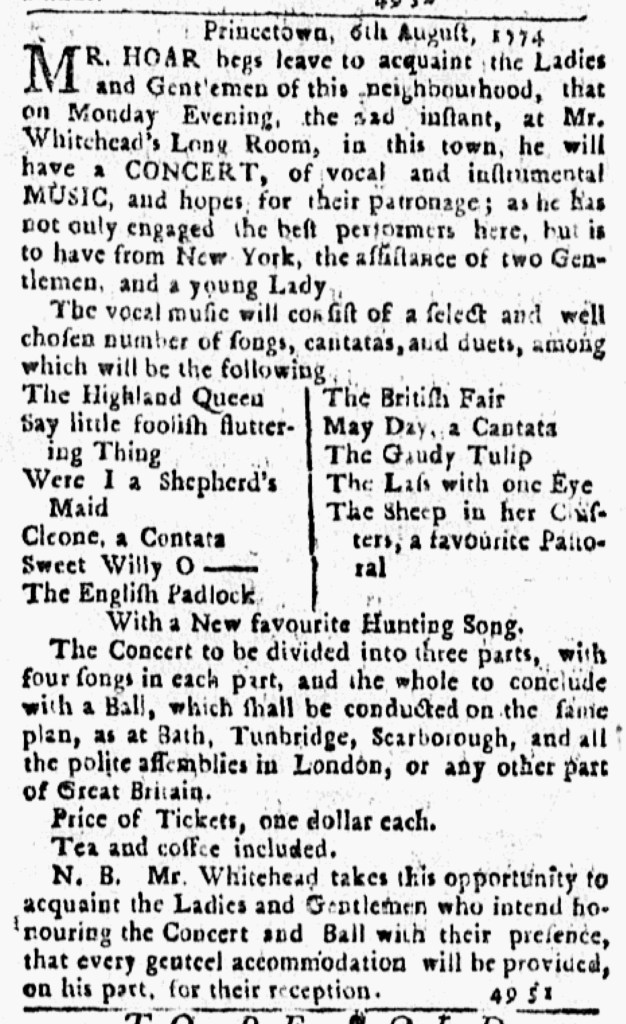
The same day that Bardin published his advertisement for the first time, Mr. Hoar of Princeton, New Jersey, inserted his own notice in the New-York Journal to invite readers in his town to attend a “CONCERT, of vocal and instrumental MUSIC” at “Mr. Whitehead’s Long Room.”  He listed several “songs, cantatas, and duets” on the program.  In addition, the concert would “conclude with a Ball, which shall be conducted on the same plan, as at Bath, Tunbridge, Scarborough, and all the polite assemblies in London.”  The proprietor of the establishment, in a nota bene, promised that “every genteel accommodation will be provided.”  Among those genteel accommodations, “Tea and coffee included” with each ticket.  Neither Hoar nor Whitehead anticipated that serving tea would alienate so many people that it would be better not to mention the beverage.  Instead, they made it a selling point in their advertisement.  Did they face any ramifications for doing so?  Perhaps growing public sentiment eventually encouraged more caution, but the tide had not turned against tea so much that some advertisers refused to include the drink as one amenity among many when they promoted entertainments to colonizers in the summer of 1774.

August 5

What was advertised in a colonial American newspaper 250 years ago today?

South-Carolina and American General Gazette (August 5, 1774).

“*Extract from Dr. RUSH’s Oration.”

Robert Wells had sufficient content to fill a four-page supplement (though printed on a smaller sheet) as well as the standard four-page issue when he took the August 5, 1774, edition of the South-Carolina and American General Gazetteto press.  With so much space to fill, he devoted the entire final page of the standard issue to a book catalog, listing dozens and dozens of titles in four columns.  His inventory represented an array of subjects, though he did not classify or categorize his offerings under headings like other booksellers sometimes did.  Instead, he left it to readers to discover the variety as they perused the catalog.  Among the many titles, he hawked “THE VISIONS of THOMAS SAY of the City of Philadelphia, which he saw in a Trance.”  Wells was either unaware that Say had disavowed that publication in an advertisement in the Pennsylvania Gazette several months earlier or he disregarded it in favor of generating revenue from selling the curious work.

The printer and bookseller also stocked “AN ORATION delivered … before the American Philosophical Society at Philadelphia, containing an Enquiry into the NATURAL HISTORY of MEDICINE among the INDIANS in NORTH-AMERICA … By BENJAMIN RUSH, M.D. Professor of Chemistry in the College of Philadelphia*.”  The asterisk directed readers to an “*Extract from Dr. RUSH’s Oration” that filled the bottom third of the column.  Despite the title, the excerpt (starting on page 67) warned against “luxury and effeminacy” among colonizers, stating that the damage was not so extensive that it could not be remedied.  He offered a series of recommendations, including improved education for children and temperance for adults, while some of them reflected the imperial crisis.  Politics and medicine intertwined when Rush commented on “the ravages which Tea is making upon the health and populousness of our country.  Had I a double portion of all that eloquence which has been employed in describing the political evils which lately accompanied this East-India herb, it would be too little to set forth the numerous and complicated diseases which it has introduced among us.”  The doctor described tea as a hydra, asserting that colonizers needed the strength of Hercules “to vanquish monsters.”  Parliament, the East India Company, and colonizers’ own desire for tea were presumably among the many heads of that monstrous hydra.  The excerpt concluded with an argument that “America is a theatre where human nature will probably receive her last and principal literary, civil and military honours.”

Wells almost certainly selected passages intended to pique the curiosity of readers and leave them wanting more.  They could examine Rush’s entire argument and learn what his comments about education, temperance, and tea had to do with “MEDICINE among the INDIANS” by purchasing the book.  Just as modern publishers provide excerpts to entice prospective customers, Wells published an “Extract” to help boost sales.

South-Carolina and American General Gazette (August 5, 1774).

July 28

What was advertised in a colonial American newspaper 250 years ago today?

Rivington’s New-York Gazetteer (July 28, 1774).

“Excellent Tea.”

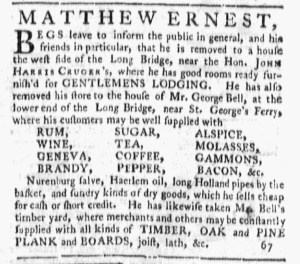
Despite the complicated politics of tea in the wake of the Boston Tea Party and the Boston Port Act that closed and blockaded the harbor as punishment, some merchants and shopkeepers continued to sell tea and printers continued to publish their advertisements in the summer of 1774.  At the same time that many advertisers quietly dropped tea from the lists of merchandise in their newspaper notices, others refused to do so.  In New York, for instance, Matthew Ernest enumerated a dozen commodities that customers could acquire at his store.  In capital letters in three columns, making each item easy for readers to spot, Ernest listed “RUM, WINE, GENEVA, BRANDY, SUGAR, TEA, COFFEE, PEPPER, ALSPICE, MOLASSES, GAMMONS, [and] BACON.”  The merchant supplied tea to consumers willing to purchase it.

Rivington’s New-York Gazetteer (July 28, 1774).

One printer, James Rivington, even sold tea himself or acted as a broker for a customer who did wish for their name to appear in print.  For many weeks, Rivington’s New-York Gazetteer ran an advertisement that announced “Excellent Tea” in a font much larger than almost anything else that appeared among news or advertisements.  It further clarified, “SUPERFINE HYSON, To be sold.  Enquire of the Printer.”  Colonial printers often stocked books, stationery, patent medicines, and other goods, so perhaps Rivington sought to supplement revenues with tea.  On the other hand, an advertisement on the same page as the “Excellent Tea” notice in the July 28 edition promoted “Middleton’s incomparible Pencils, Red and black Lead, Sold by James Rivington.”  Whether or not he was the purveyor of the tea or merely a broker, the printer disseminated the advertisement and sought to earn money through trucking in tea.

In Tea: Consumption, Politics, and Revolution, 1773-1776, James R. Fichter argues that most colonizers who continued to advertise tea did not face significant repercussions, quite a different interpretation than the traditional narrative.  “If we only look at people who got in trouble over tea,” Fichter states, “we will think tea was troublesome.  But if we note the hundreds of people who did not get in trouble over tea, we see a very different story.”[1]  Even as the imperial crisis intensified, there was still space in the public marketplace for advertising and selling tea in the summer of 1774.

**********

[1] James R. Fichter, Tea: Consumption, Politics, and Revolution, 1773-1776 (Ithaca: Cornell University Press, 2023), 145.

July 19

What was advertised in a colonial American newspaper 250 years ago today?

Connecticut Courant (July 19, 1774).

“BOHEA TEA, (not infected with a duty).”

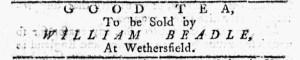
Advertisements for tea did not disappear from American newspapers following the Boston Tea Party in December 1773, nor after the Boston Port Act closed that city’s harbor as punishment in June 1774.  Some merchants and shopkeepers made a point of announcing that they no longer stocked such a controversial commodity.  Others did not include tea alongside coffee and chocolate, an omission that likely did not escape notice since shopkeepers so often marketed those three beverages together.  A few continued with business as usual.  William Beadle, for instance, advertised “GOOD TEA” in the Connecticut Courant in the summer of 1774.

Amos Wadsworth and Fenn Wadsworth also advertised tea in the Connecticut Courant, but they took a more careful approach in marketing it to the public.  They included “BOHEA TEA” among a list of groceries that included coffee and chocolate, though they clarified that their tea was “not infected with a duty.”  The Wadsworths did not explain how they had managed to acquire tea without paying a duty; perhaps they acknowledged with a wink and a nod that they sold smuggled tea, thus enhancing its value to consumers who would derive pleasure from the part they would play in putting one over on Parliament when they purchased the tea.

Realizing how much consumers enjoyed tea despite the political problems associated with it, the Wadsworths highlighted that item in their advertisement.  They stocked “a genuine assortment of DRUGS, MEDICINS” and “an assortment of European and India GOODS” as well as the groceries that they listed in their advertisement.  Among the groceries, only “BOHEA TEA” appeared in capital letters, drawing attention to that item over others.  With capital letters used sparingly in throughout the advertisement, the Wadsworths seemingly made a deliberate decision to accentuate tea while simultaneously affirming that it was acceptable for supporters of the American cause to purchase and drink this tea “not infected with a duty.”  That made their marketing strategy consistent with the principles expressed in editorials that lamented the “oppressive and unconstitutional Acts of the British Parliament.”  The July 19, 1774, edition of the Connecticut Courant also included the text of the Massachusetts Government Act and a poem, “HAIL LIBERTY!”  In that context, the Wadsworths provided a means for consumers to enjoy their favorite beverage in good conscience.

June 28

What was advertised in a colonial American newspaper 250 years ago today?

Connecticut Courant (June 28, 1774).

“GOOD TEA, To be Sold.”

William Beadle was at it again.  He advertised “GOOD TEA, To be Sold by WILLIAM BEADLE, At Wethersfield” in the June 28, 1774, edition of the Connecticut Courant and Hartford Weekly Intelligencer.  Unlike many other merchants and shopkeepers, Beadle had not refrained from advertising tea after colonizers disguised as Indians dumped tea into Boston Harbor on December 16, 1773.  In March 1774, he advertisedBest Bohea TEA, Such as Fishes never drink!!”  In April, he opened a new advertisement with a headline promoting “A New Supply of TEA, Extraordinary good.”  Perhaps Beadle sold smuggled tea that evaded the duties imposed by Parliament but could not state that was the case in the public prints … or his politics did not align with the patriots who objected to Parliament regulating trade in the colonies … or he realized that many consumers still wished to drink tea even with the controversy swirling around that commodity.

Still, his latest advertisement hawking tea and only tea seemed especially bold.  It was the first one he published after the Boston Port Act closed and blockaded the harbor until residents of that town paid for the tea that some of them destroyed.  Word of that punishment arrived in the colonies in May, before the legislation went into effect on June 1.  Newspapers throughout the colonies carried coverage of the Boston Port Act and reactions in Boston and other towns.  Many people called for a new round of boycotts on goods imported from England, including tea.  Further coverage focused on other measures meant to bring Boston in line, the series of Coercive Acts that included an Act for the Impartial Administration of Justice and a Quartering Act.  The issue of the Connecticut Courant that ran Beadle’s advertisement featured “AnAUTHENTIC ACCOUNT” from London “of Friday’s DEBATE on the second Reading of the Bill regulating the civil government of the Massachusetts-Bay.”  Known as the Massachusetts Government Act, that legislation abrogated the colony’s charter from 1691 and gave new powers to the royal governor.  That same issue included updates from Boston and, on the same page as Beadle’s advertisement for tea, a “Copy of a Letter from the Committee of Correspondence in New-York, to the Committee in Boston.”  Yet not everyone held what seemed to be the prevailing political sentiments captured in the public prints.  Even as John Holt swapped out the British coat of arms for the severed snake representing American unity in the masthead of the New-York Journal, some merchants and shopkeepers, such as William Beadle, continued advertising tea rather than making pronouncements about abstaining from the beverage due to political principles.

May 27

What was advertised in a colonial American newspaper 250 years ago today?

South-Carolina and American General Gazette (May 27, 1774).

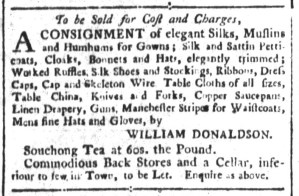
“Souchong Tea at 60s. the Pound.”

As summer approached in 1774, William Donaldson advertised a variety of goods in the South-Carolina and American General Gazette.  On May 27, he promoted “elegant Silks, Muslins and Humhums for Gowns; Silk and Sattin Petticoats, Cloaks, Bonnets and Hats, elegantly trimmed; [and] Table China,” among other merchandise.  He had a separate entry for “Souchong Tea at 60s. the Pound.”  As in other towns, decisions about buying, selling, and consuming tea were part of an unfolding showdown between the colonies and Parliament.

Residents of Charleston were well aware of the Boston Tea Party that occurred the previous December.  They also anticipated some sort of response from Parliament, but at the time that Donaldson ran his advertisement, word of the Boston Part Act had not yet arrived in South Carolina.  Indeed, four days after Donaldson’s advertisement appeared in the South-Carolina and American General Gazette, another newspaper, the South-Carolina Gazette and Country Journalcarried updates from London, dated March 15, that included an overview of the proposed act to close Boston Harbor until the town paid for the tea that had been destroyed and “made proper concession for their tumultuous behaviour.”  In addition, the report stated that a “light vessel is said to have been kept ready by some friends to the Bostonians in England, in order to carry accounts of the first determination of a Great Assembly.”  By the end of May, colonizers in New England and New York knew that the Boston Port Act had passed and would go into effect on June 1.  The news was still making its way to South Carolina.

When it arrived, Peter Timothy, the printer of the South-Carolina Gazette, considered it momentous enough to merit an extraordinary, a supplemental issue.  Timothy usually published his newspaper on Mondays, but felt that this news could not wait three more days.  He rushed the South-Carolina Gazette Extraordinary to press on Friday, June 3.  The masthead included thick black borders, traditionally a sign of mourning the death of an influential member of the community but increasingly deployed by American printers to lament the death of liberty.  Confirmation of the Boston Port Act inspired new debates about consuming tea and purchasing other imported goods, eventually leading to a boycott known as the Continental Association, but colonizers did not immediately forego buying, selling, drinking, or advertising tea following the Boston Tea Party.  That happened over time (and loyalists like Peter Oliver claimed that even those who claimed to support the boycott devised ways to cheat).  In the interim, Donaldson continued marketing tea along with other merchandise.

May 26

What was advertised in a colonial American newspaper 250 years ago today?

Rivington’s New-York Gazetteer (May 26, 1774).

“Gentlemen and Ladies, may be furnished with tea and coffee, Morning and Afternoon.”

Mrs. Brock invited “Gentlemen and Ladies” to gather at “her elegant and very pleasantly situated house, opposite the Battery,” in New York in the spring of 1774.  In an advertisement in the May 26 edition of Rivington’s New-York Gazetteer, she declared that she “continues to furnish Relishes and all kinds of eatables, as usual.”  She also served “Mead and Cakes, of the very best quality.”  The hostess also took the opportunity to express “her grateful thanks to her friends, who have heretofore favour’d her with their custom.”  Brock had been in business for at least five years, having previously advertised in the New-York Journal.  Given the reputation she had cultivated during that time, she assured her existing clientele and the public “that she will use her utmost endeavour to please.”

Despite such assurances, some readers may not have been pleased with Brock.  In addition to “Relishes” and “eatables,” she also served “tea and coffee, Morning and Afternoon, on the shortest notice.”  New York had recently received word of the Boston Port Act that closed that harbor of that town until residents paid for the tea destroyed the previous December.  Residents were certainly aware of efforts to turn away ships carrying tea to their own colony.  Though no prohibition on buying, selling, or drinking tea had been enacted, many colonizers looked on the commodity with suspicion.  Some merchants and shopkeepers already advertised that they stocked a variety of groceries but not tea, while others made clear that they continued business as usual.  Brock joined their ranks.  Her advertisement could not be mistaken as one merely reprinted after having run for some time, perhaps originating prior to the latest controversy; it was dated “May 26, 1774” and bore the issue number, “58,” of the current edition.  Whatever measures were coalescing around consuming tea, Brock considered it appropriate to continue serving the beverage to “Gentlemen and Ladies” and anticipated that she would meet with a ready market.  Many colonizers, she surmised, were not yet ready to dispense with tea, no matter the complicated politics swirling around it.