May 15

What was advertised in a colonial American newspaper 250 years ago this week?

Massachusetts Spy (May 12, 1774).

“All sorts of Groceries as usual – except TEA.”

By the time that Thomas Walley’s advertisement ran in the May 12, 1774, edition of the Massachusetts Spy, it would have been a familiar sight to regular readers of that newspaper.  It previously appeared on six occasions in March, April, and May, advising the public that Walley stocked a variety of items that he sold wholesale or retail at his “Store on Dock-Square” in Boston.  He had “Dutch looking-glasses of various sizes,” “quart and pint Mugs and Chamber Pots,” and “choice junk” (or old rope) “to make into cordage of any size.”

Walley also sold “Oatmeal per bushel,” “all sorts of Spices,” “choice Rice,” “new Raisins,” and “all sorts of Groceries as usual – except TEA.”  That last entry, listing what he did not sell rather than what he wanted to put into the hands of consumers, may have the primary reason that Walley inserted his advertisement in the Massachusetts Spy so many times.  As one of the owners of the Fortune, the vessel that transported the tea involved in the second Boston Tea Party, Walley had been under suspicion, though he and his partners asserted that they did not have “any share, interest or property, directly or indirectly in any part of the Tea that came from London in said vessel.”  They made that declaration, affirmed by a justice of the peace, in an advertisement that ran in the March 10 edition of the Massachusetts Spy, just days after colonizers disguised as Indians once again dumped tea into Boston Harbor.

A week later, Walley’s advertisement listing a variety of goods “except TEA” appeared in the Massachusetts Spy for the first time.  Given the political orientation of that publication, printed by ardent patriot Isaiah Thomas, it made sense for Walley to take to the pages of that newspaper in his effort to convince the public that he was not trucking in tea.  His advertisement ran again the following week and then on April 7, 15, and 22 and May 5 and 12, missing from only the March 31 and April 28 editions.  Merchants and shopkeepers often ran notices for several months, but in this instance a desire to sell his inventory probably was not Walley’s sole consideration.  He continuously reminded the public that he wanted nothing to do with peddling tea, probably even more so on May 12 when Thomas published a two-page Postscript to the Massachusetts Spy that featured the text of the Boston Port Act that closed the harbor until the colonizers made restitution of the tea they destroyed.  As the crisis intensified, Walley sought to distance himself from tea.

March 10

What was advertised in a colonial American newspaper 250 years ago today?

Massachusetts Spy (March 10, 1774).

“We neither jointly nor separately had any share, interest or property, directly or indirectly in any part of the Tea that came from London in said vessel.”

Thomas Walley, Peter Boyer, and William Thompson needed to do some damage control and salvage their reputations in the wake the second Boston Tea Party.  That trio owned the Fortune, a brig that recently arrived from London. Among its cargo, the ship carried twenty-eight chests of tea “destined for some independent merchants,” according to the Massachusetts Historical Society’s overview of events.  The brig arrived in port on March 6, 1774.  J.L. Bell explains that Walley, Boyer, and Thompson worked with those merchants to request that the tea be returned, but customs officers refused.  Bostonians did not spend weeks debating what to do like they had a few months earlier.

A news item in the March 10, 1774, edition of the Massachusetts Spy reported that “His Majesty Oknookortunkogog King of the Narragansett tribe of Indians, on receiving information of the arrival of another cargo of the cursed weed Tea, immediately summoned his Council.”  Colonizers once again played Indian in their acts of resistance against imperial authority.  The imaginary leader of the Narragansetts “did advise and consent to the immediate destruction” of the tea, “after resolving that the IMPORTATION of this Herb, by ANY persons whatever, was attended with pernicious and dangerous consequences to the lives and properties of all his subjects throughout America.”  The king and council dispatched “the seizor and destroyer-general, and their deputies … to the place where this noxious herb was.”  They made their way to the Fortune on the evening of March 7, where they “emptied every chest … and effectually destroyed the whole” before they “returned to Narrangasett to make report of their doings to his Majesty.”  The Sons of Liberty and their allies maintained the ruse deployed the previous December.

Walley, Boyer, and Thompson’s advertisement appeared immediately below that description of the destruction of another cargo of tea.  They opened by rehearsing the story of “a certain WILLAIM BOWES, Brazier, on Dock-square” who “industriously propagated … a false and scandalous report, that the owners of the brig … have imported a quantity of Tea in that vessel upon their own account.”  Walley, Boyer, and Thompson suspected that Bowes might have even “invented” the story himself rather than repeating gossip he heard elsewhere.  The merchants did not trust his motives at all, claiming that Bowes “impudently asserted” that he knew all about the tea they supposedly imported from London and told the story “with a malignant design … to injure their reputation, and expose them to public resentment.”  As a result, they found it necessary to run an advertisement “in vindication of themselves from the vile and groundless aspersion of that impertinent medler in other men’s matters.”  Although they had tried to defuse the situation by assisting merchants who shipped cargo on their vessel in receiving permission to return the tea to London, they had not been aware in advance that the Fortune carried tea.  They wished to make that clear.

To that end they published a “deposition” which explicitly stated, “WE the subscribers, owners of the brig Fortune, do solemnly declare that we neither jointly nor separately had any share, interest or property, directly or indirectly in any part of the Tea that came from London in said vessel.”  Just as Jeremiah Cronin had done when facing allegations that he acted against the interests of the patriots, Walley, Boyer, and Thompson enlisted the aid of a justice of the peace to lend credibility to their explanation of what occurred.  Edmund Quincy asserted that the merchants “personally appeared and made oath to the truth of the above declaration.”  As was often the case in early American newspapers, the section devoted to news did not contain all the information about current events.  Instead, readers garnered valuable information from an advertisement as well.

May 9

What was advertised in a colonial American newspaper 250 years ago this week?

Massachusetts Gazette and Boston Weekly News-Letter (May 6, 1773).

“His Store is the cheapest after all is said and done, &c. &c. &c. &c.”

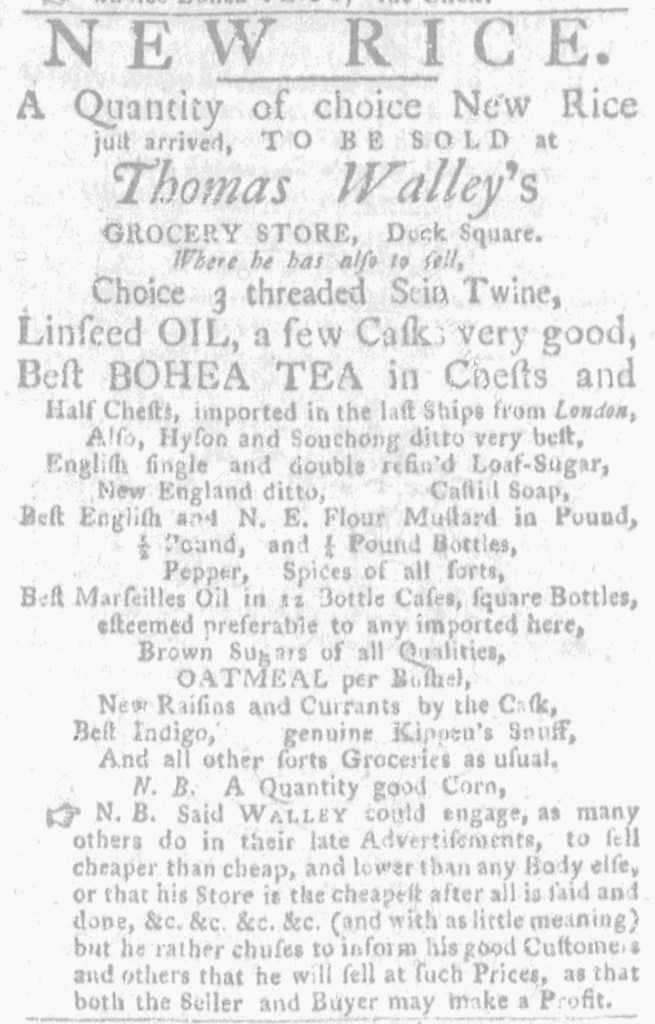
Thomas Walley stocked a variety of items at his “GROCERY STORE” on Dock Square in Boston in the spring of 1773.  In an advertisement in the May 6 edition of the Massachusetts Gazette and Boston Weekly News-Letter, he listed many of those items, from “New Rice” to “BOHEA TEA” to “Flour Mustard” to “Brown Sugars of all Qualities.”

Walley concluded his advertisement with a lively nota bene that commented on the marketing strategies deployed in the city’s newspapers by various purveyors of goods.  He stated that he “could engage, as others do in their late Advertisements, to sell cheaper than cheap, and lower than any Body else, or that his Store is the cheapest after all is said and done, &c. &c. &c. &c.”  The string of “&c.” (which modern readers would recognize as “etc. etc. etc. etc.”) communicated his exasperation with advertisers who went on and on about the bargains that they made available to their customers.  More bluntly, he declared that if he did the same that it would have “as little meaning,” something that he suspected both advertisers and savvy consumers realized.  Instead of making bold claims about his prices to dazzle prospective customers, Walley considered simplicity and honesty the better means of cultivating relationships of trust.  He “rather chuses to inform his good Customers and others that he will sell at such Prices, as that both the Seller and the Buyer may make a Profit.”  In other words, both parties got a good deal.

Walley’s approach echoed the one taken by Samuel Flagg when he advertised imported goods available at his store in Salem several months earlier.  Flagg proclaimed that he did not “mean to make such a Parade, not furnish the Publick with so many pompous Promises (as have lately been exhibited) of Goods being so amazingly cheap, but would rather convince them of the Cheapness of his Goods and of his Integrity in dealing, whenever they may please to call and favour him with their Custom.”  When it came to engaging prospective customers with his advertisements, he did not wish to “tell them a Story” like in “so many flashy Advertisements as weekly present themselves.”  Flagg asserted that such stories had no “true Meaning” … and readers knew that as well as he did.

Both Walley and Flagg saw critiquing advertising as the most effect means of marketing their wares.  They flattered readers by suggesting that they all knew that other advertisers inflated their claim yet Walley and Flagg would not insult the intelligence of their prospective customers.  Instead, they opted for honesty and integrity in presenting prices that worked to the advantage of both the shopkeepers and consumers.

March 25

What was advertised in a colonial American newspaper 250 years ago today?

Boston-Gazette (March 25, 1771).

“Said Gazette has an extensive Circulation.”

In the eighteenth century, some newspaper printers used the colophon on the final page to promote subscriptions and advertising, but not every printer did so.  Samuel Hall, printer of the Essex Gazette, regularly updated his colophon.  In March 1771, the colophon informed readers of the subscription price, “Six Shillings and Eight Pence per Annum, (exclusive of Postage),” and the advertising rates, “Three Shillings” for notices “not exceeding eight or ten Lines.”  Printers often inserted notices calling on subscribers, advertisers, and others to settle accounts or face legal action, but they rarely advertised their own newspapers to prospective subscribers or potential advertisers.

That made Hall an exception.  He began in his own newspaper, printed in Salem, Massachusetts, with a brief notice on March 12, 1771.  Hall informed “Gentlemen, in and near Boston, who have signified their Desire of becoming Subscribers” that Thomas Walley accepted subscriptions at his store on Dock Square.  Two weeks later, Hall placed an advertisement in the Boston-Gazette, hoping to reach a greater number of readers.  He once again listed Walley as his local agent in Boston.  He also explained that he printed the Essex Gazette on Tuesdays and instructed subscribers that they could “apply for their Papers” at Walley’s store “every Tuesday or Wednesday.”

Hall did not limit his advertisement to seeking subscribers this time around.  He devoted eight of the thirteen lines to soliciting advertising for the Essex Gazette.  Addressing “Those Gentlemen who may have Occasion to advertise,” Hall proclaimed that his newspaper had “an extensive Circulation, particularly in every Town in the County of Essex.”  Furthermore, he declared that the Essex Gazette was “universally read in the large Sea Port Towns of Salem, Marblehead, Glocester and Newbury-Port” as well as “many other considerable Towns in that County.”  That was not the extent of the newspaper’s dissemination, according to the printer.  He noted that it also “circulated in most of the Towns on the Eastern Road as far as Casco-Bay” (today part of Maine).

In his efforts to increase the number of advertisers (and enhance an important revenue stream) for the Essex Gazette, Hall focused on the circulation of his newspaper.  After all, prospective advertisers knew that placing notices in any newspaper was a good investment only if a significant number of readers actually saw their advertisements.  Hall carefully delineated the reach of the Essex Gazette to reassure “Gentlemen who may have Occasion to advertise” that his newspaper had established a significant readership in the region.

March 7

GUEST CURATOR: Olivia Burke

What was advertised in a colonial American newspaper 250 years ago today?

Essex Gazette (March 7, 1769).

“The best New-England Flour of Mustard.”

In “A Taste for Mustard: An Archaeological Examination of a Condiment and Its Bottles from a Loyalist Homestead in Upper Canada,” Denise C. McGuire provides an overview of mustard production and consumption and examines an excavation of the Butler Homestead site in Niagara-on-the-Lake, Ontario. “Flour of Mustard” was very popular in Britain. It played an important role in eighteenth-century cooking, but was also considered to have medicinal value. It also reveals changes in transatlantic trade. Initially imported in the American colonies, it was subsequently grown there. As we can see in this advertisement, flour of mustard was sold in the colonies; it even specifically states that it was “New-England Flour of Mustard,” proudly showing that the mustard was grown and produced in the colonies.

That production continued after the American Revolution, intended for local consumption as well as export. When a cache of glass bottles was discovered, the square shape led McGuire to believe that they were mustard bottles. The discoveries at the Butler Homestead show that Loyalists got their flour of mustard from American producers after the Revolution. “[E]ven two generations after the first wave of Loyalist settlement, the ability to acquire simple commodities was not always easily accessible in more remote locations.”[1] Such evidence shows that the Butler family retained commercial ties to upstate New York even after the Revolutionary War.

**********

ADDITIONAL COMMENTARY: Carl Robert Keyes

When she consulted me about including this advertisement among those she would examine during her week as guest curator, Olivia expressed some concern about Chloe Amour previously examined flour of mustard in another advertisement recently featured on the Adverts 250 Project. She did not wish to duplicate the work of one of her peers. I encouraged her to continue with Thomas Walley’s advertisement, especially after she revealed that she had already consulted McGuire’s article. We certainly had more to learn about this particular commodity. As we move chronologically from the imperial crisis to the early republic, our Revolutionary America class has so far focused on the politics and economics of producing, trading, and consuming goods in the 1760s through the early 1780s. By incorporating mustard bottles uncovered during an archaeological excavation of a Loyalist site in Canada, Olivia has given our class a preview of the period we will be examining later in the semester.

For my part, I’m interested in the many similarities between Walley’s advertisement in the Essex Gazette and William Chace’s advertisement in the Providence Gazette. Both named their products “New-England Flour of Mustard,” emphasizing that it had been produced locally. Walley underscored that his mustard “has been greatly admired, both for its Strength and Flavor, by all that have used it.” Similarly, Chace proclaimed that his mustard “is allowed by the best Judges to be superior both for Strength and Flavour to any imported.” In this instance, Chace more explicitly attached a political meaning to acquiring his mustard, comparing it imports that many colonists had vowed to eschew as acts of economic resistance against the Townshend Acts. Walley made a nod toward such appeals when he offered to make “An Allowance … to those that buy to sell again, in order to encourage this Manufacture.” Such discounts may have helped to move his product out the door and, eventually, into the hands of greater numbers of consumers, but they also invoked images of “domestic manufacture” so often touted in news and editorials, especially in those moments that the imperial crisis intensified. Even Samuel Hall, the printer of the Essex Gazette, stocked a “small Parcel of the above Mustard” to make it available to residents of Salem who might not otherwise have an opportunity to acquire it from Walley at his store in Boston. In advancing similar appeals to prospective customers, Walley and Chace demonstrated that they participated in a larger conversation about the meaning of mustard. In the late 1760s, mustard did more than merely flavor food. It was enmeshed in the politics of the period.

**********

[1] Denise C. McGuire, “A Taste for Mustard: An Archaeological Examination of a Condiment and Its Bottles from a Loyalist Homestead in Upper Canada,” International Journal of Historical Archaeology 20, no. 4 (December 2016): 680.

December 11

What was advertised in a colonial American newspaper 250 years ago this week?

Massachusetts Gazette [Draper] (December 8, 1768).
New-England FLOUR MUSTARD … superior in Strength and Flavor to any IMPORTED.”

Although he carried some imported goods at his store on Dock Square in Boston, Thomas Walley emphasized locally produced goods in his advertisement in the December 8, 1768, edition of Richard Draper’s Massachusetts Gazette. Indeed, even the headline in a larger font than most of the rest of his advertisement proclaimed that many of his wares had local origins: “New-England Flour of Mustard.” Ever since learning of the Townshend Act and new duties placed on certain imported goods, colonists in Boston and throughout Massachusetts had vowed to limit their purchases of English goods as a means of protest. This coincided with concerns about an imbalance of trade that favored Britain over the colonies, prompting interest in encouraging “domestic manufactures” whenever possible as alternatives to imported goods. Some advertisers explicitly promoted the politics of consumption, but others made such arguments implicitly, realizing that declarations that their wares had been produced in the colonies would resonate with prospective customers already primed to recognize the political meanings of their decisions as consumers.

Still, advertisers like Walley made it clear that customers did not have to sacrifice quality for their principles. For most of the “domestic manufactures” in his advertisement, he included some sort of explanation concerning its quality. The “much-admired New-England FLOUR MUSTARD,” for instance, had been “found by repeated Trials of the best Judges to be superior in Strength and Flavor to any IMPORTED.” Walley did not provide further details about these “best Judges,” but he did offer assurances that this product was not unknown or new to the market. Customers could purchase it with confidence that others had already enjoyed and endorsed it. When it came to “PIGTAIL TOBACCO” and “Choice SNUFF,” Walley indicated that his inventory “manufactured in Boston” met the same standards as a well-known brand. The tobacco was “equal to Kippin’s” and the snuff “equal to Kippen’s best.” Similarly, Walley sold “STARCH, manufactured in Boston” that was “the best Sort” and “equal to [imports from] Poland,” known for their quality. Readers may have greeted such proclamations with skepticism, but such assurances may have helped to convince prospective customers to give these products a chance. Walley did not allow the political ramifications of consumer choices to stand alone in marketing his wares. Instead, he paired politics and quality to enhance the appeal of several “domestic manufactures” he made available to consumers in Boston.

June 9

What was advertised in a colonial American newspaper 250 years ago today?

Jun 9 - 6:9:1768 Massachusetts Gazette Draper
Massachusetts Gazette [Draper] (June 9, 1768).
“Choice N.E. Flour of Mustard.”

Thomas Walley’s advertisement in the June 9, 1768, edition of the Massachusetts Gazette included an interesting mixture of imported and locally produced wares. He first promoted the imported goods: figs, tea, sugar, coffee, rice, and other groceries. Then he shifted attention to two products produced in New England: “choice Starch made in BOSTON” and “choice N.E. Flour of Mustard.” In describing each as “choice,” Walley indicated that they achieved the same quality as imported goods. He further underscored that the starch was “equal to Poland.”

He devoted significantly more space to mustard seeds, inserting a nota bene that made the advertisement half again as long. Walley had previously advertised “Choice New-England Flour of Mustard … which by repeated Trials is found to be extraordinary good, therefore needs no further Recommendation.” In his new advertisement he called on colonists not only to purchase mustard produced locally but also to participate in making it available as an option for all consumers. He offered cash for mustard seed, but he encouraged “Persons in the Country [to] endeavour to raise and save more Mustard Seed than they have done heretofore” for reasons other than financial gain. He depicted such efforts as “serving their Country” since “N.E. Flour of Mustard” was “certainly found to be preferable to any that is imported.” In what ways was it preferable? Walley did not mean solely the quality or taste. Instead, he invoked a movement to encourage “domestic manufactures” and the consumption of goods produced in the colonies as a means of resistance to abuses perpetrated by Parliament, including the Townshend Act that had gone into effect the previous November. Over the past several months, newspapers throughout the colonies published or reprinted the resolutions of, first, the Boston Town Meeting and, in response, other towns that determined to decrease their dependence on goods imported from or via Britain.

Walley’s advertisement demonstrates that the idealism did not always keep pace with the practical realities. After all, he deployed “Choice Turkey FIGS” recently imported as the headline for an advertisement that eventually turned its attention to goods produced in the colonies. A series of advertisements encouraged colonists to drink “LABRADORE TEA” instead of imported “Best Bohea Tea,” but the demand for imported teas continued. Colonists could not produce some of the groceries listed in Walley’s advertisement. The merchant realized that was the case. Still, he encouraged colonists to modify their behaviors concerning products that were readily available, such as “Starch made in BOSTON,” as well as participate in bringing greater quantities of others, especially “N.E. Flour of Mustard,” into the local marketplace.

April 21

GUEST CURATOR: Mary Bohane

What was advertised in a colonial American newspaper 250 years ago today?

Apr 21 - 4:21:1768 Massachusetts Gazette
Massachusetts Gazette (April 21, 1768).

“New Rice by the Cask.”

Thomas Walley sold “New Rice by the Cask” at his “Store, on Dock-Square.” Rice was one of the most profitable goods cultivated in colonial America. According to James M. Clifton, settlers from Barbados and other colonies in the West Indies introduced rice to South Carolina. Colonists there had much to learn about rice, doing so through trial and error. The earliest mention of rice shipment recorded was in 1692, but after that point it became a staple crop, one that supported much of the economy for the entire colony.[1] In order to reduce the amount of strenuous labor required to produce this popular commodity, colonists in South Carolina sought to perfect machines and mills that could aid in processing rice.[2] Unfortunately, this proved quite unsuccessful and remained a challenging process throughout the colonial period. Rice crops became more profitable, however, with the labor of black slaves who worked on plantations and knew how to properly cultivate rice.

**********

ADDITIONAL COMMENTARY: Carl Robert Keyes

In addition to “New Rice by the Cask,” Thomas Walley also peddled a variety of other goods. He emphasized textiles and “all sorts of Groceries,” such as tea, olive oil, and mustard. The assortment of fabrics available at his store included “homespun check,” cloth that had been woven in the colonies rather than imported from England. Walley did not explicitly link his products to the imperial crisis that had intensified six months earlier when the Townshend Act went into effect, but he did offer prospective customers the opportunity to participate in a larger coordinated effort to resist Parliament’s attempts to impose taxes for the purpose of raising revenue without the consent of the colonies. Several months before Walley’s advertisement appeared in the Massachusetts Gazette, the Boston Town Meeting (followed by many others) had voted to use commerce as leverage in the political dispute with Parliament. They pledged to encourage “American manufactures” rather than continue their dependence on imported goods. In so doing, they acknowledged that in order to change their consumption habits that they first needed to modify the amount of goods produced in the colonies.

Just as this advertisement obscures the role of enslaved labor in producing “New Rice by the Cask,” it also obscures the role women played in this political strategy. Barred from participating in the formal mechanisms of government, women pursued other avenues when it came to participating in resistance efforts during the imperial crisis that culminated in the Revolution. American women produced Walley’s “homespun Check,” first spinning the thread and then weaving it into checkered cloth. Women also made choices about which goods to consume, their decisions extending to entire households. Women who purchased homespun could make very visible political statements by outfitting every member of their families in garments made from that cloth. The meanings of consumption increasingly took on political valences in the late 1760s and into the 1770s. In that realm, women often exercised as much power as men as they exercised their judgment in selecting which goods to acquire and which to reject. Their decisions reverberated beyond the point of purchase; everyday use of clothing, housewares, groceries, and other goods advertised in newspapers and sold by merchants and shopkeepers became laden with political significance.

**********

[1] James M. Clifton, “The Rice Industry in Colonial America,” Agricultural History 55, no. 3 (July 1981): 267.

[2] Clifton, “Rice Industry,” 278.