October 13

What was advertised in a colonial American newspaper 250 years ago today?

Pennsylvania Journal (October 13, 1773).

“He therefore flatters himself, that he, a young beginner, will receive suitable encouragement from the generous public.”

Benjamin January, a “BOOK-BINDER and STATIONER,” offered his services to residents of Philadelphia in an advertisement in the October 13, 1773, edition of the Pennsylvania Journal.  He declared that he had recently opened a shop “where he carries on the BOOK-BINDING BUSINESS … and where Merchants, Shop-keepers, and others, may be supplied with all sorts of account books, and and ruled to any pattern, at the lowest price.”  He also listed a variety of stationery and writing supplies available for sale.  Like many other advertisers, January emphasized customer service as an important part of his business.  He promised that “he shall make it his peculiar study to merit the approbation of all such, who please to employ him, so shall it be his constant endeavour to give, to the utmost of his power, entire satisfaction.”  In a final plea to prospective customers, the bookbinder and stationer emphasized that he was “a young beginner” who would benefit “suitable encouragement from the generous public.”  He suggested that consumers had a duty to reward him for his enterprising spirit.

Benjamin January, Trade Card (Philadelphia, ca. 1783-87).  Courtesy American Antiquarian Society.

That “young beginner” apparently convinced prospective customers to give him a chance, at least for a time.  In the 1780s, he remained in business and continued to advertise by distributing an engraved trade card that gave his location as “the sign of the Bible & Dove” with “in Front Street” written in a blank space.  The bookbinder and stationer could change locations, retain the sign associated with his shop, and update his trade card accordingly.  He first listed Front Street as his location in an advertisement for a lost pocketbook in the May 3, 1780, edition of the Pennsylvania Gazette, but did not make reference to “the sign of the Bible and Dove” until advertising in the June 5, 1783, edition of the Pennsylvania Packet.  Advertising did not guarantee success.  The December 3, 1787, edition of the Independent Gazetteer carried a bankruptcy notice “issued forth against Benjamin January, of the city of Philadelphia, Bookbinder and Stationer.”  Following that setback, January tried again, soliciting “a continuance of the favours of his former employers, and of all others who wish to encourage him” at his new location on Chestnut Street in an advertisement in the February 13, 1788, edition of the Independent Gazetteer.  He continued advertising in newspapers throughout the remainder of the 1780s and into the 1790s.

Whatever the difficulties that January encountered, he joined several merchants, shopkeepers, and artisans in marketing efforts that extended beyond newspaper notices, the most common form of advertising in eighteenth-century America.  His trade card resembled those that circulated in London and urban ports in the colonies.  An ornate border depicted books, ink wells, shakers, quills, and desk accessories.  A ribbon woven throughout the border listed other wares, including “INK POWDER,” “SLATES,” “WAFERS,” “PENCILS,” “WAX,” and “PAPER.”  In the text contained within the border, January advanced some of the same appeals he deployed when he introduced himself to readers of the Pennsylvania Journal and other newspapers published in Philadelphia.  He asserted “all Sorts of Account Books are Made & Ruled to any Pattern” and sold “all Sorts of stationary wares at the Lowest Rates.”  Such a fine trade card signaled initiative and industriousness, though January may not have received the return on this investment that he hoped.  Still, his trade card testifies to the rich visual landscape of advertising media that circulated in Philadelphia during the era of the American Revolution.

July 15

What was advertised in a colonial American newspaper 250 years ago today?

Maryland Gazette (July 15, 1773).

“Catalogues both of the library and the books he has for sale to be had at his shop.”

On July 15, 1773, William Aikman once again took to the pages of the Maryland Gazette to promote the circulating library that the bookseller and stationer recently opened in Annapolis.  He inserted the same advertisement that appeared in the previous issue, seeking subscribers for the library and hawking books, stationery, and writing supplies.  In addition to deploying the newspaper notice, Aikman used other forms of advertising.

For instance, he concluded his notice with a nota bene that advised, “Catalogues both of the library and the books he has for sale to be had at his shop.”  According to Robert Winans in A Descriptive Checklist of Book Catalogues Separately Printed in America, 1639-1800, the Maryland Historical Society has the only known copy of a book catalog that may have been the one that Aikman mentioned in his newspaper advertisement.  It contains “854 consecutively numbered medium and full author and title entries, arranged alphabetically,” falling short of the “1200 volumes” that Aikman tallied in his newspaper advertisement.  However, that sole copy lacks a title page and other evidence suggests that additional pages may have been lost as well.

Trade Card for William Aikman’s Circulating Library (Annapolis, 1773). Courtesy American Antiquarian Society.

In addition to publishing at least one book catalog, Aikman also distributed an item that may have served as a trade card, a bookplate, or membership card.  The copperplate engraving features an ornate border that encloses the words “W. AIKMAN’S Circulating Library” in the upper portion of the cartouche and an advertisement for his book and stationery shop in the lower portion: “All kinds of Books, Letter Cases, Message Cards, Gilt &Plain Paper, Wax, &c. Sold at his Shop, Annapolis, at the British Prices, for Cash Only.  Paper rul’d, Books bound in the neatest manner.”  The final portion of that advertisement echoed the services that Aikman listed in his newspaper advertisement.  Images of a globe and a pen and inkpot resting on two books outside the border testified to both the world of knowledge and the products available at Aikman’s circulating library and bookshop.  The upper portion of the cartouche also included “No” with space to write in a number.  The number “474” appears in manuscript on the copy in the collections of the American Antiquarian Society.  That number may have been associated with a book in the numbered catalog or a subscriber to the circulating library, depending on whether Aikman used the engraved card as a bookplate or a membership card.

Aikman’s marketing efforts extended beyond newspaper advertisements.  He also distributed book catalogs and engraved cards to draw attention to his bookshop and circulating library, joining other entrepreneurs who diversified the kinds of advertisements that circulated in the colonies during the era of the American Revolution.

June 23

What was advertised in a colonial American newspaper 250 years ago today?

Pennsylvania Gazette (June 23, 1773).

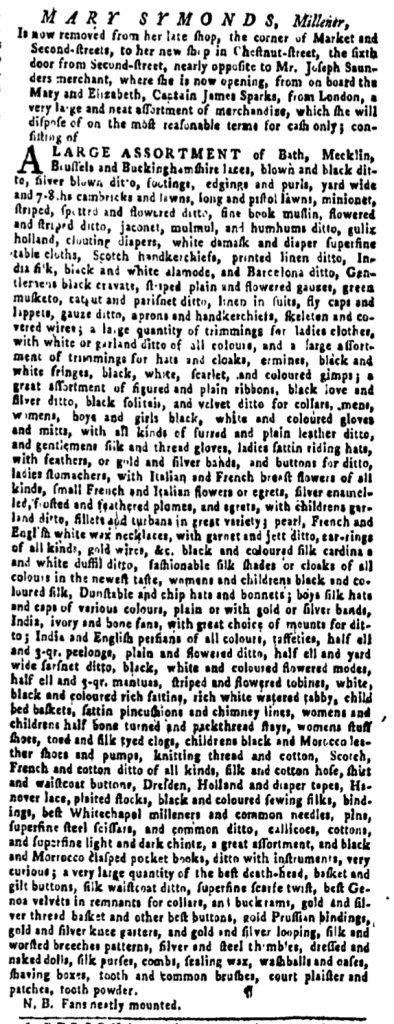
“Now selling at prime coast, at the house of the late Mrs. MARY SYMONDS, deceased.”

In June 1773, James Reynolds, the executor of the estate, ran a newspaper notice concerning the sale of a “LARGE and general assortment of MILLINERY and other GOODS” at “the house of the late Mrs. MARY SYMONDS, deceased,” in Philadelphia.  While many female shopkeepers, milliners, seamstresses, and other entrepreneurs did not promote their businesses in the public prints in the eighteenth century, Symonds was an exception who regularly advertised her wares. Compared to the brief estate notice that listed about a dozen items and summarized the rest of her inventory as “a great variety of other genteel articles,” Symonds published extensive advertisements that rivaled in length those of her male competitors.  In March 1766 and May 1768, she inserted advertisements that each included an extensive catalog of her merchandise in the Pennsylvania Gazette.

Symonds did not limit her marketing efforts to newspaper notices.  She also distributed an engraved trade card, one of the finest known example of this format belonging to a woman who ran her own business in eighteenth-century America.  In Boston, Jane Eustis also provided her customers with engraved trade cards.  The only known copy of Symonds’s trade card survives among the Cadwalader Papers at the Historical Society of Pennsylvania because Symonds used the reverse to write a receipted bill for purchases made by Elizabeth Lloyd Cadwalader in October and November 1770.  Based on those manuscript additions, Symonds’s trade card has been dated to circa 1770.  The text so closely replicated her advertisements that appeared in the Pennsylvania Gazette in May 1768 (or perhaps the text of the newspaper advertisement closely replicated the trade card) that it seems almost certain that Symonds commissioned the trade card by the late 1760s and distributed it to customers for several years.  In so doing, she joined the ranks of other entrepreneurs, most of them men, who demonstrated the elegance and sophistication of their goods and services with marketing materials – engraved trade cards and billheads – that resembled those that commonly circulated in London, the cosmopolitan center of the empire.  The notice about the estate sale that her executor placed in the Pennsylvania Gazettedid not do justice to Symonds’s acumen as a marketer responsible for promoting her own business during her lifetime.

August 29

What was advertised in a colonial American newspaper 250 years ago today?

Pennsylvania Chronicle (August 29, 1772).

“FISHING TACKLE.”

In the summer of 1772, Edward Pole advertised a variety of items available at his ‘GROCERY STORE” on Second Street in Philadelphia.  He stocked everything from wines and spirits to “Green, Bohea, Hyson and Soushong Teas” to raisins and currants to “mustard by the bottle or pound.”  Pole declared that he would “make it his chief study to merit” repeat business from his customers “by keeping an assortment of the best kind of GROCERIES, and selling them on the lowest terms.”

Yet Pole stocked more than just groceries.  His advertisement in the August 29 edition of the Pennsylvania Chronicle included a headline and a section for “FISHING TACKLE” available at his store.  He carried “Fishing rods of various kinds, best Kerby and common hooks of all sizes, artificial flies, wheels, silk, hair and trolling lines of every kind, length, and goodness, deapseas, casting, minnow and scoop nets,” and other items.  He made a point of promoting “the best kind of fish-hooks, made by ROBERT CARTER, fish-hook maker, from Trenton.”

Over time, the appropriately-named Pole placed greater emphasis on marketing fishing supplies.  By 1781, he was placing advertisements for “Fishing Tackle Of all sorts, for Use of either SEA or RIVER, MADE AND SOLD By Edward Pole” in the Pennsylvania Packet.  A woodcut depicting a fish adorned those advertisements.  He commissioned another woodcut of a fish, this one with a decorative border, for his advertisement in the March 24, 1784, edition of the Freeman’s Journal.  At about the same time, he made an even greater investment in a trade card engraved by David Tew.  A vignette showed two gentlemen fishing, one with a rod and the other with a net.  The gentleman with the rod had a fish on the line, its head sticking out of the water, while the gentleman with the net attempted to scoop up the fish.  An ornate cartouche, complete with fishing lures dangling from it, served as border for the text of this advertisement.  The trade card announced that “Edward Pole FISHING-TACKLE-MAKER … es & Sells all kinds of the best Fishing Tackle for the use of either Sea or River.”  A nota bene advised, “Gentlemen going on parties, in the Fishing Way Compleatly fitted out on the shortest notice.”

The headline for “FISHING TACKLE” in Pole’s newspaper advertisements published in 1772 foreshadowed the more extensive marketing efforts he launched in the 1780s.  He further enhanced newspaper notices with visual images as he increasingly specialized in fishing supplies.  He also distributed an engraved trade card that featured images that rivaled any on the hundreds of trade cards distributed in London in the eighteenth century, making his business all the more memorable to the gentlemen he aimed to serve.

Edward Pole, Trade Card, engraved by David Tew (Philadelphia, 1780s). Courtesy Historical Society of Pennsylvania.

February 5

What was advertised in colonial America 250 years ago today?

Henry Knox, trade card, engraved by Nathaniel Hurd, Boston, ca. 1771-1774. Courtesy American Antiquarian Society.

“London Book Store.”

Earlier this week, the Adverts 250 Project featured an advertisement that bookseller Henry Knox placed in the Boston Evening-Post.  In addition to listing various genres of books available at the “LONDON BOOK-STORE, Opposite Williams’s Court, A little Southward of the Town-House in Cornhill,” the advertisement also informed readers that “A Catalogue … may be seen at said Store.”  Like many eighteenth-century entrepreneurs, Knox supplemented his newspaper advertisements with other marketing media.  He distributed at least three book catalogs in the early 1770s.  He also disseminated a trade card to capture the attention of prospective customers.

Measuring approximately four inches by five inches, the trade card gave Knox’s address, “London Book Store Cornhill, Boston” and announced that the bookseller “Makes & binds Waste Books, Journals Ledgers, and all other Sorts of Blank Books at the Shortest Notice.”  Knox offered those services in his newspaper advertisements as well, though he usually mentioned them at the end of his notice.  He reversed the order on his trade card, advising colonizers that he “ALSO Sells Books in all Languages, Arts, and Sciences, Stationary, &c. &c.”  Ending with “&c.” (a common abbreviation for et cetera) signaled that he stocked a variety of other writing supplies.  His newspaper advertisements mentioned “Quills, Sealing Wax, Wafers, very neat gilt and border’d Message Cards, [and] fine black Writing Ink.”

An ornate border surrounded the advertising copy on Knox’s trade card.  As a result, it resembled trade cards produced and distributed in London, but it bore the initials “NH.”  Nathaniel Hurd, an American artisan, did the engraving for Knox’s trade card and others.  For instance, he engraved a trade card that promoted “Sperma-ceti Candles Made by Joseph Palmer & Co. at Germantown Near Boston, & Sold at their Store in Boston New-England.”  He also engraved a trade card for Philip Godfrid Kast, an apothecary who “Hath Lately Imported from London, a Large Assortment of Drugs & Medicines.”  Hurd likely lent his skills to the production of other trade cards, contributing to a culture of advertising in early America that extended beyond newspaper notices.

June 6

What was advertised in a colonial American newspaper 250 years ago today?

Massachusetts Spy (June 6, 1771).

“The Estate of JANE EUSTIS, late of Boston, Shop-keeper.”

For several weeks in the spring of 1771 the Massachusetts Spy carried a notice requesting “all those persons who are indebted to the Estate of JANE EUSTIS, late of Boston, Shop-keeper, deceased, or that have any Demands on, or accounts open with the estate … settle such accounts with JOSEPH PEIRCE, merchant, in Boston.”  During her lifetime, Eustis ran advertisements in the public prints in order to promote her business, but that was not the only form of marketing that she deployed.  In the late 1760s, Eustis distributed an engraved trade card, known at the time as a shopkeeper’s bill, to supplement her newspaper advertising.

Jane Eustis’s Trade Card or Shopkeeper’s Bill, ca. 1769. Courtesy American Antiquarian Society.

Surrounded by a rococo border, the text resembled a newspaper advertisement.  It opened with a familiar phrase, “Imported from LONDON,” before naming Eustis, giving her location, and listing a variety of “English and India Goods,” primarily textiles, “Millinary & Haberdashery.”  A brief note assured prospective customers that Eustis sold her merchandise “All Cheap for Cash.”  Although a significant number of female entrepreneurs in Boston and other towns placed newspapers advertisements, relatively few disseminated trade cards, billheads, broadsides, or other forms of advertising in eighteenth-century America.  Eustis’s trade card is also notable for being the earliest known shopkeeper’s bill distributed by a woman.  The copy in the collections of the American Antiquarian Society features a receipted bill for lace, gloves, and textiles dated April 17, 1769, on the reverse.  Merchants and shopkeepers tended to use the same design for years, so Eustis may have commissioned her trade card well before 1769.

The design, especially the ornate border, testified to genteel tastes that resonated with many consumers.  Merchants, shopkeepers, and artisans in London and other English cities distributed similar trade cards throughout the eighteenth century.  Eustis, like other American entrepreneurs who commissioned trade cards, replicated a common style, positioning her marketing efforts within transatlantic networks of commerce and consumption.  In so doing, she enhanced her appeal asserting connections to London and current fashions in the largest and most cosmopolitan city in the empire.  Commissioning and distributing an engraved trade card that resembled those passed out in London suggested that even though Eustis operated a shop on the other side of the Atlantic neither she nor her merchandise could be dismissed as merely provincial.

Receipted Bill Dated April 17, 1769, on Reverse of Jane Eustis’s Trade Card. Courtesy American Antiquarian Society.

November 27

What was advertised in a colonial American newspaper 250 years ago today?

Essex Gazette (November 27, 1770).

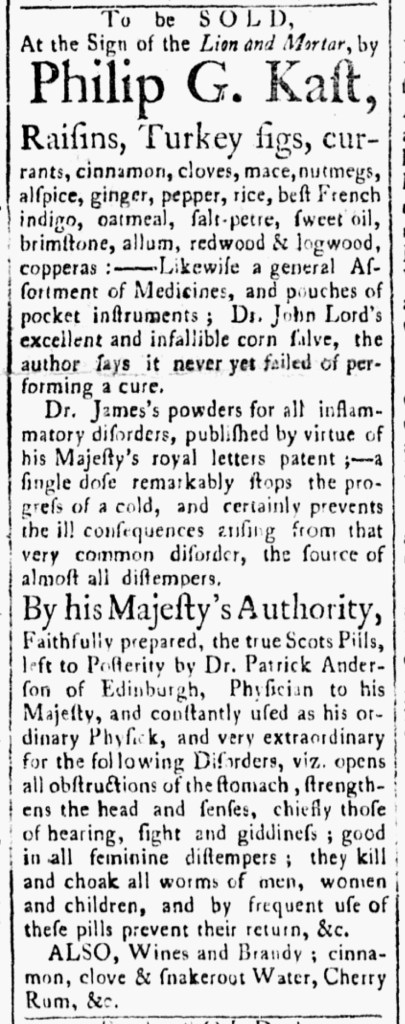
“At the Sign of the Lion and Mortar.”

In the fall of 1770, Philip Godfrid Kast, an apothecary, placed an advertisement in the Essex Gazette to inform potential customers that he carried “a general Assortment of Medicines” at his shop “At the Sign of the Lion and Mortar” in Salem, Massachusetts.  Purveyors of goods and services frequently included shop signs in their newspaper advertisements in the eighteenth century, usually naming the signs that marked their own location but sometimes providing directions in relation to nearby signs.  On occasion, they included woodcuts that depicted shop signs, but few went to the added expense.  Eighteenth-century newspaper advertisements provide an extensive catalog of shop signs that colonists encountered as they traversed city streets in early America, yet few of those signs survive today.

Kast did not incorporate an image of the Sign of the Lion and Mortar into his newspaper advertisements in the fall of 1770, but four years later he distributed a trade card with a striking image of an ornate column supporting a sign that depicted a lion working a mortar and pestle.  Even if the signpost was exaggerated, the image of the sign itself likely replicated the one that marked Kast’s shop.  Nathaniel Hurd’s copperplate engraving for the trade card captured more detail than would have been possible in a woodcut for a newspaper advertisement.  Absent the actual sign, the engraved image on Kast’s trade card provided the next best possible option in terms of preserving the Sign of the Lion and Mortar given the technologies available in the late eighteenth century.  Trade cards, however, were much more ephemeral than newspapers and the advertisements they contained.  That an image of the Sign of the Lion and Mortar survives today is due to a combination of luck, foresight (or accident) on the part of Kast or an eighteenth-century consumer who did not discard the trade card, and the efforts of generations of collectors, librarians, catalogers, conservators, and other public historians.  Compared to woodcuts depicting shop signs in newspaper advertisements, trade cards like those distributed by Kast even more accurately captured the elaborate details.  Those shop signs contributed to a rich visual landscape of marketing in early America.

Philip Godfrid Kast’s Trade Card, Engraved by Nathaniel Hurd, Boston, 1774 (American Antiquarian Society).

May 5

What was advertised in a colonial American newspaper 250 years ago today?

May 5 - 5:5:1768 Pennsylvania Gazette
Pennsylvania Gazette (May 5, 1768).

“A LARGE ASSORTMENT of Bath, Mecklin, Brussels and Buckinghamshire laces.”

Mary Symonds, a milliner, placed a short advertisement in the April 28, 1768, edition of the Pennsylvania Gazette to announce that she now stocked “A VERY large and neat Assortment of MERCHANDIZE” imported from London via the Mary and Elizabeth. The ship had just arrived in port, so Symonds had not yet had time to compose a complete list of her new inventory, but she promised more information about the “Particulars” in the next issue of the Gazette.

The following week Symonds’s lengthy advertisement did indeed appear, occupying a prominent place on the front page, making it difficult for readers to miss. Yet the Pennsylvania Gazette and other newspapers were not the only places where Symonds published this impressive assortment of millinery wares and other goods. Symonds was one of very few women who distributed trade cards in eighteenth-century America. With an elegant cartouche containing her name and location and a decorative border enclosing her list of merchandise, Symonds’s engraved trade card was unparalleled among any extant examples belonging to American women.

Careful comparison of her trade card and her advertisement in the Pennsylvania Gazette reveals that the former almost exactly paralleled the latter. All of the items appear in the same order, though sometimes the spelling and capitalization varied or descriptions changed slightly (such as “quantity of trimmings for ladies clothes” becoming “assortment of trimmings for ladies clothes”). Occasionally the trade card deployed the word “ditto” or its abbreviation, “Do,” rather than repeating words that appeared in the previous clause. A small number of items listed in the newspaper advertisement disappeared from the trade card, but no new items were listed. Symonds eliminated “Scotch handkerchiefs” (but listed many other varieties), “gentlemens silk and thread gloves” (but, again, listed other options), and “basket” buttons. The removal of basket buttons caused a slight revision in Symonds’s description of the variety of buttons she stocked: “a very large quantity of the best death-head, basket and gilt buttons” became “a large Quantity of the best Death-head and Gilt Buttons.” The trade cared even included the nota bene that appeared as its own line at the conclusion of the advertisement: “N.B. Fans neatly mounted.” For the most part, Symonds’s trade card replicated her newspaper advertisement.

This prompts reconsideration of when Symonds commissioned and began distributing her trade card to current and prospective customers. Previously it has been dated to circa 1770 because the only known copy, part of the Cadwalader Collection at the Historical Society of Pennsylvania, has a receipted bill on the reverse. That bill lists five occasions in October and November 1770 that “Mrs. Cadwalader” made a series of purchases from Symonds, who received payment in full on November 20, 1770. The similarities between the trade card and the newspaper advertisement, however, suggest that Symonds first distributed the trade card more than two years earlier.

That seems particularly appropriate since, regardless of the other content of her newspaper advertisements, Symonds regularly stressed that she was “now removed from her late shop, the corner of Market and Second-streets, to her new shop in Chestnut-street, the sixth door from Second-street.” This corresponds to the address listed on her trade card: “the South Side of Chesnut Street between Front and Second Streets, the Sixth Door from Second street.” Having recently moved to a new location, Symonds may have considered it particularly imperative to enhance her marketing efforts to direct existing and prospective clients to her new shop. The occasion of her move may have justified branching out to an additional form of advertising media. This also suggests that Symonds’s use of her trade card may have changed over time. She may have distributed beyond her shop when it was new and the contents accurately represented her current inventory, but over time she may have reserved the outdated remaining copies for use as receipted bills within her shop, presenting her best customers with a memento of their shopping experience.

Mar 23 - Mary Symonds Trade Card
Trade card (with receipted bill on reverse) distributed  by Mary Symonds in 1770 (Historical Society of Pennsylvania:  Cadwalader Collection, Series II: General John Cadwalader Papers, Box 5: Incoming Correspondence: Pa-Sy, Item 19: Su-Sy).

March 24

GUEST CURATOR:  Elizabeth Curley

What was advertised in a colonial newspaper 250 years ago today?

Mar 24 - 3:24:1766 Boston-Gazette
Boston-Gazette (March 24, 1766).

Elizabeth Clark placed this advertisement to sell an assortment of seeds. She got her supplies “per Capt. Freeman” from London. The timing makes perfect sense, because April showers bring May, June, July, and August crops. With it being late March the planting season was right upon colonists in Boston and the rest of Massachusetts.

Anyone who frequently visits the Adverts 250 Project might notice that this advertisement seems repetitive. To be honest I had to review my work from my first week as guest curator in February. The historical impact that woman of the past have on women of the present and future interests me greatly so I try to pick advertisements that feature primarily woman if I am able. On February 17, I featured an advertisement from Lydia Dyar, who also sold garden seeds and had gotten them from Captain Freeman. In his additional commentary Prof. Keyes also pointed out an advertisement from yet another woman, Susanna Renken, who both sold seeds and bought them from Captain Freeman. All three of these woman posted similar advertisements, for mostly the same product, and bought their goods from the same man.

Two of them seem to have had shops in the same vicinity: Mill Creek. Susanna Renken states that her shop is “near the Draw Bridge” and Elizabeth Clark advertised that she was located “near the Mill Bridge,” which was located on Mill Creek. This trade card helped further convince me that these two woman shops were near each other because William Breck had a shop “at the Golden Key near the draw-Bridge Boston.”

Mar 25 - William Breck Trade Card
William Breck’s trade card (Paul Revere, engraver, ca. 1768).  This trade card is part of the American Antiquarian Society’s Paul Revere Collection.
Mar 24 - Nathaniel Abraham - 2:20:1766 Massachusetts Gazette
Massachusetts Gazette (February 20, 1766).

Nathaniel Abraham, who also regularly advertised in the Boston newspapers, listed “Sign of the Golden Key, in Ann-street” as his location too.

This map shows that Ann Street intersected Mill Creek.  The drawbridge crossed Mill Creek.  Elizabeth Clark, Susanna Renken, William Breck, and Nathaniel Abraham had shops located near each other.

Mar 24 - Detail of Map
Detail of A Plan of the Town of Boston.

**********

Mar 24 - Map of Boston.jpg
A Plan of the Town of Boston with the Intrenchments &ca. of His Majesty’s Forces in 1775, from the Observations of Lieut. Page of His Majesty’s Corps of Engineers, and from Those of Other Gentlemen (1777?).  Library of Congress.

**********

ADDITIONAL COMMENTARY:  Carl Robert Keyes

I am impressed with the way that Elizabeth mobilizes several different primary sources –newspaper advertisements, trade cards, maps – in a preliminary attempt to reconstruct neighborhoods and marketplaces in Boston in the 1760s. This is work that historians and scholars in related fields have undertaken on a grander scale.

I appreciate that Elizabeth draws attention to an aspect of eighteenth-century advertisements that has not yet received much attention here: when examined systematically the locations listed in the advertisements help us to understand not only the geography of early American towns and cities but also relationships of various sorts.

More than two decades would pass before publication of the Boston Directory, the city’s first directory that listed the occupations and residences of its inhabitants, in 1789. That and subsequent city directories from Boston and other urban centers in early America have been invaluable to historians, but such sources do not exist for earlier periods.

Elizabeth has discovered on her own – and helps to demonstrate – that newspaper advertisements provide more information than just lists of goods or attempts to convince potential customers to make purchases. They include valuable information about where people worked and where they lived, details that fill in some of the blanks for an era before city directories.

January 11

What was advertised in a colonial newspaper 250 years ago this week?

Jan 11 - 1:10:1766 New-Hampshire Gazette
New-Hampshire Gazette (January 10, 1766)

“NATHANIEL BABB, Taylor, … informs his Customers and others, That he has removed from the Shop where he formerly Work’t to a new Shop.”

Who hasn’t heard a particular hackneyed phrase — “Location!  Location!  Location! — when contemplating buying a home or, especially, opening a business.  Nathaniel Babb understood that location was important:  he could not remain in business if former and potential customers did not know where to find him.  His advertisement offers few appeals to consumers (though he does indicate he was “ready with Fidelity and Dispatch”) in favor of instead making sure that they knew where to find him after his move to a new location.

Many shopkeepers and artisans used elaborate shop signs, such as the one seen below, to identify their places of business in eighteenth-century America (and England as well), but not everyone did so.  In an era before standardized street numbers, Babb offers convoluted directions:  his shop was “lately erected near the Corner of Clement Jackson’s, in the Street leading to the Canoe Bridge.”  Even if Babb had a sign to hang at his new shop, he still needed to direct customers to the general vicinity.

Philip Godfrid Kast Trade Card
Philip Godfrid Kast’s trade card engraved by Nathaniel Hurd in Boston in 1774 (American Antiquarian Society).

The druggist who issued this trade card included an image of his shop sign, an early form of branding that helped customers remember and locate his business.