April 13

What was advertised in a colonial American newspaper 250 years ago today?
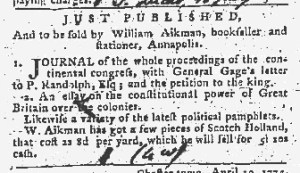
Maryland Gazette (April 13, 1775).

“JOURNAL of the whole proceedings of the continental congress.”

An advertisement by William Aikman, a bookseller and stationer in Annapolis, in the April 13, 1775, edition of the Maryland Gazette proclaimed, “JUST PUBLISHED, And to be sold … JOURNAL of the whole proceedings of the continental congress” and “An essay on the constitutional power of Great Britain over the colonies.”  While Aikman no doubt sold those items, they had not been “JUST PUBLISHED,” nor had he published them.

Readers understood that “JUST PUBLISHED” did not always mean that an item was hot off the presses; sometimes that phrase was a vestige of an advertisement originally composed and disseminated weeks or months earlier and printed once again without revisions.  Readers also understood that “JUST PUBLISHED, and to be sold by” did not necessarily mean that the retailer was also the publisher, merely that the retailer sold an item that had been published by someone, somewhere.  Keeping that in mind yields a better understanding of the production and dissemination of the items that Aikman advertised.

Although printers in many towns, including Anne Catharine Green and Son in Annapolis, produced and advertised local editions of the Extracts from the Votes and Proceedings of the American Continental Congress in the weeks after the First Continental Congress concluded its meetings in Philadelphia near the end of October 1774, only two printing offices published the complete Journal of the Proceedings of the Congress in the following months.  William Bradford and Thomas Bradford printed an edition in Philadelphia, as did Hugh Gaine in New York.  Aikman most likely stocked and advertised the Bradfords’ edition, especially considering that they also printed John Dickinson’s Essay on the Constitutional Power of Great-Britain over the Colonies in America in 1774.  Gaine did not publish a New York edition of that volume.

Aikman’s advertisement also stated that he carried “a variety of the latest political pamphlets,” but he did not list additional titles.  Perhaps he followed the lead of James Rivington in New York and tried to profit from selling pamphlets “on both sides, in the unhappy dispute with Great-Britain.”  As the imperial crisis reached its boiling point in April 1775, Aikman took to the pages of the Maryland Gazette to hawk two items published by the Bradfords in 1774 that became more timely and relevant as well as the “latest political pamphlets” that provided even more for colonizers to consider as they learned about and participated in current events.
June 30

What was advertised in a colonial American newspaper 250 years ago today?

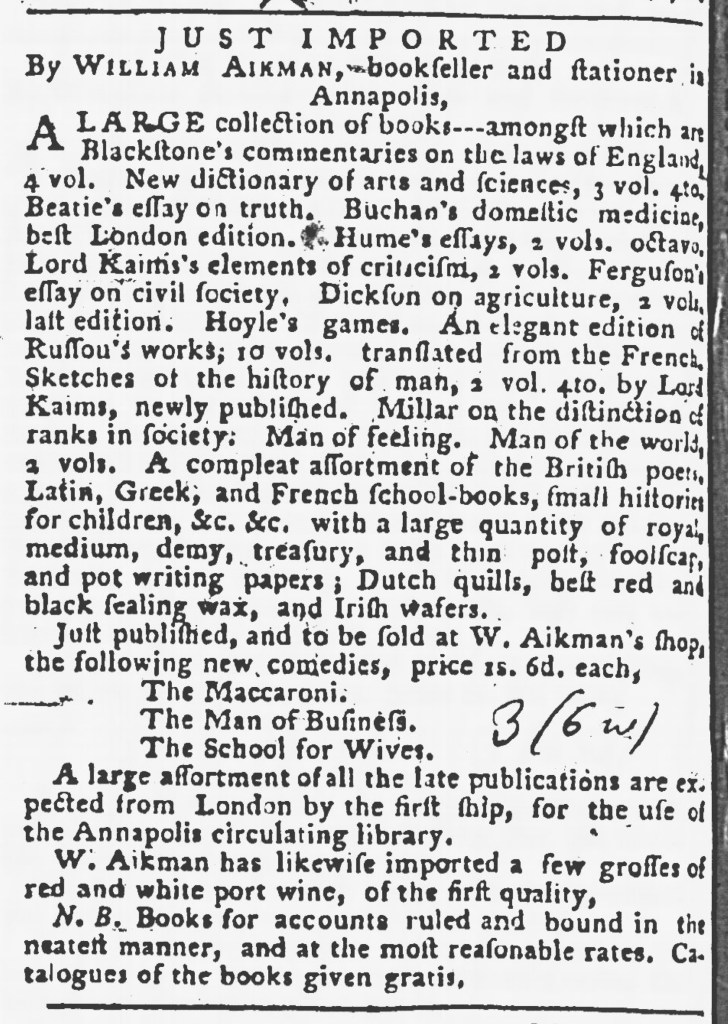
Maryland Gazette (June 30, 1774).

“Just published … the following new comedies.”

In the spring and summer of 1774, William Aikman, “bookseller and stationer in Annapolis,” advertised a “LARGE collection of books” in the Maryland Gazette.  He listed all sorts of titles, including “Blackstone’s commentaries on the laws of England” in four volumes, “Buchan’s domestic medicine, best London edition,” and “Russou’s works, … translated from the French.”  In addition, he stocked a variety of books from several genres, ranging from a “compleat assortment of the British poets” to “Latin, Greek, and French school-books” to “small histories for children.”  Aikman had something for every reader.

The bookseller also devoted a portion of his advertisement to three “new comedies” that sold for one shilling and six pence each.  These works, “Just published,” most likely were reprints that he acquired from John Dunlap in Philadelphia.  In 1774, Dunlap printed American editions of Robert Hitchcock’s The Macaroni: A Comedy, as It Is Performed at the Theatre Royal, George Coleman’s The Man of Business: A Comedy: As It is Acted at the Theatre-Royal in Covent-Garden, and Hugh Kelly’s The School for Wives: A Comedy: As It Is Performed at the Theatre-Royal in Drury Lane.  Perusing those works gave readers in the colonies, in Philadelphia or Annapolis or anywhere else that Dunlap distributed his reprinted editions, a taste of the theater scene in the cosmopolitan center of the empire.

In addition, Aikman announced that a “large assortment of all the late publications are expected from London by the first ship, for the use of the Annapolis circulating library.”  That was another venture that the enterprising bookseller and stationer oversaw.  A year earlier, he opened that library and advertised the subscription fees for joining for a month, a quarter, six months, or a year.  In the fall of 1773, he advertised that his Annapolis Circulating Library provided delivery service to Baltimore, both a convenience for members there and an attempt to undercut a competing library proposed by a competitor who did not manage to establish a library there.

Overall, Aikman’s advertisement revealed multiple trajectories for producing, distributing, and acquiring books on the eve of the American Revolution.  Booksellers received most of their inventory from English printers, though printers in the colonies published both American editions and original works.  Those printers worked with printers and booksellers in other towns to exchange, market, and sell books and pamphlets printed in the colonies.  For their part, readers could purchase books or join circulating libraries to increase their access to larger libraries than they could afford on their own.

November 6

What was advertised in a colonial American newspaper 250 years ago this week?

Maryland Journal (November 6, 1773).

“PROPOSALS FOR ESTABLISHING A CIRCULATING LIBRARY IN BALTIMORE-TOWN.”

When he opened a circulating library in Annapolis in 1773, bookseller and stationer William Aikman faced competition in his efforts to recruit subscribers in Baltimore.  Joseph Rathell announced his own intention for “ESTABLISHING A CIRCULATING LIBRARY IN BALTIMORE-TOWN” in the October 23 edition of the Maryland Journal.  A week later, he published a longer advertisement, one that offered the same amenities, lower fees, and greater convenience for patrons than Aikman outlined in his notices.

In his updated address to prospective subscribers, Rathell emphasized the fees for “this much wish’d for Institution,” just “one Dollar a Quarter … (tho’ the Subscription to the Annapolis Library is One Guinea per Annum, besides the Expence of a Dollar a Year for Carriage of Books from thence to this Place by Water).”  He expected readers to recognize the bargain for the quarterly fee, while simultaneously mocking Aikman’s most recent advertisement.  Aikman apparently learned of Rathell’s “PROPOSALS” and, wary of the threat to his own efforts to expand his clientele beyond Annapolis, devised a plan to address the concerns that prospective subscribers had expressed about the “trouble and risk they run of procuring and returning the books.”  In an advertisement in the October 30 edition of the Maryland Journal, the first issue after Rathell’s original advertisement, Aikman presented what he considered a reasonable solution, “any orders for books left with Mr. Christopher Johnston, merchant, in Baltimore, will be regularly forwarded by a packet that goes weekly between Baltimore and Annapolis.”  Subscribers could request and return books for just a dollar a year, an additional fee that Rathell derided.  Somehow, the bookseller in Baltimore became aware of Aikman’s proposal before it appeared in print in the Maryland Journal.  In the same issue that Aikman first introduced delivery service Rathell published a rejoinder on another page.  The advertisements ran next to each other in the November 6 edition, drawing even more attention to the bargain that Rathell offered.  How did he know about Aikman’s newest proposal before reading the advertisement in the newspaper?  The annual subscription fee previously appeared in notices in the Maryland Gazette, advertisements that Rathell could have seen, but the delivery service was a new aspect of Aikman’s library.  Did someone in the printing office pass along that information?

Rathell sought to cater to “the Convenience of Gentlemen and Ladies of Literary Taste and Discernment” in Baltimore and surrounding towns, but he was not quite ready to launch his own circulating library.  His advertisement undercutting Aikman also served as an invitation to prospective subscribers to submit their names within three weeks of his advertisement’s first appearance in the Maryland Journal.  At that time, “if an adequate Number of Subscribers appear, the Library will be completed and opened without Delay.”  Rathell encouraged subscribers “to be speedy in entering their Names … that he may be the sooner enable to provide a COLLECTION OF BOOKS … very considerable in Number.”  He likely also intended that such haste would prompt prospective subscribers to choose between his library and Aikman’s library in Annapolis, boosting the prospects for his own by drawing subscribers away from a rival.  This ploy did not work, in part because prospective subscribers considered Aikman’s proposal the more viable option.  Rathell did not open a circulating library in Baltimore, despite the savvy appeals he made.  Other factors defeated his plan.  As Joseph Towne Wheeler explains, “the growing commercial town was still dependent upon the older community.”[1]  After all, the Maryland Journal, Baltimore’s first newspaper, commenced publication just a couple of months earlier.  “After the Revolution the situation was reversed,” Wheeler continues, noting that “when Parson Weems visited Annapolis in 1800, he could write, ‘There is not a book store in the whole town.’”[2]  Baltimore was not quite ready for the circulating library that Rathell envisioned.

**********

[1] Joseph Towne Wheeler, “Booksellers and Circulating Libraries in Colonial Maryland,” Maryland Historical Magazine 34, no. 2 (June 1939): 118.

[2] Wheeler, “Booksellers and Circulating Libraries,” 119.

October 30

What was advertised in a colonial American newspaper 250 years ago today?

Maryland Journal (October 30, 1773).

“Any orders for books … will be regularly forwarded by a packet that goes weekly between Baltimore and Annapolis.”

When William Aikman opened a circulating library in Annapolis in the summer of 1773, he hoped to gain subscribers in Baltimore and other towns.  Unlike modern public libraries open to all patrons, eighteenth-century circulating libraries lent books and other reading material only to subscribers who paid fees to access them.  To make the venture viable, Aikman needed to recruit as many subscribers as possible.  According to the advertisement he placed in the October 30 edition of the Maryland Journal, the newspaper only recently established in Baltimore, Aikman stated that he had learned that a “number of the friends of literature” in that city expressed interest in subscribing to his library yet refrained solely due to the “trouble and risk they run of procuring and returning the books” at such a distance.  His library catalog revealed which books subscribers could borrow, but the logistics of checking them out and returning them to the library remained an obstacle.

Aikman proposed a solution to that problem.  He instructed that “any orders for books left with Mr. Christopher Johnston,” a merchant in Baltimore, “will be regularly forwarded by a packet that goes weekly between Baltimore and Annapolis.”  Aikman charged an additional fee for this service, a dollar a year.  He also advised that it would go into effect “provided a proper number of subscribers can be got.”  In other words, prospective subscribers needed to consider not only the benefits that would accrue to them but also their duty to make the library more accessible to the “friends of literature” in their town.  Aikman promised “above two hundred volumes of all the new publications of merit” that subscribers could borrow rather than buy.

The bookseller and stationer in Annapolis may not have been aware that he faced a competitor.  Elsewhere in the October 30 edition of the Maryland Journal, Joseph Rathell published “PROPOSALS FOR ESTABLISHING A CIRCULATING LIBRARY IN BALTIMORE-TOWN,” offering residents a local alternative to the library in Annapolis.  The Adverts 250 Project will examine that advertisement, including Rathell’s dismissive reference to Aikman’s fees for delivering books to Baltimore, in another entry.

July 15

What was advertised in a colonial American newspaper 250 years ago today?

Maryland Gazette (July 15, 1773).

“Catalogues both of the library and the books he has for sale to be had at his shop.”

On July 15, 1773, William Aikman once again took to the pages of the Maryland Gazette to promote the circulating library that the bookseller and stationer recently opened in Annapolis.  He inserted the same advertisement that appeared in the previous issue, seeking subscribers for the library and hawking books, stationery, and writing supplies.  In addition to deploying the newspaper notice, Aikman used other forms of advertising.

For instance, he concluded his notice with a nota bene that advised, “Catalogues both of the library and the books he has for sale to be had at his shop.”  According to Robert Winans in A Descriptive Checklist of Book Catalogues Separately Printed in America, 1639-1800, the Maryland Historical Society has the only known copy of a book catalog that may have been the one that Aikman mentioned in his newspaper advertisement.  It contains “854 consecutively numbered medium and full author and title entries, arranged alphabetically,” falling short of the “1200 volumes” that Aikman tallied in his newspaper advertisement.  However, that sole copy lacks a title page and other evidence suggests that additional pages may have been lost as well.

Trade Card for William Aikman’s Circulating Library (Annapolis, 1773). Courtesy American Antiquarian Society.

In addition to publishing at least one book catalog, Aikman also distributed an item that may have served as a trade card, a bookplate, or membership card.  The copperplate engraving features an ornate border that encloses the words “W. AIKMAN’S Circulating Library” in the upper portion of the cartouche and an advertisement for his book and stationery shop in the lower portion: “All kinds of Books, Letter Cases, Message Cards, Gilt &Plain Paper, Wax, &c. Sold at his Shop, Annapolis, at the British Prices, for Cash Only.  Paper rul’d, Books bound in the neatest manner.”  The final portion of that advertisement echoed the services that Aikman listed in his newspaper advertisement.  Images of a globe and a pen and inkpot resting on two books outside the border testified to both the world of knowledge and the products available at Aikman’s circulating library and bookshop.  The upper portion of the cartouche also included “No” with space to write in a number.  The number “474” appears in manuscript on the copy in the collections of the American Antiquarian Society.  That number may have been associated with a book in the numbered catalog or a subscriber to the circulating library, depending on whether Aikman used the engraved card as a bookplate or a membership card.

Aikman’s marketing efforts extended beyond newspaper advertisements.  He also distributed book catalogs and engraved cards to draw attention to his bookshop and circulating library, joining other entrepreneurs who diversified the kinds of advertisements that circulated in the colonies during the era of the American Revolution.

July 11

What was advertised in a colonial American newspaper 250 years ago this week?

Maryland Gazette (July 8, 1773).

“The library will be of real utility to the publick.”

In the summer of 1773, William Aikman, a bookseller and stationer, opened a circulating library in Annapolis.   Like other libraries founded in eighteenth-century America, Aikman’s new venture was a subscription library that required users to pay fees to borrow books.  The bookseller accumulated and lent “12 hundred volumes on the most useful sciences, history, poetry, agriculture, voyages, travels, miscellanies, plays, with all the most approved of novels, magazines and other books of entertainment,” but library patrons had to pay for borrowing privileges.

Aikman provided an overview of those fees, a sliding scale that gave greater bargains to patrons who subscribed for longer periods. The nominal difference in the fees for six months compared to a year seemed designed for Aikman to attract yearly subscribers that he could then promote to prospective subscribers.  Just as newspaper printers boasted about their extensive circulation in their efforts to entice new subscribers and, especially, advertisers, the bookseller likely realized that some colonizers would subscribe to his library for an entire year when they learned how many others had already done so.  The perceived popularity of this service had the potential to spawn even more demand.  Aikman’s pricing structure encouraged patrons to subscribe for longer periods, enhancing the appearance of the popularity of the new venture.

  • 5 shillings per month
  • 12 shillings per quarter
    • saving 3 shillings or 20% compared to the monthly rate
  • 20 shillings for six months
    • saving 4 shillings or 17% compared to the quarterly rate
    • saving 10 shillings or 33% compared to the monthly rate
  • 1 guinea (or 21 shillings) per year
    • saving 19 shillings or 48% compared to the semiannual rate
    • saving 27 shillings or 56% compared to the quarterly rate
    • saving 39 shillings or 65% compared to the monthly rate

The bookseller also offered a nightly rate, three pence, for patrons who desired access to the library but did not wish to pay for an entire month or longer.  Depending on the patron’s perspective, the nightly rate was either a bargain or exorbitant.  It granted entry to those who might not have been able to commit to the monthly, quarterly, semiannual, or annual rates, but at a much higher cost per night.

Whether patrons opted to check out books by the night or purchase subscriptions to borrow two books at a time for a year, Aikman considered his new circulating library an important service “of real utility to the publick.”  He requested “encouragement from the friends of literature” to make it a successful venture that met the needs of the community as well as generating revenues for the proprietor.