March 4

GUEST CURATOR:  Trevor Delp

What was advertised in a colonial newspaper 250 years ago this week?

Mar 4 - 3:3:1766 New-York Mercury
New-York Mercury (March 3, 1766).

“Making or mending any Kind of Diamond or enameled Work.”

Charles Oliver Bruff’s advertisement offers a wide variety of popular jewelry to be made and mended. Jewelry made between 1714 and 1847 comes from the Georgian Era. It is important to note that jewelry was not made the same way it is today. According to the International Gem Society, the process was far more labor-intensive. Gold and metal ingots needed to be rolled into thin sheets before they could be formed into the popular styles of the time.

Bruff chose to market a variety of popular merchandise, but one that is specifically interesting is pinchbeck buckles. Pinchbeck was a material commonly used that looks like gold but is much more affordable. Oliver’s choice to advertise this along with more expensive jewelry is interesting because it shows that he was trying to appeal to people of many different economic backgrounds. Jewelry was primarily a luxury of the elite society, but Oliver’s advertisement alludes to the inclusion of customers from other economic statuses.

**********

ADDITIONAL COMMENTARY:  Carl Robert Keyes

Of all the possible items in Bruff’s advertisement that Trevor chose to investigate, he selected pinchbeck buckles. That, in turn, led me to a fascinating discovery when I clicked the hyperlink to a dictionary definition of “pinchbeck” that he included to accompany his commentary for today. The first entry refers explicitly to “the Jewellery Way” (as Bruff put it): “an alloy of copper and zinc used especially to imitate gold in jewelry.”

A second entry, however, indicates that “pinchbeck” could also mean “something counterfeit or spurious.” It seems unlikely that Bruff intended to suggest that his buckles should be considered inferior in any way, but colonial consumers would have known that pinchbeck buckles were made of something other than gold (especially since Bruff promised to sell them “cheap by the dozen”).

A variety of scholars – including those who study consumer culture, material culture, manners, and reputation – have argued that assessing the dress and comportment of others became a cultural preoccupation in the eighteenth century. Especially as greater numbers of people of diverse statuses possessed an increasing array of goods as the consumer revolution progressed, colonists attempted to distinguish the truly genteel from those who merely simulated gentility. Colonists carefully observed each other to see if inner character matched an individual’s outward appearance.

In that context, pinchbeck buckles potentially presented a bit of a conundrum. What did it say about someone who wore accoutrements that looked like gold all while knowing that the appearance of the more costly metal misrepresented the true nature of the alloy that was actually used? Could that be interpreted as a reflection on one’s own character? Social mobility was fraught with such dilemmas in the eighteenth century.
March 3

GUEST CURATOR:  Trevor Delp

What was advertised in a colonial newspaper 250 years ago today?

Mar 3 - 3:3:1766 Boston Evening-Post
Boston Evening Post (March 3, 1766).

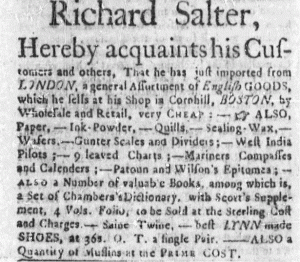
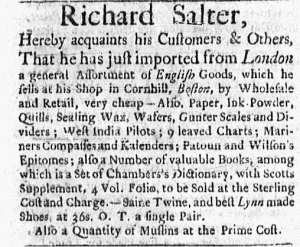
“West India Pilots; 9 leaved Charts; Mariners Compasses and Kalenders.”

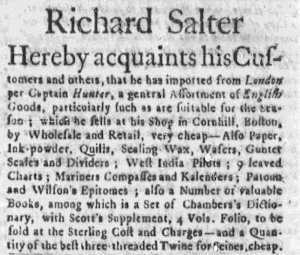
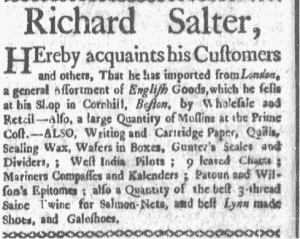
Richard Salter’s advertisement in the Supplement to the Boston-Gazette gives a look into what was being sold in Boston during 1766. The goods advertised were “just imported from London” and to be sold at Salter’s shop in Boston “by Wholesale and Retail.” There was a great variety of goods being sold, from books to maritime instruments and even shoes.

Many of the items listed show the development of Boston’s economy and its successful port. One specific item in Salter’s advertisement I find interesting is the “West India Pilots.” This was a book published by Joseph Smith Speer an English mariner who spent many years in Central America and the Caribbean. The book contained thirteen maps and detailed instructions on how to navigate between Caribbean ports. A book like this would have been invaluable to merchants interested in trading in the Caribbean.

Items being sold this one, as well as paper, quills, and “Chambers Dictionary, with Scotts Supplement,” all allude to the growing literacy rate in Boston. An article published by Colonial Williamsburg explains how cities like Boston, by the end of the eighteenth century were approaching one hundred percent literacy rates. Advertisements like Salter’s helped push the colonies into the educational boom that transpired in the late eighteenth century and early nineteenth century.

**********

ADDITIONAL COMMENTARY:  Carl Robert Keyes

Mar 3 - 3:3:1766 Boston-Gazette Supplement
Supplement to the Boston-Gazette (March 3, 1766).

Richard Salter wanted to make sure that potential customers in Boston and its hinterland saw his advertisement. While many advertisers were content with publishing their notices in just one of the four newspapers printed in Boston in 1766, Salter arranged to have his advertisement inserted in three of them, presumably at some cost. In addition to the advertisement Trevor chose from the Monday, March 3, 1766 issue of the Boston Evening-Post, a similar advertisement appeared in the Supplement to the Boston-Gazette on the same day. In addition, a nearly identical advertisement was also featured the previous Friday in the February 27 issue of the Supplement to the Massachusetts Gazette.

Mar 3 - 2:27:1766 Massachusetts Gazette Supplement
Supplement to the Massachusetts Gazette (February 27, 1766).

Only the Boston Post-Boy, also published on Mondays, neglected to print an advertisement from Salter during that week. Perhaps Salter could not afford to pay to advertise in yet another newspaper. Or, perhaps he figured that placing his advertisement in two of the three newspapers published on Monday gave him sufficient coverage of the market at the beginning of the week.

I am often asked if advertising actually worked in eighteenth-century America. Unfortunately, that is an extremely difficult question to answer. Early American consumers did not leave behind documents in which they explicitly stated that they did (or did not) make purchases based on advertising. Those who placed advertisements were more likely to comment that they believed in the effectiveness of their methods.

Dec 8 - 12:6:1765 Massachusetts Gazette
Massachusetts Gazette (December 6, 1765).

Salter’s multiple advertisements could be interpreted several ways. He may have placed them because they were indeed effective. Alternately, he may have placed so many of them out of sheer desperation, a last resort to move his merchandise out the door. I featured a nearly identical advertisement by Salter last December when this project existed exclusively on Twitter. Would Salter have placed this advertisement three months later (and in three newspapers!) if he did not believe it would garner new business? Although I believe that advertising incited consumer demand in the eighteenth century, examples like this one force me to consider the possible limits of marketing during the period.

March 2

GUEST CURATOR:  Trevor Delp

What was advertised in a colonial newspaper 250 years ago this week?

Mar 2 - 2:28:1766 New-Hampshire Gazette
New-Hampshire Gazette (February 28, 1766).

“AS many Persons Licenced to sell Spirituous LIQUORS … have neglected to render their Accounts of Sale of such Liquors.”

During the eighteenth century in North America the production and distribution of rum was becoming increasingly popular. In 1733, Great Britain enacted the Molasses Act as apart of the Navigation Acts. The Molasses Act imposed a tax on molasses, sugar, and rum imported to the colonies. This act was largely ignored by the colonists and loosely enforced by the British. Several years later it was replaced by the Sugar Act of 1764. This act was designed to impose taxes at half of the rate that the Molasses Act did, but be strictly enforced. Many of these acts were put into place to rescue Britain from the enormous debt it had allotted during the Seven Years War, although the colonists did not respond well to Britain’s acts. Many of the colonists felt that they were not responsible for the debt Britain had acquired over the Seven Years War and were reluctant to give in.

In addition, colonists were used to taxing themselves, such as through the local excise tax George Jaffrey mentions in this advertisement threatening prosecution against colonists who had been cheating the taxes. Advertisements like the one here are interesting because they were a broad way for officials to address the public without physical confrontation that could result in further uproar and unrest. As the local receiver of the colony’s excise taxes, Jaffrey made it known to colonists that they were no longer to break the law and go unnoticed and that they must now reconcile their actions or face prosecution.  He took this action at the same time Parliament cracked down on colonists with the Sugar Act.

**********

ADDITIONAL COMMENTARY:  Carl Robert Keyes

NH Gaz 2:28:1766 Notice from Printers
New-Hampshire Gazette (February 28, 1766).

Colonists were indeed accustomed to raising revenues through taxes they assessed internally via their colonial legislatures, which helps to explain why they bristled so much when Parliament stepped in and attempted to enact and better enforce new methods of raising revenues through collecting taxes throughout the empire.

Edward J. Perkins compiled a list of the “Types of Domestic Taxes, 1763-1775” enacted locally by colonial assemblies in the period between the Seven Years War and the Revolution.[1] Examining the many kinds of taxes colonists already paid (or were expected to pay but often avoided, as Jaffrey’s notice indicated) offers additional context for understanding why they reacted so vehemently to Parliament’s new efforts to tax and regulate the colonial economy in the 1760s and 1770s.

  • Land – unimproved: Rhode Island, Pennsylvania
  • Land – assed value: Massachusetts, Rhode Island, Connecticut, Pennsylvania, New Jersey
  • Land – per acre: Virginia, Maryland, South Carolina, Georgia
  • Other property – assessed: Massachusetts, New Jersey, South Carolina
  • Excise – liquor, etc. – New Hampshire, New York, Maryland, Virginia, North Carolina
  • Merchant profits – Massachusetts, New Hampshire, Pennsylvania, Connecticut, Rhode Island, South Carolina
  • Import – finished goods: Pennsylvania, New York, Georgia
  • Import – slaves: New York, Maryland, South Carolina
  • Export – tobacco: Maryland, Virginia
  • Poll – flat: Maryland, Virginia, North Carolina
  • Poll – linked to wealth: Connecticut, Massachusetts, Rhode Island
  • Poll – discriminatory toward free blacks: South Carolina, Georgia

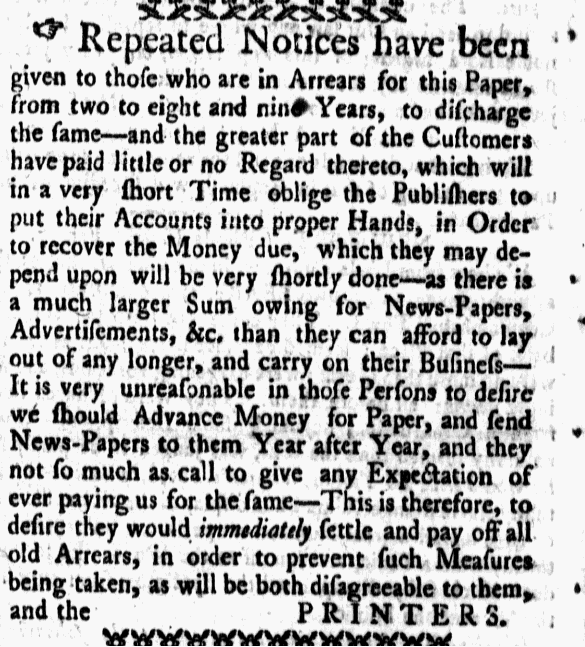
The advertisements in this particular issue of the New-Hampshire Gazette indicate that “Persons Licenced to sell Spirituous LIQUORS” were not the only people who neglected to settle up their accounts. The printers inserted this notice, stating that “there is a much larger Sum owing for News-Papers, Advertisement, &c., than they can afford to lay out any longer.” They called on debtors to “immediately settle and pay off old Arrears” and, not unlike Jaffrey, the printers threatened “such Measures being taken, as will be … disagreeable” to those who did not pay.

**********

[1] Edward J. Perkins, The Economy of Colonial America, 2nd ed. (New York: Columbia University Press, 1988), 191.

March 1

GUEST CURATOR:  Trevor Delp

What was advertised in a colonial newspaper 250 years ago this week?

Mar 1 - 2:28:1766 New-Hampshire Gazette
New-Hampshire Gazette (February 28, 1766).

“Will give Cash for Forty HEIFERS or young COWS.”

Jonathan Moulton’s advertisement in the New-Hampshire Gazette gives insight into a society where bartering was accepted in lieu of cash or credit at times. Although Moulton’s advertisement does state he will give cash payment in exchange for cows, he initially asks for “ABOUT Eighty Tons of good Salt and English HAY, for Boards or Staves.” The decision to offer a trade in replacement of cash allowed Moulton to target a wide range of people that may not have had consistent access to cash.

In order to be successful in the colonies, entrepreneurs needed to be flexible and work with their fellow colonists in the developing economy. Moulton’s decision to accept boards or staves instead of cash and then later to pay cash for young cows likely made his advertisement applicable and appealing to more people.

The second half of Moulton’s advertisement is directed towards people with livestock, giving him a targeted audience, one that did not always have large sums of cash readily available. The opportunity for people to choose either to trade or to use local currency was appealing to many colonists.

**********

ADDITIONAL COMMENTARY:  Carl Robert Keyes

In the wake of Currency Acts passed by Parliament in 1751 and 1764, colonists feared “the likelihood of a diminished supply of local currency and a return to a heavier reliance on the more burdensome, less flexible alternatives: barter, commodity money (e.g., tobacco or sugar), and foreign gold or silver coin.”[1] Trevor has chosen an advertisement that suggests how some colonists incorporated both currency and barter into their business practices, resorting to one or the other depending on the circumstances. Given the relatively short supply of currency, Moulton’s offer to pay cash for heifers and young cows may indeed have been all the more attractive to colonists looking to sell some of their livestock.

2:7:1766 New-Hampshire Gazette
New-Hampshire Gazette (February 7, 1766).

Does this advertisement sound familiar? It should, even if it does not visually look familiar, because a portion of it was previously featured on the Adverts 250 Project. This advertisement was printed in two separate pieces in the February 7, 1766, issue of the New-Hampshire Gazette. The first half appeared at the bottom of the first page, running across both columns. The second half appeared at the bottom of the final page, also running across both columns.

Mar 1 - New-Hampshire Gazette 2:7:1766
New-Hampshire Gazette (February 7, 1766).

When Trevor and I discussed the advertisements he wished to feature this week, I approved this one because, technically, it is a different advertisement than the previous one. It includes new material and the type for the entire advertisement was reset for this variant. Besides, as I have previously explained, our methodology (requiring us to consult the most recently published newspaper in the colonies) disproportionately privileges the New-Hampshire Gazette. The paucity of advertisements for consumer goods and services in that publication, compared to others from the period, can be frustrating. The guest curators and I have learned to make do with the slim pickings in the New-Hampshire Gazette.

Why did the printer reset the type and combine two advertisements into one? Friday’s extended commentary will explain how I solved that mystery when I examined the original copies at the American Antiquarian Society.

**********

[1] John J, McCusker and Russell L. Menard, The Economy of British America, 1607-1789 (Chapel Hill: University of North Carolina Press for the Institute of Early American History and Culture, 1985), 337.

February 29

GUEST CURATOR:  Trevor Delp

What was advertised in a colonial newspaper 250 years ago this week?

Feb 29 - 2:28:1766 New-Hampshire Gazette
New-Hampshire Gazette (February 28, 1766).

Just Imported from LONDON … A fine assortment of Bedding suitable for the Season.”

Joseph Bass’s advertisement in the New-Hampshire Gazette is intriguing because of the diversity of goods he was selling. The advertisement suggests that he was trying to target as many different audiences as possible, while spending the least amount of money. In the world of advertising this is a very basic concept but one that can prove difficult. During this time, businesses operated on a face-to-face level of interaction that has been lost in todays culture. People chose who they bought their goods from based on the foundation of who they trusted and supported.

I also find it interesting that some of the goods advertised were seasonal. The first thing advertised was “A fine assortment of Bedding suitable for the season.” Seasons in New Hampshire are very different than those of England, especially during the end of winter to the beginning of spring. The “Bedding suitable for the season” then exemplifies the demand of the colonial market in comparison to England’s market.

**********

ADDITIONAL COMMENTARY:  Carl Robert Keyes

Many scholars of consumer culture in eighteenth-century America have demonstrated that colonists demonstrated their connections to the larger British Empire by purchasing and using the same goods as their cousins in London and the English provinces. In “Baubles of Britain,” T.H. Breen demonstrated a rapid expansion of consumer choice in colonial America, accompanied by increasing standardization of consumer behavior and Anglicization of the consumer market.[1]

Some English observers, upon visiting the colonies, commented on how quickly fashions en vogue in London could be seen in British mainland North America. Residents of Boston, New York, Philadelphia, Charleston, and smaller towns like Portsmouth, New Hampshire, may have resided in some of the empire’s distant outposts, but that did not mean that they lacked taste. Perhaps because they were so far from the metropole they desired to demonstrate that they did not lack sophistication. Consumer culture gave them a means for doing so.

Trevor’s commentary challenges us to update, but not overturn, the narrative of Anglicization of American markets by reminding us that consumers (and advertisers!) often contended with very local concerns, including the changing of the seasons. Some of the goods included in Bass’s advertisement adhered to the current fashions in London, but that did not deprive colonists of the ability to make decisions independently of consumers on the other side of the Atlantic.

Jan 25 - 1:24:1766 New-Hampshire Gazette
New-Hampshire Gazette (January 24, 1766).

Today’s advertisement may look familiar. A variant was previously featured five weeks ago, at which time I commented on the layout. I found the layout awkward as a result of the pilcrows forming a line to divide the columns. The graphic design has been improved for this advertisement, which features many of the same goods.

The entire first column of today’s advertisement was listed in the earlier one. This one inserts “black walnut and mahogony fram’d looking Glasses ; brass Nails ; choice cannon powder ; Shot ; black Pepper by the doz. or smaller quantity” before returning to the list included in the earlier version. The nota bene running across the bottom is new as well.

This and similar examples undercut claims that goods had been “Just Imported from LONDON.” Savvy consumers, especially those who paid attention to the shipping news elsewhere in newspapers, likely calibrated how much they weight they wished to give such appeals, just as modern consumers assess the advertising that assails them.

**********

[1] T.H. Breen, “‘Baubles of Britain’: The American and Consumer Revolutions of the Eighteenth Century,” Past and Present 119 (May 1988): 73-104.

February 28

GUEST CURATOR:  Trevor Delp

What was advertised in a colonial newspaper 250 years ago today?

Feb 28 - 2:28:1766 New-Hampshire Gazette
New-Hampshire Gazette (February 28, 1766).

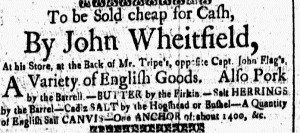
“Pork by the Barrell. – BUTTER by the Firkin. … English Sail CANVIS – One ANCHOR.”

This advertisement offers insight into the economy of New Hampshire during the late 1700s. Although many of the goods listed were common during this time period, the diversity and quantity of the goods is what I found interesting. Many of the goods were preserved foods being sold in large quantities, suggesting they were expected to last long durations of time. In the New Hampshire area during this time, the port of Portsmouth was thriving, leading me believe these goods were being marketed towards sailors.

Furthermore, after the advertisements for different foods there are two advertisements, one for English sail canvases and another for an anchor. These final two products further support the idea that this advertisement is being marketed towards sailors. When comparing the two different groups of goods being sold they seem out place, but when taking into account the variety of goods and the time period, it is suggestive that the advertisement was meant primarily for supplying ships and the sailors on them.

**********

ADDITIONAL COMMENTARY:  Carl Robert Keyes

The New-Hampshire Gazette was printed by Daniel Fowle, the newspaper’s founder (1756), and his nephew, Robert Fowle (admitted to a share in the management in 1764), in Portsmouth. As Trevor notes, this was a maritime community. Advertisers wished to attract a variety of customers, including sailors, captains of vessels, and merchants and quartermasters responsible for outfitting ships headed to sea. In this advertisement, John Wheitfield highlighted goods that would have been of particular interest to seafarers.

That being said, I suspect that he intended to address multiple audiences with this advertisement. While the goods he specifically enumerated would have been of interest to sailors, he first mentioned “A Variety of English Goods” that he did not describe in detail. Perhaps he could not afford or did not wish to purchase the space for a lengthier advertisement to list some of those wares. Perhaps he hoped to draw in customers curious about what that “Variety” might include and intentionally avoided listing specific goods. Whatever his reasoning, his advertisement suggests that his store did not cater to one clientele exclusively. He highlighted merchandise for crews of sailing vessels, but also indicated that he stocked assorted other wares for other members of the Portsmouth community.

Welcome, Guest Curator Trevor Delp

Trevor Delp is a sophomore and History major at Assumption College in Worcester, Massachusetts. His favorite historical topics include Latin American history and Revolutionary American history. Outside of studying history, Trevor is interested in literature and film and cooking. He will be guest curating from Sunday, February 28 through Saturday, March 5.

Welcome, Trevor Delp!