June 8

Who was the subject of an advertisement in a colonial newspaper 250 years ago this week?

Jun 8 - 6:6:1766 Virginia Gazette
Virginia Gazette (June 8, 1766).

“RUN away … some time in October 1762, a Mulatto woman named VIOLET.”

Violet made her escape almost four years earlier, but Philip Kearny was still actively pursuing her in June 1766.

This advertisement demonstrates the efforts enslaved men and women put into making their escapes as well as how vigorously their masters worked to return them to bondage. From hundreds of miles away, Kearny used this advertisement to tell quite a story about Violet. She was born, or so Kearny claimed, in “Princetown” (now Princeton), New Jersey, but in her mid twenties she ran away. She made it to “Frederick town” (now Frederick), Maryland, before being captured and “committed to the gaol.” She managed to escape, which didn’t seem to surprise Kearny, since he described her as “cunning and artful.” He suspected that she was in Maryland, Virginia, or North Carolina, hence his advertisement in the Virginia Gazette.

Even before she ran away, Violet did not recognize Kearny as her master. According to the slaveholder, Violet “pretends to be a free woman,” but his narrative indicates that the story was more complex. She disputed that she was a “slave for life,” suggesting that perhaps she had engaged in some sort of indenture or other contract and then been forced into slavery. The details were murky (and Violet would have given a different account of events than the slaveholder), but Kearney reiterated that “she was born a slave.”

Advertisements for runaway slaves have sometimes been called the first slave narratives. Although Violet did not write this advertisement, it is possible to recognize her resistance and recover some of her story by reading against the narrative presented by Kearny.

June 7

What was advertised in a colonial newspaper 250 years ago this week?

Jun 7 - 6:6:1766 Virginia Gazette
Virginia Gazette (June 6, 1766).

“Whoever secures my servants and Negro … shall, besides the reward allowed by law, be paid any reasonable satisfaction.”

John Mercer turned to the Virginia Gazette to advertise more than just beer, porter, and ale. His lengthy advertisement for the “MARLBOROUGH BREWERY” appeared on the opposite side of the page as this notice concerning a slave and two indentured servants who ran away from the brewer. John Mercer had a hard time holding on to his help!

That may tell us something about what kind of master Mercer was, but he used this advertisement to shape the narrative. What else could be expected of Temple, the slave? After all, he “carries the marks of the discipline he underwent” while on a ship in the West Indies. It was plain for anybody to see (especially from the scars Neptune bore on his body), Mercer suggested, that the slave had a history of challenging authority, not following instructions, and stepping out of his appropriate place.

The two indentured servants, Joseph Wain and William Cantrell, were equally troublesome, according to Mercer. A single glance could reveal that Wain was trouble, considering the way that he “stoops pretty much in his walk” and “has a down look.” Cantrell apparently had a habit of misrepresenting his skills: “he pretend[s] to understand ploughing and country business.” (Advertisers regularly denigrated runaway slaves and servants by accusing them of not possessing the skills they claimed.) Mercer suspected his servants had conspired with others that went missing at the same time. Furthermore, several horses disappeared around that time. In addition to being runaways, Wain and Cantrell were likely thieves, at least according to Mercer.

All three men – Temple, Joseph Wain, and William Cantrell – sought their own freedom when they ran away from their master. Mercer’s exasperation concerning Wain and Cantrell may have been justified considering that they served only half a year of their indentures, skipping out on a contract when they departed, but his frustration at Temple’s escape from more than three decades of slavery garners no sympathy at all.

June 1

What was advertised in a colonial newspaper 250 years ago this week?

Jun 1 - 5:30:1766 Virginia Gazette
Virginia Gazette (May 30, 1766).

“[… advertisement clipped from original copy …]”

The contents of today’s featured advertisement remain a mystery. At some point, an advertisement was cut out of the copy of the May 30, 1766, issue of the Virginia Gazette that was photographed and digitized for broader public and scholarly consumption. Similarly, an advertisement seemingly of the same length was cut out of the next two issues (June 9 and 13) as well. Perhaps it was the same advertisement.

Why was the advertisement cut out of the newspaper? When did it happen? Answering these questions would help to understand the reception of eighteenth-century advertising – how colonial readers responded to marketing – if indeed the advertisement had been excised by the original subscriber or another reader in 1766. Too many possibilities exist to even claim that the advertisement was removed by one of those readers.

It’s possible that the printer removed the advertisement for some reason. Notice the marks and numbers on the page. This copy may have been used for accounting and keeping track of how many times each advertisement appeared. While it may seem counterintuitive to suggest that the printer removed evidence that an advertisement had been published, it may have made sense for other reasons at the time.

The advertiser may have cut out the advertisement. A local shopkeeper may have submitted it to the other local newspaper for publication in its pages. A master attempting to recover a runaway slave or servant may have forwarded copies to newspapers in other cities in nearby colonies with instructions to reprint the same advertisement. If it was a legal notice, the advertiser may have clipped it to add to his or her records.

A consumer may have clipped the advertisement in order to bring it along when visiting a shopkeeper or merchant or artisan. A reader who suspected he or she could identify a runaway slave or servant may have cut it out and carried it in order to refer to the description of the runaway’s appearance and clothing.

Alternately, the advertisement may have been removed at a later time by a collector or by a descendant who recognized the name of a relative. It may have found a special place in a new context with other artifacts from the colonial period – or, upon being removed, it may have been discarded that much more easily rather than preserved like the rest of this issue of the Virginia Gazette.

Somebody noticed this advertisement. Somebody made use of it. Who, when, and for what purpose, however, remain questions without ready answers.

May 25

What was advertised in a colonial newspaper 250 years ago this week?

May 25 - 5:23:1766 Virginia Gazette
Virginia Gazette (May 23, 1766).

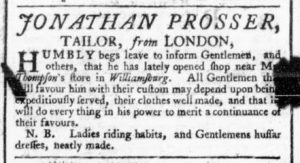
“JONATHAN PROSSER, TAILOR, from LONDON … has lately opened shop.”

Jonathan Prosser concluded his advertisement by drawing special attention to the “Ladies riding habits and Gentlemens hussar dresses” that he “neatly made.”

Although women often employed seamstresses, dressmakers, and mantuamakers to make most of their garments, they also consulted male tailors for their riding apparel. “Ladies riding habits,” intended for riding sidesaddle, consisted of a tailored jacket with a matching long skirt and a tailored shirt as well as a hat, which often mimicked current styles of hats worn by men. The garments were often made of darker fabrics more often associated with men’s clothing. Sometimes tailors integrated other masculine touches, such as mariner’s cuffs. “Ladies riding habits” were intended to be both functional and fashionable.

“Gentlemens hussar dresses” likely referred to riding apparel for the male companions of the women who purchased “Ladies riding habits.” The term “hussar” derived from cavalry units in late medieval Europe. Light cavalry regiments in European and European colonial armies adopted the title and distinctive “hussar dresses” in the late seventeenth and eighteenth centuries. When Prosser advertised “Gentlemens hussar dresses” he most likely sought the patronage of elite Virginians, the men who served as officers on muster days when the colonial militia drilled. Such events had social ramifications as much as military utility. Elite men in Virginia would have certainly desired “Gentlemens hussar dresses, neatly made” to signify their status and to impress their peers and other colonists.

May 24

What was advertised in a colonial newspaper 250 years ago this week?

May 24 - 5:23:1766 Virginia Gazette
Virginia Gazette (May 23, 1766).

“He continues to do business in the commission way.”

Thomas Hepburn was a broker who sold goods on consignment or, as he put it, he did “business in the commission way.” Rather than purchase and maintain his own stock, he sold merchandise that others supplied to him under an agreement that he would keep a portion of the proceeds from every sale. This minimized the risk of becoming overextended within the networks of credit that accompanied the consumer revolution of the eighteenth century; Hepburn did not lose any investment required to procure his merchandise.

What might Hepburn have sold? While it’s possible that he carried new merchandise, it seems more likely that he carried secondhand or used goods that colonists decided that they no longer wanted or needed for whatever reasons. Selling such items on commission facilitated a secondhand economy that permitted a greater number of colonists to participate in the consumer revolution that was taking place on both sides of the Atlantic. The “baubles of Britain” that found their ways into the possession of so many colonists did not always take a direct path from British merchant to colonial shopkeeper to colonial consumer. Sometimes they passed from person to person or household to household, making detours through shops that did “business in the commission way.”

May 11

What was advertised in a colonial newspaper 250 years ago this week?

May 11 - 5:9:1766 Virginia Gazette
Virginia Gazette (May 9, 1766).

“He proposes to begin the publication of a NEWSPAPER on Friday next.”

William Rind was preparing to publish a newspaper. In fact, he was a week away from launching a rival newspaper to the Virginia Gazette published by Alexander Purdie and Company. Rind also published his newspaper in Williamsburg on Fridays, but to avoid confusion he named it Rind’s Virginia Gazette in order to distinguish it from its competitor as much as possible. (I wonder if Purdie and Company engaged in similar sarcasm as they set type for this advertisement promoting a rival publication, an advertisement that appeared in their own newspaper.)

Rind needed to estimate how many copies of the first and subsequent issues he should print. His advertisement included a call for “those Gentlemen with whom he has left subscription papers, to return the lists of those who have already signed.” What did he mean by subscription papers? To assess and encourage interest in his newspaper Rind, like others who printed books and periodicals in the eighteenth century, first distributed another form of advertising known as subscription papers or subscription notices: printed announcements that included a prospectus describing the purpose and intentions of the proposed publication as well as a list of terms for subscribing (such as cost and frequency of publication). Rind likely made arrangements with local merchants and shopkeepers to post his subscription papers. The subscription papers may have had space for new subscribers to write their names; alternately, the merchants and shopkeepers aiding Rind may have kept lists of their own. Whichever method was employed, Rind called on “those Gentlemen with who he has left subscription papers” to forward the lists of subscribers to him.

May 10

Who was the subject of an advertisement in a colonial newspaper 250 years ago this week?

May 10 - 5:9:1766 Virginia Gazette
Virginia Gazette (May 9, 1766).

“AGNES … is a fair straight made lusty Mulatto, and has small breasts.”

When the Virginia Gazette made its debut in the Adverts 250 Project a week ago, I opted to feature a genre of advertisements – those seeking the return of runaways – rather than a particular advertisement. Accompanied by crude woodcuts, runaway advertisements were easy to identify at a glance. I remarked how startling it seemed to see nine runaway advertisements on a single page of the Virginia Gazette. As David Waldstreicher has argued, slavery, commerce, and print culture were bound together in eighteenth-century America.

Runaway advertisements presented an alternate means of placing black bodies on display in early America, first by describing them in great detail and then by encouraging readers to carefully surveil the black men and women they encountered. In the case of Agnes (also known as Agie), this amounted to more than noticing her garments (“a striped red, white, and yellow calamanco gown, a short white linen sack, petticoat of the same, a pair of stays with fringed blue riband, a large pair of silver buckles”). It also included attention to physical features, such as “a small scar over one of her eyes.”

Yet the descriptions could sometimes be far more intimate and invasive, especially as white colonists characterized black and mulatto women’s bodies. According to today’s advertisement, Agnes was “a fair straight made lusty Mulatto, and has small breasts.” Even as the advertiser acknowledged one of the essential aspects of Agnes’ womanhood, he deprived her of the consideration and deference that would have been shown to most white women (especially middling and elite white women) when describing them in conversation or in print. Calling specific attention to the size of Agnes’ breasts served to further commodify her rather than humanize her.

N.B. Notice that this advertisement states that Agnes ran away in the middle of January, yet it was published nearly four months later in early May. I hope that she made good on her escape permanently.

May 4

What was advertised in a colonial newspaper 250 years ago this week?

May 4 - 5:2:1766 Virginia Gazette
Virginia Gazette (May 2, 1766).

“William Godfrey, PERUKE MAKER, ACQUAINTS the publick that he has opened shop/”

What was a peruke maker? Once again we discover that eighteenth-century consumers often spoke a language that would become unfamiliar to modern readers. “Peruke” is another name for “periwig” or “wig.” William Godfrey made wigs! When he stated that “he proposes carrying on his business in all its branches,” he most likely meant “making wigs, shaving, cutting and dressing men’s hair and, presumably, dressing wigs,” according to historians from Colonial Williamsburg.

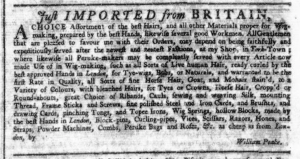
Although his advertisement was relatively short, Godfrey’s occupation opens up an entire world of colonial fashion, a culture of consumption, and the commerce and labor that fueled both. For instance, although Godfrey made his wigs in Virginia, he most likely imported hair and other materials from England. In 1751, William Peale advertised that he had “Just IMPORTED from BRITAIN, A CHOICE Assortment of the best Hairs, and all other Materials proper for Wigmaking.”

May 4 - 7:25:1751 Virginia Gazette
Virginia Gazette (July 25, 1751).

Other scholars have created a variety of resources about peruke makers for various audiences, including:

I find the use of advertisements from eighteenth-century Virginia in “Wigmaking in Colonial America” especially interesting. With only one extant account book from a  wigmaker in colonial Virginia, much of what we know about their wares and services in that colony derives from newspaper advertisements. The original intention of those advertisements may have been to incite demand and attract customers, but, just as language has shifted over time, our purpose in examining those advertisements and what we expect to learn from them has changed as well.

May 3

What was advertised in a colonial newspaper 250 years ago this week?

May 3 - 5:2:1766 Virginia Gazette
Virginia Gazette (May 2, 1766).

“To be SOLD, at the MARLBOROUGH BREWERY.”

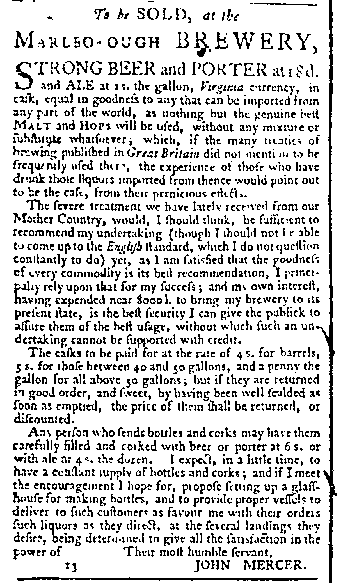
Brewer John Mercer took an interesting approach in his advertisement for “STRONG BEER and PORTER … and ALE” available from the Marlborough Brewery: quite frankly, he confessed, it was not as good as beer from England.

Actually, Mercer presented a mixed message in his lengthy advertisement. He initially stated that his beer was “equal in goodness to any that can be imported from any part of the world, as nothing but the genuine best MALT and HOPS will be used, without any mixture of substitute whatsoever.” Mercer seems to have been a stickler for quality control! He also made an increasingly common appeal. In the 1760s many American artisans asserted that their goods were equal or superior to imports.

Later in the advertisement, however, he acknowledged “I should not be able to come up to the English standard” despite his constant efforts. Still, since “goodness of every commodity is its best recommendation,” Mercer “principally rel[ied] upon that for my success.” In effect, Mercer seemed to be saying, “You’ll like my beer if you try it. Sure, it may not be as good as English beer, but it’s more than good enough and you’re sure to enjoy it. Buy some and prove it for yourself.”

That seems like a curious and daring appeal to make, but consider the other context he provided to promote his brewery: “The severe treatment we have lately received from our Mother Country, would, I should think, be sufficient to recommend my undertaking.” Once again we see how politics and commerce converged in the wake of the Stamp Act, its repeal, and the promulgation of the Declaratory Act. Even if his beer did not “come up to the English standard,” quality was not the only – or event the primary – concern that potential customers should consider. Thanks to the strained relationship between the colonies and “our Mother Country,” imported beer, porter, and ale was bound to leave a bad taste in consumers’ mouths. They were better off trusting Mercer to supply their beverages, brewed from the “best MALT and HOPS.”

**********

I have included the image available via Readex’s Early American Newspaper database.  Colonial Williamsburg’s online resources include the same issue of the Virginia Gazette.  You may find portions of the advertisement more legible via that resource.  I worked back and forth between the two in order to read the entire advertisement.

May 2

Who was the subject of an advertisement in a colonial newspaper 250 years ago today?

May 2 - Single 5:2:1766 Virginia Gazette
Virginia Gazette (May 2, 1766).

“RUN away … a Negro man named PETER.”

I could not select a single advertisement to feature today. Instead, I have chosen an entire genre: advertisements for runaway slaves.

Today’s advertisements from the Virginia Gazette are the first from the Chesapeake colonies featured by the Adverts 250 Project. As I have explained previously, different institutions provide varying levels of access to Readex’s Early American Newspapers database. The most complete access is available via the American Antiquarian Society (there listed as America’s Historical Newspapers), Readex’s partner in creating the database. Via my own campus library and the Boston Public Library’s online electronic resources, I am able to access about two-thirds of the titles from 1766 available via the American Antiquarian Society, but those titles are restricted primarily to New England and Middle Atlantic colonies. (My students and I are able to access Early American Newspapers via the campus library and the Boston Public Library anywhere we are connected to the Internet. Accessing the database via the American Antiquarian Society, however, requires being on site. To avoid an additional layer of responsibilities for an already extensive class project, I did not require my students to visit the American Antiquarian Society. Instead, I delayed incorporating the additional newspapers from the Chesapeake colonies into the Adverts 250 Project until I resumed my role as sole curator once the semester concluded.)

May 2 - 5:2:1766 Virginia Gazette
Virginia Gazette (May 2, 1766).

I have argued before that regional differences within eighteenth-century newspapers have shaped the Adverts 250 Project to this point. Today I present visually striking evidence to make that case.

We have certainly seen that slavery was present in New England and Middle Atlantic colonies in the 1760s. Advertisements seeking to buy and sell enslaved men, women, and children appeared regularly in the local newspapers, as did other advertisements warning against runaway slaves and offering rewards for their capture and return to their masters. Such advertisements did not appear, however, with the frequency seen here. A single page of the May 2, 1766, issue of the Virginia Gazette included NINE advertisements for runaway slaves, each easily identified by the crude woodcut that accompanied it. I have previously argued that advertisements for slaves in newspapers in New England and the Middle Atlantic colonies demonstrated that slavery was a part of everyday life, commerce, and culture in early America. The Virginia Gazette gives us a glimpse even further south where a greater number of slaves toiled – and seized their own liberty by running away. Slavery was well integrated into the northern colonies, but it was truly ubiquitous in the Chesapeake and Lower South.

The appearance of this page of the Virginia Gazette is stunning in its own regard. It becomes even more jarring when taking into consideration the recent repeal of the Stamp Act, a development widely celebrated as delivering the American colonies from enslavement by Great Britain. Virginians were among the first and most vocal opponents of the Stamp Act. Their yelps for their own liberty, to paraphrase Samuel Johnson, stand in strike juxtaposition to the bondage of enslaved men, women, and children in their colony.