July 12

What was advertised in a colonial newspaper 250 years ago this week?
Jul 12 - 7:11:1766 Virginia Gazette
Virginia Gazette (July 12, 1766).

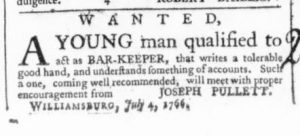
“WANTED, A YOUNG man qualified to act as BAR-KEEPER.”

Today we rely on a variety of media to connect employers and prospective employees. Many jobseekers identify potential positions via announcements or listings in online forums. Increasingly, they submit all or most of their application materials electronically. Qualified candidates may be invited for in-person interviews or those conversations might take place over the telephone or internet. The job search apparatus has changed significantly within living memory.

Today’s advertisement provides a glimpse of how some positions were filled in eighteenth-century America. When Joseph Pullett needed to hire a barkeeper, he placed a notice in the Virginia Gazette. His announcement included a series of qualifications, not unlike today’s employment listings.

Pullett expected candidates to have at least minimal education, but probably assumed that they would learn experience as well. For instance, he suggested that applicants should understand “something of accounts.” In other words, it was not necessary to know all the ins and outs of advanced bookkeeping, but Pullett wanted a barkeeper familiar enough with ledgers that (with a little eighteenth-century on-the-job training) he could assist with those responsibilities. To that end, he also needed to be able to write “a tolerable good hand” in order to effectively keep the accounts.

Reputation and recommendations also played a role in successful job searches in the eighteenth century. It was not enough to demonstrate that he possessed these skills and knowledge; any young many that applied needed recommendations testifying to his skill and his character. Many employment advertisements sought “sober” applicants, though this most likely referred to an appropriate temperament and comportment rather than abstaining from alcohol.

Although some of the methods for filling jobs have changed in the past two centuries other aspects continue to look very familiar.

July 11

What was advertised in a colonial newspaper 250 years ago today?

Jul 11 - 7:11:1766 Virginia Gazette
Virginia Gazette (July 11, 1766).

To be SOLD, or RENTED, with to without NEGROES, A NEW SAW MILL.”

This advertisement seeking someone to buy or rent “A NEW SAW MILL” on the Chowan River listed a variety of amenities, including the option of “NEGROES” being included in the deal. This differs significantly from commercial and industrial real estate advertisements today. Indeed, before even mentioning any of the other amenities associated with the property, Cullen Pollok announced that the sawmill could be sold or rented “with or without NEGROES.” The enslaved workers were treated like any other part of the infrastructure of the mill.

That slaves could be included in the purchase of this sawmill reveals something about how it operated. While the slaves certainly contributed their labor, the mill’s owner also benefited from the knowledge that slaves brought to the enterprise. Operating a sawmill required specific skills and a routine designed for efficiency. Experience was important as well. A new owner or overseer could certainly train slaves to take on these responsibilities over time, but the advertisement provided the option of a skilled workforce already intact. Reading this advertisement from a twenty-first-century perspective might privilege the labor provided by the enslaved workers, but eighteenth-century readers would have also factored in other advantages – skill and expertise – that those workers provided. Their familiarity with this particular mill would have been invaluable.

Even if a buyer or renter did not wish to set the slaves to work in the sawmill, they were available to work “a small plantation cleared on the river side,” just one of the many amenities listed with the house with “one brick chimney, and a very fine orchard.”

This advertisement seeking someone to buy or rent “A NEW SAW MILL” on the Chowan River listed a variety of amenities, including the option of “NEGROES” being included in the deal. This differs significantly from commercial and industrial real estate advertisements today. Indeed, before even mentioning any of the other amenities associated with the property, Cullen Pollok announced that the sawmill could be sold or rented “with or without NEGROES.” The enslaved workers were treated like any other part of the infrastructure of the mill.

That slaves could be included in the purchase of this sawmill reveals something about how it operated. While the slaves certainly contributed their labor, the mill’s owner also benefited from the knowledge that slaves brought to the enterprise. Operating a sawmill required specific skills and a routine designed for efficiency. Experience was important as well. A new owner or overseer could certainly train slaves to take on these responsibilities over time, but the advertisement provided the option of a skilled workforce already intact. Reading this advertisement from a twenty-first-century perspective might privilege the labor provided by the enslaved workers, but eighteenth-century readers would have also factored in other advantages – skill and expertise – that those workers provided. Their familiarity with this particular mill would have been invaluable.

Even if a buyer or renter did not wish to set the slaves to work in the sawmill, they were available to work “a small plantation cleared on the river side,” just one of the many amenities listed with the house with “one brick chimney, and a very fine orchard.”

July 6

Who was the subject of an advertisement in a colonial newspaper 250 years ago this week?

Jul 6 - 7:4:1766 Virginia Gazette
Virginia Gazette (July 4, 1766).

The previous issue of the Virginia Gazette included an advertisement announcing that “two hundred choice healthy” slaves from the Windward and Gold Coasts in Africa had “JUST arrived in James river.” It did not give additional information about those slaves, except to announce that they would be sold starting on July 7.

Today’s featured advertisement similarly offered little information about the “THIRTY choice SLAVES” slated to be sold in October, three months later, but it did indicate that “men, women, and children” were included among their ranks. In addition, several of the slaves were tradesmen, though the advertisement did not reveal if they were carpenters, coopers, blacksmiths, or practitioners of other crafts. Those slaves would have been particularly valuable given their ability to make unique contributions beyond agricultural labor to a plantation. Their prospective owners might also stand to make a profit by hiring them out at times that they did not have enough work to keep them busy. Slaves that knew a trade could also teach it to their children, passing down specialized knowledge from generation to generation, further benefiting the master or his heirs.

As if it were not already apparent that these men, women, and children had been reduced to commodities, the advertisement included terms of exchange intended to facilitate the sale. Buyers could receive two years of credit (or more, if necessary), but they would receive a “Five per cent. discount” for payment in full at the time of purchase. In the end, these “THIRTY choice SLAVES” amounted to little more than numbers in a ledger, just like other goods and services during the eighteenth century. Their existence could be summed up as the best sort of deal that could be haggled between buyer and seller.

July 5

What was advertised in a colonial newspaper 250 years ago this week?

Jul 5 - 7:4:1766 Virginia Gazette
Virginia Gazette (July 4, 1766).

“I have settled … in Henrico county, where I purpose to carry on the FULLING business.”

Mathew Dick, a fuller, used an advertisement in the Virginia Gazette to announce that he had just set up shop in Henrico county. Dated July 1, his notice appeared in the next issue of the Virginia Gazette. Although his “FULLING business” was a new establishment, Dick relied on many of the advertising appeals that were commonly deployed in the eighteenth century, reassuring potential customers that he knew his craft and could provide quality service.

He opened with appeals to quality and price, promising that he did his work “in the best and cheapest manner ever done in this colony.” That last bit – “ever done in this colony” – was a bit of hyperbole that underscored his confidence and dared potential customers to give him a chance and see for themselves if his work lived up to the advertisement. In addition, all the equipment and supplies were prepared “in the best order.”

He also offered some words of wisdom specific to his occupation, again reassuring potential customers of his expertise even though he operated a new establishment. “[T]he wool from the neck and shoulders is the best for the finest cloth,” he lectured. Furthermore, “all woolen cloth should be wove at least 5 quarters wide.” Dick knew his business and used his advertisement to testify to the fact.

Finally, Dick promised excellent customer service. He offered two different locations where customers could drop off the fabric they wanted him to process. He would see to it that their orders were fulfilled “in the neatest manner” and as quickly as possible, but not at the expense of deviating from their instructions. Dick fulled cloth to his customers’ specifications and satisfaction: “their directions most punctually observed and followed.”

Dick’s fulling mill may have been new, but he leveraged multiple appeals in his advertisement to demonstrate that he knew his craft and potential customers could depend on him.

June 29

What was advertised in a colonial newspaper 250 years ago this week?

Jun 29 - 6:27:1766 Virginia Gazette
Virginia Gazette (June 27, 1766).

Edward Westmore’s advertisement tells only a portion of the story of “a Negro fellow named JAMES” who had been “COMMITTED to the publick gaol [jail] in Williamsburg,” Virginia. It appears that Westmore believed that James was a runaway slave; he refers to James having an owner, but it seems less clear that James acknowledged that he was a runaway or that anybody had alerted Westmore and other Virginians to be alert for a runaway fitting James’ description (including the distinctive “gashes of his country” that marked each cheek, an African practice).

James apparently revealed a portion of his past to Westmore, including a sale that took place six years earlier when Colonel Hunter sold him to David Sallen. Did Sallen still own James? Did James acknowledge that Sallen was his master and admit to being a runaway? It’s difficult to reach a definitive conclusion based on the truncated narrative in this advertisement. James reported that he had most recently been in Philadelphia, but whether he was there with his master – either Sallen or someone else – was ambiguous, at least as far as what was reported in Westmore’s advertisement. After all, it states that “The owner may have him” rather than “said Sallen may have him.”

James may very well have been a runaway slave. It was the most probable scenario, but it wasn’t the only one. It was also possible that he had achieved or been granted his freedom, yet as an African man traveling through Virginia he would have been subject to suspicion. His word would not necessarily have been enough to keep him from being captured and committed to the local jail with the expectation that a master was looking for him and would eventually claim him. His appearance alone – the color of his skin and his African origins – made him a target for harassment and incarceration that would not have been directed at most white colonists.

June 28

What was advertised in a colonial newspaper 250 years ago this week?

Jun 28 - 6:27:1766 Virginia Gazette
Virginia Gazette (June 27, 1766).

“JUST arrived … two hundred choice healthy Windward and Gold Coast slaves.”

Eighteenth-century advertisements for consumer goods often deployed formulaic language, especially for goods “just imported from” London or other ports in England or the Caribbean. This advertisement offers several variations on those familiar advertisements.

First of all, “the ship Apollo, Capt. Elias Glover,” carried human cargo – slaves – rather than the “bauble of Britain” so frequently advertised in newspapers throughout the colonies. Although slaves were often offered for sale in the New England and the Middle Atlantic colonies, ships loaded with two hundred Africans usually did not sail into those ports. Here we encounter a regional difference in the kinds of advertisements that appeared in local newspapers. Rather than a ship loaded with textiles, housewares, and grocery items, Captain Glover’s vessel delivered people who had been reduced to commodities to be put up for sale.

The slave traders who sold this human cargo – Thomas Tabb, William Bolden, and John Lawrence – reported that the Apollo had come from Africa, but they do not make clear whether it had made any stops along the way. Were these slaves being imported directly from Africa? Or had the Apollo stopped in the Caribbean or other ports on the North American mainland before making its way to the James River?

Not unlike advertisements for dry goods or hardware, this notice emphasized the quality of the commodities offered for sale: they were “choice” and “healthy.” Furthermore, they came from specific places in Africa, the Windward and Gold Coasts. Plantation owners often desired slaves from particular regions, associating specific skills or knowledge with those places.

All in all, even though the wording differed from advertisements for goods imported from England, this and other advertisements for slaves took a similar tone. What seems horrifying from a twenty-first-century perspective was business as usual for slaveholders and slave traders. None of that even takes into account the perspectives of the enslaved Africans themselves.

June 22

What was advertised in a colonial newspaper 250 years ago this week?

Jun 22 - 6:20:1766 Virginia Gazette
Virginia Gazette (June 20, 1766).

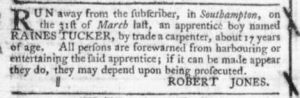
“RUN away … an apprentice boy named RAINES TUCKER.”

It was easy to spot the advertisements for runaway slaves in the Virginia Gazette. Most had a woodcut of a slave in the upper left corner, announcing the content of the advertisement before subscribers even read a single word.

Advertisements for other sorts of runaways were much less likely to be adorned with a woodcut, yet slaves were not the only people who ran away from their masters in eighteenth-century America. An assortment of unfree labor statuses existed in colonial America, including slaves, indentured servants, and apprentices.

The life of an apprentice could be difficult. Although part of his master’s household during the years that he learned his trade, an apprentice was not necessarily treated as part of the family. Sometimes apprentices were not provided the same quality of food, clothing, or shelter as the master’s wife, children, and other members of the household. Masters often set strict rules for their apprentices and monitored their activities during what little free time they were allowed. Some masters also used corporal punishment to discipline apprentices. On occasion, apprentices accused masters of exploiting them for their labor but not teaching them all the aspects of their craft. Such masters, they claimed, kept apprentices dependent and subservient by withholding the complete education they were supposed to provide.

What was the relationship like between Robert Jones and his runaway apprentice, Raines Tucker? What prompted Tucker to run away? Today’s advertisement does not reveal those answers, but it does tell us that for some reason Tucker chose to depart before he completed his apprenticeship. It also tells us that unfree laborers of various sorts resorted to running away.

June 21

What was advertised in a colonial newspaper 250 years ago this week?

Jun 21 - 6:20:1766 Virginia Gazette
Virginia Gazette (June 20, 1766).

For BRISTOL, THE ship RIALTO, DAVIDE MERIWETHER master.”

The Rialto was scheduled to sail for Bristol in less than two months, but the master of the vessel had only arranged for half of the cargo that the ship could carry.

In addition to shipping tobacco and other freight, the Rialto also provided passage for colonists who wished to travel to Bristol and, from there, on to other places in England or Europe. Such passengers may or may not have intended to return to Virginia or other colonies in the Americas. Many who made such a voyage did not have any plans to return to the New World.

Given the high rates of migration during the seventeenth and eighteenth century, motivated by a variety of push and pull factors that made life in Britain’s vast North American colonies appear filled with opportunities for social and economic improvement, it becomes fairly easy to imagine that Europeans traveled only one direction across the Atlantic. Not all migrants encountered the success they anticipated in the colonies. A good number of them ended up returning to Europe, a process called “return migration.” Thanks to the memoir he published after his own failed venture to the New World, William Moraley may be the most famous of the indentured servants and apprentices who departed from London, couldn’t make a go of it in the colonies, and ended up back in England. How many disillusioned colonists might have been traveling on the Rialto to Bristol 250 years ago?

June 15

What was advertised in a colonial newspaper 250 years ago today?

Jun 15 - 6:13:1766 Virginia Gazette
Virginia Gazette (June 13, 1766).

“The unwary purchaser may make use of this to prevent their being taken in.”

Throughout the eighteenth century many advertisers emphasized their own virtues, especially their good character. As urban centers increased in size, residents did not necessarily always know all the merchants and retailers who lived in their area. In addition, mobility and migration were common. People were constantly coming and going in colonial America: arriving from Europe, moving from colony to colony, seeking new opportunities wherever they could find them. Many commercial exchanges began with the parties not knowing each other. Accordingly, advertisers frequently assured potential customers of their good character.

This anonymously placed advertisement, on the other hand, warned readers of the Virginia Gazette against trusting Robert Bolling. Less than two weeks earlier “an examination of the weights at Robert Bolling’s warehouse” were “found to have lost, from 2 and half per cent. to 5 per cent. or more.” Bolling, “the designing seller” was cheating his customers.

Maintaining a good reputation played an important role in inaugurating and continuing commercial exchanges in eighteenth-century America. According to this advertisement, Bolling had taken advantage of “unwary purchaser[s]” who bought tobacco at his warehouse, calling his character into question.

Had Bolling intentionally adjusted the weights? Was he even aware that they were off? The advertisements suggest that was the case by describing him as a “designing seller.” However, it’s also possible that a competitor, disgruntled employee, or unhappy customer placed this advertisement as a means of undermining Bolling’s reputation, though it seems that “the designing seller” might have tracked down the author of this advertisement fairly easily with a visit or letter to the printer of the Virginia Gazette.

Jun 15 - 6:13:1766 response Virginia Gazette
Virginia Gazette (June 13, 1766).

At any rate, Bolling seems to have offered a response that suggested the original advertisement was nothing more than subterfuge designed by competitors who had “a great many ships to load” and wanted to prevent planters from selling their tobacco through Bolling’s warehouse. Empty or partially loaded ships diminished revenues. This advertisement suggested that the accusations against Bolling were nothing more than an attempt to direct business to another warehouse.

This was not the first time that commercial rivalries found voice in newspaper advertisements in the eighteenth century, nor would it be the last.

June 14

What was advertised in a colonial newspaper 250 years ago this week?

Jun 14 - 6:13:1766 Virginia Gazette
Virginia Gazette (June 13, 1766).

“Those who fail complying may depend upon being sued.”

Merchants, shopkeepers, and artisans frequently placed advertisements advising their customers to settle their debts or face the consequences. Both the consumer revolution of the eighteenth century and the colonial economy operated on credit, often webs of credit that extended far beyond consumers and the retailers who sold them goods. Those same retailers had often procured imported goods from English merchants on credit themselves. Hard money was fairly rare in the colonies, often making credit a necessary substitute. Yet extending credit had its risks. Producers, suppliers, and retailers might never receive payment. Consumers might find themselves hauled into court when they did not pay.

Thomas Craig expressed exasperation in his advertisement calling on “those who have been dilatory in paying off their accounts to discharge them.” He wanted to receive payment while the current court was sitting. While this might have seemed like short notice to some, he reminded them that he had “long before now advertised” that the “present state of my affairs makes it absolutely necessary” to settle accounts.

Still, Craig depended on the good will of customers to continue to earn a living. He knew enough about customer service to attempt to mediate any offense he might have given to “good and punctual customers” by offering a nota bene that emphasized that his advertisement was not directed at them. He needed payment from others, but he did not want to risk alienating those who settled their accounts in a timely fashion.