November 5

What was advertised in a colonial American newspaper 250 years ago today?
Nov 5 - 11:5:1767 New-York Gazette Weekly Post-Boy
New-York Gazette: Or, the Weekly Post-Boy (November 5, 1767).

“He has been over to London for Improvement.”

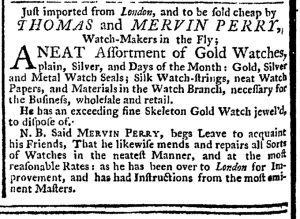
In their advertisements, artisans who had migrated across the Atlantic frequently asserted their origins as part of their attempt to attract customers. For instance, Joseph Beck promoted himself as a “Stay-Maker, from LONDON” in the November 5, 1767, edition of the New-York Gazette: Or, the Weekly Post-Boy. Establishing a connection to London laid the foundation for making other appeals to consumers. It often suggested some sort of specialized training in a trade (and some artisans explicitly noted that they had served out an apprenticeship with a master in London). It also signaled familiarity with the current fashions in the cosmopolitan center of the empire. Artisans sought to allay anxieties that the items they made and sold in the colonies were inferior in quality or taste when compared to the wares available in London.

Not all colonial artisans, however, could proclaim that they migrated “from LONDON” in their advertisements. Many had been born and received their training in the colonies. Such was probably the case for Thomas Perry and Mervin Perry, “Watch-Makers in the Fly” in New York.  Like many of their competitors in New York and their counterparts in other cities and towns, the Perrys not only made and repaired watches but also imported them from London. Yet they realized they could acquire more cachet among consumers if they established other connections to London. It was not sufficient merely that they acquired their merchandise from London.

To that end, the watchmakers inserted a nota bene that informed potential customers that Marvin Perry had “been over to London for Improvement, and has had Instructions from the most eminent Masters.” Although he did not undertake a complete apprenticeship in London, Perry had supplemented his training and presumably improved his skills. He implied that readers could expect that the “Instructions from the most eminent Masters” improved the quality of Perry’s work. This additional training also confirmed that he performed his work “in the neatest Manner.”

September 24

What was advertised in a colonial American newspaper 250 years ago today?

Sep 24 - 9:24:1767 Pennsylvania Gazette
Pennsylvania Gazette (September 21, 1767).

“Good, sound, and neat silver watches.”

Advertisements for imported goods – textiles, housewares, hardware – filled the pages of colonial newspapers. In most instances, artisans and manufacturers in England made items colonists either could not produce on their own or that surpassed the quality of similar items made by colonial crafters. As the eighteenth-century progressed, however, greater numbers of skilled artisans participated in transatlantic migrations, bringing their expertise to colonial cities and towns. They set up shop in their new places of residence; their skills and experience contributed to improving the reputation associated with domestically produced goods.

By the 1760s, residents of Philadelphia and major urban ports worried that observers in England, especially London, might look down on them as backwater provincials since they were so far distant from the center of the empire. Some advertisers in Boston, Charleston, New York, and Philadelphia attempted to allay these anxieties with assurances that they made and sold goods of the highest quality and most recent fashions. Yet concerns about cosmopolitanism were not confined to the largest and busiest port cities. In Lancaster, more than fifty miles west of Philadelphia, Thomas Skidmore opened a workshop where customers interested in purchasing expensive watches “may be here supplied as in London.”

In an advertisement in the Pennsylvania Gazette, Skidmore, a “WATCH-FINISHER, from London,” insisted that local consumers were no longer “under the necessity of importing good watches from England or Ireland.” For only £12, he made “good, sound, and neat silver watches” in the town of Lancaster. Skidmore did not work alone; instead, he employed two assistants, “the one a movement-maker, and the other a motion-maker,” both of whom had previously followed their trade in England. Working together, the three produced “good watches” that Skidmore asserted rivaled any imported from Britain. Skidmore was so certain of the quality of the work done in his shop that he offered a guarantee that his watches would not require repairs in the first three years. He made appeals that would have been familiar to residents of Philadelphia, the largest city in the American colonies in the decade before the Revolution. His location in Lancaster, however, demonstrates that desire to participate in consumer culture extended beyond urban centers, far into the hinterland.

June 20

What was advertised in a colonial American newspaper 250 years ago today?

Jun 20 - 6:20:1767 Providence Gazette
Providence Gazette (June 20, 1767).

“For further Particulars inquire of EDWARD SPALDING, in Providence.”

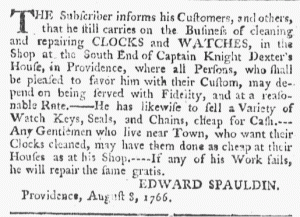
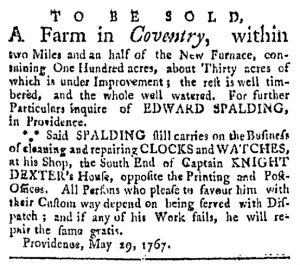
Edward Spalding (sometimes Spauldin in other advertisements) had two purposes when he took an advertisement in the Providence Gazette in the spring of 1767. First, he wished to sell a farm in Coventry. As long as he was purchasing space in the newspaper, he also opted to promote his business. He reminded readers that he “still carries on the Business of cleaning and repairing CLOCKS and WATCHES” at his shop across the street from the printing office. In the past, Spalding advertised fairly regularly. He was one of the first advertisers to insert commercial notices in the Providence Gazette when it resumed publication the previous year. He must have considered it a good return on his investment since he decided to include commercial marketing at the end of his notice concerning real estate.

Spalding’s hybrid advertisement presents a conundrum for conducting any sort of quantitative study of advertising in eighteenth-century America. Newspapers of the era did not have classifieds. They did not organize advertisements in any particular order or by categories that suggested the general purpose of the notices. Sometimes, as seen here, individual advertisements had multiple purposes. Spalding and the printers of the Providence Gazette did not classify this advertisement. How should historians do so? It would not be appropriate to categorize it solely as a real estate notice or solely as marketing consumer goods and services. More appropriately, it should count as both, but that sort of double counting does not address another issue. Together or separately, both halves of Spalding’s advertisement were relatively short compared to many others for both real estate and consumer goods and services inserted in eighteenth-century newspapers. This suggests that tabulating column inches devoted to advertisements (or portions of advertisements) might produce more accurate data for assessing the proliferation of advertising in relation to news and other content as well as comparing the quantity of advertising space utilized for various purposes. This, however, would be extremely labor intensive. It also requires access to the original newspapers rather than digital surrogates. Working with digitized sources allows for examining other sorts of questions concerning advertising in early America.

Earlier in my career I was much more enthusiastic about incorporating quantitative analysis into my study of advertisements for consumer goods and services in eighteenth-century America. Over time, however, I have determined that identifying general trends rather than hard numbers provides a sufficiently accurate portrait of the expansion of advertising in the era that the colonies became a nation.

June 16

What was advertised in a colonial American newspaper 250 years ago today?

Jun 16 - 6:16:1767 South-Carolina Gazette and Country Journal
South-Carolina Gazette and Country Journal (June 16, 1767).

“Will be sold at the London retailing prices.”

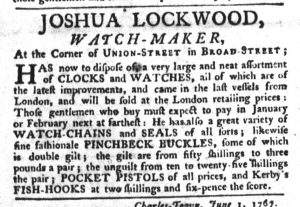
Watchmaker Joshua Lockwood ran a shop at the corner of Union and Broad Streets in Charleston, South Carolina, where he sold “a very large and neat assortment of CLOCKS and WATCHES” recently imported from London. In an advertisement in the June 16, 1767, edition of the South-Carolina Gazette and Country Journal, he informed potential customers that his clocks and watches “are of the latest improvements,” signaling that the quality, style, and technology matched what they could purchase in London. His clientele did not need to worry about obtaining inferior timepieces simply because they lived in a small city at the edge of the empire.

Such assurances did not come with an inflated price. Lockwood pledged that his clocks and watches “will be sold at the London retailing prices.” Some prospective customers may have expected to pay a premium in order to obtain clocks and watches with “the latest improvements” that had been shipped across the Atlantic, but Lockwood indicated that this did not incur higher prices for his local buyers. They would be charged the same as if they lived in London and dealt directly with watchmakers there. There was no need to worry that distance and the smaller size of the local community lessened competition and raised prices.

Colonial advertisers most often compared their prices to those of their local competitors, asserting that they sold at the “lowest rates” in their town or colony. On occasion, however, advertisers made price comparisons that took into account the size of the community in which they lived and worked. Shopkeepers in the hinterlands beyond the major port cities, for instance, claimed that they set prices that competed with those in Boston, Charleston, New York, and Philadelphia. Advertisers in smaller cities, such as Portsmouth and Providence, favorably compared their prices to the going rates in larger ports. Transatlantic comparisons represented the next link in the chain, as merchandisers in the largest colonial cities, like Lockwood, declared that their prices matched what counterparts in London charged. Regardless of their location, advertisers believed potential customers looked to the next larger community and suspected prices might be lower there. In turn, advertisers sought to ease such anxieties (and promote more sales) by persuading potential customers that they benefited from the same deals as if they shopped in a locale with a larger population and considered less remote.

April 1

GUEST CURATOR: Evan Sutherland

What was advertised in a colonial American newspaper 250 years ago today?

Apr 1 - 4:1:1767 Georgia Gazette
Georgia Gazette (April 1, 1767).

“The CLOCK and WATCH MAKING BUSINESS in all its branches.”

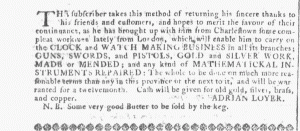
Adrian Loyer announced that he “carr[ied] on the CLOCK and WATCH MAKING BUSINESS in all its branches.” However, watchmaking was not as common as making clocks in colonial America, despite some colonists from England with the necessary skills and tools. Many colonists with watchmaking skills usually repaired watches, rather than creating them. Many of the watches used in colonial America were imported from England instead.

Clockmaking was much more common during the eighteenth century. Clocks were typically made of brass for the dial and wood for the case, including oak, walnut, and mahogany. Some clocks were made with expensive satinwood for inlays. Tall-case clocks made during the eighteenth century were typically expensive; their owners were usually wealthy. As a result, tall-case clocks were usually handed down through generations.

Individual clockmakers typically did not produce more than an average of four to five clocks per year. This was most likely due to the expensiveness of the materials required to produce clocks. Large clocks with tall cases required more materials and more time to produce. Despite these drawbacks, some clockmakers still managed to make a decent living.

**********

ADDITIONAL COMMENTARY: Carl Robert Keyes

Adrian Loyer seemed to be expanding the business he operated in Savannah, thanks to the assistance of “some compleat workmen lately from London” that he recruited on a recent trip to Charleston in neighboring South Carolina. As Evan indicates, Loyer was set “to carry on the CLOCK and WATCH MAKING BUSINESS in all its branches” at his shop, but he offered a variety of other services as well. He and his assistants also repaired mathematical instruments and performed metalwork on weapons and other items.

Residents of Savannah were apparently familiar with Loyer’s work and his reputation: he opened his advertisement by acknowledging “his friends and customers.” Former and potential customers, however, did not know much about Loyer’s new assistants and their work beyond the brief description that appeared in the advertisement. Accordingly, Loyer offered assurances to anyone who visited his shop. He pledged that any work contracted and completed in his shop “will be warranted for a twelvemonth.” In other words, Loyer offered a guarantee that lasted for a year.

Loyer did not provide further details about how his guarantee worked. Was it a money back guarantee? Or did he not charge to repair items that failed within the specified period? Or did he offer customers a choice? Edward Spauldin, who “carries on the Business of cleaning and repairing CLOCKS AND WATCHES” in Providence, explained how his guarantee worked in an advertisement published the previous summer. “If any of his Work fails,” Spauldin stated, “he will repair the same gratis.”

Loyer seemed quite conscious that potential patrons might choose his competitors in Savannah or even send their work to workshops in Charleston. That being the case, it seems most likely that he followed Spauldin’s example and made repairs for free. Doing so gave him the opportunity to satisfy customers rather than relinquish them to other clockmakers and smiths. Whatever the mechanisms of the guarantee, Loyer underscored that he took responsibility for any work that left his shop, whether undertaken by himself or by any of the “compleat workmen” he now employed.

February 6

What was advertised in a colonial America newspaper 250 years ago today?

feb-6-261767-south-carolina-and-american-general-gazette
South-Carolina and American General Gazette (February 6, 1767).

“ALEXANDER KIRKWOOD, Watch and Clock Maker from London, HAS taken shop.”

A print of An Exact Prospect of CHARLESTOWN, the Metropolis of the Province of SOUTH CAROLINA, “Engrav’d for the London Magazine” in the early 1760s, depicted a bustling colonial port city. It provided a view of the waterfront, including the wharves where vessels took on cargoes of rice, indigo, and other local products after unloading commodities imported from Europe and the West Indies, slaves arriving directly from Africa or transshipped through other ports in the New World, and migrants from Europe looking for new opportunities.

08835v
An Exact Prospect of Charlestown, the Metropolis of the Province of South Carolina (ca. 1762).  Courtesy Library of Congress.

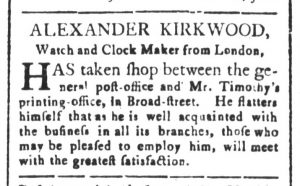
Alexander Kirkwood, a “Watch and Clock Maker from London,” made the journey across the Atlantic at some point, though his advertisement in the South-Carolina and American General Gazette did not indicate how recently he had arrived in the colony. Whenever he made the voyage, he likely chose to settle in Charleston because it was indeed “the Metropolis” of South Carolina (though readers of the London Magazine may have chuckled a bit over that characterization when they viewed the print), the largest settlement in Britain’s North American colonies south of Philadelphia. The “Watch and Clock Maker from London” needed a sufficient customer base to succeed, making a prosperous settlement the size of Charleston an attractive place to set up shop.

Most likely Kirkwood was a relatively new arrival when he placed this advertisement, given that he stated that he “has taken shop” rather than “removed” from one shop to another. Like shopkeeper David Conkie in Boston, who placed his own advertisement earlier the same week, Kirkwood needed to make prospective customers aware of his business. To that end, he placed notices in both the South-Carolina and American General Gazette and the South Carolina Gazette, published by his neighbor, “Mr. Timothy’s printing-office, in Broad-street.” Residents may not have been familiar with Kirkwood’s shop just yet, but they certainly knew where to find the businesses on either side of him, Timothy’s printing office and the “general post-office.” Not only did his advertisements serve to garner attention, Kirkwood’s location certainly yielded a fair amount of visibility for his shop.

August 24

What was advertised in a colonial American newspaper 250 years ago this week?

Aug 24 - 8:23:1766 Providence Gazette
Providence Gazette (August 23, 1766).

“THE Subscriber … still carries on the Business of cleaning and repairing CLOCKS and WATCHES.”

Publication of the Providence Gazette lapsed for more than a year from May 11, 1765, to August 9, 1765 (with the exception of two “extraordinary issues” on August 24, 1766, and March 12, 1766). The Stamp Act played a role in temporarily suspending the newspaper, but in the revival issue Sarah Goddard and Company indicated that an “inadequate Number of Subscribers” had delayed its return after the hated legislation had been repealed.

When the Providence Gazette once again commenced publication, it included an advertisement from clock- and watchmaker Edward Spauldin, an advertisement that appeared in all four issues published in August 1766. This advertisement had previously appeared in the most recent extraordinary on March 12, 1766. For the August iterations, a nota bene promoting compasses for mariners had been removed and the date listed below Spauldin’s name had been updated. Otherwise, the advertisement was the same, from the text to some rather curious line breaks. It’s possible that the type may not have been reset at all; it may have been sitting in the form for months.

Edward Spauldin made a decision to advertise in the extraordinary issue published nearly half a year earlier. Upon learning that the Providence Gazette would be revived, did he once again decide to place an advertisement in hopes of attracting customers? Or did the Providence Gazette publish his advertisements in order to fulfill a bargain that had been made months earlier? The reappearance of his advertisement can be interpreted in more than one way. It might indicate an enthusiastic advertiser who saw returns from his marketing efforts earlier in the year and hoped to make similar gains once again. Alternately, since the printer had been attempting to revive the newspaper for some time, it might have merely been the continuation of a set number of insertions that had been delayed.

May 7

What was advertised in a colonial newspaper 250 years ago this week?

May 7 - 5:5:1766 New-York Gazette
New-York Gazette (May 5, 1766).

“He upholds and warrants their Performance for one Year.”

Isaac Heron made, sold, and repaired watches. He was proud of his work and stood behind, as the assurances in this advertisements demonstrate. This was not only a point of pride in a job well done, however, but also a strategy for encouraging potential clients to visit his shop.

Heron offered several guarantees in his advertisement. If he repaired a watch, he pledged that it would work correctly for at least a year (though he excluded accidents and “Mismanagement” on the part of the owner). For watches that he made and sold, he guaranteed that they would work correctly for several years. The greater the value of the watch, the longer the period before this warranty expired.

To prove that these were not hollow promises, Heron called on former customers from the past year to bring in their watches if his work had failed. Just as he expected “to receive his Money when earn’d,” he acknowledged his obligation to “Rectify” any of his work that did not live up to the promises he had made.

From start to finish, Heron stressed that his customers “may depend on their [watches] being carefully repair’d, justly charg’d for, and return’d” in a (ahem) timely manner.