September 24

What was advertised in a revolutionary American newspaper 250 years ago today?

Pennsylvania Evening Post (September 24, 1776).

“Hancock and other printed handkerchiefs.”

When William Adcock first announced a “VENDUE” or auction of “a great variety of goods suitable to the season” to be held on September 18, 1776, he included “Hancock and Washington handkerchiefs, and a great variety of other printed handkerchiefs” among the items “exposed for sale.”  A week later he inserted another advertisement in the Pennsylvania Evening Post, informing the public that he would host another sale “at his vendue store.”  This time he promoted “a variety of GOODS, among which are … coarse white linens, checks, stripes, superfine mens and womens cotton stockings, silk and worsted knee garters, flax, gimps, fringes, [and] Hancock and other printed handkerchiefs.”  He did not include “Washington handkerchiefs” among his wares.

Did that mean that he had sold all the handkerchiefs bearing a depiction of the commander-in-chief of the Continental Army at his previous sale?  Possibly.  Even if that was the case, it did not necessarily indicate that commemorative items depicting the general were more popular than those with a likeness of the president of the Continental Congress.  The advertisements did not mention the quantity of each handkerchief available.  Adcock may have had a limited supply of “Washington handkerchiefs” compared to “Hancock handkerchiefs.”  The second advertisement did, however, clarify an element of the design of those handkerchiefs.  It was not clear from the first advertisement whether “Hancock and Washington handkerchiefs” featured both men on a single handkerchief.  Other handkerchiefs produced during the era, after all, had images of multiple prominent politicians and military officers.  “Hancock and Washington handkerchiefs” could have had profiles of the two men facing each other, but the second advertisement suggests that each prominent leader had his own commemorative handkerchief.  They may have been made in the same workshop by a savvy entrepreneur who hoped that patriotic consumers would treat them as collectibles by purchasing both rather than just one.  Given that vendues often sold goods in quantities, retailers likely purchased some of the “Hancock and Washington handkerchiefs” to stock in their own shop and sell to consumers who visited with other purchases in mind.
September 17

What was advertised in a revolutionary American newspaper 250 years ago today?

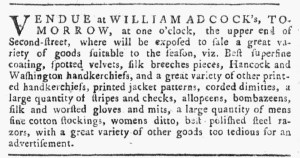
Pennsylvania Evening Post (September 17, 1776).

“Hancock and Washington handkerchiefs.”

William Adcock placed an advertisement in the September 17, 1776, edition of the Pennsylvania Evening Post to inform the public of a “VENDUE” or auction scheduled for the following day.  He declared that “a great variety of goods suitable to the season” would “be exposed to sale.”  He listed some of them, mostly textiles, to give prospective bidders an idea of the available goods.  In addition to “spotted velvets, silk breeches pieces, … a large quantity of stripes and checks, … silk and worsted gloves and mits, [and] a large quantity of mens fine cotton stockings,” Adcock promoted “a great variety of other goods too tedious for an advertisement.”

He did not, however, find it “too tedious” to mention “Hancock and Washington handkerchiefs, and a great variety of other printed handkerchiefs.”  As the Museum of the American Revolution notes, “newspapers, pamphlets, and books … convey[ed] information” during the era of the American Revolution, yet “[s]imilar technology of the time – engraved copper plates, presses, and type – were used to print other paper items used for practical purposes [and the] images used on one type of item were often copied and used on other types of items,” including handkerchiefs.

Most of the handkerchiefs at Adcock’s vendue likely featured decorative patterns, but the “Hancock and Washington handkerchiefs” sported portraits of the new nation’s most prominent political leader, John Hancock, president of the Continental Congress, and its most prominent military leader, George Washington, commander-in-chief of the Continental Army.  A single handkerchief might have included images of both men.  Alternately, the politician and the general may have been depicted individually on separate handkerchiefs, presenting patriotic consumers with more merchandise to purchase.  Either way, the handkerchiefs simultaneously commemorated American leaders and commodified the American Revolution.  Consumers could demonstrate their support for the American cause by purchasing and then using or displaying these handkerchiefs.

Few such handkerchiefs have survived, in part because textiles are so fragile.  In 2023, the Museum of the American Revolution mounted an exhibition that included an anti-Stamp Act handkerchief and a heroes of the Revolution handkerchief (with Washington in the center and John Adams, Benjamin Franklin, General Nathanael Greene, and General Benjamin Lincoln in the corners), giving visitors to the museum (and the museum’s website) a glimpse of the commemorative items that the founding generation produced and purchased.