April 15

What was advertised in a colonial American newspaper 250 years ago today?
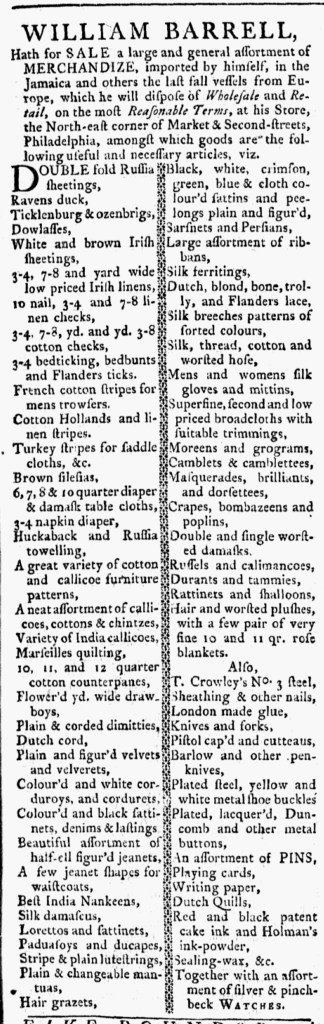
Pennsylvania Ledger (April 15, 1775).

“MERCHANDIZE, imported [in] the last fall vessels from Europe.”

William Barrell’s advertisement in the April 15, 1775, edition of the Pennsylvania Ledger looked much like many of the advertisements that merchants and shopkeepers had been placing in American newspapers for the past couple of decades.  That was even though the Continental Association, a nonimportation agreement devised by the First Continental Congress, had been in effect since December 1, 1774.  Colonizers sought to use economic leverage to convince Parliament to repeal the Coercive Acts.

The notice filled most of the first column on the first page, making it difficult for readers to miss.  Barrell promoted a “large and general assortment of MERCHANDIZE.”  To demonstrate the choices available to consumers, he included an extensive catalog that accounted for most of the space occupied by the advertisement.  He did not opt for dense paragraphs of text, instead arranging with the compositor to divide the list of his inventory into two columns with a line comprised of printing ornaments running down the center.  One, two or three related items appeared on each line.  Barrell stocked all sorts of textiles, everything from “Ticklenburg & ozenbrigs” to “Colour’d and white corduroys, and cordurets” to Crapes, bombazeens and poplins.”  He also carried “Mens and womens silk gloves and mittins,” “Playing cards,” and “Plated, lacquer’d Duncomb and other metal buttons.”  Prospective customers had access to the same variety of goods as they did before the nonimportation agreement.

In his introduction to his list of “useful and necessary articles,” Barrell made a standard appeal to price, stating that he sold his wares “on the most Reasonable Terms.”  He also noted that he imported them via the “last fall vessels from Europe.”  The savvy merchant carefully alerted the public that he was not breaking the Continental Association by selling goods imported since December 1.  Instead, he continued to stock and sell only items that arrived in Philadelphia before the Continental Association went into effect.  In that regard, his advertisement did differ from those published at other times.  Merchants and shopkeepers often emphasized that they peddled new inventory that just arrived.  Customers could select from among the latest styles.  In this instance, however, Barrell realized that consumers would accept, even embrace, goods that had been on the shelves for a few months, especially if he emphasized that they had not been there for too long, just since the arrival of the “last fall vessels.”

November 4

What was advertised in a colonial American newspaper 250 years ago today?

Nov 4 - 11:4:1768 New-Hampshire Gazette
New-Hampshire Gazette (November 4, 1768).

“Said BARRELL having an utter Abhorrence of Law Suits.”

In the fall of 1768, William Barrell placed an advertisement in advance of departing New Hampshire on a voyage. He did not indicate where he was going, how long he planned to be away, or whether he intended to return to the colony. He did make it clear, however, that he wished to settle accounts, especially with those who owed him money. Merchants and shopkeepers frequently extended credit to customers, one of the factors that contributed to the widespread consumer revolution during the eighteenth century. Their advertisements for all sorts of imported goods often included or ran alongside calls for settling accounts.

Barrell made an investment in recovering what he was owed. His notice ran in the New-Hampshire Gazette for six consecutive weeks, commencing in the September 30 edition (the same date that appeared on the final line of the advertisement each time it appeared) and appearing for the last time on November 4. He advised that he planned to depart “within six or eight weeks at farthest.” He gave those who had done business with him plenty of opportunities to spot his notice, as well as time to make arrangements for payment. He “begs they wou’d be so obliging as to wait on him at his Store for that Purpose, any Day within the said Time.”

Yet Barrell anticipated that he might need to make an additional investment to “discharge any Ballances.” He confided that he had “an utter Abhorrence of Law Suits.” To that end, he pleaded that no one would “lay him under the painful Necessity of impowering an Attorney” to pursue payment. After all, everyone would be much happier if they voluntarily settled accounts “with but little Trouble, and no charge.” In other words, his customers would find their purchases much more expensive, despite having received credit to acquire them initially, if they found themselves in the position of paying legal fees as well as the price of the merchandise. Like other merchants and shopkeepers, Barrell was polite but firm in making this point. Given his “utter Abhorrence of Law Suits,” those found themselves prosecuted to make payment would have only themselves to blame.

August 22

Who was the subject of an advertisement in a colonial American newspaper 250 years ago today?

Aug 22 - 8:22:1766 New-Hampshire Gazette
New-Hampshire Gazette (August 22, 1766).

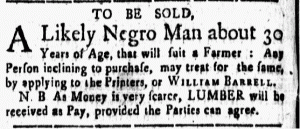
“A Likely Negro Man about 30 Years of Age.”

Yesterday’s featured advertisement announced that the sloop Ranger had arrived in Philadelphia carrying a human cargo, a “Parcel of healthy SLAVES, men, women, boys, and girls” “from the river Gambia” who were soon to be “sold upon low terms.” I argued that although the number of slaves that resided in northern colonies did not approach those in southern colonies, the advertisement demonstrated that slavery and the transatlantic slave trade were indeed part of society, culture, and commerce throughout all the colonies. Contrary to common misconceptions about the American past, slavery was not absent in the colonies that eventually became free states in the nineteenth century.

I concluded by noting that a single advertisement was one piece of evidence, suggestive but perhaps not sufficient documentation to be completely convincing. To that end, today I have selected a companion advertisement published one day later but hundred of miles further north in another colony. William Barrell wished to sell “A Likely Negro Man about 30 Years of Age.” He indicated that the unnamed enslaved man “will suit a Farmer.” These two advertisements are representative of the many similar ones inserted in newspapers published in cities in northern cities.

Advertisements for enslaved people – seeking to sell them or to buy them, warning against runaways or announcing their capture – certainly appeared in greater numbers in newspapers published in the Chesapeake and the Lower South, but that does not mean that such notices in northern newspapers may be dismissed. This advertisement for “A Likely Negro Man” inserted in the New-Hampshire Gazette, published in Portsmouth (the most northern city with a newspaper in 1766 in what became the United States*), testifies to an accepted practice and part of everyday life. (*Halifax, Nova Scotia, founded less than two decades earlier, also had a newspaper. None of the issues from 1766 in the collections of the American Antiquarian Society include advertisements for slaves, though the commodities offered for sale were certainly part of the larger networks of trade that crisscrossed the Atlantic and incorporated the slave trade.) Colonists in New England and the Middle Atlantic lived in a society that allowed for slavery. They encountered slaves regularly. Some owned or traded slaves. To assume that slavery was a southern phenomenon misconstrues the past.