What was advertised in a revolutionary American newspaper 250 years ago today?
Newport Mercury (September 11, 1775).
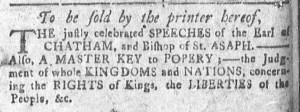
“THE justly celebrated SPEECHES of the Earl of CHATHAM, and Bishop of St. ASAPH.—Also, A MASTER KEY to POPERY.”
To fill the space at the bottom of the last column on the final page of the September 11, 1775, edition of the Newport Mercury, Solomon Southwick, the printer, inserted a short advertisement that listed several books and pamphlet that he sold at his printing office. Most of them had been featured in longer advertisements, including “the Judgment of whole KINGDOMS and NATIONS, concerning the RIGHTS of Kings, the LIBERTIES of the People, &c.” Southwick’s edition was one of three printed in the colonies in the past two years. The printer also stocked the “justly celebrated SPEECHES of the Earl of CHATHAM, and Bishop of St. ASAPH.” The bishop, a member of Parliament, opposed “altering the Charters of the Colony of Massachusetts Bay,” one of the Coercive Acts enacted by Parliament in retaliation for the Boston Tea Party. When prevented from delivering his speech during deliberations, he instead published it. That earned him significant acclaim in the colonies. William Pitt, the first earl of Chatham, had been “dear to AMERICA” for a decade thanks to his opposition to the Stamp Act. Southwick’s printing office was clearly a place for Patriots to shop for reading material.
The books on offer included “A MASTER KEY to POPERY.” Southwick promoted that volume widely even before taking it to press, disseminating subscription proposals in newspapers throughout New England. They promised an extensive anti-Catholic screed, an exposé of “popery” by a former priest. Southwick either gained enough subscribers to make the project viable or felt strongly enough about the supposed dangers of Catholicism that he printed the book. Once he had copies ready for sale, he linked religion and politics in an advertisement that condemned “the infernal machinations of the British ministry, and their vast host of tools, emissaries, &c. &c. sent hither to propagate the principles of popery and slavery, which go hand in hand, as inseparable companions.” Such prejudices resonated as colonizers expressed dismay over the Quebec Act, yet another of their grievances against Parliament. That legislation gave several benefits to Catholic settlers in territory gained from the French during the Seven Years War, an insult to Protestants in New England who had sacrificed so much in fighting the British Empire’s Catholic enemies. For Southwick and many of the readers of the Newport Mercury, support for the American cause and anti-Catholicism went hand in hand during the imperial crisis and the beginning of the Revolutionary War.
What was advertised in a revolutionary American newspaper 250 years ago today?
Constitutional Gazette (September 2, 1775).
“A collection of the most elegant swords ever before made in America.”
John Anderson’s call for advertisers to insert notices in the Constitutional Gazette yielded more results. He touted the circulation of his new newspaper in the August 23, 1775, edition, asserting that the “Public will easily perceive the advantage of advertising in the Constitutional Gazette.” Three days later, Abraham Delanoy ran an advertisement for pickled lobsters and fried oysters, adorning it with the woodcut depicting a lobster trap and an oyster cage that accompanied his advertisements in other newspapers. Like printers of other newspapers, Anderson also inserted several advertisements that promoted the goods and services available at his printing office.
For the September 2 edition, other advertisers submitted notices. Roger Haddock and William Malcolm described the contents of a chest stolen from onboard the Thistle on August 30 and offered a reward for apprehending the thief and returning the missing items. Peter Garson and Caleb Hall advertised a house and land at “Peek’s-Kill, on the post-road, within three quarters of a mile of a convenient landing” that they considered “suitable for a merchant, trader, or mechanick.” In collaboration with Mrs. Joyce and other local printers, Anderson once again hawked “JOYCE’s Grand American Balsam,” a patent medicine that alleviated a variety of disorders. He also continued advertising a pamphlet, “Self defensive WAR lawful.”
In addition, Charles Oliver Bruff, a goldsmith and jeweler with experience advertising in other newspapers, placed an advertisement for “SWORDS.” Although Delanoy republished copy from his previous advertisements, Bruff generated new copy for his advertisement in the Constitutional Gazette. “Those Gentlemen who are forming themselves into Companies in Defence of their LIBERTIES,” he proclaimed, “that are not provided with SWORDS, May be suited therewith by applying to Charles Oliver Bruff.” Such an appeal kept with the tone of Anderson’s Constitutional Gazette. Bruff presented several options for the pommel, including William Pitt’s head with the motto “Magna Charta and Freedom” and John Wilkes’s head and the motto “Wilkes and Liberty.” Both men had been vocal advocates of American rights in Britain. Bruff was not the first advertiser in the colonies to honor Pitt and Wilkes with commemorative items. The goldsmith and jeweler declared that he stocked “the most elegant swords ever made in America, all manufactured by said BRUFF.” His advertisement fit the times now that hostilities had commenced in Massachusetts and George Washington took command of the Continental Army laying siege to Boston. As Anderson sought to expand advertising in the Constitutional Gazette, Bruff’s advertisement for swords addressed to gentlemen defending “their LIBERTIES” complemented his own advertisement for John Carmichael’s sermon, “Self defensive WAR lawful.”
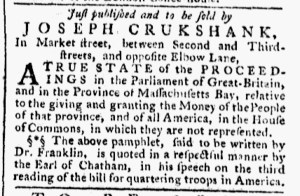
“The above pamphlet … is quoted in a respectful manner by the Earl of Chatham.”
Two weeks after the First Continental Congress commenced its meetings in Philadelphia, Joseph Crukshank took to the pages of Dunlap’s Pennsylvania Gazette to advertise that he had “Just published … A TRUE STATE of the PROCEEDINGS in the Parliament of Great-Britain, and in the Province of Massachusetts Bay, relative to the giving and granting the Money of the People of that province, and of all America, in the House of Commons, in which they are not represented.” As was often the case, the extensive title simultaneously provided an overview of the pamphlet’s contents and served as advertising copy.
Yet that was not the only appeal made in this advertisement. Crukshank, the printer of this American edition of a work originally published in London, sought to entice buyers with additional information. “The above pamphlet, said to be written by Dr. Franklin,” he informed readers, “is quoted in a respectful manner by the Earl of Chatham, in his speech on the third reading of the bill for quartering troops in America.” Colonizers had long celebrated William Pitt the Elder for his advocacy on their behalf, doing so once again when he considered the wisdom of the Quartering Act, one of the Coercive Acts that Parliament passed in the wake of the Boston Tea Party. Historians have determined that Arthur Lee compiled the pamphlet from material furnished by Benjamin Franklin.
The title of the pamphlet, including its reference to the colonies lacking direct representation in Parliament, buttressed the arguments presented in letters and editorials that ran elsewhere in the September 19, 1774, edition of Dunlap’s Pennsylvania Packet. On its own, the advertisement operated as a miniature editorial among the other content of the newspaper. Scholars debate the extent that political pamphlets shaped public opinion, some arguing that newspapers reached many more people. Compared to pamphlets, newspapers were inexpensive, plus they circulated widely. Yet advertisements for political pamphlets did important work, even if few readers opted to purchase or read those pamphlets. The advertisements contributed to an impression of the discourse taking place, signaling to readers what others believed about current events and why they should prefer one position over another. Most readers of Dunlap’s Pennsylvania Packet never purchased Crukshank’s American edition of a political pamphlet originally published in London, yet the advertisement relayed information about the position taken by a popular politician and made an argument about the colonies’ lack of representation in Parliament. The advertisement became part of the news environment.
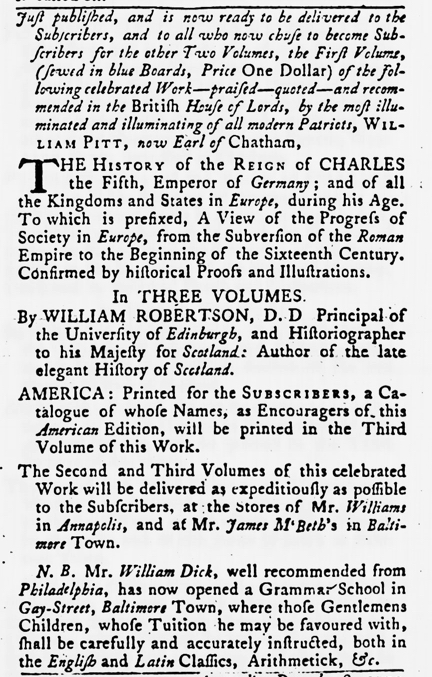
When Robert Bell published an American edition of “THE HISTORY of the REIGN of CHARLES the Fifth, Emperor of Germany” in 1771, he placed advertisements and subscription notices in multiple newspapers in several colonies. Printer-publishers regularly adopted that strategy, especially prior to the American Revolution, because local markets did not necessarily support the publication of American editions as alternatives to imported ones. To generate sufficient demand to make American editions viable ventures, Bell and his counterparts had to engage consumers across large regions rather than just in their own towns.
Bell, one of the most famous and influential American booksellers both before and after independence, made innovations to the practice of reprinting the same advertisements and subscription notices from one newspaper to another. Rather than submitting identical copy to multiple newspapers, updating only the names of the local sellers and subscription agents, he devised a series of notices that varied from publication to publication. Each contained some of the especially elaborate, even by eighteenth-century standards, language that became one of Bell’s trademarks. He opened his advertisement in the January 31 edition of the Maryland Gazette, for instance, with a proclamation that he had “Just published … the following celebrated Work – praised – quoted – and recommended in the British House of Lords, by the most illuminated and illuminating of all modern Patriots, WILLIAM PITT, now Earl of Chatham.” Pitt became popular among American colonists for defending their interests against attempts by Parliament to regulate commerce and other impositions. In particular, he vigorously opposed the Stamp Act, arguing that it was unconstitutional to impose taxes on the colonies. It was not merely Pitt’s testimonial regarding “THE HISTORY of the REIGN of CHARLES the Fifth, Emperor of Germany” that Bell expected would resonate with consumers but also his reputation as an advocate for the colonies.
Bell also included a version of the imprint in his advertisement: “AMERICA: Printed for the SUBSCRIBERS, a Catalogue of whose Names, as Encouragers of this American Edition, will be printed in the Third Volume of this Work.” He did not follow the usual practice of listing a city. This was not, after all, a book printed in Philadelphia, but instead an American production that demonstrated the literary culture of the colonies considered collectively. Bell worked to create a sense of community among subscribers who purchased copies, an imagined community, to use the phrase coined by Benedict Anderson, constructed with print and extending great distances. Despite those distances, the subscribers had a common meeting place in the “Catalogue” of names printed in the final volume. Publishing a list of subscribers who made a publication possible was not new, but Bell presented the opportunity for prospective buyers to be included as a testament to their patriotism and support for the American cause rather than merely an indication of their status and good taste.
The advertisement concluded with a quirky nota bene in which Bell recommended a schoolmaster from Philadelphia who recently moved to Baltimore, an endorsement seemingly unrelated to the remainder of notice. It may have been less expensive for Bell to append the nota bene rather than insert a separate advertisement. Whatever the reason, the nota bene fit well with Bell’s pattern of deviating from expectations and setting his own standards, both within his advertisements and in his eccentric behavior at book auctions. His advertisement deployed familiar “Buy American” appeals, but did so in especially exuberant language, invited prospective subscribers to become part of a community of citizen-readers, and ended with a recommendation for a schoolmaster. Bell presented consumers some of the appeals they came to expect from him as well as at least one surprise, a pattern for engaging with customers and audiences that he further developed over the next several decades.
What was advertised in a colonial American newspaper 250 years ago today?
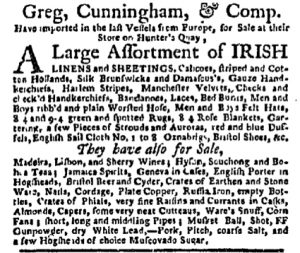
Occasional Supplement to W. Weyman’s Gazette of Yesterday [New-York Gazette] (September 30, 1766).“LINENS and SHEETINGS, … Russia Iron, … Ware’s Snuff.”
Today’s advertisement features Greg, Cunningham, & Company and their vast assortment of all different types of goods recently “imported in the last Vessels from Europe.” Fairly unlike any other advertisements I have looked at this week, this shop offered more than a surplus of different textiles and clothing materials, such as “LINENS and SHEETINGS,” laces, velvets, and handkerchiefs, Greg, Cunningham, and Company also carried products that would be found in a modern hardware and sporting goods store. Materials like “Russia Iron,” gunpowder and musket balls were available as well as “Plate Copper” and “dry White Lead.” I had not seen these products advertised before; they stood out because they show that colonists needed supplies that allowed for expansion, growth, and opportunities for new development. From the hardware products to clothing to even a selection of medicines, Greg, Cunningham, and Company offered a diverse selection of goods to consumers.
The advertisement also listed “Ware’s Snuff.” Since it was listed with “middling pipes” and different alcoholic beverages, at first glance I assumed “Ware’s Snuff” was just another pleasure for adults. In fact snuff was extremely popular among men, not only as a product to enjoy, but as a social measure as well. According to Edwin Tunis, “Nearly every man carried the most expensive [snuff box] he could afford.” Some had a different box for every day. Even women took advantage of the readily available product, but only in private.[1] However, after researching further, I found that “Ware’s Snuff” was actually used as a cure for some sicknesses as well. Taking this up the nose would often lead to “a very large discharge of mucus.”[2]
**********
ADDITIONAL COMMENTARY: Carl Robert Keyes
Nick focused on the content of the advertisement he selected for today, but I am also interested in the context in which it appeared. Today’s advertisement was included in a half sheet Occasional Supplement to W. Weyman’s Gazette of Yesterday. Like nearly half of colonial American newspapers published in 1766, William Weyman distributed the New-York Gazette on Mondays – and, usually, only Mondays. Typically, each issue consisted of four pages, two printed on each side of a broadsheet that was then folded in half. In most cases, that was the extent of the news and advertising made available by any particular newspaper during any particular week.
At this time the Pennsylvania Gazette did provide a notable departure. It frequently inserted an additional half sheet in its standard four-page issue, bringing the entire issue to a total of six pages. Even with this additional content, however, the Pennsylvania Gazette did not attempt to distribute additional full issues more than once a week. In the 1770s some newspapers experimented with printing two or three issues per week, but it was not until after the Revolution that newspapers in the largest cities began daily publication.
This brings us back to Greg, Cunningham, and Company’s advertisement and the Occasional Supplement to the New-York Gazette in which it appeared. Why deviate from the usual publication schedule? Considering the amount of labor involved in producing an additional half sheet, why have an Occasional Supplement appear just one day after Monday’s regular issue, rather than later in the week? The “Subject of the Day is quite altered,” the first line of the Occasional Supplement proclaimed, due to “the Arrival of the Lord Hyde Packet” and the news it carried “with regard to the Change in the Ministry.” At the end of July, Lord Rockingham had been dismissed as prime minister. The king instructed William Pitt the Elder to form a government and granted him a title, making him the first Earl of Chatham. Pitt was popular among American colonists, both for his incisive leadership during the Seven Years War and, especially, for his opposition to the Stamp Act. Yet the Occasional Supplement noted that in Britain “there is pro and con, for and against Mr. PITT.” Weyman selected excerpts from letters that arrived on the packet ship “to give both Sides a Chance, and must leave our Readers to judge for themselves.” This news was too significant to wait an entire week to report it in the next issue of the New-York Gazette, hence Weyman’s decision to rush to press with an Occasional Supplement.
This news filled almost the entire first page of the Occasional Supplement, but the other side featured advertisements (including Greg, Cunningham, and Company’s advertisement) exclusively. Sometimes supplements and additional half sheets (like those that accompanied the Pennsylvania Gazette in 1766) were mechanisms for distributing additional advertising, the demand for advertising space exceeding the what was available in regular issues. In this case, however, we see that political reporting opened an opportunity to distribute greater numbers of advertisements. Weyman and others who worked in his shop could have cut their work in half by printing a broadside that reported the news, but instead chose to print advertising on the other side before distributing the Occasional Supplement on September 30, 1766.
**********
[1] Edwin Tunis, Colonial Craftsmen and the Beginnings of American Industry (New York: World Publishing Company, 1965), 53.
[2] Thomas John Graham, Modern Domestic Medicine (London: Published for the Author, 1827), 369.
“Some excellent pieces of sculpture in relieve of Lord CAMDEN and Mr. PITT.”
In the wake of the American Revolution, a variety of artists created and marketed items that commemorated American statesmen and military heroes and depicted significant events. In so doing, they participated in creating a national culture that celebrated the new republic while uniting geographically dispersed citizens in common acts of consumption and veneration. They helped to cultivate a sense of patriotism rooted in a distinct American identity.
Prior to the Revolution, artists also produced and sold items that shaped national identity and allegiance. In the summer of 1766, colonists in Virginia could purchase “some excellent pieces of sculpture in relieve of Lord CAMDEN and Mr. PITT” created by a “Celebrated artist in London.” Camden and Pitt were British politicians who had gained popularity in the colonies due to their opposition to the Stamp Act, arguing that it was not constitutional to impose taxes on the colonies without their consent and that consent was only possible with representation. Camden was one of the few who opposed the Declaratory Act as well. From the perspective of Americans who opposed the Stamp Act, Camden and Pitt truly understood the appropriate and just relationship between Great Britain and the colonies. The advertisement for the sculpture in relieve pieces described them as “names which will be ever dear to AMERICA,” but offered no further explanation. None was needed. Any colonists who read the newspaper or listened to discussions taking place in public places already knew of the accomplishments of Camden and Pitt.
This advertisement and the works it marketed envisioned American political and cultural identity in complicated ways. Americans still thought of themselves as Britons in 1766. At the time, few wanted to sever ties; instead, they sought to benefit from all the protections and advantages that were supposed to be inherent in being part of the British Empire. By purchasing sculpture in relievo pieces of Camden and Pitt and displaying them in their homes, colonists could confirm their allegiance to Britain and the ideals of its political system while simultaneously affirming their particular concerns as Americans. They did not need to prioritize one over the other. The two found themselves in balance rather than opposition to each other, a situation that would change dramatically over the course of the next two decades.