April 5

What was advertised in a colonial American newspaper 250 years ago today?

Pennsylvania Journal (April 5, 1775).

“JOHN MITCHELL’s WINE, SPIRIT, RUM, and SUGAR STORES.”

John Mitchell operated an alcohol emporium in Philadelphia in the 1770s.  In April 1775, he advertised his “WINE SPIRIT, RUM, and SUGAR STORES” on Front Street, inviting customers in the city and its hinterland to purchase his wares and then retail them at their shops or taverns or enjoy imbibing them at home.  To entice prospective customers, he compiled a lengthy list of his current selection along with a pledge to “keep a constant supply of the above Articles” to avoid disappointments associated with selling out of any favorites.

His inventory included, for instance, “BEST Genuine Madeira Wines,” “Excellent bottled Claret,” “Genuine new and old Port Wine,” “Teneriffe and Fyal Wines,” “Red Lisbon Wine,” “Genuine old French Brandy,” “Shone’s, Ben. Kenton and Parker’s best London bottled Porter,” “Genuine Button and Taunton Ale,” and “West-India and New-England Rum,” along with many other choices.  For many items, Mitchell listed several sizes, indicating that customers could purchase the right amount for their home or business.  He sold Madeira by the gallon or in barrels of various sizes, including “by the pipe, hogshead, [and] quarter-cask.”  The bottled porters came “by the hogshead, hamper or dozen” to meet the budget and the convenience of his customers.

The format of Mitchell’s advertisement highlighted the choices.  Rather than list his wines and spirits in a dense paragraph, as many advertisers did when they sought to demonstrate the selection of goods they offered to consumers, Mitchell devoted one line to each item.  That made it easier for readers to peruse his catalog while also creating visual elements that differentiated his advertisement from news items and other notices that consisted of blocks of text justified on both the left and the right.  The variations in white space that resulted from centering each item on its own line made “Best Genuine Madeira Wines,” “Teneriffe and Fyal Wines,” “Genuine old French Brandy,” and “Spanish Brandy” even more visible within the advertisement.  Both the extensive accounting of wines and spirits and the design of Mitchell’s notice contributed to attracting the attention of prospective customers.
May 25

What was advertised in a colonial American newspaper 250 years ago today?

Pennsylvania Gazette (May 25, 1774).

“His Liquor shall ever be pure and unmixed.”

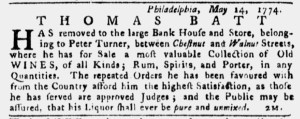
Thomas Batt believed in the power of advertising to yield success for his business.  In 1774, he took to the pages of the Pennsylvania Gazette to announce that he had “opened his WINE and SPIRIT STORE” on Water Street in Philadelphia, pledging “to render the retailing of Liquors as compleat and convenient to the Public, as it is in the Power of Expence and strict Attention to do.”  Not long after that advertisement concluded its run, Batt placed another advertisement, this one dated May 14, to alert the public to his new location at “the large Bank House and Store … between Chestnut and WalnutStreet.”

He took the opportunity to review his inventory with prospective customers, asserting that he stocked “a most valuable Collection of Old WINES, of all Kinds” as well as “Rum, Spirits, and Porter, in any Quantities.”  Batt made a similar appeal about customers purchasing whatever quantity they desired in his previous advertisement, declaring that he was “determined to sell any Quantity, from a Pipe [a large barrel] to a Gallon.”  Perhaps he sought to distinguish himself from local vendors known for selling only large quantities or only small quantities.  Batt emphasized convenience in his initial advertisement; allowing consumers to select the quantity that suited their needs helped him to deliver on that promise.

He also highlighted quality and satisfaction.  He concluded his advertisement with an assurance that “his Liquor shall ever be pure and unmixed.”  Batt did not water down his wine or dilute higher quality spirits with lesser quality ones to increase his profit margins by fooling customers.  The retailer was well on his way to securing a favorable reputation, especially considering the “repeated Orders” he received from “approved Judges” of wines and spirits.  Batt hoped that existing clientele would follow him to his new location as well as new customers seeking him there.  His advertisements suggested a variety of reasons for choosing him over other retailers.

August 25

What was advertised in a colonial American newspaper 250 years ago today?

Connecticut Courant (August 25, 1772).

“WINES.”

William Ellery stocked a variety of wares, but emphasized “WINES” in his advertisement in the August 25, 1772, edition of the Connecticut Courant.  Many purveyors of goods and services used their names as the sole or primary headline in their newspaper advertisements, but Ellery opted to open his advertisement with a segment of his merchandise that he thought would attract attention.  The headline, “WINES,” appeared in a large font, followed by a list of “CHOICE Old Madeira, Claret, Teneriff and Mountain, Malaga WINES.”  Only after that preview did Ellery give his name and location as a secondary headline before providing a more extensive account of beer, spirits, and groceries.  In contrast, an advertisement in the next column featured a more familiar headline, “Imported from LONDON, and to be sold by Stephen Mears, Opposite the North Meeting House in Hartford,” with “Stephen Mears” centered and in a larger font.

Ellery used graphic design to his advantage elsewhere in his advertisement as well.  The “N.B.” that marked the nota bene that followed his list of merchandise appeared in an even larger font than “WINES,” as did the “M” in “MR. ELLERY.”  Even if readers skimmed over “Bristol Beer, and Dorchester Ale, by the Cask, or Dozen Bottles” and “Coffee by the Bag or single Pound,” the large letters guided them to a message from the merchant.  He expressed “his Thanks to those People who have heretofore favour’d him with their Custom” and invited them to continue to “favour him with their Custom.”  Ellery deployed two of the most popular marketing appeals of the period, choice and price, proclaiming that he “his Shop is fuller sorted than ever, as he has just received a large Supply of the above Articles, and flatters himself he cans sell so low as to give intire satisfaction” to his customers.  In contrast, other advertisers tended to position such notes below the headline and above the list of goods.  Once again, Ellery adopted a format that distinguished his advertisement from others.

Ellery’s notice consisted entirely of text, as did all of the advertisements in most issues of the Connecticut Courant.  That did not mean, however, that every advertisement looked the same.  Some advertisers did rely on standard formats, but others sought to engage readers by presenting familiar messages in less familiar formats.  The design of Ellery’s advertisement challenged prospective customers to look more closely at his merchandise and the assertions he made about low prices and extensive choices.

March 30

GUEST CURATOR: Sean Duda

What was advertised in a colonial American newspaper 250 years ago today?

Massachusetts Gazette (March 30, 1769).

“WINE To be Sold by ROSANNA MOORE.”

Rosanna Moore advertised wine imported from other places around the Atlantic world, including Madeira, an island that lies about 450 miles off the western coast of Morocco. Wine, like many other goods, was a common import into the colonies. However, when colonists first came to Virgnia, they tried to make wine. According to Charles M. Holloway, “it was tobacco that made a market, but in the beginning wine looked more likely.” This was one of the contributing factors to the colony not doing well when it was first founded; the colonists could not trust the water source.” Holloway states that “settlers [were] often reduced to drinking from the wide muddy tidal stream, and … sometimes paid for the gamble with their lives.” Because of this, colonists relied on imported wines and they tried to make cider to replace wine. Eventually, the vineyards were actually profitable, but that would not be for a long time. Holloway gives a figure from 1768, a year before Moore’s advertisement: “Virginians exported to Britain a little more than thirteen tons of wine while importing 396,580 gallons of rum from overseas, and another 78,264 from other North American colonies.”

**********

ADDITIONAL COMMENTARY: Carl Robert Keyes

On many occasions Rosanna Moore would have been the only female entrepreneur advertising goods and services in Richard Draper’s Massachusetts Gazette, but that was not the case in the March 30, 1769, edition. Three other women also inserted advertisements in that issue. Elizabeth Clark, Elizabeth Greenleaf, and Anna Johnson each listed the “Assortment of Garden Seeds” they imported from London and offered for sale at their shops in Boston. Their notices appeared in a single column, one after another, forming a block of advertisements placed by women, making their presence in the public prints difficult to overlook.

Throughout the late winter and early spring of 1769, female seed sellers advertised in most of the newspapers published in Boston. It was an annual ritual that contributed to a rhythm of advertising. Just as advertisements for almanacs tapered off, a sign that the new year had come and gone, advertisements for garden seeds, the vast majority placed by women, began filling the pages of Boston’s newspapers. During the last week of March 1769, female seed sellers placed advertisements in all of the city’s newspapers except the Boston Chronicle. (Established within the past couple of years, the Chronicle had not cultivated the same volume of advertising as its competitors. All sorts of advertisers, including seed sellers, apparently preferred to pursue their marketing efforts in other publications.) Advertisements from Elizabeth Clark, Bethiah Oliver, Susanna Renken, and Elizabeth Greenleaf filled the entire final column on the last page of the Boston Evening-Post. Advertisements from Susanna Renken, Rebeckah Walker, Lydia Dyar, and Abigail Davidson appeared one after another in the Boston-Gazette, while Elizabeth Clark’s advertisement ran elsewhere on the same page. In Green and Russell’s Massachusetts Gazette (published on the same broadsheet as the Boston Post-Boy), Sarah Winsor, Susanna Renken, Anna Johnson, and Elizabeth Greenleaf occupied almost an entire column with their advertisements for imported seeds.

The merchandise offered by these female seed sellers differed from the “OLD Sterling MADEIRA … and other WINES” hawked by Moore. Renken, who noted in some of her advertisements that she had “a Box of China Ware to sell,” was the only one of those female seed sellers who regularly advertised other sorts of wares throughout the rest of the year. Although female shopkeepers comprised a significant minority of shopkeepers in port cities like Boston, New York, and Philadelphia, they did not advertise in proportion to their numbers. Female seed sellers appear to have been the exception. Perhaps the occupation became so feminized as to outweigh any concerns about trumpeting their presence in the marketplace as suppliers rather than consumers. Even as competitors, Clark, Davidson, Dyar, Greenleaf, Johnson, Oliver, Renken, and Walker participated in a common venture when they advertised seeds in Boston’s newspapers. Rosanna Moore, the lone female entrepreneur advertising anything other than seeds in late March 1769, remained an outlier.

October 13

What was advertised in a colonial American newspaper 250 years ago today?

Oct 13 - 10:13:1768 Massachusetts Gazette Draper
Massachusetts Gazette [Draper] (October 13, 1768).
“All Persons shall be as well served by Letter as if present.”

In the late 1760s Joshua Blanchard operated a “Wine-Cellar near the Market” in Boston. He sold “Choice Sterling Madeira … and all other Sorts of Wine” in a variety of quantities, “by the Pipe, Quarter-Cask, or in Bottles by the Groce or Dozen” or any other measure “as may suit the Buyer.” In addition, he also sold “West India and New-England Rum.” Transporting, repackaging, and selling wine and spirits required special skills and attention compared to textiles, housewares, hardware, and many other imported goods frequently promoted in newspaper advertisements. To that end, Blanchard informed prospective customers of the care exhibited in distributing his wine in the marketplace.

Blanchard envisioned several sorts of customers. He addressed “Gentlemen of the Town, Masters of Vessels, and all Persons going abroad,” promising them that he offered the “best Kinds” of wine. He also assured prospective customers about the packaging, noting that they “may depend on having their Wine put up in the best Manner.” There was no need to worry about spilling or spoiling that resulted from the work undertaken at Blanchard’s wine cellar to transfer wine from its original casks to new bottles or barrels of various sizes. Blanchard’s emphasis on quality extended beyond the product itself; it included his efforts in distributing the wine.

In addition to serving customers in the busy port, Blanchard invited “Gentlemen in the Country, Inn-keepers, and all other Persons” to send orders to his wine cellar. Transactions did not need to take place face to face. Instead, customers “shall be as well served by Letter as if present.” In other words, Blanchard provided a form of mail order service. That made his attention to quality an even more important marketing appeal. He first needed to assure prospective customers that his wine and rum would survive transport without incident before presenting the option of delivering it in response to orders placed in letters. Blanchard underscored “Care & Fidelity” in the second half of his advertisement, in relation to his work as a broker, but that phrase also applied to treatment of the products that passed through his wine cellar as well.

September 11

What was advertised in a colonial American newspaper 250 years ago today?

Sep 11 - 9:11:1767 New-London Gazette
New-London Gazette (September 11, 1767).

“Choice MADEIRA, TENERIFE, and FAYAL WINES.”

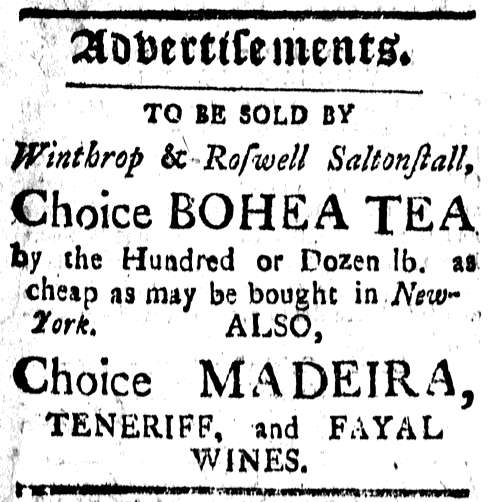
Some newspaper advertisements presented consumers with lengthy lists of manufactured goods imported from England, but others promoted foods and beverages that originated in places outside Britain’s global empire. In the September 11, 1767, edition of the New-London Gazette, for instance, Winthrop and Roswell Saltonstall announced that they sold “Choice … WINES” imported from islands in the eastern Atlantic. Madeira and Fayal wines came from Portuguese outposts. Madeira, a fortified wine, derived its name from the main island in the Madeira archipelago. Fayal (an English variation of Faial) wines came from one of the islands in the central group of the Azores, an archipelago consisting of nine islands. Tenerife wines came from the largest of the seven Canary Islands, conquered and colonized by Spain. In consuming wines from Madeira, Tenerife, and Fayal, colonists participated in vibrant networks of exchange that crisscrossed the Atlantic. Such networks often crossed imperial boundaries, even as nation-states attempted to enforce mercantilist policies.

Given that the Saltonstalls advertised these wines in the public prints, they most likely had imported them legally. Yet a variety of commodities – sugar, molasses, rum, foodstuffs, and wine – found their way to colonial markets via smuggling. “The case of wine is a good example,” according to David Hancock. “Not just in war but also in peace, the varieties and amounts of wine available in British America were greater than those allowed by law and recorded at the customs house.”[1] As the Saltonstalls’ advertisement suggests, colonists could identify many types of wine and made associations with their places of origin. Just as they were accustomed to extensive choices when it came to textiles and housewares, they expected wine merchants to present an assortment so they could make their own selections. Without going into elaborate detail, the Saltonstalls listed three different wines to signal the diversity of their stock to prospective customers.

[1] David Hancock, “Rethinking The Economy of British America,” in The Economy of Early America: Historical Perspectives and New Directions, ed. Cathy Matson (University Park: Pennsylvania State University Press, 2006), 81.

August 18

What was advertised in a colonial American newspaper 250 years ago today?

Aug 18 - 8:18:1767 South-Carolina Gazette and Country Journal Supplement
Supplement to the South-Carolina Gazette and Country Journal (August 18, 1767).

“They will be warranted to be equal, if not superior in quality, to any WINES that has been imported this season.”

Samuel Peronneau advertised “A large parcel of genuine Made[i]ra Wines” in the supplement that accompanied the August 18, 1767, edition of the South-Carolina Gazette and Country Journal. On the same page, William Hulme promoted the “MADEIRA, VIDONIA and LISBON WINES, BRANDY and GIN” he sold, along with “RUMS, from Jamaica, Barbados, and the Northward.” Elsewhere in the issue, several shopkeepers advertised other alcoholic beverages. James McCall included “bottled beer, cyder, ale, and perry” among a list of dozens of imported items in stock at his shop. Samuel Grove carried “best Taunton ale, [and] cyder,” while Greenland and Jones sold “best Bristol bottled beer, [and] Philadelphia ditto in whole and half barrels.” Other merchants and shopkeepers regularly advertised beers, wines, and liquors in the South-Carolina Gazette and Country Journal and other newspapers printed in Charleston in the late 1760s. Residents of Charleston had many options when it came to acquiring alcohol.

Amid this sea of choices, Peronneau attempted to distinguish his offerings from those presented by his competitors. He confidently stated that his wines were “Of the best London, York, and Jamaica qualities” and boldly pledged that they “will be warranted to be equal, if not superior in quality, to any WINES that has been imported this season.” Some competitors made passing comments about the quality of their beverages, but Peronneau elaborated on why potential customers could trust his assurances in that regard. He did not sell whatever happened to be shipped to him by faraway associates. Instead, he contracted “a gentleman on the spot” to examine “every pipe.” In each instance, that gentleman “spared no pains in the choice of them.” In effect, Peronneau had a quality control agent overseeing the merchandise that entered his warehouse. Ultimately, that “gentleman” worked on behalf of Peronneau’s clients, his efforts mutually benefitting the retailer and the customers rather than the suppliers.

Whether they sold wine or other imported goods, most advertisers did not provide much information about the processes through which they acquired their inventory. Peronneau, however, had a system that distinguished his wines from others on the market. This allowed him to include specific details that further developed his appeal to quality, one of the most common appeals in eighteenth-century advertisements. Rather than make vague and general statements about the quality of his merchandise, Peronneau offered potential customers specific details explaining why they should believe that he did indeed stock wine “equal, if not superior in quality” to any others they could purchase locally.

March 27

What was advertised in a colonial American newspaper 250 years ago today?

Mar 27 - 3:27:1767 Connecticut Gazette
New-London Gazette (March 27, 1767)

“Genuine Medeira, Tenerif, and Fayal Wines, per Pipe or lesser Quantity.”

Winthrop and Roswell Saltonstall’s advertisement for imported wines and other commodities stood out in the March 27, 1767, issue of the New-London Gazette. It was one of only three advertisements promoting consumer goods and services. One of them advertised ferry service – “A Passage-Boat” – that Ebenezer Webb operated between Long Island and New London. The other, placed by the printer, announced the publication of “An excellent Treatise, entituled Heaven upon Earth.” Very few other paid notices appeared in that issue.

Such was usually the case when it came to advertising in the New-London Gazette. Of the more than twenty newspapers published in the colonies in 1767, the New-London Gazette and Hartford’s Connecticut Courant carried the least advertising, often half a dozen or fewer total notices. Even the Providence Gazette, which experienced a dearth of advertising in the winter of 1766 and 1767, usually filled a page or more with advertisements repeated from earlier issues, but the printers of the New-London Gazette and the Connecticut Courant did not adopt that strategy. Visually, both newspapers from Connecticut stood in stark contrast to their counterparts published in other colonies. Other eighteenth-century newspapers overflowed with advertising, often to the extent that printers distributed supplements devoted exclusively to paid notices of all sorts.

In general, advertisements for consumer goods and services manifested dual purposes in early America. They did more than merely announce the availability of various wares. Instead, advertisers sought to incite demand among potential customers, fueling a consumer revolution that did not emerge from incipient demand alone. In the process of generating demand, advertisers also engaged in competition with others in the same occupation. At least this is the story the Adverts 250 Project tells almost every day. It is a story that flows naturally from the Pennsylvania Gazette and the South-Carolina Gazette and Country Journal, from the Boston Post-Boy and the New-York Mercury, each of them filled with advertisements, but not from the New-London Gazette or the Connecticut Courant.

What explains the differences? Was advertising primarily an urban phenomenon in the decade prior to the American Revolution? Do other factors explain the relative scarcity of advertising in some, but not all, newspapers published outside the largest cities? This project grew out of a dissertation that examined advertising in eighteenth-century Philadelphia. Consulting as many newspapers from as many places as possible raises new questions and suggests that previous conclusions merit moderation.

February 27

GUEST CURATOR: Samuel Birney

What was advertised in a colonial American newspaper 250 years ago today?

feb-27-2271767-south-carolina-and-american-general-gazette
South-Carolina and American General Gazette (February 27, 1767).

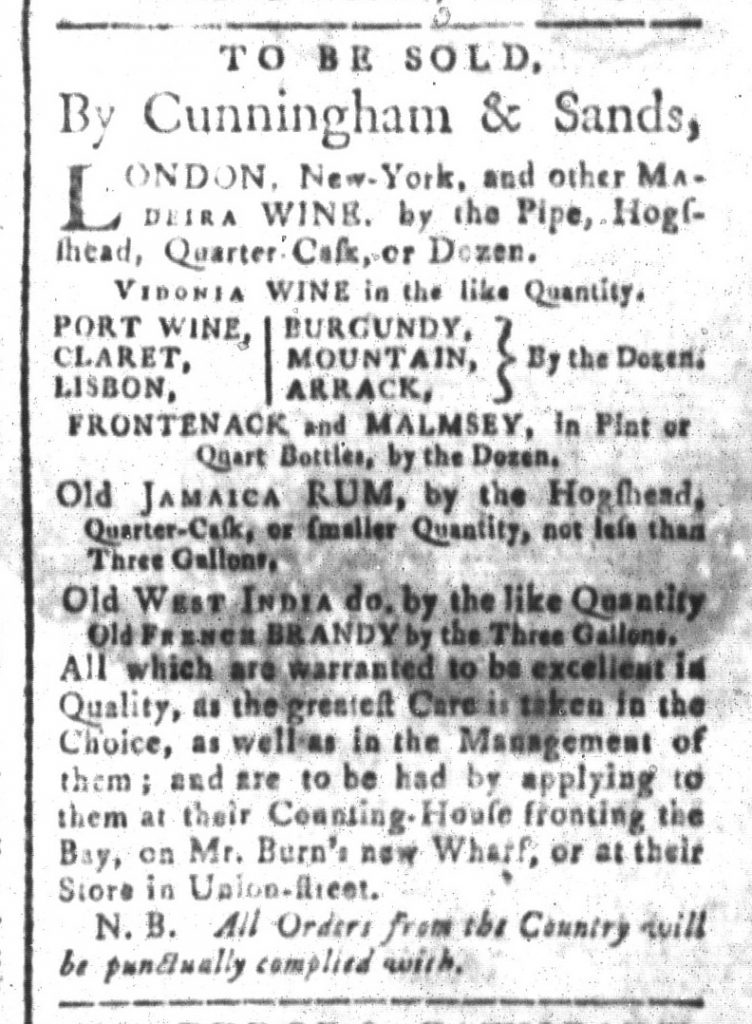
“LONDON, New-York, and other MADEIRA WINE, by the Pipe, Hogshead, Quarter Cask, or Dozen.”

Colonial Americans drank alcoholic beverages all the time and at any time they wanted. According to Ed Crews, colonists commonly had a drink for breakfast, brunch, lunch, pre-dinner snacking, during supper, and right before bed. Colonists enjoyed drinking at social events, work, and, even during studies at colleges. In fact, Crews reports, in 1639 Nathaniel Eaton, the President at Harvard College at the time, “lost his job” when he did not provide enough beer for students and staff. Alcohol was a wonder drink believed to have many beneficial properties ranging from warming the body, making people stronger, aiding the sick, and generally causing people to have a good time.

Today’s notice advertised the sale of a variety of wines and spirits imported from across the Atlantic, including Madeira, Port, Burgundy, Claret, and Brandy, as well as Jamaican Rum from the Caribbean. Colonists had a variety of different drinks they preferred, including mixers called Rattle-Skull, Stonewall, Bogus, Blackstrap, Bombo, Mimbo, Whistle, Belly, Syllabub, Sling, Toddy, and Flip, and just as many names for being drunk.

Wine, rum, and whiskey were favored drinks among the colonists, with rum being king amongst the common man. Elites imported wine, especially Jefferson who loved French wine and attempted to produce wine in America, a failed endeavor. George Washington, on the other hand, owned and operated a private whiskey distillery on his property at Mt. Vernon.

American colonists consumed a large variety of alcoholic beverages for various occasions and at times throughout the day, with wine, rum, and whiskey being especially favorite drinks.

For more on “Drinking in Colonial America,” see Ed Crews’ article on the Colonial Williamsburg website.

**********

ADDITIONAL COMMENTARY: Carl Robert Keyes

Cunningham and Sands, purveyors of all sorts of alcohol, emphasized quality and service in their advertisement. Whether customers purchased any of a dozen different varieties of wine or instead opted for rum from Jamaica and other locales in the West Indies, all were “warranted to be excellent in Quality.” This was possible because Cunningham and Sands took “the greatest Care” in choosing which wines and rum to import and sell, implying a certain level of expertise on their part. They also took great care in “the Management” of the wines they stocked, suggesting that they were shipped and stored under the best conditions in order to avoid any sort of contamination or turning. Cunningham and Sands implied that they knew wine as well as artisans knew their trades.

In terms of service, the partners offered several options to potential customers interested in obtaining their products. Consumers could visit Cunningham and Sands at one of two locations in Charleston, either “at their Counting-House fronting the Bay, on Mr. Burn’s new Wharf, or at their Store in Union-street.” Realizing that not all readers of the South-Carolina and American General Gazette – and prospective customers – resided in the Charleston or had easy access to either of their two locations, Cunningham and Sands also announced that “All Orders from the Country will be punctually complied with.” In effect, they offered mail order service! They apparently believed this convenience would attract customers. Not only did they include it in their advertisements, they also drew special attention to it by inserting it as a separate nota bene rather than including it in the paragraph of dense text that detailed the other aspects of quality and service they provided. (Whether Cunningham and Sands or the printer decided that the nota bene should be printed in italics is much more difficult to determine. Advertisers generally wrote their own copy and printers generally made decisions about layout, but occasionally advertisers exercised some influence over format.)

Sam notes that Americans consumed a fair amount of alcohol and enjoyed various sorts of wines and spirits. Today’s advertisement reveals some of the options available to them as well as part of the process involved in shopping for these items.

December 14

What was advertised in a colonial American newspaper 250 years ago this week?

dec-14-12131766-new-york-journal-supplement
Supplement to the New-York Journal (December 13, 1766).

“TO BE SOLD, by THOMAS DERHAM, … CHOICE Teneriffe Wine.”

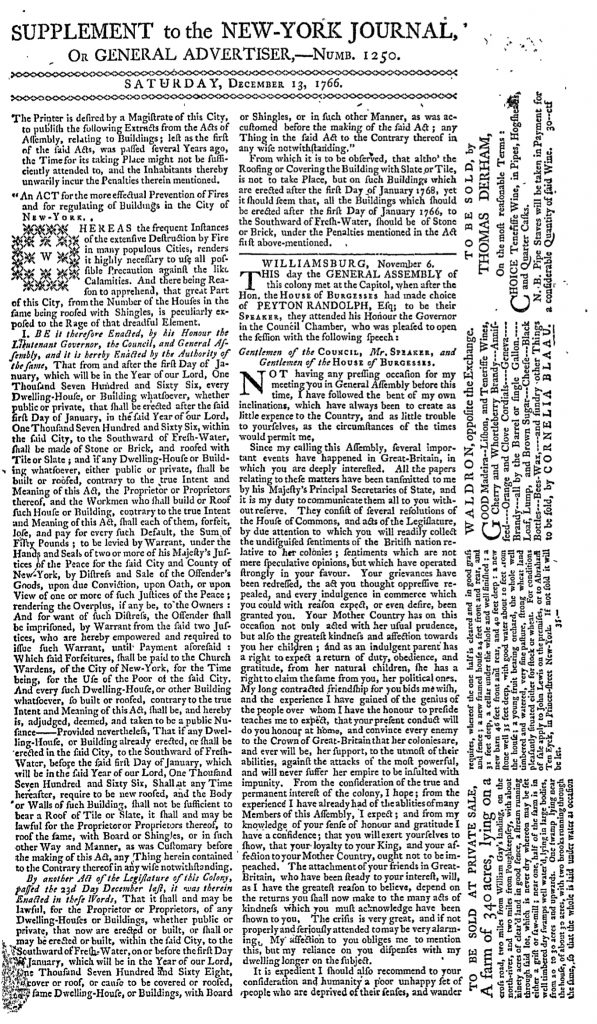
Thomas Derham’s advertisement for “CHOICE Teneriffe Wine” occupied a rather unique position on the first page of the Supplement to the New-York Journal, printed two days after that week’s regular issue of December 11. It appeared in the upper right corner, but the entire advertisement had been rotated ninety degrees counterclockwise, such that it was printed perpendicularly to the two columns that comprised the majority of the news and advertising on the page. A narrow column of text – actually four columns, each rotated ninety degrees counterclockwise – appeared on the right side of the page.

dec-14-12131766-full-page-new-york-journal-supplement
Supplement to the New-York Journal (December 13, 1766).

When I first encountered this striking image when consulting the digitized reproductions of eighteenth-century newspaper made available via Readex, I suspected that I knew how to explain it, having examined something similar in the New-Hampshire Gazette earlier this year. It looked as though the supplement had been printed on a smaller broadsheet than the regular issue, reducing the number of columns, but the industrious printer rotated some of the text to squeeze in as much news and advertising as possible. There was no way to know for certain that this was the case, however, without examining original copies of the supplement and standard issues of the New-York Journal from 1766. Readex does not supply metadata about the measurements of broadsheets and columns, nor do I fault the company for not providing this information since it would be prohibitively expensive to collect and code. This is an instance in which working with digital surrogates hides information about the sources that would have been apparent from just a glance at the original. For the record, unless a ruler appeared in every frame of the microfilm reproduction of the New-York Journal, I would have encountered the same difficulty. The shortcoming is not specific to digitization but rather to any sort of surrogate that removes the researcher from interacting with the text in its material form.

Besides, as much as I appreciate the convenience of working with so many digitized newspapers as I pursue this project, sometimes it’s nice to have an excuse for working with the originals. Upon examining the American Antiquarian Society’s copy of the New-York Journal I learned that my assumption was indeed correct. John Holt used a smaller sheet for the supplement (8 & ½ inches by 14 inches rather than 10 inches by 15 & ½ inches). He maintained the same column width, 2 & 7/8 inches, but did not have sufficient space for a third column, at least not unless he rotated some of the text in order to make it fit on the narrower page. Each of the four columns in the “bonus” column measured 2 & 7/8 inches. All of the text from those miniature, rotated columns appeared in a previous issue of the New-York Journal. Holt did not need to set new type; he simply moved around advertisements that had been set already.

Did readers take special notice of Thomas Derham’s advertisement because of its rather unique placement on the page? Possibly, but whatever additional interest it may have generated cannot reasonably be attributed to any sort of intentional effort to produce an innovative layout to draw attention to advertising. Instead, the printer was practical and pragmatic when putting together the December 13 supplement. Examining the original allows me to make such claims with confidence, while the digital surrogate alone could not resolve my questions or point me in the direct of the best possible interpretation to explain the interesting placement of Derham’s advertisement.