August 25

What was advertised in a revolutionary American newspaper 250 years ago today?
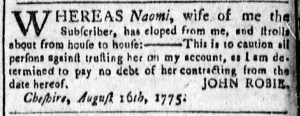
Essex Journal (August 25, 1775).

“This is to caution all persons against trusting her on my account.”

It was a familiar sight.  Advertisements about runaway wives peppered the pages of early American newspapers.  Husbands, like John Robie, took to the public prints to warn that since their wives, in this case Naomi Robie, “eloped” from them that those women no longer had access to credit.  “This is to caution all persons against trusting [Naomi] on my account,” John proclaimed, “as I am determined to pay no debt of her contracting from the date hereof.”  He presented himself as the aggrieved husband, yet his wife likely had her own version of the origins of their marital discord.  Running away may have been the best option to remove her from a bad situation.

When John placed his advertisement about Naomi in the August 25, 1775, edition of the Essex Journal, it ran immediately after a petition from “The FEMALE SUPPORTERS of LIBERTY” reprinted from the Newport Mercury.  “WHEREAS our country has long groaned under the oppression of a tyrannical ministry; and has lately been invaded by our enemies, who stained the land with the blood of our dear brethren,” the petition began, “THEREFORE we, the subscribers, are determined to defend our liberties, both civil and religious, to do the utmost that lies in our power.”  These women took a stand to defend their “liberties” in a manner considered acceptable, while Naomi had asserted her liberty in an inappropriate manner.  “We do not mean to take up arms,” the petitioners continued, “for that does not become our sex.”  They affirmed that they knew their proper place, unlike Naomi who departed from John’s household “and strolls from house to house.”  The petitions vowed to “put our hands to the plough, hoe and rake, and till the ground, for our men to go to the assistance of our distressed brethren, there to conquer our enemies or die in the attempt.”  Those women faced uncertain futures, realizing that the deaths of husbands, fathers, and brothers would be sacrifices that affected them and their families.  They also pledged to “forsake the gaieties of the world,” such as abiding by nonimportation and nonconsumption agreements, “before we will give up our country’s liberties and religion.”

The petition ended with a vow of mutual support: “Our company is to consist of as many true daughters of liberty as will undertake the noble cause.”  Furthermore, “No one to be admitted who retains any of the tory principles.”  Women (and men) recognized legitimate ways for women to participate in politics and advocate for their own interests, but only to any extent.  In this instance, advocacy extended to words and deeds that supported women (and their country) collectively, defending their “liberties and religion,” but not to condoning individual acts of resistance like Naomi Robie’s plan for self-determination when they ran counter to her husband’s wishes.  Many of the women who signed the petition may have privately sympathized with Naomi, but the press carried nothing but condemnations of her actions even as it celebrated the “FEMALE SUPPORTERS of LIBERTY” and their commitment to the American cause.

November 6

What was advertised in a colonial American newspaper 250 years ago this week?

Postscript to the Virginia Gazette [Purdie and Dixon] (November 3, 1774).

“It has been thought necessary, for the publick Good, to enter into several particular Resolves.”

As the imperial crisis intensified in the fall of 1774, the distinction between news items and advertisements in colonial newspapers became blurry with greater frequency.  Such was the case with letter-advertisements expressing regret for signing “an Address to the late Governor Hutchinson, on his leaving this Province” in several newspapers in Massachusetts.  Another instance appeared in the Virginia Gazette, published by Alexander Purdie and John Dixon in Williamsburg.  On November 3, they distributed a two-page Postscript to accompany the standard four-page issue.  That supplement included nothing but advertising except, perhaps, the first item in the first column on the first page.  With a dateline that read, “EDENTON, NORTH CAROLINA, October 25, 1774,” it featured the petition signed by fifty-one women at the Edenton Tea Party and listed their names in two columns.

Those women expressed their support for resolutions protesting the Tea Act of 1773 passed by the North Carolina Provincial Congress in August.  They proclaimed, “AS we cannot be indifferent on any Occasion that appears nearly to affect the Peace and Happiness of our Country, and as it has been thought necessary, for the publick Good, to enter into several particular Resolves, by a Meeting of Members deputed from the whole Province, it is a Duty which we owe, not only to our near and dear Connections, who have concurred in them, but to ourselves, who are essentially interested in their Welfare, to do every Thing as far as lines in our Power to testify our sincere Adherence to the same; and we do therefore accordingly subscribe this Paper, as a Witness of our fixed Intention and solemn Determination to do so.” In a single sentence, the women of Edenton declared their position on current events and pledged to participate in politics through the decisions they made about consumption.  They added their voices to those who adopted nonimportation agreements.

Why did their petition appear in an advertising supplement?  Had the women involved in the Edenton Tea Party sent their petition to Purdie and Dixon to feature in the Virginia Gazette?  Probably not, but they may have submitted it to the printer of the North-Carolina Gazette in New Bern.  The few extant issues of that newspaper have not been digitized for greater accessibility, making it difficult to determine if the petition appeared in that newspaper and then Purdie and Dixon reprinted it.  After all, colonial printers constantly reprinted items from other newspapers.  The printers in Williamsburg could have received an issue of the North-Carolina Gazette with the petition from the Edenton Tea Party after they printed the November 3 edition of the Virginia Gazette but did not wish to wait a week to disseminate it in the next issue.  Take into consideration as well that news, especially “Extracts from the Votes and Proceedings of the AMERICAN CONTINENTAL CONGRESS,” filled much of the newspaper, crowding out advertisements.  The printers had reason to produce an advertising supplement, yet they may have also wished to highlight the petition signed by patriotic women in Edenton.  The “Extracts” started with an overview of the Continental Association, a nonimportation agreement, as the first news item.  The women’s petition ran as the first item in the Postscript, mirroring the placement of the Continental Association and demonstrating the commitment already expressed for such measures even before the First Continental Congress formally adopted them.  At a glance, it looked like another advertisement among those in the Postscript, yet it delivered important news to readers.

March 24

GUEST CURATOR:  Madison Kenney

What was advertised in a colonial American newspaper 250 years ago today?

New-York Journal (March 24, 1774).

“The best Price given for ALL SORTS OF LINEN RAGS.”

John Keating, the owner of a “PAPER MANUFACTORY” in New York, uses politics as an advertising strategy. In 1774, “The demand for paper in America, is of late so greatly increased, that very large sums are continually sent abroad, for the purchase of it.” Keating attempted to take advantage of the political tension with Britain by connecting the donation of spare rags to make into paper with patriotism. He argued, “All those who really wish to promote the interest of America … will contribute their aid to the success of the paper manufactory in this place.”

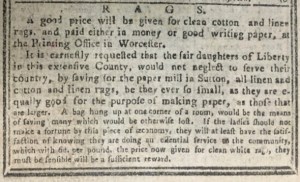
Advertisements asking families to save linen rags to support American printing were not uncommon during the era of the American Revolution. An advertisement printed on the back of Thomas’s Massachusetts, New-Hampshire, and Connecticut Almanack for the Year of our Lord Christ 1779 claims “ fair daughters of Liberty…would not neglect to serve their country, by saving for the paper mill in Sutton, all linen and cotton and linen rags.” Again, entrepreneurs who made paper or printed on it used patriotism to pressure households to support American industry by donating rags. Kayla Haveles argues that printing was “as vital to revolution as guns and gunpowder” because the colonists used it to spread ideology and attack the British.

Thomas’s Massachusetts, Connecticut, and New-Hampshire Almanack for the Year of Our Lord Christ 1779 (Worcester: Isaiah Thomas, 1778).

Additionally, the frequency of these advertisements highlights the contributions of women in the Revolution. Both advertisements focus on saving rags in the home. Keating’s advertisement asked every family to save spare rags in their household. Women were responsible for the housework so Keating’s call to action targeted women. The advertisement on the back of the almanac asked “daughters of Liberty” to save rags. Both advertisements are examples of how women contributed to the Revolution by supporting the American economy.

**********

ADDITIONAL COMMENTARY:  Carl Robert Keyes

John Keating had been placing similar advertisements for the “NEW-YORK Paper MANUFACTORY” for years by the time this advertisement appeared in the March 24, 1774, edition of the New-York Journal.  The Adverts 250 Project first featured one of his advertisements that offered “Ready Money for clean Rags” that ran in that newspaper on February 18, 1768.  During the six years in between, Keating maintained an almost constant presence in the public prints, encouraging colonizers, especially women, to collect rags for paper production and explaining the patriotic benefits of their efforts.  He advertised at times when relationships with Parliament deteriorated, including when nonimportation agreements went into effect to protest various legislation, as well as when the situation cooled and most merchants, shopkeepers, and consumers returned to business as usual.  Keating remained a steady voice in favor of “domestic manufactures” or goods produced in the colonies.

In this instance, Keating ran his advertisement at a time of crisis.  Throughout the colonies, the destruction of the tea in Boston the previous December remained a topic of conversation, including in New York.  The Sons of Liberty anticipated the arrival of the Nancy with a cargo of tea that they did not want landed in their city.  Keating’s advertisement, which had been running since before the Boston Tea Party, appeared on the last page of the March 24 issue, interspersed among other advertisements.  A notice that the Sons of Liberty would meet every Thursday evening “till the Arrival and Departure of the TEA SHIP,” on the other hand, made its second appearance, this time in the first column on the first page.  Only tables showing prices current and sunrise, sunset, and high tide preceded the announcement.  Its placement made it more likely that readers would see it, while also framing how they read other advertisements in the issue.  Most readers likely did not need that notice from the Sons of Liberty to influence their reaction to Keating’s advertisement calling on “all those who really wish to promote the interest of America” to do their part, considering how widely colonizers discussed the politics of tea at the time.  Still, the combination of print culture and public discourse occurring everywhere from the town common to taverns made Keating’s appeals to patriotism even more urgent.

December 26

What was advertised in a colonial American newspaper 250 years ago this week?

Massachusetts Spy (December 23, 1773).

“The above teas were imported before the East India Company’s teas arrived, or it was known that they would send any here on their own account.”

A week after colonizers in Boston dumped tea into the harbor in an event now known as the Boston Tea Party, Cyrus Baldwin continued to advertise “CHOICE Bohea and Souchong Teas, best Hyson ditto.”  His advertisement on the December 23, 1773, edition of the Massachusetts Spy, like his advertisement that ran in the Boston Evening-Post three days earlier, concluded with a nota bene declaring that the “teas were imported before the East India Company’s teas arrived, or it was known that they would send any here on their own account.”  That previous advertisement ran below a “NOTIFICATION” that called on “all the Dealers in, and Venders of Teas” to attend a meeting on December 21 for the purpose of “determining on suitable Measures to be adopted, and to cooperate with a great number of respectable Inhabitants of this Province, express’d by a Vote of their late Assembly to suppress the Use of that detested Article.”  Those who attended did not reach any final decisions.  Instead, a notice dated December appeared in the Massachusetts Spy, advising the “Traders in TEA … that their meeting stands Adjourned to THIS Evening at 5 o’clock, at the Royal-Exchange Tavern.”

In addition to that brief notice, the December 23 edition of the Massachusetts Spy, the first published since the Boston Tea Party, included several articles and editorials about tea.  Among the local news in the first column on the first page, readers learned that East India Company’s tea commissioners remained at Castle William on an island in the harbor.  Mixing news and editorial, this update stated, “Their obstinacy has rendered them infinitely more obnoxious to their countrymen than even the Stamp-Masters were.”

Elsewhere on the first page, a letter to the printer, Isaiah Thomas, signed by “A WOMAN,” objected to the recitation “a great number of arguments used to persuade the ladies to leave off the use of [tea].”  The correspondent inquired, “If Tea has been really known to be a baneful weed, a poisonous draught, &c. why were not these arguments used against the use of it in former times, before it was thought a political evil?”  She also noted that “gentlemen as well as ladies” enjoyed drinking tea and derived benefits to their health from doing so.  However, she did not make these arguments to justify continuing to consume the beverage.  Instead, she wished to be presented with a rationale for boycotting tea “such as will convince persons who are capable of using their reason,” whether male or female.  To that end, she recommended that “the gentlemen who are fully acquainted with all the political reasons for discarding the use of Tea … to publish a full and plain narrative of fact, so that we might see how it comes to pass that the use of Tea is a political evil in this country.”  If men were to instruct women “in all they know” about the political implications of drinking tea “it would be a much more probable method to make us leave off the use of it than the calling it hard names, and telling us scare-crow stories about it.”  Women participated in politics through their decisions in the marketplace.  When treated as capable of understanding rational arguments, the correspondent suggested, women would join with men in more effective and powerful resistance to Parliament’s abuses.

Three other letters to the printer expressed outrage over tea, while a news article offered an overview of the town meetings that occurred in the days before colonizers disguised as Indians boarded three ships and destroyed the tea they carried.  Another article described that event: “A number of brave and resolute men, determined to do all in their power to save their country from the ruin which their enemies had plotted, emptied every chest of tea on board the three ships … without the least damage done to the ships or any other property.”  According to this article, “The masters and owners are well pleased that their ships are thus cleared; and the people are almost universally congratulating each other on this happy event.”

Among the advertisements, Baldwin was not the only shopkeeper who promoted tea in the December 23 edition of the Massachusetts Spy, though he alone inserted an explanation about when he acquired the tea in hopes of convincing the community that he could sell it in good conscious and prospective customers that they could purchase and drink it in good conscious.  Even as many colonizers in Boston and other towns called for a boycott of tea, many retailers and consumers did not immediately cease buying and selling the popular beverage.

March 4

What was advertised in a colonial American newspaper 250 years ago today?

Massachusetts Gazette and Boston Weekly News-Letter (March 4, 1773).

“AN ESSAY Concerning the true original Extent and End of CIVIL GOVERNMENT.”

In 1773, Benjamin Edes and John Gill, printers of the Boston-Gazette, published an American edition of John Locke’s Essay Concerning the True Original Extent and End of Civil Government, the second of the political philosopher’s Two Treatises of Government.  The printers promoted the book in their own newspaper and in the Massachusetts Gazette and Boston Weekly News-Letter.

Edes and Gill exercised their prerogative as printers to give their advertisement a privileged place in the Boston-Gazette.  It appeared as the first item in the first column on the first page of the March 1 edition, immediately below the masthead.  The lengthy advertisement filled the entire column and overflowed into the next.  Even as Edes and Gill proclaimed that studying Locke’s treatise “will give to every Intelligent Reader a better View of the Rights of Men and of Englishmen” they published an advertisement offering an enslaved woman for sale in the lower right corner of the same page.  In addition to generating revenue from that advertisement, they served as brokers.  The anonymous advertiser instructed interested parties to “Inquire of Edes & Gill.”  Their advertisement in the March 4 edition of the Massachusetts Gazette and Boston Weekly News-Letter did not benefit from so prime a placement, running in the center column on the fourth page.  Consisting of the same copy that ran in the Boston-Gazette, it extended nearly an entire column.

In their efforts to convince colonizers to purchase the book, Edes and Gill asserted, “IT is well known among the Learned, that Mr. Locke’s two Treatise’ on Government, of which this is the Principal and by far the most Valuable, contributed more essentially to the establishing the Throne of our Great Deliverer King William, and consequently to the securing the Protestant Succession, than the Battle of the Boyne, or indeed all the Victories since obtained.”  They acknowledged that Locke’s “first Discourse has also been of great Use, as it is a most thorough Refutation of the Errors of Sir Robert Filmer,” known for defending the divine right of kings.  In a postscript, the printers explained why they opted not to publish both treatises.  Even though both had been “lately published together in England, and universally read and admired by all Lovers of Liberty there,” Edes and Gill did not consider the first treatise as essential for colonizers, in part because “few of [Filmer’s disciples] are yet to be found in this Country.”  That decision also made the book less expensive and more accessible to consumers since the second treatise was not “incumbered with the prolix Confutation of Filmer.”

Edes and Gill argued that all colonizers had a duty to read Locke’s work and discuss it with others.  They declared, “It should be early and carefully explained by every Father to his Son, by every Preceptor to his Pupils, and by every Mother to her Daughter.”  Just as many colonizers encouraged women to participate in politics through the decisions they made as consumers, the printers envisioned a role for women in educating their children about civic virtue.  In so doing, they drew upon the example of “Roman Ladies, especially those of the first Rank and Fashion” who “not only taught their Daughters, but their Sones, the first Rudiments of Learning.”  They achieved significant results; those “noble Matrons by their Sense and Virtue, contributed in this and a Thousand other Instances, no less toward the building up their glorious Republic than the Wisdom and Valour of the greatest Captain’s.”  Edes and Gill anticipated the notion of republican motherhood that citizens, male and female, embraced during the era of the early republic that followed the American Revolution.

Why did Edes and Gill publish and promote Locke’s Essay Concerning the True Original Extent and End of Civil Government?  Historians disagree about the motivations of printers, publishers, and booksellers who produced and sold political treatises during the imperial crisis.  Did they align with the ideology in the books and pamphlets they published and sold, hoping to convert other colonizers to share their perspective?  Or did they merely seek to generate revenues?  Such motivations are not necessarily mutually exclusive.  By the time they published an American edition of Locke’s Essay, Edes and Gill already established their reputation as patriot printers.  They very likely considered printing, promoting, and selling this treatise a political act … but that did not mean they did not also seek to make money.  For Richard Draper, the printer of the Massachusetts Gazette and Boston Weekly News-Letter, running an advertisement for Locke’s Essay may have been more about generating revenues, especially considering that he tended to support British officials.  Edes and Gill may have chosen to advertise in his newspaper as a means of reaching readers less likely to peruse newspapers published by patriot printers, exposing them to some of Locke’s reasoning in the lengthy advertisement even if they opted not to purchase or read the Essay.

February 1

What was advertised in a colonial American newspaper 250 years ago today?

New-York Gazette and Weekly Mercury (February 1, 1773).

He most humbly addresses the Fair Sex, requesting their aid.”

John Keating regularly offered “READY MONEY … for CLEAN LINEN RAGS” in the New-York Gazette and Weekly Mercury in the late 1760s and early 1770s.  The papermaker needed as many rags as he could gather to supply his mill with raw materials.  To convince readers to make an effort to collect and submit rags, he developed appeals that emphasized both commerce and devotion to the best interests of the colonies.

In an advertisement that ran on February 1, 1773, for instance, Keating stated that the “advantages that must result to this colony from the establishment of manufactories in it, are so obvious that the subject needs no elucidation.”  Then he elucidated.  “Since paper manufactories were established in Pennsylvania, the money saved and brought into that province, the money saved and brought into the province” amounted to “the many thousand pounds of which is annually drained of[f] by purchasing paper in England.”  Supporting domestic manufactures, goods produced in the colonies, helped to address the trade imbalance with Great Britain.  Keating challenged readers to think about what more they accomplish by working together.  “Might not every shilling of this money be saved?  Have we not materials amongst ourselves?  Is our patriotism all pretence …?

New Yorkers did indeed already have the materials necessary for making paper, clean linen rags.  Keating suggested that women played a vital role in sustaining the patriotic project that he pursued, declaring that he “most humbly addressed the Fair Sex, requesting their aid, without which it will be impossible for him to establish this manufactory upon a respectable or prudent footing.”  He requested that every “frugal matron … hang up a bag … and take care to put every piece of linen that is unfit for any other use, in it.”  When the bag was full, the frugal matron would sell the contents to Keating in an eighteenth-century version of recycling to support a good cause.  The papermaker indicated that in return for the clean linen rags the frugal matron would receive enough money to “supply herself and family with the very essential article of pins.”  Just as significantly, “she will have the satisfaction of being conscious of contributing her part to the advancement of her country.”  Women’s industry served a dual purpose when it manifested patriotism.

The project did not depend solely on those frugal matrons.  Keating also asked “young ladies to co-operate … in saving rags,” though he presented a more romantic rationale to them.  The papermaker asked young women to “observe a very curious remark made by the celebrated Mr. Addison in the Spectator, ‘That a young lady who sends her shift to the paper mill, may very possibly in less than six months, have it returned made into a piece of fair paper, upon which her lover has written a billet doux.’”  Although Keating (and Addision) asked young women to imagine love letters, their shifts and other linen garments may just as likely been transformed into newspapers that kept their households informed about the imperial crisis that faced New York and other colonies.

Women, both “frugal matrons” and “young ladies,” participated in politics and expressed their patriotism when they heeded the call of papermakers who encouraged them to collect clean linen rags.  Similarly, their actions and decisions made an impact when they produced homespun textiles and garments and participated in nonconsumption agreements.  During the era of the American Revolution, both men and women understood that the personal was political.  That included gathering clean linen rags in “a bag in some convenient part of the house.”

March 30

What weas advertised in a colonial American newspaper 250 years ago today?

Supplement to the Pennsylvania Packet (March 30, 1772).

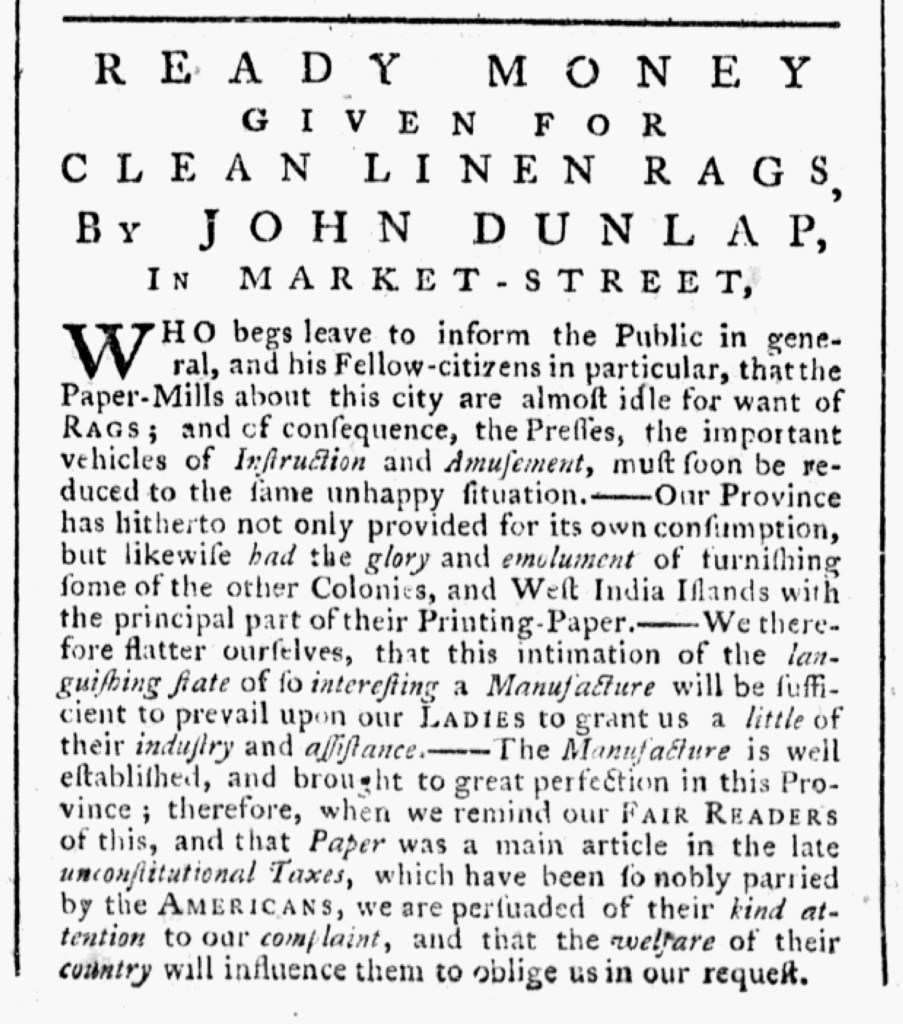
“Prevail upon our LADIES to grant us a little of their industry and assistance.”

Women played a vital role in supporting the early American press.  So claimed John Dunlap, printer of the Pennsylvania Packet, in a notice calling on colonizers to exchange “CLEAN LINEN RAGS” for “READY MONEY” at his printing office on Market Street in Philadelphia.  What was the connection between rags and newspapers?  Printers produced their publications on paper made from linen.  The papermakers who supplied them needed “CLEAN LINEN RAGS” to transform into paper for printing items of “Instruction and Amusement” for the public.

Dunlap commenced his notice by addressing “the Public in general, and his Fellow-citizens in particular,” suggesting that colonizers had a civic responsibility to support the press by participating in the production of paper through collecting rags.  He claimed that until recently papermakers in Pennsylvania not only produced enough “Printing-Paper” to serve that colony “but likewise had the glory and emolument of furnishing some of the other Colonies, and West India Islands” with a significant amount of their “Printing-Paper.”  Recently, however, the “Paper-Mills about this city are almost idle for want of RAGS,” thus putting printing offices in danger of a similar fate.

He then pivoted to addressing the “LADIES,” the “FAIR READERS” of the Pennsylvania Packet, imploring them “to grant us a little of their industry and assistance” by collecting rags to recycle into paper.  Dunlap reminded that that paper “was a main article in the late unconstitutional Taxes, which have been so nobly parried by the AMERICANS.”  Readers, both women and men, needed little reminder that Parliament imposed duties on imported paper and other goods in the Townshend Acts.  In response, American merchants and shopkeepers coordinated nonimportation agreements, leveraging commerce into acts of protests.  At the same time, colonizers promoted “domestic manufactures,” including paper, to replace imported goods they refused to consume.  Such protests played a role in convincing Parliament to repeal most of the import duties.

Yet readers of the Pennsylvania Packet still had a responsibility in maintaining the press.  “FAIR READERS” acted as “Fellow-citizens” when they gave their “kind attention” to Dunlap’s “complaint” about the scarcity of rags.  Women could attend to “the welfare of their country,” Dunlap asserted, by heeding his request.  Just as decisions about consumption became political acts for women during the imperial crisis that led to the American Revolution so too did mundane chores like collecting rags.  Women’s work in that regard became imperative to the continued operation of American presses in the era of the American Revolution.