January 27

What was advertised in a colonial newspaper 250 years ago today?
Jan 27 - 1:27:1766 New-York Gazette
New-York Gazette (January 27, 1766)

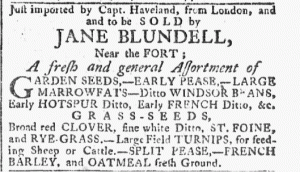
“To be SOLD by JANE BLUNDELL, Near the FORT; A fresh and general Assortment of GARDEN SEEDS.”

Eighteenth-century advertisements make it clear that women did not act solely as consumers during the period.  They were also producers, suppliers, and retailers who marketed goods and services to the general public.

It is difficult, however, to describe how frequently they placed commercial notices in the public prints.  It seems to vary from place to place, from newspaper to newspaper.  Women rarely resorted to advertising in smaller cities and towns.  They were more likely to use advertising to attract potential customers in larger port cities:  Philadelphia, Boston, Charleston, and New York.  Even in those urban centers, however, women were underrepresented on the advertising pages.  By numbers, they operated a significant proportion of shops, yet their male counterparts were more likely to place advertisements.

Jane Blundell not only advertised, she offered specialized merchandise that set her apart from the female shopkeepers, seamstresses, and milliners more likely to market their goods and services.  Advertisements like this one demonstrate what was possible (rather than what was most probable) for women in the commercial realm in eighteenth-century America.  Jane Blundell and other “she-merchants” pursued many different kinds of entrepreneurial activities, even as men outnumbered them.  Perhaps advertising helped Blundell to operate a viable business in the face of competition from male competitors.

January 20

What was advertised in a colonial newspaper 250 years ago today?

Jan 20 - 1:20:1766 Boston Post-Boy
Boston Post-Boy (January 20, 1766)

“At his STORE … Where LADIES may find as compleat an Assortment as at any Store in Town.”

Consumption is feminized in the twenty-first century.  After all, ladies love shopping, right?  At first glance, Samuel Fletcher’s advertisement might suggest that this is a natural conclusion, that consumption has always been a feminine pursuit because women more inherently possess a desire to shop than men do.

However, reaching such a conclusion based on Fletcher’s advertisement would be faulty.  This advertisement, listing so many of the different goods for sale in Boston and so many other colonial American port cities and villages, is rather unique among those published in the 1760s.  Very rarely did advertisers in this era identify potential customers by gender (though there were exceptions, such as seamstresses who made clothes for women and tailors who specialized in men’s garments).  In explicitly identifying “LADIES” with consumption, Fletcher engaged in a mode of marketing not yet widely practiced, but one that eventually became a largely unquestioned part of American consumer culture.

I choose many advertisements because they include common or standard aspects of eighteenth-century marketing, but this advertisement caught my attention precisely because the appeal to the “LADIES” was extraordinary, rather than ordinary, in the 1760s.

January 17

Who was the subject of an advertisement in a colonial newspaper 250 years ago today?

Jan 17 - 1:17:1766 New-London Gazette
New-London Gazette (January 17, 1766)

“My Wife Joanna Hebbard, hath for some time past Eloped from me.”

This advertisement does not present a commodity to be traded in the marketplace.  Unlike slaves and indentured servants, Robert Hebbard could not buy or sell his wife.  That did not necessarily make Joanna Hebbard’s position much less precarious than that of runaway indentured servant Daniel O’Mullen or the “Likely strong NEGRO GIRL” featured in recent days.  Under the laws of coverture, a woman’s legal rights and obligations — indeed, her identity as well — were subsumed under her husband upon marriage.  Joanna Hebbard, like so many other women in colonial America, was expected to abide by the will of the family patriarch, the head of household, in order to maintain good order within the family and, by extension, stable government within the colony.  Robert Hebbard’s advertisement does not reveal what sorts of domestic relations caused his wife to depart, but advertisements for runaway wives indicate that not all women were willing to be confined by the laws of coverture.  Sometimes “eloping” from their husbands became their only option.

January 16

Who was the subject of an advertisement in a colonial newspaper 250 years ago today?

Jan 16 - 1:16:1766 Massachusetts-Gazette
Massachusetts-Gazette (January 16, 1766)

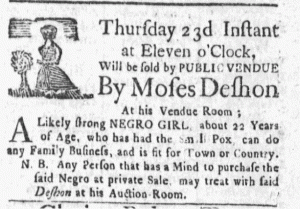
“Will be sold … A Likely strong NEGRO GIRL.”

Many, many different kinds of merchandise were bought and sold via the advertisements in eighteenth-century newspapers — certainly more than an assortment of textiles, housewares, and foodstuffs imported from London and other ports throughout the Atlantic world.  People could also be commodities in eighteenth-century America, as this advertisement demonstrates.

Advertisements for buying and selling slaves — and for runaways who sought to escape their captivity — were not uncommon in newspapers printed in New England and the Middle Atlantic and an even more familiar feature in the Chesapeake and Lower South.  This advertisement, however, is rather unique:  unlike most others peddling slaves, it includes an image, a woodcut intended to depict “A Likely strong NEGRO GIRL.”  This would have been a stock piece owned by the printer.  It could have been inserted in any number of advertisements for female slaves or even runaway wives since its features did not depict any particular woman or girl.  The “Likely strong NEGRO GIRL” remained nameless in this advertisement, just as interchangeable with other slaves, other pieces of property that could be bought and sold, as a piece of type that could be inserted in any number of advertisements.