What was advertised in a colonial newspaper 250 years ago today?
Georgia Gazette (May 28, 1766).
Domestic strife from the M’Carty household found its way into the advertisements that appeared in the Georgia Gazette. Advertisements for runaway wives, warning shopkeepers and others not to extend credit because abandoned and disgruntled husbands refused to pay any charges on their behalf, were quite common in eighteenth-century America. Most were of a similar length as today’s advertisement by Cornelius M’Carty about his wife Lydia.
Georgia Gazette (May 28, 1766).
Responses to such advertisements appeared much less regularly, though they were not unknown. For instance, see an advertisement by Robert Hebbard published in the New-London Gazette in January and a response refuting Hebbard from the next issue. (Intrigued by this exchange, J.L. Bell conducted additional research on the messy marriage of Joanna and Robert Hebbard.) Similarly, Jonathan Remington published an advertisement that explained, at least in part, why Cornelius M’Carty claimed that he “suffered too much” at the hands of Lydia.
It seems that Remington (as well as his wife and children) had been a boarder in the M’Carty household for eighteen months. Cornelius was present for some of that time but apparently away during a portion of it. It sounds as though Cornelius suspected that Remington had an affair with his wife, but the boarder declared that “he has never had, directly or indirectly, any indecent freedom or criminal conversation” with Lydia. He published his advertisement to dispel gossip, having heard “a report … greatly prejudicial to the character and conduct” of Lydia.
Remington defended Lydia’s reputation, but in the process he also defended his own, taking the extraordinary step of appearing before two justices of the peace to swear to the veracity of hic claim’s about Lydia’s character. Remington, a tailor, likely feared the social and economic repercussions of the rift between Cornelius and Lydia M’Carty. This advertisement thus served more than one end by proclaiming publicly that neither Lydia M’Carty nor Jonathan Remington had engaged in any unsavory activities in the absence of Cornelius M’Carty.
What was advertised in a colonial newspaper 250 years ago today?
Pennsylvania Gazette (May 15, 1766).
“To be sold by MARY HARVEY, … a well chosen and neat Assortment of Dry and wet Goods.”
Female shopkeepers were disproportionately underrepresented among the advertisements placed in colonial newspapers. Consciously seeking to avoid erasing women from the commercial landscape as producers, suppliers, and retailers – not solely as consumers on the other side of exchanges – I take notice every time I spot an advertisement placed by a woman when I am making selections about which to feature here.
It would be unfair, however, to assume that I chose Mary Harvey’s advertisement solely based on her sex. It reveals so much more about early American marketing and consumer culture than “just” demonstrating that women played varied roles (though I contend that is significant in its own right). When I first began studying eighteenth-century advertising I expected to identify distinct methods or appeals made by men and women, but Mary Harvey’s advertisement, like so many others placed by women, demonstrates that male and female advertisers relied on similar appeals. In this advertisement, Harvey promised low prices. By providing an extensive list of her wares she also engaged potential customers to think of the range of choices that will allow them to make selections according to their own tastes.
Harvey also concludes with a political appeal that mirrored those frequently made by male advertisers: “as she has made it her Study to promote Home-made Manufactures, she hopes for the Countenance of her old Friends, and all those who are Lovers of their Country.” Although not allowed to participate in the formal mechanisms of politics due to her sex, Harvey joined many others in imbuing consumer choices with political ramifications. Through her advertising, Mary Harvey gained a voice in public discourse about the Stamp Act, the Declaratory Act, and the relationship between Parliament and the colonies.
Who was the subject of an advertisement in a colonial newspaper 250 years ago this week?
Virginia Gazette (May 9, 1766).
“AGNES … is a fair straight made lusty Mulatto, and has small breasts.”
When the Virginia Gazette made its debut in the Adverts 250 Project a week ago, I opted to feature a genre of advertisements – those seeking the return of runaways – rather than a particular advertisement. Accompanied by crude woodcuts, runaway advertisements were easy to identify at a glance. I remarked how startling it seemed to see nine runaway advertisements on a single page of the Virginia Gazette. As David Waldstreicher has argued, slavery, commerce, and print culture were bound together in eighteenth-century America.
Runaway advertisements presented an alternate means of placing black bodies on display in early America, first by describing them in great detail and then by encouraging readers to carefully surveil the black men and women they encountered. In the case of Agnes (also known as Agie), this amounted to more than noticing her garments (“a striped red, white, and yellow calamanco gown, a short white linen sack, petticoat of the same, a pair of stays with fringed blue riband, a large pair of silver buckles”). It also included attention to physical features, such as “a small scar over one of her eyes.”
Yet the descriptions could sometimes be far more intimate and invasive, especially as white colonists characterized black and mulatto women’s bodies. According to today’s advertisement, Agnes was “a fair straight made lusty Mulatto, and has small breasts.” Even as the advertiser acknowledged one of the essential aspects of Agnes’ womanhood, he deprived her of the consideration and deference that would have been shown to most white women (especially middling and elite white women) when describing them in conversation or in print. Calling specific attention to the size of Agnes’ breasts served to further commodify her rather than humanize her.
N.B. Notice that this advertisement states that Agnes ran away in the middle of January, yet it was published nearly four months later in early May. I hope that she made good on her escape permanently.
What was advertised in a colonial newspaper 250 years ago today?
Boston-Gazette (March 24, 1766).
Elizabeth Clark placed this advertisement to sell an assortment of seeds. She got her supplies “per Capt. Freeman” from London. The timing makes perfect sense, because April showers bring May, June, July, and August crops. With it being late March the planting season was right upon colonists in Boston and the rest of Massachusetts.
Anyone who frequently visits the Adverts 250 Project might notice that this advertisement seems repetitive. To be honest I had to review my work from my first week as guest curator in February. The historical impact that woman of the past have on women of the present and future interests me greatly so I try to pick advertisements that feature primarily woman if I am able. On February 17, I featured an advertisement from Lydia Dyar, who also sold garden seeds and had gotten them from Captain Freeman. In his additional commentary Prof. Keyes also pointed out an advertisement from yet another woman, Susanna Renken, who both sold seeds and bought them from Captain Freeman. All three of these woman posted similar advertisements, for mostly the same product, and bought their goods from the same man.
Two of them seem to have had shops in the same vicinity: Mill Creek. Susanna Renken states that her shop is “near the Draw Bridge” and Elizabeth Clark advertised that she was located “near the Mill Bridge,” which was located on Mill Creek. This trade card helped further convince me that these two woman shops were near each other because William Breck had a shop “at the Golden Key near the draw-Bridge Boston.”
William Breck’s trade card (Paul Revere, engraver, ca. 1768). This trade card is part of the American Antiquarian Society’s Paul Revere Collection.Massachusetts Gazette (February 20, 1766).
Nathaniel Abraham, who also regularly advertised in the Boston newspapers, listed “Sign of the Golden Key, in Ann-street” as his location too.
This map shows that Ann Street intersected Mill Creek. The drawbridge crossed Mill Creek. Elizabeth Clark, Susanna Renken, William Breck, and Nathaniel Abraham had shops located near each other.
Detail of A Plan of the Town of Boston.
**********
A Plan of the Town of Boston with the Intrenchments &ca. of His Majesty’s Forces in 1775, from the Observations of Lieut. Page of His Majesty’s Corps of Engineers, and from Those of Other Gentlemen (1777?). Library of Congress.
**********
ADDITIONAL COMMENTARY: Carl Robert Keyes
I am impressed with the way that Elizabeth mobilizes several different primary sources –newspaper advertisements, trade cards, maps – in a preliminary attempt to reconstruct neighborhoods and marketplaces in Boston in the 1760s. This is work that historians and scholars in related fields have undertaken on a grander scale.
I appreciate that Elizabeth draws attention to an aspect of eighteenth-century advertisements that has not yet received much attention here: when examined systematically the locations listed in the advertisements help us to understand not only the geography of early American towns and cities but also relationships of various sorts.
More than two decades would pass before publication of the Boston Directory, the city’s first directory that listed the occupations and residences of its inhabitants, in 1789. That and subsequent city directories from Boston and other urban centers in early America have been invaluable to historians, but such sources do not exist for earlier periods.
Elizabeth has discovered on her own – and helps to demonstrate – that newspaper advertisements provide more information than just lists of goods or attempts to convince potential customers to make purchases. They include valuable information about where people worked and where they lived, details that fill in some of the blanks for an era before city directories.
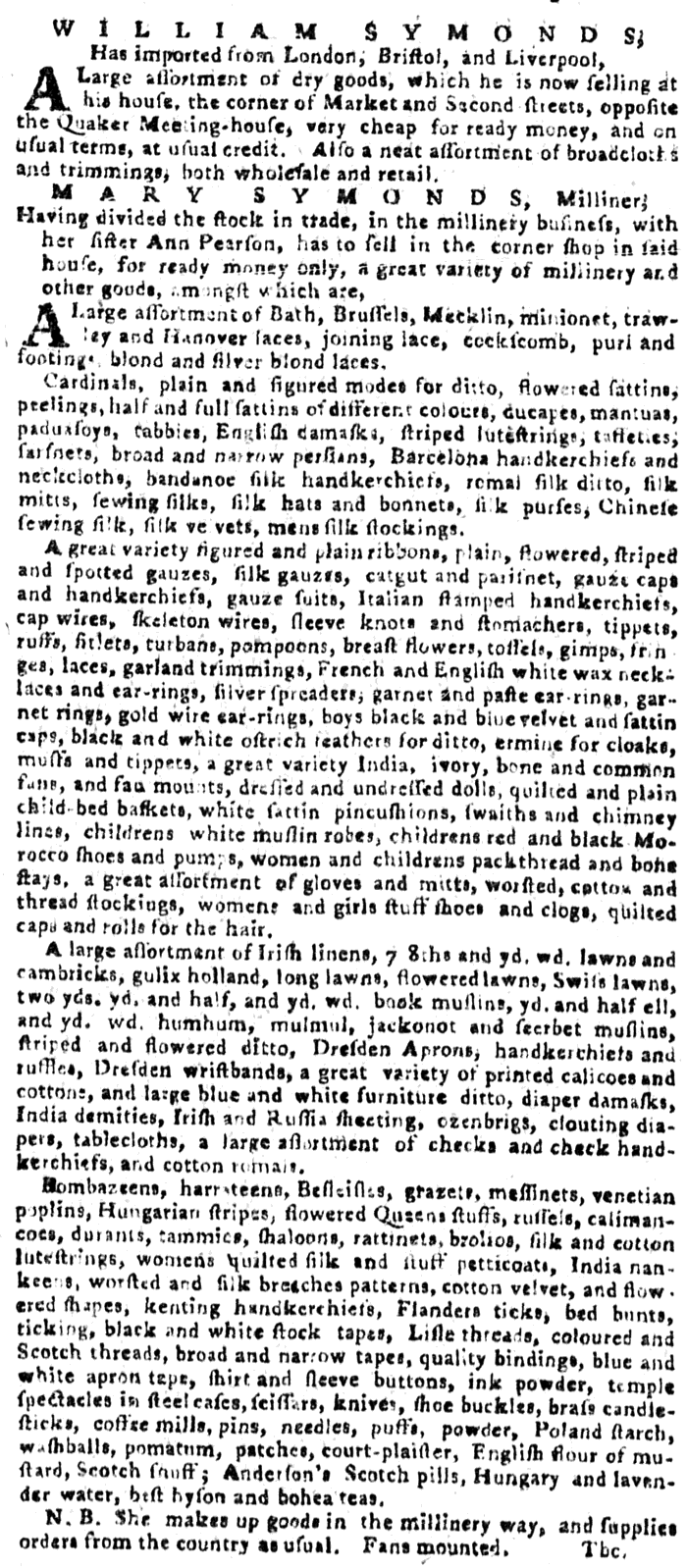
Symonds describes the different materials and trimmings she sold, such as “a great variety of printed calicoes and cottons” and “A great variety of figured and plain ribbons” along with “sattins of different colours.” Unfortunately, I could not identify a lot of descriptive words, but I could tell that all those paragraphs were different trimmings, fabrics, and their descriptions.
In the 1760s all types of people – from the rich to the poor – wore hats. The difference, however, was the material and how much detail was put into them. Hats could be extremely detailed, depending on how much money the colonist could pay. Milliners could add ribbons and other trimmings like the ones in Symonds’ advertisement if customers so chose. Like today, how people dressed was a status symbol that was very important to American colonists. Whether her customers had enough money to wear a different hat every day or wore the same hat every day, they could keep Symonds in business for years to come.
I was curious about how hats in America and England looked in the 1760s. These paintings all show women with hats during the period.
There’s so much going on in this advertisement that it’s hard to know where to begin. Indeed, an entire chapter or more could be devoted to teasing out the various aspects of this advertisement. As Elizabeth notes, average readers today do not recognize the various kinds of textiles and trimming that Symonds listed. Material culture specialists, on the other hand, have written entire books about the quality and characteristics, production and consumption, and social and cultural meanings of these fabrics and accoutrements.
Mary Symonds operated her shop in the same location as William Symonds, but this advertisement suggests that they operated their businesses independently of each other. Although William’s business appeared first in the advertisement, Mary’s list of wares comprised a significantly lengthier section. Mary also noted that she had once been in partnership with “her sister Ann Pearson,” a milliner who ran her own advertisements in Philadelphia’s newspapers. The two sisters ran a series of advertisements in previous weeks announcing that they were dissolving their partnership and dividing the merchandise in anticipation of running separate shops. Such advertisements help to demonstrate that some colonial women operated businesses independently or in partnership with other women. Male relations, including William Symonds, did not necessarily oversee women who acted as retailers.
There’s another reason I was excited when Elizabeth selected this advertisement. I’ve identified only a handful of eighteenth-century trade cards and billheads distributed by women. Mary Symonds is the only female advertiser from Philadelphia with a trade card still extant (as part of the Cadwalader Collection at the Historical Society of Pennsylvania). Her trade card, listed a broad range of millinery supplies similar to what appeared in her newspaper advertisements, circulated in 1770 and perhaps even earlier. It included a border and her name in a rococo-style cartouche. Overall, it was less ornate than some of the trade cards distributed by male advertisers, but it was the most impressive trade card known to have been used by a female advertiser. It appears that Symonds took pride in her business and invested in it accordingly.
Trade card (with receipted bill on reverse) distributed by Mary Symonds in 1770 (Historical Society of Pennsylvania: Cadwalader Collection, Series II: General John Cadwalader Papers, Box 5: Incoming Correspondence: Pa-Sy, Item 19: Su-Sy).
The copy at the HSP has been dated to 1770 because a receipted bill appears on the reverse. On five different occasions in October and November 1770, somebody – probably Symonds herself – recorded more than a dozen purchases made by “Mrs. Cadwalader” (including “White Gloves,” a “Lace Cap,” and several yards of satin and muslin) amounting to more than £20. This receipted bill indicates that Symonds “Recevd the Contents in full” on November 22, 1770.
What was advertised in a colonial newspaper 250 years ago today?
New-York Gazette (March 10, 1766).
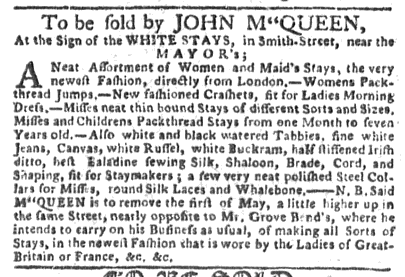
“To be sold by JOHN M”QUEEN, At the Sign of the WHITE STAYS.”
Staymaker John M”Queen was concerned with fashion – and from start to finish his advertisement suggested that his potential customers should be as well. He opened with a summary of his wares (“A Neat Assortment of Women and Maid’s Stays, the very newest Fashion, directly from London”) and concluded with a reassurance (“all sorts of Stays, in the newest Fashion that is wore by the Ladies of Great-Britain or France”). What is a stay? Colonial Williamsburg offers “A Glossary of Terms” describing women’s clothing in the colonial era: stays were the eighteenth-century version of what became corsets in the nineteenth century, but visit the glossary for a much more complete examination.
New York was one of the largest cities in the colonies in the 1760s, but it was a provincial outpost. M”Queen incited anxieties that residents did not want to be seen as inhabitants of some backwater village. Instead, his advertisement suggests, they wanted full membership in British (and European) fashion and culture. His stays were not merely of the “newest Fashion” in the colonies. Instead, they had arrived “directly from London” and were the same style as those “wore by the Ladies of Great-Britain or France.” Not just an importer, M”Queen was a staymaker himself, but as he produced stays locally he kept his eyes on changing fashions in London.
As an aside, it is worth mentioning that this advertisement linking consumption and fashion was aimed at female customers, but that should not be misinterpreted as evidence that eighteenth-century women placed more emphasis on fashion than men. Given the nature of the product he marketed, M”Queen addressed women, but advertisements for men’s garments during the period were just as likely to invoke a language of fashion and cosmopolitan connections to European metropolitan centers.
What was advertised in a colonial newspaper 250 years ago today?
Pennsylvania Gazette (March 6, 1766).
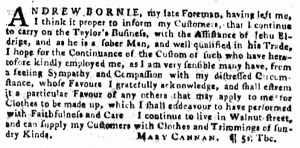
“My late Foreman, having left me, … I continue to carry on the Taylor’s Business.”
On several occasions I have noted that advertisements by female shopkeepers and artisans did not appear in the public prints in proportion to the numbers of women who kept shop or plied a trade in eighteenth-century America. When they did appear they could be interpreted as assertions of independence by women publicly proclaiming that they participated in the marketplace as retailers, producers, and suppliers – rather than exclusively as consumers – alongside their male counterparts.
Mary Cannan’s advertisement, however, merits different consideration. The first three lines name two men affiliated with Cannan’s “Taylor’s Business.” Indeed, she opens her advertisement naming “ANDREW BORNIE, my late Foreman,” a male colleague who presumably oversaw her business operations. In his absence, Cannan made it clear that another man, Jehu Elridge (“a sober man, and well qualified in his Trade”), continued his association with her “Taylor’s Business.”
On the other hand, it may be worth noting that even though we now use the word “tailor” to describe both men and women, in the eighteenth century men were more likely to describe themselves as tailors and women to describe themselves as seamstresses. In addition, the word – then and now – conjured connotations of working on men’s clothing.
I suspect that Cannan may have been unmarried, given her request for “a feeling of Sympathy and Compassion with my distressed Circumstance,” in which case making sure potential customers and the public more broadly knew men worked in her shop was a savvy business move and necessary to protect her reputation. After all, making and measuring clothes involved close and sometimes awkward contact with another person’s body. Putting men front and center in her advertisement may have been a strategy to ward off unsavory assumptions and accusations.
Even taking all of this into consideration, Cannan still crafted an advertisement that was different, based on her gender, than those placed by her male counterparts in the “Taylor’s Business.”
**********
Note: This is Spring Break week at Assumption College. I am resuming my regular duties while the students in my Public History class are away. They will return as guest curators two weeks from today.
Who were the subjects of advertisements in a colonial newspaper 250 years ago this week?
Massachusetts Gazette (February 20, 1766).
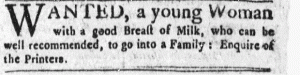
“WANTED, a young Woman with a good Breast of Milk.”
“A Very good WET-NURSE is willing to take a Child.”
These two advertisements are interesting in the fact that they relate to the same service but come from different angles. The first is an advertisement for a wet nurse while the second is advertising a woman’s willingness to be a wet nurse. Using a wet nurse was a common practice among European elite women that was not as popular across the pond in the colonies.
New-York Gazette (February 24, 1766)
There were cases when a wet nurse was needed, such as the death of the mother or if she was too busy to take care of her child or some kind of ailment that prevented her from breastfeeding. Women generally used breastfeeding as a form of contraception, albeit unreliable, but it did give them some control over the spacing of their pregnancies.
The first advertisement is looking for “a young woman with a good breast of milk” to “go into a family.” It is interesting that this advertisement is seeking to incorporate this wet nurse into the family whereas the second gives the option of nursing “abroad,” which meant not in the house.
**********
ADDITIONAL COMMENTARY: Carl Robert Keyes
I noted last week that women offering goods and services (shopkeepers, milliners, schoolmistresses, and the like) were disproportionately underrepresented in newspaper advertisements in colonial America. Today, Mary has selected two notices that illustrate the most common reason women were featured in advertisements for goods and services during the eighteenth century: offering or seeking assistance from wet nurses.
Note that even though both advertisements testify to labor (pun not necessarily intended) undertaken by women, they both also obscure the identity of the woman seeking or offering this service. Instructions to “Enquire of the Printers” or “Inquire of W. Weyman” (the printer of the New-York Gazette) rendered these women anonymous, perhaps by their own choice as a means of retaining their privacy. These advertisements figuratively put women’s bodies on display for public consumption, making it understandable why the advertisers might not have desired further identifying information.
Mary notes that these advertisements speak about two sides of the same transaction. I would like to suggest that each also incorporates concerns specific to the woman who placed the notice. For the first, seeking a wet nurse, it is quite possible that the advertisement was a last resort. A woman and her family may have first exhausted a network of family and trusted friends and neighbors before looking more broadly for a wet nurse. For the second, offering services as a wet nurse, Mary comments on the distinction between “in the House or abroad.” The advertiser demonstrated her willingness to adapt to conditions set by a potential employer. In looking for employment, she likely had to acclimate to the wishes of potential employers, whereas those seeking to hire wet nurses may have felt that they had more flexibility to set the terms.
What was advertised in a colonial newspaper 250 years ago this week?
New-York Gazette (February 21, 1766).
“Wants a Place, A Young Woman that is capable to attend Children.”
A woman looking for placement was not an uncommon thing in early American newspapers. Young women usually would look to be a housekeeper or cook, to care for children, or assist the women of the house. This young woman described her skills as “capable to attend Children, make up small Clothes,” and be all around helpful to the family. Our generation would describe her as a nanny.
In the American colonies, the number of servants a family had often depended on their economic status. Like the size and grandeur of a family’s house, the number of servants could be a status symbol. Not much has changed today.
Masthead for New-York Gazette (February 17, 1766).
For me, this advertisement was also an interesting find because normally the New-York Gazette published on Mondays. This week they published both a Monday (February 17) and a Tuesday (February 18) edition, which is were I found this advertisement. Normally for the Adverts 250 Project I would have had to go back to a Monday edition, but for this week I did not have to.
Masthead for New-York Gazette Extraordinary (February 18, 1766).
**********
ADDITIONAL COMMENTARY: Carl Robert Keyes
“Not much has changed today.” Indeed, conspicuous consumption was not an invention of the twentieth or twenty-first centuries. It existed before the consumer revolution of the eighteenth century and genteel colonists engaged in it as a means of further differentiating themselves from each other as the middling and lower sorts gained greater access to consumer goods throughout the 1700s.
I believe that Elizabeth is the first guest curator to comment explicitly on the methodology used in selecting the featured advertisement for each day. She notes the same methods that I have described elsewhere in extended commentary about the project’s methodology and how it shapes the scope of the project.
As an instructor, this is an important behind-the-scenes element of students’ work. Each guest curator has compiled a census of newspapers published during his or her week based on the calendars generated by Early American Newspapers. As a result of supplements and extraordinary (“extra”) issues as well as publications starting or stopping in response to the Stamp Act or other reasons, the list of newspapers published in one week often differs from the list for the next week.
As Elizabeth indicates, many colonial American newspapers were published at the beginning of the week, on Mondays, but in most weeks no newspapers were printed on Tuesdays. As we examined this more closely, we discovered that William Weyman actually published the New-York Gazette three times during this week in 1766: the regular issue on Monday, February 17; a broadside (one-page) “Extraordinary” issue on Tuesday, February 18; and a two-page “2d Extra” on Friday, February 21.
Masthead for New-York Gazette 2d Extra (February 21, 1766).
This was not immediately apparent, however, due to a coding error in the metadata. The two extraordinary issues were treated as one in Early American Newspapers. As I have noted elsewhere, researchers need to be aware of faulty metadata (background information or “data that provides information about other data”) that may lead them to incorrect conclusions about digitized sources.
Note that the calendar of issues generated by Early American Newspapers does not indicate that the New-York Gazette was published on February 21, 1766. That “2d Extraordinary” has been conflated with the Extraordinary issue of February 18, 1766.
Elizabeth’s advertisement was actually published in the “2d Extra” on February 21. The February 18 Extraordinary did not include any advertisements. That means that today’s featured advertisement technically departs from the established methodology for this project.
I asked Elizabeth not to edit her original submission when we discovered this. Together we have fast forwarded three days to February 21, but this allows us to make a valuable point about the shortcomings that sometimes emerge when relying on digitized sources.
(Besides, February 18 is my birthday. I’m glad that we found a way to incorporate at least a masthead from a newspaper published 250 years ago on February 18, 1766, into the project.)
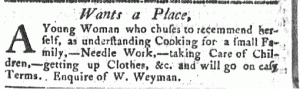
What was advertised in a colonial newspaper 250 years ago this week?
New-York Gazette (February 3, 1766).
“Wants a Place, a Young Woman who chuses to recemmend herself, as understanding Cooking for a small family.”
This advertisement does not sell a good, per se, but a young woman is “selling” her services. I found it interesting that this sort of advertisement would be included in a colonial newspaper. To me, it is an example of a woman having a level of freedom in the colonial area. This woman was able to put herself out there to do work for others. Now, she is still doing work associated with women and the household during the colonial period, but she now has the freedom to choose who she wants to employ her. Also, she has already chosen what work she will do for whoever hires her. She has, in a sense, laid out a contract for herself.
I do not usually associate the colonial period with women having the freedom to choose any sort of work that they will do, which is why I found this advertisement to be interesting.
**********
ADDITIONAL COMMENTARY: Carl Robert Keyes
Several scholars have demonstrated that advertisements help us to glimpse women’s work and the role of women in the marketplace in colonial America. I first began examining advertising in early America after reading Frances Manges’ “Women Shopkeepers, Tavernkeepers, and Artisans in Colonial Philadelphia” (a Ph.D. dissertation completed at the University of Philadelphia in 1958). Manges scoured newspapers published in colonial Philadelphia to find evidence of women pursuing a variety of occupations, culling a significant amount of her evidence from advertisements for goods and services. (Other sorts of advertisements, including legal notices and announcements by executors, also fleshed out women’s visible participation in commerce in colonial Philadelphia.)
Manges focused primarily on women identified by name in their advertisements and other parts of the newspaper. This anonymous “Young Woman,” however, certainly would not have been alone among the many job seekers, female and male, throughout the colonial period who placed advertisements seeking employment, listing their skills and qualifications, and giving directions for how to contact them.
Like so many other advertisements, this one hints at a story that will likely never be fully recovered. Compiling similar advertisements can produce a general sense of what some young women experienced and the labor they performed in colonial America, but broad patterns are not the same as individual stories. What kind of circumstances led this particular “Young Woman” to seek employment in someone else’s household?