September 1

What was advertised in a revolutionary American newspaper 250 years ago today?
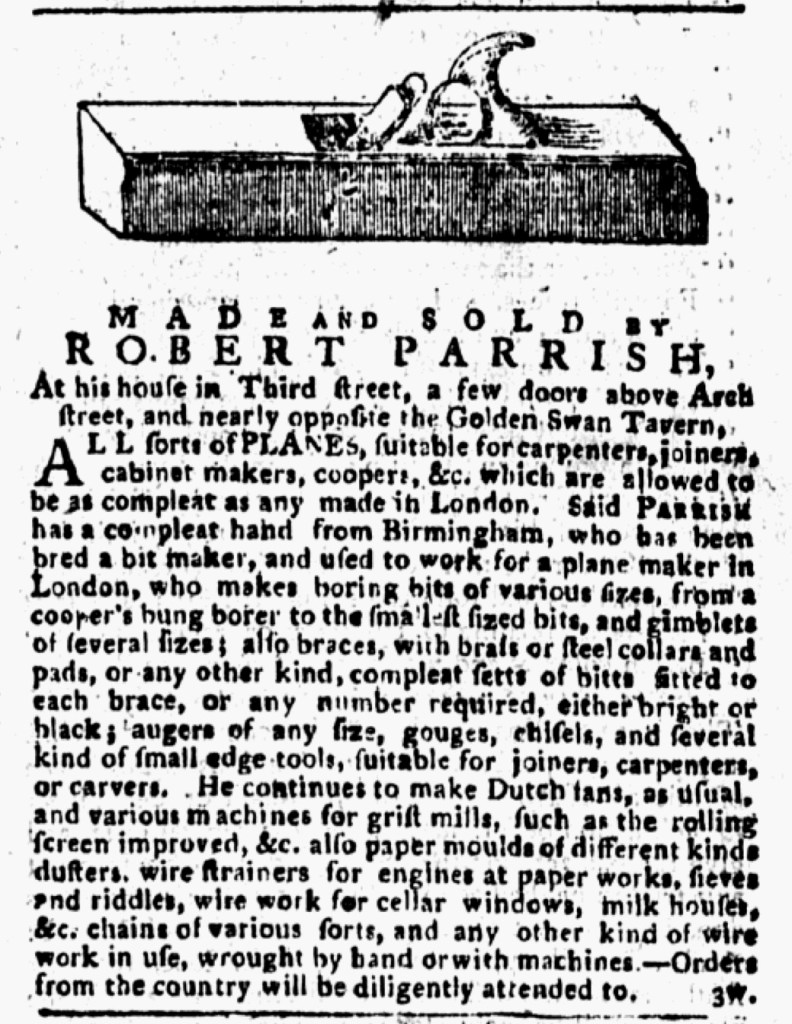
Story and Humphreys’s Pennsylvania Mercury (September 1, 1775).

“ALL sorts of PLANES, suitable for carpenters.”

When Robert Parrish published an advertisement adorned with a woodcut depicting a carpenter’s plane in the August 26, 1775, edition of the Pennsylvania Ledger, it was the first of several appearances that image would make in newspapers printed in Philadelphia over the course of eight weeks.  It next appeared in Story and Humphreys’s Pennsylvania Mercuryon September 1 as part of an advertisement with identical copy.  Perhaps Parrish had clipped his advertisement from the Pennsylvania Ledger and delivered it to Story and Humphreys’s printing office along with the woodcut that he retrieved from the Pennsylvania Ledger.

Having commissioned only one woodcut constrained Parrish’s schedule for publishing his advertisements.  Story and Humphreys’s Pennsylvania Mercury came out on Fridays and the Pennsylvania Mercury on Saturdays.  That did not leave enough time to transfer the woodcut back and forth between the two printing offices and have the compositors in each include them in the new issues when they set the type and laid them out.  Compositors, after all, sought to streamline that process as much as possible.  To that end, the initial insertion of Parrish’s advertisement in the Pennsylvania Ledgerincluded a dateline, “Philadelphia, August 25, 1775,” above the woodcut, but the compositor did not include it with subsequent insertions (even though advertisements often ran with their original dates for weeks or months).  It was much easier to retain the copy for the main body of the advertisement without worrying about a header that ran above the woodcut.

Parrish’s advertisement first ran in the Pennsylvania Ledger on a Saturday (in the first week of his advertising campaign) and then in Story and Humphreys’s Pennsylvania Mercury the following Friday (in the second week of his advertising campaign).  It did not appear in the Pennsylvania Ledger the next day.  Instead, it ran in that newspaper a week later (in the third week of his advertising campaign).  In the fourth week, the woodcut returned to Story and Humphreys’s printing office and Parrish’s advertisement appeared in their newspaper once again on September 15.  It did not run in either newspaper the following week but instead found its way to yet another newspaper, the Pennsylvania Journal published on Wednesday, September 27.  That allowed enough time to get the woodcut back to the Pennsylvania Ledger for its September 30 edition (during the sixth week of Parrish’s advertising campaign).  Parrish returned to alternating between the two original newspapers during the next two weeks.  His advertisement with the woodcut went back to Story and Humphreys’s Pennsylvania Mercury for the October 6 issue and then ran in the Pennsylvania Ledger on October 14.

Investing in a woodcut increased the chances that prospective customers would take note of an advertisement, but Parrish and other advertisers had limits to how much they would spend.  He apparently considered it worth it to commission a single woodcut but not more than one.  Instead, he arranged to transfer that woodcut from printing office to printing office to printing office over the course of many weeks.

August 26

What was advertised in a revolutionary American newspaper 250 years ago today?

Constitutional Gazette (August 26, 1775).

“He proposes to continue his business of pickling oysters and lobsters.”

John Anderson’s effort to solicit advertisements in the August 23, 1775, edition of the Constitutional Gazette yielded results.  When he published the next issue three days later, the final page carried four advertisements.  The printer was responsible for two of them, one for a pamphlet, “Defensive War in a Just Cause Sinless,” and the other for “All sorts of Blanks used in this Province,” children’s books, and “New Pamphlets.”  Another advertisement hawked “JOYCE’s Grand American Balsam,” a patent medicine sometimes advertised in other newspapers.  Customers could acquire the medicine and directions from “Mrs. Joyce, at Brookland Ferry” and from “Messrs. Anderson, Gaine, and Rivington, Printers in New-York.”  Although Edward Joyce’s widow or the other two printers may have played a role in placing the advertisement, Anderson certainly had a hand in publishing it.

One advertisement, however, had not connection to the printer of the Constitutional Gazette.  Abraham Delanoy placed a notice “to inform his customers, and the public in general, THAT … he proposes to continue his business of pickling oysters and lobsters; and also puts up fired oysters so as to keep a long time even in a hot climate.”  His advertisement featured a woodcut depicting a lobster trap and an oyster cage, accounting for half the space and attracting attention in a newspaper that did not have any other visual images.  That woodcut previously accompanied Delanoy’s advertisement in Rivington’s New-York Gazetteer.  He either retrieved it from another printing office to deliver to Anderson or carefully stored it in anticipation of using it again.  Delanoy also replicated much of the copy from that previous advertisement. The similarities suggest that he either copied directly from it, making minor revisions as he went, or indicated changes directly on a clipping of the advertisement.  Some readers likely recognized Delanoy’s advertisement, but this time it generated revenue for John Anderson and the Constitutional Gazette.  The printer must have been pleased that Delanoy set an example for others to advertise in this new publication.

January 12

What was advertised in a colonial American newspaper 250 years ago today?

Supplement to the New-York Journal (January 12, 1775).

“A GENERAL and complete assortment of MUFFS and TIPPETS.”

Lyon Jonas, a “FURRIER, from LONDON,” was consistent in his advertising in two newspapers published in New York on the eve of the American Revolution.  He ran notices with identical copy in the New-York Gazette and Weekly Mercury in November 1774 and the New-York Journal in January 1775.  As was often the case when advertisers purchased space in more than one publication, the notices featured variations in format at the discretion of the compositor, including line breaks and capitalization.  Otherwise, the copy in Jonas’s advertisement was identical.  Rather than writing it out twice, the furrier may very well have clipped his advertisement from one newspaper to submit to the printing office of the other.

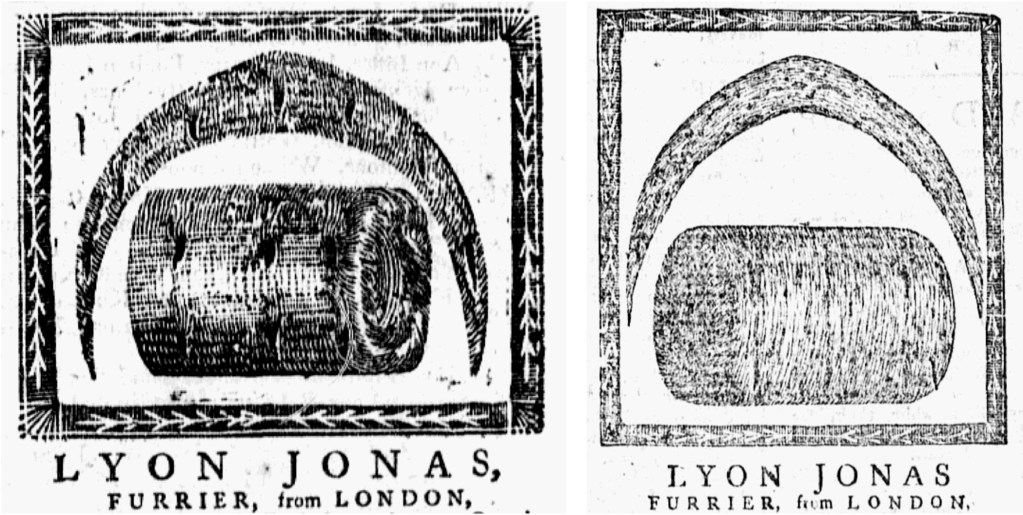
The two notices featured another striking similarity.  Both were adorned with a woodcut depicting a muff and a tippet enclosed within a decorative border, the size of the image accounting for approximately half of the space of the advertisement and certainly drawing attention.  Advertisers commissioned such distinctive woodcuts to promote their businesses, making additional investments in their marketing efforts.  In most instances that they incorporated images into advertisements in more than one newspaper, they collected their woodcut from one printing office and delivered it to another.

Jonas, however, commissioned a second woodcut.  Though similar at a glance, enough so that consumers would recognize the devise that represented Jonas’s business, the woodcuts had several variations.  The one in the New-York Gazette and Weekly Mercury was rectangular while the one in the New-York Journal was nearly a square.  The borders had different decorative elements, especially the corners.  The muffs faced opposite directions.  The ends of the tipped almost touched the border in the woodcut in the New-York Journal, but much more space appeared between the ends and the border in the version in the New-York Gazette and Weekly Mercury.

Most advertisers who adorned their newspaper notices with custom images limited their investment to one woodcut, transferring it from printing office to printing office when they wished to include those images in more than one publication.  Jonas, however, opted for a second woodcut.  Doing so allowed him, if he wished, to circulate advertisements with identical copy accompanied by distinctive images in two newspapers simultaneously without having to worry about the logistics of the printing offices sharing a single woodcut.

Left: New-York Gazette and Weekly Mercury (November 21, 1774); Right: Supplement to the New-York Journal (January 12, 1775).

April 29

What was advertised in a colonial American newspaper 250 years ago today?

Rivington’s New-York Gazetteer (April 29, 1773).

“RD. SAUSE. CUTLER.”

In the second issue of Rivington’s New-York Gazetteer, the printer continued publishing a significant number of advertisements to supplement the revenue earned from subscriptions.  Advertising accounted for six of the twelve columns in the April 29, 1773, edition.  Many of those advertisers also placed notices in other newspapers.

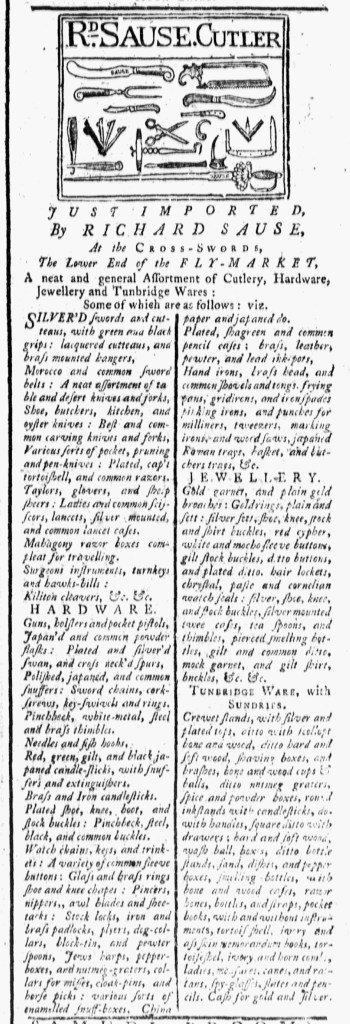
Richard Sause, a cutler, ran an advertisement that filled more than half a column.  He listed a variety of goods from among the “neat and general Assortment of Cutlery, Hardware, Jewellery and Tunbridge Wares” that he recently imported, clustering the various categories of merchandise together with headings to help readers locate items of interest.  A woodcut that depicted more than a dozen forms of cutlery, including knives, scissors, a saw, and a sword, adorned the advertisement.  That image may have replicated the sign that marked the location of Sause’s shop.  It likely looked familiar to readers who regularly perused the New-York Gazette and Weekly Mercury since it had previously accompanied the cutler’s advertisements in that newspaper.

Nesbitt Deane, a hatmaker who frequently advertised in the city’s newspapers, placed a notice that featured a woodcut of a tricorne hat with his name enclosed in a banner beneath it in the first issue of Rivington’s New-York Gazetteer, but it did not appear in the second issue.  Like Sause’s woodcut, that image would have been familiar to readers who regularly read other newspapers since it had been appearing in the New-York Journal for more than a year.  Deane apparently wished to increase the visibility of his business among curious colonizers who examined the first issue of Rivington’s newspaper, but returned to advertising in a publication that he had greater confidence would yield customers.  His advertisement, complete with the woodcut, ran in the New-York Journal rather than Rivington’s New-York Gazetteer on April 29.  Deane either collected the woodcut from one printing office and delivered it to the other or made arrangements for the transfer.

In both instances, the advertisers benefitted from visual images that prominently displayed their names and distinguished their notices from others that consisted solely of text.  To gain those advantages, they made additional investments in commissioning woodcuts and then carefully coordinated when and where they appeared in the public prints.  Like other advertisers who incorporated images into their notices, Deane and Sause each commissioned a single woodcut rather than multiple woodcuts that would have allowed them to enhance their advertisements in more than one newspaper simultaneously.

November 16

What was advertised in a colonial American newspaper 250 years ago today?

New-York Gazette and Weekly Mercury (November 16, 1772).

“SABLE MUFFS and TIPPETS.”

When furrier John Siemon returned to New York in the fall of 1772 after having spent several months in Philadelphia, he announced his intention to remain in the busy port with advertisements in at least two of the newspapers published in the city, the New-York Gazette and Weekly Mercury and the New-York Journal.  (Unfortunately, the New-York Gazette or Weekly Post-Boy has not been digitized, making it more difficult to consult.)  Siemon inserted identical copy in the two newspapers, first in the New-York Journal on November 12 and then in the New-York Gazette and Weekly Mercury on November 16, though the compositors in the printing offices made different decisions about the format of the advertisements.

Despite differences in typography, an image of a muff remained consistent between the notices in the two newspapers.  Upon examining digitized editions, it appears that the printing offices used the same woodcut, which suggests that Siemon invested some effort in having that woodcut transferred from one printing office to another.  He may have retrieved it himself or he may have made arrangements with the printers to exchange the woodcut.  Either way, that resulted in some inconvenience in the printing offices, especially since Siemon’s advertisement did not run just once.  A notation at the end of his advertisement in the New-York Journal, “58 61,” indicated that he initially intended for the notice to run for four issues from “NUMB. 1558” to “NUMB. 1561.”  According to the colophon, that was a standard run: “Five Shillings, four Weeks.”  The advertisement actually ended up running through “NUMB. 1566” on January 7, 1773, for a total of nine consecutive weeks.

In contrast, Siemon’s advertisement ran in the New-York Gazette and Weekly Mercury for only four weeks.  After the first insertion, the image no longer adorned the notice, further evidence that the furrier commissioned only one woodcut rather than one for each printing office.  After moving the woodcut from one printing office to another and back again when he first began advertising in the middle of November, Siemon may have decided that he did not have the time to oversee its transfer between the two printing offices twice a week.  Alternately, the printers may have made the decision for the furrier, determining that adding and removing the woodcut from type already set each time they took an issue to press was too disruptive.  Either way, Siemon likely had to settle for the image appearing in his advertisements the first time they ran in each newspaper, drawing attention to his return to New York, and then continuing in only one of those publications.

November 12

What was advertised in a colonial American newspaper 250 years ago today?

New-York Journal (November 12, 1772).

“SABLE Muffs and Tippets.”

When John Siemon, a furrier from London, first arrived in New York in December 1771, he took to the pages of the New-York Gazette and Weekly Mercury and the New-York Journal to alert prospective customers that he “he intends to stay a month only in this city,” encouraging them to acquire “the newest fashion’d MUFFS, TIPPETS, ERMINE and lining for CLOAKS … now worn by the LADIES at the Court of Great-Britain” before he departed.  Siemon advised that any milliners and shopkeepers “who intend to purchase after his departure” could direct their orders to “FROMBERGER and SIEMON, in Second Street, Philadelphia.”  Rather than arriving in New York directly from London, the furrier had first visited the Quaker City, established a partnership, and set up shop there.

Siemon returned to New York in November 1772.  In an advertisement in the New-York Journal, he once again described himself as “from London,” but this time added “but last from Philadelphia.”  He reminded readers that he “resided in this city last winter,” but this time he “intends settling here.”  He brought with him “to this Metropolis” a “General Assortment of FURS.”  Siemon hoped to resume relationships with his clients “who were pleased to favour him with their custom last winter,” pledging that new and returning clients “may depend on” him producing muffs, tippets, and other items “agreeable to fashion and beauty, on reasonable terms.”  He did not mention an ongoing partnership with Fromberger; instead, the headline promoted “JOHN SIEMON, and Co.”

Some readers may have remembered Siemon, his furs, and his advertisements.  They may have also remembered that an image adorned some of his advertisements.  When Siemon ventured to New York, he took with him a woodcut depicting a muff and tippet that previously appeared in advertisements in the Pennsylvania Chronicle and the Pennsylvania Journal.  Siemon’s new advertisement included an image of the muff, but the woodcut appears to have been modified to remove the tippet.  Eliminating the long scarf significantly reduced the size of the woodcut.  Since advertisers paid by the amount of space their notices occupied rather than the number of words, that reduced how much Siemon spent to publish his new advertisement.  Reducing costs, however, may not have been the reason for reworking the image.  Upon dissolving his partnership with Fromberger, he may have considered the updated image an appropriate representation of his new enterprise.  On the other hand, Siemon may not have put that much thought into the image if the woodcut simply broke and he could salvage only the portion depicting the muff.

Whatever the explanation, the woodcut experienced greater mobility than others created for advertisers, transported back and forth between two cities and delivered to three different printing offices.  Including the image in his advertisements required some effort by Siemon, suggesting that he considered it effective in attracting clients.

April 6

What was advertised in a colonial American newspaper 250 years ago today?

Boston Evening-Post (April 6, 1772).

“At the GOLDEN MORTAR … A compleat and fresh Assortment of Drugs & Medicines.”

Very few images appeared in the April 6, 1772, edition of the Boston Evening-Post.  The masthead ran on the first page, as usual, featuring a cartouche with an ornate border enclosing an image of a crown suspended over a heart.  Immediately below, the colophon stated that the newspaper was “Printed by THOMAS and JOHN FLEET, at the HEART and CROWN in Cornhill.”  Readers encountered only two other images in that issue, both of them adorning advertisements on the second page.  A woodcut depicting a ship at sea embellished a notice that announced the London would soon sail for London.  It helped draw attention to instructions for anyone interested in “Freight or Passage [to] apply to the Captain on board, or to Nath. Wheatley’s Store in King-Street.”

That woodcut belonged to the printers, Thomas Fleet and John Fleet.  The woodcut that accompanied Oliver Smith’s advertisement, however, did not.  It depicted a mortar and pestle, replicating Smith’s shop sign, “the GOLDEN MORTAR,” in the same way the image in the masthead represented the sign that marked the Fleets’ printing office.  The Fleets and other printers supplied a small number of woodcuts – ships at sea, houses, horses, enslaved people – for eighteenth-century advertisers to include in their newspaper notices.  If advertisers wished for specialized images associated exclusively with their businesses, they commissioned the woodcuts and provided them to the printers.  That also meant they could retrieve their woodcuts from one printing office and submit them to another.

Smith did so in the early 1770s.  His woodcut depicting a mortar and pestle enhanced an advertisement in the Massachusetts Gazette and Boston Weekly News-Letter in the fall of 1771.  More than half a year later, the same woodcut appeared in an advertisement in the Boston Evening-Post.  Not only did Smith attempt to widen his share of the market for “Drugs & Medicines” in Boston by advertising in multiple newspapers, he also sought to increase the visibility of the device associated with his shop.  The “GOLDEN MORTAR” served as a rudimentary trademark or brand that made his advertisements and his shop easy for consumers to identify.

December 22

What was advertised in a colonial American newspaper 250 years ago this week?

New-York Journal (December 19, 1771).

“MUFFS, TIPPETS, ERMINE and lining for CLOAKS.”

In the fall of 1771, furriers Fromberger and Siemon placed a series of advertisements in the Pennsylvania Chronicle and the Pennsylvania Journal.  On several occasions, an image of a muff and tippet adorned their notices, helping to draw attention to the various appeals they made concerning fashion, quality, and price.  The partners even offered ancillary services to entice prospective customers, including caring for furs “gratis for the summer season.”

The furriers apparently considered the image of the muff and tippet so effective in promoting their enterprise that when Siemon traveled to New York to conduct business there he took the woodcut with him in order to enhance advertisements he placed in newspapers published in that busy port.  He placed a notice in the December 19, 1771, edition of the New-York Journal that included both the image and copy, effectively doubling the cost.  According to the newspaper’s colophon, John Holt charged five shillings to insert “Advertisements of no more Length than Breadth” for four weeks and “larger Advertisements in the same Proportion.”  The woodcut doubled the length of Siemon’s advertisement, but very well may have been worth the additional expense if it aided in cultivating a clientele previously unfamiliar with the furrier.

Familiar appeals accompanied the visual image.  Siemon informed “the LADIES and others” that he brought with him “a general assortment of the newest fashion’d MUFFS, TIPPETS, ERMINE and lining for CLOAKS … now worn by the LADIES at the Court of Great-Britain,” echoing appeals to fashion, taste, and gentility advanced in advertisements that ran in newspapers in Philadelphia.  He also encouraged prospective customers to make their purchases soon because he would be in New York for a limited time.  Siemon had plans to return to Philadelphia, so would stay “a month only in this city.”  Milliners and shopkeepers who missed that window of opportunity, however, could direct orders to Fromberger and Siemon in Philadelphia.

Although printers provided stock images of ships, houses, horses, indentured servants, and enslaved men and women, woodcuts with images that represented specific businesses belonged to the advertisers to transfer from newspaper to newspaper as they saw fit.  Some advertisers did indeed deploy the same woodcut in multiple newspapers printed in a city, but it was much more unusual for advertisers to transport an image to newspapers published in other cities. Fromberger and Siemon did so, their advertisement running in the Pennsylvania Journal without an image on the same day that Siemon’s advertisement first appeared in the New-York Journal with an image.  Having gained some visibility in Philadelphia over the course of several months, the furriers likely aimed to achieve maximum effectiveness through using the woodcut to call attention to their advertisements in another city when one of the partners visited and temporarily conducted business there.

December 12

What was advertised in a colonial American newspaper 250 years ago today?

Pennsylvania Journal (December 12, 1771).

“Newest fashionable muffs, tippets and ermine.”

In the fall of 1771, furrier Fromberger and Siemon placed newspaper advertisement in their efforts to entice customers to visit their new shop on Market Street in Philadelphia.  They adopted several strategies that may have served them well, though their effectiveness may have been mitigated by an uneven rollout of the furriers’ advertising campaign.

Fromberger and Siemon commenced advertising in the Pennsylvania Journal in late September.  They incorporated a variety of appeals into their notice.  They informed customers that they catered to the latest tastes, stating that they carried “the newest fashionable muffs, tippets, and ermine, now worn by the ladies at the courts of Great Britain and France.”  They also called on consumers “to encourage their American manufacture” rather than purchase imported items.  In addition, the furriers sought to establish ongoing relationships with their customers by providing ancillary services.  Their customers could send their furs to Fromberger and Siemon to have them “taken care of gratis for the summer season.”  To draw attention to these various marketing strategies, the furriers adorned their advertisements with a woodcut depicting a muff and tippet.

That advertisement did not last long in the Pennsylvania Journal before it appeared in the Pennsylvania Chronicle.  Fromberger and Siemon commissioned only one woodcut, so they arranged to have it transferred from one printing office to another.  Once again, their advertisement quickly lapsed.  They revived it in the Pennsylvania Journal on December 5, though without the woodcut.  The following week, it ran once again, this time with the image of the muff and tippet.  The woodcut made its way back to William Bradford and Thomas Bradford’s printing office.  On December 19, however, Fromberger and Siemon’s advertisement appeared once more without the image that made it so distinctive.  Why, after investing in the woodcut, did the furriers deploy it so haphazardly?  Was it a tradeoff against the expense of purchasing the additional space?  Did the printers play any role in deciding that they needed the space for other content?  What other factors played a role in how Fromberger and Siemon executed their advertising campaign?

October 30

What was advertised in a colonial American newspaper 250 years ago this week?

Pennsylvania Packet (October 28, 1771).

“JAMES CUNNING, At the sign of the SPINNING-WHEEL.”

When John Dunlap launched the Pennsylvania Packet on October 28, 1771, the first edition featured an astounding number of advertisements, enough that he distributed a supplement containing some of the news and advertising that did not fit in the standard issue.  Still, he did not print all of the advertisements submitted to his printing office.  Dunlap included a note that “Some Advertisements … are deferred till next week, when they shall be carefully regarded.”  Most colonial newspapers did not benefit from such an abundance of advertising in their inaugural issues.  Advertisers tended to wait to assess the success and circulation of new newspapers before investing in advertising that might not be seen by many readers.  Dunlap may have attracted so many advertisers because he announced in the subscription proposals that “The first Number shall be given gratis.”  Many advertisers may have assumed that free newspapers would result in high demand, at least for that first issue, making their own advertisements sound investments.

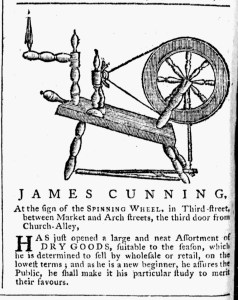
James Cunning, a merchant who did business “At the sign of the SPINNING WHEEL, in Third-street,” was among the advertisers who placed notices in the first issue of the Pennsylvania Packet.  He adorned his advertisement with an image of a spinning wheel, replicating the sign that marked his location.  That image, however, was not unique to the Pennsylvania Packet.  It previously appeared in advertisements Cunning placed in the Pennsylvania Journal on October 10 and October 17.  Colonial printers tended to supply stock images of ships, houses, horses, enslaved people, and indentured servants to advertisers, but advertisers who wished to publish other kinds of images had to commission woodcuts that then belonged to them, not the printers.  Three advertisements in the inaugural issue of the Pennsylvania Packet included images of ships at sea, but Cunning’s was the only advertisement with a specialized image keyed to his particular business.  To make that happen, he had to retrieve his woodcut of the spinning wheel from the printing office operated by William Bradford and Thomas Bradford at the corner of Front and Market Streets and deliver it, along with copy for his advertisement, to Dunlap’s “NEWEST PRINTING-OFFICE” on Market Street.  Already in the first issue of the Pennsylvania Packet, Dunlap participated in a longstanding practice of providing stock images for advertisers while also incorporating more specialized woodcuts that advertisers submitted with their copy.