July 14

What was advertised in a colonial American newspaper 250 years ago today?

Pennsylvania Gazette (July 14, 1773).

“He is determined to sell as low as any person can sell in Philadelphia, Lancaster, or elsewhere.”

At a glance, readers of the Pennsylvania Gazette may have thought that Frederick Hubley was a distiller.  After all, the woodcut that adorned his advertisement in the July 14, 1773, edition depicted a still.  On closer examination, however, they discovered that Hubley was a coppersmith who plied his trade in Lancaster.  He advised prospective customers in and near that town that he “MAKES all sorts of COPPER and BRASS WARE, in the neatest and best manner.”  In particular, he made “STILLS, brewers, hatters, wash, fish and tea kettles, bake-pans, [and] sauce-pans,” though repeating “&c.” (an abbreviation for et cetera) indicated that he accepted orders for other items.

To entice prospective customers, Hubley advanced some of the appeals most commonly deployed by colonial artisans who placed newspaper advertisements.  He offered assurances about the quality of the items he produced in his shop, declaring that he made them “in the neatest and best manner.”  Such declarations simultaneously testified to his skill as a coppersmith.  Hubley also leveraged price as a means of attracting customers.  He did not merely mention low prices or reasonable prices.  Instead, he compared his prices to those charged by his competitors, both coppersmiths and shopkeepers, near and far, stating that he “is determined to sell as low as any person can sell in Philadelphia, Lancaster, or elsewhere.”  Prospective customers, Hubley asserted, would not find better deals, not even in Philadelphia, the largest city and busiest port in the colonies.

Hubley advertised in a newspaper published in that city because Lancaster did not yet have its own newspaper in 1773.  The Pennsylvania Gazette and several other newspapers published in Philadelphia, as well as Germantowner Zeitung, served the entire colony and portions of Delaware, Maryland, and New Jersey.  Lancaster would not have its own newspaper until late November 1777 when John Dunlap temporarily moved the Pennsylvania Packet to town when the Continental Congress briefly relocated there during the British occupation of Philadelphia.  Although the Continental Congress quickly moved to York in hopes that even more distance meant more safety from the British, Dunlap and his press remained in Lancaster.  For six months, he printed the Pennsylvania Packet in Lancester, but ceased when he returned to Philadelphia to resume the newspaper there on July 4, 1778.  The war disrupted publication of several newspapers.  In addition, some folded completely, while printers established others.  In the summer of 1773, however, Hubley and others in Lancaster who wished to advertise did so within a fairly stable media environment, one with a center of gravity in Philadelphia.

July 8

What was advertised in a colonial American newspaper 250 years ago today?

Rivington’s New-York Gazetteer (July 8, 1773).

“He has obtained a certificate from the Queen’s Stay-Maker in London.”

Readers of Rivington’s New-York Gazetteer likely noticed the image that adorned John Burchett’s advertisement in the July 8, 1773, edition.  After all, it was the only image featured throughout the issue, with the exception of a woodcut depicting a ship at sea that appeared in the masthead.  Burchett, a “STAY and RIDING HABIT-MAKER” who kept shop “at the Sign of the Crown and Stays,” led his advertisement with a woodcut that replicated that sign.

Yet Burchett did not rely on the image alone to market his goods and services.  Instead, he incorporated other appeals in his efforts to convince prospective customers to purchase stays from him.  For instance, he invoked his origins and previous experience, describing himself as “From LONDON and PARIS.”  Like others in the garment trades, Burchett suggested to consumers that they would derive additional cachet from hiring someone with connections to such cosmopolitan cities.  Most tailors, milliners, and staymakers who migrated across the Atlantic could claim roots in only one of those capitals of fashion and gentility, yet Burchett asserted ties to both.  He especially emphasized the recognition he gained in London, informing prospective customers that “he has obtained a certificate form the Queen’s Stay-Maker in London.”

That testified to the taste and quality associated with stays made by Burchett.  For those concerned about price, he declared that he “has also a good number of ready made stays of the best quality, cheaper than can be imported.”  He even gave prices so prospective customers could assess the bargains for themselves without having to visit his shop.  In addition, he proposed a payment plan meant to encourage consumers to select him over his competitors.  The staymaker pledged that “any lady who shall employ him” could pay “half cash … and the rest in dry goods.”  That put him in a position to barter with female shopkeepers and the wives and daughters of merchants and shopkeepers.

Burchett did not merely announce that he made and sold stays and then hope that customers would visit his shop at the Sign of the Crown and Stays.  Instead, he deployed an image that corresponded to the sign associated with his business as an invitation to peruse a lively narrative that included a variety of marketing strategies.  He commented on fashion and price while emphasizing his experience working in London and Paris and alternatives to paying with cash or credit.  As a result of such attention to so many aspects of his business, prospective customers could trust that the staymaker would indeed “use all possible endeavours to merit their interest.”

June 20

What was advertised in a colonial American newspaper 250 years ago this week?

Supplement to the Boston-Gazette (June 14, 1773).

“UMBRILLOES.”

Isaac Greenwood may not have believed that imitation was the sincerest form of flattery when John Cutler decided to run advertisements adorned with a woodcut that closely replicated the image of genteel woman shaded by an umbrella that he had included in many of his advertisements for the past couple of years.  Greenwood first used the image in May 1771 and continued incorporating it into his newspaper notices in 1772 and 1773.  In the summer of 1773, he launched a new advertising campaign that featured the woodcut and the headline “NOT IMPORTED” to underscore that he made the “UMBRILLOES” he sold while simultaneously encouraging consumers to support domestic manufactures by choosing them over imported alternatives.

Boston Evening-Post (June 14, 1773).

Cutler also made “Umbrilloes of all sorts for Ladies and Gentlemen … in the best Manner.”  In addition, he “mended and covered” old umbrellas.  As Greenwood’s latest advertisement with the image of the woman and umbrella appeared in supplement that accompanied the June 14 edition of the Boston-Gazette, Cutler debuted his strikingly similar woodcut in an advertisement in the Boston Evening-Post on the same day.  He then took the rather extraordinary step of having the woodcut transferred to the printing offices of the Massachusetts Gazette and Boston Weekly News-Letter in time to run in the June 17 edition.  Such transfers continued for the next several weeks as Cutler increased the exposure for the image by inserting it in more than one newspaper.

Massachusetts Gazette and Boston Weekly News-Letter (June 17, 1773).

Some prospective customers may have considered the woman depicted in Cutler’s advertisements more elegant than the one in Greenwood’s notices.  Both wore necklaces.  In the original image, the necklace hugged the woman’s chin, making it difficult to distinguish, while in the imitation the necklace hung lower on the woman’s neck and featured a pendant that enhanced it.  The original image offered a view of the woman’s decolletage, while the imitation placed greater emphasis on embroidery and other adornments.  The hairstyles differed as well.  The woman in the original image wore a high roll, but some viewers may have mistaken it for a turban.  In the imitation, the woman had her hair pile high upon her head, but the image suggested elaborate curls and even a tendril that hung below her right ear to frame her face.

In several ways, Cutler’s new image was superior to the familiar one that Greenwood had circulated for more than two years.  Cutler could have chosen another image to represent his business in the public prints.  After all, he advised prospective customers that he made umbrellas “at the Golden Cock, in Marlborough Street.”  Some advertisers experimented with branding and logos in the late eighteenth century, consistently associating an image with their shops and their goods.  Greenwood may not have been very happy that Cutler devised an image that so closely resembled the one that already represented his business.

May 23

What was advertised in a colonial American newspaper 250 years ago this week?

Rivington’s New-York Gazetteer (May 20, 1773).

“The Sign of the Tea-Cannister and two Sugar Loaves.”

When James Rivington launched Rivington’s New-York Gazetteer in the spring of 1773, he had a significant number of advertisers lined up for the first several issues.  Those advertisers included entrepreneurs who previously invested in woodcuts that depicted some aspect of their business.  Such visual images distinguished their advertisements from others that consisted entirely of text.  Nesbitt Deane, a hatmaker, ran an advertisement featuring the familiar image of a tricorne hat with his name in a ribbon below it in the first issue.  Richard Sause, a cutler, included his woodcut depicting items made and sold at his shop in the second issue of Rivington’s New-York Gazetteer.

A couple of weeks later, Smith Richards, a “GROCER and CONFECTIONER, At the Sign of the Tea-Cannister and two Sugar Loaves,” ran an advertisement with an image that replicated his shop sign.  Within a thick border, sugar loaves flanked a tea canister embellished with the names of popular varieties of tea, “HYSON,” “SOUCHONG,” and “CONGO.”  Unlike the woodcuts that adorned advertisements placed by Deane and Sause, this one had not previously appeared in the New-York Gazette and Weekly Mercury or the New-York Journal.  (It may have run in the New-York Gazette or Weekly Post-Boy.  Issues from January 1771 through the last known issue of July 12, 1773, have not yet been digitized for greater accessibility.)  The image of the “Sign of the Tea-Cannister and two Sugar Loaves” very well may have been the first woodcut commissioned for an advertisement in Rivington’s New-York Gazetteer.

Richards had not previously advertised in the New-York Gazette and Weekly Mercury or the New-York Journal, but he apparently believed that the new Rivington’s New-York Gazetteer offered a good opportunity and a sound investment when it came to advertising his wares.  Even though most advertisers did not commission woodcuts to accompany their notices, many other entrepreneurs, some who previously advertised in other newspapers and some who had not, shared Richards’s confidence in the effectiveness of disseminating their advertisements via New York’s newest newspaper. Rivington had successfully convinced prospective advertisers that his newspaper enjoyed a wide circulation for even its earliest issues.

May 12

What was advertised in a colonial American newspaper 250 years ago today?

Supplement to the Pennsylvania Gazette (May 12, 1773).

“A MUSICIAN.”

When an anonymous musician offered “to teach the art of playing on the Guittar, in the best and newest taste” and “likewise teaches the German flute,” he adorned his advertisement in the May 12, 1773, edition of the Pennsylvania Gazette with an image of a guitar, a flute, and a sheet of music.  The woodcut accounted for half of the space occupied by the advertisement.  The combination of visual image and advertising copy likely drew the attention of readers, especially since most advertisements did not feature any sort of image.

Some did have a stock image in the upper left corner.  For instance, four advertisements that sought passengers and freight for ships preparing to depart for other ports incorporated woodcuts of vessels at sea, perhaps the most common image that appeared in a newspaper published in the bustling urban port of Philadelphia.  In contrast, images depicting enslaved people appeared about as often as images of ships in advertisements in newspapers published in Charleston.  The May 12 edition of the Pennsylvania Gazette did not have any images of enslaved people, even though it included advertisements about enslaved men, women, and children for sale as well as notices describing enslaved people who liberated themselves and offering rewards for their capture and return.  That issue did feature one advertisement with a woodcut depicting an indentured servant who absconded.  Two advertisements for stallions “to cover” (or breed with) mares had woodcuts of horses.

Pennsylvania Gazette (May 12, 1773).

In addition to those stock images supplied by the printers, three images commissioned by advertisers to correspond to the goods and services they marketed adorned advertisements in that issue.  A woodcut depicting a stagecoach drawn by two horses enhanced the notice for the route that connected Philadelphia and New York, operated by Charles Bessonett and Company.  An image of a sickle accompanied the advertising copy in Jacob Eckfelt’s notice.  Finally, the woodcut depicting the guitar, flute, and sheet music distinguished the anonymous musician’s advertisement from others that consisted solely of text.

To varying degrees, eighteenth-century advertisers experimented with images in their newspaper notices, sometimes opting for stock images provided by the printers and other times commissioning woodcuts for their sole use.  Although the majority of advertisers did not incorporate images into their notices, enough did so to demonstrate both curiosity about the practice and a suspicion or even a belief that images were worth the additional investment.  While these images may seem quaint or rudimentary when viewed through modern eyes, they likely resonated with eighteenth-century readers who usually encountered images in advertisements and nowhere else in newspapers, with the exception of the image that appeared in the masthead on the first page of each issue.

May 5

What was advertised in a colonial American newspaper 250 years ago today?

Pennsylvania Gazette (May 5, 1773).

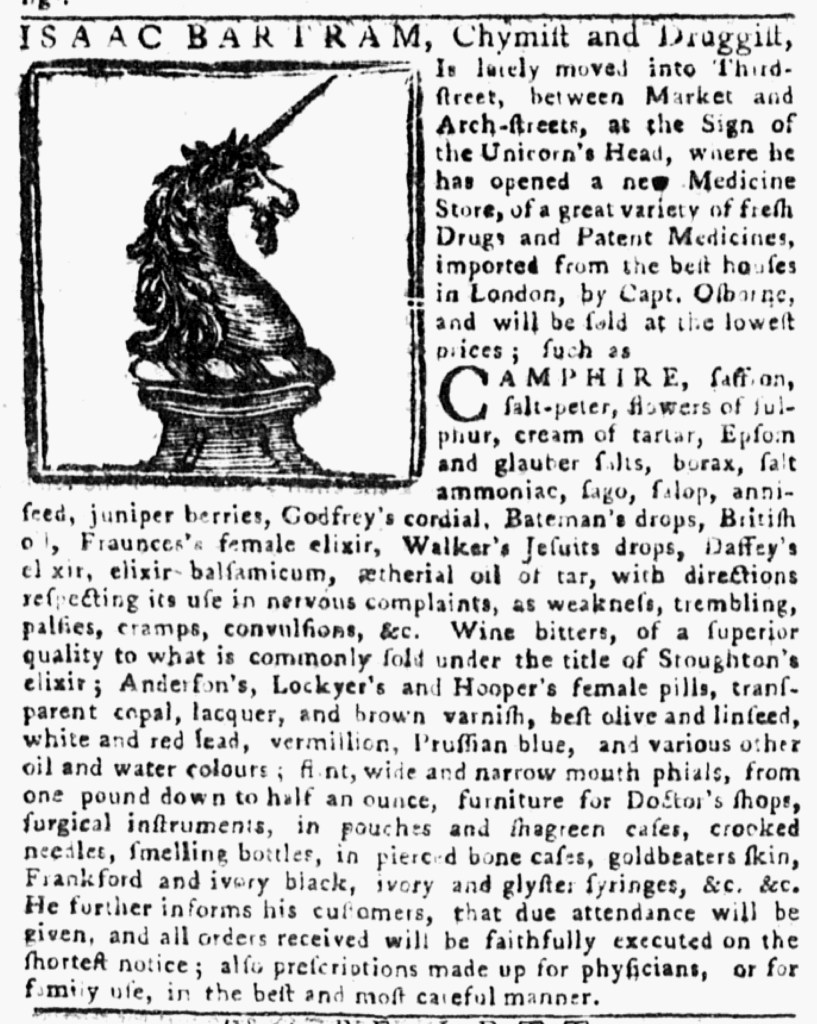
“Chymist and Druggist … at the Sign of the Unicorn’s Head.”

Isaac Bartram, “Chymist and Druggist,” offered a variety of goods and services at his “new Medicine Store” in Philadelphia in the spring of 1773.  According to his advertisement in the May 5 edition of the Pennsylvania Gazette, he sold a “great variety of fresh Drugs and Patent Medicines, imported from the best houses in London.”  Prospective customers would have been familiar with the patent medicines that Bartram listed in his notice, just as modern consumers recognize various brands of over-the-counter medications.  Among other nostrums, the apothecary carried “Godfrey’s cordial, Bateman’s drops, … Walker’s Jesuits drops, Daffey’s elixir, [and] Anderson’s Lockyer’s and Hooper’s female pills.”  For those willing to try equivalent products, like modern consumers who purchase generics, Bartram marketed “Wine bitters, of a superior quality to what is commonly sold under the title of Stoughton’s elixir.”  He also stocked medical equipment, including syringes, vials, and surgical instruments, and prepared prescriptions “for physicians, or for family use.”

In addition to the copy, Bartram deployed an image to draw more attention to his advertisement.  He indicated that he kept shop “at the Sign of the Unicorn’s Head.”  Appropriately, a woodcut depicting a unicorn’s head enclosed within a border adorned the upper left corner of his notice, accounting for nearly one-quarter of the space occupied by his advertisement.  This certainly increased Bartram’s advertising costs since he had to commission the unique image associated with his business and then pay for the additional space.  Most advertisers did not invest in images for their notices, though a growing number adopted the practice in the early 1770s.  Elsewhere in the same issue of the Pennsylvania Gazette, Stephen Paschall and son Stephen Paschall, as they styled themselves, included an image of a scythe, a sickle, and other sort of iron work available at their workshop “at the Sign of the Scythe and Sickle.”  The initials “SP” marked one of the items.  The Paschalls first published the image a year earlier.  These images may have replicated the signs displayed by Bartram and the Paschalls, the only surviving visual representations of signs that colonizers glimpsed as they traversed the streets of Philadelphia.

Most advertisers relied solely on the text of their notices to encourage readers to visit their shops.  Such was the case for Robert Bass, an apothecary whose advertisement for a “new and fresh Assortment of DRUGS and PATENT MEDICINES” appeared on the same page as Bartram’s advertisement.  The woodcut depicting the Sign of the Unicorn’s Head certainly made Bartram’s notice much more visible to readers, prompting them to read about his wares and, in the process, quite possibly justifying the investment.

March 31

What was advertised in a colonial American newspaper 250 years ago today?

Pennsylvania Gazette (March 31, 1773).

“A Quantity of well made RIFLES.”

Thomas Palmer, a gunsmith, made several appeals to prospective customers in Philadelphia in the advertisement he placed in the March 31, 1773, edition of the Pennsylvania Gazette.  He declared that his inventory included a wide selection, a “Quantity of well made RIFLES, of different Lengths and Sizes of Bores.”  Palmer was so confident of the quality of those guns that he proclaimed that he “will insure to the Purchasers” that they were “as good and as handsomely fitted up as any made in America.”  Consumers would not find better in Philadelphia or anywhere else in the colonies.  In addition, the gunsmith “makes Fowling Pieces, of different Sizes, such as have been approved of by Gentlemen of this City.”  Short of publishing testimonials from his clients, Palmer suggested that men with good reputations endorsed the guns produced in his workshop.  In addition to making rifles and fowling pieces, he also “repairs old Guns in the most careful Manner.”

Palmer did not rely on advertising copy alone to market his services.  Instead, he incorporated a visual image into his notice.  A woodcut that may have replicated a sign that marked the gunsmith’s location adorned the advertisement, though the copy did not make reference to any sign at Palmer’s shop on “the North Side of Market-street, between Fourth and Fifth-streets.”  On the other hand, Palmer may have considered it unnecessary to mention a sign in copy that appeared immediately below an image of a rifle and the words “THO: PALMER Gun Smith” enclosed within a double border.  Residents of Philadelphia may have already been familiar with the sign and readers from beyond the city would have easily recognized it if they decided to visit Palmer’s shop.  Whether or not Palmer displayed a sign at his shop on Market Street, the woodcut helped distinguish his advertisement from other content in the Pennsylvania Gazette, likely making it worth the investment.  With the exception of the seal in the masthead, only one other image appeared in that issue.  A stock image of a house ran with a real estate notice, but that lacked the same level of customization as the woodcut in Palmer’s advertisement.  The gunsmith deployed text and image simultaneously in his efforts to engage prospective customers.

January 11

What was advertised in a colonial American newspaper 250 years ago today?

Pennsylvania Packet (January 11, 1773).

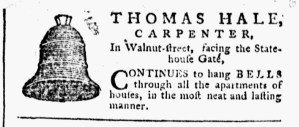
“THOMAS HALE … CONTINUES to hang BELLS.”

When Thomas Hale, a carpenter, arrived in Philadelphia from London in the late 1760s, he placed an advertisement in the Pennsylvania Chronicle to advise prospective customers that he “undertakers the Business of hanging Bells through all the Apartments of Houses.”  A woodcut depicting a bell adorned his advertisement.  Hale acknowledged that he was “a Stranger” in the city, but asserted that “any Person can be credibly assured of his Integrity.”

Hale was no longer “a Stranger” when he inserted a similar advertisement in the Pennsylvania Packet in January 1773.  He reminded readers that he “CONTINUES to hang BELLS through all the apartments of houses, in the most neat and lasting manner.”  He once again adorned his advertisement with an image of a bell, likely the same woodcut from his advertisement in 1767.  Hale sought a return on his initial investment in commissioning the woodcut, using it to draw attention to his notice.  Elsewhere in the January 11 edition of the Pennsylvania Packet, an image of a ship in the masthead was the only other image.  The bell certainly distinguished Hale’s advertisement from others.  The two-page supplement that accompanied that issue featured two woodcuts, both of them stock images of runaway indentured servants provided by the printer.  Among the merchants, shopkeepers, and artisans who placed notices, Hale was the only advertiser who incorporated an image, humble through it was, directly linked to the business he operated.

If it was the same woodcut that Hale used in his advertisement more than half a decade earlier, that suggests that he collected it from the printing office and retained possession of it after he discontinued his previous advertisement.  The same week that he advertised in the Pennsylvania Packet he also ran an advertisement with identical copy but no image in the Pennsylvania Chronicle, the newspaper that previously carried his advertisement with the woodcut of the bell.  Including an image enhanced an advertisement, but when Hale opted to advertise in more than one newspaper, he had to make a choice about which one should feature the image … or invest in a second woodcut.  He apparently did not consider the image so essential to his business that he needed to make the additional investment.  It was one of several choices that he made when budgeting for marketing, including the length of his advertisement and where to publish it.  For instance, he did not insert it in the Pennsylvania Gazette, the Pennsylvania Journal, or the Wochentliche Pennsylvanische Staatsbote, the other newspapers published in Philadelphia at the time.  With limited resources to devote to marketing, Hale decided to get more use out of the woodcut in one newspaper and supplement that advertisement with a notice in a second newspaper.

December 9

What was advertised in a colonial American newspaper 250 years ago today?

Pennsylvania Journal (December 9, 1772).

“MUFFTS, TIPPITS, ERMINE.”

When furriers John Fromberger and John Siemon formed their partnership, they placed advertisements in newspapers published in Philadelphia.  A woodcut depicting a miff and tippet adorned the notice they placed in the Pennsylvania Journal in September 1771.  Several weeks later, they transferred the woodcut to the printing office of the Pennsylvania Chronicle so it could appear in advertisements they ran in that newspaper.  In December, the furriers once again made arrangements for the image to accompany their advertisements in the Pennsylvania Journal.  Within in a few weeks, it appeared in yet another newspaper, the New-York Journal.  Siemon visited the city, advised prospective customers that “he intends to stay a month only,” and took the woodcut with him to help draw attention to his advertisements.  Given his short stay, Siemon did not manage to transfer the woodcut from one printing office to another.  His advertisements in the New-York Gazette and Weekly Mercury did not feature any image.

Siemon returned to New York in November 1772.  In a new advertisement in the New-York Journal, he informed readers that “he intends settling here” and requested “a further continuance of those Ladies and Gentlemen who were pleased to favour him with their custom last winter.”  That advertisement did not mention any connection to Fromberger; apparently the furriers dissolved their partnership.  The advertisement did include a familiar image, at least a portion of one.  Siemon included the muff, but not the tippet formerly arranged above it.  Perhaps he modified the woodcut to acknowledge his new enterprise.  Perhaps the portion depicting the tippet had been damaged so he had that part removed and salvaged the rest.  Perhaps he had the tippet removed because it occupied so much space.  A smaller woodcut cost less to include in his advertisements.  Whatever the explanation, Siemon had a familiar, but updated, image for customers to associate with his business.

Fromberger apparently thought that was a good idea.  A month after John Siemon and Company advertised in the New-York Journal, John Fromberger and Company placed a notice with an image in the Pennsylvania Journal.  Since Siemon retained the original woodcut, Fromberger commissioned a new woodcut.  He exercised some consistency in selecting what appeared in the image, a muff and a tippet.  This time, however, the muff and the tippet appeared side by side rather than one above the other.  Both items had the same patterns as the muff and the tippet in the original woodcut. Fromberger likely believed that consumers in Philadelphia associated a similar image with the business he operated.  A similar image repeatedly accompanied his previous notices, making a new one that depicted both a muff and a tippet familiar and appropriate for marketing his new enterprise.

December 7

What was advertised in a colonial American newspaper 250 years ago today?

Pennsylvania Packet (December 7, 1772).

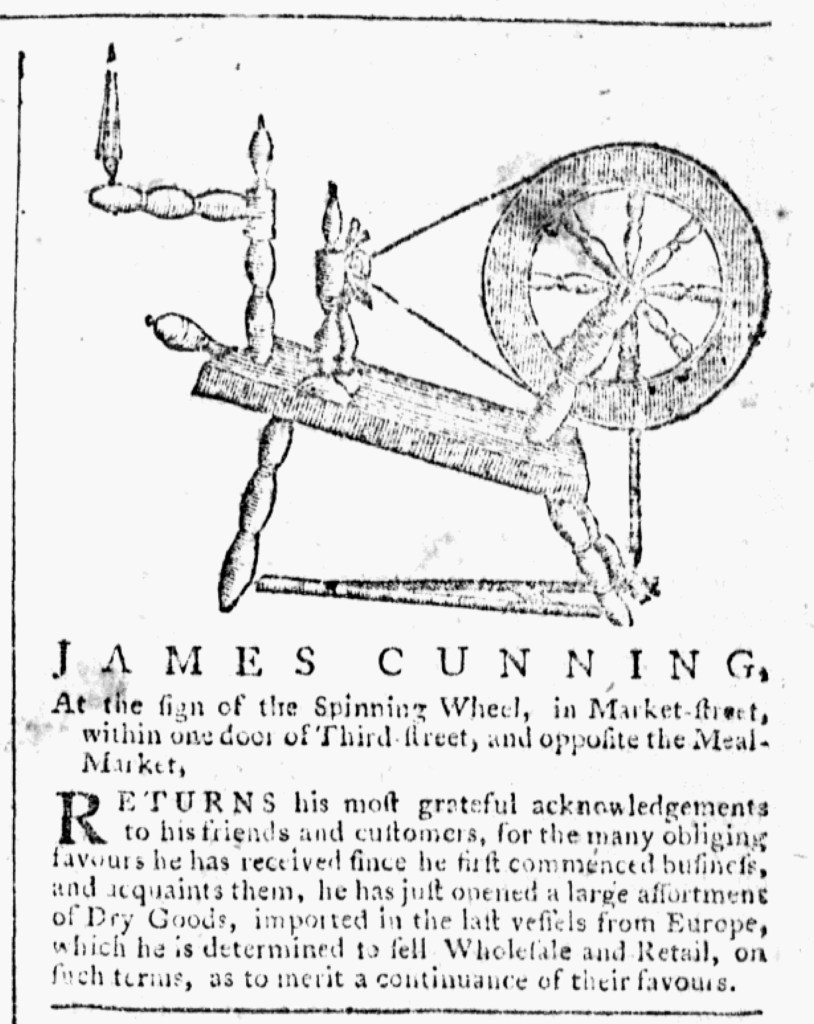
“At the sign of the Spinning Wheel.”

In December 1772, James Cunning took the pages of the Pennsylvania Packet to advertise the “large assortment of Dry Goods” available at his shop on Market Street in Philadelphia.  He took the opportunity to express his “grateful acknowledgments to his friends and customers,” thanking them for “the many obliging favours he has received since he first commenced business.”  In order to “merit a continuance of their favours,” Cunning declared that he would set favorable “terms” for both wholesale and retail sales.  Those “terms” certainly included price and likely credit as well.  They may have also included packaging, delivery, and other services.

Cunning advised readers that they would find his shop “At the sign of the Spinning Wheel.”  To strengthen the association between that symbol of industriousness and his business, Cunning adorned his advertisement with a woodcut that depicted a spinning wheel.  Larger than the stock images of vessels at sea and horses in the upper left corners of half a dozen advertisements in the December 7 issue and its supplement, the spinning wheel accounted for more than half the space occupied by Cunning’s advertisement.  That represented significant expense for Cunning, first for commissioning a woodcut tied to his business and for his exclusive use, then for the space required to publish it.  Printers charged by the amount of space, not the number of words.

Cunning apparently considered including the image in his notices worth the expense, especially since he continued to use it when placing new advertisements.  The image first appeared in advertisements Cunning inserted in the Pennsylvania Journal in October 1771.  By the end of the month, he transferred the woodcut to the printing offices of the newly-launched Pennsylvania Packet.  It appeared in an advertisement in the inaugural issue.  More than a year later, Cunning included the image in a new advertisement in the Pennsylvania Packet, convinced that it would result in a satisfactory return on his investment in commissioning it.  He could have retired the image after it appeared in that initial run of advertising if he did not believe that it resulted in greater attention for his business.  That he used it again suggests that he determined that image and text together helped to draw “friends and customers” to his shop.