What was advertised in a colonial newspaper 250 years ago this week?
New-York Mercury (June 9, 1766).
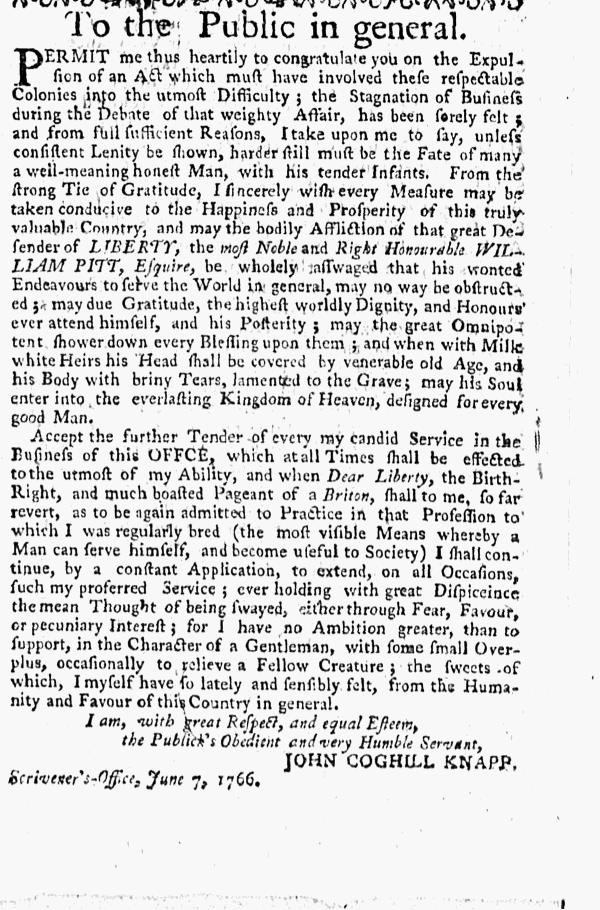
“PERMIT me thus heartily to congratulate you on the Expulsion of an Act which must have involved these respectable Colonies into the utmost Difficulty.”
A week ago the Adverts 250 Project featured a “to be continued” advertisement placed by John Coghill Knapp from the “Scrivener, Register, and Conveyancer’s OFFICE, on Rotten-Row.” The lawyer’s advertisement concluded with a not that “The Remainder of this Advertisement, with some further Remarks that may be beneficial to the Publick, in our next.” The wording raised questions about whether the advertiser or the printer made the decision to delay publication of “The Remainder.” Did Knapp devise a clever means of inciting interest in whatever might appear in “The Remainder” or did the printer run out of space and choose to truncate the advertisement? After all, it wasn’t uncommon for printers to insert notices that advertisements that had not appeared in the current issue would be published in the next.
An examination of the dates attached to each advertisement may help to answer this question. The original advertisement, published in the June 2 issue of the New-York Mercury, was dated “2d of June.” It was written the same day that it was printed (or, more likely, post-dated to be current with the issue). “The Remainder” that appeared in the June 9 issue of the New-York Mercury was dated “June 7” – after the previous issue, making it more likely that Knapp did originally intend to have the advertisement appear in separate pieces in two consecutive issues.
What were these “further Remarks that may be beneficial to the Publick” that Knapp promised and expected readers to anticipate? Knapp published an extended reflection on the repeal of the Stamp Act, “the Expulsion of an Act which must have involved these respectable Colonies in the utmost Difficulty.” In particular , he lauded “that great Defender of LIBERTY, the most Noble and Right Honorable WILLIAM PITT.” Knapp used politics and current events to appeal to potential clients who had protested the Stamp Act.
In a second paragraph, he discussed his own virtues as an attorney. In addition, he stated that he was “again admitted to Practice in that Profession to which I was regularly bred.” In his previous advertisement he had announced that he “received his Education at the University of Oxford; was regularly bred to the Profession of the LAW.” The Stamp Act disrupted attorneys’ work since legal documents were supposed to be recorded on stamped paper. Knapp lamented that “the Stagnation of Business during the Debate of that weighty Affair, has been sorely felt.” Now that the repeal had gone into effect, Knapp was “again admitted” to practicing the law now that the colonies had reverted to “Dear Liberty, the Birth-Right” of the Britons who resided there.
When Jane Gillam announced that she stocked “a Variety of English Goods” she was not exaggerating. The shopkeeper named approximately fifty textiles, but that may not have been an exhaustive list. Even if it was, she offered a dizzying assortment of fabrics, especially considering that some fabrics came in multiple colors or patterns.
To many modern readers, this advertisement may seem disorienting. What’s the difference between “Cherederies” and “Garlicks” or between “Callamancoes” and “Ozenbrigs”? Gillam expected eighteenth-century readers – her potential customers – recognized all the variations, but most of the distinctions are likely lost among modern Americans. Fortunately, historians of material culture have created a variety of resources documenting the different types of fabrics that made their way across oceans and into merchants’ warehouses and retailers’ shops.
Advertisements like those placed by Gillam have aided historians in determining which fabrics were available in early America. Consider the subtitle for one of the standard works in the field, Florence M. Montgomery’s Textiles in America, 1650-1870: A Dictionary Based on Original Documents, Prints and Paintings, Commercial Records, American Merchants’ Papers, Shopkeepers’ Advertisements, and Pattern Books with Original Swatches of Cloth (New York: W.W. Norton, 1984).
Initially I set about providing a short description of each fabric in Gillam’s advertisement as described in Montgomery’s dictionary, but I quickly discovered that the distinctions were too numerous and too complicated to do that here. Instead, how about a quick definition of the four textiles listed above, just to get a sense of what colonial Americans knew about textile that most Americans never learn.
Cherederies = Cherryderry (charadary, carridary): “Striped or checked woven cloth of mixed silk and cotton imported from India from the late seventeenth century.” (199)
Garlicks = Garlick (garlits, garlix, gulick, gulix): “A linen cloth first imported from Goerlitz, Silesia. It could be fully or partially bleached.” (245)
Callamancoes = Calimanco (calamande, calamandre): “A worsted ‘stuff … [with] a fine gloss upon it. There are calamancoes of all colours, and diversly wrought; some ate quite plain; others have broad stripes, adorned with flowers; some with plain broad stripes; some with narrow stripes; and others watered.’” (185)
Ozenbrigs = Osnaburg (oznabrig): “Coarse, unbleached linen or hempen cloth first made in Osnabrück, Germany. It was commonly used for trousers, sacking, and bagging.” (312)
As we can see from the descriptions of just four of the fabrics listed in Gillam’s advertisement, colonial consumers imagined different uses for different kinds of cloth. At a glance, they would have made assumptions about which they desired and which they could afford.
Who was the subject of an advertisement in a colonial newspaper 250 years ago this week?
Virginia Gazette (June 8, 1766).
“RUN away … some time in October 1762, a Mulatto woman named VIOLET.”
Violet made her escape almost four years earlier, but Philip Kearny was still actively pursuing her in June 1766.
This advertisement demonstrates the efforts enslaved men and women put into making their escapes as well as how vigorously their masters worked to return them to bondage. From hundreds of miles away, Kearny used this advertisement to tell quite a story about Violet. She was born, or so Kearny claimed, in “Princetown” (now Princeton), New Jersey, but in her mid twenties she ran away. She made it to “Frederick town” (now Frederick), Maryland, before being captured and “committed to the gaol.” She managed to escape, which didn’t seem to surprise Kearny, since he described her as “cunning and artful.” He suspected that she was in Maryland, Virginia, or North Carolina, hence his advertisement in the Virginia Gazette.
Even before she ran away, Violet did not recognize Kearny as her master. According to the slaveholder, Violet “pretends to be a free woman,” but his narrative indicates that the story was more complex. She disputed that she was a “slave for life,” suggesting that perhaps she had engaged in some sort of indenture or other contract and then been forced into slavery. The details were murky (and Violet would have given a different account of events than the slaveholder), but Kearney reiterated that “she was born a slave.”
Advertisements for runaway slaves have sometimes been called the first slave narratives. Although Violet did not write this advertisement, it is possible to recognize her resistance and recover some of her story by reading against the narrative presented by Kearny.
What was advertised in a colonial newspaper 250 years ago this week?
Virginia Gazette (June 6, 1766).
“Whoever secures my servants and Negro … shall, besides the reward allowed by law, be paid any reasonable satisfaction.”
John Mercer turned to the Virginia Gazette to advertise more than just beer, porter, and ale. His lengthy advertisement for the “MARLBOROUGH BREWERY” appeared on the opposite side of the page as this notice concerning a slave and two indentured servants who ran away from the brewer. John Mercer had a hard time holding on to his help!
That may tell us something about what kind of master Mercer was, but he used this advertisement to shape the narrative. What else could be expected of Temple, the slave? After all, he “carries the marks of the discipline he underwent” while on a ship in the West Indies. It was plain for anybody to see (especially from the scars Neptune bore on his body), Mercer suggested, that the slave had a history of challenging authority, not following instructions, and stepping out of his appropriate place.
The two indentured servants, Joseph Wain and William Cantrell, were equally troublesome, according to Mercer. A single glance could reveal that Wain was trouble, considering the way that he “stoops pretty much in his walk” and “has a down look.” Cantrell apparently had a habit of misrepresenting his skills: “he pretend[s] to understand ploughing and country business.” (Advertisers regularly denigrated runaway slaves and servants by accusing them of not possessing the skills they claimed.) Mercer suspected his servants had conspired with others that went missing at the same time. Furthermore, several horses disappeared around that time. In addition to being runaways, Wain and Cantrell were likely thieves, at least according to Mercer.
All three men – Temple, Joseph Wain, and William Cantrell – sought their own freedom when they ran away from their master. Mercer’s exasperation concerning Wain and Cantrell may have been justified considering that they served only half a year of their indentures, skipping out on a contract when they departed, but his frustration at Temple’s escape from more than three decades of slavery garners no sympathy at all.
What was advertised in a colonial newspaper 250 years ago today?
New-Hampshire Gazette (June 6, 1766).
“Gentlemen may have any sorts of Books Bound.”
William Appleton described his occupation as bookbinder, but his advertisement makes clear that he offered a variety of services at “his Shop in Queen Street, near the School House.”
“Gentlemen may have any sorts of Books Bound,” Appleton announced. In the eighteenth century, readers frequently purchased books that took a very different material form than what modern consumers expect today. Customers often purchased just the printed pages of the books (and the same went for magazines when they gained popularity after the Revolution) and then arranged for binding on their own, if they wished to have their books bound at all. Printers chose not to raise the production costs of books by having them bound, thus minimizing the risk for books that did not sell. Sometimes they did not even separate the leaves to create pages but instead passed along folded sheets to customers, leaving it to them or a bookbinder to do so. Sometimes printers and booksellers did sell bound books – or offered a choice for bound or unbound – but they marketed this as a convenience that added value. In other instances, however, Appleton and other bookbinders offered a service that allowed readers to customize their books through the various choices that went into selecting materials and appearance for bindings. In turn, bookbinders inserted their own binder’s labels into books to further advertise their services.
Appleton also bound blank books that customers would fill themselves with manuscript rather than print. The “Account Books” may have been lined to aid organizing entries for debiting and crediting accounts.
In addition, Appleton’s advertisement indicated that he supplemented his business by selling books and writing paper. He listed several kinds of reading material, but he likely did not stock as many volumes as contemporary booksellers who distributed catalogues that included hundreds of titles. Still, he gave the impression that potential customers could discover a variety of books when he truncated his list with “&c. &c.” (etc. etc.).
As a member of the book trades, Appleton worked with printers, booksellers, and publishers. Sometimes he took on some of the responsibilities of a bookseller, but likely did not do any printing. Printers and bookbinders provided complementary services that modern consumers usually consider part of the standard production of a commodity, a book, but the bound volume as a finished product was not necessarily what customers purchased in bookstores in the eighteenth century.
What was advertised in a colonial newspaper 250 years ago today?
Pennsylvania Journal (June 5, 1766).
“A handsome English made Phaeton, two Curricles in good order, two Chairs &c.”
William Tod, “Coach-Maker from London,” sold several kinds of wheeled conveyances, including carriages, chairs, curricles, and phaetons, to Philadelphia’s elite. Only the affluent could afford to purchase a coach, maintain the horses to pull it, and pay servants with specialized skills to drive the coach and care for the horses. When Tod spoke of “Gentlemans carriages” he was not extending a courtesy title to all possible customers regardless of their status; instead, he knew that his potential customers possessed wealth and renown in the colony.
Even though only a fraction of the readers of the Pennsylvania Journal could afford to purchase some sort of coach, they chose from a broad array of options to suit their tastes and budgets. According to Colonial Williamsburg, more than a dozen varieties of wheeled carriages traveled the streets of Virginia in the eighteenth-century: berlins, calishes, chairs, chaises, chariots, coaches, coaches, curricles, gigs, landaus, landaulets, phaetons, post-chaises, post-chariots, sociable, stage wagons, sulkies, and whiskies. Elite residents of Philadelphia likely purchased a similar array of coaches.
Among those advertised by Tod, a curricle was a light two-wheeled carriage usually drawn by two horses and a phaeton was a four-wheeled open carriage of light construction, with one or two seats facing forward, usually drawn by a pair of horses. Chair and chaise could be used interchangeably with each other and often with a variety of other types of carriages. In offering these definitions in “Wheeled Carriages in Eighteenth-Century Virginia,” Mary R.M. Godwin notes that these definitions come from the Oxford English Dictionary. During the eighteenth-century, however, colonists sometimes differed on the exact specifications that distinguished one sort of coach from another. Variety and innovation meant that names and descriptions had some fluidity. Much as modern consumers customize cars when they purchase them, colonial consumers could work with coachmakers like Tod to design carriages that suited their needs and desires.
What was advertised in a colonial newspaper 250 years ago today?
Georgia Gazette (June 4, 1766).
“He will also bake every day … any thing for dinner that may be sent to him.”
Joseph Williams promoted the bread and biscuits he baked “at his house opposite to the Dutch church,” a landmark so familiar that no other directions were necessary in Savannah in 1766. In addition to the bread and other baked goods he made each day, Williams announced that he provided an additional service: “He will also bake every day between 11 and 1 o’clock any thing for dinner that may be sent to him.” What exactly did Williams mean “any thing for dinner that may be sent to him”? Did he anticipate that patrons would send him orders that he would fulfill? Or did he envision that customers would drop off items that they had prepared but wished for him to bake in his ovens? Whatever the answer, Williams peddled more than bread and biscuits. He sold convenience to readers in Savannah, aiding them in preparing that day’s dinner, and provided a service that would have been attractive to a variety of customers, from single laborers to wives burdened with a myriad other domestic chores. Williams offered an eighteenth-century version of take-out food. In so doing, he commodified convenience.
What was advertised in a colonial newspaper 250 years ago this week?
New-York Mercury (June 2, 1766).
For all intents and purposes, John Coghill Knapp’s advertisement for his legal service concluded with a version of “to be continued,” prompting readers to seek out his advertisement in the next issue of the New-York Mercury. Perhaps this helped to draw greater attention to the services he offered.
The wording, however, suggests that Knapp may not have devised this innovation on his own. Indeed, it may have been an accidental innovation rather than a purposeful strategy for inciting interest in the remainder of Knapp’s advertisement. The notice at the end of the advertisement states that it will be continued “in our next” issue rather than “in the next” issue. The distinction between “our” and “the” puts the statement in the printer’s voice, regardless of who composed the rest of the advertisement. This notice appeared at the bottom of a column. It seems likely that the printer ran out of space to insert Knapp’s entire advertisement but instead included as much as possible (probably adjusting the fees charged to Knapp accordingly).
What may have been the inconvenience of an incomplete advertisement could have worked to Knapp’s advantage in the end. The note that “further Remarks that may be beneficial to the Publick” would appear “in our next” issue incited anticipation and curiosity about what else Knapp would say about the legal services he provided. It certainly worked on this modern reader; I’ll feature the continuation of Knapp’s advertisement next week. (Did it work on you? Are you curious to see the updated advertisement a week from now?!)
**********
As an aside, be sure to note that this lawyer’s office was located “on Rotten-Row.” Modern readers may make of that what they wish!
Last week I participated in the Early American Material Texts, a conference co-sponsored by the Library Company of Philadelphia, the McNeil Center for Early American Studies, and the Kislak Center for Special Collections, Rare Books, and Manuscripts at the University of Pennsylvania. During my time in Philadelphia I had a series of encounters with material texts, both at the conference and in my exploration of the city.
The current exhibition at the Library Company of Philadelphia, which I was told was a happy coincidence rather than specifically planned to overlap with the conference, depended on the materiality of texts. Common Touch: The Art of the Senses in the History of the Blind opened on April 4 and will be on view through October 21. According to the Library Company’s website, Common Touch is a multimedia exhibition that looks at historical embossed and raised-letter documents for the visually impaired as a starting point for a multi-sensory exploration of the nature of perception. Inspired by her research in the Library Company’s Michael Zinman Collection of Printing for the Blind, artist-in-residence Teresa Jaynes” curated an exhibition “that combines her own original works with historical collections that document the education of the blind in the 19th century.”
Because so many of the texts included in this exhibition were intended – indeed, designed – to be read via the sense of touch rather than the sense of sight, the materiality of the texts took on additional significance. What have become familiar systems today, particularly Braille texts, emerged and gained prominence only after experimenting with a variety of other methods for creating texts that blind and sight-impaired individuals could read with their fingertips. Some, such as books that featured large embossed words, could be read fairly easily by sighted individuals, merely replicating traditional texts by adding raised surfaces. (See the image of The Students’ Magazine on the homepage for the exhibition.) Others seemed completely foreign and inaccessible to sighted individuals who would have had little reason to learn systems of reading that relied on tactile sensations. Just as one can hear Morse code and recognize a form of communication without understanding what is being transmitted, many of the texts on display revealed modes of communication reserved for a relatively small number of people who developed specialized skills to decipher it, effectively reversing the relationship between sighted and sight-impaired individuals when it comes to reading most texts.
The exhibition included texts designed for a variety of purposes; not all of them were intended to relay narratives. For instance, it included several methods for writing equations and doing mathematics, including wooden arithmetic blocks that had a surprising limited number of raised surfaces for communicating a lot of information. As a sighted individual, the equations looked like some sort of code, but it was their materiality that made them understandable to sight-impaired readers. In addition, mathematics texts included raised surfaces to demonstrate patterns (the snowflakes were especially beautiful) and teaching geometry. I was challenged to think about the materiality of texts in new ways throughout the conference, but this exhibition raised issues not even considered on the conference program. I was glad that I had a chance to view it before the conference began.
I discovered that some of the arguments made at the conference continued to resonate as I explored museums during my extended stay in Philadelphia. On Saturday I toured the Mütter Museum, operated by the College of Physicians of Philadelphia. I especially enjoyed their current exhibition, Vesalius on the Verge: The Book and the Body. According to the Mütter Museum’s website, “December 31st marked the 500th birthday of the ‘Father of Modern Anatomy’ Andreas Vesalius. In 1543 Vesalius published De humani corporis fabrica (On the Fabric of the Human Body), a series of seven books based on the dissection and research he conducted while at the University of Padua. This treatise on the human body was a groundbreaking work, with both detailed text and illustrations. To this day the Fabrica is still considered a masterpiece of both detailed text and illustrations.” This exhibition will remain on view through the end of August.
During my panel, Nancy Siegel, an art historian from Towson University, examined ephemeral prints by Paul Revere, including illustrations he engraved to accompany eighteenth-century cookbooks. Siegel argued that there were three texts that should be taken into consideration when considering the instructions for cooking a rabbit: the recipe, the illustration, and the rabbit itself. I continued to think about this point as I toured the Vesalius exhibition, which featured medical artifacts as well as the famous anatomical text. In his own time, Vesalius treated bodies as texts and encouraged his students to do the same. Today the exhibition can best be appreciated and understood only by engaging the interplay between “The Book and the Body,” treating each as texts that inform the other.
I was especially intrigued by the portion of the exhibition devoted to Vesalius’s Epitome, a companion piece to the Fabrica that was intended to be a less expensive study guide for students who could not afford the seven volume set. The Epitome included several anatomical plates, but that last two were not meant to be simply viewed and nothing else. Instead, readers were “encouraged to cut up these plates and match individual pieces to the corresponding parts of the first nine anatomical plates.” In this manner, Vesalius intended the Epitome would encourage “interactive learning, furthering the connections between reader, text and illustration” in the Fabrica. Such material manipulations of the printed text also came in handy as alternative texts in the absence of bodies to dissect.
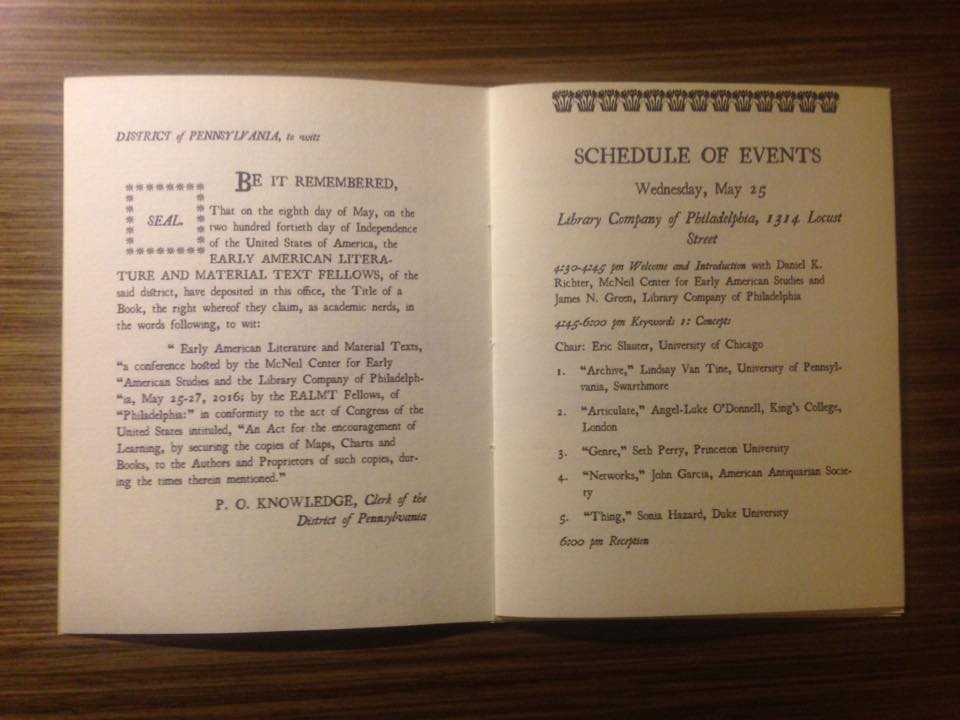
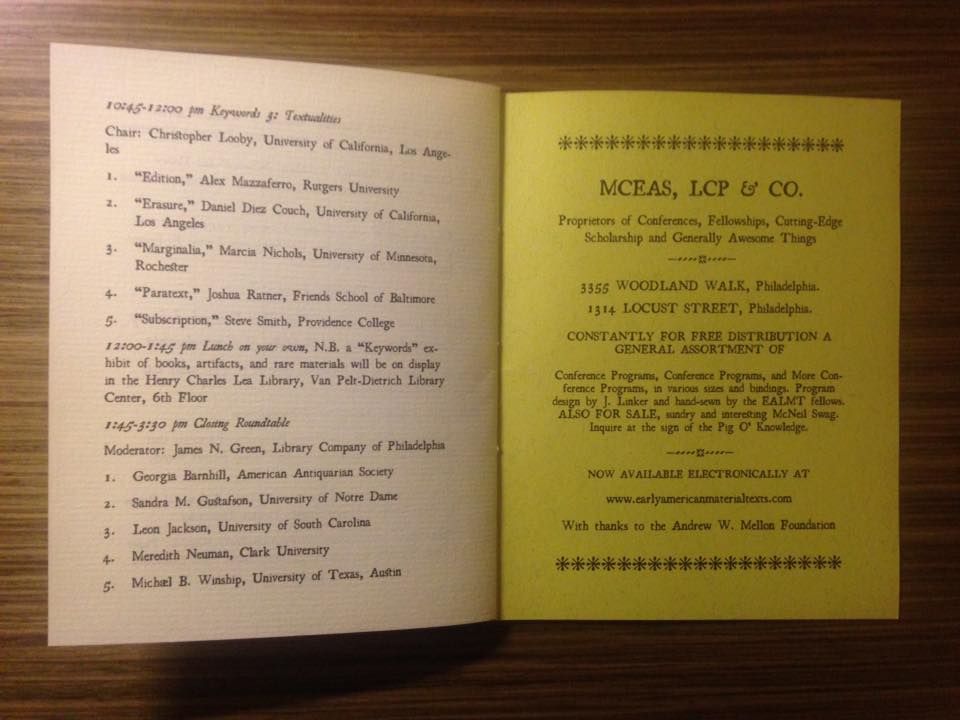
Finally, the conference program was an unexpected delight as a result of the material considerations that went into its design and execution. Measuring 4¼ by 5½ inches, it had the appearance of an eighteenth-century chapbook, complete with a simple binding hand-sewn by the Early American Literature and Material Texts fellows. The covers were printed on drab colored paper, not unlike the covers or wrappers that would have enclosed many eighteenth-century publications. The fonts, format, and illustrations replicated eighteenth-century printing and publishing practices. Advertisements and announcements were included on the interiors of the covers, just as they might have been for books or pamphlets printed in the eighteenth century. It was the most creative conference program I have encountered, but also extremely fitting for a conference about Early American Material Texts.
Program for Early American Material Texts (designed by Jessica Linker).
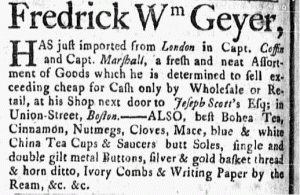
What was advertised in a colonial newspaper 250 years ago today?
Boston Post-Boy (June 2, 1766).
“HAs just imported from London in Capt. Coffin and Capt. Marshall, a fresh and neat Assortment of Goods.”
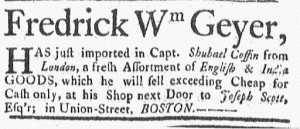
Fredrick William Geyer wanted to make sure that readers of the Boston Post-Boy were aware of the “fresh and neat Assortment of Goods which he is determined to sell exceeding cheap for Cash only by Wholesale or Retail.” He was so anxious for potential customers to know that he could supply them with “a fresh Assortment of English & India GOODS” that he placed two advertisements in the June 2, 1766, issue of the Boston Post-Boy. One appeared on the second page and the other on the fourth page. Whether by design or coincidence, if a reader held open the broadsheet newspaper to peruse its contents one of Geyer’s advertisements would have been visible.
Boston Post-Boy (June 2, 1766).
The advertisement from the second page appears to be an updated version of the one from the fourth page. In the latter, Geyer announced that he had just imported goods via the vessel captained by Shubael Coffin. The other advertisement indicated that he had just received goods shipped by “Capt. Coffin and Capt. Marshall.” According to the shipping news from the Boston Custom House published in this issue of the Boston Post-Boy, “Marshall from London” entered port on May 31. The previous issue, published a week earlier, indicated that Coffin’s ship had just arrived, which probably prompted Geyer to compose the shorter notice (which also appeared in the previous issue, making it as current as possible for a weekly publication). He later updated his advertisement to underscore that he really did sell goods “fresh” from London. (He used the word “fresh” in both advertisements.)
The appeal in Geyer’s advertisement required active reading on the part of potential customers. It worked best if consumers engaged with different parts of the newspaper – the shipping news and the advertisements – simultaneously in order to reach the intended conclusions.