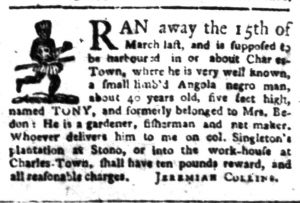
The Slavery Adverts 250 Project chronicles the role of newspaper advertising in perpetuating slavery in the era of the American Revolution. The project seeks to reveal the ubiquity of slavery in eighteenth-century life from New England to Georgia by republishing advertisements about enslaved people – for sale as individuals or in groups, wanted to purchase or for hire for short periods, runaways who liberated themselves, and those who were subsequently captured and confined in jails and workhouses – in daily digests on this site as well as in real time via the @SlaveAdverts250 Twitter feed, utilizing twenty-first-century media to stand in for the print media of the eighteenth century.
The project aims to provide modern audiences with a sense of just how often colonizers encountered these advertisements in their daily lives. Enslaved men, women, and children appeared in print somewhere in the colonies almost every single day. Those advertisements served as a constant backdrop for social, cultural, economic, and political life in colonial and revolutionary America. Colonizers who did not purport to own enslaved people were still confronted with slavery as well as invited to maintain the system by purchasing enslaved men, women, and children or assisting in the capture of so-called “runaways” who sought to free themselves from bondage. The frequency of these newspaper advertisements suggests just how embedded slavery was in colonial and revolutionary American culture in everyday interactions beyond the printed page.
These advertisements also testify to the experiences of enslaved men, women, and children, though readers must consider that those experiences have been remediated through descriptions offered by enslavers rather than enslaved people themselves. Often unnamed in the advertisements, enslaved men, women, and children were not invisible or unimportant in early America.
These advertisements appeared in colonial American newspapers 250 years ago today.
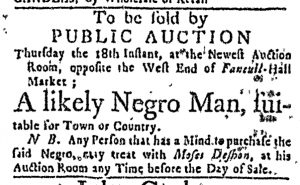
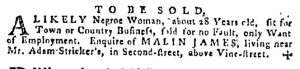
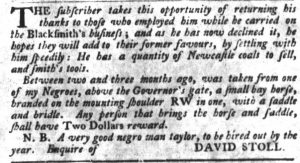
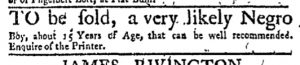
Massachusetts Gazette (December 4, 1766).
**********
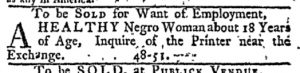
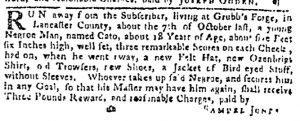
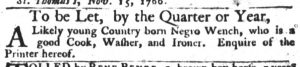
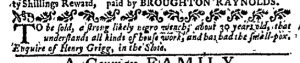
New-York Journal (December 4, 1766).
**********
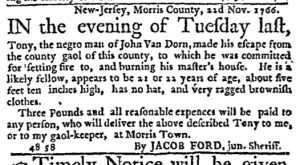
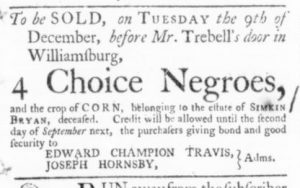
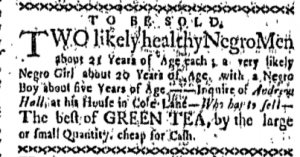
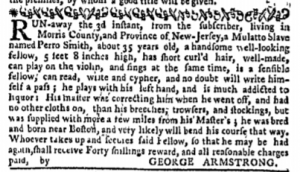
New-York Journal (December 4, 1766).
**********
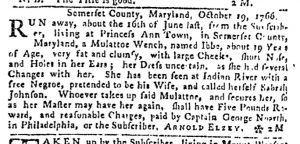
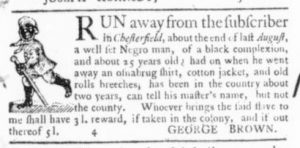
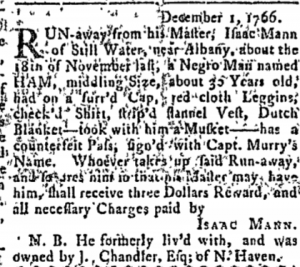
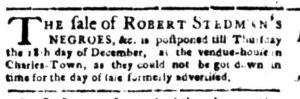
Pennsylvania Gazette (December 4, 1766).
**********
Supplement to the Pennsylvania Gazette (December 4, 1766).
What was advertised in a colonial newspaper 250 years ago today?
Georgia Gazette (December 3, 1766).
“A YOUNG MAN that can write a good hand.”
This employment advertisement sought an assistant or clerk to “copy distinctly” in the “Secretary’s-Office” in Georgia. When I saw this advertisement I was curious to know exactly where a young man would have received the education necessary to know how to write. According to Robert A. Peterson in “Education in Colonial America,” children could learn this skill at home or in schools. Before public schools, parents taught their children how to read and write, but only if they knew how.
Peterson also discusses other ways colonists were educated: at church, from voluntary associations such as library companies and philosophical societies, circulating libraries, apprenticeships. Many colonists turned to their church where they could learn through sermons. Pastors would at times speak for hours on end. Families followed sermons closely, took mental notes, and discussed the sermon together on a Sunday afternoon. Adults had the advantage of going to a library or a philosophical society. For example, Peterson discusses the society called “The Literary Republic.” This society, where artisans, tradesmen, and common laborers met to discuss “logic, jurisprudence, religion, science, and moral philosophy,” opened in 1764 in Philadelphia.
**********
ADDITIONAL COMMENTARY: Carl Robert Keyes
This employment advertisement stands in stark contrast to the ten advertisements for slaves that appeared in the same issue of the Georgia Gazette. A young man with sufficient education to “write a good hand” and “copy distinctly” had an opportunity to work for the colonial government in the “Secretary’s-Office.” Even for a youth of humble origins, this might have been a stepping stone that enhanced his possibilities for social mobility through meeting and working under the direction of the better sorts in colonial Georgia.
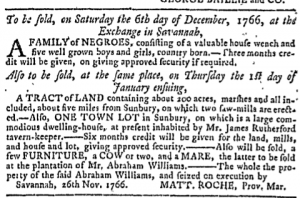
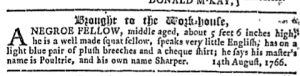
The slaves advertised in the Georgia Gazette did not have the same opportunities for social mobility, thought they were certainly mobile in other ways. Of the ten advertisements featuring slaves in that issue, four described runaway slaves and five announced captured slaves who had been “Brought to the Workhouse” until such time that their masters could retrieve them. The final advertisement promoted the sale of “A FAMILY of NEGROES, consisting of a valuable house wench and five well grown boys and girls, country born.” Almost certainly none of them had been taught to read or “write a good hand” or “copy distinctly.”
Indeed, none of those advertisements indicated that any of the slaves possessed even basic literacy, though several pointed out that one runaway or another “speaks very little English” or could not speak English well enough “so as to be understood.” On occasions when advertisements did associate literacy with slaves they usually attributed nefarious purposes to slaves’ ability to read or write, such as warning against passes that had been altered.
The employment advertisement offering employment in the “Secretary’s-Office” to a qualified young man opened up a variety of possibilities and opportunities for at least one colonist. A great many more advertisements, however, thwarted opportunities that slaves had seized for themselves. Masters used the power of print in attempts to return slaves to situations in which their opportunities would be further circumscribed. Side by side, the employment advertisement and the slavery advertisement demonstrate two very different sets of possibilities open to colonists in Georgia in the decade before the American Revolution.
These tables indicate how many advertisements for slaves appeared in colonial American newspapers during the week of November 27 – December 3, 1766. Data for both tables was compiled by Megan Watts.
Note: These tables are as comprehensive as currently digitized sources permit, but they may not be an exhaustive account. They includes all newspapers that have been digitized and made available via Accessible Archives, Colonial Williamsburg’s Digital Library, and Readex’s America’s Historical Newspapers. There are several reasons some newspapers may not have been consulted:
Issues that are no longer extant;
Issues that are extant but have not yet been digitized; and
Newspapers published in a language other than English (including the Wochentliche Philadelphische Staatsbote).
**********
Slavery Advertisements Published November 27 – December 3, 1766: By Date
**********
Slavery Advertisements Published November 27 – December 3, 1766: By Region
The Slavery Adverts 250 Project chronicles the role of newspaper advertising in perpetuating slavery in the era of the American Revolution. The project seeks to reveal the ubiquity of slavery in eighteenth-century life from New England to Georgia by republishing advertisements about enslaved people – for sale as individuals or in groups, wanted to purchase or for hire for short periods, runaways who liberated themselves, and those who were subsequently captured and confined in jails and workhouses – in daily digests on this site as well as in real time via the @SlaveAdverts250 Twitter feed, utilizing twenty-first-century media to stand in for the print media of the eighteenth century.
The project aims to provide modern audiences with a sense of just how often colonizers encountered these advertisements in their daily lives. Enslaved men, women, and children appeared in print somewhere in the colonies almost every single day. Those advertisements served as a constant backdrop for social, cultural, economic, and political life in colonial and revolutionary America. Colonizers who did not purport to own enslaved people were still confronted with slavery as well as invited to maintain the system by purchasing enslaved men, women, and children or assisting in the capture of so-called “runaways” who sought to free themselves from bondage. The frequency of these newspaper advertisements suggests just how embedded slavery was in colonial and revolutionary American culture in everyday interactions beyond the printed page.
These advertisements also testify to the experiences of enslaved men, women, and children, though readers must consider that those experiences have been remediated through descriptions offered by enslavers rather than enslaved people themselves. Often unnamed in the advertisements, enslaved men, women, and children were not invisible or unimportant in early America.
These advertisements appeared in colonial American newspapers 250 years ago today.
What was advertised in a colonial American newspaper 250 years ago today?
South-Carolina Gazette and Country Journal (December 2, 1766).
“Silk handkerchiefs, cloaks, petticoats.”
After reading through the products being advertised I decided to focus on petticoats because I was somewhat familiar with them, but I did not exactly know what they were. Through my research I learned they were first introduced as undergarments in the 1500s, but they were constantly enlarged over time and eventually replaced by the slip in the 1920s.
Between 1770 and 1776, petticoats were usually made of “dainty colored materials that were filled with a layer of cotton or wadding. The wadding was kept in place by using various patterns of the quilting stitch.”One petticoat from the 1760s in the collections of George Washington’s Ferry Farm and Historic Kenmore was made of “peach satin silk with wool batting between the two layers.” In the 1700s, women often wore quilted petticoats under “open-front robes or as stand-alone skirts.” In certain cases quilted petticoats were made to showcase “intricate handiwork in the quilted pattern. Geometric patterns, birds, flowers and even pastoral scenes were all common themes for quilted petticoats.”
Petticoats were a common piece of women’s outfit throughout the colonial period. They could be worn them under other clothing either for fashion or simply for warmth.
**********
ADDITIONAL COMMENTARY: Carl Robert Keyes
The petticoats in this advertisement were certainly intended for female customers, yet Nathaniel Hayward did not make any particular effort to address the women of Charleston. Women may well have been the primary consumers of many of the textiles and adornments listed in Hayward’s advertisement (though many of the women who purchased those goods would have done so with the intention of making garments and other items for use by men as well as women). Other imported goods in the advertisement – stationery, ironmongery, “saddlery,” and “cabinet ware” – would have appealed to both sexes and the “mens hats” were designated specifically for, well, men.
While it may be tempting to divide the eighteenth-century worlds of production and consumption into male and female pursuits, respectively, especially given the feminization of consumption in later periods, newspaper advertisements from the colonial and Revolutionary eras suggest that early Americans did not necessarily equate consumption almost exclusively with women. Very few eighteenth-century advertisements directly addressed female consumers. Those that did tended to come from advertisers who offered services specifically for women, such as seamstresses who made women’s clothing, but they were balanced by a similar number of advertisements for men’s tailors. Early Americans were more often exposed to advertisements that addressed both women and men as “ladies and gentlemen” or used other language that otherwise made it clear that they sought potential customers of both sexes.
In the 1760s, however, the greatest number of advertisements for consumer goods and services made little effort at all to acknowledge the gender of prospective customers or to make special appeals to one sex rather than the other or to differentiate most merchandise according to the sex. Instead, advertisers generally promoted their wares to all colonists, only occasionally noting that certain goods were appropriate for either women or men (such as the “mens hats” nestled within today’s advertisement). Nathaniel Hayward sold petticoats for women, but he made no effort to suggest only women might be interested in the myriad of textiles he sold. In that regard his approach aligned with most eighteenth-century advertisers who did not make assumptions about the feminization of fashion and consumption. Such views sometimes found voice in editorials in other parts of eighteenth-century newspapers, but advertisements that positioned women as more likely to be consumers than men were relatively rare. That marketing strategy became much more common in the nineteenth century, following the rise of industrialization and the cult of domesticity that made the home the domain of middle-class women.
The Slavery Adverts 250 Project chronicles the role of newspaper advertising in perpetuating slavery in the era of the American Revolution. The project seeks to reveal the ubiquity of slavery in eighteenth-century life from New England to Georgia by republishing advertisements about enslaved people – for sale as individuals or in groups, wanted to purchase or for hire for short periods, runaways who liberated themselves, and those who were subsequently captured and confined in jails and workhouses – in daily digests on this site as well as in real time via the @SlaveAdverts250 Twitter feed, utilizing twenty-first-century media to stand in for the print media of the eighteenth century.
The project aims to provide modern audiences with a sense of just how often colonizers encountered these advertisements in their daily lives. Enslaved men, women, and children appeared in print somewhere in the colonies almost every single day. Those advertisements served as a constant backdrop for social, cultural, economic, and political life in colonial and revolutionary America. Colonizers who did not purport to own enslaved people were still confronted with slavery as well as invited to maintain the system by purchasing enslaved men, women, and children or assisting in the capture of so-called “runaways” who sought to free themselves from bondage. The frequency of these newspaper advertisements suggests just how embedded slavery was in colonial and revolutionary American culture in everyday interactions beyond the printed page.
These advertisements also testify to the experiences of enslaved men, women, and children, though readers must consider that those experiences have been remediated through descriptions offered by enslavers rather than enslaved people themselves. Often unnamed in the advertisements, enslaved men, women, and children were not invisible or unimportant in early America.
These advertisements appeared in colonial American newspapers 250 years ago today.
South-Carolina Gazette and Country Journal (December 2, 1766).
**********
South-Carolina Gazette and Country Journal (December 2, 1766).
**********
South-Carolina Gazette and Country Journal (December 2, 1766).
**********
South-Carolina Gazette and Country Journal (December 2, 1766).
**********
South-Carolina Gazette and Country Journal (December 2, 1766).
**********
South-Carolina Gazette and Country Journal (December 2, 1766).
**********
South-Carolina Gazette and Country Journal (December 2, 1766).
**********
South-Carolina Gazette and Country Journal (December 2, 1766).
**********
South-Carolina Gazette and Country Journal (December 2, 1766).
**********
South-Carolina Gazette and Country Journal (December 2, 1766).
**********
Supplement to the South-Carolina Gazette and Country Journal (December 2, 1766).
**********
Supplement to the South-Carolina Gazette and Country Journal (December 2, 1766).
**********
Supplement to the South-Carolina Gazette and Country Journal (December 2, 1766).
**********
Supplement to the South-Carolina Gazette and Country Journal (December 2, 1766).
**********
Supplement to the South-Carolina Gazette and Country Journal (December 2, 1766).
**********
Supplement to the South-Carolina Gazette and Country Journal (December 2, 1766).
**********
Supplement to the South-Carolina Gazette and Country Journal (December 2, 1766).
**********
Supplement to the South-Carolina Gazette and Country Journal (December 2, 1766).
**********
Supplement to the South-Carolina Gazette and Country Journal (December 2, 1766).
**********
Supplement to the South-Carolina Gazette and Country Journal (December 2, 1766).
What was advertised in a colonial American newspaper 250 years ago today?
Boston Evening-Post (December 1, 1766).
“A Parcel of choice JAMAICA SUGARS.”
Since this advertisement from the December 1, 1766, edition of the Boston Evening-Post advertised Jamaican sugar I decided to focus on the plantations the English established in the Caribbean. England was in the race to become the most important economic power in Europe. In order to do that England needed colonies, including Jamaica (taken from the Spanish in 1655), to produce of one of the most popular staple crops.
For this goal plantations needed a large labor force. At first the Spanish utilized natives of the area and African slaves. European diseases became a problem for plantation owners as Indian populations dwindled. Later, English planters also found it difficult to persuade indentured servants to work in the harsh environment so by the end of the seventeenth century they focused on primarily using enslaved Africans because they were able to acquire more of them. The demand for African laborers also rose because they too were dying from diseases and the conditions they worked under. According to the British National Archives, between 1702 and 1808 around “840,000 Africans were shipped to Jamaica and a further 100,000 imported into Virginia and Chesapeake.” Overall, around “four million slaves were brought to the Caribbean, and almost all ended up on the sugar plantations.”
The constant demand for sugar in the colonies as well as England itself drove up the need for African slaves in the Caribbean. Since the cost for slaves was low, planters were able to produce more sugar, which in turn drove down the cost. Boston did not have as many slaves as other parts of the colonies, but readers of the Boston Evening-Post who purchased “choice JAMAICA SUGARS” were part of an economy that depended on slavery.
**********
ADDITIONAL COMMENTARY: Carl Robert Keyes
Joseph Russell was a busy auctioneer. He was also a busy advertiser. Nick has selected one of three advertisements Russell placed in the December 1, 1766, issue of the Boston Evening-Post. The printers grouped the three advertisements together at the top of the third and final column on the third page.
Boston Evening-Post (December 1, 1766).
The first announced an auction to be held “TO-MORROW,” December 2. Given how soon that auction was slated to take place, “TO-MORROW” appeared in a larger font than anything else in any of Russell’s advertisements. Only one other advertisement on the same and the facing page included font that large: shopkeeper Richard Salter’s name in his advertisement for imported goods. As a result, Russell’s advertisement likely caught readers’ eyes and demanded their attention. The large font gave his impending auction the sense of urgency required to attract prospective bidders in the final hours before the vendue began. The advertisement named a series of goods nearly identical to those listed in Russell’s advertisement that appeared in the Massachusetts Gazette three days earlier (featured earlier this week). It repeated ancillary material verbatim, including a nota bene announcing that “Goods are daily selling off at private Sale at the above Auction-Room, VERY CHEAP.”
Russell’s second advertisement promoted the auction of “choice JAMAICA SUGARS” to take place “On THURSDAY next 4th of December,” the advertisement that Nick selected to examine today. Russell’s final advertisement previewed an auction scheduled to take place a week after that, “On THURSDAY the 11th Instant.” At that time, Russell planned to sell different sorts of merchandise than what appeared in either of the other two advertisements: “A great Variety of genteel House Furniture” and “Glass and China Ware.”
In these advertisements Russell used time to his advantage in three different ways. In the first, he created a sense of urgency. The auction was imminent. Readers needed to make plans to attend or risk being shut out of the deals. However, those unable to make it to that auction could still shop at their leisure, as the nota bene about goods “daily selling off at private Sale” made clear. In the latter two advertisements, he advised the public of upcoming auctions with sufficient time to generate interest. Potential buyers had plenty of time to envision bidding on “Mahogany Tables, Looking Glasses,” and other furnishings, perhaps imagining the deals they might get at auction. Depending on their personalities, readers would have reacted to each use of time in different ways. Some would have been more susceptible to the excitement of an impending auction. Others would have responded better to planning for a vendue more than a week away or shopping at their convenience in “the Auction Room in Queen-Street.” Russell creatively deployed all three strategies to attract as many potential consumers as possible.
The Slavery Adverts 250 Project chronicles the role of newspaper advertising in perpetuating slavery in the era of the American Revolution. The project seeks to reveal the ubiquity of slavery in eighteenth-century life from New England to Georgia by republishing advertisements about enslaved people – for sale as individuals or in groups, wanted to purchase or for hire for short periods, runaways who liberated themselves, and those who were subsequently captured and confined in jails and workhouses – in daily digests on this site as well as in real time via the @SlaveAdverts250 Twitter feed, utilizing twenty-first-century media to stand in for the print media of the eighteenth century.
The project aims to provide modern audiences with a sense of just how often colonizers encountered these advertisements in their daily lives. Enslaved men, women, and children appeared in print somewhere in the colonies almost every single day. Those advertisements served as a constant backdrop for social, cultural, economic, and political life in colonial and revolutionary America. Colonizers who did not purport to own enslaved people were still confronted with slavery as well as invited to maintain the system by purchasing enslaved men, women, and children or assisting in the capture of so-called “runaways” who sought to free themselves from bondage. The frequency of these newspaper advertisements suggests just how embedded slavery was in colonial and revolutionary American culture in everyday interactions beyond the printed page.
These advertisements also testify to the experiences of enslaved men, women, and children, though readers must consider that those experiences have been remediated through descriptions offered by enslavers rather than enslaved people themselves. Often unnamed in the advertisements, enslaved men, women, and children were not invisible or unimportant in early America.
These advertisements appeared in colonial American newspapers 250 years ago today.
Boston-Gazette (December 1, 1766).
**********
Connecticut Courant (December 1, 1766).
**********
New-York Mercury (December 1, 1766).
**********
New-York Mercury (December 1, 1766).
**********
New-York Mercury (December 1, 1766).
**********
New-York Mercury (December 1, 1766).
**********
New-York Mercury (December 1, 1766).
**********
South Carolina Gazette (December 1, 1766).
**********
South Carolina Gazette (December 1, 1766).
**********
South Carolina Gazette (December 1, 1766).
**********
South Carolina Gazette (December 1, 1766).
**********
South Carolina Gazette (December 1, 1766).
**********
South Carolina Gazette (December 1, 1766).
**********
South Carolina Gazette (December 1, 1766).
**********
Supplement to the South Carolina Gazette (December 1, 1766).
**********
Supplement to the South Carolina Gazette (December 1, 1766).
**********
South Carolina Gazette (December 1, 1766).
**********
Supplement to the South Carolina Gazette (December 1, 1766).
**********
Supplement to the South Carolina Gazette (December 1, 1766).