The Slavery Adverts 250 Project chronicles the role of newspaper advertising in perpetuating slavery in the era of the American Revolution. The project seeks to reveal the ubiquity of slavery in eighteenth-century life from New England to Georgia by republishing advertisements about enslaved people – for sale as individuals or in groups, wanted to purchase or for hire for short periods, runaways who liberated themselves, and those who were subsequently captured and confined in jails and workhouses – in daily digests on this site as well as in real time via the @SlaveAdverts250 Twitter feed, utilizing twenty-first-century media to stand in for the print media of the eighteenth century.
The project aims to provide modern audiences with a sense of just how often colonizers encountered these advertisements in their daily lives. Enslaved men, women, and children appeared in print somewhere in the colonies almost every single day. Those advertisements served as a constant backdrop for social, cultural, economic, and political life in colonial and revolutionary America. Colonizers who did not purport to own enslaved people were still confronted with slavery as well as invited to maintain the system by purchasing enslaved men, women, and children or assisting in the capture of so-called “runaways” who sought to free themselves from bondage. The frequency of these newspaper advertisements suggests just how embedded slavery was in colonial and revolutionary American culture in everyday interactions beyond the printed page.
These advertisements also testify to the experiences of enslaved men, women, and children, though readers must consider that those experiences have been remediated through descriptions offered by enslavers rather than enslaved people themselves. Often unnamed in the advertisements, enslaved men, women, and children were not invisible or unimportant in early America.
These advertisements appeared in colonial American newspapers 250 years ago today.
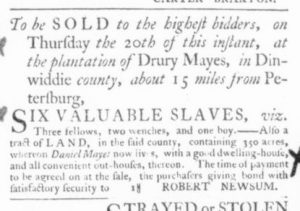
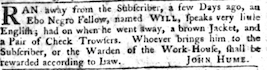
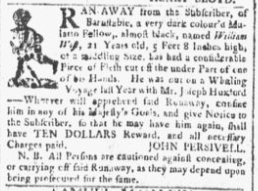
New-York Journal (November 6, 1766).
**********
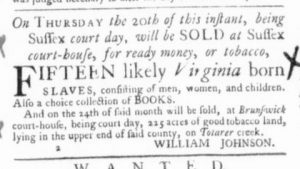
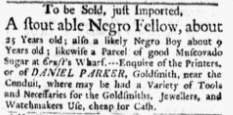
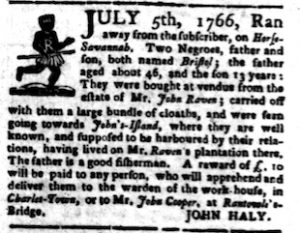
Supplement to the New-York Journal (November 6, 1766).
**********
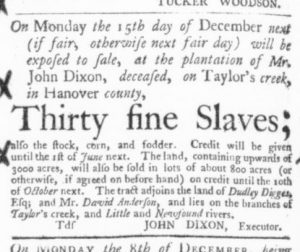
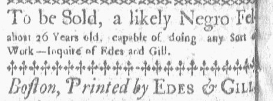
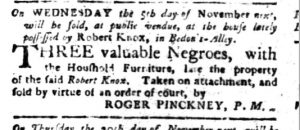
Supplement to the New-York Journal (November 6, 1766).
Before this project, I didn’t really know about the advertising aspect of colonial America. Delving into these advertisements opens many doors into the actual lives of colonists. I got to see what type of items the colonists were interested in and what was offered to them through Britain and other countries that imported goods into the colonies. Not only did I get to learn history that isn’t normally in the textbooks, I also got to work with historical documents and learned how to better navigate through both primary and secondary sources.
Most people think what they are learning in the textbooks is all they need to know about history. However, this project pushes those boundaries of just reading and remembering dates that so many believe is what history is about. Prof. Keyes pushed me to find out what is behind these advertisements, why items were sold, what was their importance, and so on. While this may sound easy, at the same time it was quite challenging. First I had to find something I wanted to look into. Then I delved into secondary or primary sources on that topic, finding information that pertains to what I wanted to talk about. Nonetheless, I was up for the challenge.
I personally found the American Antiquarian Society most helpful in that they have a vast number of newspapers to choose from, which helped make picking these advertisements in the first place much easier. Then for secondary sources, I normally turn to either Google Scholar or JSTOR to help me back up my analysis. This proved beneficial at times, but also hindered because it was harder to find specific articles that pertained to some of my topics.
During this project, I focused on vastly different topics day to day. One of my favorites that I focused on was the advertisement for an almanac. Finding an article about magic and astrology and focusing on the parts that mentioned almanacs was quite interesting. The best part was finding out that there were some people who did enjoy reading the almanacs and even put them up there close to the Bible, which back then definitely meant something since many colonist were very religious. Another one of my favorites (but actually what proved to be one of my harder advertisements) was my last one, about a piece of land being sold in Georgia. With the previous ones, I focused on a certain item or where these items came from. However, with this advertisement I had to take a completely different route. So I researched selling land in Georgia and I came across Jonathan Bryan. The fact that one man could be that influential at one time over so much land astounded me, but that’s what history is about for me: finding out facts and learning something new that I didn’t know before, especially something that expands my knowledge like this project did.
Coming into this project, I didn’t know what to expect from it. Just by going over the gigantic packet of instructions it all seemed very overwhelming and quite frightening. Nonetheless, once I actually got started with researching for articles that backed up my analysis, it became quite easier, especially after I had a few advertisements under my belt.
Overall, I have thoroughly enjoyed working on this project. It has succeeded in broadening my horizons into the life of the average colonist. I can’t wait to see what else is in store for me on my exploration of history as I work on earning a history degree. I also look forward to spending more time in the American Antiquarian Society.
What was advertised in a colonial American newspaper 250 years ago today?
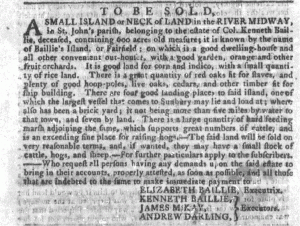
Georgia Gazette (November 5, 1766).
“A SMALL ISLAND or NECK of LAND in the RIVER MIDWAY … known by the name of Baillie’s Island.”
This notice in the Georgia Gazette advertises an island being sold by “the estate of Col. Kenneth Baillie, deceased.” This island, “containing 600 acres,” already had “a good dwelling-house and other convenient out-houses” and good land for growing crops. Land sales of this sort would have been interesting to men like Jonathan Bryan.
Bryan bought a lot of land in both Georgia and South Carolina during the eighteenth century. Alan Gallay notes that Bryan’s “possessions [lands he purchased or that were granted to him] placed him at the very top of the small group of men who ruled Georgia during the quarter century before the American Revolution.”[1] Bryan was able to capitalize on both undeveloped and developed lands, which would have made the island in this advertisement very appealing. To make the most of the land he had, Bryan created plantations and bought African slaves to perform the labor. By 1763, he owned 125 slaves in Georgia.[2] Owning land was an important step for colonists like Jonathan Bryan to become prosperous and powerful.
**********
ADDITIONAL COMMENTARY: Carl Robert Keyes
Colonel Kenneth Baillie’s executrix and executors painted quite a picture of the bounty available on Baillie’s Island. Whoever purchased this land would possess a variety of resources and could produce a variety of commodities to send to market, including corn, indigo, rice, barrel staves, lumber, and all sorts of livestock. All of these goods, the advertisement promised, could be easily transported because there were “four good landing places to said island, one of which the largest vessel that comes to Sunbury may lie and load it.” Furthermore, Baillie’s Island was close to Sunbury, “it not being more than five miles by water to that town, and seven by land.” The island’s proximity to Sunbury and the trade that took place there was a selling point.
Sunbury, founded in 1758, likely sounds unfamiliar to modern readers, but for a few decades in the middle of the eighteenth century it rivaled Savannah as a port city. Readers of the Georgia Gazette would have known that it was a seaport on the Medway River, south of Savannah. Today, however, Sunbury has disappeared. Some call it “one of Georgia’s most famous ‘dead’ or lost towns.” William Bartram, the prominent naturalist from Pennsylvania, visited Sunbury while en route to Florida shortly before the American Revolution. “There are about one hundred houses in the town neatly built of wood frame having pleasant Piasas around them,” Bartram wrote. “The inhabitants are genteel and wealthy, either Merchants or Planters from the Country who resort here in the Summer and Autumn, to partake of the Salubrious Sea Breeze, Bathing & sporting on the Sea Islands.”
Sunbury was a vibrant town and emerging center of commerce in the 1760s and 1770s, but it never recovered after the disruptions of the American Revolution.
**********
[1] Alan Gallay, “Jonathan Bryan’s Plantation Empire: Land, Politics, and the Formation of a Ruling Class in Colonial Georgia,” William and Mary Quarterly, 3rd ser. 45, no. 2 (April 1988): 253.
These tables indicate how many advertisements for slaves appeared in colonial American newspapers during the week of October 23-29, 1766. Data for both tables was compiled by Elizabeth Curley.
Note: These tables are as comprehensive as currently digitized sources permit, but they may not be an exhaustive account. They includes all newspapers that have been digitized and made available via Accessible Archives, Colonial Williamsburg’s Digital Library, and Readex’s America’s Historical Newspapers. There are several reasons some newspapers may not have been consulted:
Issues that are no longer extant;
Issues that are extant but have not yet been digitized; and
Newspapers published in a language other than English (including the Wochentliche Philadelphische Staatsbote).
**********
Slavery Advertisements Published October 30 – November 5, 1766: By Date
**********
Slavery Advertisements Published October 30 – November 5, 1766: By Region
The Slavery Adverts 250 Project chronicles the role of newspaper advertising in perpetuating slavery in the era of the American Revolution. The project seeks to reveal the ubiquity of slavery in eighteenth-century life from New England to Georgia by republishing advertisements about enslaved people – for sale as individuals or in groups, wanted to purchase or for hire for short periods, runaways who liberated themselves, and those who were subsequently captured and confined in jails and workhouses – in daily digests on this site as well as in real time via the @SlaveAdverts250 Twitter feed, utilizing twenty-first-century media to stand in for the print media of the eighteenth century.
The project aims to provide modern audiences with a sense of just how often colonizers encountered these advertisements in their daily lives. Enslaved men, women, and children appeared in print somewhere in the colonies almost every single day. Those advertisements served as a constant backdrop for social, cultural, economic, and political life in colonial and revolutionary America. Colonizers who did not purport to own enslaved people were still confronted with slavery as well as invited to maintain the system by purchasing enslaved men, women, and children or assisting in the capture of so-called “runaways” who sought to free themselves from bondage. The frequency of these newspaper advertisements suggests just how embedded slavery was in colonial and revolutionary American culture in everyday interactions beyond the printed page.
These advertisements also testify to the experiences of enslaved men, women, and children, though readers must consider that those experiences have been remediated through descriptions offered by enslavers rather than enslaved people themselves. Often unnamed in the advertisements, enslaved men, women, and children were not invisible or unimportant in early America.
These advertisements appeared in colonial American newspapers 250 years ago today.
What was advertised in a colonial American newspaper 250 years ago today?
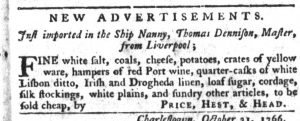
South-Carolina Gazette and Country Journal (November 4, 1766).
“Irish and Drogheda linen.”
In this advertisement in the South-Carolina Gazette and Country Journal, Thomas Dennison sold various items, such as “Fine white salt, coals, cheese, potatoes, [and] crates of yellow ware.” Nonetheless one item specifically drew my eye: “Irish and Drogheda linen.” I had never before heard of Drogheda and Iam also Irish so I was immediately drawn to it. I learned that Drogheda is one of Ireland’s oldest towns.
The commercial relationship between Ireland and colonial America was beneficial and profitable. Thomas M. Truxes notes that it was expensive to produce linen in the colonies while in Ireland it was far cheaper. This made Irish linen that much more desirable because it was “attractively priced” and “became progressively less expensive.”[1] This was also ideal for England who wanted to discourage “industrial development in the colonies.” Plus the English merchants earned money when they were the middlemen who imported Irish linens into the colonies, but “Irish merchants and factors played key roles in the distribution system” too.
**********
ADDITIONAL COMMENTARY: Carl Robert Keyes
Price, Hest, and Head listed a variety of goods in their advertisement. From among them, Ceara chose to investigate a commodity that appeared repeatedly in eighteenth-century advertisements: Irish linens. Ceara consulted Thomas M. Truxes’s Irish-American Trade, 1660-1783 to identify some of the reasons why Irish linen was transported to the colonies. As Ceara and I worked together on researching and revising her analysis of this advertisement, I was struck by the data Truxes provided to demonstrate the magnitude of the Irish linen trade.
Truxes devotes an entire chapter to Irish linen, which he begins by stating that “British America was Ireland’s second largest market for linen and its most important vent for coarse, low-priced cloths.”[2] For the purposes of placing today’s advertisement in context, let’s have a look at some of the numbers for the middle of the eighteenth century. “With the English bounty of 1743,” Truxes explains, the linen export to America experienced a surge in growth of unprecedented proportions, reaching a level of 4.4 million yards per annum by the early 1770s.” Furthermore, between 1750 and 1770, the quantity of Irish linen exports to the American colonies quadrupled. During the same period, the colonies became an increasingly important market for Irish linens: the share of Ireland’s total linen export that went to British America doubled.
Advertisements for textiles were incredibly common in eighteenth-century newspapers. Many of those advertisements relied on lengthy lists of fabrics of varying qualities, colors, and patterns. Amid that diversity, any list of imported textiles almost invariably included Irish linens. Those advertisements offer impressionistic evidence that Irish linens were ubiquitous in the colonial American marketplace, though they rarely specified how many yards of Irish linen merchants imported or shopkeepers stocked. Truxes clarifies the volume of Irish linens that flowed to America in the decades before the Revolution, confirming the significance of this commodity.
**********
[1] All quotations in this entry: Thomas M. Truxes, Irish-American Trade, 1660-1784 (Cambridge: Cambridge University Press, 1988), 170.
[2] As above, all quotations and statistics in this entry: Thomas M. Truxes, Irish-American Trade, 1660-1784 (Cambridge: Cambridge University Press, 1988), 170.
The Slavery Adverts 250 Project chronicles the role of newspaper advertising in perpetuating slavery in the era of the American Revolution. The project seeks to reveal the ubiquity of slavery in eighteenth-century life from New England to Georgia by republishing advertisements about enslaved people – for sale as individuals or in groups, wanted to purchase or for hire for short periods, runaways who liberated themselves, and those who were subsequently captured and confined in jails and workhouses – in daily digests on this site as well as in real time via the @SlaveAdverts250 Twitter feed, utilizing twenty-first-century media to stand in for the print media of the eighteenth century.
The project aims to provide modern audiences with a sense of just how often colonizers encountered these advertisements in their daily lives. Enslaved men, women, and children appeared in print somewhere in the colonies almost every single day. Those advertisements served as a constant backdrop for social, cultural, economic, and political life in colonial and revolutionary America. Colonizers who did not purport to own enslaved people were still confronted with slavery as well as invited to maintain the system by purchasing enslaved men, women, and children or assisting in the capture of so-called “runaways” who sought to free themselves from bondage. The frequency of these newspaper advertisements suggests just how embedded slavery was in colonial and revolutionary American culture in everyday interactions beyond the printed page.
These advertisements also testify to the experiences of enslaved men, women, and children, though readers must consider that those experiences have been remediated through descriptions offered by enslavers rather than enslaved people themselves. Often unnamed in the advertisements, enslaved men, women, and children were not invisible or unimportant in early America.
These advertisements appeared in colonial American newspapers 250 years ago today.
South-Carolina Gazette and Country Journal (November 4, 1766).
**********
South-Carolina Gazette and Country Journal (November 4, 1766).
**********
South-Carolina Gazette and Country Journal (November 4, 1766).
**********
South-Carolina Gazette and Country Journal (November 4, 1766).
**********
South-Carolina Gazette and Country Journal (November 4, 1766).
**********
South-Carolina Gazette and Country Journal (November 4, 1766).
**********
South-Carolina Gazette and Country Journal (November 4, 1766).
What was advertised in a colonial American newspaper 250 years ago today?
Connecticut Courant (November 3, 1766).
“Choice Bohea Tea.”
In this notice in the Connecticut Courant, William Lamson advertised different goods, such as “Bohea Tea,” “Cod Fish,” and “Black Barcelona Handkerchiefs.” Lamson sold his goods at the stores of Ebenezer Bernard in Hartford and Oliver Pomeroy at Rockey-Hill.
Drinking tea was an important part of colonial life. Drinking tea was a symbol of status in England; this was true in colonial society also. According to Rodris Roth, “During the first half of the eighteenth century the limited amount of tea, available at prohibitively high prices, restricted its use to a proportionately small segment of the population. About mid-century, however, tea was beginning to be drunk by more and more people, as supplies increased and costs decreased, due in part to the propaganda and merchandising efforts of the East India Company.”[1] (Bohea tea, a category of black and oolong teas, originates from China. The East India Company acquired it and distributed it to England and the colonies.) As tea became more accessible more people were able to buy it and partake in the social rituals of drinking tea.
**********
ADDITIONAL COMMENTARY: Carl Robert Keyes
William Lamson’s advertisement for tea, codfish, handkerchiefs, sugar, and mackerel included a rather unique feature. He included a price for each of the items listed. Eighteenth-century advertisements rarely included prices. Advertisers that hawked only one or two commodities sometimes indicated their prices. Shopkeepers occasionally named a price for one or two items included in their lengthy lists of merchandise. It was rare, however, for any advertisement to match a price to every item offered for sale.
Lamson made it possible for potential customers to engage in comparison shopping more easily. He depended on readers remembering their recent purchases and having some general familiarity with the prices local shopkeepers charged for the popular commodities he sold. Many potential customers likely would have known at a glance if Lamson offered good deals. That made it unnecessary for him to resort to one of the most common appeals in eighteenth-century advertising, emphasizing low prices. Lamson did not need to underscore that these were low prices; readers would have made that determination on their own. Lamson also cultivated a sense of trust with prospective customers by letting them know in advance what they could expect to spend when they purchased any of these commodities from him.
On the other hand, Lamson may have also had some practical reasons for listing specific prices. As Ceara noted, he sold tea, sugar, and other goods “At Mr. Ebenezer Barnard’s in Hartford, and at Mr. Oliver Pomeroy’s at Rockey-Hill.” Lamson may never have been present at either location; instead, Bernard and Pomeroy may have sold his commodities on commission or by some other arrangement. By indicating specific prices, Lamson eliminated the possibility that potential customers would have to haggle with a third party. Lamson did not need to be present for transactions or empower agents to act on his behalf. His advertisement, with prices plainly indicated, could stand in on his behalf.
**********
[1] Rodris Roth, “Tea Drinking in Eighteenth-Century America: Its Etiquette and Equipage,” in Material Life in America, 1600-1860, ed. Robert Blair St. George (Boston: Northeastern University Press, 1988), 442.
The Slavery Adverts 250 Project chronicles the role of newspaper advertising in perpetuating slavery in the era of the American Revolution. The project seeks to reveal the ubiquity of slavery in eighteenth-century life from New England to Georgia by republishing advertisements about enslaved people – for sale as individuals or in groups, wanted to purchase or for hire for short periods, runaways who liberated themselves, and those who were subsequently captured and confined in jails and workhouses – in daily digests on this site as well as in real time via the @SlaveAdverts250 Twitter feed, utilizing twenty-first-century media to stand in for the print media of the eighteenth century.
The project aims to provide modern audiences with a sense of just how often colonizers encountered these advertisements in their daily lives. Enslaved men, women, and children appeared in print somewhere in the colonies almost every single day. Those advertisements served as a constant backdrop for social, cultural, economic, and political life in colonial and revolutionary America. Colonizers who did not purport to own enslaved people were still confronted with slavery as well as invited to maintain the system by purchasing enslaved men, women, and children or assisting in the capture of so-called “runaways” who sought to free themselves from bondage. The frequency of these newspaper advertisements suggests just how embedded slavery was in colonial and revolutionary American culture in everyday interactions beyond the printed page.
These advertisements also testify to the experiences of enslaved men, women, and children, though readers must consider that those experiences have been remediated through descriptions offered by enslavers rather than enslaved people themselves. Often unnamed in the advertisements, enslaved men, women, and children were not invisible or unimportant in early America.
These advertisements appeared in colonial American newspapers 250 years ago today.
Boston Evening-Post (November 3, 1766).
**********
Boston Evening-Post (November 3, 1766).
**********
Boston Evening-Post (November 3, 1766).
**********
Boston-Gazette (November 3, 1766).
**********
Supplement to the Boston-Gazette (November 3, 1766).
What was advertised in a colonial newspaper 250 years ago this week?
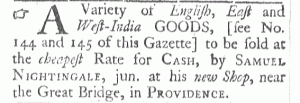
Providence Gazette (November 1, 1766).
“A Variety of English, East and West-India GOODS, … to be sold at the cheapest Rate for CASH.”
In this advertisement in the Providence Gazette, Samuel Nightingale, Jr., sold an assortment of goods from England, as well as both the East and West Indies, in his “new Shop, near the Great Bridge” in Providence.
Since this advertisement mentions earlier issues that included the actual information about what was being sold, I went in search of them. In issue 145, published on October 25, 1766, I found a much larger advertisement with a vast list of goods. The majority of the items on the list were linens and other sorts of textiles, but it also included other things, such as “Ivory and buckling combs,” “Pewter dishes, plates and basons,” and “Flat irons. English Steel.”
Providence Gazette (October 18, 1766).
Pewter was very popular in the eighteenth century. James A. Mulholland notes that “[a]ll but the poorest families owned at least one or two pewter items, and wealthier families accumulated substantial inventories of pewterware, including porrigngers, tankards, coffeepots, and candlesticks.”[1] He also noted that the majority of pewter came from England.
**********
ADDITIONAL COMMENTARY: Carl Robert Keyes
I was very excited when Ceara selected this advertisement. When guest curators are participating in this project I leave the decisions about which advertisements to feature to them, provided they follow the project’s methodology. That means that they sometimes pass over advertisements that I find either interesting or significant, but that’s just the way it goes sometimes when working on a collaborative project. After all, the guest curators can learn something interesting or significant about colonial America from any advertisement.
Why was I so excited when Ceara submitted this advertisement for approval? She mentioned the reason in her own analysis. Samuel Nightingale, Jr., instructed potential customers to “[see No. 144 and 145 of this Gazette]” for a list of the “Variety of English, East and West-India GOODS” that he sold. When she noticed this, Ceara did the sort of historical detective work that I consider an enjoyable part of this project: she consulted the earlier issues (October 11 and 18, 1766) of the Providence Gazette to find out more about those advertisements. In the process, she discovered an advertisement that resembled others by Thompson and Arnold and Benjamin Thurber and Edward Thurber, both previously featured by the Adverts 250 Project.
In the course of a few weeks, Nightingale published two advertisements with rather extraordinary features. His first advertisement borrowed innovations from competitors, but those innovations had not been so widely adopted that Nightingale’s advertisement blended in with others. With a decorative border and spanning two columns, Nightingale’s earlier advertisements dominated the pages on which they appeared.
Providence Gazette (October 18, 1766).
Today’s advertisement did not have the same visual impact, but it did incorporate one rather unusual feature. It instructed readers to consult another newspaper to see the original advertisement. Nightingale assumed a high level of interest among potential customers. At the very least, he hoped to incite interest by offering a brief description and then challenging readers to find the original advertisements in earlier issues.
This tells us something about how colonists used newspapers. Nightingale’s directions to “[see No. 144 and 145 of this Gazette]” only worked if readers still had access to those issues. It suggests that subscribers held on to newspapers for at least several weeks to consult the news, advertisements, and other items they contained. Newspapers were not immediately ephemeral in the eighteenth century. In turn, that means that the advertisement printed in colonial newspapers had longer lives than the week that passed before the publication of the next issue.
Running his lengthy advertisement for two weeks may have been a significant investment for Samuel Nightingale, Jr., but it may also have been a risk worth taking if he could depend on it to keep circulating for quite some time after that. To shore up his bet, today’s brief notice directed potential customers back to the impressive original advertisement.
**********
[1] James A. Mulholland, History of Metals in Colonial America (Tuscaloosa: University of Alabama Press, 1981), 95.