November 1

GUEST CURATOR: Ceara Morse

What was advertised in a colonial American newspaper 250 years ago today?
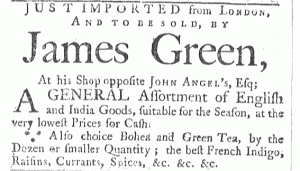
nov-1-1111766-providence-gazette
Providence Gazette (November 1, 1766).

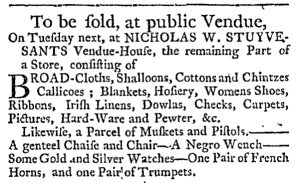
“A GENERAL Assortment of English and India Goods.”

In this advertisement in the Providence Gazette, James Green sought to sell an “assortment of English and India Goods.” The “India Goods” had been sent to London by the British East India Company.

Originally, the British East India Company’s primarily goal was trade, but it eventually became a ruling power in India. How? What kept the British East India Company in India was something more useful than any goods that could be exported: armies. They realized that Indians with modern weaponry could be just as good as European soldiers, but for half the price. The Company also used its armies to gain favor with rulers in India. Those armies aided Indian princes, thus creating opportunities for the Company to have sway in governing India.

The Company was able to avoid certain taxes that would normally be put on them for trading. Some Indian leaders tried to oppose the Company, such as the nawāb (or governor) Sirajud-Dawla and the Mughal emperor. They failed when the Company’s army defeated their armies in 1764. After that, the British East India Company gained more control over trade, including the revenue systems of Bengal, Orissa, and Bihar.

Learn more about the British East India Company Raj.

**********

ADDITIONAL COMMENTARY: Carl Robert Keyes

James Green sold “A GENERAL Assortment of … Goods” and commodities that had been transported great distances. The “Bohea and Green Tea” came from China, the indigo came from France, the spices came from the East Indies, and the “India Goods” came from the Indian subcontinent.

Ceara traces some of the history of the British East India Company in the years immediately before this advertisement appeared in a newspaper on the other side of the world. In providing glimpses of the British East India Company’s interventions in India, she demonstrates that colonists in New England were connected to faraway places that, until recently, have not been associated with the colonial American experience. For a generation and more, however, scholars have been reconceiving of colonial America as only a portion of a larger Atlantic world, but even those expansive boundaries cannot contain the webs of commerce and conquest that spread around the globe. Historians continue to discover that early America was much more vast than we previously realized!

For instance, in a book published earlier this year, Selling Empire: India in the Making of Britain and America, 1600-1830, Jonathan Eacott “recasts the British empire’s chronology and geography by situating the development of consumer culture, the American Revolution, and British industrialization in the commercial intersections linking the Atlantic and Indian Oceans.” Eacott examines “evolving networks, ideas, and fashions that bound India, Britain, and America” in the seventeenth through nineteenth centuries.

In doing her research to write about today’s advertisement, Ceara discovered a portion of this story on her own. It is a story that departs from traditional definitions and expectations about what should be included in a history of colonial America, but it is a more complete story that acknowledges that shopkeepers like James Green and his potential customers who read the Providence Gazette represented only two links in a much longer chain of supply and exchange that extended far beyond London to British merchants and officials operating in a very different colonial context in India.

Slavery Advertisements Published November 1, 1766

GUEST CURATOR:  Elizabeth Curley

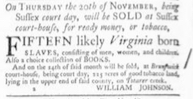
The Slavery Adverts 250 Project chronicles the role of newspaper advertising in perpetuating slavery in the era of the American Revolution. The project seeks to reveal the ubiquity of slavery in eighteenth-century life from New England to Georgia by republishing advertisements about enslaved people – for sale as individuals or in groups, wanted to purchase or for hire for short periods, runaways who liberated themselves, and those who were subsequently captured and confined in jails and workhouses – in daily digests on this site as well as in real time via the @SlaveAdverts250 Twitter feed, utilizing twenty-first-century media to stand in for the print media of the eighteenth century.

The project aims to provide modern audiences with a sense of just how often colonizers encountered these advertisements in their daily lives. Enslaved men, women, and children appeared in print somewhere in the colonies almost every single day. Those advertisements served as a constant backdrop for social, cultural, economic, and political life in colonial and revolutionary America. Colonizers who did not purport to own enslaved people were still confronted with slavery as well as invited to maintain the system by purchasing enslaved men, women, and children or assisting in the capture of so-called “runaways” who sought to free themselves from bondage. The frequency of these newspaper advertisements suggests just how embedded slavery was in colonial and revolutionary American culture in everyday interactions beyond the printed page.

These advertisements also testify to the experiences of enslaved men, women, and children, though readers must consider that those experiences have been remediated through descriptions offered by enslavers rather than enslaved people themselves. Often unnamed in the advertisements, enslaved men, women, and children were not invisible or unimportant in early America.

These advertisements appeared in colonial American newspapers 250 years ago today.

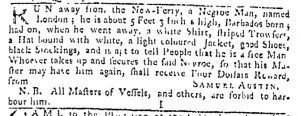
nov-1-providence-gazette-slavery-1
Providence Gazette (November 1, 1766).

October 31

GUEST CURATOR: Ceara Morse

What was advertised in a colonial American newspaper 250 years ago today?

oct-31-10311766-new-hampshire-gazette
New-Hampshire Gazette (October 31, 1766).

An Astronomical DIARY, Or ALMANACK, For the Year of our Lord CHRIST 1767.”

In this advertisement the printers of the New-Hampshire Gazette announced that their almanac for 1767 “soon will be Publish’d, and Sold.”

My previous knowledge of almanacs was that they told about the weather, moon phases, and other astronomical events, as well as gave information that helped with raising crops. Many different almanacs were published, each depending on the location where colonists lived. The almanac in this advertisement was made for Portsmouth, New Hampshire, and the surrounding area.

As a result of my research on this advertisement, I learned that almanacs were almost as popular as the Bible in colonial America. Jon Butler discusses the demand people had for information about the next year such, such as “all of the astronomical information … necessary to make astrological calculations.[1] Colonists enjoyed the predictions about the weather and astronomical events, often craving more.

Butler also noted that some colonists used “almanacs rather than Bibles to solve personal crises through occult means.”[2] The authors of some almanacs, however, “linked astrology to the ‘filthy Superstition of Heathens.’”[3] Some authors saw astrology as a form of sorcery and witchcraft, even though many colonists demanded almanacs with astrological features, including the “anatomy,” which was “a crude figure of a man … circled by signs of the zodiac that pointed to the parts of the body that each controlled.”[4]

**********

ADDITIONAL COMMENTARY: Carl Robert Keyes

Ceara correctly notes that almanacs were extremely popular in eighteenth-century America. Thanks to the useful and entertaining information they contained, these pamphlet-like periodicals could be found in all sorts of households, from the elite to the most humble. This advertisement hints at their popularity: the printers of the New-Hampshire Gazette sold their almanac both “Wholesale and Retail.” In addition to individual customers purchasing copies for personal use, the printers anticipated that booksellers, shopkeepers, and other retailers would buy in volume and then resell almanacs.

Printers in practically every city that had a printing press produced almanacs for local use in the eighteenth century. This was not merely a matter of authors and printers attempting to get a share of the market (though that played a part as well); each almanac contained precise astronomical information specific to a particular location. Note that the almanac promoted in this advertisement was “Calculated for the Meridian of Portsmouth in New-Hampshire, Lat. 43. 15 N. Long. 70 45 W.” Provided the calculations had been done correctly, readers of the New-Hampshire Gazette would have found this almanac more accurate and useful than one keyed to nearby Boston and certainly better than almanacs produced in other cities. The printers underscored that “Care and Pains ha[d] been taken to have this Almanack Correct.”

To that end, many printers and authors created a sort of brand loyalty associated with the almanacs they produced throughout the eighteenth-century. Benjamin Franklin’s “Poor Richard” lives on in popular memory as the most famous, but other authors gained prestige for the accuracy of their astronomical calculations. Year after year the titles of many almanacs included the names of authors who had gained the public’s confidence. This advertisement also makes a nod in that direction: “’tis presum’d ‘twill be as Acceptable as tho’ it appear’d under the very respectable Name of the late Doctor AMES, or his surviving Son and Successor Nathaniel.” The advertisement did not indicate the author of this particular almanac, but the printers sought to at least associate it with the names of two of the most popular and trusted authors.

Like newspapers and the advertisement they contained, almanacs provided an important source of revenue for colonial printers. The printers of the New-Hampshire Gazette announced that their almanac would soon be for sale while it was still in press, an entire two months before the new year began. Other printers began advertising their almanacs two months earlier. Demand certainly existed for these slim periodicals, but printers used frequent advertisements over many months to encourage even greater numbers of customers to purchase almanacs.

**********

[1] Jon Butler, “Magic, Astrology, and the Early American Religious Heritage, 1600-1760,” American Historical Review 84, no. 2 (April 1979): 330.

[2] Butler, “Magic, Astrology,” 331.

[3] Butler, “Magic, Astrology,” 340.

[4] Butler, “Magic, Astrology,” 330.

Slavery Advertisements Published October 31, 1766

GUEST CURATOR:  Elizabeth Curley

The Slavery Adverts 250 Project chronicles the role of newspaper advertising in perpetuating slavery in the era of the American Revolution. The project seeks to reveal the ubiquity of slavery in eighteenth-century life from New England to Georgia by republishing advertisements about enslaved people – for sale as individuals or in groups, wanted to purchase or for hire for short periods, runaways who liberated themselves, and those who were subsequently captured and confined in jails and workhouses – in daily digests on this site as well as in real time via the @SlaveAdverts250 Twitter feed, utilizing twenty-first-century media to stand in for the print media of the eighteenth century.

The project aims to provide modern audiences with a sense of just how often colonizers encountered these advertisements in their daily lives. Enslaved men, women, and children appeared in print somewhere in the colonies almost every single day. Those advertisements served as a constant backdrop for social, cultural, economic, and political life in colonial and revolutionary America. Colonizers who did not purport to own enslaved people were still confronted with slavery as well as invited to maintain the system by purchasing enslaved men, women, and children or assisting in the capture of so-called “runaways” who sought to free themselves from bondage. The frequency of these newspaper advertisements suggests just how embedded slavery was in colonial and revolutionary American culture in everyday interactions beyond the printed page.

These advertisements also testify to the experiences of enslaved men, women, and children, though readers must consider that those experiences have been remediated through descriptions offered by enslavers rather than enslaved people themselves. Often unnamed in the advertisements, enslaved men, women, and children were not invisible or unimportant in early America.

These advertisements appeared in colonial American newspapers 250 years ago today.

oct-31-new-london-gazette-slavery-1
New-London Gazette (October 31, 1766).

October 30

GUEST CURATOR: Ceara Morse

What was advertised in a colonial American newspaper 250 years ago today?

oct-30-10301766-massachusetts-gazette
Massachusetts Gazette (October 30, 1766).

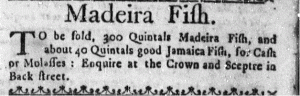
“Madeira Fish.”

In this advertisement certain types of fish were being sold: “Madeira Fish” and “Jamaica Fish.”

What drove me to pick this advertisement? I was interested in where these fish came from and how they show the vast networks of trade the colonies are involved in. At the time Jamaica was under British rule; however, Madeira was (and continues to be) an archipelago in the eastern Atlantic that belongs to Portugal. I found this quite interesting since before this I had never heard of Madeira and found it intriguing that the island traded with the New England colonies.

T.H. Breen notes that economic growth of colonial America was not just due to the exporting of goods from the colonies but also consumption thanks to the importation of new goods.[1] These fish are prime examples of this. Breen argued that colonists were not as self-sufficient as later historians claimed. They imported food, like “Madeira Fish” and “Jamaica Fish,” to supplement what they produced themselves. This also showed a taste or craving for goods rather than the common fish from the area.

**********

ADDITIONAL COMMENTARY: Carl Robert Keyes

Ceara rightly notes that this relatively plain advertisement reveals transatlantic networks of commerce. Despite the rich fishing grounds of the North Atlantic, colonists imported and consumed fish from Madeira and the Caribbean, diversifying their diets.

Even as this advertisement conjured an imaginative map of trade throughout the Atlantic, it also oriented colonists toward London, the center of the British Empire. The anonymous purveyor of “Madeira Fish” and “Jamaica Fish” gave few directions to the shop where customers could acquire these fish: “Enquire at the Crown and Sceptre in Back street.” This shop sign invoked two symbols of royal authority. The proprietor could have selected from among countless other devices to mark the location of this shop but chose a sign that asserted allegiance to the king and the British nation. Furthermore, the proprietor continued to display this particular shop sign even after the Stamp Act controversy and the Declaratory Act. Three days earlier, William Murray published an advertisement in the supplement to the Boston Evening-Post, an advertisement that listed his location as “at the Sign of General Wolfe.” Murray associated his shop with the English hero killed at the Battle of Quebec during the Seven Years War. Both Murray and the anonymous proprietor at the “Crown and Sceptre” promoted British identity as integral to their own commercial identities. They also expected this would resonate with potential customers. Elsewhere in the same issue of the Massachusetts Gazette, however, John Gore, Jr., stated that he sold goods imported from London “Opposite LIBERTY-TREE, BOSTON.”

These advertisements reveal a tension that began to emerge in advertisements and elsewhere during the 1760s as colonists contemplated how to organize the spatial geography of urban ports in light of their evolving relationship with Britain. Many continued to put great stock in their British identity and membership in the empire, despite new regulations passed by Parliament, but others used new symbols to define their businesses and their relationship to England.

**********

[1] T.H. Breen, “An Empire of Goods: The Anglicization of Colonial America, 1690-1776,” Journal of British Studies 25, no. 4 (October 1986): 478-485.

Welcome, Guest Curator Ceara Morse

Ceara Morse is a sophomore majoring in History and Secondary Education at Assumption College. From a young age she found history interesting because history is being made every day, not just in the distant past. She is fascinated by many historical periods and places, but wants to focus on U.S. History. She will be guest curator of the Adverts 250 Project during the week of October 30 to November 5, 2016.  She previously curated the Slavery Adverts 250 Project during the week of October 9 to 15, 2016.

Welcome, Ceara Morse!

Slavery Advertisements Published October 30, 1766

GUEST CURATOR:  Elizabeth Curley

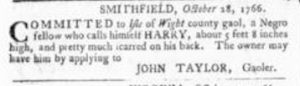
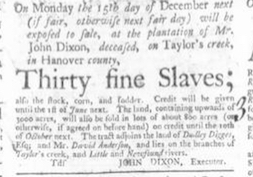
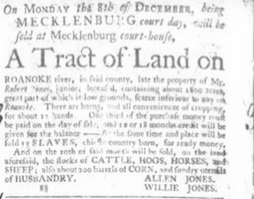
The Slavery Adverts 250 Project chronicles the role of newspaper advertising in perpetuating slavery in the era of the American Revolution. The project seeks to reveal the ubiquity of slavery in eighteenth-century life from New England to Georgia by republishing advertisements about enslaved people – for sale as individuals or in groups, wanted to purchase or for hire for short periods, runaways who liberated themselves, and those who were subsequently captured and confined in jails and workhouses – in daily digests on this site as well as in real time via the @SlaveAdverts250 Twitter feed, utilizing twenty-first-century media to stand in for the print media of the eighteenth century.

The project aims to provide modern audiences with a sense of just how often colonizers encountered these advertisements in their daily lives. Enslaved men, women, and children appeared in print somewhere in the colonies almost every single day. Those advertisements served as a constant backdrop for social, cultural, economic, and political life in colonial and revolutionary America. Colonizers who did not purport to own enslaved people were still confronted with slavery as well as invited to maintain the system by purchasing enslaved men, women, and children or assisting in the capture of so-called “runaways” who sought to free themselves from bondage. The frequency of these newspaper advertisements suggests just how embedded slavery was in colonial and revolutionary American culture in everyday interactions beyond the printed page.

These advertisements also testify to the experiences of enslaved men, women, and children, though readers must consider that those experiences have been remediated through descriptions offered by enslavers rather than enslaved people themselves. Often unnamed in the advertisements, enslaved men, women, and children were not invisible or unimportant in early America.

These advertisements appeared in colonial American newspapers 250 years ago today.

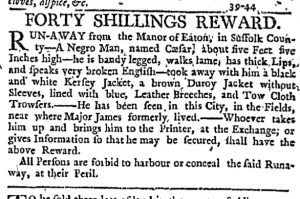
oct-30-new-york-journal-slavery-1
New-York Journal (October 30, 1766).

**********

oct-30-new-york-journal-slavery-2
New-York Journal (October 30, 1766).

**********

oct-30-new-york-journal-slavery-3
New-York Journal (October 30, 1766).

**********

oct-30-new-york-journal-slavery-4
Supplement to the New-York Journal (October 30, 1766).

**********

oct-30-pennsylvania-gazette-slavery-1
Pennsylvania Gazette (October 30, 1766).

**********

oct-30-pennsylvania-gazette-supplement-slavery-1
Supplement to the Pennsylvania Gazette (October 30, 1766).

**********

oct-30-pennsylvania-gazette-supplement-slavery-2
Supplement to the Pennsylvania Gazette (October 30, 1766).

**********

oct-30-virginia-gazette-slavery-1
Virginia Gazette (October 30, 1766).

**********

oct-30-virginia-gazette-slavery-2
Virginia Gazette (October 30, 1766).

**********

oct-30-virginia-gazette-slavery-3
Virginia Gazette (October 30, 1766).

**********

oct-30-virginia-gazette-slavery-4
Virginia Gazette (October 30, 1766).

**********

oct-30-virginia-gazette-slavery-5
Virginia Gazette (October 30, 1766).

Reflections from Guest Curator Megan Watts

Guest curating the Adverts 250 Project was a challenging, but rewarding, experience. I learned a substantial amount about “doing” history. In the past I had read books and articles analyzing historical documents, but my only experience in really making sense of history was writing essays on a very specific topic. Adverts 250 differed from that. There was a huge amount of flexibility and autonomy. While I had to remain in a specific year, month, and week range, I had a plethora of newspaper options to choose from. I could choose an advertisement from Savannah or one from Boston or one from Newport. More than that, I could decide which advertisement should be considered for the research blog. There was much more choice in the matter, and much more discernment needed. A difficult component of this project for me was deciding what part of the advertisement to focus on and remaining faithful to that choice. Some advertisements had dozens of items listed. But I had to be careful to choose an element that I could write about and compose a significant entry; sometimes it was challenging. At times I chose a product that I thought would be easy to write about, only to find that there was not a lot of information out there on the subject. In the end, however, I learned more about why it is so important to actually dissect historical documents and their purpose because doing so offers so much insight into colonial life.

The advertisements I analyzed contained significant commercial and social elements of colonial times and taught me a lot about that period. Some of these included that indigo was a primary crop of South Carolina, there was a specific etiquette regarding clothes, and that leather was an important commodity in early America. It really opened my eyes to the realities of colonial life and what would have been important to colonists, which differed from some of my expectations. There were some details that I never would have thought were significant before this project taught me to look more closely at primary documents. Everything had a purpose. The use of lowercase “long s” (that looks like an “f”) instead of the standard “s,” saved space in newspapers. Mentioning a landmark, like a bridge, street or shop sign, served to tell potential consumers where something was to be sold, especially since some stores were not well known and also there were some communities that did not have established names for streets. A shorter advertisement could mean that there were less products to sell, that the advertisement was very direct, or that it was too expensive to publish a longer advertisement.

In addition to improving my understanding of American history and improving my analytical skills, this project also exposed me to new kinds of primary documents. Prior to this class I had never worked with newspapers, neither in digitized databases nor with original issues. In the course of this assignment I had the opportunity to do both and discover new resources that could be used for historical research. These included not only online sources but also archives of physical documents. Also this project helped me improve my skills in discerning useful secondary sources. Originally some sources I thought would apply and add to my entries ended up not working upon further review. It really helped me reevaluate what I was writing, what I wanted to say, and how the secondary source either complemented it or contradicted it.

Overall Adverts 250 taught me a lot about history and how to go about analyzing it. Over the course of this assignment I improved my process of choosing relevant primary and secondary materials. I learned how to analyze in a more precise manner. Also I made important strides in discovering a wealth of sources that provide access to historical information. It was a great learning experience.

October 29

GUEST CURATOR: Megan Watts

What was advertised in a colonial American newspaper 250 years ago today?

oct-29-10291766-georgia-gazette
Georgia Gazette (October 29, 1766).

“A PARCEL of TANNED SOLE LEATHER.”

I chose this advertisement because it dealt with a material whose impact on society I did not know a lot about overall: leather. This short advertisement attempted to sell “A PARCEL of TANNED SOLE LEATHER.” I did realize that throughout history leather played a role, but did not fully understand its importance in the colonial world. Obviously there was demand for it. But why was leather in demand? I engaged in some research to find out more about it. According to Colonial Williamsburg, leather was used for myriad of items: equestrian equipment, fashion items and storage products. It even was used for luxury items like “ fur and leather hand muffs” and “razor cases.”

The importance of equipment used in harnessing horses cannot be overstated. During the colonial period the primary mode of travel, other than walking, was horseback or a horse drawn vehicle. There would have been thousands of colonists using horses to travel across towns or colonies. None of that travel would have been possible without bridles, saddles, harnesses, and other leather goods. That is one of the main reasons leather was a commodity that was worth selling. It was a necessary component of colonial travel, as well as a resource used in fashion. A colonist reading this advertisement would have recognized the value of leather goods.

**********

ADDITIONAL COMMENTARY: Carl Robert Keyes

Megan has selected an advertisement that differs from many other advertisements for consumer goods and services in one significant aspect: “MATT. ROCHE, Prov. Mar.” signed this notice. Roche was not a producer, supplier, or retailer. Instead, he was a local official, a provost marshal (a law enforcement officer roughly equivalent to a sheriff). As part of their own institutional history, the U.S. Marshals Service states that “as soon as the colony of Georgia was founded in 1733, the office of provost marshal was established.” Other colonies, including Virginia, also had provost marshals. Their duties included collecting fines, apprehending and transporting criminals, and, most significantly for the purposes of understanding this advertisement, “taking inventory of a deceased person’s estate.”

Roche did not seek to sell his own goods or make a profit from transactions with customers. That was not his way of earning a living. Instead, in his official capacity he participated in settling the estate of “the late Mr. William Smith.” Note that Roche did not have his own shop, auction house, or warehouse for dispersing the “PARCEL of TANNED SOLE LEATHER.” Instead, those interested in purchasing this commodity needed to seek it out at “Joseph Pruniere’s store adjoining his house.” Notice as well that Roche did not announce an ongoing sale. The “PARCEL” had been divided into lots that were to be sold on a specific date (“Tuesday the 4th of November, 1766”) at a specific place. This was an auction intended to quickly and efficiently liquidate the deceased Smith’s inventory of sole leather in order to move forward with settling his estate. Roche inserted an announcement of the sale in the Georgia Gazette, but he did not attempt to incite demand by resorting to any particular appeals to entice buyers, unlike shopkeepers whose livelihoods depended on attracting customers.

Most likely many colonists eventually wore shoes constructed from this “PARCEL of TANNED SOLE LEATHER,” but the path from producer to consumer took unanticipated turns along the way.

Summary of Slavery Advertisements Published October 23-29, 1766

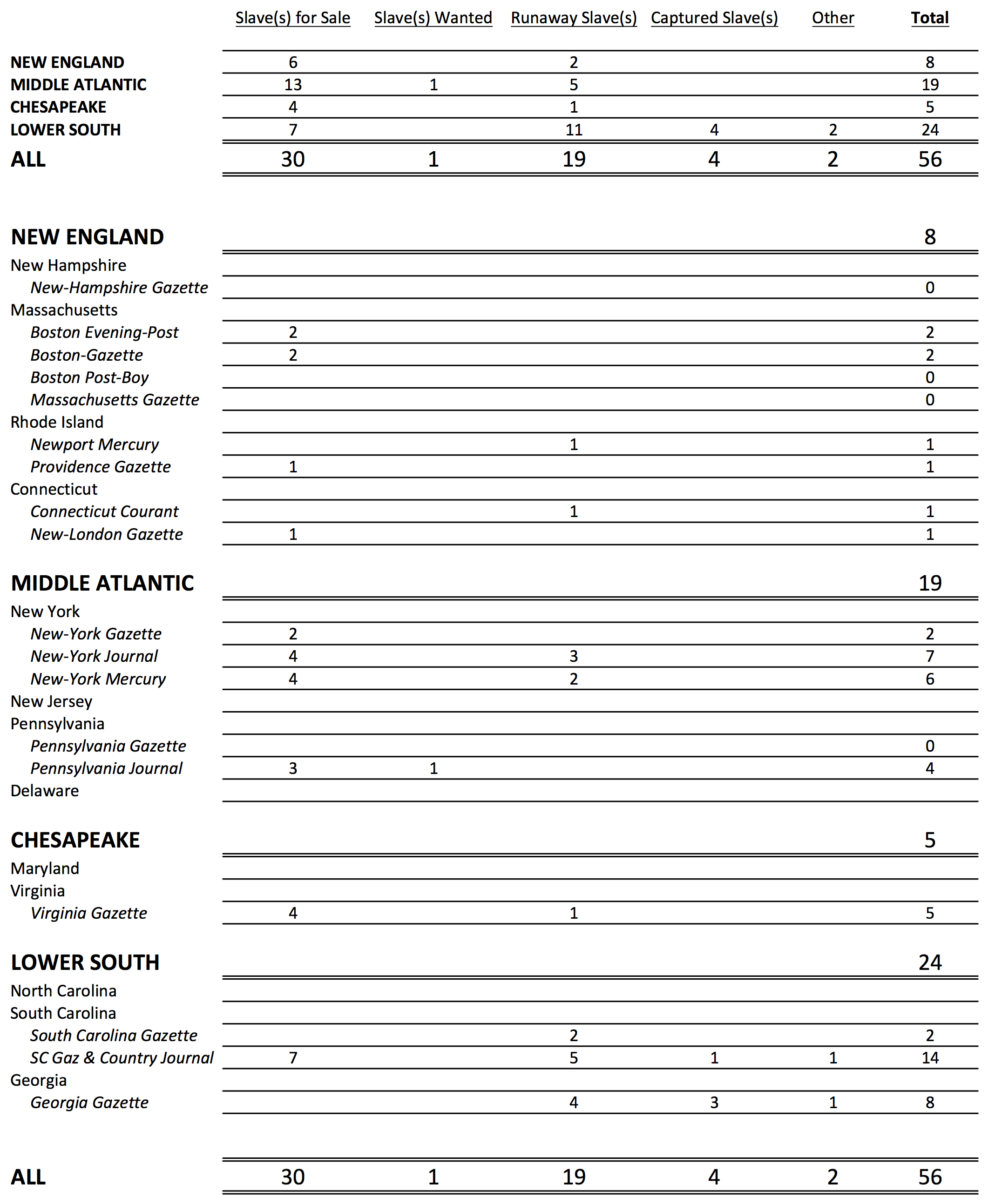
These tables indicate how many advertisements for slaves appeared in colonial American newspapers during the week of October 23-29, 1766.  Data for both tables was compiled by Patrick Keane.

Note:  These tables are as comprehensive as currently digitized sources permit, but they may not be an exhaustive account.  They includes all newspapers that have been digitized and made available via Accessible Archives, Colonial Williamsburg’s Digital Library, and Readex’s America’s Historical Newspapers.  There are several reasons some newspapers may not have been consulted:

  • Issues that are no longer extant;
  • Issues that are extant but have not yet been digitized; and
  • Newspapers published in a language other than English (including the Wochentliche Philadelphische Staatsbote).

**********

Slavery Advertisements Published October 23-29, 1766:  By Date

slavery-adverts-table-by-date-oct-23

**********

Slavery Advertisements Published October 23-29, 1766:  By Region

slavery-adverts-table-by-region-oct-23