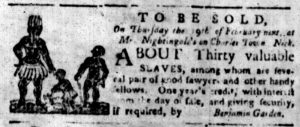
Shannon Holleran is a sophomore majoring in Education and History at Assumption College. She has always had a love for history, but truly recognized her passion for the past when she visited Washington, DC, to participate in the finals for the National History Day competition. She spent a week in DC exploring the city and delving into our nation’s history. After that incredible experience, she was certain she wanted to pursue a career in history. She will be the guest curator of the Adverts 250 Project during the week of February 19 to 25, 2017. She will also curate the Slavery Adverts 250 Project during the week of March 19 to 26, 2017.
The Slavery Adverts 250 Project chronicles the role of newspaper advertising in perpetuating slavery in the era of the American Revolution. The project seeks to reveal the ubiquity of slavery in eighteenth-century life from New England to Georgia by republishing advertisements about enslaved people – for sale as individuals or in groups, wanted to purchase or for hire for short periods, runaways who liberated themselves, and those who were subsequently captured and confined in jails and workhouses – in daily digests on this site as well as in real time via the @SlaveAdverts250 Twitter feed, utilizing twenty-first-century media to stand in for the print media of the eighteenth century.
The project aims to provide modern audiences with a sense of just how often colonizers encountered these advertisements in their daily lives. Enslaved men, women, and children appeared in print somewhere in the colonies almost every single day. Those advertisements served as a constant backdrop for social, cultural, economic, and political life in colonial and revolutionary America. Colonizers who did not purport to own enslaved people were still confronted with slavery as well as invited to maintain the system by purchasing enslaved men, women, and children or assisting in the capture of so-called “runaways” who sought to free themselves from bondage. The frequency of these newspaper advertisements suggests just how embedded slavery was in colonial and revolutionary American culture in everyday interactions beyond the printed page.
These advertisements also testify to the experiences of enslaved men, women, and children, though readers must consider that those experiences have been remediated through descriptions offered by enslavers rather than enslaved people themselves. Often unnamed in the advertisements, enslaved men, women, and children were not invisible or unimportant in early America.
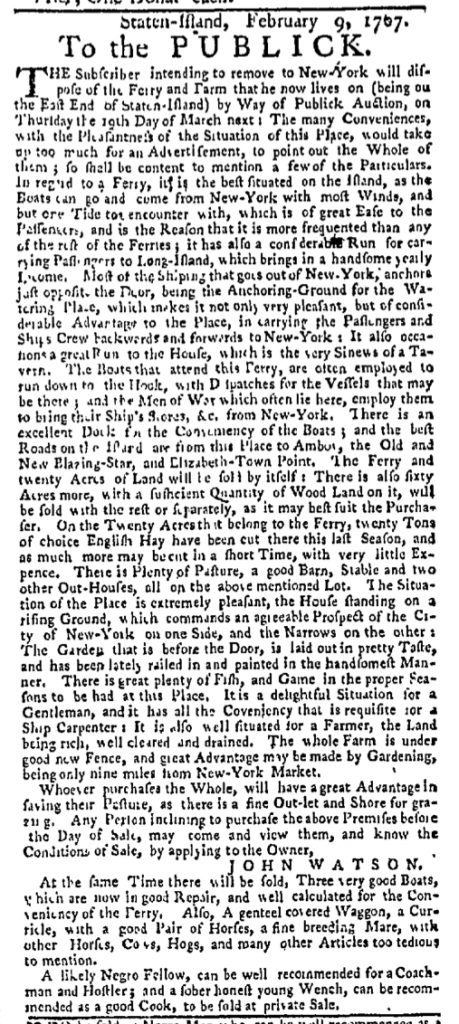
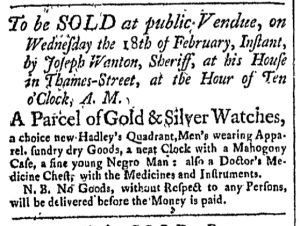
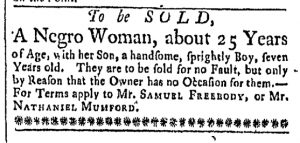
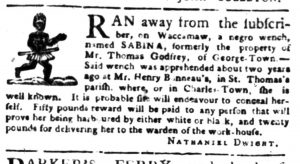
These advertisements appeared in colonial American newspapers 250 years ago today.
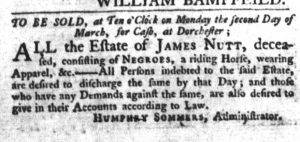
Massachusetts Gazette (February 19, 1767).
**********
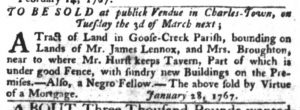
New-York Gazette: Or, the Weekly Post-Boy (February 19, 1767).
**********
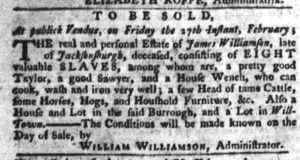
New-York Gazette: Or, the Weekly Post-Boy (February 19, 1767).
What was advertised in a colonial American newspaper 250 years ago today?
Georgia Gazette (February 18, 1767).
“SILK-WORM SEED.”
The February 18, 1767, issue of the Georgia Gazette included only a small number of advertisements for consumer goods and services. Instead, the production of local commodities for export played a much more prominent role among the notices in that issue. In one advertisement, an overseer “who understands the planting of Rice, and making of Indico” sought employment. In the lengthiest advertisement, filling more than half a column on the final page, George Baillie announced that “the Hemp seed ordered to be purchased at the Publick charge is now received” and invited “all persons who are inclinable to make any trial or experiment in planting seed” to contact him. That part of the notice was fairly short. The bulk of the advertisement was given over to extensive “Directions for the Culture, Raising, and Curing of Hemp.” Due to its exceptionally strong and durable fibers, hemp was a valuable commodity for making rope, used widely aboard ships pursuing Britain’s maritime commercial ventures as well as its navy.
The shortest advertisement simply stated, “Notice is hereby given, That the SILK-WORM SEED Is now ready to be distributed as usual at the house of JOSEPH OTTOLENGHE.” This “seed” was actually the eggs of silkworms. From its founding in 1732, the trustees of the Georgia colony encouraged silk production. In 1735, Governor James Oglethorpe famously transported eight pounds of silk to England, which was then used to make a dress for the queen. In 1749, England eliminated duties on silk imported from Georgia. According to Frank P. Bennett, silk produced in Georgia “was of such a high grade that it commanded a price in the London market three shillings higher than any other silk in the world.”[1] The silk industry in Georgia, however, declined in the 1770s and disappeared after the Revolution, in part because the invention of the cotton gin at the end of the century made that commodity so much more profitable.
American colonists were able to participate in the consumer revolution of the eighteenth century because they produced surplus goods for export as a means of affording the vast array of goods imported from London and other English ports. (Networks of credit also helped colonists acquire those baubles of Britain.) The advertisements promoting the colonial production of rice, indigo, hemp, and silk in the Georgia Gazette were counterparts to other advertisements hawking goods to prospective customers.
**********
[1] Frank P. Bennett, History of American Textiles: With Kindred and Auxiliary Industries (Boston: 1922), 108
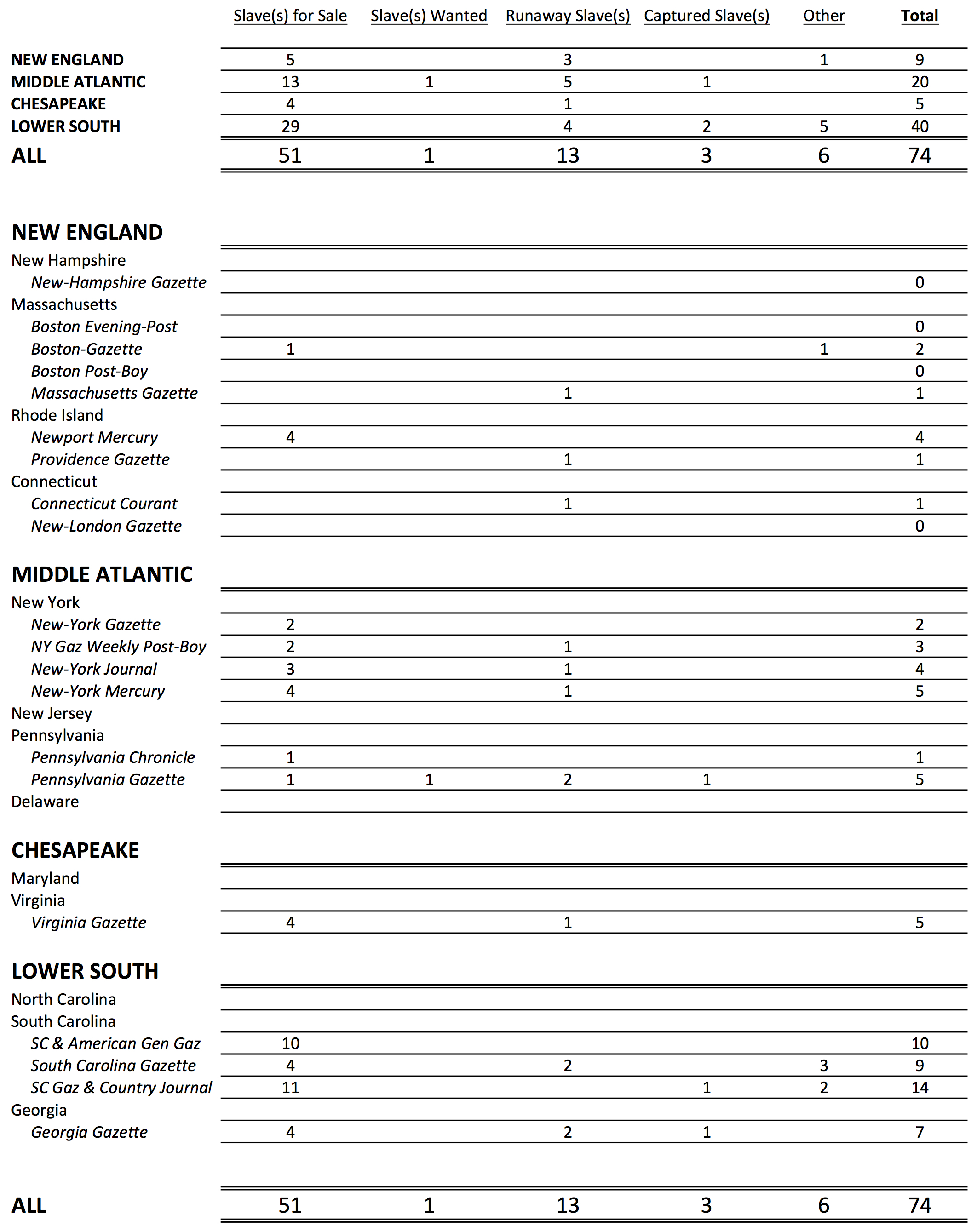
These tables indicate how many advertisements for slaves appeared in colonial American newspapers during the week of February 12-18, 1767.
Note: These tables are as comprehensive as currently digitized sources permit, but they may not be an exhaustive account. They includes all newspapers that have been digitized and made available via Accessible Archives, Colonial Williamsburg’s Digital Library, and Readex’s America’s Historical Newspapers. There are several reasons some newspapers may not have been consulted:
Issues that are no longer extant;
Issues that are extant but have not yet been digitized (including the Pennsylvania Journal); and
Newspapers published in a language other than English (including the Wochentliche Philadelphische Staatsbote).
**********
Slavery Advertisements Published February 12-18, 1767: By Date
**********
Slavery Advertisements Published February 12-18: By Region
The Slavery Adverts 250 Project chronicles the role of newspaper advertising in perpetuating slavery in the era of the American Revolution. The project seeks to reveal the ubiquity of slavery in eighteenth-century life from New England to Georgia by republishing advertisements about enslaved people – for sale as individuals or in groups, wanted to purchase or for hire for short periods, runaways who liberated themselves, and those who were subsequently captured and confined in jails and workhouses – in daily digests on this site as well as in real time via the @SlaveAdverts250 Twitter feed, utilizing twenty-first-century media to stand in for the print media of the eighteenth century.
The project aims to provide modern audiences with a sense of just how often colonizers encountered these advertisements in their daily lives. Enslaved men, women, and children appeared in print somewhere in the colonies almost every single day. Those advertisements served as a constant backdrop for social, cultural, economic, and political life in colonial and revolutionary America. Colonizers who did not purport to own enslaved people were still confronted with slavery as well as invited to maintain the system by purchasing enslaved men, women, and children or assisting in the capture of so-called “runaways” who sought to free themselves from bondage. The frequency of these newspaper advertisements suggests just how embedded slavery was in colonial and revolutionary American culture in everyday interactions beyond the printed page.
These advertisements also testify to the experiences of enslaved men, women, and children, though readers must consider that those experiences have been remediated through descriptions offered by enslavers rather than enslaved people themselves. Often unnamed in the advertisements, enslaved men, women, and children were not invisible or unimportant in early America.
These advertisements appeared in colonial American newspapers 250 years ago today.
What was advertised in a colonial American newspaper 250 years ago today?
South-Carolina Gazette and Country Journal (February 17, 1767).
“Men, women, boys and girls worsted, cotton, thread, and silk stockings.”
Thomas Radcliffe’s lengthy advertisement filled more than two-thirds of a column in the South-Carolina Gazette and Country Journal, but it could have been published in any of the nearly two dozen newspapers printed in colonial America in 1767. Radcliffe promoted his “large and neat Assortment of Goods” that he “sold on the most reasonable Terms.” He listed scores of specific imported items included in his inventory, yet concluded with “&c. &c.” (the eighteenth-century version of “etc. etc.”) to suggest an even more vast array of goods customers would encounter in his shop. In so doing, he emphasized that customers could make their own choices based on personal tastes and budgets. The appeals he made to consumers matched appeals other advertisers made in Virginia, Pennsylvania, Massachusetts, and throughout the colonies.
Yet it was not only Radcliffe’s marketing strategies that would have looked familiar to visitors from other colonies who read his notice in the South-Carolina Gazette and Country Journal. Shopkeepers throughout the colonies would have hawked the merchandise he stocked, a result of so much of it being imported from London and other English ports. T.H. Breen has labeled this the standardization of consumer culture in eighteenth-century America. Unique markets or regional tastes did not develop.
As a result, the letter by the pseudonymous Anthony Afterwrit published in the Providence Gazette just a few days before Radcliffe’s advertisement made its way into print hundreds of miles to the south could have appeared in any of South Carolina’s newspapers. The Afterwrit character might have expressed dismay at the bounty of goods offered to colonial shoppers, especially the “women’s fashionable hats, shades, handkerchiefs and scarfs” and “new fashionable stuffs for ladies gowns” intended the catch the attention of women, like his wife, interested in using conspicuous consumption to attest to their social status. Radcliffe’s advertisement even concluded with a “compleat set of tea china,” one of his wife’s acquisitions that Afterwrit explicitly lamented. Afterwrit conveniently ignored, however, merchandise marketed directly to men, such as “men’s silk, worsted and cotton caps” and “gentlemen’s watch chains.”
That demonstrates yet another aspect of colonial commerce common throughout the colonies: editorials that complained about feminized luxury achieved via consumption that appeared in the same newspapers that ran advertisements that marketed all sorts of goods to both female and male consumers.
The Slavery Adverts 250 Project chronicles the role of newspaper advertising in perpetuating slavery in the era of the American Revolution. The project seeks to reveal the ubiquity of slavery in eighteenth-century life from New England to Georgia by republishing advertisements about enslaved people – for sale as individuals or in groups, wanted to purchase or for hire for short periods, runaways who liberated themselves, and those who were subsequently captured and confined in jails and workhouses – in daily digests on this site as well as in real time via the @SlaveAdverts250 Twitter feed, utilizing twenty-first-century media to stand in for the print media of the eighteenth century.
The project aims to provide modern audiences with a sense of just how often colonizers encountered these advertisements in their daily lives. Enslaved men, women, and children appeared in print somewhere in the colonies almost every single day. Those advertisements served as a constant backdrop for social, cultural, economic, and political life in colonial and revolutionary America. Colonizers who did not purport to own enslaved people were still confronted with slavery as well as invited to maintain the system by purchasing enslaved men, women, and children or assisting in the capture of so-called “runaways” who sought to free themselves from bondage. The frequency of these newspaper advertisements suggests just how embedded slavery was in colonial and revolutionary American culture in everyday interactions beyond the printed page.
These advertisements also testify to the experiences of enslaved men, women, and children, though readers must consider that those experiences have been remediated through descriptions offered by enslavers rather than enslaved people themselves. Often unnamed in the advertisements, enslaved men, women, and children were not invisible or unimportant in early America.
These advertisements appeared in colonial American newspapers 250 years ago today.
South-Carolina Gazette and Country Journal (February 17, 1767).
**********
South-Carolina Gazette and Country Journal (February 17, 1767).
**********
South-Carolina Gazette and Country Journal (February 17, 1767).
**********
South-Carolina Gazette and Country Journal (February 17, 1767).
**********
South-Carolina Gazette and Country Journal (February 17, 1767).
**********
South-Carolina Gazette and Country Journal (February 17, 1767).
**********
South-Carolina Gazette and Country Journal (February 17, 1767).
**********
South-Carolina Gazette and Country Journal (February 17, 1767).
**********
South-Carolina Gazette and Country Journal (February 17, 1767).
**********
South-Carolina Gazette and Country Journal (February 17, 1767).
**********
South-Carolina Gazette and Country Journal (February 17, 1767).
**********
South-Carolina Gazette and Country Journal (February 17, 1767).
**********
South-Carolina Gazette and Country Journal (February 17, 1767).
**********
South-Carolina Gazette and Country Journal (February 17, 1767).
What was advertised in a colonial American newspaper 250 years ago today?
Boston Evening-Post (February 16, 1767).
“Any of those with this Mark (*) may be had by the Dozen, at a small Advance.”
Like other colonial booksellers, M. Williams imported from London most of the “good Assortment of Books” he sold. His newspaper advertisements amounted to miniature catalogs that listed dozens of titles. In most regards, his notice looked little different from those published by his competitors. To make it easier for potential customers to read and identify items of interest, each title occupied its own line. To increase the number of titles that could be listed, the advertisement was divided into two columns, making it dense yet still readable. Williams also hawked a variety of other goods (“Stationary Wares,” including paper, inkpots, quills, penknives, and sealing wax) and services (blank books made and ruled and “old Books new bound”).
In one regard, however, Williams’ advertisement differed from most others. A printing ornament preceded the majority of titles. Williams explained its meaning in a nota bene that concluded his notice: “Any of those with this Mark (*) may be had by the Dozen, at a small Advance.” This reveals that the bookseller did not operate merely as a retailer of individual books one at a time but instead sold in volume to others that then retailed the books themselves.
Given that Williams’ shop was in Salem, he most likely did not intend his advertisement to address readers of the Boston Evening-Post who resided in Boston itself. After all, residents of Boston could conveniently purchase “Books and Stationary Wares” from several local printers and booksellers. Instead of soliciting their patronage, Williams depended on the dissemination of the Boston Evening-Post throughout the city’s hinterland, which included Salem as well as smaller towns and villages. While some of the books he stocked would have been appropriate for schoolmasters to purchase in volume, Williams likely anticipated that others might find their way into shops in surrounding villages, where they would supplement other sorts of merchandise. Stressing that he sold books by the dozen may have allowed him to capture some of the market among these shopkeepers that otherwise prominent printers and booksellers in Boston would have dominated.
The Slavery Adverts 250 Project chronicles the role of newspaper advertising in perpetuating slavery in the era of the American Revolution. The project seeks to reveal the ubiquity of slavery in eighteenth-century life from New England to Georgia by republishing advertisements about enslaved people – for sale as individuals or in groups, wanted to purchase or for hire for short periods, runaways who liberated themselves, and those who were subsequently captured and confined in jails and workhouses – in daily digests on this site as well as in real time via the @SlaveAdverts250 Twitter feed, utilizing twenty-first-century media to stand in for the print media of the eighteenth century.
The project aims to provide modern audiences with a sense of just how often colonizers encountered these advertisements in their daily lives. Enslaved men, women, and children appeared in print somewhere in the colonies almost every single day. Those advertisements served as a constant backdrop for social, cultural, economic, and political life in colonial and revolutionary America. Colonizers who did not purport to own enslaved people were still confronted with slavery as well as invited to maintain the system by purchasing enslaved men, women, and children or assisting in the capture of so-called “runaways” who sought to free themselves from bondage. The frequency of these newspaper advertisements suggests just how embedded slavery was in colonial and revolutionary American culture in everyday interactions beyond the printed page.
These advertisements also testify to the experiences of enslaved men, women, and children, though readers must consider that those experiences have been remediated through descriptions offered by enslavers rather than enslaved people themselves. Often unnamed in the advertisements, enslaved men, women, and children were not invisible or unimportant in early America.
These advertisements appeared in colonial American newspapers 250 years ago today.
Who was the subject of an advertisement in a colonial American newspaper 250 years ago this week?
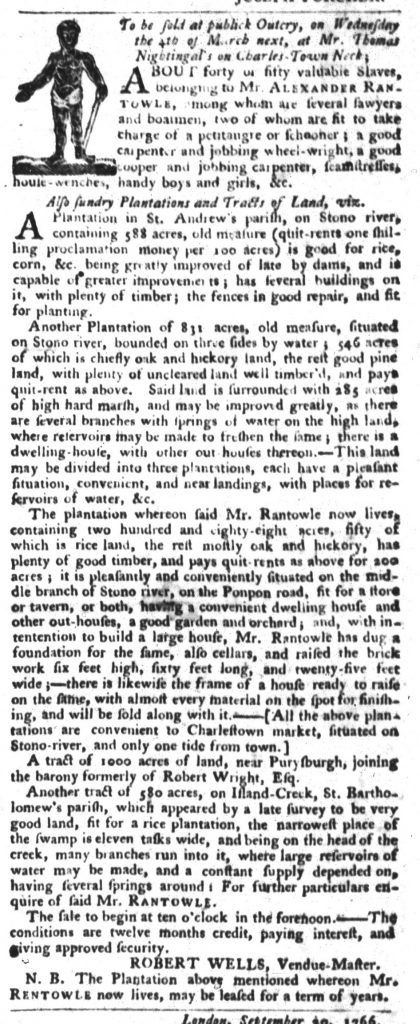
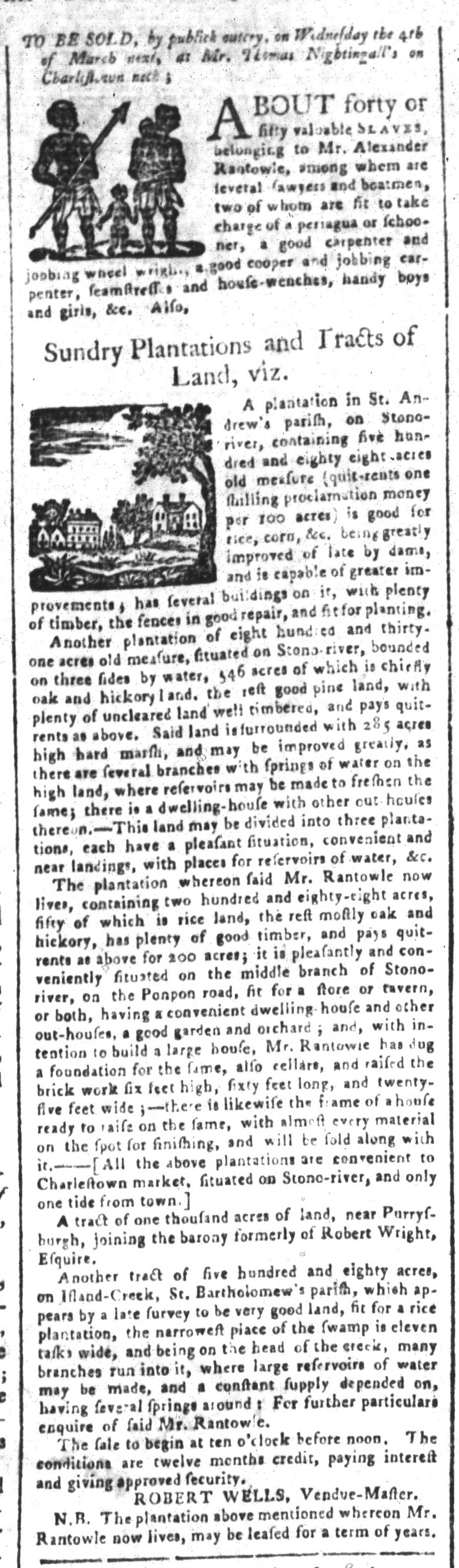
South-Carolina and American General Gazette (February 13, 1767).
“Forty or fifty valuable SLAVES … Also, Sundry Plantations and Tracts of Land.”
The vast majority of colonial newspaper advertisements did not include visual images. When illustrations did appear with advertisements, they usually came from one of four categories. Images of ships at sea accompanied notices for vessels seeking passengers and freight, though they occasionally appeared in advertisements for imported goods. Depictions of horses ran alongside announcements by breeders offering stallions “to cover” mares. Images of slaves served two purposes: they were included with both advertisements seeking to sell slaves and notices that warned about runaways. (Curiously, similar advertisements for indentured servants were much less likely to include depictions of runaways making their escape.) Finally, real estate advertisements sometimes included images of houses or pastoral scenes. In each case, the woodcut belonged to the printer and could be used interchangeably with advertisements placed for similar purposes. On occasion, some advertisers commissioned their own woodcuts to attract attention to their advertisements, usually opting for an image that replicated their shop signs.
From the standard categories of woodcuts, all four appeared in the February 13, 1767, issue of the South-Carolina and American General Gazette. No advertisers, however, spiced up their notices with original illustrations. That did not mean that the advertising in that issue lacked creativity when it came to the deployment of visual images. When advertisements included woodcuts they tended to have only one. Vendue master Robert Wells, however, oversaw the sale of both “forty or fifty valuable SLAVES” and “Sundry Plantations and Tracts of Land.” He opted to include both types of relevant woodcuts in his notice, a choice that likely resulted in readers noticing the rich visual texture of his advertisement. Given that Wells was charged with selling both slaves and real estate, he may have believed that if he was going to include any sort of woodcut at all then using both images was necessary. After all, readers might have passed over an advertisement showing just a slave or just a plantation, assuming that the woodcut summarized the contents of the entire notice. In a newspaper with few illustrations, Wells’ advertisement with two woodcuts stood out from the rest of the content.