February 14

What was advertised in a colonial American newspaper 250 years ago today?
feb-14-2141767-providence-gazette
Providence Gazette (February 14, 1767).

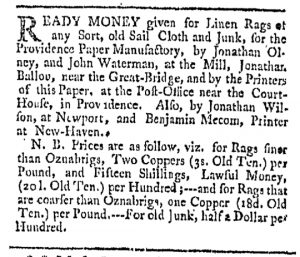
“READY MONEY given for Linen Rags.”

Sarah Goddard and Company inserted a letter “To the PRINTERS” by the pseudonymous Anthony Afterwrit in the February 14, 1767, issue of the Providence Gazette, along with a preface that stated, “There being at this Time a great Dearth of News among us, and as there appears to be some Oeconomy in the following Letter, we hope our giving it a Place in this Paper will Prove agreeable to our Readers.” Based on the number of paid notices published in the same issue, it appears that Goddard and Company also experienced a dearth of advertising submitted by local merchants, shopkeepers, and artisans. They once again ran multiple advertisements for their own printing and bookselling enterprises, including a call for linen rags that had first been inserted at least six months earlier.

The colophon on the final page continued to announce that the printing office accepted advertisements for the newspaper, but the editorial decisions made by Goddard and Company may have worked at cross purposes when it came to attracting advertisers. The entertaining letter from Anthony Afterwrit, its inclusion occasioned by the “great Dearth of News among us,” told the story of a wife with “a strong inclination to be a gentlewomen” who found expression for this desire through purchasing a new looking glass after her husband’s “old fashioned looking-glass” broke under suspicious circumstances. In turn, the wife purchased “a more proper table” and “handsome chairs” to complement the new looking glass. Next, she acquired “a tea-table with its appurtenances of china and silver” and hired a maid. Not yet content, she convinced her husband that “it was absolutely necessary to buy a clock,” which became “a great ornament” in the household. Finally, this wife with aspirations decided that she needed “a very fine pacing mare” rather than the “wretched ugly” horses the family already possessed.

After telling this story, Afterwrit concluded by revealing that his wife was away on a trip to visit a relative in the countryside. In her absence, he sold off all the new, expensive, and unnecessarily luxurious commodities recently acquired. Knowing that his wife’s relation subscribed to the Providence Gazette and that his spouse would read it before returning home, he offered the letter as a warning for what she could expect. He also reported that he had used some of the money he recovered from selling the new furniture to purchase “a sett of knitting needles” because he began to “want stockings.” Preoccupied with conspicuous consumption, his wife had presumably neglected her duties, but she should expect to take up those needles to produce, rather than purchase, clothing once she returned.

This letter from Anthony Afterwrit began on the first page and filled half of the second. Advertisements from Joseph and William Russell and Benjamin and Edward Thurber, all regular advertisers in the Providence Gazette, appeared on the third page, facing the letter. Those retailers may not have much appreciated the critique of consumer culture that preceded their advertisements. Prospective advertisers may have thought twice about purchasing space of their own in Goddard and Company’s newspaper.

Slavery Advertisements Published February 14, 1767

The Slavery Adverts 250 Project chronicles the role of newspaper advertising in perpetuating slavery in the era of the American Revolution. The project seeks to reveal the ubiquity of slavery in eighteenth-century life from New England to Georgia by republishing advertisements about enslaved people – for sale as individuals or in groups, wanted to purchase or for hire for short periods, runaways who liberated themselves, and those who were subsequently captured and confined in jails and workhouses – in daily digests on this site as well as in real time via the @SlaveAdverts250 Twitter feed, utilizing twenty-first-century media to stand in for the print media of the eighteenth century.

The project aims to provide modern audiences with a sense of just how often colonizers encountered these advertisements in their daily lives. Enslaved men, women, and children appeared in print somewhere in the colonies almost every single day. Those advertisements served as a constant backdrop for social, cultural, economic, and political life in colonial and revolutionary America. Colonizers who did not purport to own enslaved people were still confronted with slavery as well as invited to maintain the system by purchasing enslaved men, women, and children or assisting in the capture of so-called “runaways” who sought to free themselves from bondage. The frequency of these newspaper advertisements suggests just how embedded slavery was in colonial and revolutionary American culture in everyday interactions beyond the printed page.

These advertisements also testify to the experiences of enslaved men, women, and children, though readers must consider that those experiences have been remediated through descriptions offered by enslavers rather than enslaved people themselves. Often unnamed in the advertisements, enslaved men, women, and children were not invisible or unimportant in early America.

These advertisements appeared in colonial American newspapers 250 years ago today.

feb-14-providence-gazette-slavery-1
Providence Gazette (February 14, 1767).

February 13

What was advertised in a colonial American newspaper 250 years ago today?

feb-13-2131767-south-carolina-and-american-general-gazette
South-Carolina and American General Gazette (February 13, 1767).

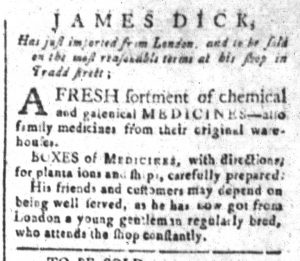
“His friends and customers may depend on being well served.”

Apothecary James Dick sold “A FRESH sortment of chemical and galenical MEDICINES” imported from London. Like other druggists in the colonies in the 1760s, he assembled “BOXES of MEDICINES, with directions, for plantations and ships.” In providing this service, he likely also moved portions of his inventory that tended to sell more slowly, especially if given the discretion to fabricate these eighteenth-century first aid kits rather than including only items specified by purchasers.

In addition to the ease and convenience of these “BOXES of MEDICINES,” Dick wanted his “friends and customers” to know that he emphasized service in other ways. He made a fairly unique pitch when he concluded his advertisement by noting that “he has now got from London a young gentleman regularly bred, who attends the shop constantly.” Advertisers from a variety of occupations and professions frequently pledged to treat potential customers well, often promising to fulfill their duties with “care” or “dispatch.” When mobilizing such appeals, however, advertisers usually referred to their own demeanor and qualities. Dick, on the other hand, described possible interactions with his employee.

Very few advertisers mentioned employees, perhaps because many ran small operations limited to family members and maybe an apprentice.   Even shopkeepers and artisans who may have had assistants of various sorts deployed advertising in which they retained their role as the public face of the businesses they operated.

By promoting the contributions of his assistant, Dick made at least two appeals to prospective customers, one practical and one aspirational. When he noted that his assistant “attends the shop constantly,” the apothecary let readers know that someone would be available to assist them no matter when they visited. Given that the druggist provided medical services, he may have been called away from the shop on occasion. Rather than close his shop, he made arrangements for an assistant to be present even when he was not.

In addition, when he noted that his assistant not only came from London but was “a young gentleman regularly bred” the apothecary conjured images of a prosperous and genteel shop where customers would be met with courtesy and deference. Given his line of business, Dick rightly assumed that some customers visited his shop when feeling their worst. The image of a “young gentleman regularly bred” serving those customers suggested an atmosphere of pampering and authentic concern rather than a hurried transaction in a busy dispensary. Some retail pharmacies make similar appeals today, emphasizing interactions – even relationships built over time – with pharmacists and other staff.

Slavery Advertisements Published February 13, 1767

The Slavery Adverts 250 Project chronicles the role of newspaper advertising in perpetuating slavery in the era of the American Revolution. The project seeks to reveal the ubiquity of slavery in eighteenth-century life from New England to Georgia by republishing advertisements about enslaved people – for sale as individuals or in groups, wanted to purchase or for hire for short periods, runaways who liberated themselves, and those who were subsequently captured and confined in jails and workhouses – in daily digests on this site as well as in real time via the @SlaveAdverts250 Twitter feed, utilizing twenty-first-century media to stand in for the print media of the eighteenth century.

The project aims to provide modern audiences with a sense of just how often colonizers encountered these advertisements in their daily lives. Enslaved men, women, and children appeared in print somewhere in the colonies almost every single day. Those advertisements served as a constant backdrop for social, cultural, economic, and political life in colonial and revolutionary America. Colonizers who did not purport to own enslaved people were still confronted with slavery as well as invited to maintain the system by purchasing enslaved men, women, and children or assisting in the capture of so-called “runaways” who sought to free themselves from bondage. The frequency of these newspaper advertisements suggests just how embedded slavery was in colonial and revolutionary American culture in everyday interactions beyond the printed page.

These advertisements also testify to the experiences of enslaved men, women, and children, though readers must consider that those experiences have been remediated through descriptions offered by enslavers rather than enslaved people themselves. Often unnamed in the advertisements, enslaved men, women, and children were not invisible or unimportant in early America.

These advertisements appeared in colonial American newspapers 250 years ago today.

feb-13-south-carolina-and-american-general-gazette-slavery-1
South-Carolina and American General Gazette (February 13, 1767).

**********

feb-13-south-carolina-and-american-general-gazette-slavery-2
South-Carolina and American General Gazette (February 13, 1767).

**********

feb-13-south-carolina-and-american-general-gazette-slavery-3
South-Carolina and American General Gazette (February 13, 1767).

**********

feb-13-south-carolina-and-american-general-gazette-slavery-4
South-Carolina and American General Gazette (February 13, 1767).

**********

feb-13-south-carolina-and-american-general-gazette-slavery-5
South-Carolina and American General Gazette (February 13, 1767).

**********

feb-13-south-carolina-and-american-general-gazette-slavery-6
South-Carolina and American General Gazette (February 13, 1767).

**********

feb-13-south-carolina-and-american-general-gazette-slavery-7
South-Carolina and American General Gazette (February 13, 1767).

**********

feb-13-south-carolina-and-american-general-gazette-slavery-8
South-Carolina and American General Gazette (February 13, 1767).

**********

feb-13-south-carolina-and-american-general-gazette-slavery-9
South-Carolina and American General Gazette (February 13, 1767).

**********

feb-13-south-carolina-and-american-general-gazette-slavery-10
South-Carolina and American General Gazette (February 13, 1767).

February 12

What was advertised in a colonial American newspaper 250 years ago today?

feb-12-2121767-pennsylvania-gazette
Pennsylvania Gazette (Februar 12, 1767).

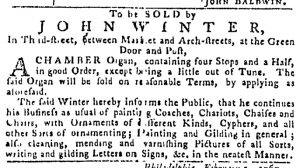
“To be SOLD by JOHN WINTER …”

Yesterday I questioned whether an advertisement for an escaped slave appeared regularly in the Georgia Gazette for six months because the aggrieved master wanted his human property returned so badly or because the printer needed content to fill the pages of the newspaper. Recently I have been contrasting the volume of advertising that appeared in newspapers published in major urban ports compared to those published in smaller cities and towns, usually noting how little advertising appeared in the latter.

Today I am featuring a newspaper at the other end of the spectrum. The Pennsylvania Gazette, founded in 1728 by Samuel Keimer but transformed into one of the most important and influential newspapers in the colonies after Benjamin Franklin in the decades after purchased it in 1729, often served as a vehicle for delivering advertising, sometimes at the expense of other content (including news items),

feb-12-supplement-pennsylvania-gazette
First page of Supplement to the Pennsylvania Gazette (February 12, 1767).

Consider the issue published 250 years ago today. David Hall and William Sellers, the printers of the Pennsylvania Gazette in 1767, placed at least some advertising on every page of the newspaper. Advertisements accounted for a quarter of a column on the second page and column and a half on the front page. Except for the colophon at the bottom of the last page, only advertisements appeared on the third and fourth pages. Nearly sixty advertisements of varying lengths filled just shy of eight columns, out of twelve total, in the February 12, 1767, issue of the Pennsylvania Gazette.

But wait: there’s more! A half sheet supplement accompanied the issue. Hall and Sellers granted a little space for the masthead. Otherwise, advertising filled all six columns of the two-page supplement. Many, but not all, were shorter than those in the regular issue, which allowed Hall and Sellers to squeeze in nearly sixty more paid notices. Unlike their counterparts in other cities, the printers of the Pennsylvania Gazette did not to insert advertisements about the goods and services they provided just to fill the page.

Historians of print culture in early America have long argued that any profits derived from printing a newspaper in the colonies derived from advertising revenue rather than subscriptions. By that measure, Hall and Sellers seemed to be doing very well for themselves as they published the Pennsylvania Gazette in 1767, presumably content to let advertisements sometimes crowd out other content. On the other hand, their decision to do so might also explain why William Goddard underscored that he intended “to give his readers a weekly relation of the most remarkable and important occurrences, foreign and domestic, collected from the best magazines and papers in Europe and America” when he issued his proposals for printing the Pennsylvania Chronicle, a competitor to the Pennsylvania Gazette. Perhaps Goddard suspected that some readers of the Gazette sometimes felt shortchanged when it came to reading actual news, rather than advertising, in their newspaper.

Slavery Advertisements Published February 12, 1767

The Slavery Adverts 250 Project chronicles the role of newspaper advertising in perpetuating slavery in the era of the American Revolution. The project seeks to reveal the ubiquity of slavery in eighteenth-century life from New England to Georgia by republishing advertisements about enslaved people – for sale as individuals or in groups, wanted to purchase or for hire for short periods, runaways who liberated themselves, and those who were subsequently captured and confined in jails and workhouses – in daily digests on this site as well as in real time via the @SlaveAdverts250 Twitter feed, utilizing twenty-first-century media to stand in for the print media of the eighteenth century.

The project aims to provide modern audiences with a sense of just how often colonizers encountered these advertisements in their daily lives. Enslaved men, women, and children appeared in print somewhere in the colonies almost every single day. Those advertisements served as a constant backdrop for social, cultural, economic, and political life in colonial and revolutionary America. Colonizers who did not purport to own enslaved people were still confronted with slavery as well as invited to maintain the system by purchasing enslaved men, women, and children or assisting in the capture of so-called “runaways” who sought to free themselves from bondage. The frequency of these newspaper advertisements suggests just how embedded slavery was in colonial and revolutionary American culture in everyday interactions beyond the printed page.

These advertisements also testify to the experiences of enslaved men, women, and children, though readers must consider that those experiences have been remediated through descriptions offered by enslavers rather than enslaved people themselves. Often unnamed in the advertisements, enslaved men, women, and children were not invisible or unimportant in early America.

These advertisements appeared in colonial American newspapers 250 years ago today.

feb-12-massachusetts-gazette-slavery-1
Massachusetts Gazette (February 12, 1767).

**********

feb-12-new-york-gazette-weekly-post-boy-slavery-1
New-York Gazette: Or, the Weekly Post-Boy (February 12, 1767).

**********

feb-12-new-york-gazette-weekly-post-boy-slavery-2
New-York Gazette: Or, the Weekly Post-Boy (February 12, 1767).

**********

feb-12-new-york-gazette-weekly-post-boy-slavery-3
New-York Gazette: Or, the Weekly Post-Boy (February 12, 1767).

**********

feb-12-new-york-journal-slavery-1
New-York Journal (February 12, 1767).

**********

feb-12-new-york-journal-slavery-2
New-York Journal (February 12, 1767).

**********

feb-12-new-york-journal-slavery-3
New-York Journal (February 12, 1767).

**********

feb-12-new-york-journal-supplement-slavery-1
Supplement Extraordinary to the New-York Journal (February 12, 1767).

**********

feb-12-pennsylvania-gazette-slavery-1
Pennsylvania Gazette (February 12, 1767).

**********

feb-12-pennsylvania-gazette-supplement-slavery-1
Supplement to the Pennsylvania Gazette (February 12, 1767).

**********

feb-12-pennsylvania-gazette-supplement-slavery-2
Supplement to the Pennsylvania Gazette (February 12, 1767).

**********

feb-12-pennsylvania-gazette-supplement-slavery-3
Supplement to the Pennsylvania Gazette (February 12, 1767).

**********

feb-12-pennsylvania-gazette-supplement-slavery-4
Supplement to the Pennsylvania Gazette (February 12, 1767).

**********

feb-12-virginia-gazette-slavery-1
Virginia Gazette (February 12, 1767).

**********

feb-12-virginia-gazette-slavery-2
Virginia Gazette (February 12, 1767).

**********

feb-12-virginia-gazette-slavery-3
Virginia Gazette (February 12, 1767).

**********

feb-12-virginia-gazette-slavery-4
Virginia Gazette (February 12, 1767).

**********

feb-12-virginia-gazette-slavery-5
Virginia Gazette (February 12, 1767).

February 11

Who was the subject of an advertisement in a colonial American newspaper 250 years ago today?

feb-11-georgia-gazette-slavery-2
Georgia Gazette (February 11, 1767).

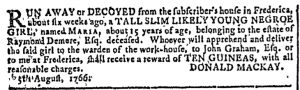
“RUN AWAY … NEGROE GIRL, named MARIA, about 15 years of age.”

This advertisement about a “TALL SLIM LIKELY YOUNG NEGROE GIRL, named MARIA” who ran away from her master would have been very familiar to readers of the Georgia Gazette. Dated August 5, 1766, it first appeared in the August 6, 1766, issue. It then appeared in almost every issue published for the next six months; the February 11, 1767, issue marked half a year that Donald Mackay inserted this runaway notice in the newspaper published in Savannah.

The longevity of this advertisement may be interpreted in more than one way. It might testify to the value that Mackay placed on Maria or how intensely he chafed for her return. As I noted when I first examined this advertisement last August, the physical description of Maria suggested that Mackay valued the “TALL SLIM LIKELY YOUNG NEGRO GIRL” for more than just her capacity to labor in the household or the fields. The expenses incurred by placing an advertisement for her return almost every week for six months (plus an award and reimbursement for “al reasonable charges” associated with Maria’s capture and transport) indicated that Mackay was willing to make a significant investment in reclaiming his human property. Maria’s potential resale value possibly more than justified such expenses.

That line of reasoning, however, assumes that Mackay instructed James Johnston, printer of the Georgia Gazette, to insert this advertisement each week and that he agreed to pay for each appearance. Like other newspapers published in smaller cities, such as the Providence Gazette, the [Portsmouth] New-Hampshire Gazette, and the [Hartford] Connecticut Courant, the Georgia Gazette featured significantly fewer advertisements than newspapers in the major urban ports. That the advertisement for the runaway Maria consistently appeared for six months may have been a function of the printer seeking to fill the pages with any sort of content, especially considering how many other advertisements in the Georgia Gazette ran for extended periods, often much longer than similar notices in newspapers published elsewhere.

Perhaps the real story combines elements of these two possibilities. Maybe Donald Mackay was so eager to have Maria returned and James Johnston was so eager to fill the columns in his newspaper that they worked out a payment schedule that included discounted rates. Whatever the circumstances, the frequency that this and other advertisements appeared in the Georgia Gazette raises suspicions that not all notices were indeed paid notices.

Summary of Slavery Advertisements Published February 5-11, 1767

These tables indicate how many advertisements for slaves appeared in colonial American newspapers during the week of February 5-11, 1767.

Note:  These tables are as comprehensive as currently digitized sources permit, but they may not be an exhaustive account.  They includes all newspapers that have been digitized and made available via Accessible Archives, Colonial Williamsburg’s Digital Library, and Readex’s America’s Historical Newspapers.  There are several reasons some newspapers may not have been consulted:

  • Issues that are no longer extant;
  • Issues that are extant but have not yet been digitized (including the Pennsylvania Journal); and
  • Newspapers published in a language other than English (including the Wochentliche Philadelphische Staatsbote).

**********

Slavery Advertisements Published February 5-11, 1767:  By Date

slavery-adverts-tables-1767-by-date-feb-5

**********

Slavery Advertisements Published February 5-11:  By Region

slavery-adverts-tables-1767-by-region-feb-5

Slavery Advertisements Published February 11, 1767

The Slavery Adverts 250 Project chronicles the role of newspaper advertising in perpetuating slavery in the era of the American Revolution. The project seeks to reveal the ubiquity of slavery in eighteenth-century life from New England to Georgia by republishing advertisements about enslaved people – for sale as individuals or in groups, wanted to purchase or for hire for short periods, runaways who liberated themselves, and those who were subsequently captured and confined in jails and workhouses – in daily digests on this site as well as in real time via the @SlaveAdverts250 Twitter feed, utilizing twenty-first-century media to stand in for the print media of the eighteenth century.

The project aims to provide modern audiences with a sense of just how often colonizers encountered these advertisements in their daily lives. Enslaved men, women, and children appeared in print somewhere in the colonies almost every single day. Those advertisements served as a constant backdrop for social, cultural, economic, and political life in colonial and revolutionary America. Colonizers who did not purport to own enslaved people were still confronted with slavery as well as invited to maintain the system by purchasing enslaved men, women, and children or assisting in the capture of so-called “runaways” who sought to free themselves from bondage. The frequency of these newspaper advertisements suggests just how embedded slavery was in colonial and revolutionary American culture in everyday interactions beyond the printed page.

These advertisements also testify to the experiences of enslaved men, women, and children, though readers must consider that those experiences have been remediated through descriptions offered by enslavers rather than enslaved people themselves. Often unnamed in the advertisements, enslaved men, women, and children were not invisible or unimportant in early America.

These advertisements appeared in colonial American newspapers 250 years ago today.

feb-11-georgia-gazette-slavery-1
Georgia Gazette (February 11, 1767).

**********

feb-11-georgia-gazette-slavery-8
Georgia Gazette (February 11, 1767).

**********

feb-11-georgia-gazette-slavery-2
Georgia Gazette (February 11, 1767).

**********

feb-11-georgia-gazette-slavery-3
Georgia Gazette (February 11, 1767).

**********

feb-11-georgia-gazette-slavery-4
Georgia Gazette (February 11, 1767).

**********

feb-11-georgia-gazette-slavery-5
Georgia Gazette (February 11, 1767).

**********

feb-11-georgia-gazette-slavery-6
Georgia Gazette (February 11, 1767).

**********

feb-11-georgia-gazette-slavery-7
Georgia Gazette (February 11, 1767).

February 10

What was advertised in a colonial America newspaper 250 years ago today?

feb-10-2101767-south-carolina-gazette-and-country-journal
South-Carolina Gazette and Country Journal (February 10, 1767).

“A few light green silk umbrelloes.”

In marketing his wares to potential customers, John Davies made many of the standard appeals that appeared in eighteenth-century newspaper advertising. He specified that his goods had been “Imported … from London” (and even named the vessel that carried them so readers could confirm how recently they had arrived). He offered customers choices, including “a great variety of printed cottons and linens” and “a large assortment of men and women’s neat made shoes and pumps.” He listed some of his goods to whet consumers’ appetites, but also allowed them to use their imaginations about what might be included among the “many other articles” in his shop. He gave assurances about the quality of his merchandise at the beginning and end of his advertisement. He also promised low prices, even mentioning specific prices for particular items as a means of guaranteeing those rates and allowing potential customers to assess the value themselves even before visiting his shop. When he stated that he sold his wares “proportionably cheap,” he likely offered discounts for buying in bulk, especially considering that he stressed that he stocked “a quantity” of several items, including printed linens and handkerchiefs. At a glance, Davies’ advertisement looks like a block of dense text, but on further examination readers discovered that it contained many of the most modern marketing strategies of its time.

In addition, Davies resorted to another sort of appeal not used quite as often in eighteenth-century advertising: an appeal to scarcity. He carried “a quantity” or “a large assortment” of several items, but only “a few light green silk umbrelloes.” This created a different sort of imperative for potential customers to visit his shop. Readers had many opportunities to purchase most of Davies’ wares, but his inventory included only a limited number of fashionable umbrellas. Anyone interested in such an item needed to buy it quickly or risk supplies being sold out. Without being heavy-handed in his approach, Davies created a sense of urgency when it came to obtaining one of the “few” green silk umbrellas he had imported from London.