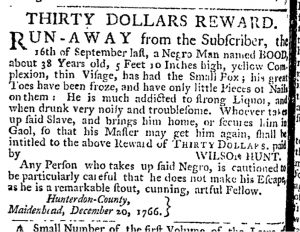
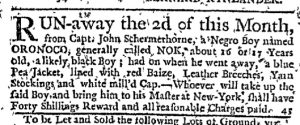
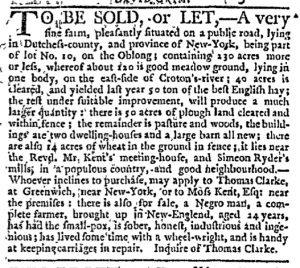
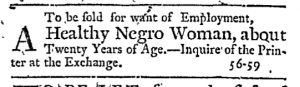
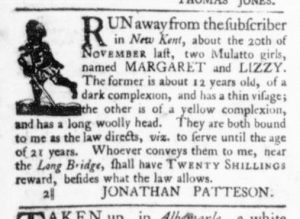
The Slavery Adverts 250 Project chronicles the role of newspaper advertising in perpetuating slavery in the era of the American Revolution. The project seeks to reveal the ubiquity of slavery in eighteenth-century life from New England to Georgia by republishing advertisements about enslaved people – for sale as individuals or in groups, wanted to purchase or for hire for short periods, runaways who liberated themselves, and those who were subsequently captured and confined in jails and workhouses – in daily digests on this site as well as in real time via the @SlaveAdverts250 Twitter feed, utilizing twenty-first-century media to stand in for the print media of the eighteenth century.
The project aims to provide modern audiences with a sense of just how often colonizers encountered these advertisements in their daily lives. Enslaved men, women, and children appeared in print somewhere in the colonies almost every single day. Those advertisements served as a constant backdrop for social, cultural, economic, and political life in colonial and revolutionary America. Colonizers who did not purport to own enslaved people were still confronted with slavery as well as invited to maintain the system by purchasing enslaved men, women, and children or assisting in the capture of so-called “runaways” who sought to free themselves from bondage. The frequency of these newspaper advertisements suggests just how embedded slavery was in colonial and revolutionary American culture in everyday interactions beyond the printed page.
These advertisements also testify to the experiences of enslaved men, women, and children, though readers must consider that those experiences have been remediated through descriptions offered by enslavers rather than enslaved people themselves. Often unnamed in the advertisements, enslaved men, women, and children were not invisible or unimportant in early America.
These advertisements appeared in colonial American newspapers 250 years ago today.
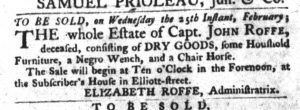
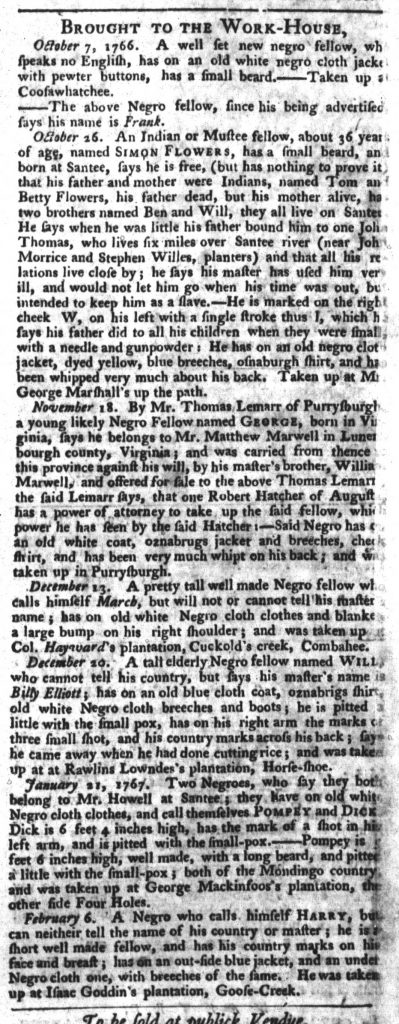
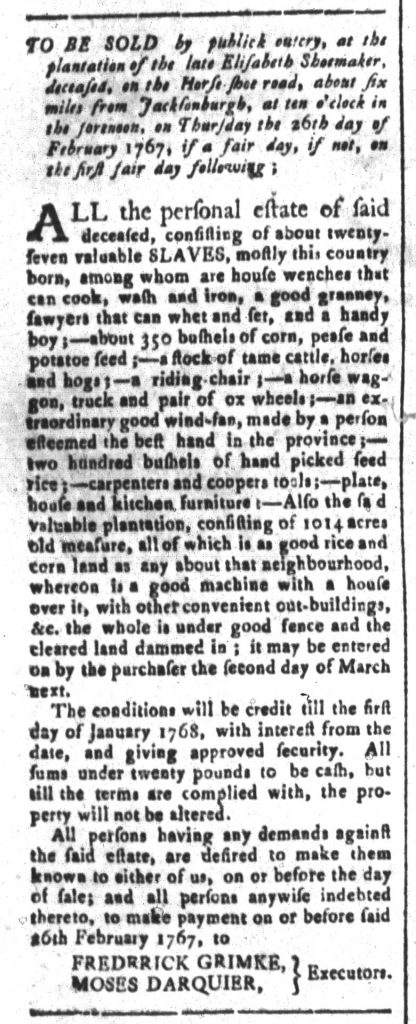
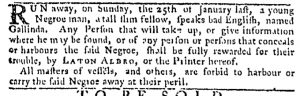
South-Carolina Gazette and Country Journal (February 10, 1767).
**********
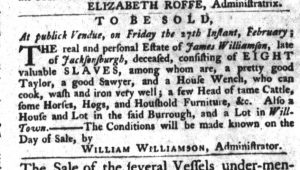
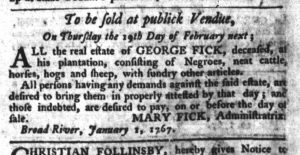
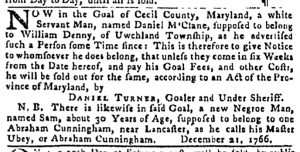
South-Carolina Gazette and Country Journal (February 10, 1767).
**********
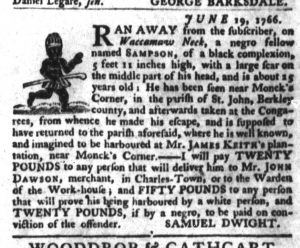
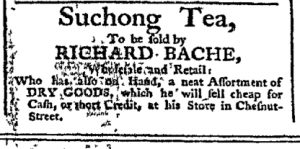
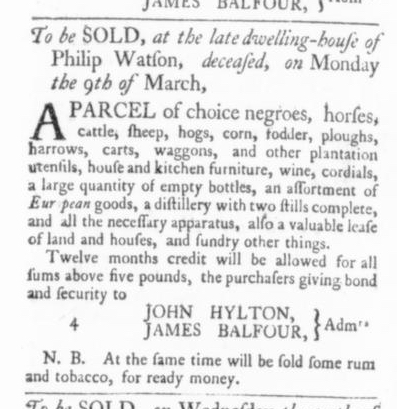
South-Carolina Gazette and Country Journal (February 10, 1767).
**********
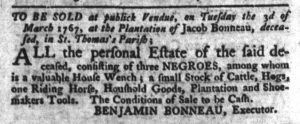
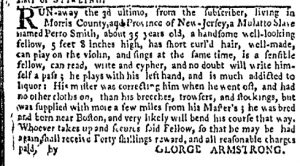
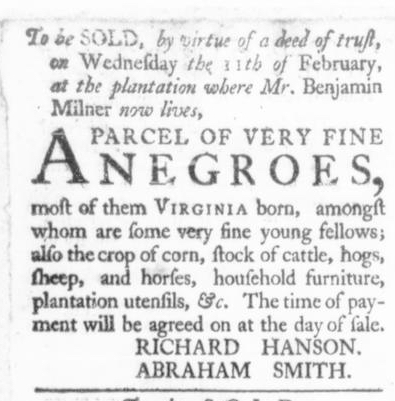
South-Carolina Gazette and Country Journal (February 10, 1767).
**********
South-Carolina Gazette and CountryJournal (February 10, 1767).
**********
South-Carolina Gazette and Country Journal (February 10, 1767).
**********
South-Carolina Gazette and Country Journal (February 10, 1767).
**********
South-Carolina Gazette and Country Journal (February 10, 1767).
**********
South-Carolina Gazette and Country Journal (February 10, 1767).
**********
South-Carolina Gazette and Country Journal (February 10, 1767).
**********
South-Carolina Gazette and Country Journal (February 10, 1767).
**********
South-Carolina Gazette and Country Journal (February 10, 1767).
**********
South-Carolina Gazette and Country Journal (February 10, 1767).
**********
South-Carolina Gazette and Country Journal (February 10, 1767).
**********
South-Carolina Gazette and Country Journal (February 10, 1767).
Goddard’s proposal included a call for advertisers to submit notices they wished to appear in the Pennsylvania Chronicle. In addition, the colophon advised readers that Goddard “gratefully received” all sorts of submissions for his newspaper, including advertisements, articles, and letters of intelligence. He achieved early successes attracting advertisers, devoting nearly half (seven of sixteen columns) of the third issue to thirty-five paid notices of varying lengths. Most promoted consumer goods and services, but some offered real estate for sale or called on debtors to settle accounts. One even offered a reward upon the return of “a young DOG of the Spaniel Breed” that had strayed from its master.
Compared to newspapers published in some smaller towns, the new Pennsylvania Chronicle overflowed with advertising, especially advertisements for consumer goods and services. The third issue even included advertisements from two entrepreneurs who branded their businesses with woodcuts that presumably replicated the shop signs that marked their locations: saddler John Young, Jr., “At the sign of the ENGLISH HUNTING SADDLE” and druggist Nathaniel Tweedy “At the GOLDEN-EAGLE.”
Detail of Nathaniel Tweedy’s advertisement in the Pennsylvania Chronicle (February 9, 1767).
This stands in stark contrast to other newspapers, such as the Providence Gazette that seemed to struggle to attract advertisers in late 1766 and early 1767. Goddard appears to have experienced no difficulty generating advertising from entrepreneurs in the busy urban port of Philadelphia. The third issue of the Pennsylvania Chronicle offered dozens of advertisements to its readers. A quarter of a millennium later, I am simultaneously excited by the range of advertisements that could potentially be incorporated into the Adverts 250 Project and disappointed to choose only one at a time.
I am also frustrated to skip over so many interesting and significant advertisements, though I continue to affirm the methodology that requires doing so. Part of this disappointment stems from the dearth of advertisements available at other times during the week. For instance, since the Providence Gazette was the only newspaper published on Saturdays in 1767 and no newspapers were published on Sundays, each week the Adverts 250 Project gives disproportionate attention to advertisements from the Providence Gazette in the process of featuring advertisements published exactly 250 years ago that day or as close to that day as possible. As a result, the Providence Gazette is overrepresented and other newspapers with much more advertising remain underrepresented. On the other hand, this means that marketing efforts in at least one smaller city are subject to examination alongside the copious newspaper advertisements published in Boston, Charleston, New York, and Philadelphia.
Again, I stand by the project’s methodology, but recognize that both researchers and readers must take into account both its strengths and limitations.
**********
(*) Although this project relies primarily on digitized primary sources, I also examined original copies of the first two issues of the Pennsylvania Chronicle. From the very first issue William Goddard managed to attract advertisers. A total of twenty-two advertisements spread over five (out of sixteen) columns appeared in the first issue (January 26, 1767), including an advertisement by Nathaniel Tweedy (without the woodcut). The second issue (February 2, 1767) included thirty-three advertisements amounting to nearly seven columns, including advertisements by John Young, Jr., and Nathaniel Tweedy (both with woodcuts).
The Slavery Adverts 250 Project chronicles the role of newspaper advertising in perpetuating slavery in the era of the American Revolution. The project seeks to reveal the ubiquity of slavery in eighteenth-century life from New England to Georgia by republishing advertisements about enslaved people – for sale as individuals or in groups, wanted to purchase or for hire for short periods, runaways who liberated themselves, and those who were subsequently captured and confined in jails and workhouses – in daily digests on this site as well as in real time via the @SlaveAdverts250 Twitter feed, utilizing twenty-first-century media to stand in for the print media of the eighteenth century.
The project aims to provide modern audiences with a sense of just how often colonizers encountered these advertisements in their daily lives. Enslaved men, women, and children appeared in print somewhere in the colonies almost every single day. Those advertisements served as a constant backdrop for social, cultural, economic, and political life in colonial and revolutionary America. Colonizers who did not purport to own enslaved people were still confronted with slavery as well as invited to maintain the system by purchasing enslaved men, women, and children or assisting in the capture of so-called “runaways” who sought to free themselves from bondage. The frequency of these newspaper advertisements suggests just how embedded slavery was in colonial and revolutionary American culture in everyday interactions beyond the printed page.
These advertisements also testify to the experiences of enslaved men, women, and children, though readers must consider that those experiences have been remediated through descriptions offered by enslavers rather than enslaved people themselves. Often unnamed in the advertisements, enslaved men, women, and children were not invisible or unimportant in early America.
These advertisements appeared in colonial American newspapers 250 years ago today.
Boston-Gazette (February 9, 1767).
**********
Boston-Gazette (February 9, 1767).
**********
Connecticut Courant (February 9, 1767).
**********
New-York Gazette (February 9, 1767).
**********
New-York Mercury (February 9, 1767).
**********
New-York Mercury (February 9, 1767).
**********
New-York Mercury (February 9, 1767).
**********
New-York Mercury (February 9, 1767).
**********
New-York Mercury (February 9, 1767).
**********
New-York Mercury (February 9, 1767).
**********
New-York Mercury (February 9, 1767).
**********
Newport Mercury (February 9, 1767).
**********
Newport Mercury (February 9, 1767).
**********
Newport Mercury (February 9, 1767).
**********
Newport Mercury (February 9, 1767).
**********
Newport Mercury (February 9, 1767).
**********
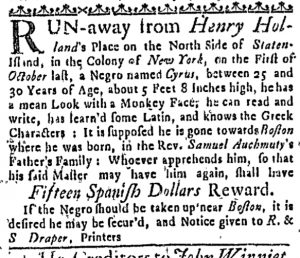
Pennsylvania Chronicle (February 9, 1767).
**********
South Carolina Gazette (February 9, 1767).
**********
South Carolina Gazette (February 9, 1767).
**********
South Carolina Gazette (January 9, 1767).
**********
South Carolina Gazette (February 9, 1767).
**********
South Carolina Gazette (February 9, 1767).
**********
South Carolina Gazette (February 9, 1767).
**********
Supplement to the South Carolina Gazette (February 9, 1767).
**********
Supplement to the South Carolina Gazette (February 9, 1767).
**********
Supplement to the South Carolina Gazette (February 9, 1767).
**********
Supplement to the South Carolina Gazette (February 9, 1767).
What was advertised in a colonial American newspaper 250 years ago this week?
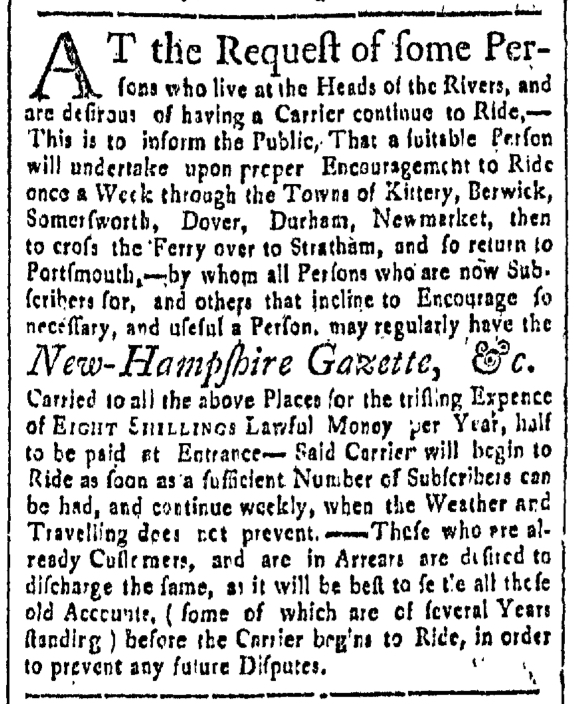
New-Hampshire Gazette (February 8, 1767).
“Said Carrier will begin to Ride as soon as sufficient Number of Subscribers can be had.”
Like other colonial printers, Daniel and Robert Fowle inserted advertisements for their own business endeavors in the newspaper they published (though they did not use the colophon as a standing advertisement for the various services provided at their printing office in Portsmouth). The Fowles were responsible for four of the advertisements that appeared in the February 6, 1767, issue of the New-Hampshire Gazette.
Three of those advertisements were fairly short: four lines each. Two of them peddled leftover almanacs for 1767 and the third informed readers that the Fowles supplemented the revenues from newspaper subscriptions and advertisements by selling “BLANKS of all sorts – and a variety of Books, Pamphlets, &c.”
The fourth advertisement took up considerably more space on the page. It advertised the newspaper itself, the title appearing in a larger font and on a line by itself in the middle of the notice. The Fowles outlined a plan to have a rider continue to deliver newspapers to subscribers in towns and villages beyond Portsmouth. The proposed route included “the Towns of Kittery, Berwick, Somersworth, Dover, Durham, Newmarket, [and] Stratham.” The Fowles offered this as a service to subscribers, though they also indicated that demand already existed among “some Persons who live at the Heads of the Rivers” who were “desirous of having a Carrier continue to Ride.”
The printers placed this notice to gauge interest in this plan, stating that “Said Carrier will begin to Ride as soon as a sufficient Number of Subscribers can be had.” Yet interest was not sufficient to bring the plan to fruition: subscribers needed to demonstrate their commitment by paying half of the delivery in advance. The printers also requested that current subscribers “in Arrears” pay up “before the Carrier begins to Ride, in order to prevent any future Disputes.”
This advertisement made clear that the rider would provide a continuation of an existing service, delivery to the local town (if not directly to each subscriber’s home). In so doing, it demonstrated the geographic reach of colonial newspapers beyond the cities where they were printed and into the towns and villages in the hinterland. Certainly some copies were disseminated even further afield, but the success (or even the continuation) of newspapers depended on cultivating local and regional customers and readers.
What was advertised in a colonial American newspaper 250 years ago today?
Providence Gazette (February 7, 1767).
“A Few Firkins of good Butter.”
Black and Smith placed this advertisement in order to obtain consumer goods rather than to market their own wares to potential customers. They did not specify what they intended to do with “A Few Firkins of good Butter” and “a small Quantity of Lump” butter. Instead they invited anyone who could supply these commodities to “enquire … at their Shop.” Black and Smith did not seek to entice potential customers to visit their shop by listing the variety of goods they stocked or guaranteeing low prices or making appeals concerning quality or fashion. Perhaps they felt that they already did brisk business and did not need to invest in marketing.
In their call for “good Butter,” the partners used a unit of measurement largely unfamiliar to modern Americans, though craft beer enthusiasts may recognize the firkin as a cask that contains one quarter of a barrel. In the colonial era, however, a firkin might be used to measure beer by volume or it might be used to measure butter and cheese by weight. For the latter, a firkin was equivalent to fifty-six pounds.
The term firkin testifies to the networks of trade that linked European nation-states to each other as well as locations throughout the Atlantic world. According to Russ Rowlett, “The unit is of Dutch origin, and its name is based on the Dutch word vier for four.” That makes sense and seems quite appropriate considering that a firkin was equivalent to four stone when measuring butter or cheese by weight or one quarter of a barrel when measuring beer and other liquids by volume.
Units of measurement used in colonial America may seem quaint and confusing when encountered by modern readers, but colonists recognized them just as easily as (and, in some cases, more easily than) modern consumers distinguish among short, tall, grande, and venti beverages at a popular coffee retailer.
The Slavery Adverts 250 Project chronicles the role of newspaper advertising in perpetuating slavery in the era of the American Revolution. The project seeks to reveal the ubiquity of slavery in eighteenth-century life from New England to Georgia by republishing advertisements about enslaved people – for sale as individuals or in groups, wanted to purchase or for hire for short periods, runaways who liberated themselves, and those who were subsequently captured and confined in jails and workhouses – in daily digests on this site as well as in real time via the @SlaveAdverts250 Twitter feed, utilizing twenty-first-century media to stand in for the print media of the eighteenth century.
The project aims to provide modern audiences with a sense of just how often colonizers encountered these advertisements in their daily lives. Enslaved men, women, and children appeared in print somewhere in the colonies almost every single day. Those advertisements served as a constant backdrop for social, cultural, economic, and political life in colonial and revolutionary America. Colonizers who did not purport to own enslaved people were still confronted with slavery as well as invited to maintain the system by purchasing enslaved men, women, and children or assisting in the capture of so-called “runaways” who sought to free themselves from bondage. The frequency of these newspaper advertisements suggests just how embedded slavery was in colonial and revolutionary American culture in everyday interactions beyond the printed page.
These advertisements also testify to the experiences of enslaved men, women, and children, though readers must consider that those experiences have been remediated through descriptions offered by enslavers rather than enslaved people themselves. Often unnamed in the advertisements, enslaved men, women, and children were not invisible or unimportant in early America.
These advertisements appeared in colonial American newspapers 250 years ago today.
What was advertised in a colonial America newspaper 250 years ago today?
South-Carolina and American General Gazette (February 6, 1767).
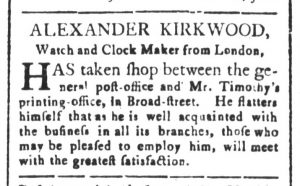
“ALEXANDER KIRKWOOD, Watch and Clock Maker from London, HAS taken shop.”
A print of An Exact Prospect of CHARLESTOWN, the Metropolis of the Province of SOUTH CAROLINA, “Engrav’d for the London Magazine” in the early 1760s, depicted a bustling colonial port city. It provided a view of the waterfront, including the wharves where vessels took on cargoes of rice, indigo, and other local products after unloading commodities imported from Europe and the West Indies, slaves arriving directly from Africa or transshipped through other ports in the New World, and migrants from Europe looking for new opportunities.
An Exact Prospect of Charlestown, the Metropolis of the Province of South Carolina (ca. 1762). Courtesy Library of Congress.
Alexander Kirkwood, a “Watch and Clock Maker from London,” made the journey across the Atlantic at some point, though his advertisement in the South-Carolina and American General Gazette did not indicate how recently he had arrived in the colony. Whenever he made the voyage, he likely chose to settle in Charleston because it was indeed “the Metropolis” of South Carolina (though readers of the London Magazine may have chuckled a bit over that characterization when they viewed the print), the largest settlement in Britain’s North American colonies south of Philadelphia. The “Watch and Clock Maker from London” needed a sufficient customer base to succeed, making a prosperous settlement the size of Charleston an attractive place to set up shop.
Most likely Kirkwood was a relatively new arrival when he placed this advertisement, given that he stated that he “has taken shop” rather than “removed” from one shop to another. Like shopkeeper David Conkie in Boston, who placed his own advertisement earlier the same week, Kirkwood needed to make prospective customers aware of his business. To that end, he placed notices in both the South-Carolina and American General Gazette and the South Carolina Gazette, published by his neighbor, “Mr. Timothy’s printing-office, in Broad-street.” Residents may not have been familiar with Kirkwood’s shop just yet, but they certainly knew where to find the businesses on either side of him, Timothy’s printing office and the “general post-office.” Not only did his advertisements serve to garner attention, Kirkwood’s location certainly yielded a fair amount of visibility for his shop.
The Slavery Adverts 250 Project chronicles the role of newspaper advertising in perpetuating slavery in the era of the American Revolution. The project seeks to reveal the ubiquity of slavery in eighteenth-century life from New England to Georgia by republishing advertisements about enslaved people – for sale as individuals or in groups, wanted to purchase or for hire for short periods, runaways who liberated themselves, and those who were subsequently captured and confined in jails and workhouses – in daily digests on this site as well as in real time via the @SlaveAdverts250 Twitter feed, utilizing twenty-first-century media to stand in for the print media of the eighteenth century.
The project aims to provide modern audiences with a sense of just how often colonizers encountered these advertisements in their daily lives. Enslaved men, women, and children appeared in print somewhere in the colonies almost every single day. Those advertisements served as a constant backdrop for social, cultural, economic, and political life in colonial and revolutionary America. Colonizers who did not purport to own enslaved people were still confronted with slavery as well as invited to maintain the system by purchasing enslaved men, women, and children or assisting in the capture of so-called “runaways” who sought to free themselves from bondage. The frequency of these newspaper advertisements suggests just how embedded slavery was in colonial and revolutionary American culture in everyday interactions beyond the printed page.
These advertisements also testify to the experiences of enslaved men, women, and children, though readers must consider that those experiences have been remediated through descriptions offered by enslavers rather than enslaved people themselves. Often unnamed in the advertisements, enslaved men, women, and children were not invisible or unimportant in early America.
These advertisements appeared in colonial American newspapers 250 years ago today.
South-Carolina and American General Gazette (February 6, 1767).
**********
South-Carolina and American General Gazette (February 6, 1767).
**********
South-Carolina and American General Gazette (February 6, 1767).
**********
South-Carolina and American General Gazette (February 6, 1767).
**********
South-Carolina and American General Gazette (February 6, 1767).
**********
South-Carolina and American General Gazette (February 6, 1767).
What was advertised in a colonial American newspaper 250 years ago today?
Pennsylvania Gazette (February 5, 1767).
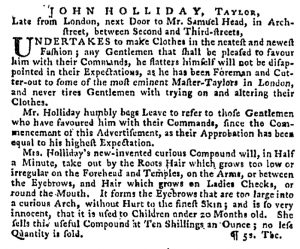
“Mrs. Holliday’s new-invented curious Compound.”
Women actively participated in the colonial marketplace as retailers of imported goods and sellers of other wares, especially in the major port cities. Historians have estimated, for instance, that as many as four out of ten shopkeepers in Philadelphia were women. Yet an overview of advertising from the period does not testify to the extensive presence of women as sellers, producers, and suppliers (as opposed to merely taking on the role of consumers) in the eighteenth century. Although some female entrepreneurs did advertise in newspapers, they were disproportionately underrepresented in that medium. Women were even less likely to distribute other forms of advertising – trade cards, billheads, broadsides, notices on magazine wrappers – in the eighteenth century, despite some notable exceptions.
Some female entrepreneurs resorted to roundabout means of promoting their business endeavors in the public prints. John Holliday’s wife, identified only as “Mrs. Holliday,” appended an announcement about her “new-invented curious Compound” to her husband’s advertisement for his tailoring shop. Throughout the eighteenth century, some women took that means of injecting their own marketing messages into a public discourse of commerce dominated by men. In addition to husbands and wives, sometimes fathers and daughters or brothers and sisters or widows and close family friends or business associates issued joint advertisements that first detailed the goods and services offered by a man and then turned to another enterprise conducted by a woman. Only on exceptionally rare occasions did shared newspapers advertisements first promote a woman’s business endeavors before turning to her male counterpart.
Certainly some of the decision to place joint advertisements resulted from minimizing expenses devoted to marketing. The pattern of privileging husbands and other male relations or associates over women, however, suggests that some female entrepreneurs felt a bit of apprehension about too boldly making their business activities visible to the general public, even as they needed to attract customers from among that public. Appending their own advertisements to those placed by men who presumably oversaw their dealings to some extent or another had the effect of providing implicit masculine endorsement as well as suggesting that female entrepreneurs operated under appropriate male supervision.
The Slavery Adverts 250 Project chronicles the role of newspaper advertising in perpetuating slavery in the era of the American Revolution. The project seeks to reveal the ubiquity of slavery in eighteenth-century life from New England to Georgia by republishing advertisements about enslaved people – for sale as individuals or in groups, wanted to purchase or for hire for short periods, runaways who liberated themselves, and those who were subsequently captured and confined in jails and workhouses – in daily digests on this site as well as in real time via the @SlaveAdverts250 Twitter feed, utilizing twenty-first-century media to stand in for the print media of the eighteenth century.
The project aims to provide modern audiences with a sense of just how often colonizers encountered these advertisements in their daily lives. Enslaved men, women, and children appeared in print somewhere in the colonies almost every single day. Those advertisements served as a constant backdrop for social, cultural, economic, and political life in colonial and revolutionary America. Colonizers who did not purport to own enslaved people were still confronted with slavery as well as invited to maintain the system by purchasing enslaved men, women, and children or assisting in the capture of so-called “runaways” who sought to free themselves from bondage. The frequency of these newspaper advertisements suggests just how embedded slavery was in colonial and revolutionary American culture in everyday interactions beyond the printed page.
These advertisements also testify to the experiences of enslaved men, women, and children, though readers must consider that those experiences have been remediated through descriptions offered by enslavers rather than enslaved people themselves. Often unnamed in the advertisements, enslaved men, women, and children were not invisible or unimportant in early America.
These advertisements appeared in colonial American newspapers 250 years ago today.
Massachusetts Gazette (February 5, 1767).
**********
New-York Gazette: Or, the Weekly Post-Boy (February 5, 1767).
**********
New-York Gazette: Or, the Weekly Post-Boy (February 5, 1767).
**********
New-York Journal (February 5, 1767).
**********
New-York Journal (February 5, 1767).
**********
New-York Journal (February 5, 1767).
**********
New-York Journal (February 5, 1767).
**********
New-York Journal (February 5, 1767).
**********
New-York Journal (February 5, 1767).
**********
Pennsylvania Gazette (February 5, 1767).
**********
Pennsylvania Gazette (February 5, 1767).
**********
Pennsylvania Gazette (February 5, 1767).
**********
Supplement to the Pennsylvania Gazette (February 5, 1767).
**********
Supplement to the Pennsylvania Gazette (February 5, 1767).
**********
Supplement to the Pennsylvania Gazette (February 5, 1767).
**********
Supplement to the Pennsylvania Gazette (February 5, 1767).