The Slavery Adverts 250 Project chronicles the role of newspaper advertising in perpetuating slavery in the era of the American Revolution. The project seeks to reveal the ubiquity of slavery in eighteenth-century life from New England to Georgia by republishing advertisements about enslaved people – for sale as individuals or in groups, wanted to purchase or for hire for short periods, runaways who liberated themselves, and those who were subsequently captured and confined in jails and workhouses – in daily digests on this site as well as in real time via the @SlaveAdverts250 Twitter feed, utilizing twenty-first-century media to stand in for the print media of the eighteenth century.
The project aims to provide modern audiences with a sense of just how often colonizers encountered these advertisements in their daily lives. Enslaved men, women, and children appeared in print somewhere in the colonies almost every single day. Those advertisements served as a constant backdrop for social, cultural, economic, and political life in colonial and revolutionary America. Colonizers who did not purport to own enslaved people were still confronted with slavery as well as invited to maintain the system by purchasing enslaved men, women, and children or assisting in the capture of so-called “runaways” who sought to free themselves from bondage. The frequency of these newspaper advertisements suggests just how embedded slavery was in colonial and revolutionary American culture in everyday interactions beyond the printed page.
These advertisements also testify to the experiences of enslaved men, women, and children, though readers must consider that those experiences have been remediated through descriptions offered by enslavers rather than enslaved people themselves. Often unnamed in the advertisements, enslaved men, women, and children were not invisible or unimportant in early America.
These advertisements appeared in colonial American newspapers 250 years ago today.
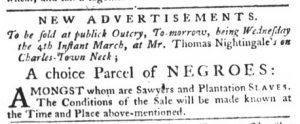
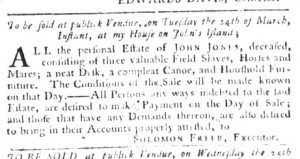
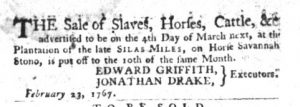
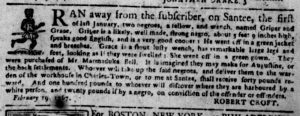
South-Carolina Gazette and Country Journal (March 3, 1767).
**********
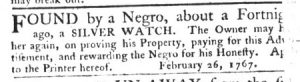
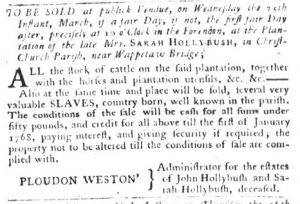
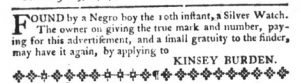
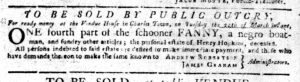
South-Carolina Gazette and Country Journal (March 3, 1767).
**********
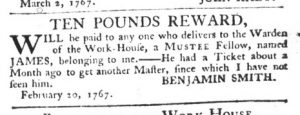
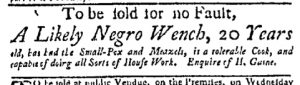
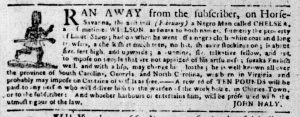
South-Carolina Gazette and Country Journal (March 3, 1767).
**********
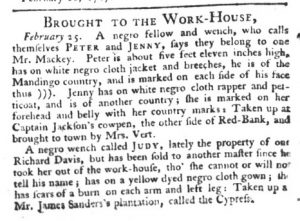
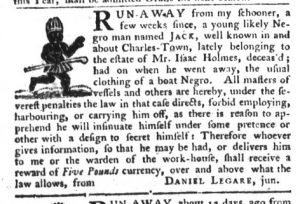
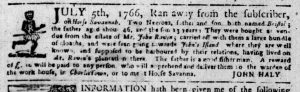
South-Carolina Gazette and Country Journal (March 3, 1767).
**********
South-Carolina Gazette and Country Journal (March 3, 1767).
**********
South-Carolina Gazette and Country Journal (March 3, 1767).
**********
South-Carolina Gazette and Country Journal (March 3, 1767).
**********
South-Carolina Gazette and Country Journal (March 3, 1767).
**********
South-Carolina Gazette and Country Journal (March 3, 1767).
**********
South-Carolina Gazette and Country Journal (March 3, 1767).
**********
South-Carolina Gazette and Country Journal (March 3, 1767).
**********
South-Carolina Gazette and Country Journal (March 3, 1767).
**********
South-Carolina Gazette and Country Journal (March 3, 1767).
**********
South-Carolina Gazette and Country Journal (March 3, 1767).
**********
South-Carolina Gazette and Country Journal (March 3, 1767).
**********
South-Carolina Gazette and Country Journal (March 3, 1767).
What was advertised in a colonial American newspaper 250 years ago today?
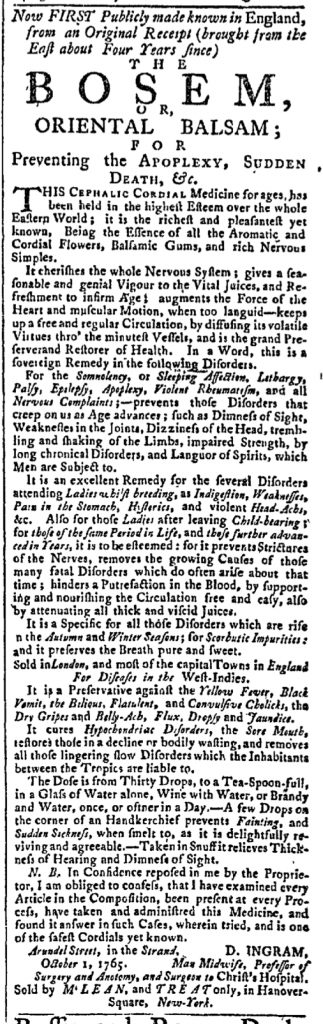
New-York Gazette (March 2, 1767).
“THE BOSEM, OR, ORIENTAL BALSAM; FOR Preventing the APOPLEXY, SUDDEN DEATH, &c.”
Today’s advertisement offered “BOSEM, OR, ORIENTAL BALSAM,” described as a “CEPHALIC CORDIAL Medicine” that imbued the user with strength and energy for the heart, body, and spirit as well as cured certain diseases. This product supposedly revitalized the nervous system and dealt with ailments gained from old age like poor sight, dizziness, weak joints, shaking limbs, and loss of strength. The medicine was used for to treat fainting, strokes, epilepsy, and other diseases affecting the brain. D. Ingram also claimed that it helped reduce dangers both prior to pregnancy and those that arose after giving birth. The Bosem was also useful for dealing with tropical diseases picked up in the West Indies.
This sort of product was commonly referred to as patent medicine, a trend dating back to medieval Europe. A patent medicine was a product advertised by swindlers and apothecaries, whose “noisily hawking, or ‘quacking,’” gave rise to the term quack. Americans brought patent medicines over from Europe, and even developed their own home grown varieties, although there was preference for European products. Patent medicine had strong ties to newspaper advertisements, sometimes purchasing much of the advertising space, thus filling both the swindler and editor’s pockets.
Jim Cox states that the appearance of patent medicines actually held more credibility than the contents, with American producers reusing old bottles of European products and refilling them with either addictive or foul tasting substances before selling them off as the original product. The bosem advertised here originated in the ancient world as a perfume, although later apothecaries used it in medicines in the Far East before, if the advertisement is to believed, it spread throughout the British empire in the 1760s.
**********
ADDITIONAL COMMENTARY: Carl Robert Keyes
Providers of goods and services who resided in England rarely placed advertisements in American newspapers. Among the exceptions, purveyors of patent medicines most commonly hawked (or quacked about) their wares in colonial publications – or at least seemed to do so. Although all but the final two lines of this notice seem to have been composed by D. Ingram, “Man Midwife, Professor of Surgery and Anatomy, and Surgeon to Christ’s Hospital” in London, McLean and Treat most likely made the arrangements with the printer of the New-York Gazette to insert the advertisement. Note that the description of the medicine was dated October 1, 1765, more than a year before this appearance among advertisements in the New-York Gazette. Ingram likely distributed the same copy to newspapers in London as well as agents in the English provinces and American colonies whenever he made arrangements to enter new markets.
As Sam explains, patent medicines were particularly susceptible to counterfeiting. Producers and sellers of these nostrums worked out various means to assure potential customers who read their advertisements that they would indeed acquire authentic medicines. As this advertisement suggests, one method was making their concoctions available exclusively from select agents. In the case of Ingram’s Bosem, this notice informed residents of New York that it was “Sold by M‘LEAN, and TREAT only.” Similarly, Dr. Hill, who peddled a variety of medicines (each for different symptoms – none seemed to be the cure all Ingram purported the Bosem to be), placed a notice in the South-Carolina and American General Gazette announcing that he had “appointed Messrs. CARNE and WILSON my agents, for the sale of my medicines in CAROLINA.” Limiting the number of sanctioned sellers of particular patent medicines allowed producers to exert control over the distribution of their products, protecting their reputation from fraudulent imitators. It may have also allowed the designated agents to charge a premium thanks to their exclusive access to the product.
The Slavery Adverts 250 Project chronicles the role of newspaper advertising in perpetuating slavery in the era of the American Revolution. The project seeks to reveal the ubiquity of slavery in eighteenth-century life from New England to Georgia by republishing advertisements about enslaved people – for sale as individuals or in groups, wanted to purchase or for hire for short periods, runaways who liberated themselves, and those who were subsequently captured and confined in jails and workhouses – in daily digests on this site as well as in real time via the @SlaveAdverts250 Twitter feed, utilizing twenty-first-century media to stand in for the print media of the eighteenth century.
The project aims to provide modern audiences with a sense of just how often colonizers encountered these advertisements in their daily lives. Enslaved men, women, and children appeared in print somewhere in the colonies almost every single day. Those advertisements served as a constant backdrop for social, cultural, economic, and political life in colonial and revolutionary America. Colonizers who did not purport to own enslaved people were still confronted with slavery as well as invited to maintain the system by purchasing enslaved men, women, and children or assisting in the capture of so-called “runaways” who sought to free themselves from bondage. The frequency of these newspaper advertisements suggests just how embedded slavery was in colonial and revolutionary American culture in everyday interactions beyond the printed page.
These advertisements also testify to the experiences of enslaved men, women, and children, though readers must consider that those experiences have been remediated through descriptions offered by enslavers rather than enslaved people themselves. Often unnamed in the advertisements, enslaved men, women, and children were not invisible or unimportant in early America.
These advertisements appeared in colonial American newspapers 250 years ago today.
Boston Post-Boy (March 2, 1767).
**********
Boston-Gazette (March 2, 1767).
**********
Boston-Gazette (March 2, 1767).
**********
Boston-Gazette (March 2, 1767).
**********
Boston-Gazette (March 2, 1767).
**********
New-York Gazette (March 2, 1767).
**********
New-York Gazette (March 2, 1767).
**********
New-York Mercury (March 2, 1767).
**********
New-York Mercury (March 2, 1767).
**********
New-York Mercury (March 2, 1767).
**********
New-York Mercury (March 2, 1767).
**********
New-York Mercury (March 2, 1767).
**********
New-York Mercury (March 2, 1767).
**********
New-York Mercury (March 2, 1767).
**********
New-York Mercury (March 2, 1767).
**********
New-York Mercury (March 2, 1767).
**********
Newport Mercury (March 2, 1767).
**********
Newport Mercury (March 2, 1767).
**********
South Carolina Gazette (March 2, 1767).
**********
South Carolina Gazette (March 2, 1767).
**********
South Carolina Gazette (March 2, 1767).
**********
South Carolina Gazette (March 2, 1767).
**********
South Carolina Gazette (March 2, 1767).
**********
South Carolina Gazette (March 2, 1767).
**********
South Carolina Gazette (March 2, 1767).
**********
South Carolina Gazette (March 2, 1767).
**********
Supplement to the South-Carolina Gazette (March 2, 1767).
**********
Supplement to the South-Carolina Gazette (March 2, 1767).
**********
Supplement to the South-Carolina Gazette (March 2, 1767).
What was advertised in a colonial American newspaper 250 years ago this week?
Providence Gazette (February 28, 1767).
“A LARGE and general Assortment of English and India Goods.”
Today’s advertisement was more of an invitation for customers to peruse the goods being sold at “Benjamin & Edward Thurber’s Shops” as opposed to advertising the actual goods themselves. The advertisement offered a wide variety of imported goods from England, India, and the West Indies, all of which were being sold at low prices and could be purchased cheaply. Note that the advertisement offered goods from India which—while becoming a part of Colonial British rule—was on the other side of the world than the American colonies. Through further research I learned that the American colonists had a more significant economic relation to India than I had previously known.
Jonathan Eacott recently published a book about trade within the British Empire, specifically analyzing how India played a role in the economic development of both Britain and America. According to Thomas R. Metcalf’s review of the book, Eacott indicates that the British initially sought to use India to supply the American colonies with goods, such as spices and textiles, which the Americans might then cultivate themselves.[1] However, due to regional differences this endeavor failed. The English began to enjoy India goods themselves, while also exporting Indian goods to the colonies through the East India Company. When India textiles caused problems for the English at home they banned the importation of the goods in Britain, although the East India Company continued to monopolize the sale of Indian goods in the American colonies.
Americans began to associate the Indian goods with the East India Company, its influence in India, and the tyrannical British control over colonies. This did not, however, halt the importation of Indian luxury goods, which increased after the Revolution.
**********
ADDITIONAL COMMENTARY: Carl Robert Keyes
Sam makes an important observation in noting that this advertisement served as an invitation for prospective customers to visit the Thurbers’ shops and explore the merchandise on their own rather than listing any particular items for sale. Their notice could be divided into two parts, the first of which could run without the second and not look out of the ordinary. The first portion announced they had “JUST IMPORTED” a variety of goods and made some of the most common appeals – quality, choice, price. Indeed, price seemed particularly important to the Thurbers. They opened by stating that they sold their ware “Cheap” and concluded the first part of the advertisement by pronouncing that they offered “the very lowest Prices.”
The Thurbers then devoted the second (and lengthier) section to convincing potential customers that they did indeed sell their merchandise at low prices. Most eighteenth-century advertisers who made appeals to price quite simply inserted phrases about “reasonable rates” or “low prices.” Some elaborated by devoting a sentence or two to their prices. In presenting an entire paragraph to the cost of the goods they sold, however, the Thurbers provided an extraordinarily extensive discussion of their low prices.
They began by noting that they obtained their inventory “much cheaper” than at any time in the past, which in turn allowed them to sell their imported goods “lower than they ever yet sold.” They then made a old pronouncement that compared their prices to others in Providence and throughout the colonies: their prices, the Thurbers “dare presume to say,” were “as low as any Person in this or the neighbouring Towns, or in North-America.”
To underscore their ability to offer low prices, the Thurbers explained that they did not provide the list of goods so common in other eighteenth-century advertisements because they had they made only a “very moderate Profit” and to “enumerate each Particular in an Advertisement” would cancel their small gains as retailers. Joshua Blanchard, a shopkeeper in Boston, made a similar argument in the Massachusetts Gazette two months earlier, though he did not go into such extensive detail. The Thurbers’ objection to lengthy list advertisements raises additional questions about the oversized advertisements they previously published in the Providence Gazette, once again raising suspicions that the printer inserted such advertisements when lacking other content rather than advertisers themselves clamoring to pursue such an innovation.
The Thurbers concluded their advertisement by further extending invitations to potential customers to visit their shops. They even shifted away from the usual use of rather impersonal address, such as “the Public in general, and their former good Customers in particular,” to directly invite readers: “come and look for yourselves,” “you will be kindly and thankfully received,” and “they again invite you to come and trade with them,” and “whatever you want you will not be disappointed.” Low prices did not have to result in impersonal transactions.
**********
[1] Thomas R. Metcalf, review of Jonathan Eacott’s Selling Empire: India in the Making of Britain and America, 1600-1830, in Journal of Interdisciplinary History 47, no. 4 (Spring 2017): 579-580.