The Slavery Adverts 250 Project chronicles the role of newspaper advertising in perpetuating slavery in the era of the American Revolution. The project seeks to reveal the ubiquity of slavery in eighteenth-century life from New England to Georgia by republishing advertisements about enslaved people – for sale as individuals or in groups, wanted to purchase or for hire for short periods, runaways who liberated themselves, and those who were subsequently captured and confined in jails and workhouses – in daily digests on this site as well as in real time via the @SlaveAdverts250 Twitter feed, utilizing twenty-first-century media to stand in for the print media of the eighteenth century.
The project aims to provide modern audiences with a sense of just how often colonizers encountered these advertisements in their daily lives. Enslaved men, women, and children appeared in print somewhere in the colonies almost every single day. Those advertisements served as a constant backdrop for social, cultural, economic, and political life in colonial and revolutionary America. Colonizers who did not purport to own enslaved people were still confronted with slavery as well as invited to maintain the system by purchasing enslaved men, women, and children or assisting in the capture of so-called “runaways” who sought to free themselves from bondage. The frequency of these newspaper advertisements suggests just how embedded slavery was in colonial and revolutionary American culture in everyday interactions beyond the printed page.
These advertisements also testify to the experiences of enslaved men, women, and children, though readers must consider that those experiences have been remediated through descriptions offered by enslavers rather than enslaved people themselves. Often unnamed in the advertisements, enslaved men, women, and children were not invisible or unimportant in early America.
These advertisements appeared in colonial American newspapers 250 years ago today.
What was advertised in a colonial American newspaper 250 years ago today?
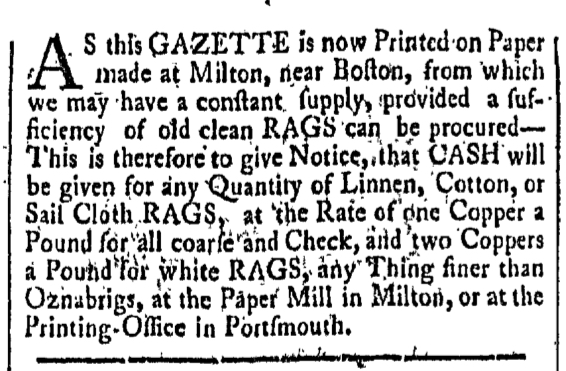
New-Hampshire Gazette (March 6, 1767).
“CASH will be given for any Quantity of Linnen, Cotton, or Sail Cloth RAGS.”
Printers regularly issued calls for rags in their newspapers throughout the eighteenth century. Most were brief, consisting of just a few lines announcing “cash for rags.” Others, like today’s advertisement, were more extensive, specifying which types of rags were desired and the prices awarded for each.
The shorter advertisements often flummox my students. The longer ones, on the other hand, provide sufficient context for figuring out why printers in early America so valued rags, one of the most important raw materials for creating the supplies they needed to pursue their trade. Encountering such notices provides wonderful opportunities for discussing how we are removed from the eighteenth century in a variety of ways.
First, we live in a world in which most paper we use was manufactured from wood pulp. Most students have not even conceived of an alternative prior to reading advertisements in the New-Hampshire Gazette and other newspapers from colonial and Revolutionary America. Here it becomes important to note that even though students are reading these advertisements, they are consulting digital surrogates to do so, keeping them removed from the eighteenth century in important ways even as they seek to better understand the period. Although they have access to the text printed in newspapers – and can even see its format and layout on the page thanks to digital images that provide more than mere transcriptions – they do not actually touch any of the pages from the original publication. In the absence of the material text they miss out on the tactile sensations that would provide clues that paper production has significantly changed in the past quarter millennium.
The more extensive calls for rags also demonstrate how we are removed from the language of consumer culture so fluently spoken in the eighteenth century. Today’s advertisement advised that “CASH will be given for any Quantity of Linnen, Cotton, or Sail Cloth RAGS, at the Rate of one Copper a Pound for all coarse and Check, and two Coppers a Pound for white RAGS, any Thing finer than Oznabrigs.” The printers assumed that readers could identify the many different kinds of fabrics used in early America and advertised for sale elsewhere in their newspapers. They assumed that readers could make distinctions among them, such as determining which were “finer than Oznabrigs.” Although today’s notice did not attempt to sell any goods or services it depended in part on familiarity with consumer culture.
The Slavery Adverts 250 Project chronicles the role of newspaper advertising in perpetuating slavery in the era of the American Revolution. The project seeks to reveal the ubiquity of slavery in eighteenth-century life from New England to Georgia by republishing advertisements about enslaved people – for sale as individuals or in groups, wanted to purchase or for hire for short periods, runaways who liberated themselves, and those who were subsequently captured and confined in jails and workhouses – in daily digests on this site as well as in real time via the @SlaveAdverts250 Twitter feed, utilizing twenty-first-century media to stand in for the print media of the eighteenth century.
The project aims to provide modern audiences with a sense of just how often colonizers encountered these advertisements in their daily lives. Enslaved men, women, and children appeared in print somewhere in the colonies almost every single day. Those advertisements served as a constant backdrop for social, cultural, economic, and political life in colonial and revolutionary America. Colonizers who did not purport to own enslaved people were still confronted with slavery as well as invited to maintain the system by purchasing enslaved men, women, and children or assisting in the capture of so-called “runaways” who sought to free themselves from bondage. The frequency of these newspaper advertisements suggests just how embedded slavery was in colonial and revolutionary American culture in everyday interactions beyond the printed page.
These advertisements also testify to the experiences of enslaved men, women, and children, though readers must consider that those experiences have been remediated through descriptions offered by enslavers rather than enslaved people themselves. Often unnamed in the advertisements, enslaved men, women, and children were not invisible or unimportant in early America.
These advertisements appeared in colonial American newspapers 250 years ago today.
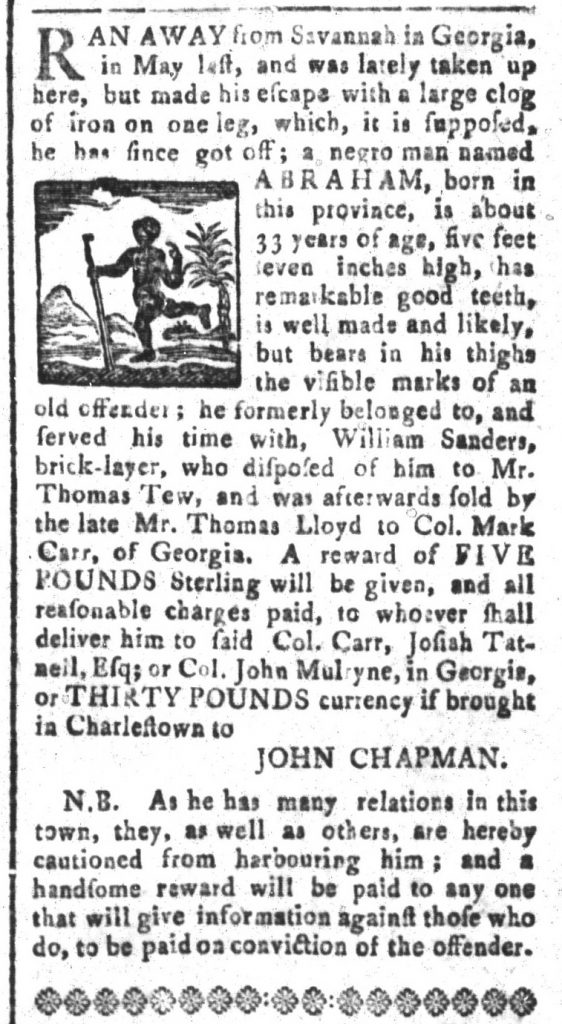
South-Carolina and American General Gazette (March 6, 1767).
**********
South-Carolina and American General Gazette (March 6, 1767).
**********
South-Carolina and American General Gazette (March 6, 1767).
**********
South-Carolina and American General Gazette (March 6, 1767).
**********
South-Carolina and American General Gazette (March 6, 1767).
**********
South-Carolina and American General Gazette (March 6, 1767).
**********
South-Carolina and American General Gazette (March 6, 1767).
**********
South-Carolina and American General Gazette (March 6, 1767).
**********
South-Carolina and American General Gazette (March 6, 1767).
What was advertised in a colonial American newspaper 250 years ago today?
Pennsylvania Gazette (March 5, 1767).
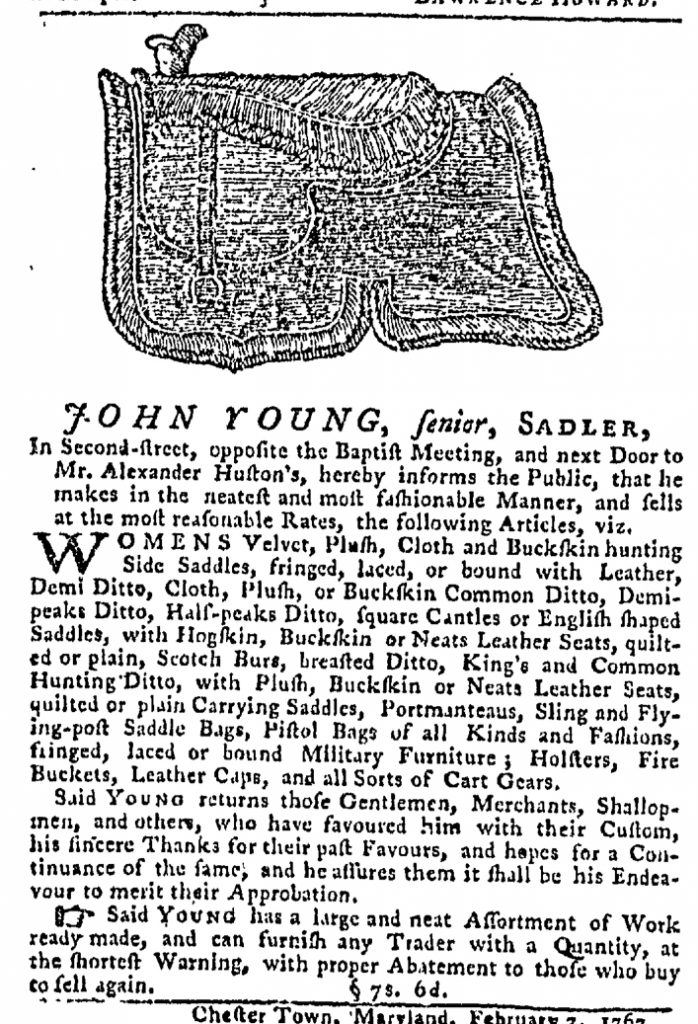
“Quilted or plain Carrying Saddles.”
“JOHN YOUNG, senior, SADLER,” operated a workshop “In Second-street, opposite the Baptist Meeting, and next Door to Mr. Alexander Huston’s,” in Philadelphia. Elsewhere in the city “JOHN YOUNG, jun. Saddler,” ran his own shop “At the sign of the ENGLISH HUNTING SADDLE, at the corner of Market and Front-streets, and opposite the LONDON COFFEE-HOUSE.” The younger Young likely learned his trade from the elder Young. Which one taught the other about the power of advertising? Was that also passed down from one generation to the next? Or did the senior Young eventually adopt marketing strategies on the recommendation of his son (or perhaps even to compete with him)?
Both Youngs advertised in newspapers printed in Philadelphia in early March 1767, the elder Young in the established Pennsylvania Gazette and the junior saddler in the new Pennsylvania Chronicle. Although both included woodcuts of saddles in their notices, the younger Young seems to have been the more sophisticated marketer when it came to mobilizing an image to identify his products. Note that Young Sr. merely listed directions to aid potential customers in finding his workshop, yet Young Jr. created a brand for his business that operated at “the sign of the ENGLISH HUNTING SADDLE.” Score one for the younger Young’s innovative marketing.
Pennsylvania Chronicle (March 9, 1767).
The saddlers offered almost identical appeals concerning quality, price, and fashion. Young Sr. stated that “he makes in the neatest and most Fashionable Manner, and sells at the most reasonable Rates” a variety of saddles and other riding equipment. In turn, Young Jr. announced that “he makes in the best and most fashionable manner, and sells at the most reasonable rates” a similar array of leather goods. Both indicated that they had sufficient inventory “ready made” that they could sell in quantity, though the elder saddler edged out his son by offering “proper Abatement to those who buy to sell again.” In other words, retailers received a bulk discount. Score one for the elder Young’s innovative pricing.
The two saddlers seemed to address slightly different clientele. Although both asserted they made saddles “in the most fashionable Manner,” Young Jr. placed more emphasis on serving elite customers. He listed “GENTLEMEN’S English hunting” saddles first among his wares (and the format of the advertisement directed readers’ eyes to the word “gentlemen”) and underscored that he did his work “in the genteelest manner.” On the other hand, Young Sr. thanked gentlemen and merchants for their previous patronage, but he included appreciation for “Shallopmen, and others” in the same sentence. One saddler traded on exclusivity for elite customers, while the other made his workshop more accessible to clients from all backgrounds. In the end, which marketing method yielded greater revenues by attracting more business? For now, that should be considered a draw.
Whether the Youngs competed or cooperated with each other, they devised advertisements that shared some of the most common appeals deployed in commercial notices printed in newspapers throughout the eighteenth century. Each other advanced unique and innovative marketing strategies, demonstrating that advertising in early America amounted to more than mere announcements that particular vendors sold certain goods.
The Slavery Adverts 250 Project chronicles the role of newspaper advertising in perpetuating slavery in the era of the American Revolution. The project seeks to reveal the ubiquity of slavery in eighteenth-century life from New England to Georgia by republishing advertisements about enslaved people – for sale as individuals or in groups, wanted to purchase or for hire for short periods, runaways who liberated themselves, and those who were subsequently captured and confined in jails and workhouses – in daily digests on this site as well as in real time via the @SlaveAdverts250 Twitter feed, utilizing twenty-first-century media to stand in for the print media of the eighteenth century.
The project aims to provide modern audiences with a sense of just how often colonizers encountered these advertisements in their daily lives. Enslaved men, women, and children appeared in print somewhere in the colonies almost every single day. Those advertisements served as a constant backdrop for social, cultural, economic, and political life in colonial and revolutionary America. Colonizers who did not purport to own enslaved people were still confronted with slavery as well as invited to maintain the system by purchasing enslaved men, women, and children or assisting in the capture of so-called “runaways” who sought to free themselves from bondage. The frequency of these newspaper advertisements suggests just how embedded slavery was in colonial and revolutionary American culture in everyday interactions beyond the printed page.
These advertisements also testify to the experiences of enslaved men, women, and children, though readers must consider that those experiences have been remediated through descriptions offered by enslavers rather than enslaved people themselves. Often unnamed in the advertisements, enslaved men, women, and children were not invisible or unimportant in early America.
These advertisements appeared in colonial American newspapers 250 years ago today.
Massachusetts Gazette (March 5, 1767).
**********
New-York Gazette: Or, the Weekly Post-Boy (March 5, 1767).
**********
New-York Journal (March 5, 1767).
**********
Supplement to the New-York Journal (March 5, 1767).
**********
Supplement to the New-York Journal (March 5, 1767).
I will admit this project was a new challenge for me as an historian. I have done research for essays and, for the most part, delved into books and treatises or reviews regarding medieval or early modern Europe, which has been the focus for most of my studies at Assumption College. So, researching eighteenth-century newspapers from colonial America was a new transition for me. It was interesting to read through the newspaper advertisements and get an impression about what life was like for colonists just prior to the Revolution that defines most of American history.
I had assumed that colonists would have been more removed from European culture and influences, but they proved to be more interested in fostering and strengthening their ties and identity to England and Europe. The colonies were also widely involved with other colonial settlements and powers, such as the West Indies, Africans, and the Dutch and French, to name a few. As I suspected, alcohol played a large role in the colonists’ lives, due to its establishment as a far more reliable drink than water or milk. I learned a lot about how colonial life varied depending on one’s economic and social standing, from transportation in single seat private carriages for the elites to a relaxing drink at work for a poor laborer. The newspaper advertisements were interesting gateways to examine colonial life and culture, from a period when the American identity had yet to form, in spite, or perhaps, because of emerging tensions between colonists and the British.
For my research I mostly focused on sources available through a simple google search because the work was going to be featured on a blog page, admittedly one that goes through a somewhat extensive research review and editing process, and as such should have been easily accessible for readers. It was also much easier to scour through google for related articles and information on the newspaper advertisements and products or related subjects than going through a college database and having to narrow down the search results. Although because of this it was a little more difficult to find creditable sources of information, although I suppose that’s where the editing and reviewing process with Prof. Keyes came in to either give a go ahead or provide alternative options. It was nice being able to send in an analysis of my research and get suggestions for improvement or new articles to explore and incorporate. I would have to say that it made the experience less stressful than I thought it was going to be.
All in all, I would have to say that this has been a bit of an eye-opening experience for me as a historian. I have seen how useful it is to have other historians available to assist and guide one’s research and writing, something that has also been a part of special topics courses and the capstone research seminar. I have utilized newspapers, and advertisements, in a way I had never considered before, due to either a lack of interest or the lack of relevance with regards to my previous classes. It’s been difficult at times trying to juggle constantly working on this project with other assignments from both the main coursework and my other classes, but as with any project or essay, seeing the final result is a pretty cathartic experience. I got to learn more about a period of history that I had been sorely lacking in knowledge and appreciation of up until this point, and as an American and a student I am grateful for this experience.
Who was the subject of an advertisement in a colonial American newspaper 250 years ago today?
Georgia Gazette (March 4, 1767).
“Five Pounds Sterling Reward. RUN AWAY … NEGROE MAN, named DAVID.”
This advertisement for a runaway slave named David provides a brief description of his appearance, including special features like the holes in his ears and the blanket, hat, and pair of “cheque trowsers, and an old cheque shirt” he took when he escaped. Slaves’ appearance was crucial to advertisements seeking their capture because clothing was one of the most important means of identifying people in the colonial and Revolutionary periods. Runaway slaves attempted to disguise themselves through altering or changing their clothes when possible.
Charmaine A. Nelson recently discussed the use of clothing in runaway slave advertisements. The amount of control slaves had over their appearance varied, and while David may not have had much choice in the clothes he possessed he still could have attempted to change his appearance after escaping his master. Nelson draws attention to David Waldstreicher’s arguments regarding the importance of describing slaves’ appearance and clothing in runaway advertisements, along with “trades or skills, linguistic ability or usage, and ethnic or racial identity.” Nelson also focuses on the case of a runaway woman named Cash, whose description included clothes she owned and that she presumably produced.
It’s depressing to realize that at a time when ideas of liberty and democracy were taking root in the American consciousness, people were also callously trampling on other humans’ attempts to gain freedom and prosperity.
Thomas Lee’s notice offering a reward for David included all four of the most common types of descriptions in runaway advertisements identified by David Waldstreicher.[1] Sam has already investigated the clothing David took with him. Lee also implicitly remarked on David’s trade or skills when he mentioned that the enslaved man fled “from the subscriber’s brick-yard.” He explicitly incorporated linguistic ability (“can speak no English”) and ethnic identity (“of the Gambia country”). This notice was one of nineteen runaway advertisements printed in newspapers throughout the colonies during the week of February 26 through March 4, 1767. Most deployed some or all of these common means of describing runaways.
From the clothes that David wore to his height to the “large hole in each year,” Lee provided means for identifying the fugitive slave according to his physical features, but doing so required surveillance by readers of the Georgia Gazette. In order for runaway advertisements to be effective, colonists needed to scrutinize black bodies – carefully, actively, and constantly. Using text rather than images, runaway advertisements put the bodies of Africans and African Americans on display in the pages of newspapers, but this effect was not limited to print. Such advertisements demanded that readers take special notice of any and all black people they encountered, especially any not previously familiar to them. Such advertisements required close inspection of black bodies as readers compared published descriptions to the flesh-and-blood people who stood before them. As a result, runaway advertisements targeted specific individuals, but they potentially affected all black people subject to being sized up by readers on the lookout for fugitives.
Readers of the Georgia Gazette grappled with only one runaway advertisement in the March 4, 1767, issue. However, other runaway advertisements had appeared recently in previous issues, including one for Maria that ran for six months. Such descriptions would have become very familiar to readers who encountered them week after week. Often multiple runaway advertisements appeared in any given issue of the Georgia Gazette. As a result, readers could mentally conjure up an assortment of mental images of various runaways whenever they encountered unfamiliar Africans and African Americans. Print furthered the display and examination of black bodies in colonial and Revolutionary America.
**********
[1] David Waldstreicher, “Reading the Runaways: Self-Fashioning, Print Culture, and Confidence in Slavery in the Eighteenth-Century Mid-Atlantic,” William and Mary Quarterly 56, no. 2 (April 1999): 248.
These tables indicate how many advertisements for slaves appeared in colonial American newspapers during the week of February 26 – March 4, 1767. The data has been compiled based on research conducted by Shannon Dewar.
Note: These tables are as comprehensive as currently digitized sources permit, but they may not be an exhaustive account. They includes all newspapers that have been digitized and made available via Accessible Archives, Colonial Williamsburg’s Digital Library, and Readex’s America’s Historical Newspapers. There are several reasons some newspapers may not have been consulted:
Issues that are no longer extant;
Issues that are extant but have not yet been digitized (including the Pennsylvania Journal); and
Newspapers published in a language other than English (including the Wochentliche Philadelphische Staatsbote).
**********
Slavery Advertisements Published February 26 – March 4, 1767: By Date
**********
Slavery Advertisements Published February 26 – March 4, 1767: By Region
The Slavery Adverts 250 Project chronicles the role of newspaper advertising in perpetuating slavery in the era of the American Revolution. The project seeks to reveal the ubiquity of slavery in eighteenth-century life from New England to Georgia by republishing advertisements about enslaved people – for sale as individuals or in groups, wanted to purchase or for hire for short periods, runaways who liberated themselves, and those who were subsequently captured and confined in jails and workhouses – in daily digests on this site as well as in real time via the @SlaveAdverts250 Twitter feed, utilizing twenty-first-century media to stand in for the print media of the eighteenth century.
The project aims to provide modern audiences with a sense of just how often colonizers encountered these advertisements in their daily lives. Enslaved men, women, and children appeared in print somewhere in the colonies almost every single day. Those advertisements served as a constant backdrop for social, cultural, economic, and political life in colonial and revolutionary America. Colonizers who did not purport to own enslaved people were still confronted with slavery as well as invited to maintain the system by purchasing enslaved men, women, and children or assisting in the capture of so-called “runaways” who sought to free themselves from bondage. The frequency of these newspaper advertisements suggests just how embedded slavery was in colonial and revolutionary American culture in everyday interactions beyond the printed page.
These advertisements also testify to the experiences of enslaved men, women, and children, though readers must consider that those experiences have been remediated through descriptions offered by enslavers rather than enslaved people themselves. Often unnamed in the advertisements, enslaved men, women, and children were not invisible or unimportant in early America.
These advertisements appeared in colonial American newspapers 250 years ago today.
What was advertised in a colonial American newspaper 250 years ago today?
South-Carolina Gazette and Country Journal (March 3, 1767).
“Imported from GRENADA … A Quantity of RUM.”
Anthony Lamotte advertised a shipment of rum and sugar to be sold at his store “next door to Mansell, Corbet & Co.” Lamotte wanted to assure his customers that he continued to supply them with the best Grenada rum, equal to imports from Jamaica. As I explained in an earlier entry, alcoholic beverages were a staple of colonial American life, consumed throughout the day. However, unlike other drinks, rum was a major commodity for the colonies due to its central role in the “Triangular Trade” arrangements between America, Africa, and Europe.
Colonists were part of multiple triangular trades. Each was a series of arrangements where raw resources and manufactured goods were traded throughout the Atlantic. One triangle began with Europe sending textiles, rum, and other manufactured goods to Africa. From there, slaves were sent to the Americas (primarily the Caribbean and southern colonies). Americans then produced and exported sugar, tobacco, and cotton to Europe. Another triangle saw Africa transport slaves to the West Indies. The slaves then worked on plantations where they produced sugar and molasses to be sent to the New England colonies. Colonists in New England then used the sugar and molasses to make rum to ship to Africa. These trade arrangements were self-propagating.
Routes for an alternate version of the triangular trade that emphasized rum production in New England.
While these trade networks are important to understanding economic relationships — and the importance of rum — they do not account for all trade in the eighteenth century. Many other vessels transported goods that did not neatly fit this pattern, such as the one that carried rum from Grenada to South Carolina.
**********
ADDITIONAL COMMENTARY: Carl Robert Keyes
Anthony Lamotte regularly placed advertisements in Charleston’s newspapers. Whether relatively brief or more extensive, his notices advanced a common theme when it came to marketing the rum he imported from Grenada. The phrase “superior in quality to what is usually imported from the other Windward Islands” appeared in both his short advertisement from the October 20, 1766, issue of the South Carolina Gazette and today’s advertisement from the South-Carolina Gazette and Country Journal published four months later.
Lamotte likely realized that he faced quite a challenge: Jamaican rum was widely considered superior to all others produced in the West Indies. As Sam notes, rum was a popular commodity that colonists enjoyed consuming, but rum from Jamaica was more popular than others. To sell his rum from Grenada, Lamotte needed to change the perception that Jamaican rum was categorically superior to all others.
He initiated his advertising campaign by seeking to establish that rum from Grenada was preferable to rum produced elsewhere in the Windward Islands. Once he advanced that argument in multiple newspapers over the course of several months he raised the stakes by claiming that “GRENADA RUM, of the finest flavor and colour” not only exceeded the quality of rum from nearby islands but should have also been considered “in every respect equal to the best Rum imported from Jamaica.”
Lamotte had “A Quantity of RUM” available for sale, but his advertisement suggested that it might have been a limited quantity that might sell out quickly. He promised “his friends and customers, that in a few months he will be able to supply them constantly” with rum imported from Grenada. Lamotte may have been hoping that by making available a limited supply he could generate word-of-mouth endorsements or, at the very least, make supplies seem temporarily rare and incite anticipation for a time in the future, but not too distant, when he could supply discerning customers with greater quantities.