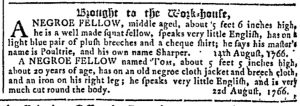
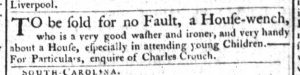
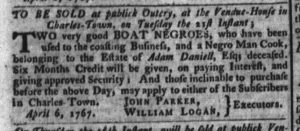
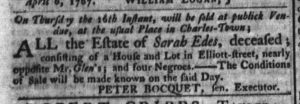
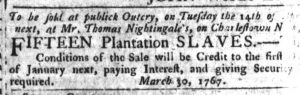
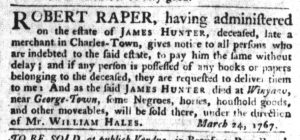
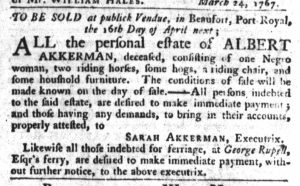
Slavery Advertisements Published April 16, 1767

GUEST CURATOR:  Evan Sutherland

The Slavery Adverts 250 Project chronicles the role of newspaper advertising in perpetuating slavery in the era of the American Revolution. The project seeks to reveal the ubiquity of slavery in eighteenth-century life from New England to Georgia by republishing advertisements about enslaved people – for sale as individuals or in groups, wanted to purchase or for hire for short periods, runaways who liberated themselves, and those who were subsequently captured and confined in jails and workhouses – in daily digests on this site as well as in real time via the @SlaveAdverts250 Twitter feed, utilizing twenty-first-century media to stand in for the print media of the eighteenth century.

The project aims to provide modern audiences with a sense of just how often colonizers encountered these advertisements in their daily lives. Enslaved men, women, and children appeared in print somewhere in the colonies almost every single day. Those advertisements served as a constant backdrop for social, cultural, economic, and political life in colonial and revolutionary America. Colonizers who did not purport to own enslaved people were still confronted with slavery as well as invited to maintain the system by purchasing enslaved men, women, and children or assisting in the capture of so-called “runaways” who sought to free themselves from bondage. The frequency of these newspaper advertisements suggests just how embedded slavery was in colonial and revolutionary American culture in everyday interactions beyond the printed page.

These advertisements also testify to the experiences of enslaved men, women, and children, though readers must consider that those experiences have been remediated through descriptions offered by enslavers rather than enslaved people themselves. Often unnamed in the advertisements, enslaved men, women, and children were not invisible or unimportant in early America.

These advertisements appeared in colonial American newspapers 250 years ago today.

Apr 16 - Massachusetts Gazette Slavery 1
Massachusetts Gazette (April 16, 1767).

**********

Apr 16 - New-York Gazette Weekly Post-Boy Slavery 1
New-York Gazette: Or, the Weekly Post-Boy (April 16, 1767).

**********

Apr 16 - New-York Journal Slavery 1
New-York Journal (April 16, 1767).

**********

Apr 16 - Pennsylvania Gazette Slavery 1
Pennsylvania Gazette (April 16, 1767).

**********

Apr 16 - Pennsylvania Gazette Slavery 2
Pennsylvania Gazette (April 16, 1767).

**********
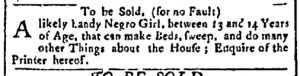
Apr 16 - Pennsylvania Gazette Slavery 3
Pennsylvania Gazette (April 16, 1767).

**********

Apr 16 - Pennsylvania Gazette Slavery 4
Pennsylvania Gazette (April 16, 1767).

**********
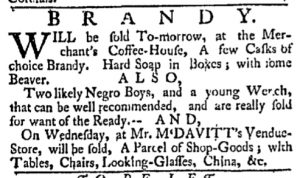
Apr 16 - Pennsylvania Gazette Slavery 5
Pennsylvania Gazette (April 16, 1767).

**********

Apr 16 - Pennsylvania Gazette Supplement Slavery 1
Supplement to the Pennsylvania Gazette (April 16, 1767).

**********
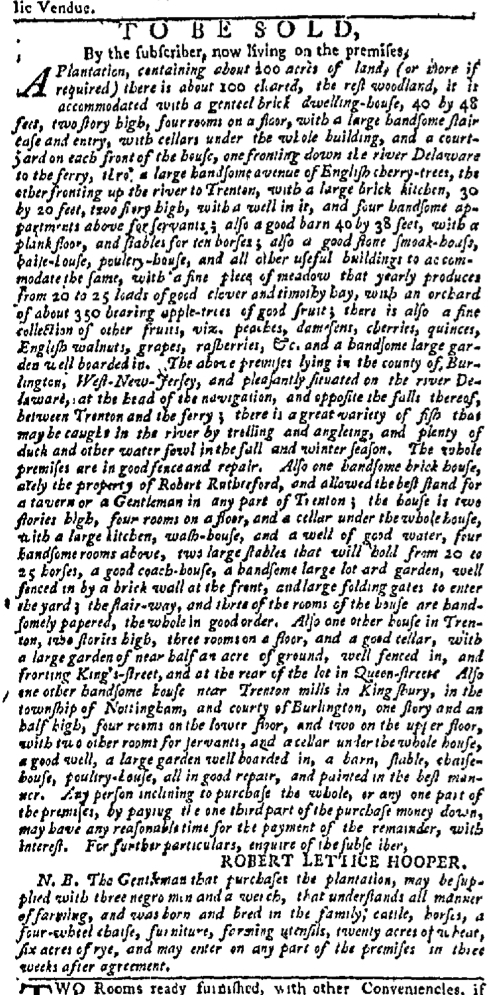
Apr 16 - Pennsylvania Gazette Supplement Slavery 2
Supplement to the Pennsylvania Gazette (April 16, 1767).

**********
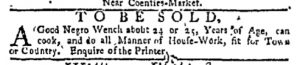
Apr 16 - Pennsylvania Gazette Supplement Slavery 3
Pennsylvania Gazette (April 16, 1767).

**********
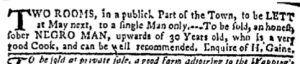
Apr 16 - Virginia Gazette Slavery 1
Virginia Gazette (April 16, 1767).

**********

Apr 16 - Virginia Gazette Slavery 2
Virginia Gazette (April 16, 1767).

**********

Apr 16 - Virginia Gazette Slavery 3
Virginia Gazette (April 16, 1767).

**********

Apr 16 - Virginia Gazette Slavery 4
Virginia Gazette (April 16, 1767).

**********

Apr 16 - Virginia Gazette Slavery 5
Virginia Gazette (April 16, 1767).

Reflections from Guest Curator Shannon Dewar

For as long as I can remember, History has been my favorite subject in school. I can remember doing full body outlines of prominent women in the Revolutionary War, basket weaving, and making our own countries up and creating their own governments throughout my days as a student in elementary school. Middle and high school challenged me to delve deeper into both primary and secondary sources and I grew a passion for uncovering knowledge about the past. My fondest memory was the summer going into junior year when we had homework for AP U.S History: it was to read John Adams by David McCullough. While most others in my class found the book long and considered it boring, I found it enriching and insightful. It was from that point on that I knew my love of history would be with me forever, and it ignited in me a spark to continue that passion as a major in college.

Being a guest curator for the Adverts 250 Project has given me the opportunity fall in love with history all over again. I have been able to view it from an entirely new perspective. Instead of just reading sources and integrating them into essays for classes, I actually get to do history. I was able to take what I’ve learned, and actually create my own pieces to be posted for many historians and others to view. After all the years I had been the one reading people’s work, now I can actually know that someone is reading and learning from mine.

While serving as guest curator has been an amazing and insightful experience, it has not come without its challenges. I have had to learn about an entirely new topic, advertising. In addition, I have had to delve deeper into commerce and business in the colonial and Revolutionary periods and learn about the economy in a new light. Though challenging, this project has allowed me to see more into the daily life of Revolutionary America and enabled me to acquire new knowledge about the period.

Just as this project has had challenges, it has also had many rewards. I have absolutely loved the chance to work on a project that allows me to address readers not just within in the small realm of my classroom on campus, but way beyond that, including both national and international readers. The thought of someone reading my work who does not know me is quite amazing. Also, I’ve grown in confidence in my ability to write about history, and take chances in my work, allowing myself to interpret what I read and see differently than how others may. Throughout the process, I have loved to work with sources at the American Antiquarian Society and in online databases that I have never seen before. Being able to work at the American Antiquarian Society, I believe, has been my favorite part, because it is places like that where history is still alive and flourishing.

Going forward, I hope that I get the chance to work again in some capacity with a digital humanities project. It has allowed me to grow in confidence as a writer and historian, as well as provided me with undergraduate experience in a different kind of project. Guest curating the Adverts 250 Project has taught me skills that will take me farther into my future endeavors.

April 15

GUEST CURATOR: Shannon Dewar

What was advertised in a colonial American newspaper 250 years ago today?

Apr 15 - 4:15:1767 Georgia Gazette
Georgia Gazette (April 15, 1767).

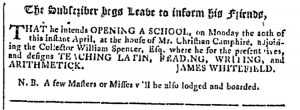
“THAT he intends OPENING A SCHOOL.”

Southern Education. James Whitefield’s advertisement announced that he planned to open a school. Regarding the content of the education provided, Whitefield “designs TEACHING LATIN, READING, WRITING, and ARITHMETICK.” I would like to discuss schools in this period, especially in the Lower South.

Note that this advertisement mentions it was a boarding school. Plantations in Georgia and other southern colonies were spaced out so daily travel for school was virtually impossible for some. Boarding schools provided an option for those who lived outside Savannah, Charleston, and other large towns.

It is also important to add that these services of education had to be purchased, as, according to Robert A. Peterson, “government had, for all practical purchases, no hand at all in education,” especially in the southern colonies. Education was something individuals had to acquire for themselves and their children. It came at a price. Free public education was not yet available for all. Children were taught at home, but those with money had other chances for education, including attending – or even being “lodged and boarded” – at a school like the one James Whitefield opened.

**********

ADDITIONAL COMMENTARY: Carl Robert Keyes

James Whitefield placed one of two advertisements about “OPENING A SCHOOL” in Savannah the April 15, 1767, issue of the Georgia Gazette. John Francklin inserted the other. Both planned for their lessons to commence the following Monday.

At a glance, the advertisements from these competing schoolmasters might give the impression of extensive educational opportunities in Savannah, yet the services they offered and their methods for promoting them to prospective students and their parents paled in comparison to advertisements for day and boarding schools in larger port cities, especially Philadelphia, New York, and Charleston.

Whitefield and Francklin each taught the basics: reading, writing, and arithmetic. Whitefield angled for a more elite clientele, listing Latin first among the subjects he taught, but he did not supplement that subject with other languages or additional subjects that many of his counterparts in larger cities promoted. Studying Latin was usually reserved for the better sorts, so some students (or their parents) may have chosen Whitefield’s school over Francklin’s for the perceived prestige of the slightly more extensive curriculum, even if they did not take Latin lessons after enrolling. Whitefield indicated that he had the capacity to take on boarders, “A few Masters or Misses,” but it was unlikely that female students would have been exposed to studying Latin.

Neither schoolmaster described their curriculum beyond listing the subjects they taught. Neither explained the care they took in the moral development of their charges. Neither described the amenities associated with the homes where they taught. Both limited their advertisements to seven lines, making them brief announcements compared to the marketing undertaken by schoolmasters in the major urban ports in the 1760s and 1770s.

Whitefield and Francklin offered valuable services to the residents of Savannah, but their efforts to provide educational opportunities appear embryonic compared to those available in larger cities. Part of this was most certainly a function of Georgia being such a young colony, founded only thirty-five years earlier. Even when colonists had more choices, they had to purchase them, as Shannon points out, which did not necessarily make education more accessible to most colonists even if they lived in close proximity to multiple schoolmasters and schoolmistresses who offered the most extensive lessons, moral guidance, and amenities. In the late colonial era, just as today, Americans had uneven access to educational opportunities, determined in part by both geography and status.

Summary of Slavery Advertisements Published April 9-15, 1767

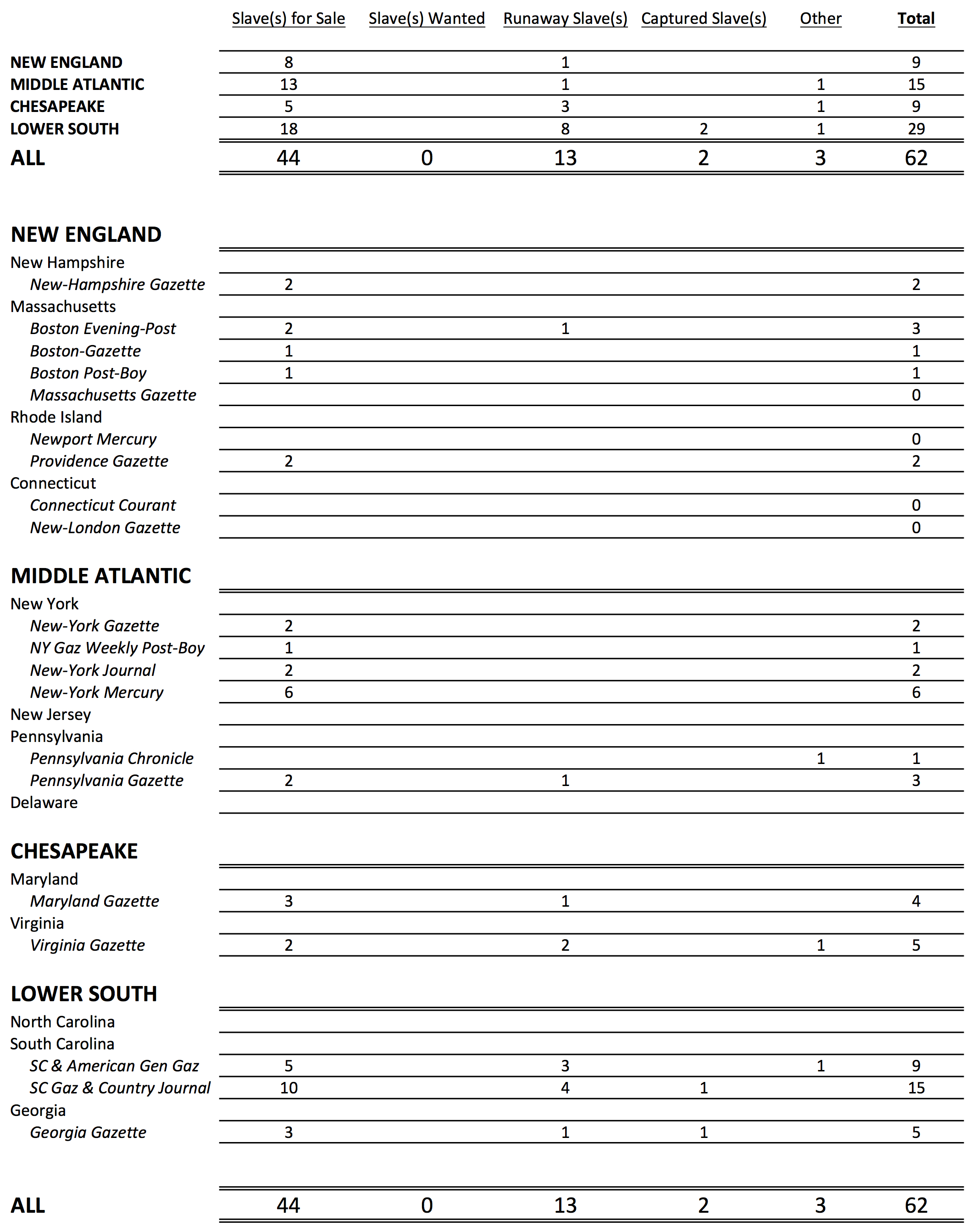
These tables indicate how many advertisements for slaves appeared in colonial American newspapers during the week of April 9-15, 1767.  The data has been compiled based on research conducted by Jonathan Bisceglia.

Note:  These tables are as comprehensive as currently digitized sources permit, but they may not be an exhaustive account.  They includes all newspapers that have been digitized and made available via Accessible Archives, Colonial Williamsburg’s Digital Library, and Readex’s America’s Historical Newspapers.  There are several reasons some newspapers may not have been consulted:

  • Issues that are no longer extant;
  • Issues that are extant but have not yet been digitized (including the Pennsylvania Journal); and
  • Newspapers published in a language other than English (including the Wochentliche Philadelphische Staatsbote).

**********

Slavery Advertisements Published April 9-15, 1767:  By Date

Slavery Adverts Tables 1767 By Date Apr 9

**********

Slavery Advertisements Published April 9-15, 1767:  By Region

Slavery Adverts Tables 1767 By Region Apr 9

Slavery Advertisements Published April 15, 1767

GUEST CURATOR:  Jonathan Bisceglia

The Slavery Adverts 250 Project chronicles the role of newspaper advertising in perpetuating slavery in the era of the American Revolution. The project seeks to reveal the ubiquity of slavery in eighteenth-century life from New England to Georgia by republishing advertisements about enslaved people – for sale as individuals or in groups, wanted to purchase or for hire for short periods, runaways who liberated themselves, and those who were subsequently captured and confined in jails and workhouses – in daily digests on this site as well as in real time via the @SlaveAdverts250 Twitter feed, utilizing twenty-first-century media to stand in for the print media of the eighteenth century.

The project aims to provide modern audiences with a sense of just how often colonizers encountered these advertisements in their daily lives. Enslaved men, women, and children appeared in print somewhere in the colonies almost every single day. Those advertisements served as a constant backdrop for social, cultural, economic, and political life in colonial and revolutionary America. Colonizers who did not purport to own enslaved people were still confronted with slavery as well as invited to maintain the system by purchasing enslaved men, women, and children or assisting in the capture of so-called “runaways” who sought to free themselves from bondage. The frequency of these newspaper advertisements suggests just how embedded slavery was in colonial and revolutionary American culture in everyday interactions beyond the printed page.

These advertisements also testify to the experiences of enslaved men, women, and children, though readers must consider that those experiences have been remediated through descriptions offered by enslavers rather than enslaved people themselves. Often unnamed in the advertisements, enslaved men, women, and children were not invisible or unimportant in early America.

These advertisements appeared in colonial American newspapers 250 years ago today.

Apr 15 - Georgia Gazette Slavery 1
Georgia Gazette (April 15, 1767).

**********

Apr 15 - Georgia Gazette Slavery 2
Georgia Gazette (April 15, 1767).

**********

Apr 15 - Georgia Gazette Slavery 3
Georgia Gazette (April 15, 1767).

**********

Apr 15 - Georgia Gazette Slavery 4
Georgia Gazette (April 15, 1767).

**********

Apr 15 - Georgia Gazette Slavery 5
Georgia Gazette (April 15, 1767).

April 14

GUEST CURATOR: Shannon Dewar

What was advertised in a colonial American newspaper 250 years ago today?

Apr 14 - 4:14:1767 South-Carolina Gazette and Country Journal
Supplement to the South-Carolina Gazette and Country Journal (April 14, 1767).

“To be sold cheap for Cash … ELEANOR REAZON.”

Women and Advertisements. In choosing this advertisement, the part that stood out to me was the fact that it was placed by a woman. Eleanor Reazon, an ordinary woman, embodied the group of women who sought to make a living for themselves and their families. What is also important to note is that women, especially once the Townshend Acts were passed, played a significant role in both adhering to boycotts, as well as breaking them and continuing their sale of goods and their tea parties. Historian T.H. Breen explains the importance of women supporting boycotts. Peter Oliver, a prominent Loyalist, accused patriot women of breaking the boycotts.

Despite the uniqueness of a woman placing an advertisement, the content is not as surprising. Hats and bonnets, as well as fabrics and tea, all represented what women most likely sold. The advertisement did not include boats, wood, or other heftier goods, but rather smaller, fine items sold within her home. During this period, the role of women and business varied. Patricia Cleary states, “A close examination of women’s trading, however, points to other possibilities: that the work itself carried implications for women beyond their family roles. Women shopkeepers, whose business practices illuminate the changing consumer world of the midcentury, highlight the interplay of gender and commerce and suggest the existence of a sphere of female entrepreneurship and association.”[1]

**********

ADDITIONAL COMMENTARY: Carl Robert Keyes

Eleanor Reazon was the only female entrepreneur to place an advertisement promoting consumer goods and services in the April 14 issue of the South-Carolina Gazette and Country Journal and its supplement, though she certainly was not the only female shopkeeper active in Charleston at the time. Women who ran shops in the eighteenth century tended not to advertise their enterprises. In turn, that produced a skewed glimpse of the marketplace in the public prints, suggesting that women acted almost exclusively as consumers.

Female shopkeepers occupied complicated space in the public sphere and market. Men dominated the world of business, while women were expected to tend to the household. Yet many women found themselves engaged in the world of trade and commerce. Sometimes this was brief, as in the case of deputy husbands who temporarily stepped forward in the absence of their husbands. Other times women had a more sustained presence in the marketplace, including widows who either continued businesses formerly run by their husbands or established their own shops, taverns, or other enterprises to support themselves. Both deputy husbands and widows justifiably participated in business only when the absence of their husbands made it necessary.

Single and married female shopkeepers were in a more precarious position. Presumably no man supervised single women, while married women who operated their own businesses usurped roles and responsibilities supposedly reserved for male heads of household. These circumstances may have made female entrepreneurs hesitant to expose themselves to unwanted scrutiny by advertising in newspapers. Instead, the language used in many advertisements placed by women in the eighteenth century suggests that many preferred to rely on word-of-mouth marketing via networks of friends and neighbors rather than listing their businesses alongside those of their male competitors in the advertising pages.

Eleanor Reazon, however, did not resort to any sort of explanations to justify inserting her voice into the world of commerce represented in the advertising section of the South-Carolina Gazette and Country Journal. As Shannon notes, she sold a relatively narrow range of goods compared to some of her male counterparts, but otherwise her marketing efforts did not much differ. Although many women downplayed their role as traders, Reazon and others claimed a place in the market as “she-merchants” and entrepreneurs. Advertising from the period demonstrates that there was not just one way for women of business to comport themselves in eighteenth-century America.

**********

[1] Patricia Cleary, “‘She Will Be in the Shop’: Women’s Sphere of Trade in Eighteenth-Century Philadelphia and New York,” Pennsylvania Magazine of History and Biography 119, no. 3 (July 1995): 182.

Slavery Advertisements Published April 14, 1767

GUEST CURATOR:  Jonathan Bisceglia

The Slavery Adverts 250 Project chronicles the role of newspaper advertising in perpetuating slavery in the era of the American Revolution. The project seeks to reveal the ubiquity of slavery in eighteenth-century life from New England to Georgia by republishing advertisements about enslaved people – for sale as individuals or in groups, wanted to purchase or for hire for short periods, runaways who liberated themselves, and those who were subsequently captured and confined in jails and workhouses – in daily digests on this site as well as in real time via the @SlaveAdverts250 Twitter feed, utilizing twenty-first-century media to stand in for the print media of the eighteenth century.

The project aims to provide modern audiences with a sense of just how often colonizers encountered these advertisements in their daily lives. Enslaved men, women, and children appeared in print somewhere in the colonies almost every single day. Those advertisements served as a constant backdrop for social, cultural, economic, and political life in colonial and revolutionary America. Colonizers who did not purport to own enslaved people were still confronted with slavery as well as invited to maintain the system by purchasing enslaved men, women, and children or assisting in the capture of so-called “runaways” who sought to free themselves from bondage. The frequency of these newspaper advertisements suggests just how embedded slavery was in colonial and revolutionary American culture in everyday interactions beyond the printed page.

These advertisements also testify to the experiences of enslaved men, women, and children, though readers must consider that those experiences have been remediated through descriptions offered by enslavers rather than enslaved people themselves. Often unnamed in the advertisements, enslaved men, women, and children were not invisible or unimportant in early America.

These advertisements appeared in colonial American newspapers 250 years ago today.

Apr 14 - South-Carolina Gazette and Country Journal Slavery 1
South-Carolina Gazette and Country Journal (April 14, 1767).

**********

Apr 14 - South-Carolina Gazette and Country Journal Slavery 2
South-Carolina Gazette and Country Journal (April 14, 1767).

**********

Apr 14 - South-Carolina Gazette and Country Journal Slavery 3
South-Carolina Gazette and Country Journal (April 14, 1767).

**********

Apr 14 - South-Carolina Gazette and Country Journal Slavery 4
South-Carolina Gazette and Country Journal (Aril 14, 1767).

**********

Apr 14 - South-Carolina Gazette and Country Journal Slavery 5
South-Carolina Gazette and Country Journal (April 14, 1767).

**********

Apr 14 - South-Carolina Gazette and Country Journal Slavery 6
South-Carolina Gazette and Country Journal (April 14, 1767).

**********

Apr 14 - South-Carolina Gazette and Country Journal Slavery 7
South-Carolina Gazette and Country Journal (April 14, 1767).

**********

Apr 14 - South-Carolina Gazette and Country Journal Slavery 8
South-Carolina Gazette and Country Journal (April 14, 1767).

**********

Apr 14 - South-Carolina Gazette and Country Journal Supplement Slavery 1
Supplement to the South-Carolina Gazette and Country Journal (April 14, 1767).

**********

Apr 14 - South-Carolina Gazette and Country Journal Supplement Slavery 2
Supplement to the South-Carolina Gazette and Country Journal (April 14, 1767).

**********

Apr 14 - South-Carolina Gazette and Country Journal Supplement Slavery 3
Supplement to the South-Carolina Gazette and Country Journal (April 14, 1767).

**********

Apr 14 - South-Carolina Gazette and Country Journal Supplement Slavery 7
Supplement to South-Carolina Gazette and Country Journal (April 14, 1767).

**********

Apr 14 - South-Carolina Gazette and Country Journal Supplement Slavery 4
Supplement to the South-Carolina Gazette and Country Journal (April 14, 1767).

**********

Apr 14 - South-Carolina Gazette and Country Journal Supplement Slavery 5
Supplement to the South Carolina Gazette and Country Journal (April 14, 1767).

**********

Apr 14 - South-Carolina Gazette and Country Journal Supplement Slavery 6
Supplement to the South-Carolina Gazette and Country Journal (April 14, 1767).

April 13

GUEST CURATOR: Shannon Dewar

What was advertised in a colonial American newspaper 250 years ago today?

Apr 13 - 4:13:1767 Boston Post-Boy
Boston Post-Boy (April 13, 1767).

“To be sold by Public Vendue by Elias Dupee”

Auction! This advertisement features a “PUBLIC VENDUE” or auction as the way of purchasing goods. This intrigued me because when I think of auctions I think of auctioneers speaking very quickly, running through prices, and then addressing the person who was the highest bidder. How did this work in the 1760s? What was the purpose of auctions during that time?

T.H Breen provides information regarding auctions during the eighteenth century. He states, “By 1750, they functioned as a major outlet in the great chain of acquisitions.”[1] These auctions, also referred to as vendue sales, provided another method for both consumers and businessmen. They allowed consumers to buy goods that might have been harder to find as well as potentially do so at a lower rate.

Breen also discusses the controversy that lay around auctions. “Defenders insisted that the public auctions represented a marvelous innovation that served the interests of everyone involved.”[2] Opponents, however, argued that, “although the large public auction supplied some small retailers with British imports at lower rates, the properties of larger stores complained about unfair competition.”[3] Auctions provided consumers another means of purchasing goods, some of which were purchased at more reasonabe prices. They also added a different spin on consumerism and business during the eighteenth century.

**********

ADDITIONAL COMMENTARY: Carl Robert Keyes

As Shannon explains, vendue sales were a popular method for buying and selling merchandise in eighteenth-century America. In addition to Elias Dupee’s notice about sales by “PUBLIC VENDUE” scheduled to take place in his “New-Auction Room in Royal Exchange Lane” on three afternoons later in the week, readers of the Boston-Post Boy encountered several other advertisements for auctions in the April 13, 1767, issue.

“J. Russell, Auctioneer” inserted multiple notices announcing that he sold various consumer goods “by PUBLIC VENDUE, at the Auction-Room in Queen-Street.” Some of the items up for bid, including “A Variety of House Furniture,” seemed to be secondhand goods. This combination of factors did indeed make a greater variety of goods accessible to greater numbers of consumers: used goods already sold for reduced prices compared to new ones and the variable winning bids at vendue sales sometimes drove those prices even lower. Auctions also reduced prices of popular commodities sold by retailers. One of Russell’s advertisements promoted “A quantity of very good Brown SUGARS, suitable for Shop-keepers or private Families.” Even if consumers did not have a chance to cut out the middleman (or middlewoman, given the number of female shopkeepers in port cities) by attending this auction, they stood to benefit when retailers passed on the savings.

In addition to facilitating commercial transactions, vendue sales were also social events. In an earlier draft, Shannon imagined residents of Boston gathering to bid on items of interest and interacting with each other in the process. This created a very different atmosphere for shopping than the customers of Frederick William Geyer, John Gillespie, and Susanna Renken – all of whom advertised their shops in the same issue of the Boston Post-Boy – experienced in one-on-one transactions with shopkeepers. Earlier this week Shannon argued that the consumer revolution was fueled in part by competition among colonists. Displaying possessions, she asserted, made consumption a public practice. Participating in auctions also became a social ritual, one that made the process of buying and selling a communal, rather than private, experience.

**********

[1] T.H. Breen, The Marketplace of Revolution: How Consumer Politics Shaped American Independence (New York: Oxford University Press, 2004), 140.

[2] Breen, Marketplace of Revolution, 141.

[3] Breen, Marketplace of Revolution, 142.

Slavery Advertisements Published April 13, 1767

GUEST CURATOR:  Jonathan Bisceglia

The Slavery Adverts 250 Project chronicles the role of newspaper advertising in perpetuating slavery in the era of the American Revolution. The project seeks to reveal the ubiquity of slavery in eighteenth-century life from New England to Georgia by republishing advertisements about enslaved people – for sale as individuals or in groups, wanted to purchase or for hire for short periods, runaways who liberated themselves, and those who were subsequently captured and confined in jails and workhouses – in daily digests on this site as well as in real time via the @SlaveAdverts250 Twitter feed, utilizing twenty-first-century media to stand in for the print media of the eighteenth century.

The project aims to provide modern audiences with a sense of just how often colonizers encountered these advertisements in their daily lives. Enslaved men, women, and children appeared in print somewhere in the colonies almost every single day. Those advertisements served as a constant backdrop for social, cultural, economic, and political life in colonial and revolutionary America. Colonizers who did not purport to own enslaved people were still confronted with slavery as well as invited to maintain the system by purchasing enslaved men, women, and children or assisting in the capture of so-called “runaways” who sought to free themselves from bondage. The frequency of these newspaper advertisements suggests just how embedded slavery was in colonial and revolutionary American culture in everyday interactions beyond the printed page.

These advertisements also testify to the experiences of enslaved men, women, and children, though readers must consider that those experiences have been remediated through descriptions offered by enslavers rather than enslaved people themselves. Often unnamed in the advertisements, enslaved men, women, and children were not invisible or unimportant in early America.

These advertisements appeared in colonial American newspapers 250 years ago today.

Apr 13 - Boston Evening-Post Slavery 1
Boston Evening-Post (April 13, 1767).

**********

Apr 13 - Boston Evening-Post Slavery 2
Boston Evening-Post (April 13, 1767).

**********

Apr 13 - Boston Evening-Post Slavery 3
Boston Evening-Post (April 13, 1767).

**********

Apr 13 - Boston Post-Boy Slavery 1
Boston Post-Boy (April 13, 1767).

**********

Apr 13 - Boston-Gazette Slavery 1
Boston-Gazette (April 13, 1767).

**********

Apr 13 - New-York Gazette Slavery 1
New-York Gazette (April 13, 1767).

**********

Apr 13 - New-York Gazette Slavery 2
New-York Gazette (April 13, 1767).

**********

Apr 13 - New-York Mercury Slavery 1
New-York Mercury (April 13, 1767).

**********

Apr 13 - New-York Mercury Slavery 2
New-York Mercury (April 13, 1767).

**********

Apr 13 - New-York Mercury Slavery 3
New-York Mercury (April 13, 1767).

**********

Apr 13 - New-York Mercury Slavery 4
New-York Mercury (April 13, 1767).

**********

Apr 13 - New-York Mercury Slavery 5
New-York Mercury (April 13, 1767).

**********

Apr 13 - New-York Mercury Slavery 6
New-York Mercury (April 13, 1767).

**********

Apr 13 - Pennsylvania Chronicle Slavery 1
Pennsylvania Chronicle (April 13, 1767).

April 12

GUEST CURATOR: Shannon Dewar

What was advertised in a colonial American newspaper 250 years ago today?

Apr 12 - 4:11:1767 Providence Gazette
Providence Gazette (April 11, 1767).

“Pork, Rice, and Indigo”

The Not-So-Bare Necessities! As we can see in this advertisement, newspapers were a prime place for merchants to advertise popular goods. Items ranging from necessary food ingredients, such as flour and rice, all the way to saws and steel were advertised and accessible to customers in the colonies. However, purchasing these items meant more than just having something of worth; purchasing these items sometimes also had added political and social connotations.

The consumer culture seen in this advertisement was present not only in Providence but also throughout the colonies. The historians at Colonial Williamsburg indicate that one of the main contributors to this was the fact that colonists had more money by the middle of the eighteenth century than they previously did. They could then purchase items, such as indigo, as a luxury because they had money left over after purchasing their basic necessities. It was a luxury to have more items, but this also made for a better reputation. If colonists could show that they could purchase things beyond just the necessities, it must mean that they have some form of disposable wealth. However, this could be misleading, especially with the rise of credit, which allowed individuals to purchase items without having the money upfront to pay for them. The rise of the use of credit as well as competition to display status both gave way the purchasing of goods beyond just basics that was part of the consumer revolution.

**********

ADDITIONAL COMMENTARY: Carl Robert Keyes

For the past several months, the Adverts 250 Project has tracked the relative scarcity of advertising that appeared in the Providence Gazette, compared to newspapers published in other port cities, during the winter of 1766 and 1767. With the arrival of spring, the number and total column space increased, including today’s advertisement from Black and Stewart. This advertisement, however, was not the only notice that Black and Stewart placed in the April 11, 1767, issue of the Providence Gazette. The partners inserted a second notice announcing that they wished to acquire “the best Kind of Hogshead Hoops, Red Oak Hogshead Staves, and Yellow Pine Boards.”

A single advertiser placing two separate notices concerning the exchange of goods or commodities in one issue was relatively rare in the late 1760s, at least as far as those outside the book trades were concerned. Printers frequently filled the pages of their own publications with multiple advertisements, a privilege of operating the press, but merchants, shopkeepers, and others buying and selling goods tended to limit themselves to just one advertisement at a time. Some certainly revised the copy or submitted new advertisements to made sure they always had a presence in the public prints, but usually not multiple notices per issue. A few departed from this general rule, mostly in the major port cities of Boston and Charleston.

That made Black and Stewart’s multiple advertisements all the more notable. In the space of just a couple of months, the Providence Gazette shifted from including virtually no advertising (except notices inserted by the printers) to featuring more than one notice placed by the same advertisers. While the significance of this example should not be exaggerated, it is worth noting that advertisers beyond the largest urban centers adopted a practice previously only identified in major port cities, places where multiple newspapers competed for readers and advertisers. Although newspapers printed in Boston, New York, Philadelphia, and Charleston provide the most plentiful examples of advertising in the 1760s, entrepreneurs in other places also experimented with format and frequency as they developed their own marketing strategies.