April 11

GUEST CURATOR: Shannon Dewar

Who was the subject of an advertisement in a colonial American newspaper 250 years ago today?

Apr 11 - 4:11:1767 Providence Gazette
Providence Gazette (April 11, 1767).

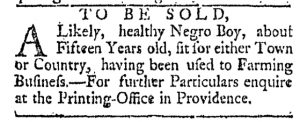
“TO BE SOLD, A likely, healthy, Negro Boy”

Slave Sales in the North! I would like to highlight the location of this advertisement regarding a slave for sale: Providence, Rhode Island, a port city in one of the northernmost of the thirteen American colonies. When I initially saw that a Providence newspaper was advertising slavery, I felt very confused; my initial assumption was that slavery really did not exist all that much in the north, much less was advertised in newspapers. Upon further research, I discovered that slavery was very pivotal in colonial Rhode Island. By the mid 1700s, the time this advertisement was published, Rhode Island had the largest percentage of blacks in its population compared to other northern colonies.

Business was one of the reasons why there was a spike in slavery in Rhode Island. Local merchants participated in the flourishing transatlantic slave trade and benefited from trade with the West Indies, the source of rum and other goods. However, in the years after this advertisement Rhode Island saw a push for emancipation of slavery. Christy Mikel Clark-Pujara writes, “The state emancipated Revolutionary War soldiers in 1778, and the gradual emancipation law freed children born to slave mothers after 1784.”[1] Despite the business some hoped to continue, Rhode Island passed gradual emancipation laws in the spirit of the Revolution.

**********

ADDITIONAL COMMENTARY: Carl Robert Keyes

Shannon expressed her surprise at learning that slaves lived and worked in northern colonies, that they were bought and sold and advertised in newspapers. She certainly was not my first student to experience such surprise. For my part, I was not surprised to find out about her surprise. Instead, I expected it because I am well aware of one of the most common misconceptions concerning slavery in early America. Most Americans tend to write history backwards when it comes to slavery. They know that slavery was a “peculiar institution” in the South in the decades before the Civil War. That leads them to erroneously assume that slavery was never practiced in northern colonies and states. Historians, however, with their attention to change over time, challenge that misconception.

When I originally designed the Slavery Adverts 250 Project as a companion to the Adverts 250 Project, I intended it to be a collaborative project undertaken with students in my classes. Rather than simply tell them about slavery in New England and the Middle Atlantic, I wanted them to discover its presence on their own as they engaged with primary sources. Rather than hearing an abstract presentation about the ubiquity of slavery throughout the colonies, I wanted them to see advertisements for slaves, such as today’s advertisement for “A Likely, healthy Negro Boy,” printed along side news and advertisements for various other sorts of commerce. I hoped that participating in the research process would cement their understanding of the scope of slavery in colonial and Revolutionary America.

Shannon and others have reported that was indeed the case. Consider the advertisement Shannon selected to examine today in the context of all the advertisements concerning slavery placed in American newspapers during the week of April 9-15, 1767. Two appeared in the Providence Gazette. Another two were printed in the New-Hampshire Gazette. A total of five were distributed among three newspapers printed in Boston. Another fifteen were inserted in newspapers in the Middle Colonies. Overall, twenty-one out of sixty-one advertisements concerning slaves printed during that week appeared in newspapers in northern colonies. Even though the total population of slaves in those colonies was small compared to the Chesapeake and Lower South, the advertisements provide striking evidence of their presence. Whether on a plantation or in an urban port, bondage was still bondage for the “Likely, healthy Negro Boy” in today’s advertisement.

**********

[1] Christy Mikel Clark-Pujara, “Slavery, Emancipation and Black Freedom in Rhode Island, 1652-1842” (PhD diss., University of Iowa, 2009), 4.
Slavery Advertisements Published April 11, 1767

GUEST CURATOR:  Jonathan Bisceglia

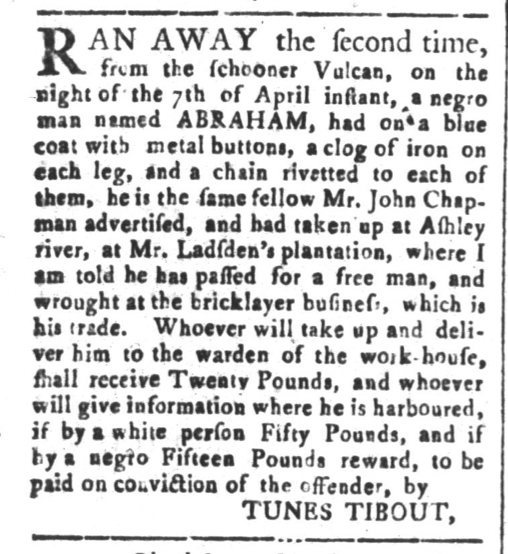
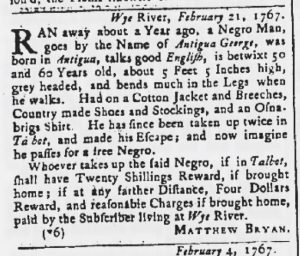
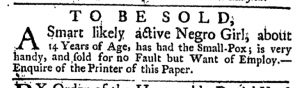
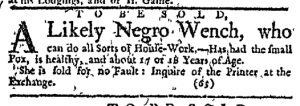
The Slavery Adverts 250 Project chronicles the role of newspaper advertising in perpetuating slavery in the era of the American Revolution. The project seeks to reveal the ubiquity of slavery in eighteenth-century life from New England to Georgia by republishing advertisements about enslaved people – for sale as individuals or in groups, wanted to purchase or for hire for short periods, runaways who liberated themselves, and those who were subsequently captured and confined in jails and workhouses – in daily digests on this site as well as in real time via the @SlaveAdverts250 Twitter feed, utilizing twenty-first-century media to stand in for the print media of the eighteenth century.

The project aims to provide modern audiences with a sense of just how often colonizers encountered these advertisements in their daily lives. Enslaved men, women, and children appeared in print somewhere in the colonies almost every single day. Those advertisements served as a constant backdrop for social, cultural, economic, and political life in colonial and revolutionary America. Colonizers who did not purport to own enslaved people were still confronted with slavery as well as invited to maintain the system by purchasing enslaved men, women, and children or assisting in the capture of so-called “runaways” who sought to free themselves from bondage. The frequency of these newspaper advertisements suggests just how embedded slavery was in colonial and revolutionary American culture in everyday interactions beyond the printed page.

These advertisements also testify to the experiences of enslaved men, women, and children, though readers must consider that those experiences have been remediated through descriptions offered by enslavers rather than enslaved people themselves. Often unnamed in the advertisements, enslaved men, women, and children were not invisible or unimportant in early America.

These advertisements appeared in colonial American newspapers 250 years ago today.

Apr 11 - Providence Gazette Slavery 1
Providence Gazette (April 11, 1767).

**********

Apr 11 - Providence Gazette Slavery 2
Providence Gazette (April 11, 1767).

April 10

GUEST CURATOR: Shannon Dewar

What was advertised in a colonial American newspaper 250 years ago today?

Apr 10 - 4:10: 1767 Massachusetts Gazette
Massachusetts Gazette (April 10, 1767).

“Wm Jackson at the Brazen Head.”

Bang Bang: Bad Business in Boston! In reading this advertisement and delving deeper into who exactly “Wm Jackson” was, I discovered that he was a very controversial merchant in Boston. He owned a store and sold a variety of imported British products ranging from gun powder (as seen in this advertisement) to linens and silk to brass and iron hardware. The store “at the Brazen Head” was conveniently located next to the Old State House in Boston, making it a prime location for consumers, but also a place of heightened revolutionary fervor. After a successful career prior to the Revolutionary era, Jackson, a Loyalist, was in for a contentious atmosphere with patriotic local merchants and consumers.

At the time this advertisement was posted, Jackson was on the verge of causing controversy with his business. The Townsend Acts were passed in 1767, resulting in boycotts made by other businessmen in Boston. This reflected poorly on Jackson, who decided not to take part in these political statements and continued his store’s importation of British goods. This strategy did not benefit Jackson in the end. After attempting to flee Boston at the beginning of the American Revolution and getting captured by an American privateer, he was brought back to city and jailed. Later, he was banished for the rest of his life.

**********

ADDITIONAL COMMENTARY: Carl Robert Keyes

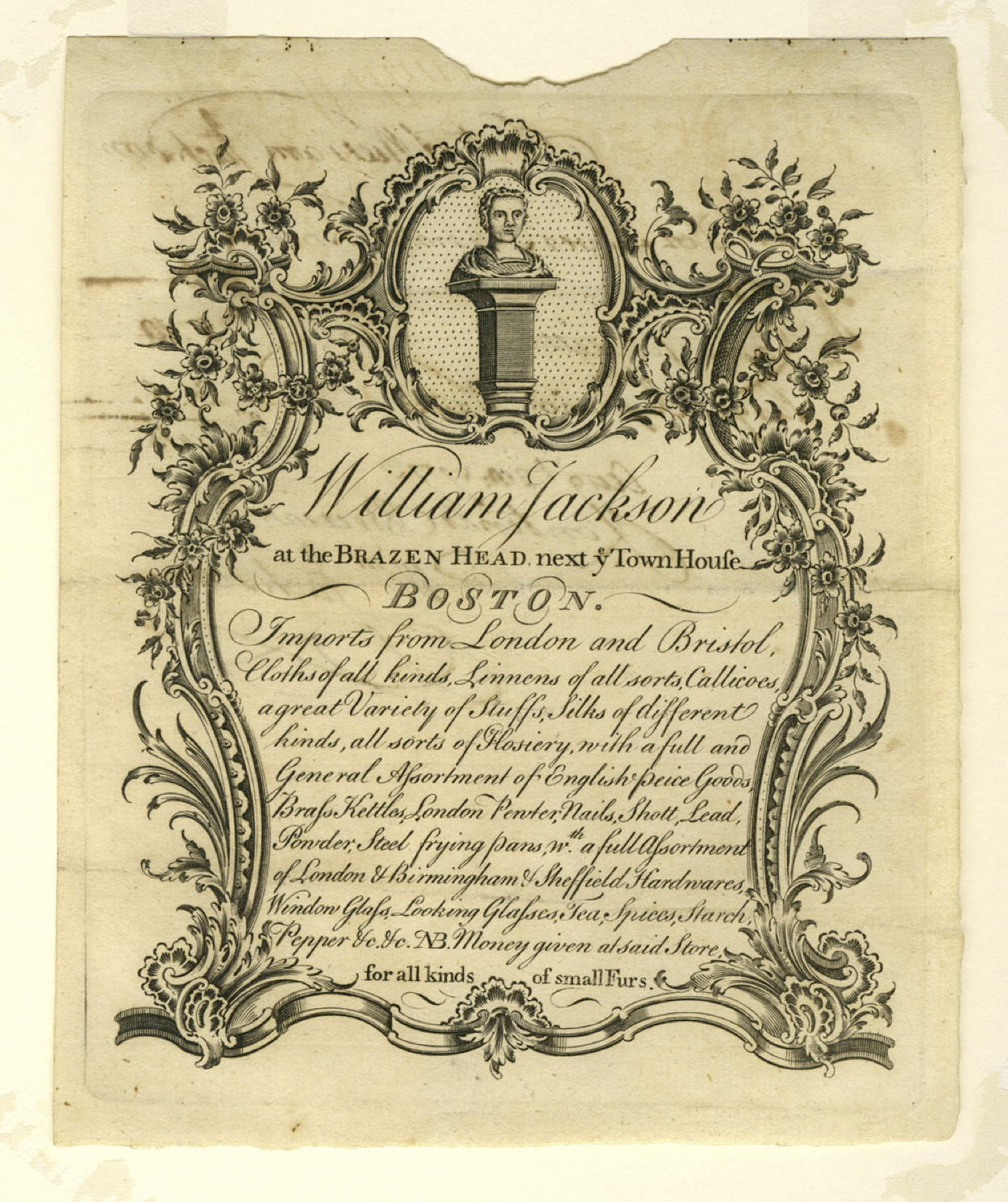
William Jackson regularly advertised in Boston’s newspapers in the 1760s and 1770s, but, like many other colonial merchants and shopkeepers, he did not confine his marketing efforts to newspaper advertising alone. Industrious entrepreneurs distributed various advertising ephemera in eighteenth-century America, including trade cards, billheads, broadsides, catalogs, and circular letters. In striking contrast to the newspaper advertisement Shannon chose to feature today, Jackson commissioned an elaborate trade card that listed the “General Assortment” of merchandise that he imported from London and Bristol.

Apr 10 - William Jackson Trade Card
William Jackson distributed this trade card engraved by Paul Revere.  Courtesy American Antiquarian Society.

Jackson’s trade card resembled many others popular in London, other English cities, and urban ports in the colonies in the middle decades of the eighteenth century. A vignette of a bust and pedestal made of brass – a brazen head – appeared in a decorative cartouche at the top of the card. An ornate Chippendale border enclosed the list of goods Jackson sold. Although some American advertisers ordered engraved images of this sort from artists in London, a local artisan engraved Jackson’s trade card. That artisan was none other than the famous patriot, Paul Revere. Jackson and Revere may not have agreed on much when it came to politics, but the two men managed to put aside their differences at least long enough to produce one of the most stunning examples of pre-Revolutionary advertising ephemera that has survived into the twenty-first century.

According to the American Antiquarian Society’s catalog record for Jackson’s trade card, it dates to 1769. By then Jackson’s political leanings were certainly known, especially since he refused to sign a nonimportation agreement in protest of the Townshend Acts that most of his competitors in Boston had signed in August 1768. Like others who distributed trade cards, Jackson doled his out to customers over several years. The trade card in the Paul Revere Collection at the American Antiquarian Society has a receipted bill signed by Jackson and dated August 20, 1773, on the reverse. By that time, given the events that had unfolded in Boston during the past four years, Jackson and Revere may have refused to undertake any more business with each other. That did not stop the loyalist Jackson, however, from promoting his own business by continuing to distribute the beautiful trade card engraved by the patriot Revere.

Slavery Advertisements Published April 10, 1767

GUEST CURATOR:  Jonathan Bisceglia

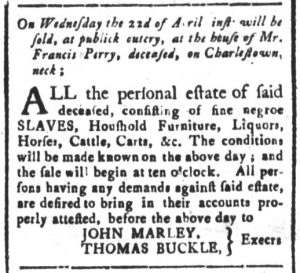
The Slavery Adverts 250 Project chronicles the role of newspaper advertising in perpetuating slavery in the era of the American Revolution. The project seeks to reveal the ubiquity of slavery in eighteenth-century life from New England to Georgia by republishing advertisements about enslaved people – for sale as individuals or in groups, wanted to purchase or for hire for short periods, runaways who liberated themselves, and those who were subsequently captured and confined in jails and workhouses – in daily digests on this site as well as in real time via the @SlaveAdverts250 Twitter feed, utilizing twenty-first-century media to stand in for the print media of the eighteenth century.

The project aims to provide modern audiences with a sense of just how often colonizers encountered these advertisements in their daily lives. Enslaved men, women, and children appeared in print somewhere in the colonies almost every single day. Those advertisements served as a constant backdrop for social, cultural, economic, and political life in colonial and revolutionary America. Colonizers who did not purport to own enslaved people were still confronted with slavery as well as invited to maintain the system by purchasing enslaved men, women, and children or assisting in the capture of so-called “runaways” who sought to free themselves from bondage. The frequency of these newspaper advertisements suggests just how embedded slavery was in colonial and revolutionary American culture in everyday interactions beyond the printed page.

These advertisements also testify to the experiences of enslaved men, women, and children, though readers must consider that those experiences have been remediated through descriptions offered by enslavers rather than enslaved people themselves. Often unnamed in the advertisements, enslaved men, women, and children were not invisible or unimportant in early America.

These advertisements appeared in colonial American newspapers 250 years ago today.

Apr 10 - New-Hampshire Gazette Slavery 1
New-Hampshire Gazette (April 10, 1767).

**********

Apr 10 - New-Hampshire Gazette Slavery 2
New-Hampshire Gazette (April 10, 1767).

**********

Apr 10 - South-Carolina and American General Gazette Slavery 1
South-Carolina and American General Gazette (April 10, 1767).

**********

Apr 10 - South-Carolina and American General Gazette Slavery 2
South-Carolina and American General Gazette (April 10, 1767).

**********

Apr 10 - South-Carolina and American General Gazette Slavery 3
South-Carolina and American General Gazette (April 10, 1767).

**********

Apr 10 - South-Carolina and American General Gazette Slavery 4
South-Carolina and American General Gazette (April 10, 1767).

**********

Apr 10 - South-Carolina and American General Gazette Slavery 5
South-Carolina and American General Gazette (April 10, 1767).

**********

Apr 10 - South-Carolina and American General Gazette Slavery 6
South-Carolina and American General Gazette (April 10, 1767).

**********

Apr 10 - South-Carolina and American General Gazette Slavery 7
South-Carolina and American General Gazette (April 10, 1767).

**********

Apr 10 - South-Carolina and American General Gazette Slavery 8
South-Carolina and American General Gazette (April 10, 1767).

**********

Apr 10 - South-Carolina and American General Gazette Slavery 9
South-Carolina and American General Gazette (April 10, 1767).

April 9

GUEST CURATOR: Shannon Dewar

What was advertised in a colonial American newspaper 250 years ago today?

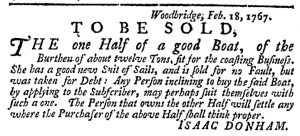
Apr 9 - 4:9:1767 New-York Gazette Weekly Post-Boy
New-York Gazette: Or, the Weekly Post-Boy (April 9, 1767).

“TO BE SOLD, THE one Half of a good Boat.”

In many of the newspapers I looked through for this week, the sale of ships really struck me as a common trend, including this advertisement from Woodbridge, Connecticut. That town is located next to New Haven, which is located directly on the Long Island Sound. This made is a great location for coasting into New York and doing business there. This form of commerce was part of what historians call coastal trading. Rather than investing in transatlantic voyages between the colonies and England, many merchants focused on moving goods between the colonies, up and down the North American coast. In The Economy of Colonial America, Edward J. Perkins states, “[T]he real strength of the colonial economy was its prodigious agricultural production for local consumption and urban centers. The value of good and services for strictly internal consumption outweighed by far the volume of colonial exports.”[1]

Perkins states, “Colonial shipowners were also permitted to participate fully in the empire’s North Atlantic trade. Along with shipowners in the mother country’s they enjoy protection inside the empire from competition with the Dutch, French, Spanish and other outsiders.”[2] This allowed a growing coastal trade to develop. In addition, due to limited roadways and other means of transportation on the mainland, coastal trading provided an efficient alternative for colonists to move goods and earn money.

**********

ADDITIONAL COMMENTARY: Carl Robert Keyes

During the initial round of selecting advertisements to examine during her week as guest curator of the Adverts 250 Project, Shannon chose several that announced ships for sale. Among those, Isaac Donham’s notice was unique in that he sold only “one Half of a good Boat … fit for the coasting Business” rather than ownership of an entire vessel. Donham explained that the “Person that owns the other Half will settle any where the Purchaser of the above Half shall think proper.” For all intents and purposes, Donham was selling a stake in a partnership with another colonial merchant.

As Shannon explains, coastal trading offered opportunities for some colonists to acquire significant wealth, but that did not mean that anyone who dabbled in moving goods between the colonies was guaranteed financial success. Coastal traders needed to be savvy entrepreneurs – and a little bit of luck never hurt anyone pursuing business opportunities. Acquiring goods to import and export among colonies represented a significant investment itself. Many merchants paid to have their goods transported on vessels owned and operated by others who regularly advertised freight services in colonial newspapers. Some of the most affluent colonial merchants sought to reduce those expenses by investing in their own ships. For those who could not afford to do this on their own, forming a partnership with one or more other merchants became a viable alternative.

Whatever the circumstances, one of Donham’s associates found himself in over his head, unable to pay his bills. He promised that there was nothing wrong with the vessel itself (“sold for no Fault”); instead, it had been “taken for Debt.” Donham apparently did not wish to operate the vessel in partnership with the “Person that owns the other Half,” preferring to sell the stake he had acquired when seizing the ship and recoup the funds owed to him. Participating in commerce in the colonies presented many opportunities for economic advancement, but with those opportunities came risks and, sometimes, failures. The matter-of-fact language in today’s featured advertisement disguised a drama that unfolded around one unfortunate merchant, his family, and his associates.

**********

[1] Edward J. Perkins, The Economy of Colonial America, 2nd ed. (New York: Columbia University Press, 1988), 43.

[2] Perkins, Economy of Colonial America, 41.

Welcome, Guest Curator Shannon Dewar

Shannon Dewar is a junior at Assumption College in Worcester, Massachusetts. She is majoring in History with minors in Education and Psychology. Her career goals include pursuing a master’s degree in Higher Education and Student Affairs in hopes of working in a university setting. On campus, she works as a resident assistant, Admissions Ambassador, and, most recently, as an intern for the Dean of Campus Life. Her favorite historical topics include imperialism, the Revolutionary War, and the Cold War.

Welcome, Shannon Dewar!

Slavery Advertisements Published April 9, 1767

GUEST CURATOR:  Jonathan Bisceglia

The Slavery Adverts 250 Project chronicles the role of newspaper advertising in perpetuating slavery in the era of the American Revolution. The project seeks to reveal the ubiquity of slavery in eighteenth-century life from New England to Georgia by republishing advertisements about enslaved people – for sale as individuals or in groups, wanted to purchase or for hire for short periods, runaways who liberated themselves, and those who were subsequently captured and confined in jails and workhouses – in daily digests on this site as well as in real time via the @SlaveAdverts250 Twitter feed, utilizing twenty-first-century media to stand in for the print media of the eighteenth century.

The project aims to provide modern audiences with a sense of just how often colonizers encountered these advertisements in their daily lives. Enslaved men, women, and children appeared in print somewhere in the colonies almost every single day. Those advertisements served as a constant backdrop for social, cultural, economic, and political life in colonial and revolutionary America. Colonizers who did not purport to own enslaved people were still confronted with slavery as well as invited to maintain the system by purchasing enslaved men, women, and children or assisting in the capture of so-called “runaways” who sought to free themselves from bondage. The frequency of these newspaper advertisements suggests just how embedded slavery was in colonial and revolutionary American culture in everyday interactions beyond the printed page.

These advertisements also testify to the experiences of enslaved men, women, and children, though readers must consider that those experiences have been remediated through descriptions offered by enslavers rather than enslaved people themselves. Often unnamed in the advertisements, enslaved men, women, and children were not invisible or unimportant in early America.

These advertisements appeared in colonial American newspapers 250 years ago today.

Apr 9 - Maryland Gazette Slavery 1
Maryland Gazette (April 9, 1767).

**********

Apr 9 - Maryland Gazette Slavery 2
Maryland Gazette (April 2, 1767).

**********

Apr 9 - Maryland Gazette Slavery 3
Maryland Gazette (April 9, 1767).

**********

Apr 9 - Maryland Gazette Slavery 4
Maryland Gazette (April 9, 1767).

**********

Apr 9 - New-York Gazette Weekly Post-Boy Slavery 1
New-York Gazette: Or, the Weekly Post-Boy (April 9, 1767).

**********

Apr 9 - New-York Journal Slavery 1
New-York Journal (April 9, 1767).

**********

Apr 9 - New-York Journal Slavery 2
New-York Journal (April 9, 1767).

**********

Apr 9 - Pennsylvania Gazette Slavery 1
Pennsylvania Gazette (April 9, 1767).

**********

Apr 9 - Pennsylvania Gazette Slavery 2
Pennsylvania Gazette (April 9, 1767).

**********

Apr 9 - Pennsylvania Gazette Slavery 3
Pennsylvania Gazette (April 9, 1767).

**********

Apr 9 - Virginia Gazette Slavery 1
Virginia Gazette (April 9, 1767).

**********

Apr 9 - Virginia Gazette Slavery 2
Virginia Gazette (April 9, 1767).

**********

Apr 9 - Virginia Gazette Slavery 3
Virginia Gazette (April 9, 1767).

**********

Apr 9 - Virginia Gazette Slavery 4
Virginia Gazette (April 9, 1767).

**********

Apr 9 - Virginia Gazette Slavery 5
Virginia Gazette (April 9, 1767).

Reflections from Guest Curator Megan Watts

Guest curating the Adverts 250 Project again was a very rewarding experience. I am always blown away by how much we can learn about a society or era by examining a few historical documents. Over the course of the project this semester I learned a lot of new things. One of my advertisements featured “West Indian Rum.” I was aware of the importance of the transatlantic trade to the American colonies, but I did not know how important rum was to local economies. Rum and molasses (a derivative of rum) were in great demand. Thus, businesses sprung up to buy rum and turn it into molasses; this helped support local communities. In addition, another advertisement I found was focused on equipment needed for whaling, including “whale boats” among other things. Before reading that advertisement I was, quite frankly, unaware that whaling was a lucrative trade in New England prior to the 1800s. I am always pleasantly surprised in the new information I gather from the research in this project. Even advertisements that I did not use for the project also expanded my knowledge of the colonial and revolutionary era. While browsing newspapers, advertisements placed by women stuck out to me, as they were fairly uncommon.

There were, of course, some challenges this time around. Some advertisements were much shorter in length, which made composing an analysis more challenging. Also choosing unique and diversified advertisements required a good amount of discernment and research skills. However, since it was my second time curating this project, there were some elements that were easier than my first curating experience. At this point, I was able to navigate the online newspaper databases in a much more efficient manner. Also, this time around I had a better idea of where to find my secondary sources. Last semester I relied heavily on one database. But this semester I drew articles from JSTOR, Colonial Williamsburg, and the New Bedford Whaling Museum. I also had the experience to know that economic journals sometimes yielded pertinent information even though they may not sound useful for a project focusing on colonial society. One such journal that I used for secondary articles was the Journal of Economic History.  My prior experience with this project helped me improve the skills I needed as guest curator this semester.

As always, the very nature of this project taught me to really look at the past with an open mind and to overcome assumptions. Over the course of guest curating for this week, I have learned more about the whaling timeline in America and also challenged my ideas about currency and monetary transactions in the 1700s. This are important realizations which deepen my understanding of America’s history and how today’s society was built on the realities of colonial and Revolutionary America.

I would have to say that my favorite part of this project is sharing the end product with other students and scholars via the website. Instead of just handing in a paper to a professor or doing a presentation in class, I actually get to contribute to historical analysis in the real world, and not just my college classroom.  Overall, my involvement with the Adverts 250 Project has granted me valuable insights into colonial and Revolutionary America. It has also granted me important experience working with online historical databases and secondary sources. I enjoyed my time working on the Adverts 250 Project. I wish all future good luck to all future guest curators.

April 8

GUEST CURATOR: Megan Watts

What was advertised in a colonial American newspaper 250 years ago today?

Apr 8 - 4:8:1767 Georgia Gazette
Georgia Gazette (April 8, 1767).

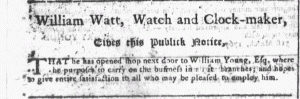
“William Watt, Watch and Clock-maker.”

I chose this advertisement because it addressed a unique occupation: clockmaking. Despite my time guest curating the Adverts 250 Project for two weeks, this advertisement surprised me. I had not seen many advertisements for clocks or clockmakers. However, I learned that timekeeping objects have had a long held place in society. Having impressive timepieces has meant something throughout most of American history. Think of society today. If someone has a Rolex or Movado, it is often thought of as symbol of wealth and sophistication. Similarly, if someone in the seventeenth or eighteenth century had an ornate freestanding clock, it was also seen as a status symbol. When I initially discovered this advertisement, I assumed that only the wealthiest colonists would be able to afford clocks, but Cathryn J. McElroy discusses the range of citizens who owned clocks in one eighteenth-century city, describing them as coming from “a wide range of economic and social status.”[1] Watches and clocks were owned by elite colonists, but also by those from the middling ranks. This made me reconsider which items consistently indicated status in colonial America and which did not.

[1]Cathryn J. McElroy, “Furniture in Philadelphia: The First Fifty Years,” Winterthur Portfolio 13 (1979): 78.

Slavery Advertisements Published April 8, 1767

GUEST CURATOR:  Ceara Morse

The Slavery Adverts 250 Project chronicles the role of newspaper advertising in perpetuating slavery in the era of the American Revolution. The project seeks to reveal the ubiquity of slavery in eighteenth-century life from New England to Georgia by republishing advertisements about enslaved people – for sale as individuals or in groups, wanted to purchase or for hire for short periods, runaways who liberated themselves, and those who were subsequently captured and confined in jails and workhouses – in daily digests on this site as well as in real time via the @SlaveAdverts250 Twitter feed, utilizing twenty-first-century media to stand in for the print media of the eighteenth century.

The project aims to provide modern audiences with a sense of just how often colonizers encountered these advertisements in their daily lives. Enslaved men, women, and children appeared in print somewhere in the colonies almost every single day. Those advertisements served as a constant backdrop for social, cultural, economic, and political life in colonial and revolutionary America. Colonizers who did not purport to own enslaved people were still confronted with slavery as well as invited to maintain the system by purchasing enslaved men, women, and children or assisting in the capture of so-called “runaways” who sought to free themselves from bondage. The frequency of these newspaper advertisements suggests just how embedded slavery was in colonial and revolutionary American culture in everyday interactions beyond the printed page.

These advertisements also testify to the experiences of enslaved men, women, and children, though readers must consider that those experiences have been remediated through descriptions offered by enslavers rather than enslaved people themselves. Often unnamed in the advertisements, enslaved men, women, and children were not invisible or unimportant in early America.

These advertisements appeared in colonial American newspapers 250 years ago today.

Apr 8 - Georgia Gazette Slavery 1
Georgia Gazette (April 8, 1767).

**********

Apr 8 - Georgia Gazette Slavery 2
Georgia Gazette (April 8, 1767).

**********

Apr 8 - Georgia Gazette Slavery 3
Georgia Gazette (April 8, 1767).

**********

Apr 8 - Georgia Gazette Slavery 4
Georgia Gazette (April 8, 1767).

**********

Apr 8 - Georgia Gazette Slavery 5
Georgia Gazette (April 8, 1767).