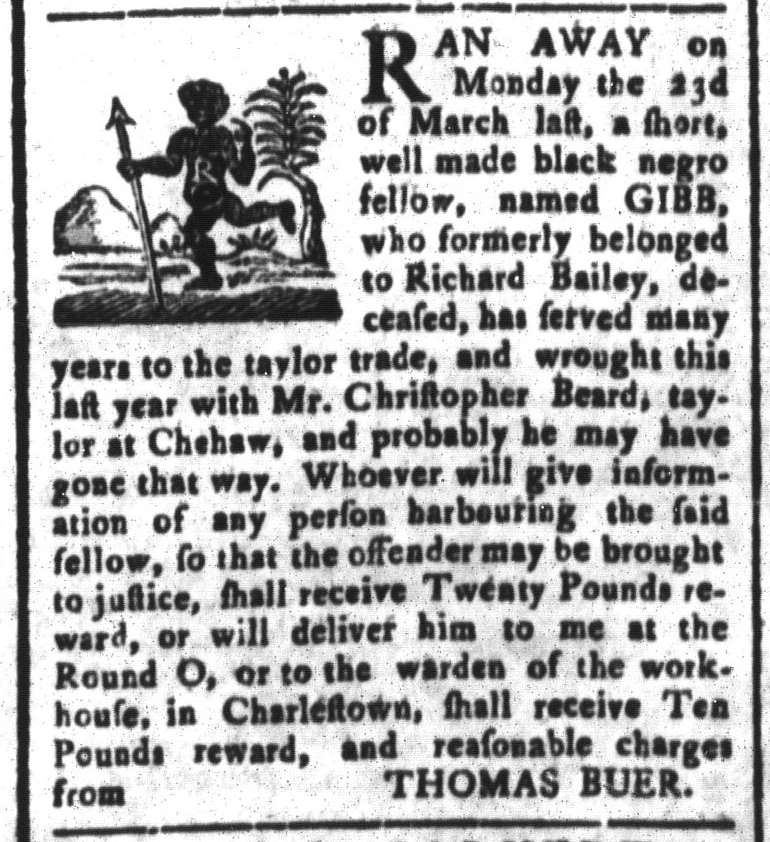
The Slavery Adverts 250 Project chronicles the role of newspaper advertising in perpetuating slavery in the era of the American Revolution. The project seeks to reveal the ubiquity of slavery in eighteenth-century life from New England to Georgia by republishing advertisements about enslaved people – for sale as individuals or in groups, wanted to purchase or for hire for short periods, runaways who liberated themselves, and those who were subsequently captured and confined in jails and workhouses – in daily digests on this site as well as in real time via the @SlaveAdverts250 Twitter feed, utilizing twenty-first-century media to stand in for the print media of the eighteenth century.
The project aims to provide modern audiences with a sense of just how often colonizers encountered these advertisements in their daily lives. Enslaved men, women, and children appeared in print somewhere in the colonies almost every single day. Those advertisements served as a constant backdrop for social, cultural, economic, and political life in colonial and revolutionary America. Colonizers who did not purport to own enslaved people were still confronted with slavery as well as invited to maintain the system by purchasing enslaved men, women, and children or assisting in the capture of so-called “runaways” who sought to free themselves from bondage. The frequency of these newspaper advertisements suggests just how embedded slavery was in colonial and revolutionary American culture in everyday interactions beyond the printed page.
These advertisements also testify to the experiences of enslaved men, women, and children, though readers must consider that those experiences have been remediated through descriptions offered by enslavers rather than enslaved people themselves. Often unnamed in the advertisements, enslaved men, women, and children were not invisible or unimportant in early America.
These advertisements appeared in colonial American newspapers 250 years ago today.
South-Carolina Gazette and Country Journal (April 21, 1767).
**********
South-Carolina Gazette and Country Journal (April 21, 1767).
**********
South-Carolina Gazette and Country Journal (April 21, 1767).
**********
South-Carolina Gazette and Country Journal (April 21, 1767).
**********
South-Carolina Gazette and Country Journal (April 21, 1767).
**********
South-Carolina Gazette and Country Journal (April 21, 1767).
**********
South-Carolina Gazette and Country Journal (April 21, 1767).
**********
South-Carolina Gazette and Country Journal (April 21, 1767).
**********
South-Carolina Gazette and Country Journal (April 21, 1767).
**********
South-Carolina Gazette and Country Journal (April 21, 1767).
**********
South-Carolina Gazette and Country Journal (April 21, 1767).
**********
South-Carolina Gazette and Country Journal (April 21, 1767).
What was advertised in a colonial American newspaper 250 years ago today?
Boston-Gazette (April 20, 1767).
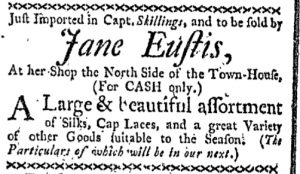
“A Large & beautiful assortment of Silks.”
Silk imports were common during the eighteenth century. According to Linda Baumgarten, Curator of Textiles at Colonial Williamsburg, “Many Virginia women favored gowns made of lustring, a crisp, light silk.” This is noteworthy because Jane Eustis ran a shop – and sold an “assortment of Silks” – in Boston and advertised in the Boston Gazette. This shows the far reach of the silk trade in eighteenth-century America. In “Baubles of Britain,” T.H. Breen presents the idea of standardization of consumer culture, seen here with the silks.[1]
Some people bought silks as a way to denote social status. In addition, much of the clothing worn in the American colonies was typically not light. In the warmer months this could cause many issues regarding the heat. Baumgarten notes, “One Virginia woman related in her diary that she did not bother to get dressed immediately on a particularly ‘sulterry’ day; she remained ‘up stairs in only shift and petticoat till after Tea.” This is fascinating because of the stark difference compared to modern ideas of modesty and appropriate ways to dress in the heat.
**********
ADDITIONAL COMMENTARY: Carl Robert Keyes
Jane Eustis advertised “Silks, Cap Laces, and a great Variety of other Goods.” Although she did not provide an extensive list of those “other Goods,” her advertisement concluded with a promise that “The Particulars of which will be in our next.” Why was Eustis’s advertisement truncated?
Perhaps Eustis had not had time to compile a list of “The Particulars.” Other advertisers, including William Fisher, indicated that their wares had “just arrived from LONDON” on the same vessel that carried Eustis’s merchandise. Instead of listing the goods, most offered some sort of variation of “A Fresh Assortment of English GOODS.” John Symmes, a goldsmith, did insert a short list, but his was very specialized merchandise of the sort that he might have placed detailed orders or may have otherwise known or anticipated in advance exactly what associates in London had shipped. Shopkeepers who carried general merchandise, like Eustis and Fisher, may not have known all “The Particulars” of what had been dispatched to them by contacts in London until they unpacked the crates and barrels. An initial advertisement for a “great Variety” of goods at least informed prospective customers that they carried new merchandise.
Alternately, Eustis may have submitted a longer advertisement to Edes and Gill, only to have the printers run out of space to print it in its entirety. While possible, that seems less likely given that Eustis’s advertisement appeared on the same page as another that extended more than a column. If Edes and Gill were rationing space, why not abbreviate Frederick William Geyer’s extensive list to free up room for at least some of Eustis’s “Particulars”? Even if the printers did not wish to displace Geyer, a regular advertiser, they could have shortened lengthy list advertisements placed by other shopkeepers. In addition, they also issued a two-page supplement with even more advertising for the week. This also suggests that Eustis had not yet generated the copy for “The Particulars” that were supposed to appear in the next issue.
A week later, no advertisement by Jane Eustis appeared in the Boston-Gazette. Two weeks later, that newspaper ran a new advertisement, though it lacked “The Particulars” that had been promised: “Just Imported in Capt. Skillings, and to be sold by Jane Eustis By Wholesale and Retail, at her Shop the North Side of the Town-House, A great Variety of India and English Goods.” By then Eustis certainly had a chance to compile a list of her new inventory. She may have decided that a shorter advertisement was sufficient for her purposes. She may have determined that a longer advertisement exceeded her budget and decided against it. Whatever the circumstances, her initial advertisement presented a bit of a mystery. It would be fascinating to know more about the factors that influenced Eustis’s decisions about advertising her wares.
**********
[1] T.H. Breen, “‘Baubles of Britain’: The American and Consumer Revolutions of the Eighteenth Century,” Past and Present 119 (May 1988): 73-104.
The Slavery Adverts 250 Project chronicles the role of newspaper advertising in perpetuating slavery in the era of the American Revolution. The project seeks to reveal the ubiquity of slavery in eighteenth-century life from New England to Georgia by republishing advertisements about enslaved people – for sale as individuals or in groups, wanted to purchase or for hire for short periods, runaways who liberated themselves, and those who were subsequently captured and confined in jails and workhouses – in daily digests on this site as well as in real time via the @SlaveAdverts250 Twitter feed, utilizing twenty-first-century media to stand in for the print media of the eighteenth century.
The project aims to provide modern audiences with a sense of just how often colonizers encountered these advertisements in their daily lives. Enslaved men, women, and children appeared in print somewhere in the colonies almost every single day. Those advertisements served as a constant backdrop for social, cultural, economic, and political life in colonial and revolutionary America. Colonizers who did not purport to own enslaved people were still confronted with slavery as well as invited to maintain the system by purchasing enslaved men, women, and children or assisting in the capture of so-called “runaways” who sought to free themselves from bondage. The frequency of these newspaper advertisements suggests just how embedded slavery was in colonial and revolutionary American culture in everyday interactions beyond the printed page.
These advertisements also testify to the experiences of enslaved men, women, and children, though readers must consider that those experiences have been remediated through descriptions offered by enslavers rather than enslaved people themselves. Often unnamed in the advertisements, enslaved men, women, and children were not invisible or unimportant in early America.
These advertisements appeared in colonial American newspapers 250 years ago today.
What was advertised in a colonial American newspaper 250 years ago this week?
South-Carolina and American General Gazette (April 17, 1767).
“A Genteel Lodging and Boarding for a single Gentleman, Enquire in Tradd-street, of JAMES KING.”
This is the entire advertisement from the South-Carolina and American General Gazette. However, this is why I picked it. Although only fourteen words, this advertisement poses a lot of questions, the most important being the usage of the word “genteel.” What did “genteel” mean in eighteenth-century America?
The Oxford English Dictionary states that genteel means “Belonging to or included among the gentry; of a rank above the commonalty.” Other definitions similarly state “Appropriate to persons of quality,” “characteristic of persons of quality,” and “suited to the station of a gentleman or gentlewoman.” When describing dwellings, food, meals, and hospitality – like the “Lodging and Boarding” in this advertisement – “genteel” means “Stylish, fashionably elegant or sumptuous.” This is important because it suggests that King advertised to someone who was looking for accommodations appropriate for his social ranking or perhaps even hoping to move up in status.
“Genteel” also referred to how people acted in addition to describing consumer goods and “Lodging and Boarding.” The Oxford English Dictionary also includes these definitions: “Having the habits characteristic of superior station” and “Of behavior: courteous, polite, obliging.” According to Cathy Hellier at Colonial Williamsburg, “Not only how something was said, but when it was said, were reflective of the social positions of the speakers.” This advertisement, regardless of its short length, shows the importance placed on social status in colonial and Revolutionary America.
**********
ADDITIONAL COMMENTARY: Carl Robert Keyes
Inviting undergraduates to serve as guest curators for the Adverts 250 Project opens up a variety of opportunities, not only for the students but also for me as an instructor and a scholar. Through their own efforts on the project, students often convince me to look at familiar material in new ways.
Take today’s featured advertisement. When Jonathan submitted it to me for consideration I told him that I would approve it because it fit within the parameters of the project and adhered to its methodology, but I also suggested that it seemed a bit sparse, especially compared to many of the more substantial advertisements that appeared in the same issue of the South-Carolina and American General Gazette. Although I approved King’s advertisement for “Lodging and Boarding,” I recommended that Jonathan consider alternatives and let him know that he could switch to another advertisement if he experienced too much difficulty examining this one. Jonathan assured me that he would find something interesting and significant to say about King’s advertisement. I was both curious and anxious when he began independently pursuing his research and writing the first draft of today’s entry. I had no idea how he might approach what appeared to be such a simple advertisement.
I was pleasantly surprised when Jonathan submitted his initial analysis of the advertisement. In focusing on a single word, “genteel,” he opened a portal to investigating eighteenth-century understandings of status, personal comportment, and social mobility. He originally relied solely on Cathy Hellier’s article, but I suggested that if he really wanted to understand the meaning of “genteel” in the eighteenth century that he also needed to incorporate the OED’s treatment of the word. This was a new source for Jonathan, at least as far as conducting historical research was concerned. In the following draft, he included one of the entries from the OED. Working together, we fleshed out his revised entry and better harnessed the OED’s extensive treatment of “genteel” to introduce readers to the many shades of meaning associated with the word in early America.
This was a learning experience for me as much as it was for Jonathan. I spend so much time examining eighteenth-century sources that the word “genteel” did not even register with me when I initially reviewed today’s advertisement. As a student interested but not immersed in early American history, on the other hand, Jonathan did not take “genteel” for granted. By training different eyes on the same advertisement, he raised important questions about an advertisement that turned out not to be as simple as I initially thought. In so doing, he implicitly made an argument that I regularly advance: advertisements that appear to be little more than notices often turn out to have layers of meaning and significance when examined more closely.
Who was the subject of an advertisement in a colonial American newspaper 250 years ago today?
Providence Gazette (April 18, 1767).
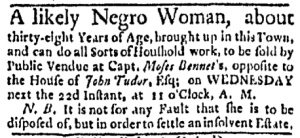
“A Negro Woman who understands all Sorts of houshold Work.”
I chose this advertisement because slavery in northern colonies and states is often overlooked when discussing slavery in American history. For the most part, slavery and the slave trade in the southern colonies get more attention. However, slavery was not only used in the northern colonies (see the census from 1774) but Rhode Island was also a hub for the slave trade. According to historians at the John Carter Brown Library, “Not only did Rhode Islanders have slaves—they had more per capita than any other New England state—but also entered with gusto into the trade.” Rhode Islanders gained so many profits from slavery that “[b]y the close of the eighteenth century, Rhode Islanders had mounted at least a thousand voyages from Africa to the Americas.” Voyages like these not only kept the institution of slavery going but encouraged it. I found this advertisement quite surprising, learning that slavery was so important so close to home.
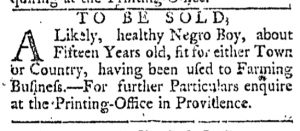
Recovering the lives of enslaved men, women, and children can be an extremely difficult task. Historians consult many different kinds of sources in their efforts to reconstruct the experiences of slaves, including advertisements like the one Jonathan selected to feature today. That advertisement offers frustratingly few details, but it does reveal the presence of an enslaved woman in Rhode Island. It includes her approximate age and suggests the type of labor she performed for her master, “all Sorts of houshold Work.” The advertisement does not, however, include the enslaved woman’s name nor the name of the slaveholder who wished to sell her. The conditions of the sale were camouflaged by instructions to interested parties: “For further Particulars enquire at the Printing-Office.” This advertisement appeared immediately below another one that revealed the presence of slavery in Rhode Island but advanced few details: “TO BE SOLD, A Likely, healthy Negro Boy, about Fifteen Years old, fit for either Town or Country, having been used to Farming Business.” It also concluded with instructions to “enquire at the Printing-Office in Providence.” Such advertisements aid historians in making generalizations about the experiences of enslaved men, women, and children, even in the absence of enough evidence to sketch more complete biographies.
On the other hand, other sorts of advertisements for slaves tell much more complete stories about their subjects. Advertisements for runaways frequently incorporated extensive descriptions of enslaved men, women, and children, from their physical appearance to their clothing to any goods they carried off. They elaborated on their ethnicity and the languages they spoke. They specified any special skills runaways possessed or trades they practiced. They revealed relationships within slave communities and among others, black and white, that might attempt to aid runaways. In some cases, they even told stories of previous attempts to abscond. Although written by white masters attempting to regain their human property, some scholars consider advertisements for runaways to be the first slave narratives. It would be difficult to deny the agency exhibited by slaves who chose to flee from those who kept them in bondage.
The Slavery Adverts 250 Project chronicles the role of newspaper advertising in perpetuating slavery in the era of the American Revolution. The project seeks to reveal the ubiquity of slavery in eighteenth-century life from New England to Georgia by republishing advertisements about enslaved people – for sale as individuals or in groups, wanted to purchase or for hire for short periods, runaways who liberated themselves, and those who were subsequently captured and confined in jails and workhouses – in daily digests on this site as well as in real time via the @SlaveAdverts250 Twitter feed, utilizing twenty-first-century media to stand in for the print media of the eighteenth century.
The project aims to provide modern audiences with a sense of just how often colonizers encountered these advertisements in their daily lives. Enslaved men, women, and children appeared in print somewhere in the colonies almost every single day. Those advertisements served as a constant backdrop for social, cultural, economic, and political life in colonial and revolutionary America. Colonizers who did not purport to own enslaved people were still confronted with slavery as well as invited to maintain the system by purchasing enslaved men, women, and children or assisting in the capture of so-called “runaways” who sought to free themselves from bondage. The frequency of these newspaper advertisements suggests just how embedded slavery was in colonial and revolutionary American culture in everyday interactions beyond the printed page.
These advertisements also testify to the experiences of enslaved men, women, and children, though readers must consider that those experiences have been remediated through descriptions offered by enslavers rather than enslaved people themselves. Often unnamed in the advertisements, enslaved men, women, and children were not invisible or unimportant in early America.
These advertisements appeared in colonial American newspapers 250 years ago today.
What was advertised in a colonial American newspaper 250 years ago today?
New-Hampshire Gazette (April 17, 1767).
“BEST London BOHEA TEA”
In this advertisement Henry Appleton promoted “BEST London BOHEA TEA.” According to Rachel Conroy at the Museum of Wales, “In the eighteenth century tea-drinking was a highly fashionable activity for the wealthy upper classes.” The idea that a drink initially denoted the elite is not surprising due to the exotic nature of the beverage. Tea was transported from China to England and then to the colonies, a notably long haul. Conroy also states “The most common tea was Bohea, a type of black tea.”
In “Baubles of Britain,” T.H. Breen indicates that tea drinking eventually became popular among a wide variety of social classes. As the eighteenth century progressed, more social classes also began to consume the beverage. To further demonstrate consumption across the classes, Breen brings up the political ramifications of the tea being sold. It became a major “bone of contention” for the colonists because of the new importation taxes on the product as part of the Townsend Acts in 1767. This led to one of the largest boycotts throughout the thirteen colonies and eventually to the dumping of tea into Boston Harbor. This advertisement examplifies how this product was sold far and wide in the colonies.
**********
ADDITIONAL COMMENTARY: Carl Robert Keyes
In addition to tea, Henry Appleton sold a variety of grocery items and “West India Good[s]” at “his Shop next Door to Robert Traill” in Portsmouth, New Hampshire. Although he marketed the tea most vigorously – listing it first, describing it as “BEST,” and inserting a nota bene promising that “The above Tea is warranted of the best kind” – Appleton also sold “Loaf Sugar.” Consumers used sugar for many purposes. Sweetening tea was one of them, making it natural that the shopkeeper advertised the two together.
Jonathan mentions the political controversies that coalesced around tea in the decade before the Revolution. Colonists objected to new taxes and enforcement mechanisms, decrying their loss of liberty at the hands of Parliament. More than any other commodity, historians use tea to tell a powerful story of the imperial crisis that culminated in the American Revolution. In recent years many scholars have widened the scope of that story, effectively linking tea to other commodities associated with it, especially the “Loaf Sugar” that Appleton simultaneously peddled.
Consumers in colonial New Hampshire were fairly far removed from slavery practiced on the same scale as in the Chesapeake, Lower South, and Caribbean. A relatively small number of slaves lived in their towns (including “A likely Negro GIRL” offered for sale in an advertisement in the column to the right of Appleton’s notice), but the economy of colonial New Hampshire did not rely on the cultivation of staple crops on plantations, cultivation made possible by the productive labor of slaves.
Even though that was the case, colonists in New Hampshire were bound up in the system of slavery through commerce and their choices as consumers. The sugar they used to sweeten the tea they coveted resulted from the involuntary labor of enslaved men and women on faraway plantations. The social rituals that emanated from purchasing tea and ancillary goods, such as elaborate tea sets, rested on a foundation of enslaved labor in the cultivation of sugar. Even as Americans clamored for liberty in the face of Parliament meddling in colonial commerce, their consumer choices maintained an economic system that denied liberty to enslaved men and women who produced some of their most valued commodities.
The Slavery Adverts 250 Project chronicles the role of newspaper advertising in perpetuating slavery in the era of the American Revolution. The project seeks to reveal the ubiquity of slavery in eighteenth-century life from New England to Georgia by republishing advertisements about enslaved people – for sale as individuals or in groups, wanted to purchase or for hire for short periods, runaways who liberated themselves, and those who were subsequently captured and confined in jails and workhouses – in daily digests on this site as well as in real time via the @SlaveAdverts250 Twitter feed, utilizing twenty-first-century media to stand in for the print media of the eighteenth century.
The project aims to provide modern audiences with a sense of just how often colonizers encountered these advertisements in their daily lives. Enslaved men, women, and children appeared in print somewhere in the colonies almost every single day. Those advertisements served as a constant backdrop for social, cultural, economic, and political life in colonial and revolutionary America. Colonizers who did not purport to own enslaved people were still confronted with slavery as well as invited to maintain the system by purchasing enslaved men, women, and children or assisting in the capture of so-called “runaways” who sought to free themselves from bondage. The frequency of these newspaper advertisements suggests just how embedded slavery was in colonial and revolutionary American culture in everyday interactions beyond the printed page.
These advertisements also testify to the experiences of enslaved men, women, and children, though readers must consider that those experiences have been remediated through descriptions offered by enslavers rather than enslaved people themselves. Often unnamed in the advertisements, enslaved men, women, and children were not invisible or unimportant in early America.
These advertisements appeared in colonial American newspapers 250 years ago today.
New-Hampshire Gazette (April 17, 1767).
**********
South-Carolina and American General Gazette (April 17, 1767).
**********
South-Carolina and American General Gazette (April 17, 1767).
**********
South-Carolina and American General Gazette (April 17, 1767).
**********
South-Carolina and American General Gazette (April 17, 1767).
**********
South-Carolina and American General Gazette (April 17, 1767).
**********
South-Carolina and American General Gazette (April 17, 1767).
**********
South-Carolina and American General Gazette (April 17, 1767).
What was advertised in a colonial American newspaper 250 years ago today?
Massachusetts Gazette (April 16, 1767).
“A Fresh Assortment of English GOODS.”
American colonists loved British goods! This gave many a sense of national pride, but some also believed that these goods gave them a boost in status. According to the public historians at Colonial Williamsburg, “As society became more mobile, houses, land, and livestock alone no longer communicated social rank. By the end of the seventeenth century, ordinary men and women began to demand consumer goods that indicated their status.” These were the roots of the consumer revolution in eighteenth-century America. “Items that once were considered luxuries reserved for the highest ranks began to ‘trickle down’ to common households.” Starting in the late seventeenth century and throughout the eighteenth century Americans purchased greater amounts of goods, such as those among the “Fresh Assortment of English GOODS” advertised by Joshua Gardner and Company. The shopkeepers may have realized the demand for these imported goods and not considered it necessary to write much about them. This advertisement demonstrates increased demand for consumer goods which became easier for all social classes – elites, middling and poorer sorts, “and occasionally even slaves” – to attain in the American colonies.
**********
ADDITIONAL COMMENTARY: Carl Robert Keyes
Jonathan’s analysis of Joshua Gardner and Company’s advertisement represents a popular interpretation of the cause of the consumer revolution. Many historians and other scholars argue that incipient demand fueled the expansion of purchasing, possessing, and displaying a vast array of goods by many different sorts of consumers in the British Atlantic world in the eighteenth century. Producers, suppliers, and retailers merely responded to the desires and demands of customers that ranked not only among the elite but also the middling sort and others who purchased what they could acquire when they could afford it (and, thanks to networks of credit, sometimes even when they could not yet afford it).
Today’s advertisement certainly lends that impression. After all, it seems to do little more than announce that Gardner and Company sold imported English goods. William Greenleaf’s advertisement, immediately above it, appeared almost identical. It informed customers that he stocked “A Fresh Assortment of Goods” imported on the same ship that carried Gardner and Company’s inventory. William Fisher’s advertisement, immediately below, stated that he sold “A General Assortment of English GOODS,” also imported “in Capt. Jenkins, who is just arrived from LONDON.” Some argue that such advertisements, which might better be described as notices given that they seem to merely announce the availability of goods that consumers already wanted, could be used to make convincing arguments about the importance of demand as the primary cause of the consumer revolution.
Doing so, however, overlooks both the innovative marketing efforts to incite demand that regularly appeared in eighteenth-century newspapers (and via other advertising ephemera, including trade cards, bill heads, catalogs, broadsides, magazine wrappers, circular letters, subscription notices, and furniture labels) and aspects of Gardner and Company’s advertisement not apparent at first glance.
For instance, note that Gardner and Company indicate their “Fresh Assortment” was imported “In the Hawk, Capt. Jenkins, from LONDON.” According to the shipping news on the previous page, the Hawk had arrived in port within the past week. Gardner and Company (as well as Greenleaf and Fisher) may not have had time to unpack all their new wares or write more extensive copy, but they did rush to Richard Draper’s printing office to have their advertisements inserted as quickly as possible. Rather than simply announce they carried goods that colonists already desired, these advertisers attempted to incite demand by noting that they sold the most current fashions and housewares from the cosmopolitan center of the empire. Furthermore, Gardner and Company engaged in other marketing efforts in their short advertisement. Promising an “Assortment” promoted consumer choice. Invoking low prices helped to convince potential customers to make purchases.
Jonathan and I place different emphasis on the importance of consumer demand in the eighteenth century. Drawing on one strand of scholarship, arguably the more prominent one, he asserts that Gardner and Company’s advertisement reacted to existing demand. That very well may have been the case, but I argue that certain aspects suggest that the shopkeepers also worked to create demand. More generally, advertising played a significant role in inciting demand throughout the eighteenth century. Early American merchants, shopkeepers, and others who produced and sold goods encouraged potential customers to desire their wares.
Jonathan Bisceglia is a sophomore double majoring in History and Education at Assumption College. He has previously completed an interview in collaboration with the Worcester Women’s Oral History Project and presented on that project at Assumption College’s annual Undergraduate Symposium in 2016. His graphic design work was featured in an exhibit at the American Antiquarian Society during Black History Month in 2016: “From Frederick Douglass to Ferguson: Graphic Design Projects on Race in Modern America Inspired by the Collections of the American Antiquarian Society.” He is a resident assistant at Assumption College during the academic year and works on Cape Cod over the summers.