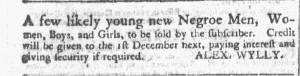
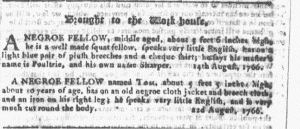
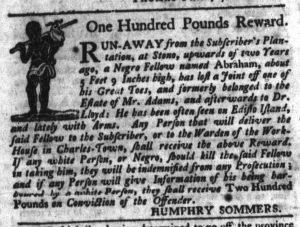
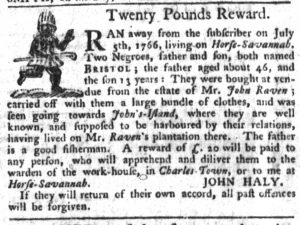
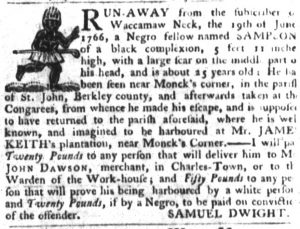
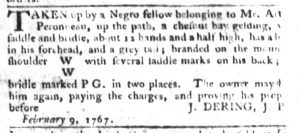
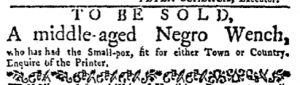
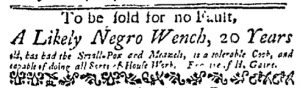
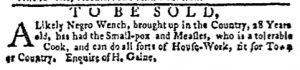
These tables indicate how many advertisements for slaves appeared in colonial American newspapers during the week of April 30 – May 6, 1767.
Note: These tables are as comprehensive as currently digitized sources permit, but they may not be an exhaustive account. They includes all newspapers that have been digitized and made available via Accessible Archives, Colonial Williamsburg’s Digital Library, and Readex’s America’s Historical Newspapers. There are several reasons some newspapers may not have been consulted:
Issues that are no longer extant;
Issues that are extant but have not yet been digitized (including the Pennsylvania Journal); and
Newspapers published in a language other than English (including the Wochentliche Philadelphische Staatsbote).
**********
Slavery Advertisements Published April 30 – May 6, 1767: By Date
**********
Slavery Advertisements Published April 30 – May 6, 1767: By Region
The Slavery Adverts 250 Project chronicles the role of newspaper advertising in perpetuating slavery in the era of the American Revolution. The project seeks to reveal the ubiquity of slavery in eighteenth-century life from New England to Georgia by republishing advertisements about enslaved people – for sale as individuals or in groups, wanted to purchase or for hire for short periods, runaways who liberated themselves, and those who were subsequently captured and confined in jails and workhouses – in daily digests on this site as well as in real time via the @SlaveAdverts250 Twitter feed, utilizing twenty-first-century media to stand in for the print media of the eighteenth century.
The project aims to provide modern audiences with a sense of just how often colonizers encountered these advertisements in their daily lives. Enslaved men, women, and children appeared in print somewhere in the colonies almost every single day. Those advertisements served as a constant backdrop for social, cultural, economic, and political life in colonial and revolutionary America. Colonizers who did not purport to own enslaved people were still confronted with slavery as well as invited to maintain the system by purchasing enslaved men, women, and children or assisting in the capture of so-called “runaways” who sought to free themselves from bondage. The frequency of these newspaper advertisements suggests just how embedded slavery was in colonial and revolutionary American culture in everyday interactions beyond the printed page.
These advertisements also testify to the experiences of enslaved men, women, and children, though readers must consider that those experiences have been remediated through descriptions offered by enslavers rather than enslaved people themselves. Often unnamed in the advertisements, enslaved men, women, and children were not invisible or unimportant in early America.
These advertisements appeared in colonial American newspapers 250 years ago today.
What was advertised in a colonial American newspaper 250 years ago today?
South-Carolina Gazette and Country Journal (May 5, 1767).
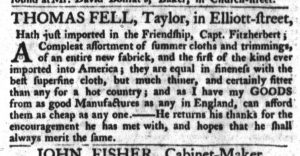
“An entire new fabrick.”
Shopkeepers frequently advertised that they stocked goods, especially materials for making apparel, which were “suitable to the season.” On occasion, they noted that they carried items especially appropriate for the climate of a particular region, whether the heat and humidity in southern colonies or the cold and chill in their northern counterparts.
Thomas Fell, a tailor in Charleston, expanded on that sort of appeal in an advertisement in the South-Carolina Gazette and Country Journal. He informed potential customers that he had just imported “A Compleat assortment of summer cloths and trimmings,” but he did not stop there. To incite curiosity and demand, he claimed that his wares were made “of an entire new fabrick, and the first of the kind ever imported into America.” Compared to more familiar textiles, this one was “much thin[n]er, and certainly fitter than any for a hot country.” As he made a pitch particular to residents of Charleston and its hinterland, the tailor neglected to name this wonderful new textile.
Lest his claims seem too good to be true, Fell resorted to other appeals to reassure customers. He described the fabric as “equal in fineness with the best superfine cloth.” His clients would not have to sacrifice quality for comfort. His inventory originated “from as good Manufactures as any in England.” He also underscored that this wonderful new material was not excessively expensive. Thanks to the relationships he cultivated with the producers, this “entire new fabrick” was as affordable as any other. Customers would not have to pay a premium for clothing materials “fitter than any for a hot country.”
Thomas Fell marketed a novelty product, but one that was exceptionally useful and suited to the clients he hoped to attract. His advertisement likely evoked both curiosity and skepticism; either reaction could draw potential customers into Fell’s shop to examine his “entire new fabrick” and decide for themselves the validity of his claims.
The Slavery Adverts 250 Project chronicles the role of newspaper advertising in perpetuating slavery in the era of the American Revolution. The project seeks to reveal the ubiquity of slavery in eighteenth-century life from New England to Georgia by republishing advertisements about enslaved people – for sale as individuals or in groups, wanted to purchase or for hire for short periods, runaways who liberated themselves, and those who were subsequently captured and confined in jails and workhouses – in daily digests on this site as well as in real time via the @SlaveAdverts250 Twitter feed, utilizing twenty-first-century media to stand in for the print media of the eighteenth century.
The project aims to provide modern audiences with a sense of just how often colonizers encountered these advertisements in their daily lives. Enslaved men, women, and children appeared in print somewhere in the colonies almost every single day. Those advertisements served as a constant backdrop for social, cultural, economic, and political life in colonial and revolutionary America. Colonizers who did not purport to own enslaved people were still confronted with slavery as well as invited to maintain the system by purchasing enslaved men, women, and children or assisting in the capture of so-called “runaways” who sought to free themselves from bondage. The frequency of these newspaper advertisements suggests just how embedded slavery was in colonial and revolutionary American culture in everyday interactions beyond the printed page.
These advertisements also testify to the experiences of enslaved men, women, and children, though readers must consider that those experiences have been remediated through descriptions offered by enslavers rather than enslaved people themselves. Often unnamed in the advertisements, enslaved men, women, and children were not invisible or unimportant in early America.
These advertisements appeared in colonial American newspapers 250 years ago today.
South-Carolina Gazette and Country Journal (May 5, 1767).
**********
South-Carolina Gazette and Country Journal (May 5, 1767).
**********
Supplement to the South-Carolina Gazette and Country Journal (May 5, 1767).
**********
Supplement to the South-Carolina Gazette and Country Journal (May 5, 1767).
**********
Supplement to the South-Carolina Gazette and Country Journal (May 5, 1767).
**********
Supplement to the South-Carolina Gazette and Country Journal (May 5, 1767).
**********
Supplement to the South-Carolina Gazette and Country Journal (May 5, 1767).
**********
Supplement to the South-Carolina Gazette and Country Journal (May 5, 1767).
**********
Supplement to the South-Carolina Gazette and Country Journal (May 5, 1767).
**********
Supplement to the South-Carolina Gazette and Country Journal (May 5, 1767).
**********
Supplement to the South-Carolina Gazette and Country Journal (May 5, 1767).
**********
Supplement to the South-Carolina Gazette and Country Journal (May 5, 1767).
**********
Supplement to the South-Carolina Gazette and Country Journal (May 5, 1767).
**********
Supplement to the South-Carolina Gazette and Country Journal (May 5, 1767)
**********
Supplement to the South-Carolina Gazette and Country Journal (May 5, 1767).
**********
Supplement to the South-Carolina Gazette and Country Journal (May 5, 1767).
What was advertised in a colonial American newspaper 250 years ago today?
Boston Evening-Post (May 4, 1767).
“GOODS, consisting of every Article that has been mentioned in the most lengthy Advertisements.”
Gilbert Deblois frequently advertised in Boston’s newspapers, sometimes at great length. On May 4, 1767, he inserted the same advertisement in both the Boston Evening-Post and the Boston Post-Boy. Several days earlier the same notice appeared in the extraordinary that accompanied the current issue of the Massachusetts Gazette. Compared to some of his other marketing efforts in the public prints, this notice was considerably shorter. Still, extending over almost one-third of a column, it occupied significantly more space – about three times as much – compared to advertisements placed by some of his competitors.
Deblois seemed less concerned about those advertisements than the much lengthier list advertisements placed by other competitors, including John Appleton and John Barrett and Sons (two-thirds of a column), Clement Jackson and John Gore, Jr. (three-quarters of a column), and Frederick William Geyer (an entire column and one-fifth of another). Those advertisements listed scores of items stocked by local shopkeepers.
Deblois devised a way to make those lengthy list advertisements (paid for by his competitors) work to his own advantage. After inserting the standard language about “A complete fashionable Assortment of English & India Piece GOODS,” he proclaimed that he carried “every Article that has been mentioned in the most lengthy Advertisements and many others not usually imported.” (The italics appeared in the advertisements in all three newspapers that carried this advertisement, indicating that Deblois gave specific instructions to the printers rather than leaving it to their discretion to make decisions about that particular aspect of formatting the notice. On the other hand, the three advertisements had other variations in format, but not copy.)
Considering the variety of consumer goods imported and advertised by Boston’s merchants and shopkeepers, readers probably greeted this pronouncement with some skepticism. As a frequent advertiser who sometimes placed lengthy list notices, however, Deblois may have previously amassed some credibility. He did not need to enumerate all of his wares in every advertisement. Invoking his competitors’ advertisements provided a means of listing his merchandise without actually listing it – or paying to do so. This also initiated a challenge to potential customers to visit his shop and assess for themselves the validity of his claim, generating foot traffic that could result in additional sales.
The Slavery Adverts 250 Project chronicles the role of newspaper advertising in perpetuating slavery in the era of the American Revolution. The project seeks to reveal the ubiquity of slavery in eighteenth-century life from New England to Georgia by republishing advertisements about enslaved people – for sale as individuals or in groups, wanted to purchase or for hire for short periods, runaways who liberated themselves, and those who were subsequently captured and confined in jails and workhouses – in daily digests on this site as well as in real time via the @SlaveAdverts250 Twitter feed, utilizing twenty-first-century media to stand in for the print media of the eighteenth century.
The project aims to provide modern audiences with a sense of just how often colonizers encountered these advertisements in their daily lives. Enslaved men, women, and children appeared in print somewhere in the colonies almost every single day. Those advertisements served as a constant backdrop for social, cultural, economic, and political life in colonial and revolutionary America. Colonizers who did not purport to own enslaved people were still confronted with slavery as well as invited to maintain the system by purchasing enslaved men, women, and children or assisting in the capture of so-called “runaways” who sought to free themselves from bondage. The frequency of these newspaper advertisements suggests just how embedded slavery was in colonial and revolutionary American culture in everyday interactions beyond the printed page.
These advertisements also testify to the experiences of enslaved men, women, and children, though readers must consider that those experiences have been remediated through descriptions offered by enslavers rather than enslaved people themselves. Often unnamed in the advertisements, enslaved men, women, and children were not invisible or unimportant in early America.
These advertisements appeared in colonial American newspapers 250 years ago today.
What was advertised in a colonial American newspaper 250 years ago this week?
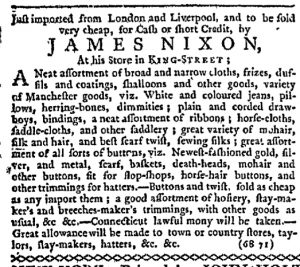
New-York Journal (April 30, 1767).
“Other trimmings for hatters.”
Unlike many shopkeepers who advertised their wares almost exclusively to end-use consumers, James Nixon sold an array of imported textiles and ornaments wholesale as well as retail. To be competitive with merchants and other wholesalers, he offered discounts to those who made purchases with the intention of acquiring inventory to resell to consumers. “Great allowance will be made,” Nixon stated, “to town or country stores, taylors, stay-makers, hatters, &c. &c.”
On occasion advertisers made such appeals to potential customers who bought in volume, but rarely did they specifically address members of so many occupations. In his advertisement, Nixon constructed a network of business associates, promoting himself as a supplier to men and women who made and sold apparel. In addition to the “Great allowance” he made to tailors, staymakers, hatters, and others, he also attempted to draw the attention of particular customers to specific goods. For instance, he listed a “great assortment of all sorts of buttons” among the various “trimmings for hatters” in stock, as well as other sorts of “stay-maker’s and breeches-maker’s trimmings.”
Doing so may have had the added advantage of attracting the attention of end-use consumers. By implying that tailors and hatters, whose livelihood depended in part on acquiring the right materials, trusted him to supply a “neat assortment” of “Newest-fashioned” dry goods, Nixon created the illusion of an endorsement from his associates. In the absence of testimonials, he prompted potential customers to imagine that “his Store in KING-STREET” was a hub of activity for members of the clothing trades.
He also suggested an impressive market penetration for his wares, which he sold to both shopkeepers in New York and others who operated “country stores,” some of them in neighboring provinces. “Connecticut lawful mon[e]y will be taken,” he pledged, alerting customers near and far that he was flexible when it came to which sort of currency he would accept.
Although “taylors, stay-makers, hatters, &c. &c.” certainly purchased materials from merchants who imported them, very few advertisers addressed them as an occupational group or promoted their goods specifically to them. Many likely concluded that notices offering goods wholesale were sufficient for their purposes. James Nixon, on the other hand, experimented with addressing various sorts of potential customers, making it clear to those in the clothing trades that he wished to work with them (and offered discounts) in addition to supplying “town or country stores.”
Consider today’s advertisement. It made several of the standard appeals in eighteenth-century advertisements for consumer goods and services: price (“at the cheapest Rate”), choice (an “Assortment of English and India Goods”), current fashions (the “Assortment” was “new and fresh”), and connections to the cosmopolitan center of the empire (“imported in the last Ships from LONDON”). To underscore the extent of consumer choice, Thompson and Arnold listed dozens of items in a dense paragraph. Like other retailers, they packed a variety of appeals into a relatively short advertisement.
Most of their counterparts incorporated one or more of these strategies but did little to elaborate on them. Thompson and Arnold, on the other hand, supplemented the formulaic format and language of these appeals with an animated nota bene, an entire paragraph that expanded on their low prices and the extensive choices they presented to customers. The shopkeepers boasted that they could “accommodate their Customers with whatever they may want” not only because they stocked so much merchandise but also because their inventory was superior to what could be found anywhere else in Providence. Their customers benefited from the convenience of what has become known as one-stop shopping; Thompson and Arnold had “a greater variety, and a larger quantity of goods than can be found in any one store in this town.” Potential customers did not need to worry about popular or inexpensive items selling out!
Unlike other shopkeepers that mentioned prices once at the beginning of an advertisement or perhaps again at the end, Thompson and Arnold doubled down on their low prices in their nota bene. They beat the prices they charged in the past (“they will now sell their goods much cheaper than they have yet sold”), but they also undersold their competitors (“cheaper than can be bought elsewhere in this town”).
Given that some advertisements lingered in colonial newspapers for weeks or months, Thompson and Arnold also affixed a date (“May 2, 1767,” the date of that issue of the Providence Gazette) so readers and potential customers would be aware of the timeliness of the appeals they made.
On their own, the introduction and list of goods in Thompson and Arnold’s advertisement replicated many other advertisement for consumer goods published in the 1760s, advancing multiple appeals to potential customers but each of them briefly. To garner additional attention and generate more business, Thompson and Arnold inserted an additional paragraph elaborating on two of those appeals, price and choice.
The Slavery Adverts 250 Project chronicles the role of newspaper advertising in perpetuating slavery in the era of the American Revolution. The project seeks to reveal the ubiquity of slavery in eighteenth-century life from New England to Georgia by republishing advertisements about enslaved people – for sale as individuals or in groups, wanted to purchase or for hire for short periods, runaways who liberated themselves, and those who were subsequently captured and confined in jails and workhouses – in daily digests on this site as well as in real time via the @SlaveAdverts250 Twitter feed, utilizing twenty-first-century media to stand in for the print media of the eighteenth century.
The project aims to provide modern audiences with a sense of just how often colonizers encountered these advertisements in their daily lives. Enslaved men, women, and children appeared in print somewhere in the colonies almost every single day. Those advertisements served as a constant backdrop for social, cultural, economic, and political life in colonial and revolutionary America. Colonizers who did not purport to own enslaved people were still confronted with slavery as well as invited to maintain the system by purchasing enslaved men, women, and children or assisting in the capture of so-called “runaways” who sought to free themselves from bondage. The frequency of these newspaper advertisements suggests just how embedded slavery was in colonial and revolutionary American culture in everyday interactions beyond the printed page.
These advertisements also testify to the experiences of enslaved men, women, and children, though readers must consider that those experiences have been remediated through descriptions offered by enslavers rather than enslaved people themselves. Often unnamed in the advertisements, enslaved men, women, and children were not invisible or unimportant in early America.
These advertisements appeared in colonial American newspapers 250 years ago today.
What was advertised in a colonial newspaper 250 years ago today?
New-Hampshire Gazette (May 1, 1767).
“MEIN and FLEMING’S MASSACHUSETTS REGISTER, with an Almanack for 1767.”
Readers of the New-Hampshire Gazette knew that John Mein had not “JUST PUBLISH’D” the “MASSACHUSETTS REGISTER, with an Almanack for 1767.” Printers throughout the colonies produced almanacs for the next year during the final months of the previous year. Some began advertising almanacs for 1767 as early as September 1766. Advertising continued throughout January and even into the first works of February, with every newspapers inserting notices about at least one and often several competing almanacs, but such advertising tapered off as the year progressed. By the time that May arrived, one-third of the year had passed and a good portion of the contents of any almanac became obsolete. Compared to the fall and early winter, it was probably particularly difficult to sell almanacs in the middle of spring.
This advertisement, however, cleverly emphasized the continuing usefulness of this volume. The Massachusetts Register just happened to include an almanac, but it also contained all sorts of other valuable reference information that residents of Portsmouth and other parts of New Hampshire might need to consult. For instance, readers knew more about the operations of local government and the legal system because the Massachusetts Register listed “the sitting of the superior and inferior Courts in the Four Provinces of New England.” In addition, its contents facilitated commerce and communication, especially the lists of the “Names of the Packet Boats and times of sailing” and the “Roads along the Continent.” To that end, “a Table of the different Currencies in North America” and a “Table of Interest at 6 per Cent” would have been useful throughout the colonies, not just in Massachusetts and other parts of New England.
Daniel and Robert Fowle, printers of the New-Hampshire Gazette, indicated “a Few of the above Registers to be sold by the Printers hereof.” John Mein may have had nothing to do with inserting this advertisement so late in the year, though he likely composed the copy for its initial publication, realizing that much of the contents would appeal to potential customers in the neighboring province. The Fowles likely had surplus copies, space to fill in their weekly newspaper, and type previously set for this advertisement (hence “JUST PUBLISH’D” as the headline), making it worth an attempt to move this inventory before it became any more outdated.