May 11

What was advertised in a colonial American newspaper 250 years ago today?

May 11 - 5:11:1767 New-York Gazette
New-York Gazette (May 11, 1767).

“None but the best of Medicines.”

The mononymous Steuart, “DRUGGIST and APOTHECARY, At the GOLDEN HEAD” on Queen Street in New York, crafted an advertising campaign intended to maximize market penetration. Most advertisers inserted paid notices in only one newspaper, though enterprising entrepreneurs sometimes promoted their goods and services in multiple publications. Rarely did advertisers in New York, however, invest the effort or expense in placing advertisements in all four of the city’s newspapers in a single week in 1767. Steuart, however, advertised in the New-York Gazette and the New-York Mercury on May 11, as well as in the New-York Journal and the New-York Gazette: Or, Weekly Post-Boy on May 7. In all except that final publication, he was fortunate that his notice appeared on the front page.

It might be tempting to conclude that a recent relocation made such advertising imperative. The advertisements indicated that he had “removed from between Burling’s and Beekman’s-Slip, to the House lately occupied by Messrs. Walter and Thomas Buchannen, in Queen-Street, (between Hanover-Square and the Fly-Market:).” The move certainly provided one motive for advertising in as many newspapers as possible, but Steuart also competed with McLean and Treat, prolific advertisers who inserted their own notices for their “Medicinal Store, in Hanover-square” in three out of four of New-York’s newspapers that same week. McLean and Treat had also been advertising in multiple newspapers for several weeks before Steuart’s notices appeared. In addition, other apothecaries and shopkeepers who sold medicines took to the public prints to promote their ware that week, including Edward Agar in the New-York Journal and the New-York Mercury; Thomas Bridgen Attwood in the New-York Journal and the New-York Gazette; and Gerardus Duyckinck in the New-York Gazette: Or, Weekly Post-Boy, the New-York Journal, and the New-York Mercury.

Steuart stated that he “hopes his Friends in Town and Country will still continue to Favour him with their Custom.” He had established a clientele and wanted them to follow him to his new location on Queen Street. While that may have been reason enough to post an advertisement in each of the city’s newspapers, Steuart also realized that he faced competition from several other druggists who advertised aggressively. Getting his share of the market required advertising. Had his notices been intended solely to inform readers of his new location, it would not have been necessary to make appeals to quality – “none but the best of Medicines” – or price – “on as low Terms as possible” – or variety recently arrived from London – “just imported … a fresh and general Assortment.”

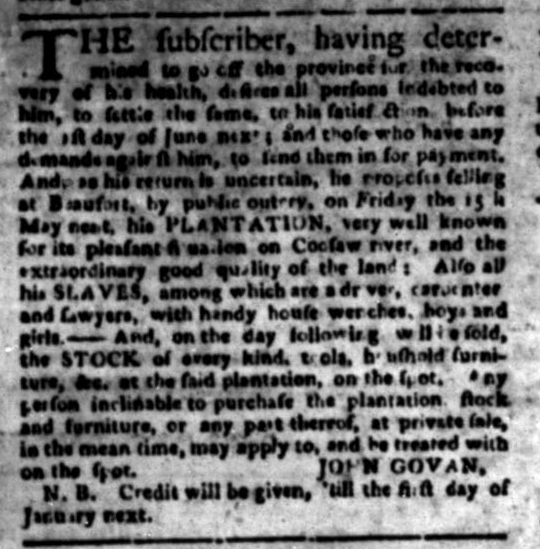
Slavery Advertisements Published May 11, 1767

The Slavery Adverts 250 Project chronicles the role of newspaper advertising in perpetuating slavery in the era of the American Revolution. The project seeks to reveal the ubiquity of slavery in eighteenth-century life from New England to Georgia by republishing advertisements about enslaved people – for sale as individuals or in groups, wanted to purchase or for hire for short periods, runaways who liberated themselves, and those who were subsequently captured and confined in jails and workhouses – in daily digests on this site as well as in real time via the @SlaveAdverts250 Twitter feed, utilizing twenty-first-century media to stand in for the print media of the eighteenth century.

The project aims to provide modern audiences with a sense of just how often colonizers encountered these advertisements in their daily lives. Enslaved men, women, and children appeared in print somewhere in the colonies almost every single day. Those advertisements served as a constant backdrop for social, cultural, economic, and political life in colonial and revolutionary America. Colonizers who did not purport to own enslaved people were still confronted with slavery as well as invited to maintain the system by purchasing enslaved men, women, and children or assisting in the capture of so-called “runaways” who sought to free themselves from bondage. The frequency of these newspaper advertisements suggests just how embedded slavery was in colonial and revolutionary American culture in everyday interactions beyond the printed page.

These advertisements also testify to the experiences of enslaved men, women, and children, though readers must consider that those experiences have been remediated through descriptions offered by enslavers rather than enslaved people themselves. Often unnamed in the advertisements, enslaved men, women, and children were not invisible or unimportant in early America.

These advertisements appeared in colonial American newspapers 250 years ago today.

May 11 - Boston-Gazette Slavery 1
Boston-Gazette (May 11, 1767).

**********

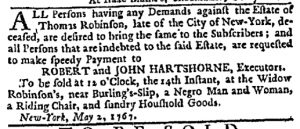
May 11 - New-York Gazette Slavery 1
New-York Gazette (May 11, 1767)

**********

May 11 - New-York Mercury Slavery 1
New-York Mercury (May 11, 1767).

**********

May 11 - New-York Mercury Slavery 2
New-York Mercury (May 11, 1767).

**********

May 11 - New-York Mercury Slavery 3
New-York Mercury (May 11, 1767).

**********

May 11 - New-York Mercury Slavery 4
New-York Mercury (May 11, 1767).

**********

May 11 - New-York Mercury Slavery 5
New-York Mercury (May 11, 1767).

**********

May 11 - New-York Mercury Slavery 6
New-York Mercury (May 11, 1767).

**********

May 11 - New-York Mercury Slavery 7
New-York Mercury (May 11, 1767).

**********

May 11 - New-York Mercury Slavery 8
New-York Mercury (May 11, 1767).

**********

May 11 - Newport Mercury Slavery 1
Newport Mercury (May 11, 1767).

**********

May 11 - South Carolina Gazette Slavery 1
South Carolina Gazette (May 11, 1767).

**********

May 11 - South Carolina Gazette Slavery 2
South Carolina Gazette (May 11, 1767).

**********

May 11 - South Carolina Gazette Slavery 3
South Carolina Gazette (May 11, 1767).

**********

May 11 - South Carolina Gazette Slavery 4
South Carolina Gazette (May 11, 1767).

**********

May 11 - South Carolina Gazette Slavery 5
South Carolina Gazette (May 11, 1767).

**********

May 11 - South Carolina Gazette Slavery 6
South Carolina Gazette (May 11, 1767).

**********

May 11 - South Carolina Gazette Slavery 7
South Carolina Gazette (May 11, 1767).

**********

May 11 - South Carolina Gazette Slavery 8
South Carolina Gazette (May 11, 1767).

**********

May 11 - South Carolina Gazette Slavery 9
South Carolina Gazette (May 11, 1767).

**********

May 11 - South Carolina Gazette Slavery 10
South Carolina Gazette (May 11, 1767).

**********

May 11 - South Carolina Gazette Slavery 11
South Carolina Gazette (May 11, 1767).

**********

May 11 - South Carolina Gazette Slavery 12
South Carolina Gazette (May 11, 1767).

**********

May 11 - South Carolina Gazette Slavery 13
South Carolina Gazette (May 11, 1767).

**********

May 11 - South Carolina Gazette Slavery 14
South Carolina Gazette (May 11, 1767).

May 10

What was advertised in a colonial American newspaper 250 years this week?

May 10 - 5:7:1767 Pennsylvania Gazette
Supplement to the Pennsylvania Gazette (May 7, 1767).

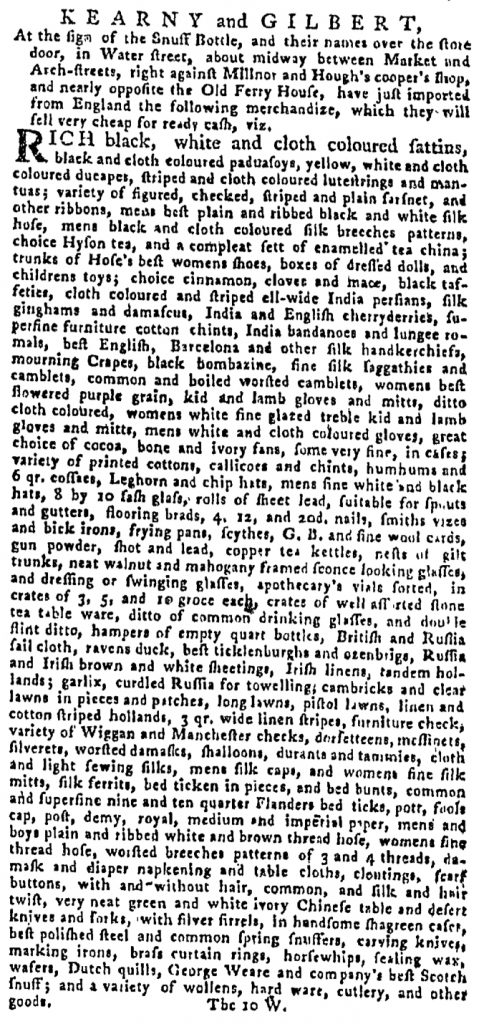
“KEARNY and GILBERT, At the sign of the Snuff Bottle, and their names over the store door.”

Newspaper advertisements from the period suggest visual elements of marketing erected in eighteenth-century cities and villages. Residents and visitors alike encountered an array of shop signs that retailers used to identify their businesses. Such was the case in the first issue of the Pennsylvania Gazette published in May 1767. Although their signs have been lost to time, several advertisers included descriptions of them alongside other directions intended to guide customers to their shops.

Nathaniel Tweedy, a druggist, announced that he could he sold medicines “At the Golden Eagle, in Market-street, near the Court-house.” Dyers Joseph Allardyce and Company practiced their trade “at the Sign of the Blue Hand, in Race-street, between Front and Second Streets.” Edward Penington, an attorney, advertised a real estate auction to be held “at the house of John Biddle, at the sign of the Indian King, in Market-street.” William Dawson, a cutler, not only stated that he made a various kinds of knives and other implements “At the sign of the Scythe and Sickle” but also included a woodcut depicting those instruments suspended from a signpost. Each of these, especially Dawson’s advertisement, hints at the rich visual cityscape of marketing in Philadelphia in the decade before the Revolution.
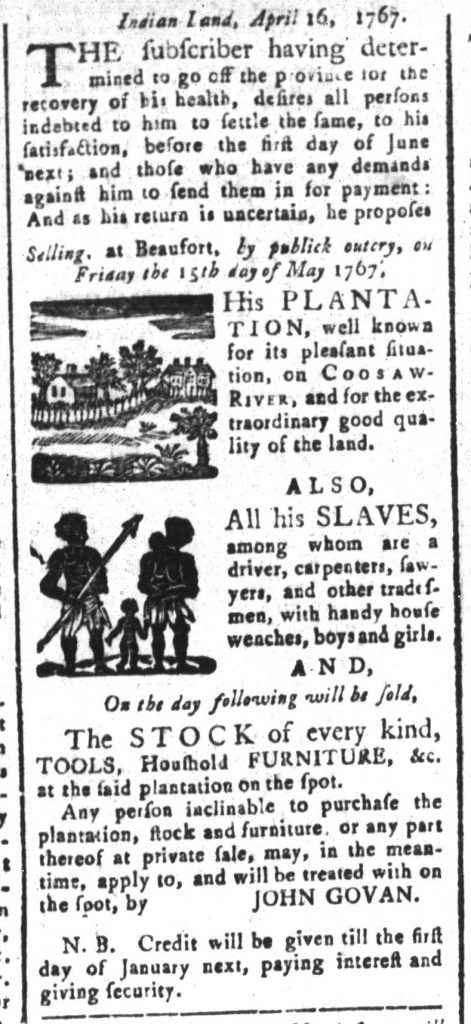
In many instances, such signs provided the sole means of identifying a shop or tavern, but other advertisers stated that they also labeled their places of business with their own names. Kearny and Gilbert, for instance, stocked an array of merchandise “At the sign of the Snuff Bottle … in Water Street.” To alleviate any potential confusion, customers could also look for “their names over the store door.” George Frederick Boyer, one of Dawson’s competitors in the cutlery business, displayed “a Sign in Front-street, and another in Water-street, with his Name thereon, and on which are painted Swords, Knives, Lancets, Razors, and Grinding Tools.”

How often did eighteenth-century shopkeepers, artisans, and other entrepreneurs label their locations with their own names or include them on their fanciful signs? Did most signs provide visual identification exclusively? Or did they also tend to incorporate at least a minimal amount of text, even if just the name of the proprietor? In the absence of devices like the Golden Eagle or the Blue Hand, did others at least post placards with their names so potential customers knew they had arrived at the correct destination? Or did they assume the extensive directions provided in advertisements sufficed?

I do not have satisfactory answers to these questions, but they remind me that the history of advertising in eighteenth-century America requires research along multiple trajectories, utilizing multiple sorts of sources. Newspaper notices and other printed ephemera (magazine wrappers, broadsides, trade cards, catalogs) tell much of the story, but material culture (such as shop signs or packaging materials, both more likely in museum collections rather than archives) reveals other important aspects of how marketing worked in early America.

May 9

What was advertised in a colonial American newspaper 250 years ago today?

May 9 - 5:9:1767 Providence Gazette
Providence Gazette (May 9, 1767).

“Assortment of English and India GOODS, at his Shop at the Sign of the BLACK-BOY.”

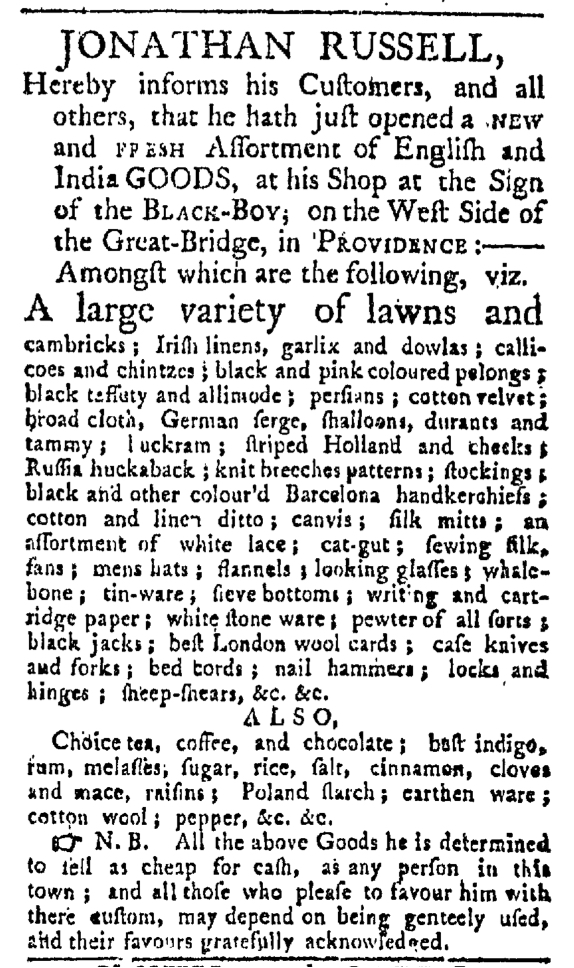
Jonathan Russell ran a shop “at the Sign of the BLACK-BOY; on the West Side of the Great-Bridge, in PROVIDENCE.” As I compiled today’s entries for the Slavery Adverts 250 Project I debated whether Russell’s advertisement should be included. Two other notices in the same issue of the Providence Gazette explicitly sold slaves, “A Negro Woman, who understands all sorts of houshold Work” and “A Likely, healthy Negro Boy … fit for either Town of Country,” but Russell’s advertisement did not promote the sale of slaves.

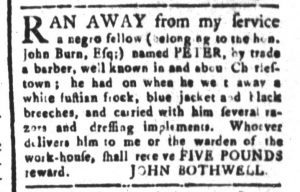
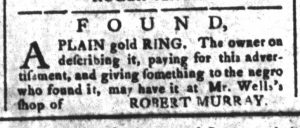
The Slavery Adverts 250 Project casts a wide net when it comes to including notices that mention slaves. Most of the advertisements fall into three main categories: slaves for sale, runaway slaves, and captured slaves. Enslaved men, women, and children, however sometimes found themselves the subjects of other sorts of advertising. Rather than sell slaves, some masters preferred to hire them out. Others mentioned the role slaves played in commercial ventures, such as Lewis Johnson’s help wanted notice seeking “AN OVERSEER who understands the BUSINESS of STAVEMAKING, to take charge of a few negroes employed in that way” in the Georgia Gazette (May 6, 1767). Some provided evidence of the presence of enslaved people in everyday life in the colonies, such as Robert Murray’s notice in the South-Carolina and American General Gazette (May 8, 1767) offering to return a “PLAIN gold RING” upon the owner “paying for this advertisement, and giving something to the negro who found it.”

Russell’s advertisement for “his Shop at the Sign of the BLACK-BOY,” however, does not refer to an actual person or to any humans treated as commodities that he attempted to sell. Yet “the Sign of the BLACK-BOY” drew meaning from the context of transatlantic commerce that included the slave trade and the production of “indigo, rum, melasses, sugar, rice,” and other goods produced by enslaved men, women, and children and transported to Russell’s and other shops throughout the Atlantic world. Slaves lived and toiled in Providence. Many merchants from the city and other ports in Rhode Island made their livings, at least in part, by participating in the slave trade. In his own fashion, Jonathan Russell also exploited black bodies for his own benefit when he adopted “the sign of the BLACK-BOY” as the device to mark his location and identify his commercial enterprises. Accordingly, I have included his advertisement in the Slavery Adverts 250 Project.

Slavery Advertisements Published May 9, 1767

The Slavery Adverts 250 Project chronicles the role of newspaper advertising in perpetuating slavery in the era of the American Revolution. The project seeks to reveal the ubiquity of slavery in eighteenth-century life from New England to Georgia by republishing advertisements about enslaved people – for sale as individuals or in groups, wanted to purchase or for hire for short periods, runaways who liberated themselves, and those who were subsequently captured and confined in jails and workhouses – in daily digests on this site as well as in real time via the @SlaveAdverts250 Twitter feed, utilizing twenty-first-century media to stand in for the print media of the eighteenth century.

The project aims to provide modern audiences with a sense of just how often colonizers encountered these advertisements in their daily lives. Enslaved men, women, and children appeared in print somewhere in the colonies almost every single day. Those advertisements served as a constant backdrop for social, cultural, economic, and political life in colonial and revolutionary America. Colonizers who did not purport to own enslaved people were still confronted with slavery as well as invited to maintain the system by purchasing enslaved men, women, and children or assisting in the capture of so-called “runaways” who sought to free themselves from bondage. The frequency of these newspaper advertisements suggests just how embedded slavery was in colonial and revolutionary American culture in everyday interactions beyond the printed page.

These advertisements also testify to the experiences of enslaved men, women, and children, though readers must consider that those experiences have been remediated through descriptions offered by enslavers rather than enslaved people themselves. Often unnamed in the advertisements, enslaved men, women, and children were not invisible or unimportant in early America.

These advertisements appeared in colonial American newspapers 250 years ago today.

May 9 - Providence Gazette Slavery 1
Providence Gazette (May 9, 1767).

**********

May 9 - Providence Gazette Slavery 2
Providence Gazette (May 9, 1767).

**********

May 9 - Providence Gazette Slavery 3
Providence Gazette (May 9, 1767).

May 8

What was advertised in a colonial American newspaper 250 years ago today?

May 8 - 5:8:1767 New-Hampshire Gazette
New-Hampshire Gazette (May 8, 1767).

“As neat as any in Boston.”

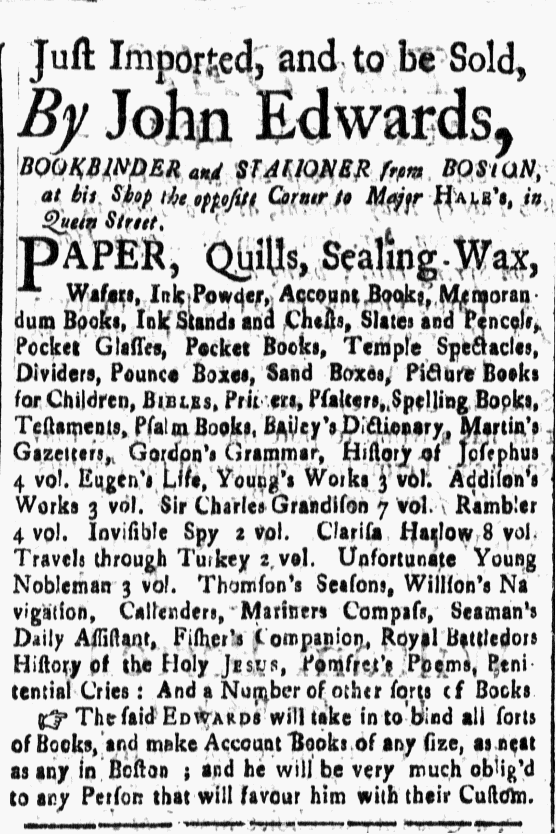
John Edwards, a “BOOKBINDER and STATIONER from BOSTON,” sold a variety of books as well as writing supplies at his shop on Queen Street in Portsmouth, New Hampshire. Edwards did not describe himself as a bookseller, even though he devoted approximately half of his advertisement to listing some of the titles he carried. Throughout the eighteenth century members of the book trades often specialized in one trade yet supplemented their incomes by taking on some responsibilities more closely associated with other aspects of book production and distribution. Both printers and bookbinders, for instance, commonly sold books that they had not printed or bound.

By trade and training, Edwards may have considered himself first and foremost a bookbinder, taking pride in the unique skills mastered in that occupation. Yet the demand for bookbinding services in the town of Portsmouth likely made it impossible to earn his living solely from that trade. Considering that Edwards had relocated from Boston at some point, competition among bookbinders for the business of a finite number of potential customers, even in that bustling port, may have prompted him to seek out other opportunities in the neighboring colony. Fewer bookbinders resided in Portsmouth, but so did fewer potential customers. In the face of less demand for the services of bookbinders, Edwards sold consumer goods related to his trade – books and writing materials – to generate additional revenues. He likely bound some of his imported books to the taste and budget of those who purchased them.

Edwards attempted to mobilize his Boston origins to his advantage. He proclaimed that he bound “all sorts of Books” and made “Account Books of any size, as neat as any in Boston.” Having lived and worked in that city, Edwards was qualified to testify to the quality of the bookbinding done there and assess his own work in comparison. He pledged to potential customers that his work was comparable to what they would find in a larger and more distinguished market, assuring them that its quality was comparable to what they would find in the urban center that most immediately commanded their attention when making comparisons. Similarly, advertisers in Boston favorably compared their wares and workmanship to what was produced in London. Colonists looked to the next larger market for validation as they shaped their own practices of consumption.

Slavery Advertisements Published May 8, 1767

The Slavery Adverts 250 Project chronicles the role of newspaper advertising in perpetuating slavery in the era of the American Revolution. The project seeks to reveal the ubiquity of slavery in eighteenth-century life from New England to Georgia by republishing advertisements about enslaved people – for sale as individuals or in groups, wanted to purchase or for hire for short periods, runaways who liberated themselves, and those who were subsequently captured and confined in jails and workhouses – in daily digests on this site as well as in real time via the @SlaveAdverts250 Twitter feed, utilizing twenty-first-century media to stand in for the print media of the eighteenth century.

The project aims to provide modern audiences with a sense of just how often colonizers encountered these advertisements in their daily lives. Enslaved men, women, and children appeared in print somewhere in the colonies almost every single day. Those advertisements served as a constant backdrop for social, cultural, economic, and political life in colonial and revolutionary America. Colonizers who did not purport to own enslaved people were still confronted with slavery as well as invited to maintain the system by purchasing enslaved men, women, and children or assisting in the capture of so-called “runaways” who sought to free themselves from bondage. The frequency of these newspaper advertisements suggests just how embedded slavery was in colonial and revolutionary American culture in everyday interactions beyond the printed page.

These advertisements also testify to the experiences of enslaved men, women, and children, though readers must consider that those experiences have been remediated through descriptions offered by enslavers rather than enslaved people themselves. Often unnamed in the advertisements, enslaved men, women, and children were not invisible or unimportant in early America.

These advertisements appeared in colonial American newspapers 250 years ago today.

May 8 - South-Carolina and American General Gazette Slavery 1
South-Carolina and American General Gazette (May 8, 1767).

**********

May 8 - South-Carolina and American General Gazette Slavery 2
South-Carolina and American General Gazette (May 8, 1767).

**********

May 8 - South-Carolina and American General Gazette Slavery 3
South-Carolina and American General Gazette (May 8, 1767).

**********

May 8 - South-Carolina and American General Gazette Slavery 4
South-Carolina and American General Gazette (May 8, 1767).

**********

May 8 - South-Carolina and American General Gazette Slavery 5
South-Carolina and American General Gazette (May 8, 1767).

**********

May 8 - South-Carolina and American General Gazette Slavery 6
South-Carolina and American General Gazette (May 8, 1767).

**********

May 8 - South-Carolina and American General Gazette Slavery 7
South-Carolina and American General Gazette (May 8, 1767).

**********

May 8 - South-Carolina and American General Gazette Slavery 8A
South- Carolina and American General Gazette (May 8, 1767).

**********

May 8 - South-Carolina and American General Gazette Slavery 8B
Continuation of previous advertisement from South-Carolina and American General Gazette (May 8, 1767).

**********

May 8 - South-Carolina and American General Gazette Slavery 9
South-Carolina and American General Gazette (May 8, 1767).

**********

May 8 - South-Carolina and American General Gazette Slavery 10
South-Carolina and American General Gazette (May 8, 1767).

**********

May 8 - South-Carolina and American General Gazette Slavery 11
South-Carolina and American General Gazette (May 8, 1767).

**********

May 8 - South-Carolina and American General Gazette Slavery 12
South-Carolina and American General Gazette (May 8, 1767).

May 7

What was advertised in a colonial American newspaper 250 years ago today?

May 7 - 5:7:1767 Pennsylvania Gazette
Supplement to the Pennsylvania Gazette (May 7, 1767).

“SUPPLEMENT to the PENNSYLVANIA GAZETTE.”

The masthead of the Pennsylvania Gazette declared that it “Contain[ed] the Freshest Advices, Foreign and Domestic.” Readers expected a variety of news updates from Europe, especially England, the Caribbean and other locales in the Atlantic world, and neighboring colonies. The Pennsylvania Gazette also carried some local news, but when it came to local affairs word of mouth often scooped newspapers published only once a week.

Readers also expected to encounter a variety of advertising. The Pennsylvania Gazette, like its counterparts in the largest colonial port cities, attracted so much advertising that the printers frequently issued a half sheet supplement devoted exclusively to paid notices of various sorts. Doing so shifted the relative balance of news items and advertising, though sometimes the supplement resulted from the regular issue including more news than usual.

Such was not the case with the May 7, 1767, edition of the Pennsylvania Gazette and the accompanying Supplement. News items appeared on only two of the four pages of the standard issue. Instead of two pages, a half sheet, Hall and Sellers created a four-page supplement, an entire broadsheet filled entirely with advertising. This doubled the number of pages in the May 7 issue. It also underscored the newspaper’s roles as a delivery mechanism for advertising. Paid notices covered three-quarters – six out of eight – pages.

Even with the supplement, space was at a premium. The paid notices were composed primarily of text with little variation in font size. Hall and Sellers incorporated few woodcuts into the advertisement: none of the houses or fleeing figures that accompanied real estate and runaway slave advertisements, respectively, and only one ship in a brief notice about “Accommodations for Passengers” aboard a ship departing “For KINGSTON, in JAMAICA,” in three weeks. Four advertisers drew attention to their notices by including woodcuts specific to their businesses that they commissioned. William Dawson, cutler, presumably replicated his shop sign, “the Scythe and Sickle,” as did dyers Joseph Allardyce and Company “at the Sign of the Blue Hand.” John Young, Sr., a saddler, and Richard Truman, who made “Dutch FANS and SCREENS,” each included images of the products they constructed.

Rather than examine a single advertisement published 250 years ago today, consider the entire issue of the Pennsylvania Gazette. Doing so underscores the importance of advertising in the dissemination of some of the most successful and widely circulated early American newspapers. It also demonstrates the extensive culture of consumption in port cities, practices of purchasing and display that filtered out to the provinces as merchants and shopkeepers distributed goods from their point of entry to customers throughout the colonies.

Slavery Advertisements Published May 7, 1767

The Slavery Adverts 250 Project chronicles the role of newspaper advertising in perpetuating slavery in the era of the American Revolution. The project seeks to reveal the ubiquity of slavery in eighteenth-century life from New England to Georgia by republishing advertisements about enslaved people – for sale as individuals or in groups, wanted to purchase or for hire for short periods, runaways who liberated themselves, and those who were subsequently captured and confined in jails and workhouses – in daily digests on this site as well as in real time via the @SlaveAdverts250 Twitter feed, utilizing twenty-first-century media to stand in for the print media of the eighteenth century.

The project aims to provide modern audiences with a sense of just how often colonizers encountered these advertisements in their daily lives. Enslaved men, women, and children appeared in print somewhere in the colonies almost every single day. Those advertisements served as a constant backdrop for social, cultural, economic, and political life in colonial and revolutionary America. Colonizers who did not purport to own enslaved people were still confronted with slavery as well as invited to maintain the system by purchasing enslaved men, women, and children or assisting in the capture of so-called “runaways” who sought to free themselves from bondage. The frequency of these newspaper advertisements suggests just how embedded slavery was in colonial and revolutionary American culture in everyday interactions beyond the printed page.

These advertisements also testify to the experiences of enslaved men, women, and children, though readers must consider that those experiences have been remediated through descriptions offered by enslavers rather than enslaved people themselves. Often unnamed in the advertisements, enslaved men, women, and children were not invisible or unimportant in early America.

These advertisements appeared in colonial American newspapers 250 years ago today.

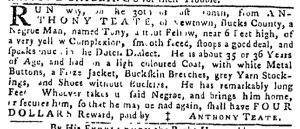
May 7 - New-York Gazette Weekly Post-Boy Slavery 1
New-York Gazette: Or, the Weekly Post-Boy (May 7, 1767).

**********

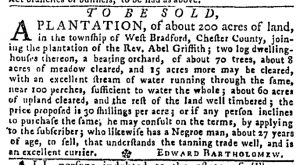
May 7 - New-York Journal Slavery 1
New-York Journal (May 7, 1767).

**********

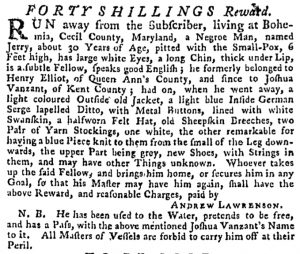
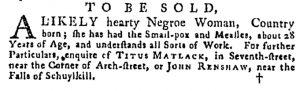
May 7 - Pennsylvania Gazette Slavery 1
Pennsylvania Gazette (May 7, 1767).

**********

May 7 - Pennsylvania Gazette Slavery 2
Pennsylvania Gazette (May 7, 1767).

**********

May 7 - Pennsylvania Gazette Supplement Slavery 1
Supplement to the Pennsylvania Gazette (May 7, 1767).

**********

May 7 - Pennsylvania Gazette Supplement Slavery 2
Supplement to the Pennsylvania Gazette (May 7, 1767).

**********

May 7 - Pennsylvania Gazette Supplement Slavery 3
Supplement to the Pennsylvania Gazette (May 7, 1767).

**********

May 7 - Pennsylvania Gazette Supplement Slavery 4
Supplement to the Pennsylvania Gazette (May 7, 1767).

**********

May 7 - Virginia Gazette Slavery 1
Virginia Gazette (May 7, 1767).

**********

May 7 - Virginia Gazette Slavery 2
Virginia Gazette (May 7, 1767).

**********

May 7 - Virginia Gazette Slavery 3
Virginia Gazette (May 7, 1767).

**********

May 7 - Virginia Gazette Slavery 4
Virginia Gazette (May 7, 1767).

**********

May 7 - Virginia Gazette Slavery 5
Virginia Gazette (May 7, 1767).

**********

May 7 - Virginia Gazette Slavery 6
Virginia Gazette (May 7, 1767).

**********

May 7 - Virginia Gazette Slavery 7
Virginia Gazette (May 7, 1767).

May 6

What was advertised in a colonial American newspaper 250 years ago today?

May 6 - 5:6:1767 Georgia Gazette
Georgia Gazette (May 6, 1767).

“A GENERAL ASSORTMENT OF MEDICINES.”

Lewis Johnson operated an apothecary shop in colonial Savannah, though his advertisement did not indicate if he compounded remedies onsite in addition to selling “A GENERAL ASSORTMENT OF MEDICINES” that included ingredients and readymade elixirs. For the latter category, he depended on customers’ familiarity with established brands, listing several popular patent medicines recently imported from London. These included “Daffy’s elixir, … Squire’s elixir, Bateman’s drops, Stoughton’s ditto, Godrey’s cordial, Turlington’s balsam, James’s powders strong and mild, and Anderson’s pills.” Johnson expected that patients were already familiar with the symptoms each of these medicines purported to relieve. Few products had so firmly established brand identities in the eighteenth century. In terms of name recognition and, sometimes, packaging materials, creators of patent medicines led the way in developing branding as an effective marketing strategy.

In addition to the half dozen or so pills and potions already noted, Johnson also carried the “Family Medicines of Dr. Hill’s,” several different elixirs associated with the same physician, each intended for specific indications. For instance, patients suffering from gout and rheumatism could purchase Hill’s “Elixir of bardana,” but those with colds, coughs, and even consumption should instead choose the “Balsam of honey.” Johnson listed nearly as many tinctures and elixirs from Hill’s “Family Medicines” as the other sorts of patent medicines combined. In this regard, Hill had worked out an effective system for increasing sales. Many competitors either marketed their medicines as cure-alls or specified an astonishing array of symptoms they relieved. Hill, on the other hand, associated particular medical problems with specific medicines formulated with unique ingredients considered especially efficacious for the circumstances. In so doing, he multiplied the number of potential sales possible for each customer.

The assorted remedies Lewis Johnson stocked in his apothecary shop would certainly look strange to modern consumers, but the experience of shopping there would not have been that much different than visiting a twenty-first-century retail pharmacy. Customers recognize certain brands. When feeling ill, they find comfort in selecting familiar remedies, often expressing preferences for one over another even when the competing brands combat the same symptoms.