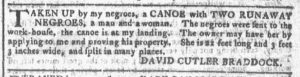
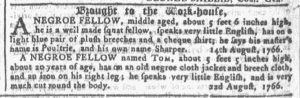
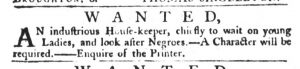
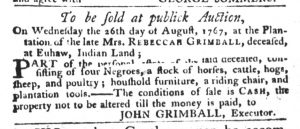
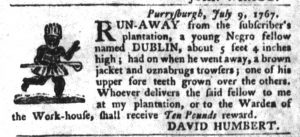
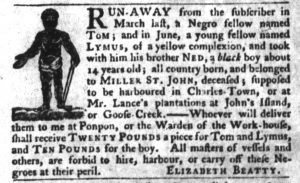
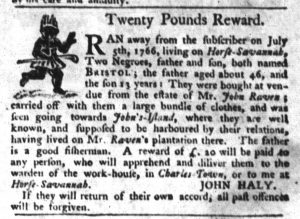
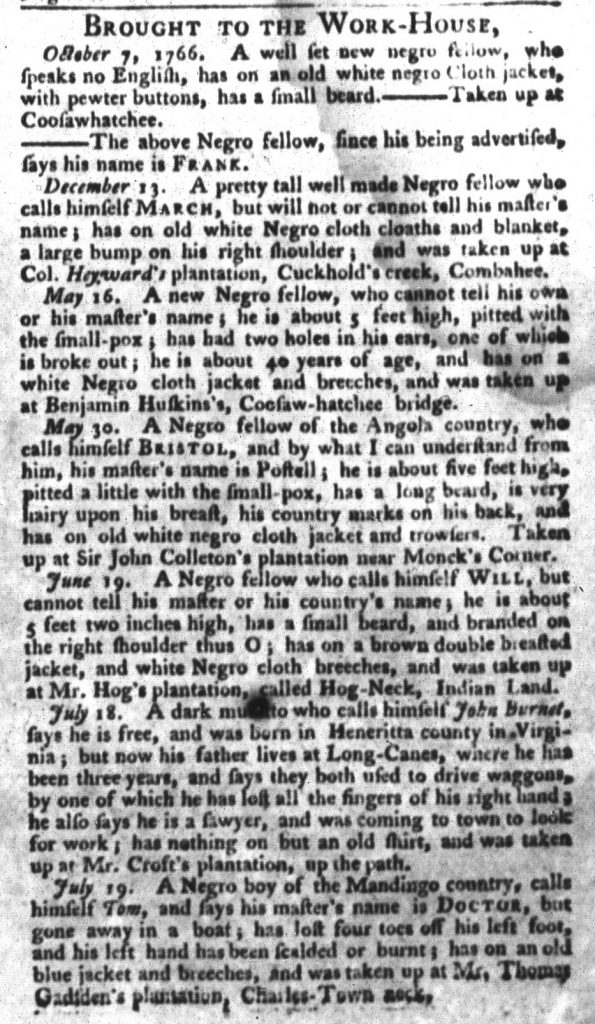
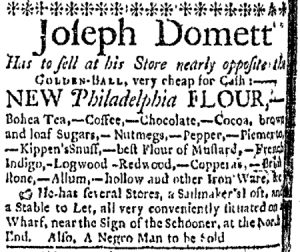
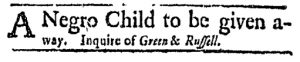
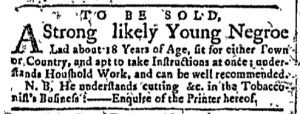
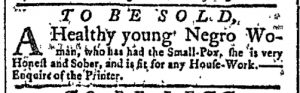
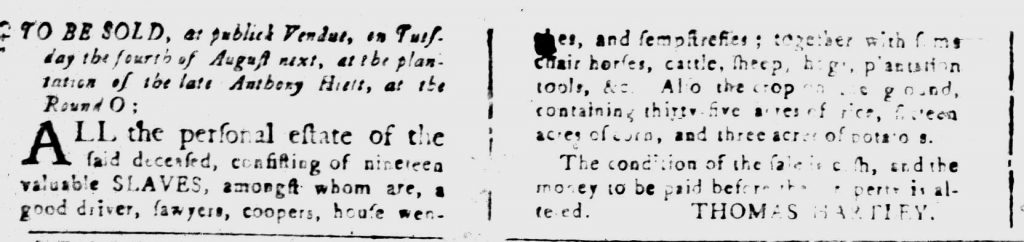
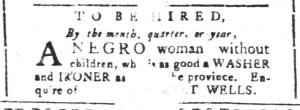
The Slavery Adverts 250 Project chronicles the role of newspaper advertising in perpetuating slavery in the era of the American Revolution. The project seeks to reveal the ubiquity of slavery in eighteenth-century life from New England to Georgia by republishing advertisements about enslaved people – for sale as individuals or in groups, wanted to purchase or for hire for short periods, runaways who liberated themselves, and those who were subsequently captured and confined in jails and workhouses – in daily digests on this site as well as in real time via the @SlaveAdverts250 Twitter feed, utilizing twenty-first-century media to stand in for the print media of the eighteenth century.
The project aims to provide modern audiences with a sense of just how often colonizers encountered these advertisements in their daily lives. Enslaved men, women, and children appeared in print somewhere in the colonies almost every single day. Those advertisements served as a constant backdrop for social, cultural, economic, and political life in colonial and revolutionary America. Colonizers who did not purport to own enslaved people were still confronted with slavery as well as invited to maintain the system by purchasing enslaved men, women, and children or assisting in the capture of so-called “runaways” who sought to free themselves from bondage. The frequency of these newspaper advertisements suggests just how embedded slavery was in colonial and revolutionary American culture in everyday interactions beyond the printed page.
These advertisements also testify to the experiences of enslaved men, women, and children, though readers must consider that those experiences have been remediated through descriptions offered by enslavers rather than enslaved people themselves. Often unnamed in the advertisements, enslaved men, women, and children were not invisible or unimportant in early America.
These advertisements appeared in colonial American newspapers 250 years ago today.
What was advertised in a colonial American newspaper 250 years ago today?
Supplement to the South-Carolina Gazette and Country Journal (July 21, 1767).
“A great Variety of new Articles, just arrived in Capt. Gordon.”
Like several other merchants and shopkeepers in colonial Charleston, John Davies advertised in more than one of the city’s newspapers. A variation of today’s advertisement from the South-Carolina Gazette and Country Journal, for instance, previously appeared in both that newspaper and the South-Carolina and American General Gazette a month earlier. This version added a nota bene informing potential customers that Davies had augmented his stock with “A very great Variety of new Articles, just arrived in Capt. Gordon.” On their own, these updates deceptively suggested that consumers could acquire merchandise fresh off a ship that had just arrived in port.
Those who consulted the shipping news, however, discovered a rather different story. No ship under the command of a Captain Gordon had arrived in port during the past week, so the nota bene did not deliver the absolutely “freshest Advices” promised in the newspaper’s masthead. Indeed, the June 30 issue indicated that the “Ship Mary, James Gordon” from London had arrived on June 26, nearly a month before today’s advertisement promoted the “very great Variety of new Articles, just arrived in Capt. Gordon.” In that issue, Davies’ advertisement appeared immediately to the left of the shipping news. Readers could verify the information communicated in the larger font used for the nota bene with a quick glance. Davies and the compositor had speedily updated the advertisement.
The revised notice appeared in the next three issues, the verity of the nota bene reduced with each passing week. Careful readers of the July 21 issue would have noticed that Captain Gordon and the Mary had been cleared for departure and a return trip to London by the Customs House on July 18. Careful readers would have also recognized Davies’ advertisement from previous issues, realizing that the information in the nota bene needed to be tempered by acknowledging that the notice had been reprinted several times over the past month. Such careful attention to the shipping news likely would not have been necessary for potential customers to approach this advertisement with some skepticism. Readers were accustomed to advertisements being reprinted for weeks and sometimes months. They would have learned to adjust their expectations when advertisers made claims about goods that had “just arrived” or had been “just imported.”
The Slavery Adverts 250 Project chronicles the role of newspaper advertising in perpetuating slavery in the era of the American Revolution. The project seeks to reveal the ubiquity of slavery in eighteenth-century life from New England to Georgia by republishing advertisements about enslaved people – for sale as individuals or in groups, wanted to purchase or for hire for short periods, runaways who liberated themselves, and those who were subsequently captured and confined in jails and workhouses – in daily digests on this site as well as in real time via the @SlaveAdverts250 Twitter feed, utilizing twenty-first-century media to stand in for the print media of the eighteenth century.
The project aims to provide modern audiences with a sense of just how often colonizers encountered these advertisements in their daily lives. Enslaved men, women, and children appeared in print somewhere in the colonies almost every single day. Those advertisements served as a constant backdrop for social, cultural, economic, and political life in colonial and revolutionary America. Colonizers who did not purport to own enslaved people were still confronted with slavery as well as invited to maintain the system by purchasing enslaved men, women, and children or assisting in the capture of so-called “runaways” who sought to free themselves from bondage. The frequency of these newspaper advertisements suggests just how embedded slavery was in colonial and revolutionary American culture in everyday interactions beyond the printed page.
These advertisements also testify to the experiences of enslaved men, women, and children, though readers must consider that those experiences have been remediated through descriptions offered by enslavers rather than enslaved people themselves. Often unnamed in the advertisements, enslaved men, women, and children were not invisible or unimportant in early America.
These advertisements appeared in colonial American newspapers 250 years ago today.
South-Carolina Gazette and Country Journal (July 22, 1767).
**********
South-Carolina Gazette and Country Journal (July 21, 1767).
**********
South-Carolina Gazette and Country Journal (July 21, 1767).
**********
South-Carolina Gazette and Country Journal (July 21, 1767).
**********
South-Carolina Gazette and Country Journal (July 21, 1767).
**********
South-Carolina Gazette and Country Journal (July 21, 1767).
**********
South-Carolina Gazette and Country Journal (July 21, 1767).
**********
South-Carolina Gazette and Country Journal (July 21, 1767).
**********
South-Carolina Gazette and Country Journal (July 21, 1767).
**********
South-Carolina Gazette and Country Journal (July 21, 1767).
**********
South-Carolina Gazette and Country Journal (July 21, 1767).
**********
Supplement to the South-Carolina Gazette and Country Journal (July 21, 1767).
**********
Supplement to the South-Carolina Gazette and Country Journal (July 21, 1767).
**********
Supplement to the South-Carolina Gazette and Country Journal (July 21, 1767).
**********
Supplement to the South-Carolina Gazette and Country Journal (July 21, 1767).
“Just Imported, and to be Sold by Harbottle Dorr.”
Harbottle Dorr’s name jumped off the page when I first spotted this advertisement in the July 20, 1767, edition of the Boston-Gazette. In terms of content and format, his notice was not particularly distinctive. So why did this particular advertisement catch my eye? Why did it create an extra spark of excitement?
In 1767, residents of Boston knew Harbottle Dorr as a merchant, in part because he advertised in several of the local newspapers. In the course of the next quarter century, he joined the Sons of Liberty and “served intermittently as a Boston selectman for many years between 1777 and 1791.” Today he is best known to historians, especially historians of print culture, thanks to his collection of newspapers from the period of the imperial crisis and the American Revolution, now in the collections of the Massachusetts Historical Society. As the MHS explains, “Beginning in 1765, Dorr spent more than a dozen years purchasing newspapers, writing comments in margins, inserting reference marks in articles, and assembling indexes.” He aimed “to form a political history” of events as he witnessed and participated in them. His indexes and annotations demonstrate one reader’s intensive engagement with the public prints. Thanks to digitization and other technologies, scholars and the general public have access to The Annotated Newspapers of Harbottle Dorr, Jr., via the Massachusetts Historical Society’s website.
In addition to advertising in the July 20 issue of the Boston-Gazette, Dorr also acquired a copy for his collection. It does not appear, however, that he purchased every newspaper that ran one of his advertisements. For instance, he inserted the same advertisement in the July 20 edition of the Boston Evening-Post, but that issue is not in the collection he assembled. At the very least, he did not save or add issues merely because they published his commercial notices. He may have confirmed that his advertisements indeed appeared as expected, but that was not sufficient reason for inclusion in his project.
Still, today’s advertisement has a unique twist compared to most others featured by the Adverts 250 Project, though a twist rendered more complex by digitization of historical sources. In most cases, the provenance of the original issue makes little difference. This advertisement, however, came from a copy originally possessed by the advertiser himself. In preparing today’s entry, I consulted Dorr’s newspaper to write about his advertisement. Or did I? Does it make sense to feel a connection to the material text – to feel excited that Dorr owned, touched, and annotated this particular issue – when I have not actually used the physical manifestation of that issue but a digital surrogate instead? Maybe, but maybe not.
In the past I have joined other scholars in arguing that digitized sources are best used as complements to, rather than replacements of, original sources. After all, sometimes consulting originals yields answers just not possible to achieve when examining digital surrogates, despite their many advantages. This response, however, does not factor in the emotional component of archival work, the excitement scholars feel when handling the things owned by the people we study, a physical connection that defies the passage of time.
Yet I still experienced a flash of excitement when I examined today’s advertisement via The Annotated papers of Harbottle Dorr, Jr., that I did not feel when I first saw the advertisement in Readex’s database of America’s Historical Newspapers. I feel a greater connection to the advertisement inserted in the Boston-Gazette, part of Dorr’s collection, than I do to the advertisement in the Boston Evening-Post, not in his collection, even though it was the same advertisement. Even mediated by digitization, “seeing” the original yields emotional satisfaction. In that regard, the Massachusetts Historical Society has done an even greater service than I previously realized. Their online collection of Dorr’s newspapers has enhanced my experience by associating a person with the material text.
The Slavery Adverts 250 Project chronicles the role of newspaper advertising in perpetuating slavery in the era of the American Revolution. The project seeks to reveal the ubiquity of slavery in eighteenth-century life from New England to Georgia by republishing advertisements about enslaved people – for sale as individuals or in groups, wanted to purchase or for hire for short periods, runaways who liberated themselves, and those who were subsequently captured and confined in jails and workhouses – in daily digests on this site as well as in real time via the @SlaveAdverts250 Twitter feed, utilizing twenty-first-century media to stand in for the print media of the eighteenth century.
The project aims to provide modern audiences with a sense of just how often colonizers encountered these advertisements in their daily lives. Enslaved men, women, and children appeared in print somewhere in the colonies almost every single day. Those advertisements served as a constant backdrop for social, cultural, economic, and political life in colonial and revolutionary America. Colonizers who did not purport to own enslaved people were still confronted with slavery as well as invited to maintain the system by purchasing enslaved men, women, and children or assisting in the capture of so-called “runaways” who sought to free themselves from bondage. The frequency of these newspaper advertisements suggests just how embedded slavery was in colonial and revolutionary American culture in everyday interactions beyond the printed page.
These advertisements also testify to the experiences of enslaved men, women, and children, though readers must consider that those experiences have been remediated through descriptions offered by enslavers rather than enslaved people themselves. Often unnamed in the advertisements, enslaved men, women, and children were not invisible or unimportant in early America.
These advertisements appeared in colonial American newspapers 250 years ago today.
What was advertised in a colonial American newspaper 250 years ago this week?
New-London Gazette (July 17, 1767).
“CASH is given for clean Linen RAGS.”
Eighteenth-century newspapers were peppered with calls for rags. In any given issue, the printer might insert this sort of notice among the advertisements or use it to complete a page featuring primarily news items. These pleas for rags, however, were not merely filler. They played a vital role in the production of paper in colonial America. At the time, paper was made of linen rather than wood pulp. As a result, the rags that colonists turned over to the “Paper Manufactory” became the paper printers used to publish books, newspapers, almanacs, and anything else that came off their presses.
In 1767, printers throughout New England dressed up their usually plain calls for rags with a short poem that extolled the virtues of rags. In four rhyming couplets, it explained:
RAGS are as Beauties, which concealed lie,
But when in Paper, how it charms the Eye!
Pray save your Rags, new Beauties to discover,
For Paper truly, every one’s a Lover.
By th’ Pen and Press such Knowledge is display’d,
As wou’dn’t exist if Paper was not made.
Wisdom of Things, mysterious, divine,
Illustriously doth as PAPER shine!
Every rag possessed hidden beauty just waiting to emerge when rags were transformed into paper. In their current form, rags were deceptive, hiding their potential to convey the “Wisdom of Things” far and wide once they became paper. Not to be discarded as trash, rags were actually a treasure beyond value.
Rags currently in the possession of readers of the New-London Gazette could eventually become future issues delivered to them, but only if subscribers turned their rags over to one of the many men listed in the extensive network of local agents who collected rags for the Paper Manufactory. Colonists who wished to continue receiving news and advertisements via the New-London Gazette (or any of the other newspapers that published this poem along with a similar announcement) had to assume responsibility for that portion of the paper production process.
Although printers exercised considerable discretion in the content of newspapers, their readers played a significant part in producing the material that became the text. The dissemination of print in early America depended in part on average colonists surrendering their rags, a rather humble start considering the tapestry of colonial life recorded in the pages of newspapers and other publications that came off American presses in the eighteenth century.
What was advertised in a colonial American newspaper 250 years ago today?
Providence Gazette (July 18, 1767).
“He will sell as Cheap as the Messrs. Thurbers.”
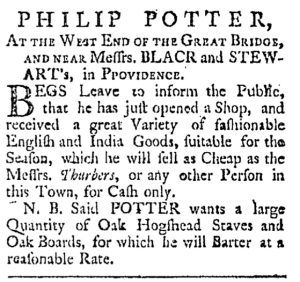
Philip Potter placed an advertisement in the Providence Gazette to announce that “he has just opened a Shop, and received a great Variety of fashionable English and India Goods.” In the process of promoting his own wares, Potter made reference to other shopkeepers in the city.
To help potential customers find his shop, Potter indicated that it was located “AT THE WEST END OF THE GREAT BRIDGE, AND NEAR Messrs. BLACK and STEWART.” While this may have called attention to a competitor (who happened to advertise on the following page of the same issue), the public’s familiarity with Black and Stewart and where they kept shop may have outweighed any risk of giving them free publicity. After all, Potter’s new shop would fail if customers could not find it, making it necessary to refer to prominent landmarks in an era before standardized street numbers.
Potter also mentioned two shopkeepers in North Providence, proclaiming that “he will sell as Cheap as the Messrs. Thurbers, or any other Person in this Town.” Merchants and shopkeepers commonly promised potential customers that they offered the best prices, but rarely did they single out specific competitors for special notice. For their part, Benjamin and Edward Thurber had previously advertised that their prices were “as low as any Person in this or the neighboring Towns, or in North-America.” They made a bold claim to the lowest prices on the continent, but they did not name any of their competitors. Did Potter refer to them because they had indeed established a reputation among consumers for particularly low prices? In promoting his own shop, did he also acknowledge the Thurbers as the shopkeepers most likely to offer great deals for shoppers? Did Potter give voice to a general sentiment among Providence residents? If the Thurbers were indeed known to offer the lowest prices, then Potter used their reputation to his own advantage, provided that he actually matched their prices when customers visited his shop.
Most local readers of the Providence Gazette would have been familiar with the commercial landscape of their city. Rather than pretend that his competitors did not exist, Potter mobilized general knowledge about their businesses to attract customers to his own shop.
The Slavery Adverts 250 Project chronicles the role of newspaper advertising in perpetuating slavery in the era of the American Revolution. The project seeks to reveal the ubiquity of slavery in eighteenth-century life from New England to Georgia by republishing advertisements about enslaved people – for sale as individuals or in groups, wanted to purchase or for hire for short periods, runaways who liberated themselves, and those who were subsequently captured and confined in jails and workhouses – in daily digests on this site as well as in real time via the @SlaveAdverts250 Twitter feed, utilizing twenty-first-century media to stand in for the print media of the eighteenth century.
The project aims to provide modern audiences with a sense of just how often colonizers encountered these advertisements in their daily lives. Enslaved men, women, and children appeared in print somewhere in the colonies almost every single day. Those advertisements served as a constant backdrop for social, cultural, economic, and political life in colonial and revolutionary America. Colonizers who did not purport to own enslaved people were still confronted with slavery as well as invited to maintain the system by purchasing enslaved men, women, and children or assisting in the capture of so-called “runaways” who sought to free themselves from bondage. The frequency of these newspaper advertisements suggests just how embedded slavery was in colonial and revolutionary American culture in everyday interactions beyond the printed page.
These advertisements also testify to the experiences of enslaved men, women, and children, though readers must consider that those experiences have been remediated through descriptions offered by enslavers rather than enslaved people themselves. Often unnamed in the advertisements, enslaved men, women, and children were not invisible or unimportant in early America.
These advertisements appeared in colonial American newspapers 250 years ago today.
What was advertised in a colonial American newspaper 250 years ago today?
New-Hampshire Gazette (July 27, 1767).
“For sale at their Shop at the Sign of the BUCK and GLOVE.”
It would have been difficult not to notice the woodcut that accompanied James and Matthew Haslett’s advertisement in the July 17, 1767, edition of the New-Hampshire Gazette. Except for the insignia of the lion and unicorn within the masthead at the top of the first page, it was the only visual image in the entire issue, immediately drawing the eye away from the text that surrounded it.
The Hasletts reminded potential customers that “they still carry on the Leather Dressing Business … at their Shop at the Sign of the BUCK and GLOVE in King Street” in Portsmouth. The woodcut indeed depicted a sign that featured a buck and glove, as well as a pair of breeches. The text of the advertisement also promoted “all sorts of Breeches ready made.”
This was not the first time that the leather dressers inserted a woodcut alongside their advertisement, but it had been ten months since they last did so. In the interim, their commercial notices had been unadorned, relying on the copy alone to convince potential customers to avail themselves of the Hasletts’ services.
When they decided to once again include a woodcut, they did not return to either of the two that previously appeared in the pages of the New-Hampshire Gazette. This woodcut was new, though it included the same elements incorporated into at least one of the previous iterations. All three depicted a signboard with a buck, a glove, and a pair of breeches hanging alongside a separate glove on the same pole. The first version included the date they founded their business and the Hasletts’ names in the same locations as the newest woodcut, but the second one eliminated their names and moved the date to the top of the sign. This version included decorative finials at the top and bottom of the sign that had not been present in either previous woodcut.
With this woodcut, the Hasletts further developed their brand. Their advertisement helps to create a better sense of the visual aspects of eighteenth-century signs that marked all kinds of businesses. However, the variations among the various woodcuts used by the Hasletts suggests that any woodcut should be considered a general or stylistic representation of how a sign might have looked rather than an attempt to closely or exactly replicate its appearance.
The Slavery Adverts 250 Project chronicles the role of newspaper advertising in perpetuating slavery in the era of the American Revolution. The project seeks to reveal the ubiquity of slavery in eighteenth-century life from New England to Georgia by republishing advertisements about enslaved people – for sale as individuals or in groups, wanted to purchase or for hire for short periods, runaways who liberated themselves, and those who were subsequently captured and confined in jails and workhouses – in daily digests on this site as well as in real time via the @SlaveAdverts250 Twitter feed, utilizing twenty-first-century media to stand in for the print media of the eighteenth century.
The project aims to provide modern audiences with a sense of just how often colonizers encountered these advertisements in their daily lives. Enslaved men, women, and children appeared in print somewhere in the colonies almost every single day. Those advertisements served as a constant backdrop for social, cultural, economic, and political life in colonial and revolutionary America. Colonizers who did not purport to own enslaved people were still confronted with slavery as well as invited to maintain the system by purchasing enslaved men, women, and children or assisting in the capture of so-called “runaways” who sought to free themselves from bondage. The frequency of these newspaper advertisements suggests just how embedded slavery was in colonial and revolutionary American culture in everyday interactions beyond the printed page.
These advertisements also testify to the experiences of enslaved men, women, and children, though readers must consider that those experiences have been remediated through descriptions offered by enslavers rather than enslaved people themselves. Often unnamed in the advertisements, enslaved men, women, and children were not invisible or unimportant in early America.
These advertisements appeared in colonial American newspapers 250 years ago today.
New-London Gazette (July 17, 1767).
**********
South-Carolina and American General Gazette (July 17, 1767).
**********
South-Carolina and American General Gazette (July 17, 1767).
**********
South-Carolina and American General Gazette (July 17, 1767).
**********
South-Carolina and American General Gazette (July 17, 1767).
**********
South-Carolina and American General Gazette (July 17, 1767).
**********
South-Carolina and American General Gazette (July 17, 1767).
**********
South-Carolina and American General Gazette (July 17, 1767).
**********
South-Carolina and American General Gazette (July 17, 1767).