July 16

What was advertised in a colonial American newspaper 250 years ago today?

Jul 16 - 7:16:1767 Massachusetts Gazette
Massachusetts Gazette (July 16, 1767).

“Just imported and to be Sold by John Mein At the LONDON BOOK-STORE.”

John Mein regularly advertised in the Massachusetts Gazette in 1767. He also advertised in the Boston Evening-Post, the Boston-Gazette, and the Boston Post-Boy. With so many local publications carrying news and advertising to local consumers, he increased the likelihood that potential customers would be exposed to his advertisements.

The length of Mein’s advertisements may have also drawn attention. Shopkeepers frequently placed advertisements that extended half a column or more, but rarely did they exceed a single column. Mein, however, inserted advertisements that overflowed into second and sometimes even third columns. The variable length of his advertisements suggests that he may have submitted extensive sample advertisements to newspaper offices with an understanding that they would include as much as possible but truncate them to fit the space available. In such cases, printers and compositors would have played a role in editing advertising copy even though they were not responsible for generating it.

This particular advertisement may have also drawn attention because it covered almost the entire front page of the July 16 edition of the Massachusetts Gazette, almost squeezing out a notice for a “Variety of Millenary Goods” at the lower right. Its placement may seem strange considering the importance associated with front-page news in the twentieth and twenty-first centuries, but it also demonstrates the evolution in journalism practices and consumption practices. Neither publishers nor readers engaged with newspapers and their content in quite the same way in the eighteenth century that they have in time since then.

Early Americans expected (or at least would not have been surprised) to encounter major news stories nestled within the inner pages of any given issue. Taking into consideration the production of the July 16 edition helps to demonstrate what that was the case. A four-page issue, it resulted from printing two pages on each side of a broadsheet and then folding it in half. The first and fourth pages, comprised entirely of the masthead and advertisements the printer received well in advance (and most of them already set in type for previous issues), were printed first. Only after they dried were the second and third pages printed on the other side. In this case, those pages included the news content for the issue, including items dated the date before and the day of publication.

To modern eyes, John Mein’s (nearly) full-page advertisement on the front page of a newspaper may seem extraordinary. Its lengthy certainly merited notice in the eighteenth-century, but contemporary readers may not have been especially surprised by its placement. That it appeared on the front page just would not have resonated as being all that significant for readers accustomed to seeing advertising, rather than news, immediately under the masthead.

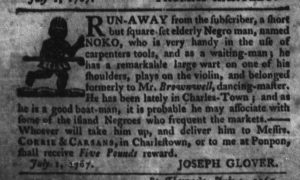
Slavery Advertisements Published July 16, 1767

The Slavery Adverts 250 Project chronicles the role of newspaper advertising in perpetuating slavery in the era of the American Revolution. The project seeks to reveal the ubiquity of slavery in eighteenth-century life from New England to Georgia by republishing advertisements about enslaved people – for sale as individuals or in groups, wanted to purchase or for hire for short periods, runaways who liberated themselves, and those who were subsequently captured and confined in jails and workhouses – in daily digests on this site as well as in real time via the @SlaveAdverts250 Twitter feed, utilizing twenty-first-century media to stand in for the print media of the eighteenth century.

The project aims to provide modern audiences with a sense of just how often colonizers encountered these advertisements in their daily lives. Enslaved men, women, and children appeared in print somewhere in the colonies almost every single day. Those advertisements served as a constant backdrop for social, cultural, economic, and political life in colonial and revolutionary America. Colonizers who did not purport to own enslaved people were still confronted with slavery as well as invited to maintain the system by purchasing enslaved men, women, and children or assisting in the capture of so-called “runaways” who sought to free themselves from bondage. The frequency of these newspaper advertisements suggests just how embedded slavery was in colonial and revolutionary American culture in everyday interactions beyond the printed page.

These advertisements also testify to the experiences of enslaved men, women, and children, though readers must consider that those experiences have been remediated through descriptions offered by enslavers rather than enslaved people themselves. Often unnamed in the advertisements, enslaved men, women, and children were not invisible or unimportant in early America.

These advertisements appeared in colonial American newspapers 250 years ago today.

Jul 16 - Massachusetts Gazette Slavery 1
Massachusetts Gazette (July 16, 1767).

**********

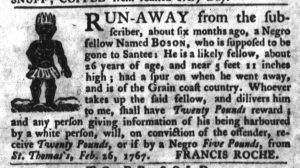
Jul 16 - Pennsylvania Gazette Slavery 1
Pennsylvania Gazette (July 16, 1767).

**********

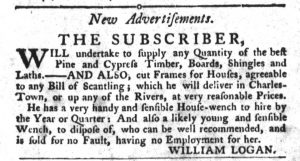
Jul 16 - Pennsylvania Gazette Slavery 2
Pennsylvania Gazette (July 16, 1767).

**********

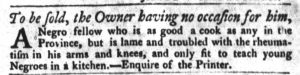
Jul 16 - Pennsylvania Gazette Slavery 3
Pennsylvania Gazette (July 16, 1767).

**********

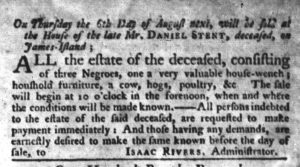
Jul 16 - Pennsylvania Gazette Supplement Slavery 4
Supplement to the Pennsylvania Gazette (July 16, 1767).

**********

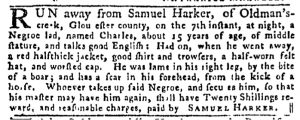
Jul 16 - Pennsylvania Gazette Supplement Slavery 1
Supplement to the Pennsylvania Gazette (July 16, 1767).

**********

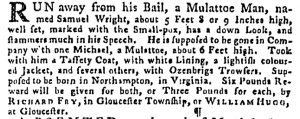
Jul 16 - Pennsylvania Gazette Supplement Slavery 2
Supplement to the Pennsylvania Gazette (July 16, 1767).

**********

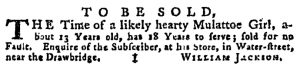
Jul 16 - Pennsylvania Gazette Supplement Slavery 3
Supplement to the Pennsylvania Gazette (July 16, 1767).

**********

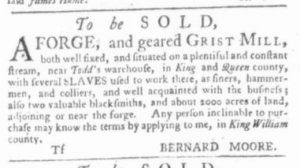
Jul 16 - Virginia Gazette Slavery 1
Virginia Gazette (July 16, 1767).

**********

Jul 16 - Virginia Gazette Slavery 2
Virginia Gazette (July 16, 1767).

**********

Jul 16 - Virginia Gazette Slavery 3
Virginia Gazette (July 16, 1767).

July 15

Who was the subject of an advertisement in a colonial American newspaper 250 years ago today?

Jul 15 - 7:15:1767 Georgia Gazette
Georgia Gazette (July 15, 1767).

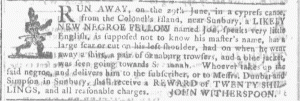
“RUN AWAY … NEGROE FELLOW named Joe.”

Joe, “a LIKELY NEW NEGROE FELLOW,” made a run for it in the summer of 1767. At the end of June, he took a canoe and attempted to make his escape from John Witherspoon. The slaveholder stated that the fugitive “was seen going towards Savannah,” perhaps heading for Savannah from Sunbury, perhaps heading toward the largest settlement in the area in hopes of attracting less attention among larger numbers of people. It may have been hard for Joe to avoid detection, however, because he “speaks very little English.”

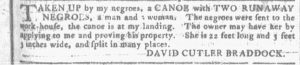
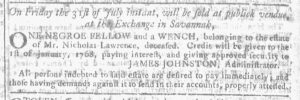
Among enslaved men and women in Georgia, Joe was not alone in desiring his freedom. In another advertisement, David Cutler Braddock reported that his slaves had “TAKEN UP … a CANOE with TWO RUNAWAY NEGROES, a man and a woman.” Braddock advertised that he would hold the canoe until its owner came to collect it. “The negroes,” on the other hand, “were sent to the work-house” (where they joined Sharper and Tom, two captured runaways listed in the final advertisement in the July 15 issue of the Georgia Gazette).

These brief advertisements told intriguing yet incomplete stories about enslaved men and women. In addition to noting that he spoke little English, Witherspoon described Joe as “NEW.” How long had he been in Georgia? Had he recently survived the Middle Passage from Africa to the Americas? Given that he was headed toward Savannah, how familiar was he with the local geography? Did he hope to reunite with friends or relatives there? Or was he on his own? What was the source of the “large scar or cut on his left shoulder”? Was it the result of some sort of punishment that may have strengthened his resolve to make an escape?

How about the runaways in the canoe? What was their relationship? Husband and wife? Brother and sister? Friends or acquaintances connected by little more than their bondage and mutual agreement to seized an opportunity to take a canoe and depart when no one was looking? What role did Braddock’s slaves play in capturing them? What was their motivation for the part they played? Did they participate willingly? Did they turn in the runaways because they expected some sort of reward? Did they turn over the fugitives and their canoe to the slaveholder reluctantly only to avoid trouble because others observed them?

Advertisements for runaway slaves have been called the first slave narratives. They certainly tell important stories about the agency exercised by enslaved men and women, but since slaveholders composed them they lack some of the perspective and insight that likely would have been present in first-person narratives. These advertisements tell rich stories, but the questions they raise can sometimes be as revealing about the experiences of enslaved people in colonial America.

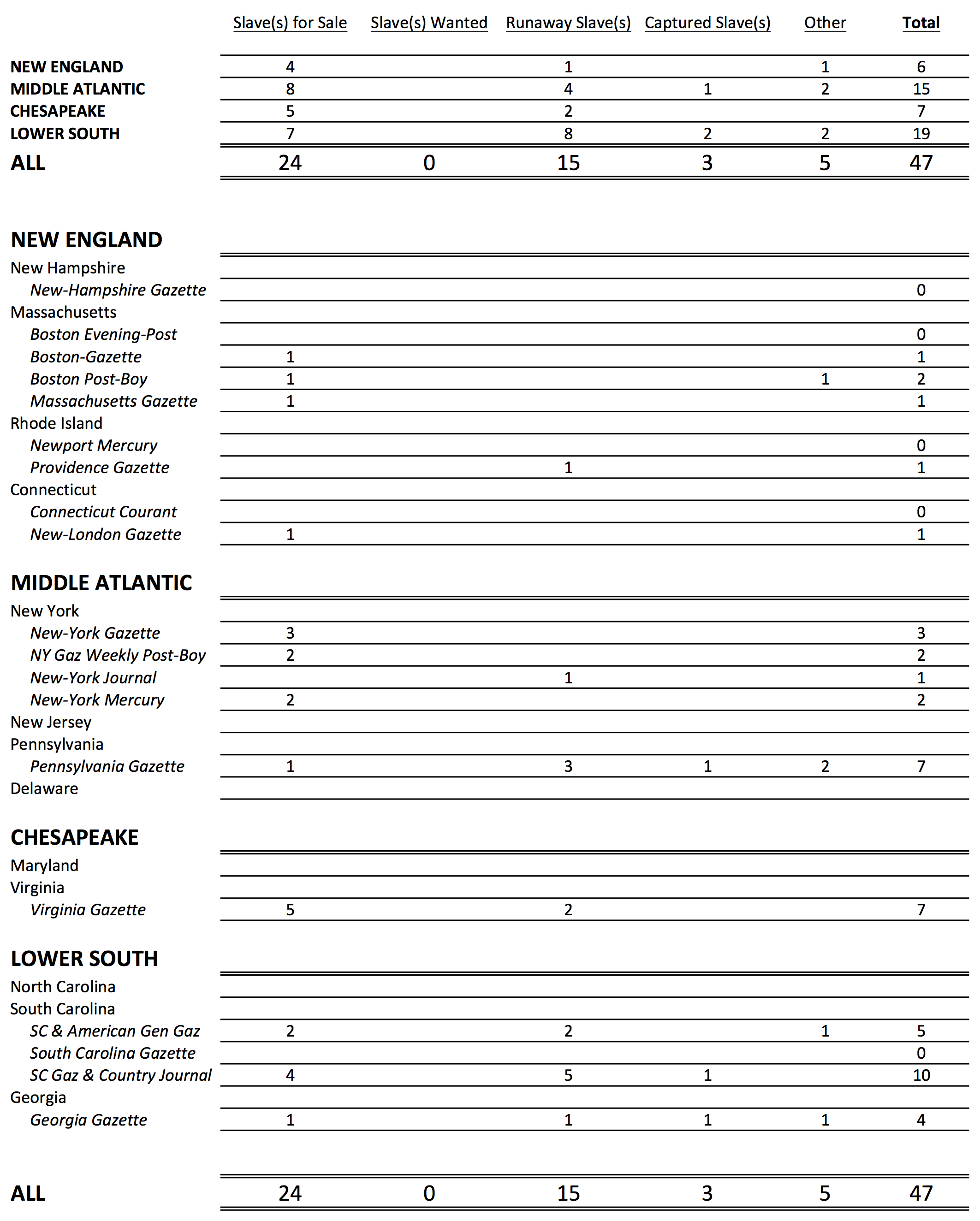
Summary of Slavery Advertisements Published July 9-15, 1767

These tables indicate how many advertisements for slaves appeared in colonial American newspapers during the week of July 9-15, 1767.

Note:  These tables are as comprehensive as currently digitized sources permit, but they may not be an exhaustive account.  They includes all newspapers that have been digitized and made available via Accessible Archives, Colonial Williamsburg’s Digital Library, and Readex’s America’s Historical Newspapers.  There are several reasons some newspapers may not have been consulted:

  • Issues that are no longer extant;
  • Issues that are extant but have not yet been digitized (including the Pennsylvania Journal); and
  • Newspapers published in a language other than English (including the Wochentliche Philadelphische Staatsbote).

**********

Slavery Advertisements Published July 9-15, 1767:  By Date

Slavery Adverts Tables 1767 By Date Jul 9


**********

Slavery Advertisements Published July 9-15, 1767:  By Region

Slavery Adverts Tables 1767 By Region Jul 9


Slavery Advertisements Published July 15, 1767

The Slavery Adverts 250 Project chronicles the role of newspaper advertising in perpetuating slavery in the era of the American Revolution. The project seeks to reveal the ubiquity of slavery in eighteenth-century life from New England to Georgia by republishing advertisements about enslaved people – for sale as individuals or in groups, wanted to purchase or for hire for short periods, runaways who liberated themselves, and those who were subsequently captured and confined in jails and workhouses – in daily digests on this site as well as in real time via the @SlaveAdverts250 Twitter feed, utilizing twenty-first-century media to stand in for the print media of the eighteenth century.

The project aims to provide modern audiences with a sense of just how often colonizers encountered these advertisements in their daily lives. Enslaved men, women, and children appeared in print somewhere in the colonies almost every single day. Those advertisements served as a constant backdrop for social, cultural, economic, and political life in colonial and revolutionary America. Colonizers who did not purport to own enslaved people were still confronted with slavery as well as invited to maintain the system by purchasing enslaved men, women, and children or assisting in the capture of so-called “runaways” who sought to free themselves from bondage. The frequency of these newspaper advertisements suggests just how embedded slavery was in colonial and revolutionary American culture in everyday interactions beyond the printed page.

These advertisements also testify to the experiences of enslaved men, women, and children, though readers must consider that those experiences have been remediated through descriptions offered by enslavers rather than enslaved people themselves. Often unnamed in the advertisements, enslaved men, women, and children were not invisible or unimportant in early America.

These advertisements appeared in colonial American newspapers 250 years ago today.

Jul 15 - Georgia Gazette Slavery 1
Georgia Gazette (July 15, 1767).

**********

Jul 15 - Georgia Gazette Slavery 2
Georgia Gazette (July 15, 1767).

**********

Jul 15 - Georgia Gazette Slavery 3
Georgia Gazette (July 15, 1767).

**********

Jul 15 - Georgia Gazette Slavery 4
Georgia Gazette (July 15, 1767).

July 14

What was advertised in a colonial American newspaper 250 years ago today?

Jul 14 - 7:14:1767 South-Carolina Gazette and Country Journal
South-Carolina Gazette and Country Journal (July 14, 1767).

“JUST IMPORTED, By JAMES DRUMMOND … a large and compleat Assortment of Goods.”

James Drummond obtained a privileged place for his advertisement in the South-Carolina Gazette and Country Journal. Or did he? The answer depends on how readers engaged with the newspaper when it came into their possession. Drummond’s advertisement appeared in the third and final column on the first page, immediately under a headline that proclaimed “New Advertisement.” An ornamental device separated it from the news item that occupied most of the page, a lengthy “Extract of a Representation from the Board of Trade to his Majesty.” Drummond’s advertisement seemed to have a prime position on the page.

However, that may not necessarily have been the case. The vast majority of the advertising in the July 14 edition appeared on the third and fourth pages of the four-page issue. Although not arranged by any sort of classification on those two pages, dozens of advertisements were grouped together. Readers who perused any particular advertisement would have also noticed the others that surrounded it. From that perspective, Drummond’s notice was isolated from the others and may have received less attention as a result. Having his advertisement inserted in closer proximity to those placed by competitors may have worked to his benefit.

Where within the issue Drummond’s advertisement appeared probably depended on decisions made in the printing office. Given its length relative to the columns of news on the first page, the compositor likely saw an opportunity to fill most of the remaining space once the “Extract” had been set, adding one short real estate announcement to complete the page. For readers who approached this issue intensively – reading straight through from start to finish – Drummond’s advertisement would have been the first commercial notice (and one of the first items of any sort) encountered, making its placement a boon to the shopkeeper. On the other hand, some readers, especially those who did not examine every column of every page, may have overlooked Drummond’s advertisement because it was not included among its counterparts. The front page may not have always been the best place as far as colonial advertisers were concerned.

Slavery Advertisements Published July 14, 1767

The Slavery Adverts 250 Project chronicles the role of newspaper advertising in perpetuating slavery in the era of the American Revolution. The project seeks to reveal the ubiquity of slavery in eighteenth-century life from New England to Georgia by republishing advertisements about enslaved people – for sale as individuals or in groups, wanted to purchase or for hire for short periods, runaways who liberated themselves, and those who were subsequently captured and confined in jails and workhouses – in daily digests on this site as well as in real time via the @SlaveAdverts250 Twitter feed, utilizing twenty-first-century media to stand in for the print media of the eighteenth century.

The project aims to provide modern audiences with a sense of just how often colonizers encountered these advertisements in their daily lives. Enslaved men, women, and children appeared in print somewhere in the colonies almost every single day. Those advertisements served as a constant backdrop for social, cultural, economic, and political life in colonial and revolutionary America. Colonizers who did not purport to own enslaved people were still confronted with slavery as well as invited to maintain the system by purchasing enslaved men, women, and children or assisting in the capture of so-called “runaways” who sought to free themselves from bondage. The frequency of these newspaper advertisements suggests just how embedded slavery was in colonial and revolutionary American culture in everyday interactions beyond the printed page.

These advertisements also testify to the experiences of enslaved men, women, and children, though readers must consider that those experiences have been remediated through descriptions offered by enslavers rather than enslaved people themselves. Often unnamed in the advertisements, enslaved men, women, and children were not invisible or unimportant in early America.

These advertisements appeared in colonial American newspapers 250 years ago today.

Jul 14 - South-Carolina Gazette and Country Journal Slavery 10
South-Carolina Gazette and Country Journal (July 14, 1767).

**********

Jul 14 - South-Carolina Gazette and Country Journal Slavery 1
South-Carolina Gazette and Country Journal (July 14, 1767).

**********

Jul 14 - South-Carolina Gazette and Country Journal Slavery 2
South-Carolina Gazette and Country Journal (July 14, 1767).

**********

Jul 14 - South-Carolina Gazette and Country Journal Slavery 3
South-Carolina Gazette and Country Journal (July 14, 1767).

**********

Jul 14 - South-Carolina Gazette and Country Journal Slavery 4
South-Carolina Gazette and Country Journal (July 14, 1767).

**********

Jul 14 - South-Carolina Gazette and Country Journal Slavery 5
South-Carolina Gazette and Country Journal (July 14, 1767).

**********

Jul 14 - South-Carolina Gazette and Country Journal Slavery 6
South-Carolina Gazette and Country Journal (July 14, 1767).

**********

Jul 14 - South-Carolina Gazette and Country Journal Slavery 7
South-Carolina Gazette and Country Journal (July 14, 1767).

**********

Jul 14 - South-Carolina Gazette and Country Journal Slavery 8
South-Carolina Gazette and Country Journal (July 14, 1767).

**********

Jul 14 - South-Carolina Gazette and Country Journal Slavery 9
South-Carolina Gazette and Country Journal (July 14, 1767).

July 13

What was advertised in a colonial American newspaper 250 years ago today?

Jul 13 - 7:13:1767 Connecticut Courant
Connecticut Courant (July 14, 1767).

“The following BOOKS.”

Compared to newspapers published in major port cities in the 1760s, Hartford’s Connecticut Courant included relatively little advertising. Even compared to other newspapers from smaller towns (such as Savannah’s Georgia Gazette, Portsmouth’s New-Hampshire Gazette, and the New-London Gazette) the amount of space the Connecticut Courant devoted to commercial notices and other sorts of paid advertisements was modest, usually limited to a few short items on the final page or scattered throughout an issue.

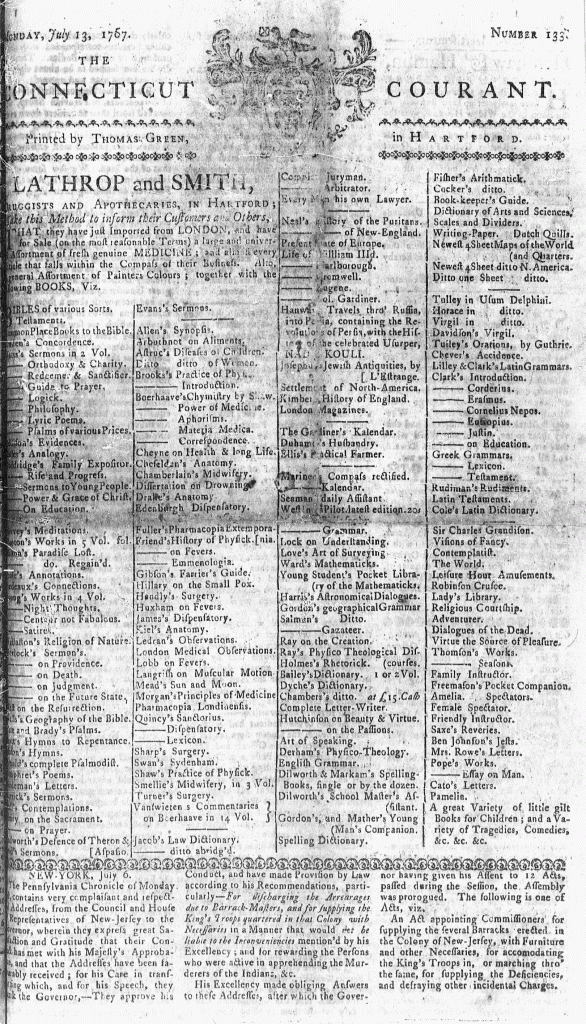
This aspect of Thomas Green’s newspaper made Lathrop and Smith’s advertisement particularly striking and unexpected. In addition to promoting the “large and universal Assortment of fresh genuine MEDICINE” they had just imported from London, the apothecaries also listed scores of books they sold. Their advertisement extended across the entire page, divided into four columns (rather than three columns throughout the rest of the newspaper) in order to squeeze in as many titles as possible.

Jul 13 - 7:13:1767 Front Page Connecticut Courant
Front Page of the Connecticut Courant (July 13, 1767).

In addition to its length, Lathrop and Smith’s advertisement dominated the front page of the Connecticut Courant; it hardly could have escaped the notice of subscribers and other readers. It also would have been readily visible to anyone who observed someone reading the newspaper, especially if it was held aloft while perusing the items in the center pages. Except for the masthead at the top and a snippet of news relayed from New York at the bottom, the apothecaries’ advertisement filled the entire first page.

Lathrop and Smith almost certainly were familiar with the standards and conventions of newspaper advertising in Hartford, yet they likely also read newspapers from Boston and New York, at least occasionally, since eighteenth-century newspapers tended to circulate far beyond their places of publication. Certain booksellers, especially John Mein in Boston and Garret Noel in New York, frequently placed lengthy advertisements listing the titles they stocked. With those notices and others as models of what was possible when it came to newspaper advertising, Lathrop and Smith devised their own marketing efforts accordingly. Their advertisement more closely replicated those placed by their counterparts in other cities than the usual notices for consumer goods and services in their local newspaper. They designed an advertisement considered appropriate and effective among others who pursued the same occupation.

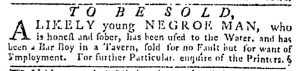
Slavery Advertisements Published July 13, 1767

The Slavery Adverts 250 Project chronicles the role of newspaper advertising in perpetuating slavery in the era of the American Revolution. The project seeks to reveal the ubiquity of slavery in eighteenth-century life from New England to Georgia by republishing advertisements about enslaved people – for sale as individuals or in groups, wanted to purchase or for hire for short periods, runaways who liberated themselves, and those who were subsequently captured and confined in jails and workhouses – in daily digests on this site as well as in real time via the @SlaveAdverts250 Twitter feed, utilizing twenty-first-century media to stand in for the print media of the eighteenth century.

The project aims to provide modern audiences with a sense of just how often colonizers encountered these advertisements in their daily lives. Enslaved men, women, and children appeared in print somewhere in the colonies almost every single day. Those advertisements served as a constant backdrop for social, cultural, economic, and political life in colonial and revolutionary America. Colonizers who did not purport to own enslaved people were still confronted with slavery as well as invited to maintain the system by purchasing enslaved men, women, and children or assisting in the capture of so-called “runaways” who sought to free themselves from bondage. The frequency of these newspaper advertisements suggests just how embedded slavery was in colonial and revolutionary American culture in everyday interactions beyond the printed page.

These advertisements also testify to the experiences of enslaved men, women, and children, though readers must consider that those experiences have been remediated through descriptions offered by enslavers rather than enslaved people themselves. Often unnamed in the advertisements, enslaved men, women, and children were not invisible or unimportant in early America.

These advertisements appeared in colonial American newspapers 250 years ago today.

Jul 13 - Boston Post-Boy Slavery 1
Boston Post-Boy (July 13, 1767).

**********

Jul 13 - Boston Post-Boy Slavery 2
Boston Post-Boy (July 13, 1767).

**********

Jul 13 - Boston-Gazette Slavery 1
Boston-Gazette (July 13, 1767).

**********

Jul 13 - New-York Gazette Slavery 1
New-York Gazette (July 13, 1767).

**********

Jul 13 - New-York Gazette Slavery 2
New-York Gazette (July 13, 1767).

**********

Jul 13 - New-York Gazette Slavery 3
New-York Gazette (July 13, 1767).

**********

Jul 13 - New-York Mercury Slavery 1
New-York Mercury (July 13, 1767).

**********

Jul 13 - New-York Mercury Slavery 2
New-York Mercury (July 13, 1767).

July 12

What was advertised in a colonial American newspaper 250 years ago this week?

Jul 12 - 7:9:1767 Massachusetts Gazette
Massachusetts Gazette (July 9, 1767).

“Ready for Sale, BY Jolley Allen.”

Regular readers of the Massachusetts Gazette may have been surprised when they glimpsed this notice for Jolley Allen’s “Shop about Midway between the Governor’s and the Town-House, and almost Opposite the Heart and Crown in Cornhill, BOSTON.” Allen regularly advertised in the Massachusetts Gazette. He also regularly advertised in the city’s other three newspapers, so the advertisements itself would not have caused surprise. No, that would have resulted from the design of the advertisement. It did not feature a border comprised of printing ornaments, a distinctive aspect of Allen’s advertising that had practically become his trademark in all of his notices, regardless of which newspaper published them. Allen had developed a consistent visual appearance for his advertisements, making them instantly recognizable. This advertisement, however, looked like so many others on the page. It lacked the most significant element that previously set Allen’s notices apart from others.

Perhaps the printer made an error. Perhaps a new compositor now worked in the shop and set the type without realizing that Jolley’s advertisement was supposed to have a decorative border. After all, the shopkeeper seems to have consistently negotiated with the printers of all four of Boston’s newspapers to include that adornment. Perhaps he forgot to underscore this request when he submitted the copy for this advertisement.

Yet later in the week, the Boston Evening-Post, the Boston-Gazette, and the Boston Post-Boy all carried Allen’s newest advertisement. None of them enclosed his list of “English and India Goods” within any sort of border. While it was possible that one printing office overlooked this particular request, it seems unlikely that all four made the same mistake. Apparently Allen had not renewed his instructions concerning the graphic design of his advertisement. Why did he abandon a practice that made his advertisements so easily identifiable to readers and potential customers? Why did he eliminate the most innovative aspect of his advertising?   Even as eighteenth-century advertisers experimented with early forms of branding, they did not consistently adopt new methods, not realizing the value of cementing unique images of their business endeavors in the minds of consumers.