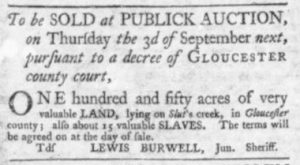
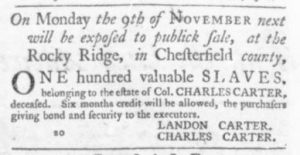
The Slavery Adverts 250 Project chronicles the role of newspaper advertising in perpetuating slavery in the era of the American Revolution. The project seeks to reveal the ubiquity of slavery in eighteenth-century life from New England to Georgia by republishing advertisements about enslaved people – for sale as individuals or in groups, wanted to purchase or for hire for short periods, runaways who liberated themselves, and those who were subsequently captured and confined in jails and workhouses – in daily digests on this site as well as in real time via the @SlaveAdverts250 Twitter feed, utilizing twenty-first-century media to stand in for the print media of the eighteenth century.
The project aims to provide modern audiences with a sense of just how often colonizers encountered these advertisements in their daily lives. Enslaved men, women, and children appeared in print somewhere in the colonies almost every single day. Those advertisements served as a constant backdrop for social, cultural, economic, and political life in colonial and revolutionary America. Colonizers who did not purport to own enslaved people were still confronted with slavery as well as invited to maintain the system by purchasing enslaved men, women, and children or assisting in the capture of so-called “runaways” who sought to free themselves from bondage. The frequency of these newspaper advertisements suggests just how embedded slavery was in colonial and revolutionary American culture in everyday interactions beyond the printed page.
These advertisements also testify to the experiences of enslaved men, women, and children, though readers must consider that those experiences have been remediated through descriptions offered by enslavers rather than enslaved people themselves. Often unnamed in the advertisements, enslaved men, women, and children were not invisible or unimportant in early America.
These advertisements appeared in colonial American newspapers 250 years ago today.
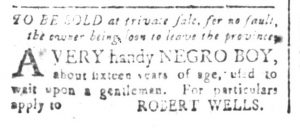
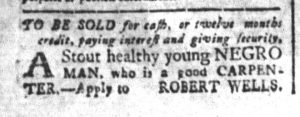
South-Carolina Gazette and Country Journal (August 11, 1767).
**********
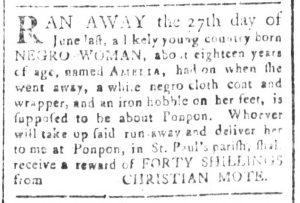
South-Carolina Gazette and Country Journal (August 11, 1767).
**********
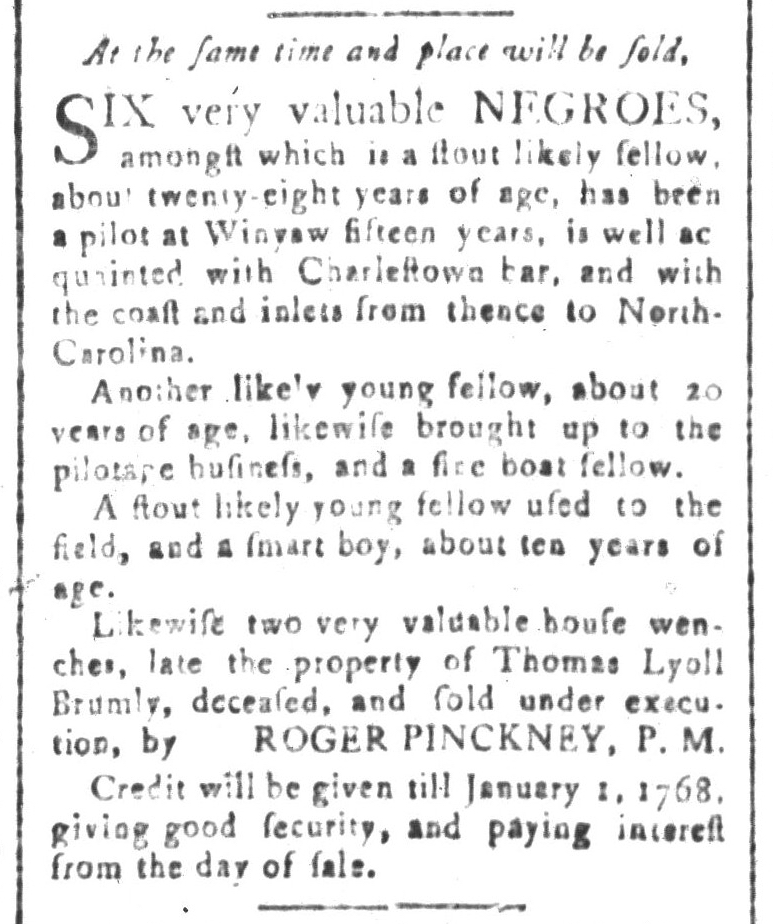
South-Carolina Gazette and Country Journal (August 11, 1767).
**********
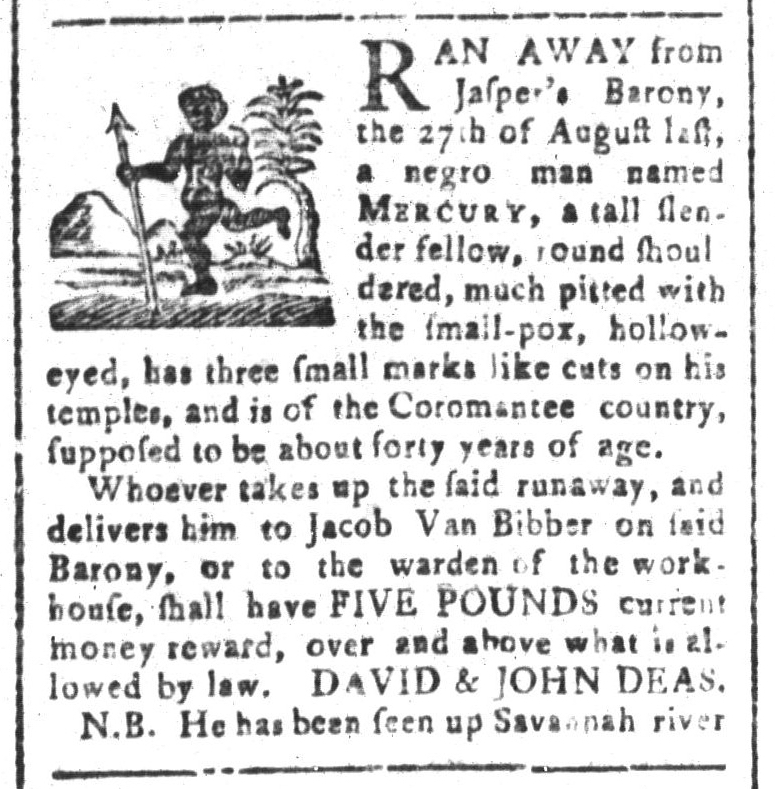
South-Carolina Gazette and Country Journal (August 11, 1767).
**********
South-Carolina Gazette and Country Journal (August 11, 1767).
**********
South-Carolina Gazette and Country Journal (August 11, 1767).
**********
South-Carolina Gazette and Country Journal (August 11, 1767).
**********
South-Carolina Gazette and Country Journal (August 11, 1767).
**********
South-Carolina Gazette and Country Journal (August 11, 1767).
What was advertised in a colonial American newspapers 250 years ago today?
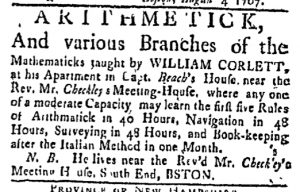
Boston Post-Boy (August 10, 1767).
“Various Branches of the Mathematicks taught by WILLIAM CORLETT.”
In the summer of 1767 William Corlett placed an advertisement in the Boston Post-Boy to announce that he had commenced teaching “ARITHMETICK, And various Branches of the Mathematicks.” He indicated that his pupils could learn “the first five Rules of Arithmatick,” navigation, surveying, and bookkeeping “after the Italian Method.” This curriculum suggests that Corlett worked as a tutor for youths and adult learners rather than as a schoolmaster for children. He taught specialized skills of particular value to those who pursued (or wished to pursue) occupations that depended on numeracy. Unlike schoolmasters who advertised their lessons, he also indicated specific outcomes so potential students could anticipate the time and total fees they could expect to invest. They learned the basics, “the first five Rules,” in forty hours. They became competent in navigation and surveying in forty-eight hours, each. Double-entry bookkeeping, “the Italian Method,” required additional study; Corlett’s students devoted an entire month to learning this skill.
What were the first five rules of arithmetic? Addition, subtraction, multiplication, and division accounted for four of them, but the final rule creates some confusion among historians of mathematics education. It may have been basic numeration, simple counting and the ability to identify and express numbers set down in numerals. Given the rest of his curriculum, however, Corlett may have included the Rule of Three (also known as the Golden Rule) in his introductory course of study. In “Numeracy in Early Modern England,” Keith Harris describes the Rule of Three as “a rule of proportion whose aim was to find a fourth number when three were known.” He offers this example: “if the wages of three carpenters are 24d, what would the wages of seven carpenters be?”[1] Solving this problem requires multiplication and division; students needed to master those skills before attempting proportions.
Some prospective students likely found the “various Branches of Mathematicks” intimidating, but Corlett assured them that “any one of a moderate Capacity” could fairly quickly learn the skills he taught. By specifying how many hours of instruction were necessary to attain each skill, he signaled that he would not prolong the process or attempt to wring as much tuition as possible out of his pupils.
**********
[1] Keith Thomas, “Numeracy in Early Modern England: The Prothero Lecture,” Transactions of the Royal Historical Society 37 (1987): 114-115.
The Slavery Adverts 250 Project chronicles the role of newspaper advertising in perpetuating slavery in the era of the American Revolution. The project seeks to reveal the ubiquity of slavery in eighteenth-century life from New England to Georgia by republishing advertisements about enslaved people – for sale as individuals or in groups, wanted to purchase or for hire for short periods, runaways who liberated themselves, and those who were subsequently captured and confined in jails and workhouses – in daily digests on this site as well as in real time via the @SlaveAdverts250 Twitter feed, utilizing twenty-first-century media to stand in for the print media of the eighteenth century.
The project aims to provide modern audiences with a sense of just how often colonizers encountered these advertisements in their daily lives. Enslaved men, women, and children appeared in print somewhere in the colonies almost every single day. Those advertisements served as a constant backdrop for social, cultural, economic, and political life in colonial and revolutionary America. Colonizers who did not purport to own enslaved people were still confronted with slavery as well as invited to maintain the system by purchasing enslaved men, women, and children or assisting in the capture of so-called “runaways” who sought to free themselves from bondage. The frequency of these newspaper advertisements suggests just how embedded slavery was in colonial and revolutionary American culture in everyday interactions beyond the printed page.
These advertisements also testify to the experiences of enslaved men, women, and children, though readers must consider that those experiences have been remediated through descriptions offered by enslavers rather than enslaved people themselves. Often unnamed in the advertisements, enslaved men, women, and children were not invisible or unimportant in early America.
These advertisements appeared in colonial American newspapers 250 years ago today.
What was advertised in a colonial American newspaper 250 years ago this week?
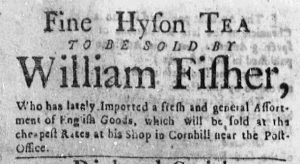
Massachusetts Gazette (August 6, 1767).
“A Fresh and general Assortment of English Goods.”
In his short advertisement in the Massachusetts Gazette, William Fisher used “Fine Hyson TEA,” a popular commodity, to attract the attention of readers, but Fisher did not sell just tea “at his Shop in Cornhill near the Post-Office.” Once he had their attention, he informed potential customers that he had also “lately Imported a fresh and general Assortment of English Goods.” To make his merchandise more alluring, he also pledged to charge “the cheapest Rates.” Although brief, especially compared to popular list-style advertisements that enumerated dozens or even hundreds of items, Fisher’s advertisement made several appeals to consumers, including choice, price, and quality.
I chose this advertisement to highlight a recent change in the methodology used for selecting advertisements featured by the Adverts 250 Project. Since the project commenced, every day it has consistently examined an advertisement published 250 years ago that day. When no newspaper had been published on a particular day, the methodology required going back a day to select an advertisement from among newspapers that would have been published most recently in the colonies, a version of consulting the “freshest advices” so often promoted in mastheads of the era. The project resorted to this fairly regularly during the 250th anniversary of the Stamp Act crisis because so many newspapers ceased publication while the act was in effect. After repeal, however, scarcity of newspapers – and advertisements – rarely presented a problem. Colonial printers returned to distributing their weekly publications in the late spring of 1766; that meant that curating the Adverts 250 Project involved working with a much fuller slate of newspapers in the spring of 2016, at least one new publication every day …
… with one exception. No colonial printers distributed newspapers on Sundays. The methodology for selecting advertisements required going back one day. As noted yesterday, the Providence Gazette was the only colonial newspaper distributed on Saturdays in 1766 and 1767. Strict adherence to the project’s methodology meant featuring advertisements from the Providence Gazette two consecutive days every week. Yesterday I celebrated the inclusion of the Providence Gazette in this project. Similarly, the regular inclusion of advertisements from the Georgia Gazette, the only newspaper printed on Wednesdays, has enhanced the project by incorporating yet another newspaper from a smaller city. Yet drawing two out of every seven advertisements from the Providence Gazette seemed to do more than shift the emphasis away from exclusively examining the most significant commercial centers and the advertisements inserted in their more fully developed newspapers. On Mondays and Thursdays, printers in Boston, New York, and Philadelphia issued multiple competing publications, each with a much, much greater array of advertising than appeared in the pages of the Providence Gazette, the Georgia Gazette, and other newspapers from smaller cities and towns. Strict adherence to the project’s methodology meant sometimes passing over important and interesting advertisements.
That prompted an adjustment to the methodology, but only as far as Sundays were concerned. (Keep in mind that Sundays in 1767 correspond to Wednesdays in 2017). The Adverts 250 Project continues to feature an advertisement originally published 250 years ago that day throughout most of the week. However, on the day that no newspapers were published the project now draws from any newspaper published during the previous week. This yields a better representation of advertising from early America. I will continue to consult newspapers from smaller cities regularly, but not at the expense of quite so disproportionately underrepresenting the multitude of publications from Boston, New York, and Philadelphia.
As a result of this modification, William Fisher’s advertisement for “Fine Hyson TEA” and other imported goods found its way into the Adverts 250 Project, displacing a second advertisement from the August 8, 1767, edition of the Providence Gazette. That issue featured only a page and a half of advertising, whereas newspapers from Boston, New York, and Philadelphia usually had at least two pages of advertising and some of them regularly distributed advertising supplements. That being the case, a slight adjustment to the project’s methodology, one that acknowledged its spirit and original intent, seemed appropriate and warranted.
What was advertised in a colonial American newspaper 250 years ago today?
Providence Gazette (August 8, 1767).
“The Publishers of this Paper, hereby inform their candid Readers, that his Week’s Paper compleats the Year.”
Sarah Goddard and Company had two purposes for placing this advertisement in the August 8, 1767, edition of the Providence Gazette. First and foremost, they wished to acknowledge that the new issue “compleats the Year” since the newspaper “was revived.” On the occasion of that anniversary, they called on subscribers, advertisers, and others to settle their accounts “as speedily as possible.” As a secondary goal, the publishers announced that “This Paper will still be carried on as usual” and requested further “Encouragement” from readers. In other words, if residents of Providence and its hinterland valued the Providence Gazette and wished for it to continue, they needed to subscribe, advertise, and pay their bills.
The previous iteration of the Providence Gazette had ceased publication with its May 11, 1765, issue and, except for extraordinary editions published on August 24, 1765, and March 12, 1766, did not resume publication until August 9, 1766. In the year since it sometimes struggled to attract advertisers, especially in the winter months. Goddard and Company may have developed certain innovations out of necessity, especially frequent oversized and full-page advertisements. Although the design would have caught the attention of reader-consumers, the format may have inspired primarily as a means of filling the page in the absence of other content.
The Providence Gazette was the only newspaper in colonial America printed and distributed on Saturdays in 1766 and 1767. In contrast, at least ten newspapers were published on Mondays (though not all have since been digitized). Similarly, multiple newspapers were published on Thursdays as well. As a result, the Adverts 250 Project has featured at least one advertisement from the Providence Gazette each week while selecting an advertisement from one among many newspapers on other days. Many of those newspapers featured a greater variety and volume of advertising that would merit more attention in a book or article; that being the case, given the nature of this digital humanities project the Providence Gazette might seem overrepresented among the advertisements included. On the other hand, the project’s methodology has required, at least as an outcome even if not originally by intentional design, attention to a smaller publication from a middling-sized port city, shifting focus away from the most significant population and commercial centers in colonial America. The history of advertising in early America would look very different if it focused exclusively on the cities with the most vibrant newspapers: Boston, Charleston, New York, and Philadelphia. Sustained consideration of the Providence Gazette and newspapers from other cities and towns tells a more nuanced story of the mobilization of print to influence consumer choices via advertising in the colonial era.
The Slavery Adverts 250 Project chronicles the role of newspaper advertising in perpetuating slavery in the era of the American Revolution. The project seeks to reveal the ubiquity of slavery in eighteenth-century life from New England to Georgia by republishing advertisements about enslaved people – for sale as individuals or in groups, wanted to purchase or for hire for short periods, runaways who liberated themselves, and those who were subsequently captured and confined in jails and workhouses – in daily digests on this site as well as in real time via the @SlaveAdverts250 Twitter feed, utilizing twenty-first-century media to stand in for the print media of the eighteenth century.
The project aims to provide modern audiences with a sense of just how often colonizers encountered these advertisements in their daily lives. Enslaved men, women, and children appeared in print somewhere in the colonies almost every single day. Those advertisements served as a constant backdrop for social, cultural, economic, and political life in colonial and revolutionary America. Colonizers who did not purport to own enslaved people were still confronted with slavery as well as invited to maintain the system by purchasing enslaved men, women, and children or assisting in the capture of so-called “runaways” who sought to free themselves from bondage. The frequency of these newspaper advertisements suggests just how embedded slavery was in colonial and revolutionary American culture in everyday interactions beyond the printed page.
These advertisements also testify to the experiences of enslaved men, women, and children, though readers must consider that those experiences have been remediated through descriptions offered by enslavers rather than enslaved people themselves. Often unnamed in the advertisements, enslaved men, women, and children were not invisible or unimportant in early America.
These advertisements appeared in colonial American newspapers 250 years ago today.
What was advertised in a colonial American newspaper 250 years ago today?
New-Hampshire Gazette (August 7, 1767).
“The Printers in this Town would without Charge publish such Accounts.”
Daniel Fowle and Robert Fowle, the printers of the New-Hampshire Gazette, regularly interspersed their own announcements among the other advertisements published in their newspaper. They inserted three such announcements in the August 7, 1767, edition. Two related notices had previously appeared, once requesting that “all Persons, who send Advertisements to this Press, would at the same Time send pay with them” and the other calling on “ALL Persons indebted for this Gazette, Advertisements, &c. … to make immediate Payment” or risk going to court. Both of these announcements addressed the financial operations of the publication.
The third, on the other hand, sought to enhance the content of the newspaper to better serve its subscribers, though the Fowles likely figured that new content of particular interest to readers would also enhance sales. Looking to their counterparts published in other cities, especially Philadelphia and New York, the Fowles noted that “the Publishers by some Means obtain Accounts from the Masters of Vessels on their Arrival of what Vessels they meet with on their Passage.” Such information was valuable to “those in the Mercantile Business” as well as the families of sailors who otherwise heard much less about the “Welfare of their Friends.”
The Fowles wished to include such information in the New-Hampshire Gazette, but they had difficulty collecting it. They called on the “Gentlemen Merchants” of Portsmouth to devise a method of reporting these accounts to the printing office, promising to publish them gratis as a service to the community. Their efforts to obtain these reports amounted to what would be described today as crowdsourcing, accepting and collating contributions of data or information from multiple participants to achieve a cumulative result. The process of crowdsourcing (as well as the term itself) became especially popular in the digital age, but new technologies improved and expanded a method already in practice much earlier. In their advertisements, the Fowles encouraged readers to participate in the production of the news via crowdsourcing the late 1760s.
The Slavery Adverts 250 Project chronicles the role of newspaper advertising in perpetuating slavery in the era of the American Revolution. The project seeks to reveal the ubiquity of slavery in eighteenth-century life from New England to Georgia by republishing advertisements about enslaved people – for sale as individuals or in groups, wanted to purchase or for hire for short periods, runaways who liberated themselves, and those who were subsequently captured and confined in jails and workhouses – in daily digests on this site as well as in real time via the @SlaveAdverts250 Twitter feed, utilizing twenty-first-century media to stand in for the print media of the eighteenth century.
The project aims to provide modern audiences with a sense of just how often colonizers encountered these advertisements in their daily lives. Enslaved men, women, and children appeared in print somewhere in the colonies almost every single day. Those advertisements served as a constant backdrop for social, cultural, economic, and political life in colonial and revolutionary America. Colonizers who did not purport to own enslaved people were still confronted with slavery as well as invited to maintain the system by purchasing enslaved men, women, and children or assisting in the capture of so-called “runaways” who sought to free themselves from bondage. The frequency of these newspaper advertisements suggests just how embedded slavery was in colonial and revolutionary American culture in everyday interactions beyond the printed page.
These advertisements also testify to the experiences of enslaved men, women, and children, though readers must consider that those experiences have been remediated through descriptions offered by enslavers rather than enslaved people themselves. Often unnamed in the advertisements, enslaved men, women, and children were not invisible or unimportant in early America.
These advertisements appeared in colonial American newspapers 250 years ago today.
New-Hampshire Gazette (August 7, 1767).
**********
New-Hampshire Gazette (August 7, 1767).
**********
New-London Gazette (August 7, 1767).
**********
South-Carolina and American General Gazette (August 7, 1767).
**********
South-Carolina and American General Gazette (August 7, 1767).
**********
South-Carolina and American General Gazette (August 7, 1767).
**********
South-Carolina and American General Gazette (August 7, 1767).
**********
South-Carolina and American General Gazette (August 7, 1767).
**********
South-Carolina and American General Gazette (August 7, 1767).
**********
South-Carolina and American General Gazette (August 7, 1767).
**********
South-Carolina and American General Gazette (August 7, 1767).
**********
South-Carolina and American General Gazette (August 7, 1767).
**********
South-Carolina and American General Gazette (August 7, 1767).
**********
South-Carolina and American General Gazette (August 7, 1767).
**********
South-Carolina and American General Gazette (August 7, 1767).
What was advertised in a colonial American newspaper 250 years ago today?”
Massachusetts Gazette (August 6, 1767).
“JACKSON’S Mineral-Well in Boston.”
The proprietor of “JACKSON’S Mineral-Well in Boston” deployed a philanthropic appeal to increase the allure of the spa. In a set of “RULES” published among the advertisements in the August 6, 1767, issue of the Massachusetts Gazette, Jackson first specified the rates for enjoying the waters: one copper for “the Use of the Water” and then another copper for “every Quart Bottle to carry away.” Lest he be seen as withholding access to the therapeutic qualities of the “Mineral-Well” by focusing exclusively on how much revenue it could generate from entry fees paid by middling and affluent colonists, Jackson also proposed a plan that more broadly served the interests of the general public. Should “any Physician in Town” prescribe visiting the spa to impoverished patients, Jackson offered free admission “to any poor Persons” who could produce a certificate verifying their circumstances. These “poor Persons” could enjoy the baths “gratis,” but only after providing sufficient documentation from their doctors. Charity, it seemed, had its limits; Jackson did not want his spa overrun by the lower sorts.
The advertisement also noted that “Rules for the hot, and for the cold Baths, will be fixed up in one of the Rooms.” That Jackson did not specify or elaborate on these additional rules in his notice suggests that he was less interested in informing the public of all the procedures for enjoying the “Mineral-Well” and more concerned with getting out the word that he incorporated humanitarian ventures into his business model. Other eighteenth-century advertisers made similar bids for approval from potential customers and the community in general, including schoolmasters who provided free lessons to less fortunate children. In modern times, corporate philanthropy is a standard public relations practice, but it was not invented after the rise of Madison Avenue. Some eighteenth-century entrepreneurs experimented with promoting their businesses by engaging the needs of the community, demonstrating that they were good citizens and neighbors who merited patronage from consumers.
The Slavery Adverts 250 Project chronicles the role of newspaper advertising in perpetuating slavery in the era of the American Revolution. The project seeks to reveal the ubiquity of slavery in eighteenth-century life from New England to Georgia by republishing advertisements about enslaved people – for sale as individuals or in groups, wanted to purchase or for hire for short periods, runaways who liberated themselves, and those who were subsequently captured and confined in jails and workhouses – in daily digests on this site as well as in real time via the @SlaveAdverts250 Twitter feed, utilizing twenty-first-century media to stand in for the print media of the eighteenth century.
The project aims to provide modern audiences with a sense of just how often colonizers encountered these advertisements in their daily lives. Enslaved men, women, and children appeared in print somewhere in the colonies almost every single day. Those advertisements served as a constant backdrop for social, cultural, economic, and political life in colonial and revolutionary America. Colonizers who did not purport to own enslaved people were still confronted with slavery as well as invited to maintain the system by purchasing enslaved men, women, and children or assisting in the capture of so-called “runaways” who sought to free themselves from bondage. The frequency of these newspaper advertisements suggests just how embedded slavery was in colonial and revolutionary American culture in everyday interactions beyond the printed page.
These advertisements also testify to the experiences of enslaved men, women, and children, though readers must consider that those experiences have been remediated through descriptions offered by enslavers rather than enslaved people themselves. Often unnamed in the advertisements, enslaved men, women, and children were not invisible or unimportant in early America.
These advertisements appeared in colonial American newspapers 250 years ago today.
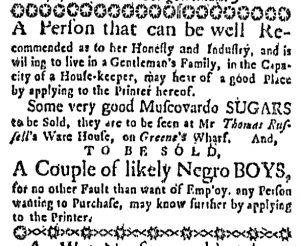
Massachusetts Gazette (August 6, 1767).
**********
Massachusetts Gazette (August 6, 1767).
**********
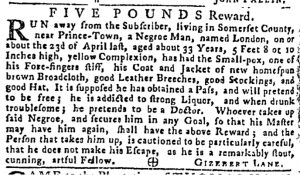
Pennsylvania Gazette (August 6, 1767).
**********
Pennsylvania Gazette (August 6, 1767).
**********
Pennsylvania Gazette (August 6, 1767).
**********
Pennsylvania Gazette (August 6, 1767).
**********
Pennsylvania Gazette (August 6, 1767).
**********
Supplement to the Pennsylvania Gazette (August 6, 1767).
**********
Supplement to the Pennsylvania Gazette (August 6, 1767).
**********
Supplement to the Pennsylvania Gazette (August 6, 1767).