August 16

What was advertised in a colonial American newspaper 250 years ago this week?

Aug 16 - 8:13:1767 New-York Journal
New-York Journal (August 13, 1767).

“At the corner store, opposite Mr. Duyckinck’s Universal Store, near the Old-slip.”

Note the final lines of this advertisement, marked by a manicule. To direct potential customers to his own workshop, the advertiser noted that it was located “opposite Mr. Duyckinck’s Universal Store.”

Gerardus Duyckinck’s “UNIVERSAL STORE; Or the MEDLEY of GOODS” was a landmark in New York in the late 1760s. Duyckinck worked carefully to brand his store with that name, frequently placing newspaper advertisements that ennumerated the “Variety of Assortments” of imported goods that he stocked and sold to consumers. His advertisement in the supplement to the August 13, 1767, issue of the New-York Journal proclaimed the name of his shop and listed everything from “Hatters Trimmings” to “Carpetting” to “Writing Paper.” Several times he invoked consumer choice and challenged potential customers to imagine the array of merchandise he carried: “a beautiful and fashionable Assortment” of some items, “Almost every Article in these Branches, too tedious to mention” for certain supplies used by artisans, and “a general Assortment” of patent medicines “as extensive” as local physicians and families needed. Some merchants and shopkeepers specialized in certain types of wares, but Duyckinck’s advertising suggested that he truly provided a “MEDLEY of GOODS” at his “UNIVERSAL STORE.”

With the exception of taverns, most eighteenth-century businesses did not have names. They were identified simply by the name of the proprietor or the device on the shop sign that marked their location. That Duyckinck’s shop had a name made it fairly unique. This name operated in addition to “the Sign of the Looking-Glass, and Druggist Pot” that decorated the exterior; text on the sign may have further identified the location as Duyckinck’s “UNIVERSAL STORE” or promoted the MEDLEY of GOODS” available inside.

This marketing strategy enjoyed some success. The “IVORY and HARD WOOD TURNER” across the street did not give directions relative to Duyckinck’s shop or the “Sign of the Looking-Galss, and Druggist Pot.” Instead, he used the name bestowed on the store by the proprietor and widely advertised in local newspapers: “Mr. Duyckinck’s Universal Store.” This name was not merely an affectation but instead a common way of identifying the business. In convincing other colonists, including potential customers, to refer to his shop as the “Universal Store,” Duyckinck successfully encouraged them to associate certain qualities with the imported goods he sold.

August 15

What was advertised in a colonial American newspaper 250 years ago today?

Aug 15 - 8:15: 1767 Providence Gazette
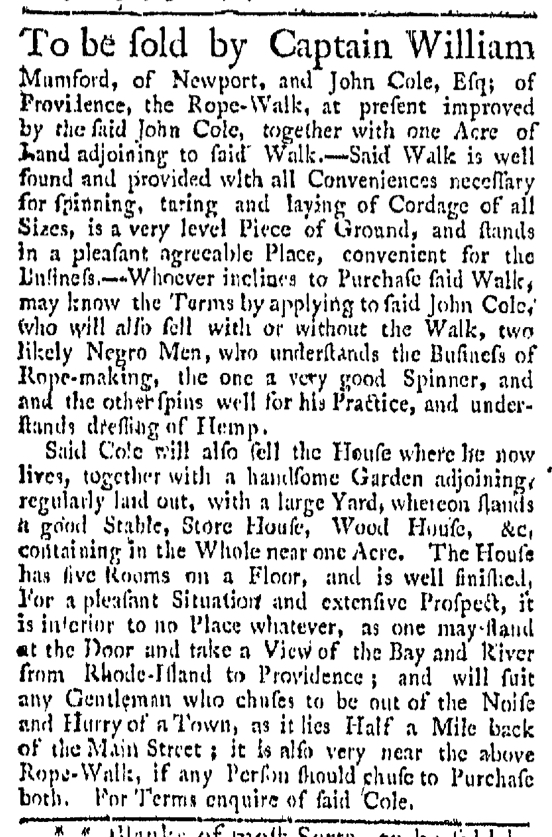
Providence Gazette (August 15, 1767).

“Will also sell with or without the Walk, two likely Negro Men.”

When William Mumford and John Cole decided to sell their ropewalk in Newport, Rhode Island, they published an advertisement in the Providence Gazette. In it, they described the property where they made rope as “well found,” “very level,” and “convenient for the Business.” In addition, it property came with all the equipment “necessary for spinning, tur[n]ing, and laying of Cordage of all Sizes.” Most of the major colonial cities had ropewalks that produced some of the supplies essential for outfitting the vessels that passed through the busy ports.

Mumford and Cole did not, however, advertise just the ropewalk. Prospective buyers could also purchase “two likely Negro Men.” These were not mere laborers; instead, each “understands the Business of Rope-making.” One was “a very good Spinner.” The other was not quite as adept at that task, but “spins well for his Practice.” His primary value derived from another contribution he made to the operation of the ropewalk: he “understands the dressing of Hemp.” These “likely Negro Men” enhanced the value of the business through their skill and experience. They made its sale more attractive to potential buyers who would not need to be as concerned with hiring and retaining workers as they otherwise might have been.

Many of the commodities advertised in the Providence Gazette and other colonial newspapers had direct connections to enslaved Africans. Consumers knew that slaves produced sugar, rice, indigo, tobacco, and other staple crops, yet that was not where the presence of slaves in the networks of eighteenth-century commerce ended. They also participated in transporting commodities from the sites of production to the places of sale. Some served on merchant vessels. Others labored in shipyards, building and repairing the vessels that carried goods from port to port. Still others worked in shops and other businesses where artisans made the equipment that outfitted those ships.

When residents of Newport and Providence drank tea sweetened with sugar, they realized that they consumed a commodity produced by enslaved men, women, and children. Yet not all of the enslaved labor that made it possible for them to enjoy sweetened beverages took place on faraway plantations. The sugar colonists purchased from local shopkeepers may very well have been transported on a vessel outfitted with ropes and other equipment made by slaves in their very own colony.

Slavery Advertisements Published August 15, 1767

The Slavery Adverts 250 Project chronicles the role of newspaper advertising in perpetuating slavery in the era of the American Revolution. The project seeks to reveal the ubiquity of slavery in eighteenth-century life from New England to Georgia by republishing advertisements about enslaved people – for sale as individuals or in groups, wanted to purchase or for hire for short periods, runaways who liberated themselves, and those who were subsequently captured and confined in jails and workhouses – in daily digests on this site as well as in real time via the @SlaveAdverts250 Twitter feed, utilizing twenty-first-century media to stand in for the print media of the eighteenth century.

The project aims to provide modern audiences with a sense of just how often colonizers encountered these advertisements in their daily lives. Enslaved men, women, and children appeared in print somewhere in the colonies almost every single day. Those advertisements served as a constant backdrop for social, cultural, economic, and political life in colonial and revolutionary America. Colonizers who did not purport to own enslaved people were still confronted with slavery as well as invited to maintain the system by purchasing enslaved men, women, and children or assisting in the capture of so-called “runaways” who sought to free themselves from bondage. The frequency of these newspaper advertisements suggests just how embedded slavery was in colonial and revolutionary American culture in everyday interactions beyond the printed page.

These advertisements also testify to the experiences of enslaved men, women, and children, though readers must consider that those experiences have been remediated through descriptions offered by enslavers rather than enslaved people themselves. Often unnamed in the advertisements, enslaved men, women, and children were not invisible or unimportant in early America.

These advertisements appeared in colonial American newspapers 250 years ago today.

Aug 15 - Providence Gazette Slavery 1
Providence Gazette (August 15, 1767).

**********

Aug 15 - Providence Gazette Slavery 2
Providence Gazette (August 15, 1767).

August 14

What was advertised in a colonial American newspaper 250 years ago today?

Aug 14 - 8:14:1767 New-Hampshire Gazette
New-Hampshire Gazette (August 14, 1767).

“Now open’d for Sale, at the Sign of the LION and MORTER.”

Little and Jackson sold “A large and fresh Assortment of genuine Medicines” at their apothecary shop near the Crown Coffee House in Portsmouth. The sign the druggists displayed made it easier for residents and visitors to the port to locate their shop. Its device, the “LION and MORTER,” testified to the type of merchandise they carried, including popular patent medicines imported from England as well as ingredients for compounding remedies on the spot.

The mortar alone, a symbol widely recognized among potential customers, would have sufficiently described Little and Jackson’s business. Adding the lion, a regal symbol, imbued their business with more prestige, but that was not all it accomplished. It also replicated a shop sign already in use by one of their counterparts in Salem, Massachusetts. As early as January 1764, Philip Godfrid Kast advertised in the Boston Post-Boy that he imported and sold “a very large Assortment of DRUGS and MEDICINES” at his shop “at the Sign of the Lyon and Mortar.” In 1774, Kast even distributed a trade card that featured his sign, a rare visual image of what would have been a ubiquitous sight in colonial cities.

In choosing to pair a lion with a mortar, had Little and Jackson infringed on Kast’s efforts to brand his business? Not by the standards of the eighteenth century. The devices depicted on many shop signs had long been in use in England, first appearing in an earlier period with lower literacy rates. Just as the mortar and pestle were associated with druggists, other symbols denoted specific occupations. For instance, a sign showing a dog with its head in a bucket indicated that a smith practiced his trade at that location. Leather dressers who made all sorts of clothing, including James and Matthew Haslett, did so at the “Sign of the BUCK and GLOVE.”

Throughout London and the provinces and, eventually, the colonies, the consistent use of these and other easily recognized symbols conveniently marked where shopkeepers and artisans carried on specific activities. To some extent they could be deployed as branding in a certain area, but they did not tend to be the sole domain of entrepreneurs and advertisers beyond their local markets.

August 13

What was advertised in a colonial American newspaper 250 years ago today?

Aug 13 - 8:13:1767 Pennsylvania Gazette
Pennsylvania Gazette (August 13, 1767).

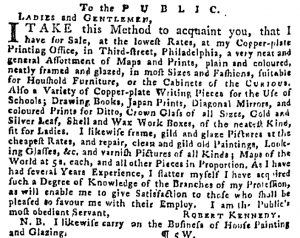
“I likewise frame, gild and glaze Pictures at the cheapest Rates.”

According to his advertisement in the Pennsylvania Gazette, Robert Kennedy provided a variety of goods and services at his “Copper-plate Printing Office, in Third-street, Philadelphia.” To entice potential customers, he extolled both the wares he sold and personal attributes that qualified him to pursue his occupation. Kennedy was no mere middleman who shuttled imported goods through his shop; instead, he was a craftsman who altered and improved his merchandise to conform to the tastes and desires of his customers.

Kennedy stocked a “general Assortment of Maps and Prints” that were “neatly framed and glazed” in a variety of sizes and fashions. Customers could choose among these items to decorate their homes. Alternately, they could bring their own prints to Kennedy’s shop for him to “frame, gild and glaze” and otherwise prepare them to be exhibited in homes, either as “Houshold Furniture” or in “Cabinets of the CURIOUS.” His other services included cleaning, repairing, and gilding paintings and looking glasses as well as painting houses and installing windows.

Lest potential customers fear that he might irreparably damage their irreplaceable possessions, Kennedy assured them that he “had several Years Experience.” During that time he “acquired such a Degree of Knowledge of the Branches of my Profession” that he would be able to “give Satisfaction” to any of his customers. Notably, Kennedy underscored his expertise in various “Branches” of preparing paintings and prints for display. He did not want prospective clients to worry or suspect that he specialized in one task and dabbled in the others. Instead, through years of experience he had developed expertise in each of the services he offered.

In his description of framed maps and prints as “Houshold Furniture,” Kennedy revealed the value colonists placed on these items. They were part of a culture of conspicuous consumption that included the exhibition of consumer goods to signal taste and status. In addition to clothing, housewares, and furniture, colonists displayed framed maps, prints, and paintings as testaments to their gentility and adherence to current fashions. These decorative items needed to withstand keen observation, which made Kennedy’s experience and expertise all the more important. Part of the “Satisfaction” that he marketed to customers was confidence that the quality of his work would impress their visitors who viewed the items he framed, gilded, and repaired.

Slavery Advertisements Published August 13, 1767

The Slavery Adverts 250 Project chronicles the role of newspaper advertising in perpetuating slavery in the era of the American Revolution. The project seeks to reveal the ubiquity of slavery in eighteenth-century life from New England to Georgia by republishing advertisements about enslaved people – for sale as individuals or in groups, wanted to purchase or for hire for short periods, runaways who liberated themselves, and those who were subsequently captured and confined in jails and workhouses – in daily digests on this site as well as in real time via the @SlaveAdverts250 Twitter feed, utilizing twenty-first-century media to stand in for the print media of the eighteenth century.

The project aims to provide modern audiences with a sense of just how often colonizers encountered these advertisements in their daily lives. Enslaved men, women, and children appeared in print somewhere in the colonies almost every single day. Those advertisements served as a constant backdrop for social, cultural, economic, and political life in colonial and revolutionary America. Colonizers who did not purport to own enslaved people were still confronted with slavery as well as invited to maintain the system by purchasing enslaved men, women, and children or assisting in the capture of so-called “runaways” who sought to free themselves from bondage. The frequency of these newspaper advertisements suggests just how embedded slavery was in colonial and revolutionary American culture in everyday interactions beyond the printed page.

These advertisements also testify to the experiences of enslaved men, women, and children, though readers must consider that those experiences have been remediated through descriptions offered by enslavers rather than enslaved people themselves. Often unnamed in the advertisements, enslaved men, women, and children were not invisible or unimportant in early America.

These advertisements appeared in colonial American newspapers 250 years ago today.

Aug 13 - Massachusetts Gazette Slavery 1
Massachusetts Gazette (August 13, 1767).

**********

Aug 13 - New-York Gazette Weekly Post-Boy Slavery 1
New-York Gazette: Or, the Weekly Post-Boy (August 13, 1767).

**********

Aug 13 - New-York Journal Slavery 1
New-York Journal (August 13, 1767).

**********

Aug 13 - New-York Journal Supplement Slavery 1
Supplement to the New-York Journal (August 13, 1767).

**********

Aug 13 - Pennsylvania Gazette Slavery 1
Pennsylvania Gazette (August 13, 1767).

**********

Aug 13 - Pennsylvania Gazette Slavery 2
Pennsylvania Gazette (August 13, 1767).

**********

Aug 13 - Pennsylvania Gazette Supplement Slavery 1
Supplement to the Pennsylvania Gazette (August 13, 1767).

**********

Aug 13 - Pennsylvania Gazette Supplement Slavery 2
Supplement to the Pennsylvania Gazette (August 13, 1767).

**********

Aug 13 - Pennsylvania Gazette Supplement Slavery 3
Supplement to the Pennsylvania Gazette (August 13, 1767).

**********

Aug 13 - Virginia Gazette Slavery 1
Virginia Gazette (August 13, 1767).

August 12

What was advertised in a colonial American newspaper 250 years ago today?

Aug 12 - 8:12:1767 Georgia Gazette
Georgia Gazette (August 12, 1767).

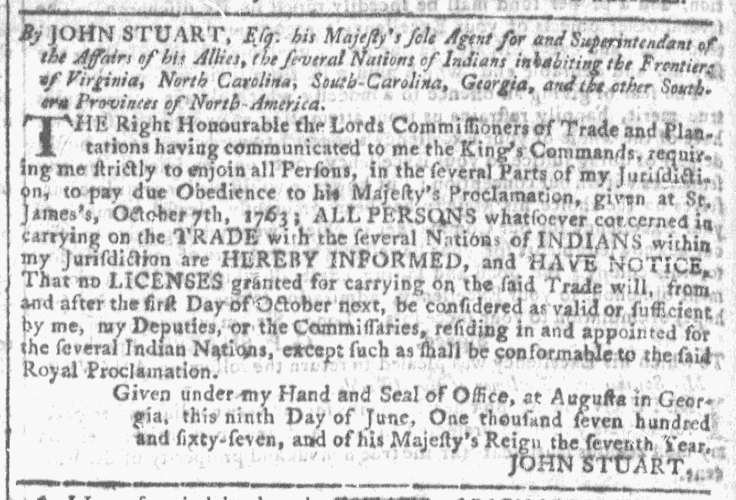
“All Persons … pay due Obedience to his Majesty’s Proclamation.”

John Stuart served as the Superintendent of Indian Affairs for Britain’s southern colonies from 1761 to 1779. Based in South Carolina, the Scottish-born official was counterpart to William Johnson in the northern colonies. Stuart and Johnson were charged with overseeing relations between indigenous Americans and Great Britain and the colonies. In the wake of British victory in the Seven Years War, the superintendents exercised diplomacy in their efforts to prevent violence and other conflict between settlers and Indians residing in the frontier lands newly acquired by the empire.

In this advertisement, Stuart pursued his duties. He informed “ALL PERSONS … carrying on the TRADE with … INDIANS … That no LICENSES granted for carrying on the said Trade will … be considered valid … except such as shall be conformable to the said Royal Proclamation.” Here he invoked what has become known as the Royal Proclamation of 1763, issued on October 7 of that year by George III.

That document provided a framework for managing Britain’s new territories ceded by the French at the conclusion of the Seven Years War. In addition to establishing four new colonies with military governments (Quebec, East Florida, West Florida, and Granada) and enumerating a scheme for distributing land to war veterans, the Royal Proclamation also addressed relations with indigenous Americans to the west of the Appalachians by creating the Proclamation Line. Settlers were forbidden to move into territory reserved for Indians, an attempt to prevent hostile encounters and pan-Indian uprisings like Pontiac’s War. The king and his advisors believed this would establish stability and order within the empire, but colonists felt betrayed. They had just fought and made sacrifices for Great Britain in a long war, but now the Royal Proclamation denied them the spoils they expected by prohibiting westward expansion. To add insult to injury, the proclamation seemed to protect Indians who recently fought against Britain at the expense of loyal subjects. Even before the Stamp Act crisis and other legislation that led to cries of “no taxation without representation,” the Royal Proclamation of 1763 angered colonists and alienated them from Britain.

In today’s advertisement, superintendent John Stuart invoked provisions of “his Majesty’s Proclamation, given at St. James’s, October 7th, 1763” to regulate trade between colonists and Indians. While other portions of the newspaper included news from London about “a plan for taxing America … now under consideration,” Stuart’s notice reminded colonists of other ways that a faraway government meddled in local affairs.

Summary of Slavery Advertisements Published August 6-12, 1767

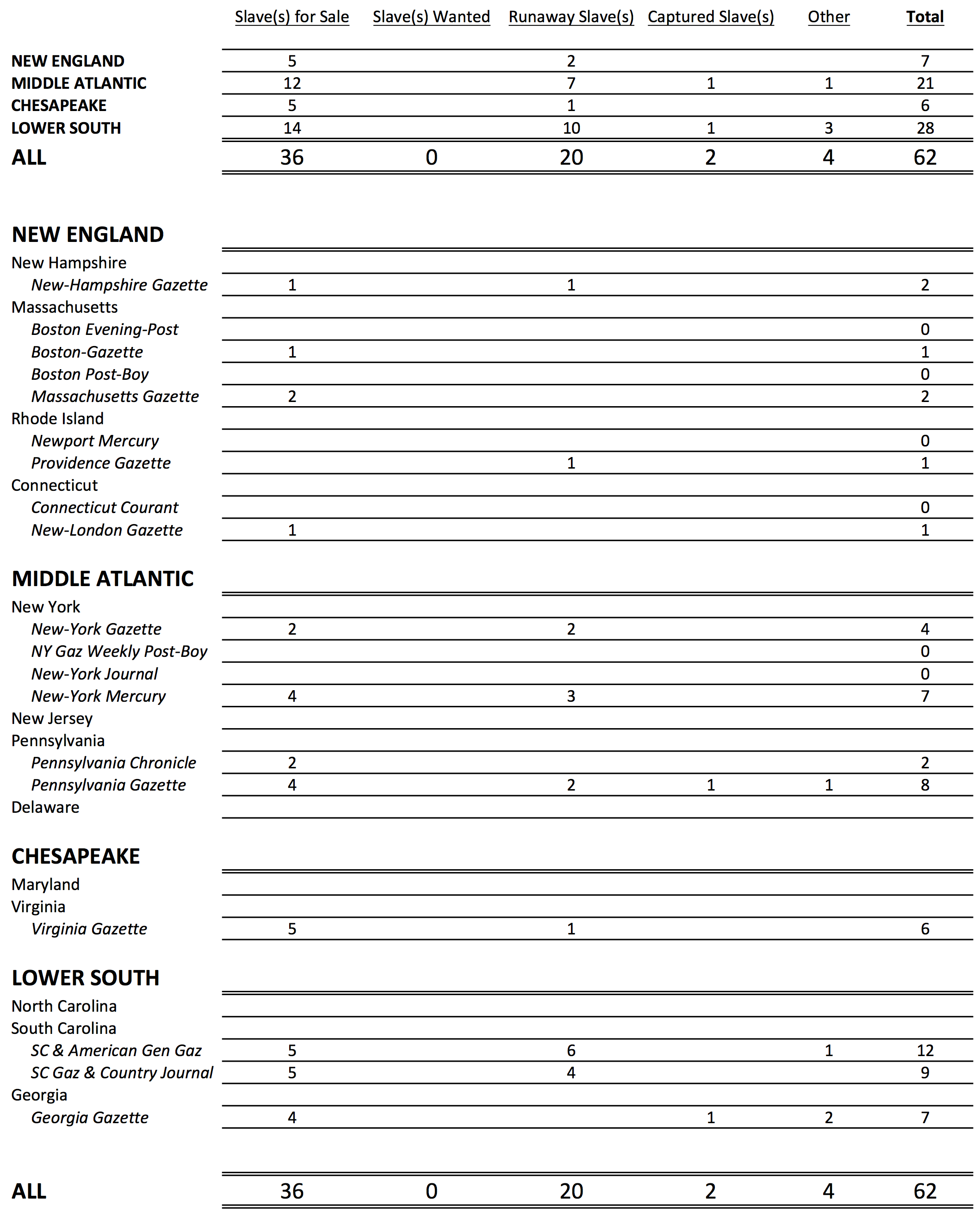
These tables indicate how many advertisements for slaves appeared in colonial American newspapers during the week of August 6-12, 1767.

Note:  These tables are as comprehensive as currently digitized sources permit, but they may not be an exhaustive account.  They includes all newspapers that have been digitized and made available via Accessible Archives, Colonial Williamsburg’s Digital Library, and Readex’s America’s Historical Newspapers.  There are several reasons some newspapers may not have been consulted:

  • Issues that are no longer extant;
  • Issues that are extant but have not yet been digitized (including the Pennsylvania Journal); and
  • Newspapers published in a language other than English (including the Wochentliche Philadelphische Staatsbote).

**********

Slavery Advertisements Published August 6-12, 1767:  By Date

Slavery Adverts Tables 1767 By Date Aug 6

**********

Slavery Advertisements Published July 23-29, 1767:  By Region

Slavery Adverts Tables 1767 By Region Aug 6

Slavery Advertisements Published August 12, 1767

The Slavery Adverts 250 Project chronicles the role of newspaper advertising in perpetuating slavery in the era of the American Revolution. The project seeks to reveal the ubiquity of slavery in eighteenth-century life from New England to Georgia by republishing advertisements about enslaved people – for sale as individuals or in groups, wanted to purchase or for hire for short periods, runaways who liberated themselves, and those who were subsequently captured and confined in jails and workhouses – in daily digests on this site as well as in real time via the @SlaveAdverts250 Twitter feed, utilizing twenty-first-century media to stand in for the print media of the eighteenth century.

The project aims to provide modern audiences with a sense of just how often colonizers encountered these advertisements in their daily lives. Enslaved men, women, and children appeared in print somewhere in the colonies almost every single day. Those advertisements served as a constant backdrop for social, cultural, economic, and political life in colonial and revolutionary America. Colonizers who did not purport to own enslaved people were still confronted with slavery as well as invited to maintain the system by purchasing enslaved men, women, and children or assisting in the capture of so-called “runaways” who sought to free themselves from bondage. The frequency of these newspaper advertisements suggests just how embedded slavery was in colonial and revolutionary American culture in everyday interactions beyond the printed page.

These advertisements also testify to the experiences of enslaved men, women, and children, though readers must consider that those experiences have been remediated through descriptions offered by enslavers rather than enslaved people themselves. Often unnamed in the advertisements, enslaved men, women, and children were not invisible or unimportant in early America.

These advertisements appeared in colonial American newspapers 250 years ago today.

Aug 12 - Georgia Gazette Slavery 1
Georgia Gazette (August 12, 1767).

**********

Aug 12 - Georgia Gazette Slavery 2
Georgia Gazette (August 12, 1767).

**********

Aug 12 - Georgia Gazette Slavery 3
Georgia Gazette (August 12, 1767).

**********

Aug 12 - Georgia Gazette Slavery 4
Georgia Gazette (August 12, 1767).

**********

Aug 12 - Georgia Gazette Slavery 5
Georgia Gazette (August 12, 1767).

**********

Aug 12 - Georgia Gazette Slavery 6
Georgia Gazette (August 12, 1767).

**********

Aug 12 - Georgia Gazette Slavery 7
Georgia Gazette (August 12, 1767).

August 11

What was advertised in a colonial American newspaper 250 years ago today?

Aug 11 - 8:11:1767 South-Carolina Gazette and Country Journal
South-Carolina Gazette and Country Journal (August 11, 1767).

“JOSEPH TURPIN, has opened a LIVERY STABLE.”

When he opened a livery stable in Charleston in the summer of 1767, Joseph Turpin turned to the advertising pages of the South-Carolina Gazette and Country Journal to encourage potential customers to contract his services. Most eighteenth-century advertisers rarely mentioned anyone who provided assistance in their shops and other places of business. In general, advertisements obscured the labor of family members, apprentices, indentured servants, and employees, usually equating the operation of businesses exclusively with the proprietors themselves. Turpin, on the other hand, made one of his employees, William Swindle, “an experienced English Groom,” a central feature of his advertisement. It was not the proprietor’s skill, expertise, or experience marketed to potential clients but rather the qualifications and contributions of a subordinate.

To that end, in addition to asserting that Swindle had previous experience that made him “equal to the Task in every respect,” Turpin also included the groom’s recent work history in the advertisement, noting that he had been “lately in the employ of Robert Jones, of North-Carolina.” Although not exactly a reference in the current sense, revealing Swindle’s former employer further established his credentials and suggested that Jones would indeed provide a positive recommendation.

Swindle alone, however, was not responsible for the care horses at Turpin’s stable received. The proprietor did not abdicate other responsibilities; instead, he managed the business, overseeing its employees and operations. Turpin pledged that “those Gentlemen who will intrust the Care of their horses” to his stable “may depend they will be used in the best Manner.” Hiring an experienced groom to care for the horses was only part of fulfilling that promise. Providing “good Provinder” to feed the horses was another part. Swindle might make suggestions on that account, but the proprietor ultimately approved decisions concerning purchasing and paying for supplies.

Turpin crafted an advertisement that credited an employee for the specialized skills and experience he contributed to the business. While that comprised the primary appeal made to prospective clients, the proprietor also marketed his own management and oversight as further assurances of the quality of the services provided.