December 10

What was advertised in a colonial American newspaper 250 years ago today?

Dec 10 - 12:10:1767 New-York Journal
New-York Journal (December 10, 1767).

“One of the most useful and entertaining Almanacks in America.”

The new year was fast approaching. Just three weeks remained in 1767 when this advertisement for “FREEMAN’s New-York ALMANACK For the Year 1768” appeared in John Holt’s New-York Journal. Over the past month advertisements for almanacs had proliferated in New York’s newspapers and their counterparts printed throughout the colonies. Some merely encouraged customers to acquire their almanacs, but others, like this one, provided much more detail about the contents as a means of inciting demand and convincing consumers to select this particular almanac over any of the alternatives.

Freeman’s New-York Almanack included the usual calendars and calculations, including “Hour and Minute of the Sun’s Rising and Setting” and the “Moon’s Age, Quartering, Full and Change, Rising, Setting,” but these were “intermixed with Proverbs or moral Sentiments.” It also contained a combination of astronomical and astrological material inserted in most almanacs, especially “The 12 signs, with an Account of the several Parts of the Body they are supposed to govern” and “a Table of the Planets’ Motions.” The almanac also featured other valuable reference information, such as a “Table of Interest at 7 per Cent,” a “List of the Council Assembly, and Officers in New-York,” and a “Table of the Value of Coins in England, New-York, Connecticut, Philadelphia, and Quebec.” The author also incorporated a variety of items to entertain and instruct readers, including “The Rose, a Fable” and “Verses on New-Year and Winter.”

Many printers relied on the contents of their almanacs to do most of the work in marketing them, but Holt added a nota bene proclaiming that Freeman’s New-York Almanack “contains more in Quantity than any other Almanack publish’d in America, and is at least as useful and entertaining as any other.” Just in case potential customers had not been duly impressed with the extensive contents listed in the advertisement, Holt underscored that this almanac overflowed with useful and entertaining material. Still, sensible that the astronomical calculations remained the foremost reason many colonists purchased almanacs, he also promised that they had been “made with the greatest Care and Accuracy.” He also placed special emphasis on the treatment of an impending eclipse on January 19, a “great Eclipse” that merited additional attention.

Holt concluded the advertisement by announcing that he also sold “DUTCH ALMANACKS,” pocket almanacs, and sheet almanacs, though he provided no other information except the prices. At his “PRINTING-OFFICE, at the EXCHANGE,” customers could select from a variety of titles and an assortment of sizes and formats. They also enjoyed a similar range of choices at other printing offices and bookseller shops throughout the city. Realizing the fierce competition to sell publications that could not be held in reserve and sold at a latter date, Holt invested significant effort in marketing the one he had published.
Slavery Advertisements Published December 10, 1767

The Slavery Adverts 250 Project chronicles the role of newspaper advertising in perpetuating slavery in the era of the American Revolution. The project seeks to reveal the ubiquity of slavery in eighteenth-century life from New England to Georgia by republishing advertisements about enslaved people – for sale as individuals or in groups, wanted to purchase or for hire for short periods, runaways who liberated themselves, and those who were subsequently captured and confined in jails and workhouses – in daily digests on this site as well as in real time via the @SlaveAdverts250 Twitter feed, utilizing twenty-first-century media to stand in for the print media of the eighteenth century.

The project aims to provide modern audiences with a sense of just how often colonizers encountered these advertisements in their daily lives. Enslaved men, women, and children appeared in print somewhere in the colonies almost every single day. Those advertisements served as a constant backdrop for social, cultural, economic, and political life in colonial and revolutionary America. Colonizers who did not purport to own enslaved people were still confronted with slavery as well as invited to maintain the system by purchasing enslaved men, women, and children or assisting in the capture of so-called “runaways” who sought to free themselves from bondage. The frequency of these newspaper advertisements suggests just how embedded slavery was in colonial and revolutionary American culture in everyday interactions beyond the printed page.

These advertisements also testify to the experiences of enslaved men, women, and children, though readers must consider that those experiences have been remediated through descriptions offered by enslavers rather than enslaved people themselves. Often unnamed in the advertisements, enslaved men, women, and children were not invisible or unimportant in early America.

These advertisements appeared in colonial American newspapers 250 years ago today.

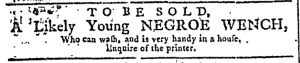
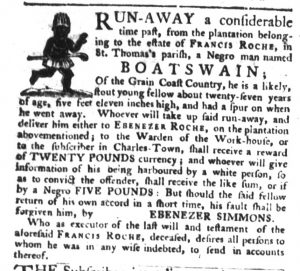
Dec 10 - New-York Journal Slavery 1
New-York Journal (December 10, 1767).

**********

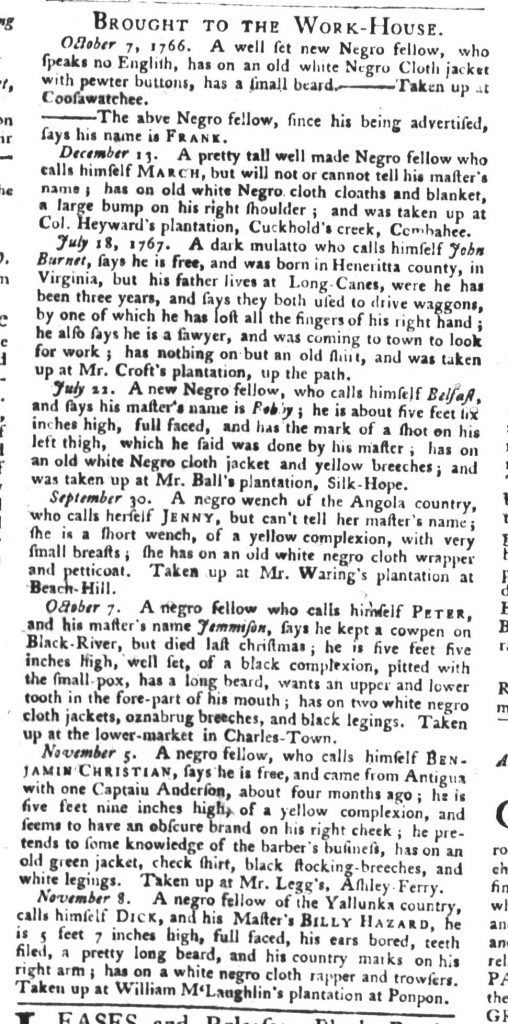
Dec 10 - Pennsylvania Gazette Slavery 1
Pennsylvania Gazette (December 10, 1767).

**********

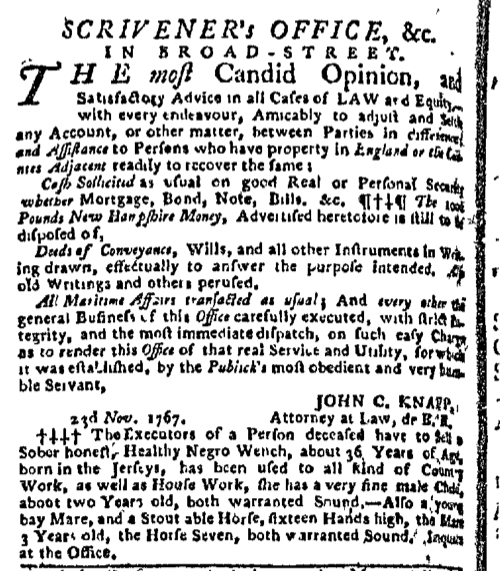
Dec 10 - Pennsylvania Gazette Slavery 2
Pennsylvania Gazette (December 10, 1767).

**********

Dec 10 - Pennsylvania Gazette Slavery 3
Pennsylvania Gazette (December 10, 1767).

**********

Dec 10 - Pennsylvania Gazette Supplement Slavery 1
Supplement to the Pennsylvania Gazette (December 10, 1767).

**********

Dec 10 - Pennsylvania Gazette Supplement Slavery 2
Supplement to the Pennsylvania Gazette (December 10, 1767).

**********

Dec 10 - Pennsylvania Gazette Supplement Slavery 3
Supplement to the Pennsylvania Gazette (December 10, 1767).

**********

Dec 10 - Virginia Gazette Slavery 1
Virginia Gazette (December 10, 1767).

**********

Dec 10 - Virginia Gazette Slavery 2
Virginia Gazette (December 10, 1767).

**********

Dec 10 - Virginia Gazette Slavery 3
Virginia Gazette (December 10, 1767).

**********

Dec 10 - Virginia Gazette Slavery 4
Virginia Gazette (December 10, 1767).

**********

Dec 10 - Virginia Gazette Slavery 5
Virginia Gazette (December 10, 1767).

**********

Dec 10 - Virginia Gazette Slavery 6
Virginia Gazette (December 10, 1767).

December 9

What was advertised in a colonial American newspaper 250 years ago today?

Dec 9 - 12:9:1767 Georgia Gazette
Georgia Gazette (December 9, 1767).

“A NEAT SECOND HAND CHAIR … hams, gammons, jowls, and bacon.”

Many colonists placed newspaper advertisements for a particular reason. The December 9, 1767, edition of the Georgia Gazette, for instance, included several real estate notices that focused exclusively on the properties for sale. Other advertisements cautioned against runaway slaves or described employment opportunities. Some marketed imported goods to consumers. Mary Hepburn’s short advertisement announced that she intended to depart from Georgia and wished to settle accounts.

In contrast, certain advertisements had more than one purpose. If colonial printers and compositors had practiced any sort of system of classification to organize the paid notices in their newspapers, such advertisements would have likely been divided into shorter notices and grouped with similar ones. Instead, the contents of individual advertisements sometimes seemed as haphazard as the assortment of notices printed in the same column or on the same page.

Such was the case with John Morel’s advertisement. In the course of two short paragraphs Morel, a prominent merchant, switched from hawking a used carriage, a “NEAT SECOND HAND CHAIR … with very good harness,” to selling pork products, including “hams, gammons, jowls, and bacon.” In the process, he addressed two very different sorts of readers. Due to the expense, only the most affluent colonists would have been in the market for a carriage, whether new or “SECOND HAND.” However, “any family” would have needed hams and bacon for sustenance.

The dual purposes of Morel’s advertisement, like the hodgepodge of content throughout the rest of the newspaper, testify to habits of intensive reading in the eighteenth century. Given that far more colonists would have been interested in purchasing pork than a used carriage, Morel depended on careful attention to his advertisement. He assumed that readers would not pass over the remainder of the advertisement when they noticed the carriage at the beginning but instead continue reading to the end, including the portion that marketed hams and bacon. Certainly not every reader actually read every word of the newspaper, but the lack of organization made it imperative for readers to cast more than a casual glance to find the content they desired.

Summary of Slavery Advertisements Published December 3-9, 1767

These tables indicate how many advertisements for slaves appeared in colonial American newspapers during the week of December 3-9, 1767.

Note:  These tables are as comprehensive as currently digitized sources permit, but they may not be an exhaustive account.  They includes all newspapers that have been digitized and made available via Accessible Archives, Colonial Williamsburg’s Digital Library, and Readex’s America’s Historical Newspapers.  There are several reasons some newspapers may not have been consulted:

  • Issues that are no longer extant;
  • Issues that are extant but have not yet been digitized (including the Pennsylvania Journal); and
  • Newspapers published in a language other than English (including the Wochentliche Philadelphische Staatsbote).

**********

Slavery Advertisements Published December 3-9, 1767:  By Date

Slavery Adverts Tables 1767 By Date Dec 3

**********

Slavery Advertisements Published December 3-9, 1767:  By Region

Slavery Adverts Tables 1767 By Region Dec 3

Slavery Advertisements Published December 9, 1767

The Slavery Adverts 250 Project chronicles the role of newspaper advertising in perpetuating slavery in the era of the American Revolution. The project seeks to reveal the ubiquity of slavery in eighteenth-century life from New England to Georgia by republishing advertisements about enslaved people – for sale as individuals or in groups, wanted to purchase or for hire for short periods, runaways who liberated themselves, and those who were subsequently captured and confined in jails and workhouses – in daily digests on this site as well as in real time via the @SlaveAdverts250 Twitter feed, utilizing twenty-first-century media to stand in for the print media of the eighteenth century.

The project aims to provide modern audiences with a sense of just how often colonizers encountered these advertisements in their daily lives. Enslaved men, women, and children appeared in print somewhere in the colonies almost every single day. Those advertisements served as a constant backdrop for social, cultural, economic, and political life in colonial and revolutionary America. Colonizers who did not purport to own enslaved people were still confronted with slavery as well as invited to maintain the system by purchasing enslaved men, women, and children or assisting in the capture of so-called “runaways” who sought to free themselves from bondage. The frequency of these newspaper advertisements suggests just how embedded slavery was in colonial and revolutionary American culture in everyday interactions beyond the printed page.

These advertisements also testify to the experiences of enslaved men, women, and children, though readers must consider that those experiences have been remediated through descriptions offered by enslavers rather than enslaved people themselves. Often unnamed in the advertisements, enslaved men, women, and children were not invisible or unimportant in early America.

These advertisements appeared in colonial American newspapers 250 years ago today.

Dec 9 - Georgia Gazette Slavery 1
Georgia Gazette (December 9, 1767).

**********

Dec 9 - Georgia Gazette Slavery 2
Georgia Gazette (December 9, 1767).

**********

Dec 9 - Georgia Gazette Slavery 3
Georgia Gazette (December 9, 1767).

**********

Dec 9 - Georgia Gazette Slavery 4
Georgia Gazette (December 9, 1767).

**********

Dec 9 - Georgia Gazette Slavery 5
Georgia Gazette (December 9, 1767).

**********

Dec 9 - Georgia Gazette Slavery 7
Georgia Gazette (December 9, 1767).

**********

Dec 9 - Georgia Gazette Slavery 6
Georgia Gazette (December 9, 1767).

December 8

What was advertised in a colonial American newspaper 250 years ago today?

Dec 8 - 12:8:1767 South-Carolina Gazette and Country Journal Supplement
Supplement to the South-Carolina Gazette and Country Journal (December 8, 1767).

“Twenty per Cent cheaper than goods usually imported.”

In a notice that appeared in the advertising supplement that accompanied the December 8, 1767, edition of the South-Carolina Gazette and Country Journal, William Gowdey relied on appeals to price to move the merchandise he had recently imported and stocked at his shop in Broad Street in Charleston. Before listing his wares he informed potential customers that they would enjoy special bargains when they visited his shop: he set prices “twenty per Cent cheaper” than his competitors usually charged. To demonstrate that was indeed the case, rather than a false promise designed to get customers through the door, Gowdey indicated the prices of several kinds of textiles. Readers could determine for themselves that the shopkeeper offered good deals on “mens worsted hose at 10s. 20s. and 30s. a pair” or “Osnabrughs at 4s. a yard.”
Even when they made appeals to price, most shopkeepers did not list prices in their newspaper advertisements during the colonial era. For instance, in the same issue William Glen and Son advertised many of the same textiles, but made only a general statement that they “will dispose of [their inventory] at a low advance.” Similarly, Thomas Radcliffe, Jr., promoted “very reasonable terms” but did not specify any prices. As a result, readers could not compare prices from one advertisement with those in another. Gowdey’s strategy depended on consumers already possessing some sense of the typical prices for popular goods and then recognizing good deals when they saw them. His assertion that his prices were “twenty per Cent cheaper” primed potential customers to imagine bargains, prompting them to become active participants in his marketing strategy when they saw the prices and confirmed for themselves that he did indeed sell at discounted rates. Such methods incited demand in the colonial era, just as they do today, when consumers who previously did not realize that they needed “mens worsted hose” or other goods in Gowdey’s advertisement decided that they could not pass up bargains once introduced to them.

Slavery Advertisements Published December 8, 1767

The Slavery Adverts 250 Project chronicles the role of newspaper advertising in perpetuating slavery in the era of the American Revolution. The project seeks to reveal the ubiquity of slavery in eighteenth-century life from New England to Georgia by republishing advertisements about enslaved people – for sale as individuals or in groups, wanted to purchase or for hire for short periods, runaways who liberated themselves, and those who were subsequently captured and confined in jails and workhouses – in daily digests on this site as well as in real time via the @SlaveAdverts250 Twitter feed, utilizing twenty-first-century media to stand in for the print media of the eighteenth century.

The project aims to provide modern audiences with a sense of just how often colonizers encountered these advertisements in their daily lives. Enslaved men, women, and children appeared in print somewhere in the colonies almost every single day. Those advertisements served as a constant backdrop for social, cultural, economic, and political life in colonial and revolutionary America. Colonizers who did not purport to own enslaved people were still confronted with slavery as well as invited to maintain the system by purchasing enslaved men, women, and children or assisting in the capture of so-called “runaways” who sought to free themselves from bondage. The frequency of these newspaper advertisements suggests just how embedded slavery was in colonial and revolutionary American culture in everyday interactions beyond the printed page.

These advertisements also testify to the experiences of enslaved men, women, and children, though readers must consider that those experiences have been remediated through descriptions offered by enslavers rather than enslaved people themselves. Often unnamed in the advertisements, enslaved men, women, and children were not invisible or unimportant in early America.

These advertisements appeared in colonial American newspapers 250 years ago today.

Dec 8 - South-Carolina Gazette and Country Journal Slavery 1
South-Carolina Gazette and Country Journal (December 8, 1767).

**********

Dec 8 - South-Carolina Gazette and Country Journal Slavery 2
South-Carolina Gazette and Country Journal (December 8, 1767).

**********

Dec 8 - South-Carolina Gazette and Country Journal Slavery 3
South-Carolina Gazette and Country Journal (December 8, 1767).

**********

Dec 8 - South-Carolina Gazette and Country Journal Slavery 4
South-Carolina Gazette and Country Journal (December 8, 1767).

**********

Dec 8 - South-Carolina Gazette and Country Journal Slavery 5
South-Carolina Gazette and Country Journal (December 8, 1767).

**********

Dec 8 - South-Carolina Gazette and Country Journal Slavery 8
South-Carolina Gazette and Country Journal (December 8, 1767).

**********

Dec 8 - South-Carolina Gazette and Country Journal Slavery 6
South-Carolina Gazette and Country Journal (December 8, 1767).

**********

Dec 8 - South-Carolina Gazette and Country Journal Slavery 9
South-Carolina Gazette and Country Journal (December 8, 1767).

**********

Dec 8 - South-Carolina Gazette and Country Journal Slavery 10
South-Carolina Gazette and Country Journal (December 8, 1767).

**********

Dec 8 - South-Carolina Gazette and Country Journal Slavery 7
South-Carolina Gazette and Country Journal (December 8, 1767).

**********

Dec 8 - South-Carolina Gazette and Country Journal Supplement Slavery 1
Supplement to the South-Carolina Gazette and Country Journal (December 8, 1767).

**********

Dec 8 - South-Carolina Gazette and Country Journal Supplement Slavery 2
Supplement to the South-Carolina Gazette and Country Journal (December 8, 1767).

**********

Dec 8 - South-Carolina Gazette and Country Journal Supplement Slavery 10
Supplement to the South-Carolina Gazette and Country Journal (December 8, 1767).

**********

Dec 8 - South-Carolina Gazette and Country Journal Supplement Slavery 3
Supplement to the South-Carolina Gazette and Country Journal (December 8, 1767).

**********

Dec 8 - South-Carolina Gazette and Country Journal Supplement Slavery 4
Supplement to the South-Carolina Gazette and Country Journal (December 8, 1767).

**********

Dec 8 - South-Carolina Gazette and Country Journal Supplement Slavery 5
Supplement to the South-Carolina Gazette and Country Journal (December 8, 1767).

**********

Dec 8 - South-Carolina Gazette and Country Journal Supplement Slavery 6
Supplement to the South-Carolina Gazette and Country Journal (December 8, 1767).

**********

Dec 8 - South-Carolina Gazette and Country Journal Supplement Slavery 7
Supplement to the South-Carolina Gazette and Country Journal (December 8, 1767).

**********

Dec 8 - South-Carolina Gazette and Country Journal Supplement Slavery 8
Supplement to the South-Carolina Gazette and Country Journal (December 8, 1767).

**********

Dec 8 - South-Carolina Gazette and Country Journal Supplement Slavery 11
Supplement to the South-Carolina Gazette and Country Journal (December 8, 1767).

**********

Dec 8 - South-Carolina Gazette and Country Journal Supplement Slavery 9
Supplement to the South-Carolina Gazette and Country Journal (December 8, 1767).

December 7

What was advertised in a colonial American newspaper 250 years ago today?

Dec 7 - 12:7:1767 Boston-Gazette
Boston-Gazette (December 7, 1767).

LABRADORE TEA.”

An advertisement in the December 7, 1767, issue of the Boston-Gazette announced “LABRADORE TEA, by the Hundred, Dozen, or less Quantity, to be Sold at Edes and Gill’s Printing-Office.” The bulk of the advertisement consisted of a testimonial that first outlined the medical and dietary benefits of drinking Labrador tea and then focused on the taste, acknowledging that the flavor differed from other popular teas but “a little Perseverance will render it very acceptable.”

By the time this advertisement appeared in early December, readers of Boston’s several newspapers had already been exposed to commentary about Labrador tea on multiple occasions, though in news items and editorial pieces rather than commercial notices. In the wake of a Boston town meeting that resolved to encourage consumption of domestic products rather than imported goods, several colonists noted the political benefits of Labrador tea. On November 2, Edes and Gill published a list of local manufactures in the Boston-Gazette. In addition to “Thirty thousand Yards of Cloth … Manufactured in one small Country Town in this Province” and “upwards of Forty Thousand Pair of Womens Shoes” made in Lynn, Massachusetts, in the past year, they described “a certain Herb, lately found in this Province, which begins already to take place in the Room of Green and Bohea Tea, which is said to be of a very salutary Nature, as well as a more agreeable Flavour – It is called Labrador.”

Two weeks later, both the Boston Evening-Post and the Boston Post-Boy inserted a letter addressed to “My Dear Countrymen” that outlined a strategy for depending less on imported goods. The prescription included Labrador tea: “we think it our duty to add, the most sincere recommendation of the disuse of the most luxurious and enervating article of BOHEA TEA, in which so large a sum is annually expended by the American colonists, altho’ it may be well supplied by the Teas of our own country, especially by that called Labrador, lately discovered to be a common growth of the more northern colonies, and esteemed very wholesome to the human species, as well as agreeable.”

A poem, “Address to the LADIES,” from the November 16 edition of the Boston Post-Boy and reprinted in other newspapers in the city discouraged purchasing and wearing imported textiles and adornments and also advised women to “Throw aside your Bohea and your Green Hyson Tea, / And all things with a new fashion duty; / Procure a good store of the choice Labradore, / For there’ll soon be enough here to suit ye.”

By the time the advertisement for “LABRADORE TEA” appeared in the Boston-Gazette in early December, colonists had already been encouraged to consume it as part of a political strategy intended to address both an imbalance of trade between the colonies and England and Parliament’s imposition of new duties in the Townshend Act. A series of news items and editorials primed consumer interest in Labrador tea, but some colonists may have been skeptical that they would enjoy the local alternative as much as their favorite imported varieties. This new advertisement assumed readers were already aware of the political ramifications of purchasing Labrador tea, so instead addressed any concerns about health and taste in order to convince consumers who may have been wavering in their commitment to adopt this new product.

Slavery Advertisements Published December 7, 1767

The Slavery Adverts 250 Project chronicles the role of newspaper advertising in perpetuating slavery in the era of the American Revolution. The project seeks to reveal the ubiquity of slavery in eighteenth-century life from New England to Georgia by republishing advertisements about enslaved people – for sale as individuals or in groups, wanted to purchase or for hire for short periods, runaways who liberated themselves, and those who were subsequently captured and confined in jails and workhouses – in daily digests on this site as well as in real time via the @SlaveAdverts250 Twitter feed, utilizing twenty-first-century media to stand in for the print media of the eighteenth century.

The project aims to provide modern audiences with a sense of just how often colonizers encountered these advertisements in their daily lives. Enslaved men, women, and children appeared in print somewhere in the colonies almost every single day. Those advertisements served as a constant backdrop for social, cultural, economic, and political life in colonial and revolutionary America. Colonizers who did not purport to own enslaved people were still confronted with slavery as well as invited to maintain the system by purchasing enslaved men, women, and children or assisting in the capture of so-called “runaways” who sought to free themselves from bondage. The frequency of these newspaper advertisements suggests just how embedded slavery was in colonial and revolutionary American culture in everyday interactions beyond the printed page.

These advertisements also testify to the experiences of enslaved men, women, and children, though readers must consider that those experiences have been remediated through descriptions offered by enslavers rather than enslaved people themselves. Often unnamed in the advertisements, enslaved men, women, and children were not invisible or unimportant in early America.

These advertisements appeared in colonial American newspapers 250 years ago today.

Dec 7 - Boston Evening Post Slavery 1
Boston Evening-Post (December 7, 1767).

**********

Dec 7 - Boston Evening Post Slavery 2
Boston Evening-Post (December 7, 1767).

**********

Dec 7 - Boston-Gazette Slavery 1
Boston-Gazette (December 7, 1767).

**********

Dec 7 - Boston-Gazette Slavery 2
Boston-Gazette (December 7, 1767).

**********

Dec 7 - New-York Gazette Slavery 1
New-York Gazette (December 7, 1767).

**********

Dec 7 - New-York Gazette Slavery 2
New-York Gazette (December 7, 1767).

**********

Dec 7 - New-York Gazette Slavery 3
New-York Gazette (December 7, 1767).

**********

Dec 7 - New-York Gazette Slavery 4
New-York Gazette (December 7, 1767).

**********

Dec 7 - New-York Mercury Slavery 1
New-York Mercury (December 7, 1767).

**********

Dec 7 - New-York Mercury Slavery 2
New-York Mercury (December 7, 1767).

**********

Dec 7 - New-York Mercury Slavery 3
New-York Mercury (December 7, 1767).

**********

Dec 7 - New-York Mercury Slavery 4
New-York Mercury (December 7, 1767).

**********

Dec 7 - Newport Mercury Slavery 1
Newport Mercury (December 7, 1767).

December 6

What was advertised in a colonial American newspaper 250 years ago this week?

Dec 6 - 12:3:1767 New-York Journal
New-York Journal (December 3, 1767).

“Sundry other Goods … will be sold great Bargains.”

Throughout the eighteenth century, newspaper advertisers most commonly deployed a handful of marketing strategies: appeals to price, quality, gentility, and consumer choice. Many advertisers incorporated several of these appeals into their commercial notices, while others crafted advertisements that emphasized a particular appeal.

Benjamin Booth adopted the latter strategy in his advertisement for several goods he imported from London that appeared in the New-York Journal in the late fall of 1767. He made nods toward quality (“BEST English sail-Cloth”) and consumer choice (a list of merchandise followed with a promise of “sundry other Goods”), but he reiterated appeals to price four times in his advertisement. Like many other advertisements placed by colonial shopkeepers, Booth’s notice included a header and a conclusion with a list of goods between them. Many advertisers inserted an appeal to price in either the header or the conclusion, but Booth attempted to incite demand for his wares by underscoring price in all three segments of his advertisement. He relied on formulaic language used by shopkeepers throughout the colonies in the header, proclaiming that his merchandise “will be sold exceeding cheap.” In the list of his inventory, he singled out “Scotch Carpeting” as “very cheap,” indicating an especially good deal among his already low prices. In the course of a single sentence in the conclusion, Booth promoted his prices twice. He stated that his assortment of goods was “laid in upon very low Terms, and will be sold great Bargains.” Here Booth once again inserted formulaic language that appeared in other advertisements: “very low Terms.” However, he concluded with a relatively novel appeal: “great Bargains.” Although shopkeepers regularly marketed low prices in the 1760s, few invoked the word “bargain” to describe the benefits to consumers. In this regard, Booth took an innovative approach, even as the format and stock phrases for the rest of the advertisement replicated other commercial notices. He borrowed heavily from existing marketing methods, but also added his own modification to attract the attention of prospective customers.