December 5

What was advertised in a colonial American newspaper 250 years ago today?

Dec 5 - 12:5:1767 Providence Gazette
Providence Gazette (December 5, 1767).

“All performed in the neatest and best manner.”

Blacksmiths Amos Atwell and Jonathan Ellis inserted an advertisement in the December 5, 1767, edition of the Providence Gazette to inform readers in “the Town and Country” that they had established a partnership and were “determined to carry on a large stroke of business.” Atwell and Ellis made a variety of items for use in the home, on the farm, in workshops, and aboard ships, including “broad and narrow axes, drawing knives, carpenters adzes, all sorts of coopers tools, farming tools, … kitchen utensils, and ships iron work of every kind.”

Shopkeepers in Providence and other colonial cities and towns frequently advertised a similar array of hardware, though they often indicated that they had imported their inventory from London and other English cities. In the face of assumptions that such goods might have been superior in quality to any produced locally, Atwell and Ellis concluded their advertisement with assurances that the items they sold had been made “in the neatest and best manner.” In so doing, they adopted a marketing strategy often deployed by colonial artisans. Advertisers of all sorts made appeals to the price and quality of their merchandise, but artisans – who produced the goods they sold – supplemented those common appeals with commentary about their own skill and expertise. Those attributes associated with individual artisans, not just the features of the goods they sold, played an important role in efforts to convince potential customers to purchase their wares.

Atwell and Ellis also promised to serve their patrons “with fidelity and dispatch,” but invoking those qualities fell into the realm of customer service rather than artisanal skill and expertise. Merchants and shopkeepers also played on personal characteristics of “fidelity and dispatch” when describing how they interacted with customers, but rarely did they express the sort of intrinsic responsibility for the quality of their merchandise that artisans made part of their testament to potential patrons.
December 4

What was advertised in a colonial American newspaper 250 years ago today?

Dec 4 - 12:4:1767 Massachusetts Gazette.jpg
Massachusetts Gazette (December 4, 1767).

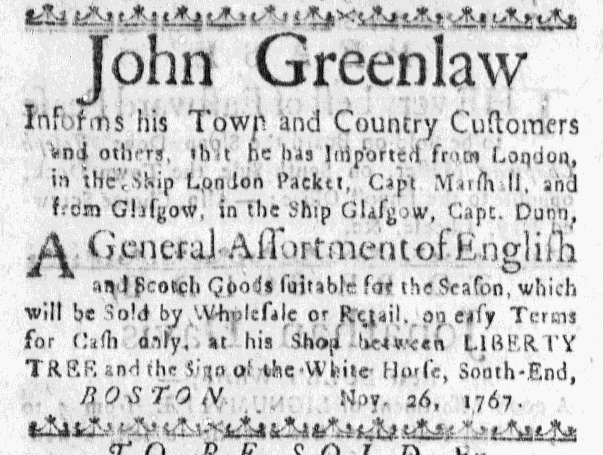
“At his Shop between LIBERTY TREE and the Sign of the White Horse.”

During the era of the American Revolution, advertisers had a variety of means for identifying locations in cities and towns. The largest ports began imposing order on urban environments by assigning standardized street numbers at the very end of the eighteenth century. Until then, colonists relied on a variety of landmarks, shop signs, and other devices for giving directions. In the December 4, 1767, edition of the Massachusetts Gazette and its supplement, for instance, Thomas Hickling invited potential customers to visit “his Shop at the Corner of Black Horse Lane, leading to Charlestown Ferry.” Samuel Hughes sold maritime supplies “At his Store next to Capt. Chever’s in King-Street, BOSTON.” Jonathan Davis indicated that he sold his wares “Near BULL’s Wharf.” Despite the varying levels of specificity, each advertiser assumed he provided enough information for potential customers to find his place of business.

In giving directions to his shop, John Greenlaw not only named local landmarks but also invoked political attitudes expressed widely throughout the colony in recent months. He informed customers that he ran a shop “between LIBERTY TREE and the Sign of the White Horse, South-End, BOSTON.” The Townshend Act went into effect less than a week before Greenlaw first inserted his advertisement in the Massachusetts Gazette in the November 26 issue. In the preceding weeks, all of the Boston newspapers devoted significant coverage to the new duties on imported goods and the local response, including resolutions calling for new non-importation agreements passed at the town meeting at the end of October. Even as he sold “A General Assortment of English and Scotch Goods” imported before the Townshend Act went into effect, Greenlaw associated his business with the Liberty Tree, a symbol of colonial resistance to Parliament.

Colonists like Greenlaw used advertisements to express their political views in the public prints. In the time between the repeal of the Stamp Act and the imposition of the Townshend Act, only John Gore, Jr., consistently incorporated the Liberty Tree into his advertisements. Now that colonists once again experienced Parliamentary overreach, other advertisers in Boston expressed political sentiments by adopting the Liberty Tree as a significant landmark for giving directions to readers. In addition to Greenlaw, another advertiser listed a “handsome Dwelling House” to rent “at the South-End of Boston, near LIBERTY TREE” in the December 4 issue. In an era when advertisers creatively devised a variety of methods for giving directions in print, Greenlaw, Gore, and others could have chosen other landmarks or devices to describe their locations. In selecting the Liberty Tree to include in their advertisements, they communicated more than just where potential customers could find them.

December 3

What was advertised in a colonial American newspaper 250 years ago today?

Dec 3 - 12:3:1767 New-York Journal
New-York Journal (December 3, 1767).

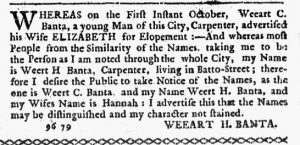
“I advertise this that the Names may be distinguished and my character not stained.”

Weert H. Banta, a carpenter, took out an advertisement in the New-York Journal in hopes of resolving a case of mistaken identity and remedying any damage done to his reputation as a result of the confusion.

Banta reported that Weert C. Banta, also a carpenter, had published an advertisement concerning the “Elopement” of his wife, Elizabeth, two months earlier. In that fairly standard runaway wife notice, the other Banta proclaimed that Elizabeth departed “without any cause” and that he was “apprehensive [she] may run me [into] Debt.” To that end, he desired to “warn all Persons, that they do not Trust, harbour or entertain her, on my Account, for I will pay no Debt of her contracting.”

Due to the similarity of their names and their shared occupation, many readers of the New-York Journal and other residents of the city had mistaken Weert H. Banta for Weert C. Banta. The former Banta clarified that he had not placed the advertisement. Furthermore, his wife’s name was Hannah, not Elizabeth. Not only did he seek to sort out the confusion, he implored “that the Names may be distinguished and my character not stained.”

Banta may have also worried about his wife’s reputation, but as a carpenter “noted through the whole City” he expressed primary concern about his own character and what friends, neighbors, and business associates would think of him. Advertisements for runaway wives typically depicted the absent women as the transgressors in marital relationships, but they still did not reflect well on the men who placed such notices in the public prints. That a wife had “eloped” revealed that her husband failed to exercise proper authority or to maintain order in his own household. These advertisements may have been considered a necessary last resort as a means of reining in recalcitrant wives or at least saving husbands money they did not authorize runaway wives to spend, but they did so at the expense of their masculinity. Anxious not to lose face, Weert H. Banta needed his fellow colonists to know that Hannah, his wife, had not run away. Instead, he competently governed his own household.

Slavery Advertisements Published December 3, 1767

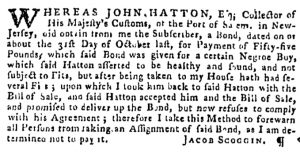
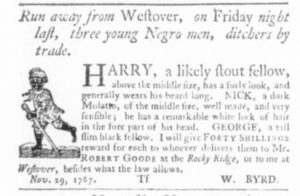
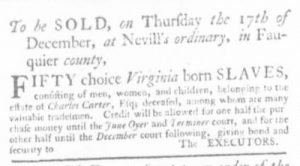
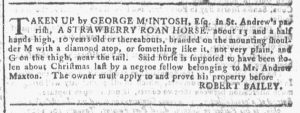
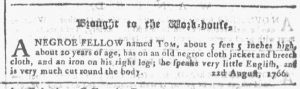
The Slavery Adverts 250 Project chronicles the role of newspaper advertising in perpetuating slavery in the era of the American Revolution. The project seeks to reveal the ubiquity of slavery in eighteenth-century life from New England to Georgia by republishing advertisements about enslaved people – for sale as individuals or in groups, wanted to purchase or for hire for short periods, runaways who liberated themselves, and those who were subsequently captured and confined in jails and workhouses – in daily digests on this site as well as in real time via the @SlaveAdverts250 Twitter feed, utilizing twenty-first-century media to stand in for the print media of the eighteenth century.

The project aims to provide modern audiences with a sense of just how often colonizers encountered these advertisements in their daily lives. Enslaved men, women, and children appeared in print somewhere in the colonies almost every single day. Those advertisements served as a constant backdrop for social, cultural, economic, and political life in colonial and revolutionary America. Colonizers who did not purport to own enslaved people were still confronted with slavery as well as invited to maintain the system by purchasing enslaved men, women, and children or assisting in the capture of so-called “runaways” who sought to free themselves from bondage. The frequency of these newspaper advertisements suggests just how embedded slavery was in colonial and revolutionary American culture in everyday interactions beyond the printed page.

These advertisements also testify to the experiences of enslaved men, women, and children, though readers must consider that those experiences have been remediated through descriptions offered by enslavers rather than enslaved people themselves. Often unnamed in the advertisements, enslaved men, women, and children were not invisible or unimportant in early America.

These advertisements appeared in colonial American newspapers 250 years ago today.

Dec 3 - New-York Journal Slavery 1
New-York Journal (December 3, 1767).

**********

Dec 3 - Pennsylvania Gazette Slavery 1
Pennsylvania Gazette (December 3, 1767).

**********

Dec 3 - Pennsylvania Gazette Slavery 2
Pennsylvania Gazette (December 3, 1767).

**********

Dec 3 - Pennsylvania Gazette Slavery 3
Pennsylvania Gazette (December 3, 1767).

**********

Dec 3 - Pennsylvania Gazette Slavery 4
Pennsylvania Gazette (December 3, 1767).

**********

Dec 3 - Pennsylvania Gazette Supplement Slavery 1
Supplement to the Pennsylvania Gazette (December 3, 1767).

**********

Dec 3 - Pennsylvania Gazette Supplement Slavery 2
Supplement to the Pennsylvania Gazette (December 3, 1767).

**********

Dec 3 - Pennsylvania Gazette Supplement Slavery 3
Supplement to the Pennsylvania Gazette (December 3, 1767).

**********

Dec 3 - Virginia Gazette Slavery 1
Virginia Gazette (December 3, 1767).

**********

Dec 3 - Virginia Gazette Slavery 2
Virginia Gazette (December 3, 1767).

**********

Dec 3 - Virginia Gazette Slavery 3
Virginia Gazette (December 3, 1767).

**********

Dec 3 - Virginia Gazette Slavery 4
Virginia Gazette (December 3, 1767).

**********

Dec 3 - Virginia Gazette Slavery 5
Virginia Gazette (December 3, 1767).

**********

Dec 3 - Virginia Gazette Slavery 6
Virginia Gazette (December 3, 1767).

December 2

What was advertised in a colonial American newspaper 250 years ago today?

Dec 2 - 12:2:1767 Georgia Gazette“A FOUR SHEET MAP of SOUTH-CAROLINA and PART of GEORGIA”
This advertisement for a “FOUR SHEET MAP of SOUTH-CAROLINA and PART of GEORGIA” would have been quite familiar to regular readers of the Georgia Gazette. It had been appearing in the pages of that newspaper for more than a year. While James Johnston, the printer of the newspaper and purveyor of the map certainly wanted to sell copies he still had on hand after all that time, the advertisement also served another important purpose. In a publication that sometimes lacked sufficient content to fill its pages, Johnston frequently inserted the advertisement as filler.

That seems to have been the case in the December 2, 1767, edition of the Georgia Gazette. The issue consisted of three pages of news and a final page devoted to advertising. A variety of articles densely filled the first three pages, yet the final page featured significant amounts of white space as part of each advertisement. Notice the amount of space between the body of the advertisement and the lines that separated it from the advertisements printed before and after. That had not been part of the design two weeks earlier when Samuel Douglass and Company’s advertisement that extended more than an entire column forced the compositor to squeeze all of the other paid notices together, eliminating any hint of negative space. The text on the two pages given over to advertising in that issue appeared just as dense as the text of the news items.

In addition to Johnston’s perennial advertisement for a map of South Carolina and Georgia, many other advertisements in the December 2 issue previously ran in other issues (though none of them nearly as many times). Each had been modified to include white space before and after the body of the advertisement, stretching them out in order to fill the entire page. This did not require completely resetting the type, but it did transform portions of each advertisement into filler that helped the printer deliver a complete issue to subscribers. Beyond the revenues they generated, newspaper advertisements served other purposes for colonial printers.

Summary of Slavery Advertisements Published November 26 – December 2, 1767

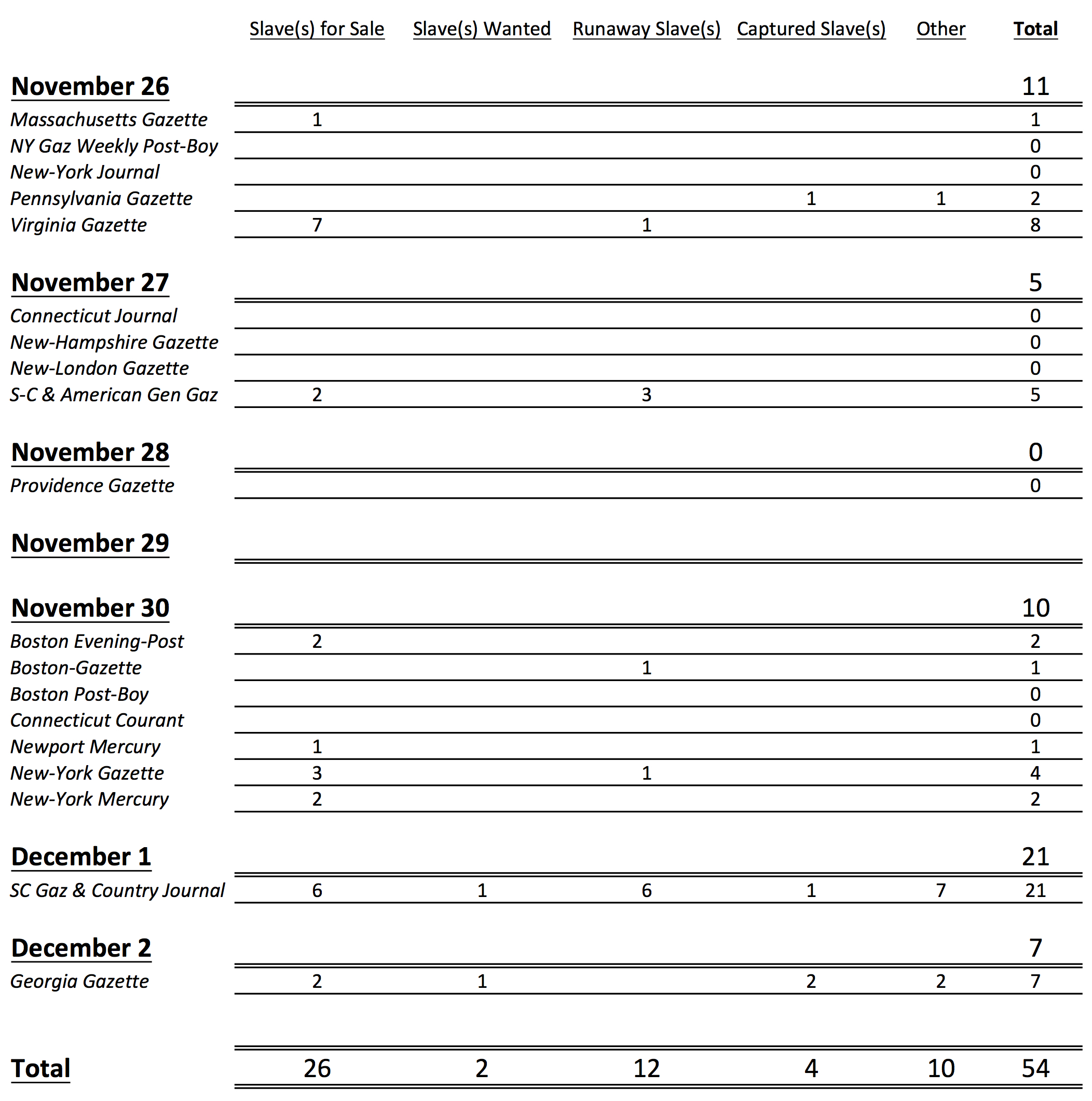
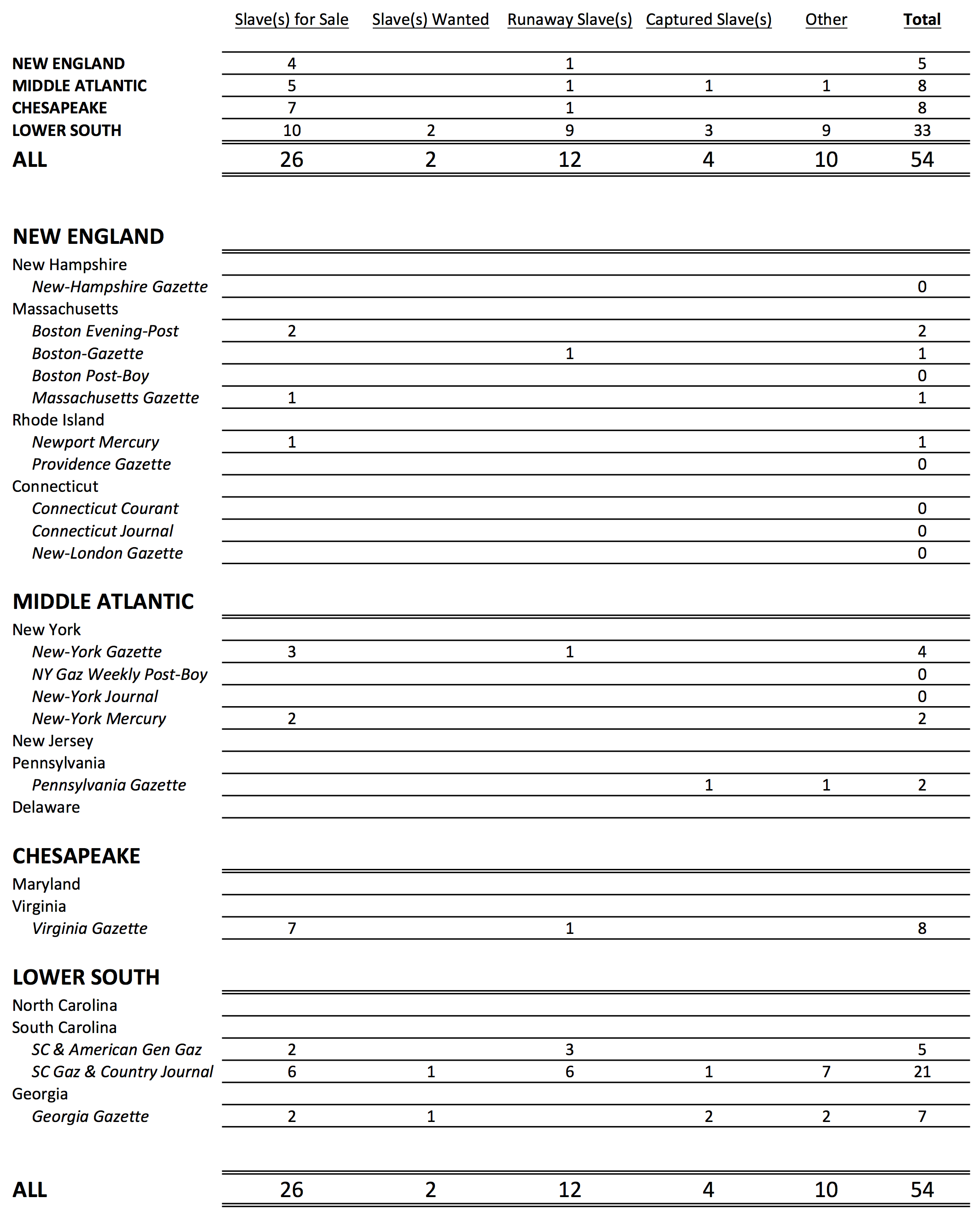
These tables indicate how many advertisements for slaves appeared in colonial American newspapers during the week of November 26 – December 2, 1767.

Note:  These tables are as comprehensive as currently digitized sources permit, but they may not be an exhaustive account.  They includes all newspapers that have been digitized and made available via Accessible Archives, Colonial Williamsburg’s Digital Library, and Readex’s America’s Historical Newspapers.  There are several reasons some newspapers may not have been consulted:

  • Issues that are no longer extant;
  • Issues that are extant but have not yet been digitized (including the Pennsylvania Journal); and
  • Newspapers published in a language other than English (including the Wochentliche Philadelphische Staatsbote).

**********

Slavery Advertisements Published November 26 – December 2, 1767:  By Date

Slavery Adverts Tables 1767 By Date Nov 26

**********

Slavery Advertisements Published November 26 – December 2, 1767:  By Region

Slavery Adverts Tables 1767 By Region Nov 26

Slavery Advertisements Published December 2, 1767

The Slavery Adverts 250 Project chronicles the role of newspaper advertising in perpetuating slavery in the era of the American Revolution. The project seeks to reveal the ubiquity of slavery in eighteenth-century life from New England to Georgia by republishing advertisements about enslaved people – for sale as individuals or in groups, wanted to purchase or for hire for short periods, runaways who liberated themselves, and those who were subsequently captured and confined in jails and workhouses – in daily digests on this site as well as in real time via the @SlaveAdverts250 Twitter feed, utilizing twenty-first-century media to stand in for the print media of the eighteenth century.

The project aims to provide modern audiences with a sense of just how often colonizers encountered these advertisements in their daily lives. Enslaved men, women, and children appeared in print somewhere in the colonies almost every single day. Those advertisements served as a constant backdrop for social, cultural, economic, and political life in colonial and revolutionary America. Colonizers who did not purport to own enslaved people were still confronted with slavery as well as invited to maintain the system by purchasing enslaved men, women, and children or assisting in the capture of so-called “runaways” who sought to free themselves from bondage. The frequency of these newspaper advertisements suggests just how embedded slavery was in colonial and revolutionary American culture in everyday interactions beyond the printed page.

These advertisements also testify to the experiences of enslaved men, women, and children, though readers must consider that those experiences have been remediated through descriptions offered by enslavers rather than enslaved people themselves. Often unnamed in the advertisements, enslaved men, women, and children were not invisible or unimportant in early America.

These advertisements appeared in colonial American newspapers 250 years ago today.

Dec 2 - Georgia Gazette Slavery 1
Georgia Gazette (December 2, 1767).

**********

Dec 2 - Georgia Gazette Slavery 2
Georgia Gazette (December 2, 1767).

**********

Dec 2 - Georgia Gazette Slavery 3
Georgia Gazette (December 2, 1767).

**********

Dec 2 - Georgia Gazette Slavery 4
Georgia Gazette (December 2, 1767).

**********

Dec 2 - Georgia Gazette Slavery 5
Georgia Gazette (December 2, 1767).

**********

Dec 2 - Georgia Gazette Slavery 7
Georgia Gazette (December 2, 1767).

**********

Dec 2 - Georgia Gazette Slavery 6
Georgia Gazette (December 2, 1767).

December 1

What was advertised in a colonial American newspaper 250 years ago today?

Dec 1 - 12:1:1767 South-Carolina Gazette and Country Journal
South-Carolina Gazette and Country Journal (December 1, 1767).

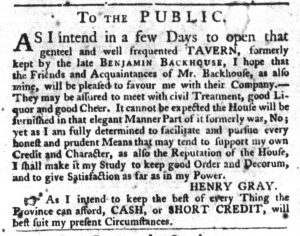
“That genteel and well frequented TAVERN.”

When Henry Gray became the proprietor of a tavern “formerly kept by the late BENJAMIN BACKHOUSE” in Charleston, he turned to the South-Carolina Gazette and Country Journal to inform the community that the establishment was under new management. The “well frequented” tavern already had a substantial clientele. It also enjoyed a fair level of familiarity among the population since Gray did not consider it necessary to specify the tavern’s location. He invited the “Friends and Acquaintance of Mr. Backhouse” to continue their patronage, but also extended a welcome to his own friends and other potential customers.

Backhouse’s tavern had been “well frequented” in part because of its “genteel” amenities and gracious service. The new proprietor promised customers that they would continue to “meet with civil treatment” as they enjoyed “good Liquor and good Cheer.” Gray intended to serve “the best of every Thing the Province can afford,” making it clear that he expected “good Order and Decorum” from patrons. Gray positioned his tavern as a destination for the better sorts rather than the sort of raucous watering hole that their social inferiors might frequent.

He also attempted to manage expectations, especially among customers familiar with the tavern from the days that Backhouse ran it. “It cannot be expected the House will be furnished in that elegant Manner Part of it formerly was,” Gray explained. Apparently he had acquired or leased the building from Backhouse’s estate, but not the furnishings. In order to avoid disappointment, he warned patrons in advance that not everything about the interior would be as it had been. He prepared customers to appreciate the features that had continued from the days Backhouse operated the “genteel and well frequented TAVERN” rather than focus on the one element that changed. With that bit of generosity extended by patrons to their new host, Gray pledged “to give Satisfaction as far as in my Power.”

Slavery Advertisements Published December 1, 1767

The Slavery Adverts 250 Project chronicles the role of newspaper advertising in perpetuating slavery in the era of the American Revolution. The project seeks to reveal the ubiquity of slavery in eighteenth-century life from New England to Georgia by republishing advertisements about enslaved people – for sale as individuals or in groups, wanted to purchase or for hire for short periods, runaways who liberated themselves, and those who were subsequently captured and confined in jails and workhouses – in daily digests on this site as well as in real time via the @SlaveAdverts250 Twitter feed, utilizing twenty-first-century media to stand in for the print media of the eighteenth century.

The project aims to provide modern audiences with a sense of just how often colonizers encountered these advertisements in their daily lives. Enslaved men, women, and children appeared in print somewhere in the colonies almost every single day. Those advertisements served as a constant backdrop for social, cultural, economic, and political life in colonial and revolutionary America. Colonizers who did not purport to own enslaved people were still confronted with slavery as well as invited to maintain the system by purchasing enslaved men, women, and children or assisting in the capture of so-called “runaways” who sought to free themselves from bondage. The frequency of these newspaper advertisements suggests just how embedded slavery was in colonial and revolutionary American culture in everyday interactions beyond the printed page.

These advertisements also testify to the experiences of enslaved men, women, and children, though readers must consider that those experiences have been remediated through descriptions offered by enslavers rather than enslaved people themselves. Often unnamed in the advertisements, enslaved men, women, and children were not invisible or unimportant in early America.

These advertisements appeared in colonial American newspapers 250 years ago today.

Dec 1 - South-Carolina Gazette and Country Journal Slavery 1
South-Carolina Gazette and Country Journal (December 1, 1767).

**********

Dec 1 - South-Carolina Gazette and Country Journal Slavery 2
South-Carolina Gazette and Country Journal (December 1, 1767).

**********

Dec 1 - South-Carolina Gazette and Country Journal Slavery 3
South-Carolina Gazette and Country Journal (December 1, 1767).

**********

Dec 1 - South-Carolina Gazette and Country Journal Slavery 11
South-Carolina Gazette and Country Journal (December 1, 1767).

**********

Dec 1 - South-Carolina Gazette and Country Journal Slavery 4
South-Carolina Gazette and Country Journal (December 1, 1767).

**********

Dec 1 - South-Carolina Gazette and Country Journal Slavery 5
South-Carolina Gazette and Country Journal (December 1, 1767).

**********

Dec 1 - South-Carolina Gazette and Country Journal Slavery 6
South-Carolina Gazette and Country Journal (December 1, 1767).

**********

Dec 1 - South-Carolina Gazette and Country Journal Slavery 12
South-Carolina Gazette and Country Journal (December 1, 1767).

**********

Dec 1 - South-Carolina Gazette and Country Journal Slavery 7
South-Carolina Gazette and Country Journal (December 1, 1767).

**********

Dec 1 - South-Carolina Gazette and Country Journal Slavery 8
South-Carolina Gazette and Country Journal (December 1, 1767).

**********

Dec 1 - South-Carolina Gazette and Country Journal Slavery 9
South-Carolina Gazette and Country Journal (December 1, 1767).

**********

Dec 1 - South-Carolina Gazette and Country Journal Slavery 10
South-Carolina Gazette and Country Journal (December 1, 1767).

**********

Dec 1 - South-Carolina Gazette and Country Journal Supplement Slavery 8
Supplement to the South-Carolina Gazette and Country Journal (December 1, 1767).

**********

Dec 1 - South-Carolina Gazette and Country Journal Supplement Slavery 1
Supplement to the South-Carolina Gazette and Country Journal (December 1, 1767).

**********

Dec 1 - South-Carolina Gazette and Country Journal Supplement Slavery 2
Supplement to the South-Carolina Gazette and Country Journal (December 1, 1767).

**********

Dec 1 - South-Carolina Gazette and Country Journal Supplement Slavery 3
Supplement to the South-Carolina Gazette and Country Journal (December 1, 1767).

**********

Dec 1 - South-Carolina Gazette and Country Journal Supplement Slavery 4
Supplement to the South-Carolina Gazette and Country Journal (December 1, 1767).

**********

Dec 1 - South-Carolina Gazette and Country Journal Supplement Slavery 5
Supplement to the South-Carolina Gazette and Country Journal (December 1, 1767).

**********

Dec 1 - South-Carolina Gazette and Country Journal Supplement Slavery 9
Supplement to the South-Carolina Gazette and Country Journal (December 1, 1767).

**********

Dec 1 - South-Carolina Gazette and Country Journal Supplement Slavery 6
Supplement to the South-Carolina Gazette and Country Journal (December 1, 1767).

**********

Dec 1 - South-Carolina Gazette and Country Journal Supplement Slavery 7
Supplement to the South-Carolina Gazette and Country Journal (December 1, 1767).