October 8

What was advertised in a colonial American newspaper 250 years ago today?

Oct 8 - 10:8:1767 Massachusetts Gazette
Massachusetts Gazette (October 8, 1767).

“The Advertisements taking up so much Room, the several Articles intended for this Page are thrown into a SUPPLEMENT.”

This notice appeared at the bottom of the first column on the second page of the October 8, 1767, edition of the Massachusetts Gazette. Richard Draper followed a standard procedure among eighteenth-century printers: when faced with too much content to fit into the allotted space he opted to distribute a two-page supplement along with the regular issue. This happened fairly frequently, especially in major port cities. Higher concentrations of residents meant greater numbers of advertisements to squeeze into each week’s four-page issue, sometimes yielding supplements devoted almost exclusively to advertising. The October 8 supplement, however, consisted primarily of news items as a result of “The Advertisements taking up so much Room” in the regular issue.

Draper and the Massachusetts Gazette did not have a higher number of advertisers than usual. Instead, advertisements placed by two local shopkeepers occupied significant amounts of space. Shopkeeper Jolley Allen continued publication of his lengthy list-style advertisement that filled two entire columns on the final page. Not to be outdone, bookseller John Mein commenced a new full-page advertisement for his “grand Assortment of the most MODERN BOOKS In every Branch of Polite Literature Arts and Sciences,” the one that he intended to launch in the Boston-Gazette three days earlier. That advertisement combined a previous advertisement for “A NEW EDITION of Dilworth’s Spelling Book” (set apart almost as a distinct advertisement in the lower right corner) and descriptions of two other books followed by a list of other books and stationery supplies in stock. The compositor created four narrow columns instead of the usual three slightly wider ones, resulting in a new look for that particular page compared to the rest of the newspaper.

Overall, just two advertisements accounted for nearly half of the October 8 issue of the Massachusetts Gazette, making the supplement practically a necessity. This happened as a result of both the printer and the advertisers experimenting with the format for newspaper notices. Although colonial newspapers published full-page advertisements sporadically in the 1760s, having an issue dominated by only two advertisements would have been an extraordinary event for readers, one that would have garnered even more notice among potential customers for John Mein and Jolley Allen.

Slavery Advertisements Published October 8, 1767

The Slavery Adverts 250 Project chronicles the role of newspaper advertising in perpetuating slavery in the era of the American Revolution. The project seeks to reveal the ubiquity of slavery in eighteenth-century life from New England to Georgia by republishing advertisements about enslaved people – for sale as individuals or in groups, wanted to purchase or for hire for short periods, runaways who liberated themselves, and those who were subsequently captured and confined in jails and workhouses – in daily digests on this site as well as in real time via the @SlaveAdverts250 Twitter feed, utilizing twenty-first-century media to stand in for the print media of the eighteenth century.

The project aims to provide modern audiences with a sense of just how often colonizers encountered these advertisements in their daily lives. Enslaved men, women, and children appeared in print somewhere in the colonies almost every single day. Those advertisements served as a constant backdrop for social, cultural, economic, and political life in colonial and revolutionary America. Colonizers who did not purport to own enslaved people were still confronted with slavery as well as invited to maintain the system by purchasing enslaved men, women, and children or assisting in the capture of so-called “runaways” who sought to free themselves from bondage. The frequency of these newspaper advertisements suggests just how embedded slavery was in colonial and revolutionary American culture in everyday interactions beyond the printed page.

These advertisements also testify to the experiences of enslaved men, women, and children, though readers must consider that those experiences have been remediated through descriptions offered by enslavers rather than enslaved people themselves. Often unnamed in the advertisements, enslaved men, women, and children were not invisible or unimportant in early America.

These advertisements appeared in colonial American newspapers 250 years ago today.

Oct 8 - Massachusetts Gazette Slavery 1
Massachusetts Gazette (October 8, 1767).

**********

Oct 8 - Massachusetts Gazette Slavery 2
Massachusetts Gazette (October 8, 1767).

**********

Oct 8 - New-York Gazette Weekly Post-Boy Slavery 1
New-York Gazette: Or, the Weekly Post-Boy (October 8, 1767).

**********

Oct 8 - New-York Gazette Weekly Post-Boy Slavery 2
New-York Gazette: Or, the Weekly Post-Boy (October 8, 1767).

**********

Oct 8 - New-York Journal Slavery 1
New-York Journal (October 8, 1767).

**********

Oct 8 - New-York Journal Slavery 2
New-York Journal (October 8, 1767).

**********

Oct 8 - New-York Journal Slavery 3
New-York Journal (October 8, 1767).

**********

Oct 8 - New-York Journal Slavery 4
New-York Journal (October 8, 1767).

**********

Oct 8 - New-York Journal Supplement Slavery 1
Supplement to the New-York Journal (October 8, 1767).

**********

Oct 8 - New-York Journal Supplement Slavery 2
Supplement to the New-York Journal (October 8, 1767).

**********

Oct 8 - Pennsylvania Gazette Slavery 1
Pennsylvania Gazette (October 8, 1767).

**********

Oct 8 - Pennsylvania Gazette Slavery 2
Pennsylvania Gazette (October 8, 1767).

**********

Oct 8 - Pennsylvania Gazette Supplement Slavery 1
Supplement to the Pennsylvania Gazette (October 8, 1767).

**********

Oct 8 - Pennsylvania Gazette Supplement Slavery 2
Supplement to the Pennsylvania Gazette (October 8, 1767).

**********

Oct 8 - Pennsylvania Gazette Supplement Slavery 3
Supplement to the Pennsylvania Gazette (October 8, 1767).

**********

Oct 8 - Virginia Gazette Slavery 1
Virginia Gazette (October 8, 1767).

**********

Oct 8 - Virginia Gazette Slavery 2
Virginia Gazette (October 8, 1767).

**********

Oct 8 - Virginia Gazette Slavery 3
Virginia Gazette (October 8, 1767).

**********

Oct 8 - Virginia Gazette Slavery 4
Virginia Gazette (October 8, 1767).

**********

Oct 8 - Virginia Gazette Slavery 5
Virginia Gazette (October 8, 1767).

**********

Oct 8 - Virginia Gazette Slavery 6
Virginia Gazette (October 8, 1767).

**********

Oct 8 - Virginia Gazette Slavery 7
Virginia Gazette (October 8, 1767).

**********

Oct 8 - Virginia Gazette Slavery 8
Virginia Gazette (October 8, 1767).

**********

Oct 8 - Virginia Gazette Slavery 9
Virginia Gazette (October 8, 1767).

**********

Oct 8 - Virginia Gazette Slavery 11
Virginia Gazette (October 8, 1767).

**********

Oct 8 - Virginia Gazette Slavery 10
Virginia Gazette (October 8, 1767).

October 7

What was advertised in a colonial American newspaper 250 years ago today?

Oct 7 - 10:7:1767 Georgia Gazette
Georgia Gazette (October 7, 1767).

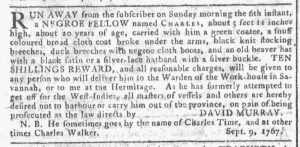
“He has formerly attempted to get off for the West-Indies.”

In the 1760s the pages of the Georgia Gazette often included far more advertising concerning slaves – slaves for sale, runaway slaves, captured slaves – than advertising for consumer goods and services. These advertisements told the story of enslaved men, women, and children reduced to commodities to be bought and sold, but they also told stories of resistance to that dehumanization and commodification. Runaway advertisements testified to the agency, perseverance, and ingenuity of slaves who seized their freedom when they saw opportunities.

Much to his chagrin, David Murray told the story of one of those bold slaves, “A NEGRO FELLOW named CHARLES.” Although he was a young man, only “about 20 years of age,” Charles had previously attempted to escape from his master. While some slaves ran away with the intention of returning after a brief respite from their bondage, Charles had other plans. He did not seek temporary freedom but instead wished to permanently alter his situation. To that end, he had previously attempted “to get off for the West-Indies.” Murray did not offer any speculation to explain why Charles chose that destination; perhaps the young slave hoped to be reunited with family there. Whatever his reasons, Charles aimed to put considerable distance between himself and Murray, prompting the slaveholder to instruct “all masters of vessels” not to “carry him out of the province.” He also cautioned others “not to harbour” Charles, threatening to prosecute anyone who aided the fugitive.

To evade detection and capture, Charles adopted aliases, sometimes calling himself “Charles Time” and other times “Charles Walker.” Such resourcefulness may have aided in his escape and his ability to remain free for at least the month that had passed since Murray first placed his advertisement.

Between changing his name and making new efforts to escape even after his first attempt had been discovered, Charles demonstrated that he would not be subdued easily. While other advertisements treated enslaved men, women, and children as commodities – such as the “SIX FIELD NEGROES” or the “Young NEGROE WENCH” advertised for sale in the same issue of the Georgia Gazette – Murray’s advertisement about a “NEGROE FELLOW named CHARLES” underscored that slaves did not passively acquiesce to lives of perpetual servitude. Although certainly not Murray’s intent, his advertisement about a runaway slave told a powerful story of one man’s determination to fight to free himself from the injustices he experienced in colonial Georgia.

Summary of Slavery Advertisements Published October 1-7, 1767

These tables indicate how many advertisements for slaves appeared in colonial American newspapers during the week of October 1-7, 1767.

Note:  These tables are as comprehensive as currently digitized sources permit, but they may not be an exhaustive account.  They includes all newspapers that have been digitized and made available via Accessible Archives, Colonial Williamsburg’s Digital Library, and Readex’s America’s Historical Newspapers.  There are several reasons some newspapers may not have been consulted:

  • Issues that are no longer extant;
  • Issues that are extant but have not yet been digitized (including the Pennsylvania Journal); and
  • Newspapers published in a language other than English (including the Wochentliche Philadelphische Staatsbote).

**********

Slavery Advertisements Published October 1-7, 1767:  By Date

Slavery Adverts Tables 1767 By Date Oct 1

**********

Slavery Advertisements Published October 1-7, 1767:  By Region

Slavery Adverts Tables 1767 By Region Oct 1

Slavery Advertisements Published October 7, 1767

The Slavery Adverts 250 Project chronicles the role of newspaper advertising in perpetuating slavery in the era of the American Revolution. The project seeks to reveal the ubiquity of slavery in eighteenth-century life from New England to Georgia by republishing advertisements about enslaved people – for sale as individuals or in groups, wanted to purchase or for hire for short periods, runaways who liberated themselves, and those who were subsequently captured and confined in jails and workhouses – in daily digests on this site as well as in real time via the @SlaveAdverts250 Twitter feed, utilizing twenty-first-century media to stand in for the print media of the eighteenth century.

The project aims to provide modern audiences with a sense of just how often colonizers encountered these advertisements in their daily lives. Enslaved men, women, and children appeared in print somewhere in the colonies almost every single day. Those advertisements served as a constant backdrop for social, cultural, economic, and political life in colonial and revolutionary America. Colonizers who did not purport to own enslaved people were still confronted with slavery as well as invited to maintain the system by purchasing enslaved men, women, and children or assisting in the capture of so-called “runaways” who sought to free themselves from bondage. The frequency of these newspaper advertisements suggests just how embedded slavery was in colonial and revolutionary American culture in everyday interactions beyond the printed page.

These advertisements also testify to the experiences of enslaved men, women, and children, though readers must consider that those experiences have been remediated through descriptions offered by enslavers rather than enslaved people themselves. Often unnamed in the advertisements, enslaved men, women, and children were not invisible or unimportant in early America.

These advertisements appeared in colonial American newspapers 250 years ago today.

Oct 7 - Georgia Gazette Slavery 1
Georgia Gazette (October 7, 1767).

**********

Oct 7 - Georgia Gazette Slavery 2
Georgia Gazette (October 7, 1767).

**********

Oct 7 - Georgia Gazette Slavery 3
Georgia Gazette (October 7, 1767).

**********

Oct 7 - Georgia Gazette Slavery 4
Georgia Gazette (October 7, 1767).

**********

Oct 7 - Georgia Gazette Slavery 5
Georgia Gazette (October 7, 1767).

**********

Oct 7 - Georgia Gazette Slavery 6
Georgia Gazette (October 7, 1767).

**********

Oct 7 - Georgia Gazette Slavery 7
Georgia Gazette (October 7, 1767).

**********

Oct 7 - Georgia Gazette Slavery 8
Georgia Gazette (October 7, 1767).

**********

Oct 7 - Georgia Gazette Slavery 9
Georgia Gazette (October 7, 1767).

October 6

What was advertised in a colonial American newspaper 250 years ago today?

Oct 6 - 10:6:1767 South-Carolina Gazette and Country Journal
South-Carolina Gazette and Country Journal (October 6, 1767).

“All GENTLEMEN may therefore save themselves a great deal of trouble.”

John Ward, a tailor, advanced a variety of marketing appeals in his advertisement aimed at “All GENTLEMEN” in Charleston, but convenience was foremost among them. Ward detailed how he imported textiles and “trimmings of all colours.” Clients did not need to obtain fabrics from shopkeepers and then contract with a tailor to make their garments. Ward considered that system “a great deal of trouble.” By constructing clothing from the materials he sold in his workshop, Ward saved his customers all of the hassle of going from shop to shop. This also streamlined the process because clients had only one bill rather than “so many different bills for their clothes.” Furthermore, Ward offered the convenience of knowing exactly how much his garments cost, making it unnecessary for prospective customers to do all kinds of tabulations based on which materials they might purchase from which retailers. Ward announced that he “fixes the price of a suit of clothes … from FORTY-FIVE to FIFTY POUNDS currency a suit.”

Realizing that all of this convenience mattered little if the price did not match the rates set by competitors or if potential clients suspected inferior quality, Ward made certain to address those concerns. His supplier on the other side of the Atlantic, described as “as good a judge [of dry goods] as any in England,” purchased the textiles and trimmings “upon the very best terms.” This, in turn, allowed Ward “to sell much lower than the common advance.” Customers who wished to acquire fabrics got a deal when they bought from Ward rather than local shopkeepers. Those who also wanted those fabrics made into garments could “have their clothes made near as cheap as can be sent from England.” Ward acknowledged a slight premium for the convenience he provided, presumably a price worth paying to work directly with a local tailor who could take his own measurements and make adjustments and repairs on the spot. In terms of quality, he also used superlatives to describe his materials: “best superfine London dress’d BROAD-CLOTHS,” “superfine plush,” and “the very best of silk and worsted breeches pieces.”

John Ward marketed convenience in acquiring materials, having garments made, and paying bills, but not at the cost of other considerations important to prospective clients. As he promoted convenience, he simultaneously made traditional appeals to price and quality to reassure skeptical consumers.

Slavery Advertisements Published October 6, 1767

The Slavery Adverts 250 Project chronicles the role of newspaper advertising in perpetuating slavery in the era of the American Revolution. The project seeks to reveal the ubiquity of slavery in eighteenth-century life from New England to Georgia by republishing advertisements about enslaved people – for sale as individuals or in groups, wanted to purchase or for hire for short periods, runaways who liberated themselves, and those who were subsequently captured and confined in jails and workhouses – in daily digests on this site as well as in real time via the @SlaveAdverts250 Twitter feed, utilizing twenty-first-century media to stand in for the print media of the eighteenth century.

The project aims to provide modern audiences with a sense of just how often colonizers encountered these advertisements in their daily lives. Enslaved men, women, and children appeared in print somewhere in the colonies almost every single day. Those advertisements served as a constant backdrop for social, cultural, economic, and political life in colonial and revolutionary America. Colonizers who did not purport to own enslaved people were still confronted with slavery as well as invited to maintain the system by purchasing enslaved men, women, and children or assisting in the capture of so-called “runaways” who sought to free themselves from bondage. The frequency of these newspaper advertisements suggests just how embedded slavery was in colonial and revolutionary American culture in everyday interactions beyond the printed page.

These advertisements also testify to the experiences of enslaved men, women, and children, though readers must consider that those experiences have been remediated through descriptions offered by enslavers rather than enslaved people themselves. Often unnamed in the advertisements, enslaved men, women, and children were not invisible or unimportant in early America.

These advertisements appeared in colonial American newspapers 250 years ago today.

Oct 6 - South-Carolina Gazette and Country Journal Slavery 1
South-Carolina Gazette and Country Journal (October 6, 1767).

**********

Oct 6 - South-Carolina Gazette and Country Journal Slavery 2
South-Carolina Gazette and Country Journal (October 6, 1767).

**********

Oct 6 - South-Carolina Gazette and Country Journal Slavery 3
South-Carolina Gazette and Country Journal (October 6, 1767).

**********

Oct 6 - South-Carolina Gazette and Country Journal Slavery 4
South-Carolina Gazette and Country Journal (October 6, 1767).

**********

Oct 6 - South-Carolina Gazette and Country Journal Slavery 5
South-Carolina Gazette and Country Journal (October 6, 1767).

**********

Oct 6 - South-Carolina Gazette and Country Journal Slavery 6
South-Carolina Gazette and Country Journal (October 6, 1767).

**********

Oct 6 - South-Carolina Gazette and Country Journal Slavery 7
South-Carolina Gazette and Country Journal (October 6, 1767).

**********

Oct 6 - South-Carolina Gazette and Country Journal Slavery 8
South-Carolina Gazette and Country Journal (October 6, 1767).

**********

Oct 6 - South-Carolina Gazette and Country Journal Slavery 9
South-Carolina Gazette and Country Journal (October 6, 1767).

**********

Oct 6 - South-Carolina Gazette and Country Journal Slavery 10
South-Carolina Gazette and Country Journal (October 6, 1767).

**********

Oct 6 - South-Carolina Gazette and Country Journal Slavery 11
South-Carolina Gazette and Country Journal (October 6, 1767).

**********

Oct 6 - South-Carolina Gazette and Country Journal Slavery 12
South-Carolina Gazette and Country Journal (October 6, 1767).

October 5

What was advertised in a colonial American newspaper 250 years ago today?

Oct 5 - 10:5:1767 Boston-Gazette
Boston-Gazette (October 5, 1767).

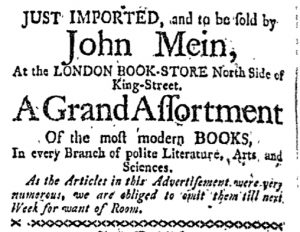
“As the Articles in this Advertisement were very numerous, we are obliged to omit them till the next Week for want of Room.”

Bookseller John Mein frequently placed advertisements in Boston’s newspapers (and sometimes publications in other towns) in the 1760s. Even if they had never visited the “LONDON BOOK-STORE North Side of King-Street,” regular readers of the Boston-Gazette would have been familiar with Mein’s marketing efforts. On occasion his advertisements occupied even more space than those inserted by shopkeepers with the most extensive lists of imported merchandise, extending anywhere from an entire column to an entire page. Mein intended to publish another lengthy advertisement in the Boston-Gazette on the first Monday in October 1767, but had to settle for a shorter notice.

Actually, Mein placed two advertisements in the October 5 issue. One appeared at the top of the third column on the second page, to the right of an open letter “To The People of Boston and all other English Americans,” a letter that argued Parliament had renewed its attempts to reduce the colonies to “perfect slavery.” This relatively short advertisement amounted to a single square, the standard length for most paid notices in that issue. The second advertisement, approximately two squares, appeared in the middle of the third column on the third page, less easy to distinguish among the other notices on the page.

Both advertisements announced that Mein stocked “A Grand Assortment Of the most modern BOOKS, In every Branch of polite Literature, Arts and Sciences” (though the typography differed significantly). The shorter notice also indicated that since “the Articles in this Advertisement were very numerous, we are obliged to omit them till the next Week for want of Room.” The second notice focused primarily on a single volume, a new edition of “Dilworth’s Spelling Book” just published on “fine Paper” with new type. It concluded with a brief note that “Printed Catalogues may be had Gratis at the Store” on King Street. Surely Mein’s catalog included many of the books he meant to advertise in the Boston-Gazette that week had space permitted.

Given the placement of Mein’s advertisements within the newspaper, he may not have submitted two separate notices for publication. Instead, the printers may have created the shorter advertisement, with its announcement anticipating a lengthier list of Mein’s titles in the next issue, and given it a prominent place to compensate for not publishing all of the copy Mein submitted. When the advertisement did appear the following week, it filled an entire page. Given the expense that Mein incurred, the printers may have considered a second advertisement promising more information about Mein’s “Grand Assortment Of the most modern BOOKS” the least they could do when they ran out of space to publish the list in its entirety. After all, they wanted to encourage the bookseller to continue (to pay) to insert lengthy advertisements in their newspaper.

Mein intended to attract attention through the volume of his advertising, yet circumstances prompted the printers to deliver an alternate marketing strategy. They incited interest by temporarily withholding the complete advertisement while simultaneously giving the announcement a prominent place in the publication to increase the number of potential customers who would read it.

Slavery Advertisements Published October 5, 1767

The Slavery Adverts 250 Project chronicles the role of newspaper advertising in perpetuating slavery in the era of the American Revolution. The project seeks to reveal the ubiquity of slavery in eighteenth-century life from New England to Georgia by republishing advertisements about enslaved people – for sale as individuals or in groups, wanted to purchase or for hire for short periods, runaways who liberated themselves, and those who were subsequently captured and confined in jails and workhouses – in daily digests on this site as well as in real time via the @SlaveAdverts250 Twitter feed, utilizing twenty-first-century media to stand in for the print media of the eighteenth century.

The project aims to provide modern audiences with a sense of just how often colonizers encountered these advertisements in their daily lives. Enslaved men, women, and children appeared in print somewhere in the colonies almost every single day. Those advertisements served as a constant backdrop for social, cultural, economic, and political life in colonial and revolutionary America. Colonizers who did not purport to own enslaved people were still confronted with slavery as well as invited to maintain the system by purchasing enslaved men, women, and children or assisting in the capture of so-called “runaways” who sought to free themselves from bondage. The frequency of these newspaper advertisements suggests just how embedded slavery was in colonial and revolutionary American culture in everyday interactions beyond the printed page.

These advertisements also testify to the experiences of enslaved men, women, and children, though readers must consider that those experiences have been remediated through descriptions offered by enslavers rather than enslaved people themselves. Often unnamed in the advertisements, enslaved men, women, and children were not invisible or unimportant in early America.

These advertisements appeared in colonial American newspapers 250 years ago today.

Oct 5 - Boston-Gazette Slavery 1
Boston-Gazette (October 5, 1767).

**********

Oct 5 - Boston-Gazette Slavery 2
Boston-Gazette (October 5, 1767).

**********

Oct 5 - Boston-Gazette Slavery 3
Boston-Gazette (October 5, 1767).

**********

Oct 5 - Boston-Gazette Slavery 4
Boston-Gazette (October 5, 1767).

**********

Oct 5 - New-York Gazette Slavery 1
New-York Gazette (October 5, 1767).

**********

Oct 5 - New-York Gazette Slavery 2
New-York Gazette (October 5, 1767).

**********

Oct 5 - New-York Mercury Slavery 1
New-York Mercury (October 5, 1767).

**********

Oct 5 - New-York Mercury Slavery 2
New-York Mercury (October 5, 1767).

**********

Oct 5 - Newport Mercury Slavery 1
Newport Mercury (October 5, 1767).

**********

Oct 5 - Pennsylvania Chronicle Slavery 1
Pennsylvania Chronicle (October 5, 1767).

October 4

What was advertised in a colonial American newspaper 250 years ago this week?

Oct 4 - 10:1:1767 Pennsylvania Gazette
Pennsylvania Gazette (October 1, 1767).

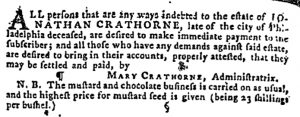
“The mustard and chocolate business is carried on as usual.”

Mary Crathorne, a widow, placed an advertisement in the Pennsylvania Gazette calling on “ALL persons that are any ways indebted to the estate of JONATHAN CRATHORNE … to make immediate payment.” She also requested that “all those who have any demands against said estate” to submit them so she could settle accounts. As administratrix (or executor) of her husband’s estate, she followed the standard protocols for placing newspaper advertisements.

Yet she also appended a nota bene to inform readers, regardless of whether they had unfinished business with her husband’s estate, that “The mustard and chocolate business is carried on as usual, and the highest price for mustard seed is given.” Like many other widows, Crathorne carried on her husband’s business after his death. Although she shouldered some new responsibilities, much of what went into the daily operations of the “mustard and chocolate business” may have been quite familiar to her already. Especially in busy port cities like Philadelphia, colonial wives often assisted their husbands who ran businesses. They served customers and provided other labor when necessary, yet their contributions usually remained hidden or unacknowledged.

Mary Crathorne may not have taken over all of her husband’s former duties. Her role may have been restricted to managing and overseeing male relatives and employees who continued the business on her behalf, leaving the specialized work to them. Still, she now held a position as the proprietress who represented the business to the public. Her name appeared in the public prints, not only peddling mustard produced at her shop but also negotiating for the supplies necessary for continuing the endeavor. She announced that she paid “23 shillings per bushel,” proclaiming it the “highest price for mustard seed” paid in the colony.

This advertisement does not tell Mary Crathorne’s entire story, but it does suggest that women played a more substantial role in the colonial marketplace as entrepreneurs – producers, suppliers, and retailers – than advertisements placed by their husbands might otherwise indicate. At least temporarily, Mary Crathorne operated her husband’s business after his death, perhaps continuing and expanding on activities that she previously performed.