September 25

What was advertised in a colonial American newspaper 250 years ago this week?
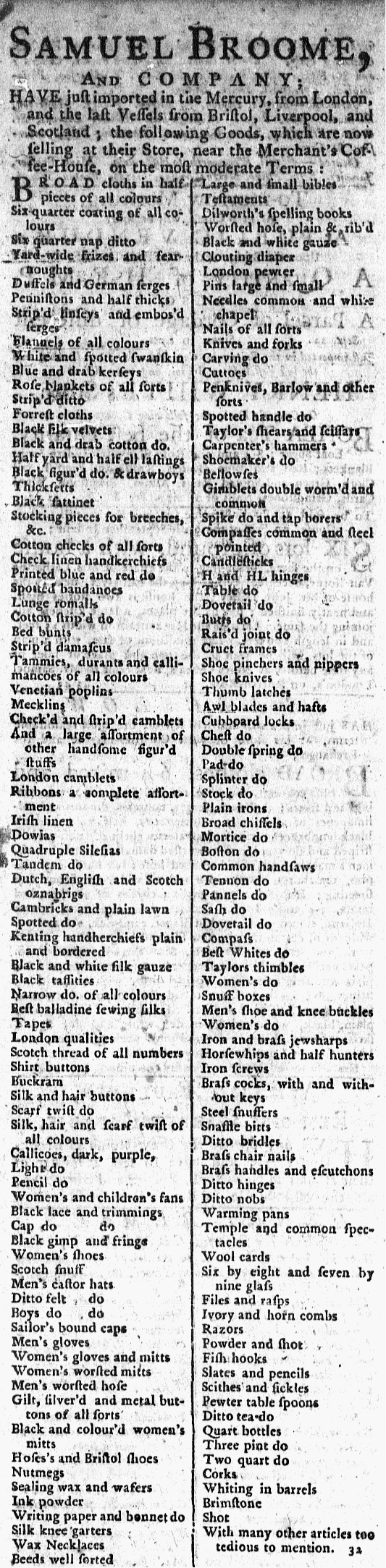
Sep 25 - 9:22:1768 New-York Journal
New-York Journal (September 22, 1768).

“Too many other articles too tedious to mention.”

In an extensive advertisement that comprised almost an entire column in the September 22, 1768, edition of the New-York Journal, Samuel Broome and Company emphasized the choices they offered consumers by listing hundreds of items. Organized into two neat columns with only one or two items listed on each line, this list of goods enumerated a vast array of merchandise “imported in the Mercury, from London, and the last vessels from Bristol, Liverpool, and Scotland.”

Visually, the design of the advertisement readily communicated the choices available to prospective customers, but Broome and Company relied on more than just copy filling so much space in the newspaper to make their point. For many items they provided descriptions that further testified to the variety readers could expect to encounter upon visiting their store “near the Merchant’s Coffee-House.” For instance, they stocked “Gilt, silver’d and metal buttons of all sorts.” After listing dozens of textiles, Broome and Company stated that they also stocked “a large assortment of other handsome figur’d stuffs.” They did not merely carry ribbons but instead “Ribbons a complete assortment.” Similarly, they carried “Rose blankets of all sorts.” They also emphasized the range of colors and prints for many of their fabrics and garments, including “Flannels of all colours,” “Tammies, durants, and callimancoes of all colours,” “Silk, hair and scarf twist of all colours,” and “Cotton checks of all sorts[,] Check linen handkerchiefs[, and] Printed blue and red do.” They used an eighteenth-century abbreviation for “ditto” – “do” – as they expanded on the variety of handkerchiefs. They did the same when they listed an assortment of hinges: “H and HL hinges[,] Table do[,] Dovetail do[,] Butts do[, and] Rais’d joint do.”

As if this was not enough to entice potential customers, Broome and Company invoked a familiar refrain to conclude their list: “With too many other articles too tedious to mention.” Despite all of the textiles, housewares, and hardware named in the advertisement, the partners suggested to consumers that they provided only a small preview of the many wares available at their store. Many of their competitors who advertised in the same issue of the New-York Journal also made appeals to consumer choice, but the combination of copy and design deployed by Broome and Company most effectively delivered the message to consumers in the city and its hinterlands.

September 24

What was advertised in a colonial American newspaper 250 years ago today?

Sep 24 - 9:24:1768 Providence Gazette
Providence Gazette (September 24, 1768).

Want of Room has obliged us to omit some Advertisements, and sundry Articles of European Intelligence, to which a due Regard will be paid in our next.”

The compositor who set type for the Providence Gazette inserted a series of instructions to aid readers in navigating the September 24, 1768, edition. Like all other newspapers published in the American colonies in the 1760s, a standard issue of the Providence Gazette consisted of four pages distributed once a week. This required a single broadsheet, folded in half. Some newspapers in largest port cities did regularly circulate an additional two-page supplement printed on a half or quarter sheet tucked inside the standard issue but often numbered sequentially as the fifth and sixth pages. The majority of newspapers, however, issued supplements, postscripts, and extraordinaries only rarely.

Printers and compositors produced four-page issues by printing two pages on each side of a broadsheet. The second and third pages were printed side-by-side on one side. In the final issue, they appeared next to each other across the center fold. The first and fourth pages were printed on the other side of the sheet, with the fourth page on the left and the first page on the right. This put each page in the proper position once both sides had been printed and the broadsheet folded in half.

The instructions the compositor inserted in the September 24, 1768, edition of the Providence Gazette make the order for setting the type clear, though not necessarily the order for printing the two sides of the broadsheet. Except for the masthead, the “Commission of the Board of Commissioners for this Continent, now held at Castle-William” in Boston harbor occupied the entire first page. The final line of the third column instructed readers to “[See the last Page.]” The “Commission” continued there, filling the entire page except for the colophon at the bottom. Again, the final line of the third column gave instructions: “[For the Remainder, turn to the second Page.]” The “Commission” continued there, in the middle of a word, and concluded after approximately one-quarter of a column. Other news from Boston rounded out the second page and a portion of the third page. The editors selected one column of local news. Only five advertisements appeared in the issue, confined to the bottom of the second and the entire third column on the third page. A short note from the printers followed the paid notices: “Want of Room has obliged us to omit some Advertisements, and sundry Articles of European Intelligence, to which a due Regard will be paid in our next.” The printers opted not to issue a supplement but instead held off on publishing additional content for a week.

These various instructions make it clear that the compositor set the type for the first and fourth pages first and only after that for the second and third pages. They also indicate that reading the issue start to finish required subscribers to jump around the pages, starting with the first, then the fourth, and finally the second and third. The technologies of printing led to readers experiencing the material text in ways that seem unfamiliar and counterintuitive to modern readers.

September 23

What was advertised in a colonial American newspaper 250 years ago today?

Sep 23 - 9:23:1768 New-London Gazette
New-London Gazette (September 23, 1768).

I have been informed that some of my customers have been displeased.”

Seth Wales had two purposes for placing an advertisement for his “clothier’s business” in the New-London Gazette in September 1768. He promoted the skills of the workman he now employed while simultaneously recanting and correcting an advertisement that appeared in the same newspaper a year earlier.

That advertisement originally ran in the September 11, 1767, edition of the New-London Gazette. In it, Seth Wales of Norwich and Nathaniel Wales of Windham announced that “every Part and Branch of the Clothier’s Business is carried on” in their towns “under the Direction and Management of one FRANCIS GILDING.” Having recently arrived from London, Gilding was unfamiliar to prospective customers so the Waleses assured them that he is “thoroughly skilled in the Art of a Scowerer and Dyer, and can imitate or strike any Colours (that are dyed in the English Nation).” The advertisement continued to extol Gilding’s skills and abilities at some length, adopting a marketing strategy frequently adopted by artisans in newspapers published throughout the colonies.

Seth Wales ultimately found himself dissatisfied with Gilding’s “Direction and Management” of the business. In an advertisement that first appeared in the September 16 (misdated 15), 1768, issue he implied that Gilding had placed the previous notice. Although Wales did not take responsibility for misleading the public about Gilding’s work, he did acknowledge that he had been “informed that some of my customers have been displeased with some of their work done at my mill.” He indicated that those customers had responded to “Gilding’s pretences” in the earlier notice, but that he had “found by experience he no ways answers to said advertisement.” Wales then savaged Gilding’s skills before declaring that he had “dismissed him.”

In the wake of Gilding’s termination, Wales hired a new “workman at the clothier’s business, that served an apprenticeship at said trade in Europe, and understands every branch of the business.” This new employee had been on the job for six months, sufficient time for Wales to confidently exclaim that his work “shall be done this year much better than it was last.” Perhaps Wales had learned a lesson about advertising the skills of an employee too soon. The trial period gave him better opportunity to assess for himself the abilities of his “present workman” before making promises in advertisements and then finding himself in the position of retracting them.

For his part, Gilding was not pleased with how Wales portrayed him. The following week he placed his own advertisement, which appeared immediately below the second insertion of Wales’s notice. He lamented that he had been “greatly Abused and Injured in my Reputation.” He considered the entire advertisement “a Piece of Malice and Detraction.” He then explained that any shortcomings in his work should be attributed to Wales for not providing proper supplies for the dyeing business. Furthermore, Gilding asserted that Wales attempted to hire him for an additional year. Gilding quit, despite Wales pretending otherwise. Finally, Gilding reported that his former employer and “the Workman he pretends to have had Six Months experience of” had parted ways, once again due to difficulties caused by Wales.

Artisans of various sorts often used newspaper advertisements to promote their skills and training in eighteenth-century America. In this incident, Wales and Gilding did that and more. Each turned to the public prints to defend their own reputation, inserting advertisements that constructed competing narratives. Airing their dirty laundry presented risks, but calculated that the rewards of presenting their own side of the dispute would result in rewards if prospective customers believed their version of events.

Slavery Advertisements Published September 23, 1768

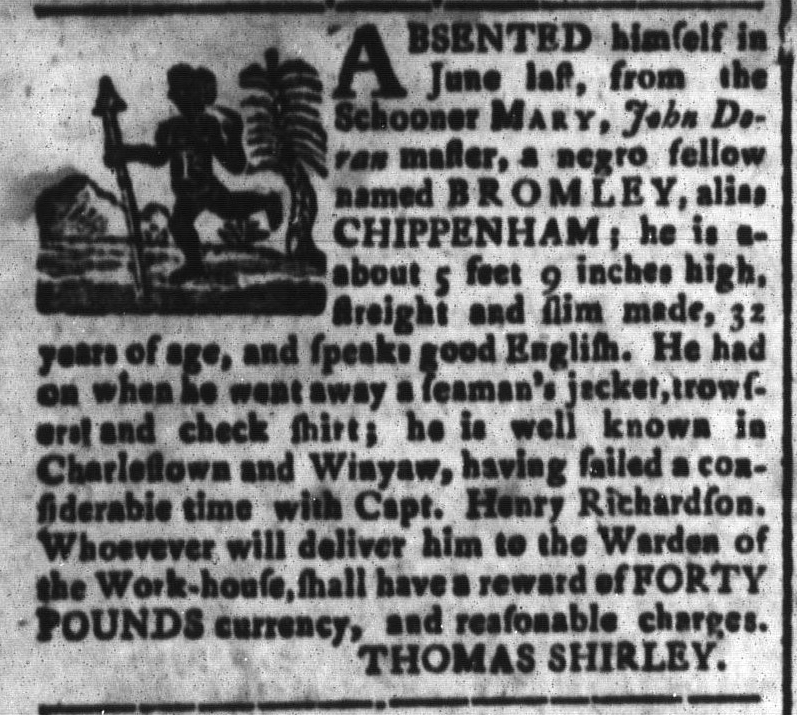
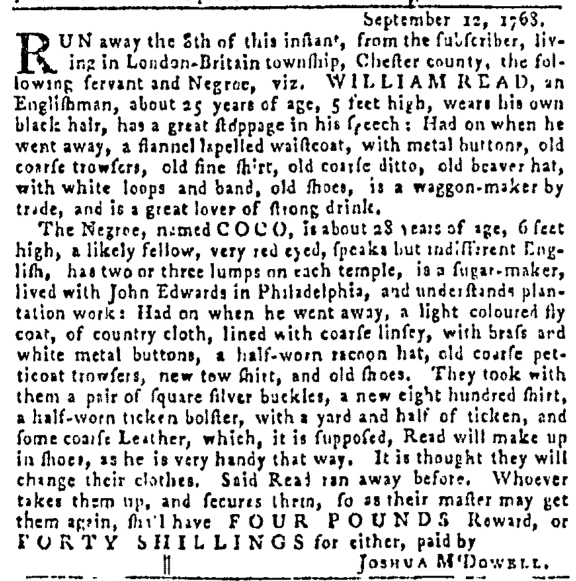
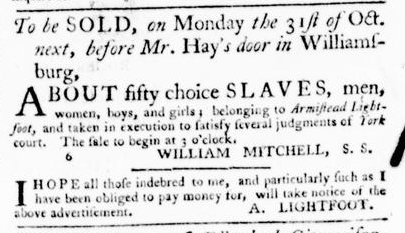
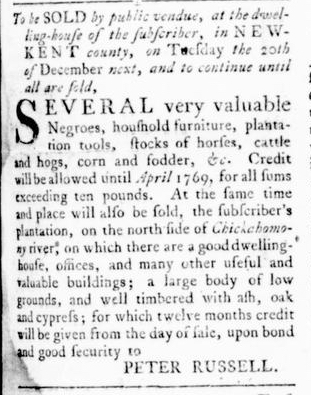
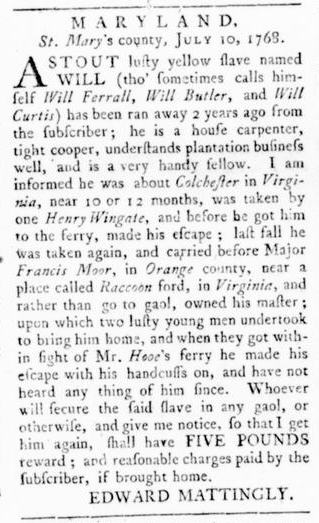
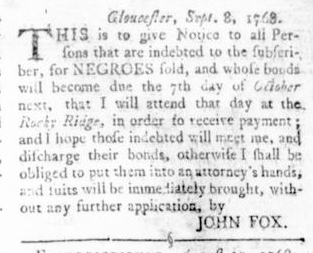
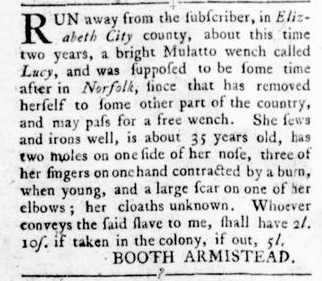
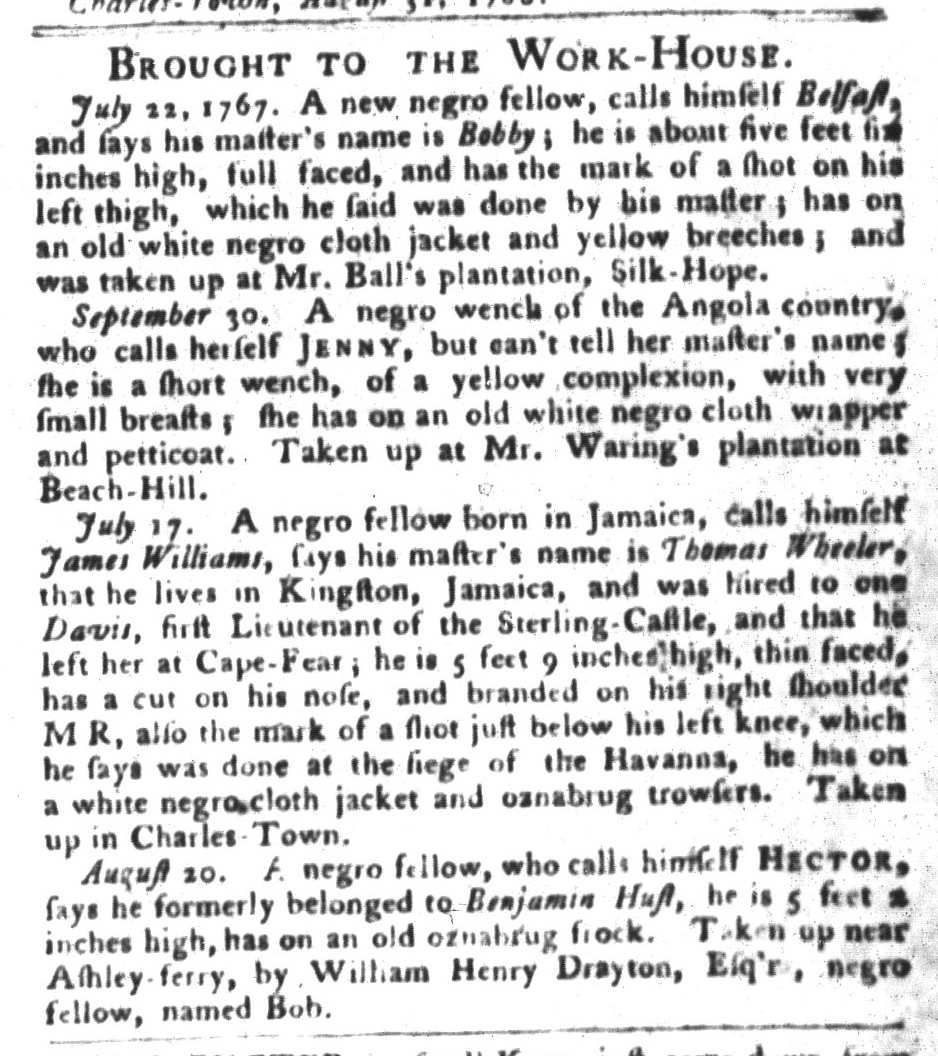
The Slavery Adverts 250 Project chronicles the role of newspaper advertising in perpetuating slavery in the era of the American Revolution. The project seeks to reveal the ubiquity of slavery in eighteenth-century life from New England to Georgia by republishing advertisements for slaves – for sale, wanted to purchase, runaways, captured fugitives – in daily digests on this site as well as in real time via the @SlaveAdverts250 Twitter feed, utilizing twenty-first-century media to stand in for the print media of the eighteenth century.

The project aims to provide modern audiences with a sense of just how often colonists encountered these advertisements in their daily lives. Enslaved men, women, and children appeared in print somewhere in the colonies almost every single day. Those advertisements served as a constant backdrop for social, cultural, economic, and political life in colonial and revolutionary America. Colonists who did not own slaves were still confronted with slavery as well as invited to maintain the system by purchasing slaves or assisting in the capture of runaways. The frequency of these newspaper advertisements suggests just how embedded slavery was in colonial and revolutionary American culture in everyday interactions beyond the printed page.

These advertisements also testify to the experiences of enslaved men, women, and children, though readers must consider that those experiences have been remediated through descriptions offered by slaveholders rather than the slaves themselves. Often unnamed in the advertisements, enslaved men, women, and children were not invisible or unimportant in early America.

These advertisements appeared in colonial American newspapers 250 years ago today.

Sep 23 - South-Carolina and American General Gazette Slavery 1
South-Carolina and American General Gazette (September 23, 1768).

**********

Sep 23 - South-Carolina and American General Gazette Slavery 2
South-Carolina and American General Gazette (September 23, 1768).

**********

Sep 23 - South-Carolina and American General Gazette Slavery 3
South-Carolina and American General Gazette (September 23, 1768).

**********

Sep 23 - South-Carolina and American General Gazette Slavery 4
South-Carolina and American General Gazette (September 23, 1768).

September 22

What was advertised in a colonial American newspaper 250 years ago today?

Sep 22 - 9:22:1768 Pennsylvania Gazette
Pennsylvania Gazette (September 22, 1768).

“All the branches of the American stocking manufacture.”

On the first day of fall in 1768 Thomas Bond, Jr., took to the pages of the Pennsylvania Gazette to promote the “STOCKING MANUFACTORY” he operated “at his house in Second-street.” He informed prospective customers that he “carries on all the branches of the American stocking manufacture.” In that regard, his advertisement differed from most others for consumer goods that appeared in the September 22 issue. Many advertisers sought to entice readers to purchase their imported wares, including several whose notices appeared in the same column. Williams and Elridge, for instance, advertised that they stocked “A NEAT and general Assortment of DRY GOODS” imported from London. Jonathan Browne, William and Andrew Caldwell, Maise and Miller, and Randle Mitchell similarly noted that they received their extensive inventories via ships from London and other English ports. Most of those advertisements occupied only half as much space as Bond’s notice.

To compete with merchants and shopkeepers who stocked so many imported goods, Bond purchased additional space in the advertising pages of the Pennsylvania Gazette to convince prospective customers that he offered a selection of stockings and caps that rivaled what they would find in other shops. Bond had “now on hand, a quantity of excellent worsted, cotton, thread, milled yarn, and milled worsted stockings, of various colours and sizes.” In their advertisements, retailers often underscored that they offered a vast array of merchandise to their customers. Appeals to consumer choice became one of the most popular marketing strategies in eighteenth-century newspaper advertisements. Bond applied that strategy to his own “domestic manufactures” as he attempted to carve out his own spot in the local market. Although he did not carry the same “LARGE assortment of Goods” as other retailers, he did offer ample choices among the items that were his specialty. In advancing this claim, he encouraged colonists to conceive of the products of “the American stocking manufacture” as just as appealing as those that came from distant ports in England. He did not belabor the point, perhaps believing that current discourse in newspapers and in the streets already primed prospective customers to think about the advantages of purchasing goods produced in the colonies.

Slavery Advertisements Published September 22, 1768

The Slavery Adverts 250 Project chronicles the role of newspaper advertising in perpetuating slavery in the era of the American Revolution. The project seeks to reveal the ubiquity of slavery in eighteenth-century life from New England to Georgia by republishing advertisements for slaves – for sale, wanted to purchase, runaways, captured fugitives – in daily digests on this site as well as in real time via the @SlaveAdverts250 Twitter feed, utilizing twenty-first-century media to stand in for the print media of the eighteenth century.

The project aims to provide modern audiences with a sense of just how often colonists encountered these advertisements in their daily lives. Enslaved men, women, and children appeared in print somewhere in the colonies almost every single day. Those advertisements served as a constant backdrop for social, cultural, economic, and political life in colonial and revolutionary America. Colonists who did not own slaves were still confronted with slavery as well as invited to maintain the system by purchasing slaves or assisting in the capture of runaways. The frequency of these newspaper advertisements suggests just how embedded slavery was in colonial and revolutionary American culture in everyday interactions beyond the printed page.

These advertisements also testify to the experiences of enslaved men, women, and children, though readers must consider that those experiences have been remediated through descriptions offered by slaveholders rather than the slaves themselves. Often unnamed in the advertisements, enslaved men, women, and children were not invisible or unimportant in early America.

These advertisements appeared in colonial American newspapers 250 years ago today.

Sep 22 - New-York Journal Slavery 1
New-York Journal (September 22, 1768).

**********

Sep 22 - New-York Journal Slavery 2
New-York Journal (September 22, 1768).

**********

Sep 22 - Pennsylvania Gazette Postscript Slavery 1
Postscript to the Pennsylvania Gazette (September 22, 1768).

**********

Sep 22 - Pennsylvania Gazette Slavery 1
Pennsylvania Gazette (September 22, 1768).

**********

Sep 22 - Pennsylvania Gazette Slavery 2
Pennsylvania Gazette (September 22, 1768).

**********

Sep 22 - Pennsylvania Gazette Slavery 3
Pennsylvania Gazette (September 22, 1768).

**********

Sep 22 - Pennsylvania Gazette Supplement Slavery 1
Supplement to the Pennsylvania Gazette (September 22, 1768).

**********

Sep 22 - Virginia Gazette Purdie and Dixon Slavery 1
Virginia Gazette [Purdie & Dixon] (September 22, 1768).

**********

Sep 22 - Virginia Gazette Purdie and Dixon Slavery 2
Virginia Gazette [Purdie & Dixon] (September 22, 1768).

**********

Sep 22 - Virginia Gazette Purdie and Dixon Slavery 3
Virginia Gazette [Purdie & Dixon] (September 22, 1768).

**********

Sep 22 - Virginia Gazette Purdie and Dixon Slavery 4
Virginia Gazette [Purdie & Dixon] (September 22, 1768).

**********

Sep 22 - Virginia Gazette Purdie and Dixon Slavery 5
Virginia Gazette [Purdie & Dixon] (September 22, 1768).

**********

Sep 22 - Virginia Gazette Purdie and Dixon Slavery 6
Virginia Gazette [Purdie & Dixon] (September 22, 1768).

**********

Sep 22 - Virginia Gazette Purdie and Dixon Slavery 7
Virginia Gazette [Purdie & Dixon] (September 22, 1768).

**********

Sep 22 - Virginia Gazette Purdie and Dixon Slavery 8
Virginia Gazette [Purdie & Dixon] (September 22, 1768).

**********

Sep 22 - Virginia Gazette Purdie and Dixon Slavery 9
Virginia Gazette [Purdie & Dixon] (September 22, 1768).

**********

Sep 22 - Virginia Gazette Purdie and Dixon Slavery 10
Virginia Gazette [Purdie & Dixon] (September 22, 1768).

**********

Sep 22 - Virginia Gazette Purdie and Dixon Slavery 11
Virginia Gazette [Purdie & Dixon] (September 22, 1768).

**********

Sep 22 - Virginia Gazette Rind Slavery 1
Virginia Gazette [Rind] (September 22, 1768).

**********

Sep 22 - Virginia Gazette Rind Slavery 2
Virginia Gazette [Rind] (September 22, 1768).

**********

Sep 22 - Virginia Gazette Rind Slavery 3
Virginia Gazette [Rind] (September 22, 1768).

**********

Sep 22 - Virginia Gazette Rind Slavery 4
Virginia Gazette [Rind] (September 22, 1768).

**********

Sep 22 - Virginia Gazette Rind Slavery 5
Virginia Gazette [Rind] (September 22, 1768).

**********

Sep 22 - Virginia Gazette Rind Slavery 6
Virginia Gazette [Rind] (September 22, 1768).

**********

Sep 22 - Virginia Gazette Rind Slavery 7
Virginia Gazette [Rind] (September 22, 1768).

**********

Sep 22 - Virginia Gazette Rind Slavery 8
Virginia Gazette [Rind] (September 22, 1768).

**********

Sep 22 - Virginia Gazette Rind Slavery 9
Virginia Gazette [Rind] (September 22, 1768).

**********

Sep 22 - Virginia Gazette Rind Slavery 10
Virginia Gazette [Rind] (September 22, 1768).

**********

Sep 22 - Virginia Gazette Rind Slavery 11
Virginia Gazette [Rind] (September 22, 1768).

**********

Sep 22 - Virginia Gazette Rind Slavery 12
Virginia Gazette [Rind] (September 22, 1768).

**********

Sep 22 - Virginia Gazette Rind Slavery 13
Virginia Gazette [Rind] (September 22, 1768).

**********

Sep 22 - Virginia Gazette Rind Slavery 14
Virginia Gazette [Rind] (September 22, 1768).

**********

Sep 22 - Virginia Gazette Rind Slavery 15
Virginia Gazette [Rind] (September 22, 1768).

September 21

What was advertised in a colonial American newspaper 250 years ago today?

Sep 21 - 9:21:1768 Georgia Gazette
Georgia Gazette (September 21, 1768).

“Whoever is inclinable to purchase the said sloop may treat with Mrs. Germain at her house in Savannah.”

The September 21, 1768, edition of the Georgia Gazette included several estate notices. The executors of Robert Adams’s estate informed readers about the sale of “ALL THE HOUSEHOLD GOODS” scheduled to take place at the end of October. Similarly, the executors of James Love’s estate announced an auction of “A LARGE QUANTITY of MAHOGANY, RED BAY, and WALNUT PLANK, an ASSORTMENT of CABINET-MAKERS and JOINERS TOOLS, and SOME HOUSEHOLD FURNITURE” to be held in early November at the shop he formerly occupied. Another estate notice described a “SLOOP called the BUTTERFLY, lately the property of Mr. Michael Germain, deceased.”

Each of these estate notices identified a female executor. “ANN ADAMS, Administratrix,” was presumably the widow of Robert Adams, given that the notice advised that the sale would take place “at the house of Mrs. Adams in Savannah.” The notice concerning the Butterfly did not formally specify that Michael Germain’s widow was an executor, but it did advise that “Whoever is inclinable to purchase the said sloop may treat with Mrs. Germain at her house in Savannah.” The notice concerning James Love’s estate does not reveal the relationship connecting “ELIZABETH WHITEFILED, Executrix,” and the deceased cabinetmaker, but she may have been a daughter or sister. In each instance, a woman assumed important legal and financial responsibilities and turned to the public prints to carry them out.

Yet they did not do so alone. “ANN ADAMS, Administratrix,” fulfilled her duties in coordination with “JAMES HERIOT, Administrator.” “ELIZABETH WHITEFIELD, Executrix,” worked with “PETER BLYTH, Executor” to settle Love’s estate. Mrs. Germain had a male counterpart as well. Those interested in purchasing the Butterfly had the option of negotiating “with Hugh Ross” instead of the widow. None of these advertisements reveal the division of labor undertaken by the executors, but they do demonstrate that colonial women were not excluded from these important duties. Their male counterparts may have provided oversight, but wives and other female relations likely possessed more knowledge about family finances and the commercial activities of deceased men than just about anybody else. Even when adult sons or former business partners also served as executors, women made invaluable contributions in the process of settling estates.

Slavery Advertisements Published September 21, 1768

The Slavery Adverts 250 Project chronicles the role of newspaper advertising in perpetuating slavery in the era of the American Revolution. The project seeks to reveal the ubiquity of slavery in eighteenth-century life from New England to Georgia by republishing advertisements for slaves – for sale, wanted to purchase, runaways, captured fugitives – in daily digests on this site as well as in real time via the @SlaveAdverts250 Twitter feed, utilizing twenty-first-century media to stand in for the print media of the eighteenth century.

The project aims to provide modern audiences with a sense of just how often colonists encountered these advertisements in their daily lives. Enslaved men, women, and children appeared in print somewhere in the colonies almost every single day. Those advertisements served as a constant backdrop for social, cultural, economic, and political life in colonial and revolutionary America. Colonists who did not own slaves were still confronted with slavery as well as invited to maintain the system by purchasing slaves or assisting in the capture of runaways. The frequency of these newspaper advertisements suggests just how embedded slavery was in colonial and revolutionary American culture in everyday interactions beyond the printed page.

These advertisements also testify to the experiences of enslaved men, women, and children, though readers must consider that those experiences have been remediated through descriptions offered by slaveholders rather than the slaves themselves. Often unnamed in the advertisements, enslaved men, women, and children were not invisible or unimportant in early America.

These advertisements appeared in colonial American newspapers 250 years ago today.

Sep 21 - Georgia Gazette Slavery 1
Georgia Gazette (September 21, 1768).

**********

Sep 21 - Georgia Gazette Slavery 2
Georgia Gazette (September 21, 1768).

**********

Sep 21 - Georgia Gazette Slavery 3
Georgia Gazette (September 21, 1768).

**********

Sep 21 - Georgia Gazette Slavery 4
Georgia Gazette (September 21, 1768).

**********

Sep 21 - Georgia Gazette Slavery 5
Georgia Gazette (September 21, 1768).

**********

Sep 21 - Georgia Gazette Slavery 6
Georgia Gazette (September 21, 1768).

**********

Sep 21 - Georgia Gazette Slavery 7
Georgia Gazette (September 21, 1768).

**********

Sep 21 - Georgia Gazette Slavery 8
Georgia Gazette (September 21, 1768).

September 20

What was advertised in a colonial American newspaper 250 years ago today?

Sep 20 - 9:20:1768 Essex Gazette
Essex Gazette (September 20, 1768).

TO BE SOLD … A Likely, strong, and remarkably healthy Negro Girl.”

The Essex Gazette commenced publication in Salem, Massachusetts, on August 2, 1768. The colophon at the bottom of the final page advised readers that it was “Printed by SAMUEL HALL, at his Printing-Office a few Doors above the Town-House; where SUBSCRIPTIONS, (at Six Shillings and Eight Pence per Annum) ADVERTISEMENTS, &c. are received for this Paper.” The first issue included half a dozen advertisements that Hall apparently solicited in advance of publication. Hall certainly included those advertisers in the message he addressed “To the PUBLICK” in the inaugural issue. He “return[ed] my sincere Thanks to every Gentleman, who has, in any Manner, patronized and encouraged my Undertaking.” Those first advertisers included an apothecary, a tailor, a shopkeeper, and a tavernkeeper. Each offered consumer goods and services to the residents of Salem and its environs.

Readers were accustomed to seeing those sorts of advertisements in the several newspapers published in nearby Boston as well as other newspapers that circulated in New England. They were also accustomed to seeing other sorts of paid notices, those that offered enslaved men, women, and children for sale or announced rewards for the capture and return of runaways slaves. It did not take long for advertisements for people reduced to commodities to find their way into the Essex Gazette. In issue “NUMB. 8,” only seven weeks after Hall distributed the first issue of the Essex Gazette, the first advertisement mentioning a slave appeared in the new publication, one of only six paid notices in that issue. In it, James Lee announced that he sought to sell a “Likely, strong, and remarkably healthy Negro Girl, between 11 and 12 Years of Age.” She would make a good domestic servant, already being “well acquainted with the Business of a Family” and knowing how to knit, spin, and sew.

Practically from the start of this new endeavor printer Samuel Hall was enmeshed in the business of human bondage. The success and continued publication of the Essex Gazette depended on those who “patronized and encouraged” the venture, including those who placed advertisements that generated revenue that sustained the newspaper. Even as the news items printed elsewhere in the Essex Gazette addressed questions concerning the “invaluable Rights and Privileges, civil and religious” of the colonists, advertisements contributed to the perpetuation of slavery in Massachusetts during the era of the American Revolution.

Slavery Advertisements Published September 20, 1768

The Slavery Adverts 250 Project chronicles the role of newspaper advertising in perpetuating slavery in the era of the American Revolution. The project seeks to reveal the ubiquity of slavery in eighteenth-century life from New England to Georgia by republishing advertisements for slaves – for sale, wanted to purchase, runaways, captured fugitives – in daily digests on this site as well as in real time via the @SlaveAdverts250 Twitter feed, utilizing twenty-first-century media to stand in for the print media of the eighteenth century.

The project aims to provide modern audiences with a sense of just how often colonists encountered these advertisements in their daily lives. Enslaved men, women, and children appeared in print somewhere in the colonies almost every single day. Those advertisements served as a constant backdrop for social, cultural, economic, and political life in colonial and revolutionary America. Colonists who did not own slaves were still confronted with slavery as well as invited to maintain the system by purchasing slaves or assisting in the capture of runaways. The frequency of these newspaper advertisements suggests just how embedded slavery was in colonial and revolutionary American culture in everyday interactions beyond the printed page.

These advertisements also testify to the experiences of enslaved men, women, and children, though readers must consider that those experiences have been remediated through descriptions offered by slaveholders rather than the slaves themselves. Often unnamed in the advertisements, enslaved men, women, and children were not invisible or unimportant in early America.

These advertisements appeared in colonial American newspapers 250 years ago today.

Sep 20 - Essex Gazette Slavery 1
Essex Gazette (September 20, 1768).

**********

Sep 20 - South-Carolina Gazette and Country Journal Slavery 1
South-Carolina Gazette and Country Journal (September 20, 1768).

**********

Sep 20 - South-Carolina Gazette and Country Journal Slavery 2
South-Carolina Gazette and Country Journal (September 20, 1768).

**********

Sep 20 - South-Carolina Gazette and Country Journal Slavery 3
South-Carolina Gazette and Country Journal (September 20, 1768).

**********

Sep 20 - South-Carolina Gazette and Country Journal Slavery 4
South-Carolina Gazette and Country Journal (September 20, 1768).

**********

Sep 20 - South-Carolina Gazette and Country Journal Slavery 5
South-Carolina Gazette and Country Journal (September 20, 1768).