January 25

What was advertised in a colonial American newspaper 250 years ago today?

Georgia Gazette (January 25, 1769).

“[NO. 278.]”

Unlike some of its counterparts in other colonies, the Georgia Gazette rarely distributed a supplement with the standard issue in the late 1760s. Occasionally, however, residents of Savannah and its environs submitted sufficient advertisements to James Johnston “at the Printing-Office in Broughton-Street” to merit a truncated supplement, such as the one that accompanied the January 25 edition. That issue did not contain any more news than usual; paid notices accounted for all of the additional space. In other words, Johnston did not fill the standard issue with news, making it necessary to create an advertising supplement. The supplement happened to consist entirely of advertising, but paid notices in the standard issue filled the usual proportion of space.

The truncated supplement consisted of a single page. Most supplements for other newspapers were two pages, half of a broadsheet printed on both sides, though sometimes an entire broadsheet doubled the size of the issue from four to eight pages. Johnston, however, either did not have enough content or sufficient time to expand the supplement to a second page, leaving the reverse side blank. This truncated supplement differed from other supplements in another significant way. Johnston so rarely issued supplements that he did not have a masthead to identify the additional half sheet delivered with the standard issue. Rather than Supplement to the Georgia Gazette running across the top, a single line at the end of the final column said “[NO. 278.]” The January 25 edition was issue number 278, according to the masthead, so this brief notation would have aided in matching the loose sheet with the standard issue.

Johnston sometimes had to deploy especially generous spacing in the advertisements, incorporating significant white space compared to the dense text in other newspapers, to fill the four pages of a standard issue of the Georgia Gazette. That was certainly not the case for the January 25 edition, one of those rare occasions when he had so much content, especially paid notices, that he devised a truncated supplement in order to fulfill his commitments to his advertisers. In the process, he did not sacrifice news items. He could have made room in the standard issue by reducing the amount of space devoted to news, but he instead opted to give readers a substantial amount of both types of content, as they had come to expect of the Georgia Gazette.

Slavery Advertisements Published January 25, 1769

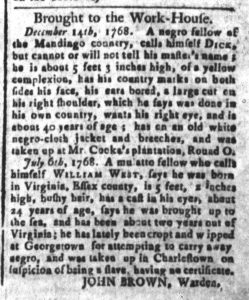
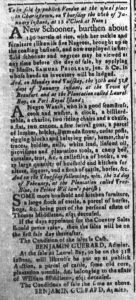
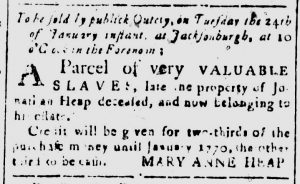
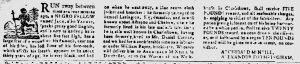
The Slavery Adverts 250 Project chronicles the role of newspaper advertising in perpetuating slavery in the era of the American Revolution. The project seeks to reveal the ubiquity of slavery in eighteenth-century life from New England to Georgia by republishing advertisements for slaves – for sale, wanted to purchase, runaways, captured fugitives – in daily digests on this site as well as in real time via the @SlaveAdverts250 Twitter feed, utilizing twenty-first-century media to stand in for the print media of the eighteenth century.

The project aims to provide modern audiences with a sense of just how often colonists encountered these advertisements in their daily lives. Enslaved men, women, and children appeared in print somewhere in the colonies almost every single day. Those advertisements served as a constant backdrop for social, cultural, economic, and political life in colonial and revolutionary America. Colonists who did not own slaves were still confronted with slavery as well as invited to maintain the system by purchasing slaves or assisting in the capture of runaways. The frequency of these newspaper advertisements suggests just how embedded slavery was in colonial and revolutionary American culture in everyday interactions beyond the printed page.

These advertisements also testify to the experiences of enslaved men, women, and children, though readers must consider that those experiences have been remediated through descriptions offered by slaveholders rather than the slaves themselves. Often unnamed in the advertisements, enslaved men, women, and children were not invisible or unimportant in early America.

These advertisements appeared in colonial American newspapers 250 years ago today.

Georgia Gazette (January 25, 1769).

**********

Georgia Gazette (January 25, 1769).

**********

Georgia Gazette (January 25, 1769).

**********

Georgia Gazette (January 25, 1769).

**********

Georgia Gazette (January 25, 1769).

**********

Georgia Gazette (January 25, 1769).

**********

Georgia Gazette (January 25, 1769).

**********

Georgia Gazette (January 25, 1769).

**********

Georgia Gazette (January 25, 1769).

**********

Georgia Gazette (January 25, 1769).

**********

Georgia Gazette (January 25, 1769).

January 24

What was advertised in a colonial American newspaper 250 years ago today?

Wochentliche Pennsylvanische Staatsbote (January 24, 1769).

All ADVERTISEMENTS to be inserted in this Paper … are by him translated gratis.”

The Adverts 250 Project does not often feature advertisements placed in the Wochentliche Pennsylvania Staatsbote, not because they were any less prevalent in that newspaper than others but because I do not possess sufficient German language skills to incorporate that publication into the larger project. As a result, the overall project is indeed truncated because it rarely includes advertisements that ran in the newspaper published by Henry Miller (Johann Heinrich Müller) in Germantown, just outside of Philadelphia.

Miller sought to serve residents of the busy urban port and the surrounding region, whether or not they happened to speak or read German. He published the Wochentliche Pennsylvania Staatsbote almost entirely in German, with the exception of the final line of the masthead: “ALL ADVERTISEMENTS to be inserted in this Paper, or printed single by HENRY MILLER, publisher hereof, are by him translated gratis.” Miller made it possible for English-speaking merchants, shopkeepers, and artisans to promote consumer goods and services to their German-speaking neighbors, as well as others to publish paid notices that covered a range of purposes, from legal notices to advertisements about stray livestock. In addition to inserting their notices into the Wochentliche Pennsylvania Staatsbote, they could also have them “printed single” as broadsides, handbills, trade cards, billheads, or other ephemera that came off printing presses in eighteenth-century America. To better encourage prospective advertisers to take advantage of this opportunity, Miller did not charge for an important part of the service. He did all of the translations for free.

This presents a new trajectory that scholars of advertising in early America could examine: how many advertisers that placed notices in the Pennsylvania Chronicle, the Pennsylvania Gazette, and the Pennsylvania Journal inserted the same notices in the Wochentliche Pennsylvania Staatsbote? Were any types of notices most likely to appear in both English and German newspapers? For instance, did legal notices run in both English and German newspapers more frequently than advertisements for consumer goods and services? One of the pleasures of working on the Adverts 250 Project is that it often just as many new questions as existing questions that it answers.

January 23

What was advertised in a colonial American newspaper 250 years ago today?

Boston-Gazette (January 23, 1769).

“John Nazro, At his Shop in Cornhill, BOSTON.”

To increase the chances that prospective customers would see his advertisement for a “Fresh Assortment of English and India GOODS,” John Nazro inserted it in more than one newspaper during the week of January 23, 1769. His options included the Boston Chronicle, the Boston Evening-Post, the Boston-Gazette, the Boston Post-Boy (co-published with Green and Russell’s Massachusetts Gazette) and the Boston Weekly News-Letter (co-published with Draper’s Massachusetts Gazette). Occasionally advertisers sought to maximize the exposure for their advertisements by placing them in all or nearly all of the newspapers printed in Boston in the late 1760s, but Nazro was more modest in his approach. He selected only two, the Boston-Gazette and the Boston Post-Boy.

Finances may have played a role in his decision. Once he determined to limit the number of publications he likely took into account his impression of the circulation of each newspaper as well as the day of the week they were published. The Evening-Post, the Gazette, and the Post-Boy were all published on Mondays. The Weekly News-Letter was published on Thursdays. Earlier the month the Chronicle had moved to semi-weekly publication, expanding from Mondays to both Mondays and Thursdays. Nazro did not spread his advertisements throughout the week by choosing one newspaper published on Monday and another on Thursday. Perhaps he considered Monday the best day to introduce consumers to his merchandise. Alternately, he may have considered the circulation of the Gazette and the Post-Boy so superior to any of the newspapers published on Thursday that he would receive a better return on his investment by advertising in them.

Due to the culture of reprinting in eighteenth-century America, many newspapers often featured the same content when it came to news items. For instance, on January 23, the Evening-Post, the Gazette, and Green and Russell’s Massachusetts Gazette (co-published with the Post-Boy) all included “The Humble Address of the Right Honourable the Lords Spiritual and Temporal, in Parliament assembled” from November 8, 1768, as well as “The Humble ADDRESS of the HOUSE of COMMONS to the KING.” By then, those items had already appeared in the January 19 edition of Draper’s Massachusetts Gazette (co-published with the Weekly News-Letter). Only the Chronicle did not run them.

As these news items and Nazro’s advertisement demonstrate, colonial readers often encountered the same content in multiple newspapers, though for different reasons. Printers reproduced news items that appeared in other newspapers or arrived by ship, but advertisers paid to have their notices populate the pages of colonial newspapers.

Slavery Advertisements Published January 23, 1769

The Slavery Adverts 250 Project chronicles the role of newspaper advertising in perpetuating slavery in the era of the American Revolution. The project seeks to reveal the ubiquity of slavery in eighteenth-century life from New England to Georgia by republishing advertisements for slaves – for sale, wanted to purchase, runaways, captured fugitives – in daily digests on this site as well as in real time via the @SlaveAdverts250 Twitter feed, utilizing twenty-first-century media to stand in for the print media of the eighteenth century.

The project aims to provide modern audiences with a sense of just how often colonists encountered these advertisements in their daily lives. Enslaved men, women, and children appeared in print somewhere in the colonies almost every single day. Those advertisements served as a constant backdrop for social, cultural, economic, and political life in colonial and revolutionary America. Colonists who did not own slaves were still confronted with slavery as well as invited to maintain the system by purchasing slaves or assisting in the capture of runaways. The frequency of these newspaper advertisements suggests just how embedded slavery was in colonial and revolutionary American culture in everyday interactions beyond the printed page.

These advertisements also testify to the experiences of enslaved men, women, and children, though readers must consider that those experiences have been remediated through descriptions offered by slaveholders rather than the slaves themselves. Often unnamed in the advertisements, enslaved men, women, and children were not invisible or unimportant in early America.

These advertisements appeared in colonial American newspapers 250 years ago today.

New-York Gazette and Weekly Mercury (January 23, 1769).

**********

New-York Gazette and Weekly Mercury (January 23, 1769).

**********

Newport Mercury (January 23, 1769).

**********

New-York Gazette: Or, the Weekly Post-Boy (January 23, 1769).

**********

New-York Gazette: Or, the Weekly Post-Boy (January 23, 1769).

**********

South-Carolina and American General Gazette (January 23, 1769).

**********

South-Carolina and American General Gazette (January 23, 1769).

**********

South-Carolina and American General Gazette (January 23, 1769).

**********

South-Carolina and American General Gazette (January 23, 1769).

**********

South-Carolina and American General Gazette (January 23, 1769).

**********

South-Carolina and American General Gazette (January 23, 1769).

**********

South-Carolina and American General Gazette (January 23, 1769).

**********

South-Carolina and American General Gazette (January 23, 1769).

**********

South-Carolina and American General Gazette (January 23, 1769).

**********

South-Carolina and American General Gazette (January 23, 1769).

**********

South-Carolina and American General Gazette (January 23, 1769).

**********

South-Carolina and American General Gazette (January 23, 1769).

January 22

What was advertised in a colonial American newspaper 250 years ago this week?

Massachusetts Gazette (January 19, 1769).

“At his House next Door to the Sign of the Three Kings in Cornhill.”

When Benjamin Adams placed an advertisement in Draper’s Massachusetts Gazette to announce that “he intends to open a Public Vendue” or auction at his house, he included a landmark to help readers find the location. They could find his house “next Door to the Sign of the Three Kings in Cornhill.” That sign was one of many that helped colonial Bostonians find businesses and navigate the streets of the urban port. Similar shop signs were a familiar sight in other colonial towns and cities.

Today students in my introductory early American history class at Assumption College begin a project that seeks to identify all the shop signs listed in newspapers printed in Boston in 1769 and, eventually, locate them in relation to others on a map from the period. Although this will be an incomplete roster of the shop signs in the city 250 years ago, it will help to create a sense of an important visual aspect of a bustling urban port on the eve of the American Revolution.

We begin the project with a history lab. Instead of a lecture or discussion about assigned readings, today we will devote our time in class to a workshop that introduces students to Readex’s America’s Historical Newspapers database. Once students have learned how to use that resource, they will work in teams to download digital copies of newspapers printed in Boston in 1769. Each team will be responsible for one newspaper. After they have acquired their newspapers, students will read through the advertisements (and, hopefully, pause to investigate some of the other content) as they search for shop signs. Each team will draw up a roster of shop signs they encounter. Later in the semester, we will plot the signs on a map from the period. I have enrolled in an introductory Geographic Information Systems class in hopes of producing a digital map based on this work.

This is very much an experiment. It may work extremely well, but it has the potential to be quite challenging, especially if we do not encounter a critical mass of shop signs in advertisements from 1769. Even if that is the case, students will enhance their research skills and information literacy. They will also learn an important lesson that historians are often confined by the sources available to us. This project is as much about the process of doing history as it is learning about the past.

January 21

What was advertised in a colonial American newspaper 250 years ago today?

Providence Gazette (January 21, 1769).

“RUN away from his Master … a well-set Negro Manm Slave, named Isaac.”

By the time the January 21, 1769, edition of the Providence Gazette was published, Samuel Rose had been placing an advertisement offering a reward for “a well-set Negro Man Slave, named Isaac,” who had run away in late November of the previous year for an entire month. Isaac had “a Scar on his Forehead” and a “thick Beard.” According to Rose, the enslaved man could “play on a Fiddle, and loves strong Drink,” though savvy readers likely realized that many slaveholder exaggerated when it came to that latter detail. Rose also warned “Masters of Vessels, and others” against providing assistance, whether “carrying off or harbouring” Isaac.

The tone of this advertisement advanced starkly different rhetoric than other items published on the same page and elsewhere throughout the issue. John Carter’s advertisement for “A NEW EDITION” of Abraham Weatherwise’s “New-England TOWN and COUNTRY Almanack” filled the entire column immediately to the right. The notable contents of the almanac promoted in the advertisement included “a beautiful poetical Essay on Public Spirit, wrote by an American Patriot” and a Portrait of the celebrated JOHN WILKES, Esq.,” the radical English politician and journalist considered friendly to the American cause during the imperial crisis that led to the Revolution. In the upper left corner of the page, a poem entitled “ADDRESS to LIBERTY” by “AMERICANUS” appeared before any of advertisements. The poem lamented recent encroachments on colonists’ liberty by “tyrant Lords,” but it addressed only the position of white colonists and not enslaved men, women, and children. The poem did not make room for Isaac the justice that was supposed to be extended to English sons who had “cross’d th’atlantic Seas / To Climes unknown.” News filled most of the rest of the issue, including a “humble Address of the House of Commons to the KING.” Parliament stated that it would “be ever ready to hear any real grievance of Your Majesty’s American subjects,” but insisted it was “one of our most important duties, to maintain entire and inviolate the supreme authority of the legislature of Great-Britain, over every part of the British empire.” Colonists considered this enslavement.

Amidst all of this rhetoric circulating in conversations and the public prints, Isaac determined to seize his own liberty. Although Rose did not recognize it, the enslaved man put into action the ideals that so many of his white neighbors espoused in the late 1760s.

Slavery Advertisements Published January 21, 1769

The Slavery Adverts 250 Project chronicles the role of newspaper advertising in perpetuating slavery in the era of the American Revolution. The project seeks to reveal the ubiquity of slavery in eighteenth-century life from New England to Georgia by republishing advertisements for slaves – for sale, wanted to purchase, runaways, captured fugitives – in daily digests on this site as well as in real time via the @SlaveAdverts250 Twitter feed, utilizing twenty-first-century media to stand in for the print media of the eighteenth century.

The project aims to provide modern audiences with a sense of just how often colonists encountered these advertisements in their daily lives. Enslaved men, women, and children appeared in print somewhere in the colonies almost every single day. Those advertisements served as a constant backdrop for social, cultural, economic, and political life in colonial and revolutionary America. Colonists who did not own slaves were still confronted with slavery as well as invited to maintain the system by purchasing slaves or assisting in the capture of runaways. The frequency of these newspaper advertisements suggests just how embedded slavery was in colonial and revolutionary American culture in everyday interactions beyond the printed page.

These advertisements also testify to the experiences of enslaved men, women, and children, though readers must consider that those experiences have been remediated through descriptions offered by slaveholders rather than the slaves themselves. Often unnamed in the advertisements, enslaved men, women, and children were not invisible or unimportant in early America.

These advertisements appeared in colonial American newspapers 250 years ago today.

Providence Gazette (January 21, 1769).

January 20

What was advertised in a colonial American newspaper 250 years ago today?

Connecticut Journal (January 20, 1769).

“He has an Assortment of GOODS on Hand.”

Although advertisements often appeared on the final pages of eighteenth-century newspapers, that was not always the case. Printers and compositors experimented with the placement of news, paid notices, and other content. Consider, for example, the January 20, 1769, edition of the Connecticut Journal and New-Haven Post-Boy. The front page featured both advertising and news. Immediately below the masthead, Michael Todd’s notice calling on former customers to settle accounts and advising prospective customers that he had “an Assortment of GOODS on Hand, as usual,” was the first item readers encountered. Two more advertisements ran in the same column above news from Boston. News from London comprised the remainder of the page. An editorial concerning the local “Manufacturing of Linen” to “put a Stop to the Importation of British Cloth,” submitted by pseudonymous “JONATHAN HOMESPUN,” comprised most of the second page. Other editorial items filled the third page. News from Philadelphia and New York, as well as the shipping news from New Haven, appeared on the final page, along with two more advertisements. Readers who perused that issue of the Connecticut Journal from first page to last began and ended with advertisements, but that was not always the case.

Usually printers Thomas Green and Samuel Green or a compositor who worked for them positioned the paid notices after the other content. Whoever set the type for the January 20 edition experimented with something different. For the standard four-page issue, type for the first and fourth pages, printed on one side of a broadsheet, could be set independently of the second and third pages, printed on the other side. Skilled compositors, for instance, could start a new item in the first column of the second page and end another item in the last column of the third page, allowing them to begin printing one side of the broadsheet before even setting type for the other. The compositor may have made an effort to do so in the January 20 edition of the Connecticut Journal, but was not completely successful. The letter from Jonathan Homespun filled most of the second page. A few lines of another editorial ran at the bottom, overflowing to the third page. A recipe for a home remedy began at the bottom of the third page and concluded on the fourth. The compositor then had sufficient space to insert all of the advertisements on that last page, but opted to place some on the first instead, departing from the usual format for that newspaper. As a result, that issue of the Connecticut Journal replicated the appearance of other newspapers that sometimes ran advertisements on the first page. Colonial printers did not uniformly give precedence to news on the front page and relegate advertising to other places in the newspaper.

Happy Birthday, Isaiah Thomas!

Isaiah Thomas, patriot printer and founder of the American Antiquarian Society, was born on January 19 (New Style) in 1749 (or January 8, 1748/49, Old Style). It’s quite an historical coincidence that the three most significant printers in eighteenth-century America — Benjamin Franklin, Isaiah Thomas, and Mathew Carey — were all born in January.

isaiah_thomas1818
Isaiah Thomas (January 30, 1739 – April 4, 1831). American Antiquarian Society.

The Adverts 250 Project is possible in large part due to Thomas’s efforts to collect as much early American printed material as he could, originally to write his monumental History of Printing in America.  The newspapers, broadsides, books, almanacs, pamphlets, and other items he gathered in the process eventually became the initial collections of the American Antiquarian Society.  That institution’s ongoing mission to acquire at least one copy of every American imprint through 1876 has yielded an impressive collection of eighteenth-century advertising materials, including newspapers, magazine wrappers, trade cards, billheads, watch papers, book catalogs, subscription notices, broadsides, and a variety of other items.  Exploring the history of advertising in early America — indeed, exploring any topic related to the history, culture, and literature of early America at all — has been facilitated for more than two centuries by the vision of Isaiah Thomas and the dedication of the curators and other specialists at the American Antiquarian Society over the years.

Thomas’s connections to early American advertising were not limited to collecting and preserving the items created on American presses during the colonial, Revolutionary, and early national periods.  Like Mathew Carey, he was at the hub of a network he cultivated for distributing newspapers, books, and other printed goods — including advertising to stimulate demand for those items.  Sometimes this advertising was intended for dissemination to the general public (such as book catalogs and subscription notices), but other times it amounted to trade advertising (such as circular letters and exchange catalogs intended only for fellow printers, publishers, and booksellers).

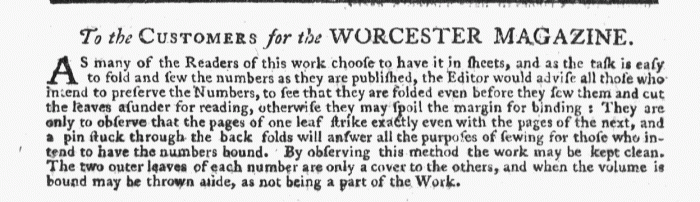
Thomas also experimented with advertising on wrappers that accompanied his Worcester Magazine, though he acknowledged to subscribers that these wrappers were ancillary to the publication:  “The two outer leaves of each number are only a cover to the others, and when the volume is bound may be thrown aside, as not being a part of the Work.”[1]

jan-30-worcerster-magazine-april-1786
Detail of Advertising Wrapper, Worcester Magazine (Second Week of April, 1786).

Thomas’s patriotic commitment to freedom of the press played a significant role in his decision to develop advertising wrappers.  As Thomas relays in his History of Printing in America, he discontinued printing his newspaper, the Massachusetts Spy, after the state legislature passed a law that “laid a duty of two-thirds of a penny on newspapers, and a penny on almanacs, which were to be stamped.”  Such a move met with strong protest since it was too reminiscent of the Stamp Act imposed by the British two decades earlier, prompting the legislature to repeal it before it went into effect.  On its heels, however, “another act was passed, which imposed a duty on all advertisements inserted in the newspapers” printed in Massachusetts.  Thomas vehemently rejected this law as “an improper restraint on the press. He, therefore, discontinued the Spy during the period that this act was in force, which was two years. But he published as a substitute a periodical work, entitled ‘The Worcester Weekly Magazine,’ in octavo.”[2] This weekly magazine lasted for two years; Thomas discontinued it and once again began printing the Spy after the legislature repealed the objectionable act.

jan-30-advertising-wrapper-worcester-magazine-4th-week-may-1786
Third Page of Advertising Wrapper, Worcester Magazine (Fourth Week of May, 1786).

Isaiah Thomas was not interested in advertising for its own sake to the same extent as Mathew Carey, but his political concerns did help to shape the landscape of early American advertising.  Furthermore, his vision for collecting American printed material preserved a variety of advertising media for later generations to admire, analyze, ponder, and enjoy.  Happy 270th birthday, Isaiah Thomas!

**********

[1] Isaiah Thomas, “To the CUSTOMERS for the WORCESTER MAGAZINE,” Worcester Magazine, wrapper, second week of April, 1786.

[2] Isaiah Thomas, The History of Printing in America: With a Biography of Printers, and an Account of Newspapers, vol. 2 (Worcester, MA: Isaac Sturtevant, 1810), 267-268.