December 19

What was advertised in a colonial American newspaper 250 years ago today?

Dec 19 - 12:19:1769 Essex Gazette
Essex Gazette (December 19, 1769).

“To be SOLD, by Priscilla Manning, At her Shop in SALEM.”

Priscilla Manning placed a remarkable advertisement for “her Shop in SALEM” in the December 19, 1769, edition of the Essex Gazette. Compared to newspapers published in nearby Boston and Portsmouth, the Essex Gazette carried relatively few advertisements for consumer goods and services. Those that did appear tended to be short, extending no more than a single “square.” Manning’s advertisement, on the other hand, filled two squares. Other advertisements in the Essex Gazette offered a summary of inventory, such as “An Assortment of English and India GOODS,” but Manning enumerated the choices she made available to customers. She stocked dozens of textiles as well as hose, caps, gloves, shoes, and trimmings to adorn garments.

Manning’s advertisement resembled those that ran in Boston’s newspapers much more than those that tended to appear in the Essex Gazette. In that regard it may have been remarkable in the Essex Gazette, but not when considered in the context of newspaper advertisements published throughout the colonies in the 1760s. Manning adopted familiar methods of marketing her wares in her advertisement, likely having consulted newspapers from Boston and other places in addition to the Essex Gazette. Yet that did not disqualify her advertisement from being remarkable in another aspect. Few female entrepreneurs advertised consumer goods and services, even in the largest and busiest port cities. Although women constituted a significant proportion of shopkeepers in urban ports, they tended not to promote their activities in the marketplace in the public prints. This made Manning’s advertisement twice as bold in the Essex Gazette, bold for its length and bold for publicizing the activities of a female entrepreneur. Manning’s name served as a headline; it appeared in larger font than anything else on the same page or the facing page. At a glance, it made her business the single most visible item in that issue of the Essex Gazette. Although women were underrepresented among advertisements for consumer goods and services in eighteenth-century America, they certainly were not absent. Advertisements like those placed by Priscilla Manning made it impossible to overlook women’s activities in the marketplace as producers, suppliers, merchants, and, especially, retailers, not just as shoppers and consumers.

Update:  This was the first of many advertisements Manning placed over several decades. Donna Seger uses them (and includes images!) as the foundation for a short biography of Priscilla Manning Abbot in “It was Her Shop” on Streets of Salem.

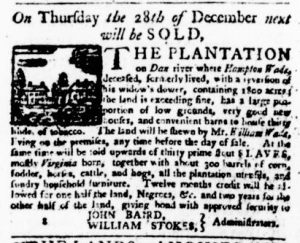
Slavery Advertisements Published December 19, 1769

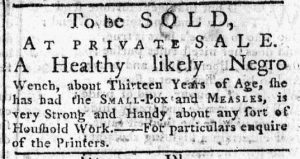
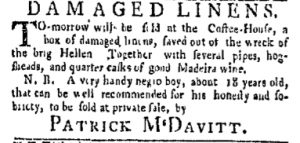
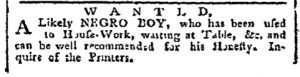
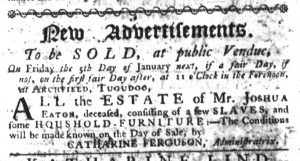
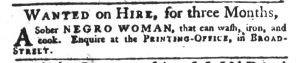
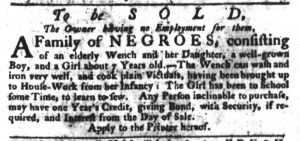
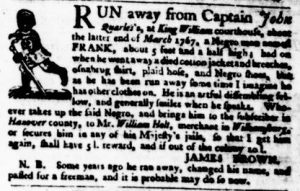
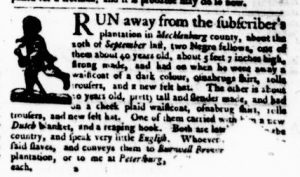
The Slavery Adverts 250 Project chronicles the role of newspaper advertising in perpetuating slavery in the era of the American Revolution. The project seeks to reveal the ubiquity of slavery in eighteenth-century life from New England to Georgia by republishing advertisements for slaves – for sale, wanted to purchase, runaways, captured fugitives – in daily digests on this site as well as in real time via the @SlaveAdverts250 Twitter feed, utilizing twenty-first-century media to stand in for the print media of the eighteenth century.

The project aims to provide modern audiences with a sense of just how often colonists encountered these advertisements in their daily lives. Enslaved men, women, and children appeared in print somewhere in the colonies almost every single day. Those advertisements served as a constant backdrop for social, cultural, economic, and political life in colonial and revolutionary America. Colonists who did not own slaves were still confronted with slavery as well as invited to maintain the system by purchasing slaves or assisting in the capture of runaways. The frequency of these newspaper advertisements suggests just how embedded slavery was in colonial and revolutionary American culture in everyday interactions beyond the printed page.

These advertisements also testify to the experiences of enslaved men, women, and children, though readers must consider that those experiences have been remediated through descriptions offered by slaveholders rather than the slaves themselves. Often unnamed in the advertisements, enslaved men, women, and children were not invisible or unimportant in early America.

These advertisements appeared in colonial American newspapers 250 years ago today.

Dec 19 - Essex Gazette Slavery 1
Essex Gazette (December 19, 1769).

December 18

What was advertised in a colonial American newspaper 250 years ago today?

Dec 18 - 12:18:1769 Boston-Gazette
Boston-Gazette (December 18, 1769).

“Will engage to make any Piece of Work as compleat as can be imported.”

In December 1769, Daniel MacNeill, a “Saddler and Cap-maker from DUBLIN,” turned to the Boston-Gazette to advise residents of Boston and its environs that he operated a shop in King Street. He made and sold a variety of items, including “Neat welted and plain Hunting Saddles,” “Pistol Cases & Holsters,” “Portmanteaus and Saddle Baggs,” and “every Article in the Sadlery Branch.” In addition to offering low prices, he assured prospective customers that he served them “with Fidelity and Dispatch.” He also made appeals to quality and fashion, proclaiming that he constructed these items “in the neatest and genteelest Manner.” MacNeill incorporated many of the most common marketing appeals of the eighteenth century into his advertisement.

As a relative newcomer to the city, MacNeill deployed another strategy that often appeared in newspaper notices placed by artisans who migrated across the Atlantic. He provided an overview of his work history as a means of convincing prospective customers of his competence. MacNeill asserted that he “had the Advantage of many Years Practice in the most principal Shops in Dublin and Towns adjacent.” In so doing, he attempted to transfer the reputation he established in one location to another, asking prospective customers to credit him for his years of experience. Although items he made during that time had not circulated for inspection in Boston, MacNeill hoped that his affiliation with “the most principal Shops” in one of the largest cities in the empire testified to his skill and expertise.

To that end, he pledged that he made saddles and other items “as compleat as can be imported.” Realizing that colonists sometimes had a preference for imported goods with an expectation of higher quality or better craftsmanship, MacNeill promised that his clients did not have to fear that they purchased inferior goods from his workshop. This appeal likely resonated with colonists who adhered to the nonimportation agreements and sought “domestic manufactures,” goods produced in the colonies, as alternatives to those transported across the Atlantic. An article on the first page of the December 18, 1769, edition of the Boston-Gazette proposed bringing artisans and their families to the colonies, suggesting that those migrants were much more welcome than imported goods that Parliament taxed. MacNeill’s advertisement reverberated with political implications, even as he made standard appeals to price, quality, and fashion.

Slavery Advertisements Published December 18, 1769

The Slavery Adverts 250 Project chronicles the role of newspaper advertising in perpetuating slavery in the era of the American Revolution. The project seeks to reveal the ubiquity of slavery in eighteenth-century life from New England to Georgia by republishing advertisements for slaves – for sale, wanted to purchase, runaways, captured fugitives – in daily digests on this site as well as in real time via the @SlaveAdverts250 Twitter feed, utilizing twenty-first-century media to stand in for the print media of the eighteenth century.

The project aims to provide modern audiences with a sense of just how often colonists encountered these advertisements in their daily lives. Enslaved men, women, and children appeared in print somewhere in the colonies almost every single day. Those advertisements served as a constant backdrop for social, cultural, economic, and political life in colonial and revolutionary America. Colonists who did not own slaves were still confronted with slavery as well as invited to maintain the system by purchasing slaves or assisting in the capture of runaways. The frequency of these newspaper advertisements suggests just how embedded slavery was in colonial and revolutionary American culture in everyday interactions beyond the printed page.

These advertisements also testify to the experiences of enslaved men, women, and children, though readers must consider that those experiences have been remediated through descriptions offered by slaveholders rather than the slaves themselves. Often unnamed in the advertisements, enslaved men, women, and children were not invisible or unimportant in early America.

These advertisements appeared in colonial American newspapers 250 years ago today.

Dec 18 - New-York Chronicle Slavery 1
New-York Chronicle (December 18, 1769).

**********

Dec 18 - New-York Gazette and Weekly Mercury Slavery 1
New-York Gazette and Weekly Mercury (December 18, 1769).

**********

Dec 18 - New-York Gazette and Weekly Mercury Slavery 2
New-York Gazette and Weekly Mercury (December 18, 1769).

**********

Dec 18 - New-York Gazette and Weekly Mercury Slavery 3
New-York Gazette and Weekly Mercury (December 18, 1769).

**********

Dec 18 - New-York Gazette and Weekly Mercury Slavery 4
New-York Gazette and Weekly Mercury (December 18, 1769).

**********

Dec 18 - New-York Gazette and Weekly Mercury Slavery 5
New-York Gazette and Weekly Mercury (December 18, 1769).

**********

Dec 18 - Pennsylvania Chronicle Slavery 1
Pennsylvania Chronicle (December 18, 1769).

**********

Dec 18 - Pennsylvania Chronicle Slavery 2
Pennsylvania Chronicle (December 18, 1769).

December 17

What was advertised in a colonial American newspaper 250 years ago this week?

Dec 17 - 12:14:1769 Massachusetts Gazette and Boston Weekly News-Letter
Massachusetts Gazette and Boston Weekly Mercury (December 14, 1769).

“The lowest Price of Lemmons.”


John Crosby’s advertisements were a familiar sight for readers of the Massachusetts Gazette and Boston Weekly News-Letter in 1769. Every week he advised prospective customers that he sold “Fresh Lemmons” and other citrus fruit “at the Sign of the Basket of Lemmons.” Yet he did more than merely invite residents of Boston to purchase his wares. His marketing efforts included listing his prices. While other purveyors of consumer goods and services frequently made appeals to low prices, most rarely advertised specific prices for their wares. Crosby made a point of promising low prices and demonstrating to prospective customers that he did indeed offer bargains. For instance, on December 14, 1769, he advertised lemons for “Two Pistareens per dozen,” stating that was “the lowest I can get them to yet.” In addition, he sold “very fine LIMES at Six Shillings per dozen.”

When it came to his lemons, Crosby set the same price regardless of how many customers purchased, from “large and small Quantities down to the single Dozen.” Some eighteenth-century merchandisers allowed for discounts for buying in volume, but Crosby took the opposite approach. He advised prospective customers that they did not need to buy in bulk to get a good deal. He made his best prices available to all customers, provided that they bought at least a dozen. He reiterated that point in order to underscore it: “any one that buys to the Amount of one Dozen, shall have them as cheap in proportion as tho’ they bought a Box.”

Crosby also provided regular reports on the price of lemons at his shop, his own abbreviated price current restricted to a single commodity. He emphasized that service in his advertisements, noting that there “will be a Weekly Account as usual in this Day’s Paper, of the lowest Price of Lemmons.” In so doing, he made his advertisements a regular feature in the newspaper, a feature that consumers could depend on finding as they perused each new edition. In an era when many advertisers inserted the same notice for three or four weeks and then allowed it to expire without publishing a new advertisement, Crosby constructed an ongoing advertising campaign that required constant maintenance. His advertisements were more than an invitation or appeal to prospective customers; in updating the prices of lemons and other citrus fruit each week, Crosby’s advertisements provided a service to consumers in Boston.

December 16

What was advertised in a colonial American newspaper 250 years ago today?

Dec 16 - 12:16:1769 Providence Gazette
Providence Gazette (December 16, 1769).

“RUN away … an Apprentice Lad.”

In December 1769, David Smith turned to the Providence Gazette when his apprentice, Eliazer Peck, “a Shoemaker by Trade,” departed without his permission. After Peck had been away for a week and Smith determined that he was unlikely to return of his own accord, he placed an advertisement that described the apprentice and offered a reward to anyone who “takes up and secures the said Apprentice, so as his Master may have him again.” Smith also advised that “All masters of Vessels are forbid to carry him off.” He did not want the delinquent apprentice further removing himself from his authority by sailing to another colony or elsewhere in the Atlantic world.

To aid in identifying the apprentice, Smith described both is physical features and the clothes he wore. He asked readers of the Providence Gazette to keep their eyes open for “a short thick-set Lad, round-shouldered, … full-faced.” Readers might also recognize his “brownish Coat, a short double-breasted Jacket, [and] blue knit Breeches.” If he did not acquire different garments, Peck could alter his appearance slightly by changing shirts; he took with him “two striped and one white Shirt.” To further aid in recognizing the apprentice, Smith gave his approximate age, “about 19 Years,” and hinted at his personality, noting he “has a Humour in his Eyes.”

Smith’s advertisement followed the same pattern as so many others that appeared in eighteenth-century newspapers throughout the colonies. That genre of notices described unfree laborers of various sorts: apprentices, indentured servants, convict servants, and enslaved men, women, and children. Such advertisements used the public prints as a mechanism of surveillance, encouraging colonists to closely examine people they encountered to determine if they matched the descriptions published in the most recent newspapers. These advertisements allowed those who already possessed greater authority and resources to exercise even more power by recruiting an entire community to aid them in capturing and returning runaway servants and apprentices and enslaved people who seized their own liberty by escaping from those who held them in bondage.

When they purchased advertising space in newspapers, colonists deployed the power of the press for various purposes. Some promoted the expansion of consumer culture by encouraging readers to acquire goods and services. Others posted legal notices for settling accounts with the estates of deceased colonists. Some offered employment opportunities. A good many utilized newspapers, the most widely circulated form of media of the period, to engage in surveillance of others, appealing to readers to carefully scrutinize their fellow colonists to detect and return runaways.

December 15

What was advertised in a colonial American newspaper 250 years ago today?

“Stript Camblets     |     Knee Garters     |     Brass Ink Pots.”

Dec 15 - 12:15:1769 New-Hampshire Gazette
New-Hampshire Gazette (December 15, 1769).

According to the advertisement he placed in the December 15, 1769, edition of the New-Hampshire Gazette, Jacob Treadwell sold an assortment of goods at his shop in Portsmouth. He carried everything from textiles to tea kettles to “Locks & Latches.” His advertisement listed more than 120 items and promised even more, concluding with “&c. &c. &c.” (the eighteenth-century abbreviation for et cetera). Enumerating his inventory served to demonstrate to prospective customers the extent of the choices Treadwell offered them. He did not have just a couple kinds of fabric in stock. Instead, he listed dozens of options available at his shop. He did not make general assertions about carrying housewares or hardware. Instead, he named an array of goods he sold, prompting consumers to imagine acquiring specific items.

Treadwell’s advertisement served as a catalog of his wares. The advertisement’s format, three neatly organized columns, helped prospective customers navigate that catalog. Publishing an extensive list of merchandise was a common marketing strategy in early America. Most advertisers who adopted that approach lumped their goods together in dense paragraphs of text that made it difficult for readers to distinguish among the multitude of items the advertisement included. Some advertisers, however, experimented with other formats, incorporating graphic design into their marketing efforts. Treadwell advertised the same items as other eighteenth-century retailers, but he made his inventory more accessible with the use of columns and white space.

Doing so liked incurred additional expense since most newspaper printers sold advertising by the amount of space it occupied rather than the number of words. Treadwell’s advertisement extended half a column as a result of its design. Had he opted for the paragraph format instead, the advertisement would have taken up a fraction of the space. Treadwell apparently believed that the potential return on his investment merited the additional expense. In making his advertisement easier for readers to peruse, he augmented the chances that they would become customers.

Slavery Advertisements Published December 15, 1769

The Slavery Adverts 250 Project chronicles the role of newspaper advertising in perpetuating slavery in the era of the American Revolution. The project seeks to reveal the ubiquity of slavery in eighteenth-century life from New England to Georgia by republishing advertisements for slaves – for sale, wanted to purchase, runaways, captured fugitives – in daily digests on this site as well as in real time via the @SlaveAdverts250 Twitter feed, utilizing twenty-first-century media to stand in for the print media of the eighteenth century.

The project aims to provide modern audiences with a sense of just how often colonists encountered these advertisements in their daily lives. Enslaved men, women, and children appeared in print somewhere in the colonies almost every single day. Those advertisements served as a constant backdrop for social, cultural, economic, and political life in colonial and revolutionary America. Colonists who did not own slaves were still confronted with slavery as well as invited to maintain the system by purchasing slaves or assisting in the capture of runaways. The frequency of these newspaper advertisements suggests just how embedded slavery was in colonial and revolutionary American culture in everyday interactions beyond the printed page.

These advertisements also testify to the experiences of enslaved men, women, and children, though readers must consider that those experiences have been remediated through descriptions offered by slaveholders rather than the slaves themselves. Often unnamed in the advertisements, enslaved men, women, and children were not invisible or unimportant in early America.

These advertisements appeared in colonial American newspapers 250 years ago today.

Dec 15 - New-Hampshire Gazette Slavery 1
New-Hampshire Gazette (December 15, 1769).

**********

Dec 15 - New-London Gazette Slavery 1
New-London Gazette (December 15, 1769).

December 14

What was advertised in a colonial American newspaper 250 years ago today?

Dec 14 - 12:14:1769 Virginia Gazette Rind
Virginia Gazette [Rind] (December 14, 1769).
“She has an assistant just arrived from London.”

In the late 1760s, relatively few women in Williamsburg, Virginia, resorted to the public prints to advertise consumer goods and services. Many certainly worked in shops operated by husbands and other male relations, their contributions hidden when it came to marketing. Others ran their own shops but neglected to make themselves more visible to the public by placing newspaper advertisements. They participated in the marketplace without calling attention to themselves, perhaps relying on friends and regular patrons to promote them via word of mouth.

Sarah Pitt, however, joined the ranks of women who did advertise. On December 14, 1769, she placed an advertisement in William Rind’s Virginia Gazette. She did not run the same advertisement in the other newspaper printed in Williamsburg, Alexander Purdie and John Dixon’s Virginia Gazette. Her marketing did not reach as many readers as notices that other advertisers placed in both publications. Still, she informed readers of Rind’s newspaper that she sold an array of textiles, accessories, and other merchandise, most of it intended for women and children.

To maintain and even enlarge her customer base or, as she described it, “a continuance of the Ladies custom,” Pitt also reported that “she has an assistant just arrived from London.” This assistant, presumably a woman, “understands the millinery business.” This allowed Pitt to expand her enterprise by providing a service associated with the goods she sold. She provided one-stop shopping for customers who wished to purchase, for example, “Balladine silk,” “rich black lace,” “white blond thread,” “fine cap wire,” and “shaded flowers” to be made into a hat. Having “just arrived from London,” Pitt’s assistant would have been familiar with the current fashions in the most cosmopolitan city in the empire. With that knowledge, she could recommend other accouterments and combinations of goods to purchase for the purpose of making hats or “mounting fans, and making cardinals and bonnets.”

Sarah Pitt made savvy decisions when she advertised in Rind’s Virginia Gazette. She emphasized consumer choice by listing a vast array of goods available at her shop. She also promoted a service that many other shopkeepers did not provide, noting the contributions her new assistant made to the business.

Slavery Advertisements Published December 14, 1769

The Slavery Adverts 250 Project chronicles the role of newspaper advertising in perpetuating slavery in the era of the American Revolution. The project seeks to reveal the ubiquity of slavery in eighteenth-century life from New England to Georgia by republishing advertisements for slaves – for sale, wanted to purchase, runaways, captured fugitives – in daily digests on this site as well as in real time via the @SlaveAdverts250 Twitter feed, utilizing twenty-first-century media to stand in for the print media of the eighteenth century.

The project aims to provide modern audiences with a sense of just how often colonists encountered these advertisements in their daily lives. Enslaved men, women, and children appeared in print somewhere in the colonies almost every single day. Those advertisements served as a constant backdrop for social, cultural, economic, and political life in colonial and revolutionary America. Colonists who did not own slaves were still confronted with slavery as well as invited to maintain the system by purchasing slaves or assisting in the capture of runaways. The frequency of these newspaper advertisements suggests just how embedded slavery was in colonial and revolutionary American culture in everyday interactions beyond the printed page.

These advertisements also testify to the experiences of enslaved men, women, and children, though readers must consider that those experiences have been remediated through descriptions offered by slaveholders rather than the slaves themselves. Often unnamed in the advertisements, enslaved men, women, and children were not invisible or unimportant in early America.

These advertisements appeared in colonial American newspapers 250 years ago today.

Dec 14 - Massachusetts Gazette and Boston Weekly News-Letter Slavery 1
Massachusetts Gazette and Boston Weekly News-Letter (December 14, 1769).

**********

Dec 14 - Pennsylvania Gazette Slavery 1
Pennsylvania Gazette (December 14, 1769).

**********

Dec 14 - Pennsylvania Gazette Slavery 2
Pennsylvania Gazette (December 14, 1769).

**********

Dec 14 - South-Carolina Gazette Slavery 1
South-Carolina Gazette (December 14, 1769).

**********

Dec 14 - South-Carolina Gazette Slavery 2
South-Carolina Gazette (December 14, 1769).

**********

Dec 14 - South-Carolina Gazette Slavery 3
South-Carolina Gazette (December 14, 1769).

**********

Dec 14 - South-Carolina Gazette Slavery 4
South-Carolina Gazette (December 14, 1769).

**********

Dec 14 - South-Carolina Gazette Slavery 5
South-Carolina Gazette (December 14, 1769).

**********

Dec 14 - South-Carolina Gazette Slavery 6
South-Carolina Gazette (December 14, 1769).

**********

Dec 14 - South-Carolina Gazette Slavery 7
South-Carolina Gazette (December 14, 1769).

**********

Dec 14 - South-Carolina Gazette Slavery 8
South-Carolina Gazette (December 14, 1769).

**********

Dec 14 - Virginia Gazette Purdie and Dixon Slavery 1
Virginia Gazette [Purdie and Dixon] (December 14, 1769).

**********

Dec 14 - Virginia Gazette Purdie and Dixon Slavery 2
Virginia Gazette [Purdie and Dixon] (December 14, 1769).

**********

Dec 14 - Virginia Gazette Purdie and Dixon Slavery 3
Virginia Gazette [Purdie and Dixon] (December 14, 1769).

**********

Dec 14 - Virginia Gazette Purdie and Dixon Slavery 4
Virginia Gazette [Purdie and Dixon] (December 14, 1769).

**********

Dec 14 - Virginia Gazette Purdie and Dixon Slavery 5
Virginia Gazette [Purdie and Dixon] (December 14, 1769).

**********

Dec 14 - Virginia Gazette Rind Slavery 1
Virginia Gazette [Rind] (December 14, 1769).

**********

Dec 14 - Virginia Gazette Rind Slavery 2
Virginia Gazette [Rind] (December 14, 1769).

**********

Dec 14 - Virginia Gazette Rind Slavery 3
Virginia Gazette [Rind] (December 14, 1769).

**********

Dec 14 - Virginia Gazette Rind Slavery 4
Virginia Gazette [Rind] (December 14, 1769).

**********

Dec 14 - Virginia Gazette Rind Slavery 5
Virginia Gazette [Rind] (December 14, 1769).

**********

Dec 14 - Virginia Gazette Rind Slavery 6
Virginia Gazette [Rind] (December 14, 1769).

**********

Dec 14 - Virginia Gazette Rind Slavery 7
Virginia Gazette [Rind] (December 14, 1769).

**********

Dec 14 - Virginia Gazette Rind Slavery 8
Virginia Gazette [Rind] (December 14, 1769).