January 19

What was advertised in a colonial American newspaper 250 years ago today?

Jan 19 - 1:19:1770 New-Hampshire Gazette
New-Hampshire Gazette (January 19, 1770).

“TO BE SOLD AT William Scott’s Store.”

When it came to disseminating his advertisements widely, William Scott was more industrious than most merchants, shopkeepers, and others who placed newspaper notices promoting consumer goods. His advertisements for a variety of textiles available “Wholesale & Retail” at his store on the “North-side of Faneuil-Hall” ran in the January 19, 1770, edition of the New-Hampshire Gazette, shortly after appearing in the Essex Gazette (published in Salem, Massachusetts) and four out of five of Boston’s newspapers. His advertisement in the New-Hampshire Gazette listed “Irish LINNENS,” “Diaper and Damask Table Cloths,” “Cambricks,” “Lawns,” and all of the other fabrics enumerated in the other newspapers, lacking only a note about “a great Variety of English, Irish and Scotch Goods, by Retail” that concluded those advertisements.

That may have been the result of the advertisement’s position on the page in the New-Hampshire Gazette. It appeared in the lower right corner, the last item on the third page. The compositor had sufficient space to include the main body of the advertisement while still achieving columns of equal length, but not the additional note. Using a smaller font for Scott’s name would have yielded the necessary space to print the entire advertisement, but the compositor did not make the choice. Comparing Scott’s notices as they appeared in all six newspapers reveals that compositors exercised considerable discretion when it came to the format of advertisements. That discretion likely even extended to occasional minor adjustments to the copy. Scott generated the copy for his advertisements and submitted it to several printing offices, but compositors adopted very different approaches to how that copy appeared on the page when it came to font sizes, capitalization, italics, line breaks, and other typographical elements. Variations in spelling (“LINNENS” or “Linens”) and fractions (“Three quarter” and “3-4”) may have originated with the advertiser or the compositor.

Scott intended to engage as many prospective customers as possible by inserting the same advertisement in six newspapers published in three port cities in New England. His marketing efforts reveal testify to a division of labor in the production of advertisements for consumer goods. Advertisers generally took responsibility for composing copy, while compositors who worked in printing offices designed the format of advertisements in eighteenth-century America.

Happy Birthday, Isaiah Thomas!

Isaiah Thomas, patriot printer and founder of the American Antiquarian Society, was born on January 19 (New Style) in 1749 (or January 8, 1748/49, Old Style). It’s quite an historical coincidence that the three most significant printers in eighteenth-century America — Benjamin Franklin, Isaiah Thomas, and Mathew Carey — were all born in January.

isaiah_thomas1818
Isaiah Thomas (January 30, 1739 – April 4, 1831). American Antiquarian Society.

The Adverts 250 Project is possible in large part due to Thomas’s efforts to collect as much early American printed material as he could, originally to write his monumental History of Printing in America.  The newspapers, broadsides, books, almanacs, pamphlets, and other items he gathered in the process eventually became the initial collections of the American Antiquarian Society.  That institution’s ongoing mission to acquire at least one copy of every American imprint through 1876 has yielded an impressive collection of eighteenth-century advertising materials, including newspapers, magazine wrappers, trade cards, billheads, watch papers, book catalogs, subscription notices, broadsides, and a variety of other items.  Exploring the history of advertising in early America — indeed, exploring any topic related to the history, culture, and literature of early America at all — has been facilitated for more than two centuries by the vision of Isaiah Thomas and the dedication of the curators and other specialists at the American Antiquarian Society over the years.

Thomas’s connections to early American advertising were not limited to collecting and preserving the items created on American presses during the colonial, Revolutionary, and early national periods.  Like Mathew Carey, he was at the hub of a network he cultivated for distributing newspapers, books, and other printed goods — including advertising to stimulate demand for those items.  Sometimes this advertising was intended for dissemination to the general public (such as book catalogs and subscription notices), but other times it amounted to trade advertising (such as circular letters and exchange catalogs intended only for fellow printers, publishers, and booksellers).

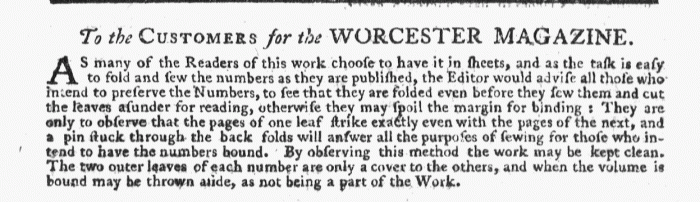
Thomas also experimented with advertising on wrappers that accompanied his Worcester Magazine, though he acknowledged to subscribers that these wrappers were ancillary to the publication:  “The two outer leaves of each number are only a cover to the others, and when the volume is bound may be thrown aside, as not being a part of the Work.”[1]

jan-30-worcerster-magazine-april-1786
Detail of Advertising Wrapper, Worcester Magazine (Second Week of April, 1786).

Thomas’s patriotic commitment to freedom of the press played a significant role in his decision to develop advertising wrappers.  As Thomas relays in his History of Printing in America, he discontinued printing his newspaper, the Massachusetts Spy, after the state legislature passed a law that “laid a duty of two-thirds of a penny on newspapers, and a penny on almanacs, which were to be stamped.”  Such a move met with strong protest since it was too reminiscent of the Stamp Act imposed by the British two decades earlier, prompting the legislature to repeal it before it went into effect.  On its heels, however, “another act was passed, which imposed a duty on all advertisements inserted in the newspapers” printed in Massachusetts.  Thomas vehemently rejected this law as “an improper restraint on the press. He, therefore, discontinued the Spy during the period that this act was in force, which was two years. But he published as a substitute a periodical work, entitled ‘The Worcester Weekly Magazine,’ in octavo.”[2] This weekly magazine lasted for two years; Thomas discontinued it and once again began printing the Spy after the legislature repealed the objectionable act.

jan-30-advertising-wrapper-worcester-magazine-4th-week-may-1786
Third Page of Advertising Wrapper, Worcester Magazine (Fourth Week of May, 1786).

Isaiah Thomas was not interested in advertising for its own sake to the same extent as Mathew Carey, but his political concerns did help to shape the landscape of early American advertising.  Furthermore, his vision for collecting American printed material preserved a variety of advertising media for later generations to admire, analyze, ponder, and enjoy.  Happy 271st birthday, Isaiah Thomas!

**********

[1] Isaiah Thomas, “To the CUSTOMERS for the WORCESTER MAGAZINE,” Worcester Magazine, wrapper, second week of April, 1786.

[2] Isaiah Thomas, The History of Printing in America: With a Biography of Printers, and an Account of Newspapers, vol. 2 (Worcester, MA: Isaac Sturtevant, 1810), 267-268.

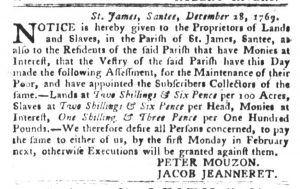
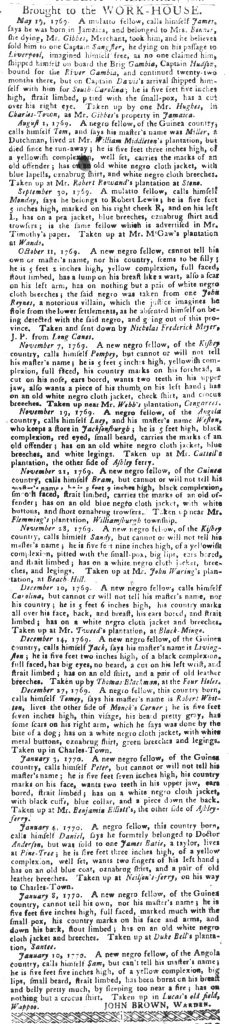
Slavery Advertisements Published January 19, 1770

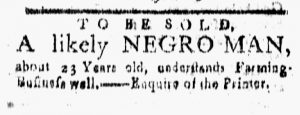
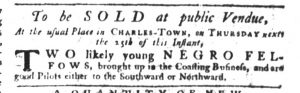
The Slavery Adverts 250 Project chronicles the role of newspaper advertising in perpetuating slavery in the era of the American Revolution. The project seeks to reveal the ubiquity of slavery in eighteenth-century life from New England to Georgia by republishing advertisements for slaves – for sale, wanted to purchase, runaways, captured fugitives – in daily digests on this site as well as in real time via the @SlaveAdverts250 Twitter feed, utilizing twenty-first-century media to stand in for the print media of the eighteenth century.

The project aims to provide modern audiences with a sense of just how often colonists encountered these advertisements in their daily lives. Enslaved men, women, and children appeared in print somewhere in the colonies almost every single day. Those advertisements served as a constant backdrop for social, cultural, economic, and political life in colonial and revolutionary America. Colonists who did not own slaves were still confronted with slavery as well as invited to maintain the system by purchasing slaves or assisting in the capture of runaways. The frequency of these newspaper advertisements suggests just how embedded slavery was in colonial and revolutionary American culture in everyday interactions beyond the printed page.

These advertisements also testify to the experiences of enslaved men, women, and children, though readers must consider that those experiences have been remediated through descriptions offered by slaveholders rather than the slaves themselves. Often unnamed in the advertisements, enslaved men, women, and children were not invisible or unimportant in early America.

These advertisements appeared in colonial American newspapers 250 years ago today.

Jan 19 1770 - New-London Gazette Slavery 1
New-London Gazette (January 19, 1770).

**********

Jan 19 1770 - New-London Gazette Slavery 2
New-London Gazette (January 19, 1770).

January 18

What was advertised in a colonial American newspaper 250 years ago today?

Jan 18 - 1:18:1770 Maryland Gazette
Maryland Gazette (January 18, 1770).

“ADVERTISEMENTS, of a moderate Length, are inserted the First Time, for 5s.”

How much did it cost to place an advertisement in a colonial American newspaper? That question does not always yield ready answers. Most printers did not regularly publish their advertising rates. Those that did publish them usually did so in one of two places: the plan in the first issue of a new publication and the colophon that ran at the bottom of the final page of each issue. Some printers commenced publication of their newspapers with a plan or overview of their purpose and the kinds of information they intended to publish as well as details that included the quality of the paper and type and subscription and advertising rates. Other printers treated the colophon as a place for recording more than just their names and place of publication. They used the colophon as a mechanism for marketing the various operations at the printing office. There they sometimes indicated subscription fees, advertising rates, or both.

Such was the case in the Maryland Gazette published by Anne Catharine Green and William Green in Annapolis in 1770. The colophon listed the costs of both subscribing and advertising. The Greens declared that “all Persons may be supplied with this GAZETTE at 12s. 6d. a Year.” In addition, “ADVERTISEMENTS, of a moderate Length, are inserted the First Time, for 5s. and 1s. for each Week’s Continuance. Long ones in Proportion to their Number of Lines.” The Greens followed standard practices, yet also introduced one modification. Most printers who published their advertising rates had both an initial fee and then an additional fee for “each Week’s Continuance.” However, for most printers that initial fee included publishing the advertisement for several weeks, usually three or four, before incurring additional costs. The Greens did not offer any sort of package deal that included multiple insertions. This had the benefit of lowering the initial cost, but may have prevented prospective advertisers from feeling as though they got a bargain on the second and third insertions. Still, the fee structure suggests that the Greens charged four shillings for setting type and another shilling for the space the advertisement occupied the first time. After that, they charged only a shilling for each additional insertion, the type having already been set. Like other printers, they increased the rates for lengthy advertisements that took up more space. Prices for advertisements much larger than a “square” were assessed “in Proportion to their Number of Lines” rather than by the number of words.

That the Greens published the price of an annual subscription, twelve shillings and six pence, allows for comparison of the relative costs of subscribing and advertising. At five shillings for the first insertion, an advertisement cost 40% of a subscription. Advertisements that ran for multiple weeks steadily gained on the price of subscriptions, only needing to run for nine weeks for the former to exceed the latter. The financial viability of many colonial newspapers often depended much more on their ability to attract advertisers rather than subscribers.

Slavery Advertisements Published January 18, 1770

The Slavery Adverts 250 Project chronicles the role of newspaper advertising in perpetuating slavery in the era of the American Revolution. The project seeks to reveal the ubiquity of slavery in eighteenth-century life from New England to Georgia by republishing advertisements for slaves – for sale, wanted to purchase, runaways, captured fugitives – in daily digests on this site as well as in real time via the @SlaveAdverts250 Twitter feed, utilizing twenty-first-century media to stand in for the print media of the eighteenth century.

The project aims to provide modern audiences with a sense of just how often colonists encountered these advertisements in their daily lives. Enslaved men, women, and children appeared in print somewhere in the colonies almost every single day. Those advertisements served as a constant backdrop for social, cultural, economic, and political life in colonial and revolutionary America. Colonists who did not own slaves were still confronted with slavery as well as invited to maintain the system by purchasing slaves or assisting in the capture of runaways. The frequency of these newspaper advertisements suggests just how embedded slavery was in colonial and revolutionary American culture in everyday interactions beyond the printed page.

These advertisements also testify to the experiences of enslaved men, women, and children, though readers must consider that those experiences have been remediated through descriptions offered by slaveholders rather than the slaves themselves. Often unnamed in the advertisements, enslaved men, women, and children were not invisible or unimportant in early America.

These advertisements appeared in colonial American newspapers 250 years ago today.

Jan 18 1770 - Maryland Gazette Slavery 1
Maryland Gazette (January 18, 1770).

**********

Jan 18 1770 - Maryland Gazette Slavery 2
Maryland Gazette (January 18, 1770).

**********

Jan 18 1770 - New-York Journal Slavery 1
New-York Journal (January 18, 1770).

**********

Jan 18 1770 - New-York Journal Slavery 2
New-York Journal (January 18, 1770).

**********

Jan 18 1770 - Pennsylvania Gazette Slavery 1
Pennsylvania Gazette (January 18, 1770).

**********

Jan 18 1770 - Pennsylvania Gazette Slavery 2
Pennsylvania Gazette (January 18, 1770).

**********

Jan 18 1770 - Pennsylvania Gazette Slavery 3
Pennsylvania Gazette (January 18, 1770).

**********

Jan 18 1770 - South-Carolina Gazette Slavery 1
South-Carolina Gazette (January 18, 1770).

**********

Jan 18 1770 - South-Carolina Gazette Slavery 2
South-Carolina Gazette (January 18, 1770).

**********

Jan 18 1770 - South-Carolina Gazette Slavery 3
South-Carolina Gazette (January 18, 1770).

**********

Jan 18 1770 - South-Carolina Gazette Slavery 4
South-Carolina Gazette (January 18, 1770).

**********

Jan 18 1770 - Virginia Gazette Purdie and Dixon Slavery 1
Virginia Gazette [Purdie and Dixon] (January 18, 1770).

**********

Jan 18 1770 - Virginia Gazette Purdie and Dixon Slavery 2
Virginia Gazette [Purdie and Dixon] (January 18, 1770).

**********

Jan 18 1770 - Virginia Gazette Purdie and Dixon Slavery 3
Virginia Gazette [Purdie and Dixon] (January 18, 1770).

**********

Jan 18 1770 - Virginia Gazette Purdie and Dixon Slavery 4
Virginia Gazette [Purdie and Dixon] (January 18, 1770).

**********

Jan 18 1770 - Virginia Gazette Purdie and Dixon Slavery 5
Virginia Gazette [Purdie and Dixon] (January 18, 1770).

**********

Jan 18 1770 - Virginia Gazette Rind Slavery 1
Virginia Gazette [Rind] (January 18, 1770).

January 17

What was advertised in a colonial American newspaper 250 years ago today?

Jan 17 - 1:17:1770 Georgia Gazette
Georgia Gazette (January 17, 1770).

“PROPOSALS FOR PRINTING BY SUBSCRIPTION.”

A subscription notice for “ESSAYS on … the Indians of the Continent of North America, especially the several Nations or Tribes of the Catawbas, Cherokees, Creeks, Chicksaws, and Choctaws, inhabiting the Western Parts of the Colonies of Virginia, North and South Carolina, and Georgia” once again ran in the January 17, 1770, edition of the Georgia Gazette. The advertisement made its first appearance of the new year, not having been among the various notices disseminated in that newspaper since November 22, 1769. Previously, it ran on the front page of the November 1 edition.

These “PROPOSALS FOR PRINTING BY SUBSCRIPTION” appeared sporadically, separated by three weeks and then by eight. That deviated from standard practices for advertisements promoting consumer goods and services in the Georgia Gazette. They usually ran in consecutive issues for a limited time, often three or four weeks. James Johnston, the printer of the Georgia Gazette, devised a different publication schedule for this particular advertisement.

Johnston served as a local agent for either James Adair, the author of the proposed book, or an unnamed printer in London or a combination of the two. Local agents were responsible for distributing subscription notices, collecting the names of subscribers, and transmitting the list to the author or printer. Local agents also collected payment and delivered books to the subscribers.

Given his familiarity with local markets, Johnston likely determined that a series of advertisements concentrated in a short period would not incite as much interest as introducing potential subscribers to the proposed work on multiple occasions over several months. Considerations of space may have also influenced his decisions about when he published the subscription notice. It received a privileged place the first time it ran in the Georgia Gazette, but for each of the subsequent iterations it appeared as the last item at the bottom of a column. That suggests the compositor held the advertisement in reserve, inserting it only once news and other advertisements were allocated space in an issue. As a local agent, Johnston had been entrusted with some latitude in making decisions about distributing subscription notices for a book that would be published on the other side of the Atlantic. Both his understanding of local markets and his own business interests likely had an impact on his methods of marketing the proposed book.

Happy Birthday, Benjamin Franklin!

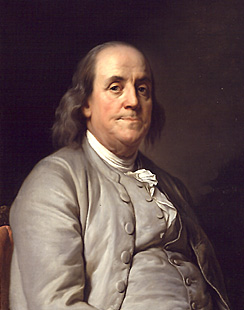
Today is an important day for specialists in early American print culture, for Benjamin Franklin was born on January 17, 1706 (January 6, 1705, Old Style), in Boston. Among his many other accomplishments, Franklin is known as the “Father of American Advertising.” Although I have argued elsewhere that this title should more accurately be bestowed upon Mathew Carey (in my view more prolific and innovative in the realm of advertising as a printer, publisher, and advocate of marketing), I recognize that Franklin deserves credit as well. Franklin is often known as “The First American,” so it not surprising that others should rank him first among the founders of advertising in America.

benjamin-franklin
Benjamin Franklin (Joseph Siffred Duplessis, ca. 1785).  National Portrait Gallery.

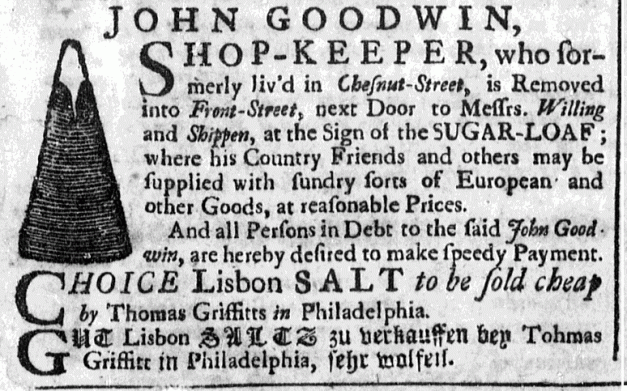
Franklin purchased the Pennsylvania Gazette in 1729. In the wake of becoming printer, he experimented with the visual layout of advertisements that appeared in the weekly newspaper, incorporating significantly more white space and varying font sizes in order to better attract readers’ and potential customers’ attention. Advertising flourished in the Pennsylvania Gazette, which expanded from two to four pages in part to accommodate the greater number of commercial notices.

jan-17-pennsylvania-gazette-19-161736
Advertisements with white space, varying sizes of font, capitals and italics, and a woodcut from Benjamin Franklin’s Pennsylvania Gazette (December 9-16, 1736).

Many historians of the press and print culture in early America have noted that Franklin became wealthy and retired as a printer in favor of a multitude of other pursuits in part because of the revenue he collected from advertising. Others, especially David Waldstreicher, have underscored that this wealth was amassed through participation in the colonial slave trade. The advertisements for goods and services featured in the Pennsylvania Gazette included announcements about buying and selling enslaved men, women, and children as well as notices offering rewards for those who escaped from bondage.

jan-17-pennsylvania-gazette-slave-19-161736
Advertisement for an enslaved woman and an enslaved child from Benjamin Franklin’s Pennsylvania Gazette (December 9-16, 1736).

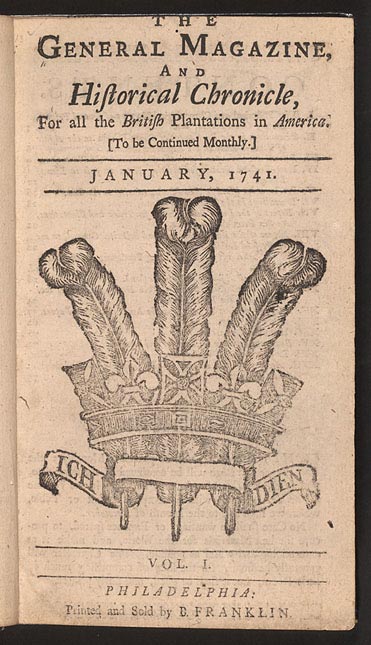
In 1741 Franklin published one of colonial America’s first magazines, The General Magazine and Historical Chronicle, for all the British Plantations in America (which barely missed out on being the first American magazine, a distinction earned by Franklin’s competitor, Andrew Bradford, with The American Magazine or Monthly View of the Political State of the British Colonies). The magazine lasted only a handful of issues, but that was sufficient for Franklin to become the first American printer to include an advertisement in a magazine (though advertising did not become a standard part of magazine publication until special advertising wrappers were developed later in the century — and Mathew Carey was unarguably the master of that medium).

general-magazine
General Magazine and Historical Chronicle, For all the British Plantations in America (January 1741).  Library of Congress.

In 1744 Franklin published an octavo-sized Catalogue of Choice and Valuable Books, including 445 entries. This is the first known American book catalogue aimed at consumers (though the Library Company of Philadelphia previously published catalogs listing their holdings in 1733, 1735, and 1741). Later that same year, Franklin printed a Catalogue of Books to Be Sold at Auction.

Franklin pursued advertising through many media in eighteenth-century America, earning recognition as one of the founders of American advertising. Happy 314th birthday, Benjamin Franklin!

Slavery Advertisements Published January 17, 1770

The Slavery Adverts 250 Project chronicles the role of newspaper advertising in perpetuating slavery in the era of the American Revolution. The project seeks to reveal the ubiquity of slavery in eighteenth-century life from New England to Georgia by republishing advertisements for slaves – for sale, wanted to purchase, runaways, captured fugitives – in daily digests on this site as well as in real time via the @SlaveAdverts250 Twitter feed, utilizing twenty-first-century media to stand in for the print media of the eighteenth century.

The project aims to provide modern audiences with a sense of just how often colonists encountered these advertisements in their daily lives. Enslaved men, women, and children appeared in print somewhere in the colonies almost every single day. Those advertisements served as a constant backdrop for social, cultural, economic, and political life in colonial and revolutionary America. Colonists who did not own slaves were still confronted with slavery as well as invited to maintain the system by purchasing slaves or assisting in the capture of runaways. The frequency of these newspaper advertisements suggests just how embedded slavery was in colonial and revolutionary American culture in everyday interactions beyond the printed page.
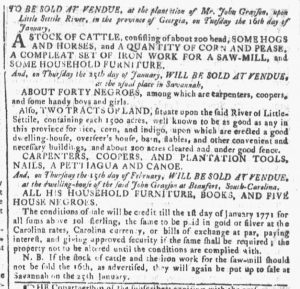
These advertisements also testify to the experiences of enslaved men, women, and children, though readers must consider that those experiences have been remediated through descriptions offered by slaveholders rather than the slaves themselves. Often unnamed in the advertisements, enslaved men, women, and children were not invisible or unimportant in early America.

These advertisements appeared in colonial American newspapers 250 years ago today.

Jan 17 1770 - Georgia Gazette Slavery 1
Georgia Gazette (January 17, 1770).

**********

Jan 17 1770 - Georgia Gazette Slavery 7
Georgia Gazette (January 17, 1770).

**********

Jan 17 1770 - Georgia Gazette Slavery 2
Georgia Gazette (January 17, 1770).

**********

Jan 17 1770 - Georgia Gazette Slavery 3
Georgia Gazette (January 17, 1770).

**********

Jan 17 1770 - Georgia Gazette Slavery 4
Georgia Gazette (January 17, 1770).

**********

Jan 17 1770 - Georgia Gazette Slavery 5
Georgia Gazette (January 17, 1770).

**********

Jan 17 1770 - Georgia Gazette Slavery 6
Georgia Gazette (January 17, 1770).

January 16

What was advertised in a colonial American newspaper 250 years ago today?

Jan 16 - 1:16:1770 Essex Gazette
Essex Gazette (January 16, 1770).

“At William Scott’s STORE, North Side of Faneuil-Hall, Boston.”

William Scott made sure that he placed his advertisement for various textiles and “a great Variety of English, Irish and Scotch Goods” before the eyes of as many consumers in Boston and its environs as possible. His notice ran in the Massachusetts Gazette and Boston Weekly News-Letter on January 11. Four days later it also appeared in the Boston Evening-Post, the Boston-Gazette, and the Massachusetts Gazette and Boston Post-Boy. Of the five newspapers published in Boston at the time, Scott refrained from inserting his advertisement in the Boston Chronicle, a newspaper notable for its Tory sympathies as well as strident critiques and demeaning caricatures of patriot leaders. Perhaps Scott did not wish to have his store on the north side of Faneuil Hall associated with the rhetoric espoused in the Boston Chronicle.

Though he declined to advertise in that notorious newspaper, Scott did place his notice in a fifth publication that week. On January 16, it ran in the Essex Gazette, printed in Salem by Samuel Hall. For all intents and purposes, Salem was part of the same media market as Boston. Until relatively recently, it did not have its own newspaper. Hall began publishing the Essex Gazette in August 1768, less than a year and a half earlier. That newspaper certainly did not entirely displace those printed in Boston; they served the entire colony and circulated far beyond the bustling port. Even though prospective customers who read the Essex Gazette likely would have seen his advertisement in any of Boston’s several newspapers, Scott followed through on his strategy of saturating the market with his notice. It may even have garnered greater attention in the Essex Gazette since that newspaper carried far less advertising than any of its counterparts from Boston. In each of the other newspapers, Scott’s advertisement was nestled among dozens of others. In the January 16 edition of the Essex Gazette, it was one of only ten advertisements, all of them appearing in the far right column on the last two pages.

Several advertisers in Boston regularly inserted notices about consumer goods and services in multiple newspapers published in that city. William Scott, however, was one of the first to experiment with placing advertisements in publications that radiated outward from the colony’s largest port.

Slavery Advertisements Published January 16, 1770

The Slavery Adverts 250 Project chronicles the role of newspaper advertising in perpetuating slavery in the era of the American Revolution. The project seeks to reveal the ubiquity of slavery in eighteenth-century life from New England to Georgia by republishing advertisements for slaves – for sale, wanted to purchase, runaways, captured fugitives – in daily digests on this site as well as in real time via the @SlaveAdverts250 Twitter feed, utilizing twenty-first-century media to stand in for the print media of the eighteenth century.

The project aims to provide modern audiences with a sense of just how often colonists encountered these advertisements in their daily lives. Enslaved men, women, and children appeared in print somewhere in the colonies almost every single day. Those advertisements served as a constant backdrop for social, cultural, economic, and political life in colonial and revolutionary America. Colonists who did not own slaves were still confronted with slavery as well as invited to maintain the system by purchasing slaves or assisting in the capture of runaways. The frequency of these newspaper advertisements suggests just how embedded slavery was in colonial and revolutionary American culture in everyday interactions beyond the printed page.

These advertisements also testify to the experiences of enslaved men, women, and children, though readers must consider that those experiences have been remediated through descriptions offered by slaveholders rather than the slaves themselves. Often unnamed in the advertisements, enslaved men, women, and children were not invisible or unimportant in early America.

These advertisements appeared in colonial American newspapers 250 years ago today.

Jan 16 1770 - South-Carolina Gazette and Country Journal Slavery 1
South-Carolina Gazette and Country Journal (January 16, 1770).

**********

Jan 16 1770 - South-Carolina Gazette and Country Journal Slavery 2
South-Carolina Gazette and Country Journal (January 16, 1770).

**********

Jan 16 1770 - South-Carolina Gazette and Country Journal Slavery 3
South-Carolina Gazette and Country Journal (January 16, 1770).

**********

Jan 16 1770 - South-Carolina Gazette and Country Journal Slavery 4
South-Carolina Gazette and Country Journal (January 16, 1770).

**********

Jan 16 1770 - South-Carolina Gazette and Country Journal Slavery 5
South-Carolina Gazette and Country Journal (January 16, 1770).

**********

Jan 16 1770 - South-Carolina Gazette and Country Journal Slavery 6
South-Carolina Gazette and Country Journal (January 16, 1770).

**********

Jan 16 1770 - South-Carolina Gazette and Country Journal Slavery 7
South-Carolina Gazette and Country Journal (January 16, 1770).