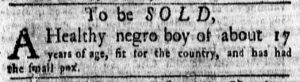
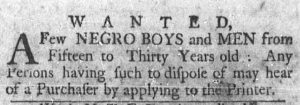
Slavery Advertisements Published March 9, 1770

The Slavery Adverts 250 Project chronicles the role of newspaper advertising in perpetuating slavery in the era of the American Revolution. The project seeks to reveal the ubiquity of slavery in eighteenth-century life from New England to Georgia by republishing advertisements for slaves – for sale, wanted to purchase, runaways, captured fugitives – in daily digests on this site as well as in real time via the @SlaveAdverts250 Twitter feed, utilizing twenty-first-century media to stand in for the print media of the eighteenth century.

The project aims to provide modern audiences with a sense of just how often colonists encountered these advertisements in their daily lives. Enslaved men, women, and children appeared in print somewhere in the colonies almost every single day. Those advertisements served as a constant backdrop for social, cultural, economic, and political life in colonial and revolutionary America. Colonists who did not own slaves were still confronted with slavery as well as invited to maintain the system by purchasing slaves or assisting in the capture of runaways. The frequency of these newspaper advertisements suggests just how embedded slavery was in colonial and revolutionary American culture in everyday interactions beyond the printed page.

These advertisements also testify to the experiences of enslaved men, women, and children, though readers must consider that those experiences have been remediated through descriptions offered by slaveholders rather than the slaves themselves. Often unnamed in the advertisements, enslaved men, women, and children were not invisible or unimportant in early America.

These advertisements appeared in colonial American newspapers 250 years ago today.

Mar 9 1770 - South-Carolina and American General Gazette Slavery 1
South-Carolina and American General Gazette (March 9, 1770).

**********

Mar 9 1770 - South-Carolina and American General Gazette Slavery 2
South-Carolina and American General Gazette (March 9, 1770).

**********

Mar 9 1770 - South-Carolina and American General Gazette Slavery 3
South-Carolina and American General Gazette (March 9, 1770).

**********

Mar 9 1770 - South-Carolina and American General Gazette Slavery 4
South-Carolina and American General Gazette (March 9, 1770).

**********

Mar 9 1770 - South-Carolina and American General Gazette Slavery 5
South-Carolina and American General Gazette (March 9, 1770).

**********

Mar 9 1770 - South-Carolina and American General Gazette Slavery 6
South-Carolina and American General Gazette (March 9, 1770).

**********

Mar 9 1770 - South-Carolina and American General Gazette Slavery 7
South-Carolina and American General Gazette (March 9, 1770).

**********

Mar 9 1770 - South-Carolina and American General Gazette Slavery 8
South-Carolina and American General Gazette (March 9, 1770).

**********

Mar 9 1770 - South-Carolina and American General Gazette Slavery 9
South-Carolina and American General Gazette (March 9, 1770).

March 8

What was advertised in a colonial American newspaper 250 years ago today?

Mar 8 - 3:8:1770 Massachusetts Gazette and Boston Weekly News-Letter
MassachusettsGazette and Boston Weekly News-Letter (March 8, 1770).

“The Landing of – Troops in the Year 1768.”

At the time of the Boston Massacre, more newspapers were published in that city than any other in the colonies.  The Boston Chronicle, the Boston Evening-Post, the Boston-Gazette, and the Massachusetts Gazette and Boston Post-Boy all came out on Mondays.  Later in the week, the Massachusetts Gazette and Boston Weekly News-Letter and another edition of the Boston Chronicle both came out on Thursdays.  The Boston Massacre occurred on a Monday evening, by which time the newspapers usually published on that day had already been distributed to subscribers.  That meant that the News-Letter and the Chronicle were the first newspapers to appear after the “BLOODY MASSACRE perpetrated in King-Street, BOSTON on March 5th 1770 by a party of the 29th REG[IMEN]T” (as Paul Revere described the event).

Both carried limited coverage of the Boston Massacre.  The Chronicle, notorious for its pro-British sympathies, stated, “We decline at present, giving a particular account of this unhappy affair, as we hear the trial of the unfortunate prisoners [Captain Thomas Preston and eight soldiers] is to come on next week.”  The News-Letter issued a Postscript supplement that acknowledged the event but provided only a brief overview.  Its publisher, Richard Draper, also tended to support the British perspective, though usually not as vociferously as the publishers of the Chronicle.  Draper indicated that “A Number of Gentlemen are collecting Evidences of the whole Transactions, as soon as these are done, an Account will be drawn up and Published in the Papers.”  Four days later, Benjamin Edes and John Gill, vocal patriots, published an account of the Boston Massacre and the funeral procession for its victims in the Boston-Gazette, complete with a woodcut depicting the coffins and heavy black borders to denote mourning.

In the aftermath of the Boston Massacre, Edes and Gill ran an advertisement for their “North-American ALMANACK, AND Massachusetts REGISTER” in the March 8, 1770, edition of the News-Letter.  The list of contents made it clear that the publishers placed far more emphasis on the patriotic propaganda in the register than the astronomical calculations in the almanack, especially more than two months into the new year.  Edes and Gill had previously placed the same advertisement for their almanac and register in the News-Letter, but it did not run in the issue of that newspaper that came out immediately before the Boston Massacre.  It did reappear in the first edition published after the “tragical Affair,” as Draper described it.  Edes and Gill led the list of contents with a description of an illustration of “a Prospective View of the Town of Boston … and the Landing of – Troops in the Year 1768.”  Those troops eventually fired on the residents of Boston, killing and wounding many of them in the “Bloody Massacre.”  Although coverage of the “Proceedings of that Evening” was tentative and abbreviated in the first issue of the News-Letter after the Boston Massacre, the patriotic tenor of the advertisements for Edes and Gill’s almanack and register took on new urgency in the wake of recent events on King Street.

Slavery Advertisements Published March 8, 1770

The Slavery Adverts 250 Project chronicles the role of newspaper advertising in perpetuating slavery in the era of the American Revolution. The project seeks to reveal the ubiquity of slavery in eighteenth-century life from New England to Georgia by republishing advertisements for slaves – for sale, wanted to purchase, runaways, captured fugitives – in daily digests on this site as well as in real time via the @SlaveAdverts250 Twitter feed, utilizing twenty-first-century media to stand in for the print media of the eighteenth century.

The project aims to provide modern audiences with a sense of just how often colonists encountered these advertisements in their daily lives. Enslaved men, women, and children appeared in print somewhere in the colonies almost every single day. Those advertisements served as a constant backdrop for social, cultural, economic, and political life in colonial and revolutionary America. Colonists who did not own slaves were still confronted with slavery as well as invited to maintain the system by purchasing slaves or assisting in the capture of runaways. The frequency of these newspaper advertisements suggests just how embedded slavery was in colonial and revolutionary American culture in everyday interactions beyond the printed page.

These advertisements also testify to the experiences of enslaved men, women, and children, though readers must consider that those experiences have been remediated through descriptions offered by slaveholders rather than the slaves themselves. Often unnamed in the advertisements, enslaved men, women, and children were not invisible or unimportant in early America.

These advertisements appeared in colonial American newspapers 250 years ago today.

Mar 8 1770 - Maryland Gazette Slavery 1
Maryland Gazette (March 8, 1770).

**********

Mar 8 1770 - New-York Journal Slavery 1
New-York Journal (March 8, 1770).

**********

Mar 8 1770 - New-York Journal Slavery 2
New-York Journal (March 8, 1770).

**********

Mar 8 1770 - New-York Journal Slavery 3
New-York Journal (March 8, 1770).

**********

Mar 8 1770 - New-York Journal Supplement Slavery 1
Supplement to the New-York Journal (March 8, 1770).

**********

Mar 8 1770 - Pennsylvania Gazette Slavery 1
Pennsylvania Gazette (March 8, 1770).

**********

Mar 8 1770 - Pennsylvania Gazette Slavery 2
Pennsylvania Gazette (March 8, 1770).

**********

Mar 8 1770 - Pennsylvania Gazette Slavery 3
Pennsylvania Gazette (March 8, 1770).

**********

Mar 8 1770 - South-Carolina Gazette Slavery 1
South-Carolina Gazette (March 8, 1770).

**********

Mar 8 1770 - South-Carolina Gazette Slavery 2
South-Carolina Gazette (March 8, 1770).

**********

Mar 8 1770 - South-Carolina Gazette Slavery 3
South-Carolina Gazette (March 8, 1770).

**********

Mar 8 1770 - South-Carolina Gazette Slavery 4
South-Carolina Gazette (March 8, 1770).

**********

Mar 8 1770 - South-Carolina Gazette Slavery 5
South-Carolina Gazette (March 8, 1770).

**********

Mar 8 1770 - South-Carolina Gazette Slavery 6
South-Carolina Gazette (March 8, 1770).

**********

Mar 8 1770 - South-Carolina Gazette Slavery 7
South-Carolina Gazette (March 8, 1770).

**********

Mar 8 1770 - South-Carolina Gazette Slavery 8
South-Carolina Gazette (March 8, 1770).

**********

Mar 8 1770 - South-Carolina Gazette Slavery 9
South-Carolina Gazette (March 8, 1770).

**********

Mar 8 1770 - South-Carolina Gazette Slavery 10
South-Carolina Gazette (March 8, 1770).

**********

Mar 8 1770 - South-Carolina Gazette Slavery 11
South-Carolina Gazette (March 8, 1770).

**********

Mar 8 1770 - South-Carolina Gazette Slavery 12
South-Carolina Gazette (March 8, 1770).

**********

Mar 8 1770 - South-Carolina Gazette Supplement Slavery 1
Supplement to the South-Carolina Gazette (March 8, 1770).

**********

Mar 8 1770 - South-Carolina Gazette Supplement Slavery 2
Supplement to the South-Carolina Gazette (March 8, 1770).

**********

Mar 8 1770 - South-Carolina Gazette Supplement Slavery 3
Supplement to the South-Carolina Gazette (March 8, 1770).

**********

Mar 8 1770 - South-Carolina Gazette Supplement Slavery 4
Supplement to the South-Carolina Gazette (March 8, 1770).

**********

Mar 8 1770 - South-Carolina Gazette Supplement Slavery 5
Supplement to the South-Carolina Gazette (March 8, 1770).

**********

Mar 8 1770 - South-Carolina Gazette Supplement Slavery 6
Supplement to the South-Carolina Gazette (March 8, 1770).

**********

Mar 8 1770 - South-Carolina Gazette Supplement Slavery 7
Supplement to the South-Carolina Gazette (March 8, 1770).

**********

Mar 8 1770 - South-Carolina Gazette Supplement Slavery 8
Supplement to the South-Carolina Gazette (March 8, 1770).

**********

Mar 8 1770 - South-Carolina Gazette Supplement Slavery 9
Supplement to the South-Carolina Gazette (March 8, 1770).

**********

Mar 8 1770 - Virginia Gazette Purdie & Dixon Slavery 1
Virginia Gazette [Purdie and Dixon] (March 8, 1770).

**********

Mar 8 1770 - Virginia Gazette Purdie & Dixon Slavery 2
Virginia Gazette [Purdie and Dixon] (March 8, 1770).

**********

Mar 8 1770 - Virginia Gazette Purdie & Dixon Slavery 3
Virginia Gazette [Purdie and Dixon] (March 8, 1770).

**********

Mar 8 1770 - Virginia Gazette Purdie & Dixon Slavery 4
Virginia Gazette [Purdie and Dixon] (March 8, 1770).

**********

Mar 8 1770 - Virginia Gazette Purdie & Dixon Slavery 5
Virginia Gazette [Purdie and Dixon] (March 8, 1770).

**********

Mar 8 1770 - Virginia Gazette Purdie & Dixon Slavery 6
Virginia Gazette [Purdie and Dixon] (March 8, 1770).

**********

Mar 8 1770 - Virginia Gazette Purdie & Dixon Slavery 7
Virginia Gazette [Purdie and Dixon] (March 8, 1770).

**********

Mar 8 1770 - Virginia Gazette Purdie & Dixon Slavery 8
Virginia Gazette [Purdie and Dixon] (March 8, 1770).

**********

Mar 8 1770 - Virginia Gazette Purdie & Dixon Slavery 9
Virginia Gazette [Purdie and Dixon] (March 8, 1770).

**********

Mar 8 1770 - Virginia Gazette Purdie & Dixon Slavery 10
Virginia Gazette [Purdie and Dixon] (March 8, 1770).

**********

Mar 8 1770 - Virginia Gazette Rind Slavery 1
Virginia Gazette [Rind] (March 8, 1770).

**********

Mar 8 1770 - Virginia Gazette Rind Slavery 2
Virginia Gazette [Rind] (March 8, 1770).

**********

Mar 8 1770 - Virginia Gazette Rind Slavery 3
Virginia Gazette [Rind] (March 8, 1770).

**********

Mar 8 1770 - Virginia Gazette Rind Slavery 4
Virginia Gazette [Rind] (March 8, 1770).

**********

Mar 8 1770 - Virginia Gazette Rind Supplement Slavery 1
Virginia Gazette [Rind] (March 8, 1770).

**********

Mar 8 1770 - Virginia Gazette Rind Supplement Slavery 2
Virginia Gazette [Rind] (March 8, 1770).

**********

Mar 8 1770 - Virginia Gazette Rind Supplement Slavery 3
Virginia Gazette [Rind] (March 8, 1770).

March 7

What was advertised in a colonial American newspaper 250 years ago today?

Mar 7 - 3:7:1770 Georgia Gazette
Georgia Gazette (March 7, 1770).

“SUNDRY HOUSEHOLD GOODS.”

A short advertisement in the March 7, 1770, edition of the Georgia Gazette informed readers of an auction that would take place nearly a month later.  “To be sold, on Monday the 2d of April,” it announced, “SUNDRY HOUSEHOLD GOODS, the property of Barbara Wilson, deceased.”  Several other notices provided details for upcoming auctions and vendue sales, as they were often called in the eighteenth century.  Stephen Mellen and Ursala Peters placed an advertisement that read: “To be sold by publick vendue … HOUSEHOLD FURNITURE, some CARPENTERS TOOLS, and a few NEGROES, belonging to the Estate of Christopher Peters, deceased.”  In the process of selling an array of goods the deceased Peters acquired during his lifetime, the administrators of his estate reduced enslaved people to commodities to be sold alongside “HOUSEHOLD FURNITURE” and “CARPENTERS TOOLS.”  Another notice mentioned “A PARCEL OF HOUSEHOLD FURNITURE” to be sold on the same day as Mrs. Simpson’s “DWELLING-HOUSE” and two lots of land.  Throughout these advertisements, “HOUSEHOLD FURNITURE” referred to a variety of personal belongings, not just chairs and tables and the like.

In contrast, the March 7 issue of the Georgia Gazette, like many others, had few advertisements placed by merchants, shopkeepers, artisans, and others promoting new goods for sale at their storehouses and shops.  This testifies to different means of participating in the consumer revolution of the eighteenth century.  Though eager to acquire new goods, especially the latest fashions, colonists also did brisk trade in secondhand goods at auctions and estate sales.  At such venues, buyers found bargains that they likely could not have achieved when purchasing new items, no matter how experienced or skillful they happened to be when it came to haggling with retailers.  While nonimportation agreements were in effect and colonists were suspicious of the origins of new merchandise, buying secondhand goods may have also provided a means of exercising their political principles.

Slavery Advertisements Published March 7, 1770

The Slavery Adverts 250 Project chronicles the role of newspaper advertising in perpetuating slavery in the era of the American Revolution. The project seeks to reveal the ubiquity of slavery in eighteenth-century life from New England to Georgia by republishing advertisements for slaves – for sale, wanted to purchase, runaways, captured fugitives – in daily digests on this site as well as in real time via the @SlaveAdverts250 Twitter feed, utilizing twenty-first-century media to stand in for the print media of the eighteenth century.

The project aims to provide modern audiences with a sense of just how often colonists encountered these advertisements in their daily lives. Enslaved men, women, and children appeared in print somewhere in the colonies almost every single day. Those advertisements served as a constant backdrop for social, cultural, economic, and political life in colonial and revolutionary America. Colonists who did not own slaves were still confronted with slavery as well as invited to maintain the system by purchasing slaves or assisting in the capture of runaways. The frequency of these newspaper advertisements suggests just how embedded slavery was in colonial and revolutionary American culture in everyday interactions beyond the printed page.

These advertisements also testify to the experiences of enslaved men, women, and children, though readers must consider that those experiences have been remediated through descriptions offered by slaveholders rather than the slaves themselves. Often unnamed in the advertisements, enslaved men, women, and children were not invisible or unimportant in early America.

These advertisements appeared in colonial American newspapers 250 years ago today.

Mar 7 1770 - Georgia Gazette Slavery 1
Georgia Gazette (March 7, 1770).

**********

Mar 7 1770 - Georgia Gazette Slavery 2
Georgia Gazette (March 7, 1770).

**********

Mar 7 1770 - Georgia Gazette Slavery 3
Georgia Gazette (March 7, 1770).

**********

Mar 7 1770 - Georgia Gazette Slavery 4
Georgia Gazette (March 7, 1770).

**********

Mar 7 1770 - Georgia Gazette Slavery 5
Georgia Gazette (March 7, 1770).

**********

Mar 7 1770 - Georgia Gazette Slavery 6
Georgia Gazette (March 7, 1770).

**********

Mar 7 1770 - Georgia Gazette Slavery 7
Georgia Gazette (March 7, 1770).

March 6

What was advertised in a colonial American newspaper 250 years ago today?

Mar 6 - 3:6:1770 South-Carolina Gazette and Country Journal
South-Carolina Gazette and Country Journal (March 6, 1770)

“The best French gloves and mits, free from spots, at 12s6. per pair.”

Like many other shopkeepers in Charleston and throughout the colonies, William Stukes stocked “a neat assortment of millenary GOODS, with many other articles.”  To demonstrate the point, he cataloged much of his inventory in a newspaper advertisement.  He carried “PLAIN and flowered sattins,” “stript thread gauze,” “scented and plain hair powder,” and “different coloured silk gloves and mitts,” along with an array of other items.  In addition, he advised prospective customers of “All sorts of millinary ware made in the newest fashion by Mrs. Stukes.”  His partner received second billing even though she provided an important service that undoubtedly supported his enterprise and supplemented the household income.

Stukes sought to incite demand for his wares by emphasizing both consumer choice and fashion.  In addition, he made appeals to price, proclaiming that he would sell these goods “extraordinary cheap.”  When eighteenth-century advertisers made such claims, they usually did not elaborate.  Stukes, however, listed his prices for several items:

  • “black sattin hats at 30s.”
  • “the newest fashion broad ribbons at 5s. per yard”
  • “the best French gloves and mits, free from spots, at 12s6. per pair”
  • “Hose’s callimanco shoes at 31s. per pair”
  • “fine bohea tea at 20s. per pound”
  • “black pepper at 15s. per pound”
  • “table knives and forks at 20s. per set”
  • “best Oronoko tobacco at 12s6 per pound”

Prospective customers did not have to take Stukes at his word that he offered low prices, only to be disappointed when they visited his shop.  Unlike most other advertisers, he published prices for several items.  That allowed consumers to assess for themselves whether Stukes actually offered bargains.  It also facilitated comparison shopping.  Prospective customers might examine the merchandise in other shops, Stukes may have reasoned, and then decide to give their business to him upon learning that his competitors did not match his prices.

Today, consumers are accustomed to prices being advertised with products.  Indeed, naming a price is a common marketing strategy, an effort to entice customers with bargains.  Most eighteenth-century advertisers did not deploy that method for attracting customers, though a few, like Stukes, did experiment with attaching prices to some of their goods when they promoted their businesses in the public prints.

Slavery Advertisements Published March 6, 1770

The Slavery Adverts 250 Project chronicles the role of newspaper advertising in perpetuating slavery in the era of the American Revolution. The project seeks to reveal the ubiquity of slavery in eighteenth-century life from New England to Georgia by republishing advertisements for slaves – for sale, wanted to purchase, runaways, captured fugitives – in daily digests on this site as well as in real time via the @SlaveAdverts250 Twitter feed, utilizing twenty-first-century media to stand in for the print media of the eighteenth century.

The project aims to provide modern audiences with a sense of just how often colonists encountered these advertisements in their daily lives. Enslaved men, women, and children appeared in print somewhere in the colonies almost every single day. Those advertisements served as a constant backdrop for social, cultural, economic, and political life in colonial and revolutionary America. Colonists who did not own slaves were still confronted with slavery as well as invited to maintain the system by purchasing slaves or assisting in the capture of runaways. The frequency of these newspaper advertisements suggests just how embedded slavery was in colonial and revolutionary American culture in everyday interactions beyond the printed page.

These advertisements also testify to the experiences of enslaved men, women, and children, though readers must consider that those experiences have been remediated through descriptions offered by slaveholders rather than the slaves themselves. Often unnamed in the advertisements, enslaved men, women, and children were not invisible or unimportant in early America.

These advertisements appeared in colonial American newspapers 250 years ago today.

Mar 6 1770 - South-Carolina Gazette and Country Journal Slavery 1
South-Carolina Gazette and Country Journal (March 6, 1770).

**********

Mar 6 1770 - South-Carolina Gazette and Country Journal Slavery 2
South-Carolina Gazette and Country Journal (March 6, 1770).

**********

Mar 6 1770 - South-Carolina Gazette and Country Journal Slavery 3
South-Carolina Gazette and Country Journal (March 6, 1770).

**********

Mar 6 1770 - South-Carolina Gazette and Country Journal Slavery 4
South-Carolina Gazette and Country Journal (March 6, 1770).

**********

Mar 6 1770 - South-Carolina Gazette and Country Journal Supplement Slavery 1
Supplement to the South-Carolina Gazette and Country Journal (March 6, 1770).

**********

Mar 6 1770 - South-Carolina Gazette and Country Journal Supplement Slavery 2
Supplement to the South-Carolina Gazette and Country Journal (March 6, 1770).

**********

Mar 6 1770 - South-Carolina Gazette and Country Journal Supplement Slavery 3
Supplement to the South-Carolina Gazette and Country Journal (March 6, 1770).

**********

Mar 6 1770 - South-Carolina Gazette and Country Journal Supplement Slavery 4
Supplement to the South-Carolina Gazette and Country Journal (March 6, 1770).

**********

Mar 6 1770 - South-Carolina Gazette and Country Journal Supplement Slavery 5
Supplement to the South-Carolina Gazette and Country Journal (March 6, 1770).

**********

Mar 6 1770 - South-Carolina Gazette and Country Journal Supplement Slavery 6
Supplement to the South-Carolina Gazette and Country Journal (March 6, 1770).

**********

Mar 6 1770 - South-Carolina Gazette and Country Journal Supplement Slavery 7
Supplement to the South-Carolina Gazette and Country Journal (March 6, 1770).

March 5

What was advertised in a colonial American newspaper 250 years ago today?

Mar 5 - 3:5:1770 Boston-Gazette
Boston-Gazette (March 5, 1770).

“Large Marrowfats, early Charlston.”

Susanna Renken and Abigail Davidson were the first in 1770.  Spring was on the way.  Newspaper advertisements for garden seeds were among the many signs of the changing seasons that greeted colonists in Massachusetts on the eve of the American Revolution.  Every year a cohort of women took to the pages of the several newspapers published in Boston to promote the seeds they offered for sale.  Renken and Davidson both placed advertisements in the March 5, 1770, edition of the Boston-Gazette, conveniently placed one after the other.  Readers could expect that soon advertisements placed by other female entrepreneurs would join them.  Although printers and compositors usually did not impose any sort of classification system on newspaper notices, they did tend to cluster advertisements by women selling seeds together, a nod toward the possibility of organizing the information in advertisements for the convenience of subscribers and other readers.  Renken, usually one of the most prolific and aggressive of the female seed sellers when it came to advertising, also placed a notice (with identical copy) in the March 5 edition of the Massachusetts Gazette and Boston Post-Boy.

Renken concluded her advertisement with a brief note about other merchandise available at her shop, “all sorts of English Goods, imported before the Non-importation Agreement took Place.”  That brief reference to a commercial strategy for protesting the duties imposed on certain imported goods by the Townshend Acts belied how the imperial crisis would intensify by the end of the day.  That evening a crowd outside the Boston Custom House on King Street (now State Street), harassing British soldiers.  The encounter culminated in the Boston Massacre or what Paul Revere termed the “BLOODY MASSACRE” in an engraving intended to stoke patriotic sentiment among the colonists.  Three men died instantly; two others who were wounded died soon after.  Collectively, they have been considered the first casualties of the American Revolution, along with Christopher Seider who had died less than two weeks earlier.  A week after Renken and Davidson placed their first advertisements of the season, other women joined them in advertising seeds in the Boston-Gazette.  Their advertisements, however, were enclosed in thick borders that denoted mourning.  Many of them appeared on the same page as coverage of the Boston Massacre.

Slavery Advertisements Published March 5, 1770

The Slavery Adverts 250 Project chronicles the role of newspaper advertising in perpetuating slavery in the era of the American Revolution. The project seeks to reveal the ubiquity of slavery in eighteenth-century life from New England to Georgia by republishing advertisements for slaves – for sale, wanted to purchase, runaways, captured fugitives – in daily digests on this site as well as in real time via the @SlaveAdverts250 Twitter feed, utilizing twenty-first-century media to stand in for the print media of the eighteenth century.

The project aims to provide modern audiences with a sense of just how often colonists encountered these advertisements in their daily lives. Enslaved men, women, and children appeared in print somewhere in the colonies almost every single day. Those advertisements served as a constant backdrop for social, cultural, economic, and political life in colonial and revolutionary America. Colonists who did not own slaves were still confronted with slavery as well as invited to maintain the system by purchasing slaves or assisting in the capture of runaways. The frequency of these newspaper advertisements suggests just how embedded slavery was in colonial and revolutionary American culture in everyday interactions beyond the printed page.

These advertisements also testify to the experiences of enslaved men, women, and children, though readers must consider that those experiences have been remediated through descriptions offered by slaveholders rather than the slaves themselves. Often unnamed in the advertisements, enslaved men, women, and children were not invisible or unimportant in early America.

These advertisements appeared in colonial American newspapers 250 years ago today.

Mar 5 1770 - Boston Evening-Post Slavery 1
Boston Evening-Post (March 5, 1770).

**********

Mar 5 1770 - New-York Gazette and Weekly Mercury Slavery 1
New-York Gazette and Weekly Mercury (March 5, 1770).

**********

Mar 5 1770 - New-York Gazette and Weekly Mercury Slavery 2
New-York Gazette and Weekly Mercury (March 5, 1770).

**********

Mar 5 1770 - New-York Gazette and Weekly Mercury Slavery 3
New-York Gazette and Weekly Mercury (March 5, 1770).

**********

Mar 5 1770 - New-York Gazette and Weekly Mercury Slavery 4
New-York Gazette and Weekly Mercury (March 5, 1770).

**********

Mar 5 1770 - New-York Gazette and Weekly Mercury Slavery 5
New-York Gazette and Weekly Mercury (March 5, 1770).

**********

Mar 5 1770 - New-York Gazette and Weekly Mercury Slavery 6
New-York Gazette and Weekly Mercury (March 5, 1770).

**********

Mar 5 1770 - New-York Gazette or Weekly Post-Boy Slavery 1
New-York Gazette or Weekly Post-Boy (March 5, 1770).

**********

Mar 5 1770 - New-York Gazette or Weekly Post-Boy Slavery 2
New-York Gazette or Weekly Post-Boy (March 5, 1770).

**********

Mar 5 1770 - Newport Mercury Slavery 1
Newport Mercury (March 5, 1770).

March 4

What was advertised in a colonial American newspaper 250 years ago this week?

Mar 4 - 3:1:1770 Pennsylvania Journal
Pennsylvania Journal (March 1, 1770).

“MAREDAUNT’s DROPS, May be had at the Book Store.”

The colophon on the final page of the Pennsylvania Journal stated that the newspapers was “Printed and Sold byWILLIAM and THOMAS BRADFORD, at the Corner of Front and Market-Streets” in Philadelphia.  Like other eighteenth-century printers, the Bradfords cultivated multiple revenue streams.  They sold subscriptions and advertising space in the Pennsylvania Journal, did job printing, and sold books and stationery wares.  They also peddled patent medicines, another supplementary enterprise undertaken by many printer-booksellers.  An eighteenth-century version of over-the-counter medications, patent medicines likely yielded additional revenue without requiring significant time, labor, or expertise from those who worked in printing offices and book stores.

In a brief advertisement in the March 1, 1770, edition of the Pennsylvania Journal, the Bradfords informed prospective customers that they carried patent medicines: “A few Bottles of MAREDAUNT’s DROPS, May be had at the Book Store of William and Thomas Bradford.”  Once again, the Bradfords followed a precedent set by other eighteenth-century printers, exercising their privilege as publishers of a newspaper to use it to incite demand for other goods they offered for sale.  Yet they did not merely set aside space that might otherwise have been used for either news for subscribers or notices placed by paying customers.

It appears that the Bradfords may have engineered the placement of their advertisement for patent medicines on the page.  It ran immediately below a lengthy advertisement for “YELLOW SPRINGS,” a property for sale in Chester County.  The notice proclaimed that the “Medicinal virtues of the springs … for the cure of many disorders inwardly and outwardly are so well known to the public, that it is thought unnecessary to mention them here.”  The advertisement than offered descriptions of the springs and the buildings and baths constructed to take advantage of their palliative qualities.

That advertisement primed readers of the Pennsylvania Journal to think about health and their own maladies.  Most were unlikely to travel to Yellow Springs, much less purchase the property, yet patent medicines were within easy reach.  Compositors often placed shorter advertisements for other goods and services offered by printers at the bottom of the column, filling in leftover space.  That the Bradfords’ advertisement appeared in the middle of a column, immediately below the advertisement for Yellow Springs, suggests that someone in the printing office made a savvy decision about where to place the two advertisements in relation to each other.