June 5

What was advertised in a colonial American newspaper 250 years ago this week?

Massachusetts Gazette and Boston Post-Boy (June 3, 1771).

“News Carrier.”

John Green and Joseph Russell, printers of the Massachusetts Gazette and Boston Post-Boy, had more content than would fit in the June 3, 1771, edition of their newspaper.  They inserted a note advising that “Advertisements omitted, will be in our next.”  Even with limited space, advertising accounted for the entire final page as well as half a column on the third page.  The printers also managed to squeeze one advertisement each on the first and second pages.  In so doing, they selected advertisements that promoted their own endeavors.

The front page consisted almost entirely of news about “the Gentlemen, who were returned to serve as Members of the Honorable House of Representatives” for the colony as well as the “Gentlemen … elected Councellors for the Ensuing Year.”  A single advertisement, however, ran across the bottom of the page.  In it, Silent Wilde, “News Carrier,” advised current and prospective customers that he would continue to “ride once every Week from Boston to Northampton,Deerfield,” and other towns in the western portion of the colony in order “to supply Gentlemen … with one of the Boston News-Papers.”  Green and Russell had a particular interest in publishing Wilde’s advertisement since recruiting customers in western towns meant more subscribers for their newspaper.  In turn, greater circulation of the Massachusetts Gazette and Boston Post-Boy made the publication more attractive to advertisers.  Green and Russell gave Wilde’s advertisement a privileged place, increasing the likelihood that readers would take note of it.

An advertisement at the bottom of the last column on the second page similarly advanced Green and Russell’s interests.  “J. RUSSELL, Auctioneer,” announced a sale “at the Auction Room in Queen-street” scheduled for the next day.  That “J. RUSSELL” was none other than Joseph Russell, the printer of the Massachusetts Gazette and Boston Post-Boy.  Throughout most of their partnership, Green oversaw the printing office while Russell operated an auction house.  Advertisements for Russell’s auctions frequently appeared in the newspaper his partner ran, often receiving special consideration in terms of placement.  In most instance, that meant they appeared first among the advertisements.  In this case, Green interspersed Russell’s advertisement among news items, making sure to find space for it while also increasing the likelihood that readers who otherwise passed over advertising would spot the notice when they perused the news.

The placement and order of other advertisements in the newspaper did not seem to follow any particular principle beyond forming columns of equal length.  Advertisements for a “News Carrier” and an “Auction Room” owned by the partners who printed the Massachusetts Gazette and Boston Post-Boy, on the other hand, received special treatment.  The printers used their position to their advantage when choosing how to present those advertisements to readers.

Massachusetts Gazette and Boston Post-Boy (June 3, 1771).

June 4

What was advertised in a colonial American newspaper 250 years ago today?

Essex Gazette (June 4, 1771).

An additional Supply of English GOODS.”

Wholesalers and retailers rarely placed multiple advertisements in a single issue of a newspaper prior to the American Revolution, but on occasion some did so.  Such was the case for George Deblois of Salem in the spring of 1771.  He originally published one advertisement in the Essex Gazette in April and then supplemented it with another advertisement in May.  The timing of the advertisements as well as the contents corresponded with the arrival of ships in port.

In an advertisement in the April 23 edition, Deblois “acquaint[ed] his Customers and others” that he stocked “A good Assortment of English Piece Goods” that he “just imported, in the last Ships from LONDON.”  To entice consumers, he enumerated some of the merchandise available at his shop, including textiles, stationery, and hardware.  That advertisement filled two-thirds of a column.  A month later, he placed another advertisement promoting “An additional Supply of English GOODS” and listing dozens of items not mentioned in the first advertisement.  These goods, Deblois explained, arrived “in the Captains Lyde, Hall, and Hood, from LONDON, and in Capt. Gough from BRISTOL.”  Like many other advertisers, he named the captains rather than the vessels that transported the goods.  The merchant also proclaimed that he received “in Captain SMITH from BRISTOL, a large Assortment of HARD WARES.”  Not as lengthy as the first advertisements, this one filled one-third of a column.

Both advertisements ran in the May 21 edition of the Essex Gazette and then appeared in the same issue again on June 4.  In each instance, they accounted for a considerable portion of the content.  Between them, they extended an entire column in a newspaper that consisted of only twelve columns.  For his marketing efforts, Deblois purchased a significant amount of space in the local newspaper.  Running two advertisements simultaneously, though briefly, enhanced the visibility of his enterprise.  Nathaniel Sparhawk, one of Deblois’s competitors, ran an advertisement that extended nearly an entire column, but readers encountered his notice only once when they perused the Essex Gazette.  That Deblois published multiple advertisements, each documenting a variety of items, suggested an even greater array of choices for consumers who visited his shop.

Slavery Advertisements Published June 4, 1771

The Slavery Adverts 250 Project chronicles the role of newspaper advertising in perpetuating slavery in the era of the American Revolution. The project seeks to reveal the ubiquity of slavery in eighteenth-century life from New England to Georgia by republishing advertisements about enslaved people – for sale as individuals or in groups, wanted to purchase or for hire for short periods, runaways who liberated themselves, and those who were subsequently captured and confined in jails and workhouses – in daily digests on this site as well as in real time via the @SlaveAdverts250 Twitter feed, utilizing twenty-first-century media to stand in for the print media of the eighteenth century.

The project aims to provide modern audiences with a sense of just how often colonists encountered these advertisements in their daily lives. Enslaved men, women, and children appeared in print somewhere in the colonies almost every single day. Those advertisements served as a constant backdrop for social, cultural, economic, and political life in colonial and revolutionary America. Colonists who did not purport to own enslaved people were still confronted with slavery as well as invited to maintain the system by purchasing enslaved men, women, and children or assisting in the capture of so-called “runaways” who sought to free themselves from bondage. The frequency of these newspaper advertisements suggests just how embedded slavery was in colonial and revolutionary American culture in everyday interactions beyond the printed page.

These advertisements also testify to the experiences of enslaved men, women, and children, though readers must consider that those experiences have been remediated through descriptions offered by enslavers rather than enslaved people themselves. Often unnamed in the advertisements, enslaved men, women, and children were not invisible or unimportant in early America.

These advertisements appeared in colonial American newspapers 250 years ago today.

Essex Gazette (June 4, 1771).

**********

South-Carolina Gazette and Country Journal (June 4, 1771).

**********

South-Carolina Gazette and Country Journal (June 4, 1771).

**********

South-Carolina Gazette and Country Journal (June 4, 1771).

**********

South-Carolina Gazette and Country Journal (June 4, 1771).

June 3

What was advertised in a colonial American newspaper 250 years ago today?

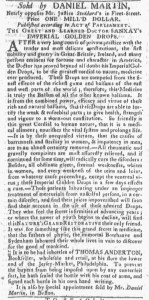
Boston-Gazette (June 3, 1771).

“It is also by special appointment sold by Mr. Daniel Martin, in Boston.”

Many patent medicines were widely available from apothecaries, shopkeepers, and even printers throughout the American colonies.  From New England to Georgia, newspaper advertisements listed popular remedies, including Stoughton’s Elixir, Bateman’s Drops, and Hooper’s Pills.  Consumers recognized the various brands and understood which symptoms each supposedly relieved without encountering additional information in the advertisements.

Other patent medicines, however, were not as widely available.  Such was the case for the “GREAT AND LEARNED DOCTOR SANXAY’s IMPERIAL GOLDEN DROPS,” the subject of a lengthy advertisement in the June 3, 1771, edition of the Boston-Gazette.  The Imperial Golden Drops required greater elaboration since they were not as widely familiar to consumers as many other medicines.  The advertisement explained that the Imperial Golden Drops “are composed from the finest essence of the richest gums and balsams of the east and west parts of the world; therefore, this Medicine is truly the Balsam of all the other known balsams.”  The advertisement claimed that this restorative could “fortify the weak & enfeebled parts; to give health, strength and vigour to a worn-out constitution.”  The Imperial Golden Drops aided with “rheumatic and gravelly complaints” as well as “barrenness and sterility in women, & impotency in men.”

Consumers could not acquire this nostrum in just any shop in the colonies.  Instead, it was exclusively available from a select few vendors.  Thomas Anderton, a bookseller in Philadelphia, began advertising the Imperial Golden Drops in January 1771.  According to his advertisement in the January 31 edition of the Pennsylvania Gazette, Anderton supplied customers to the south via “WILLIAM DIELEY, Post-rider, from Philadelphia to Virginia” and “Mr. BALL, the sign of the White Horse, in Annapolis.”  Several months later, Daniel Martin supplied the Imperial Golden Drops to consumers in Boston.  Martin reprinted Anderton’s advertisement that first ran in the Pennsylvania Chronicle on February 18, adding an additional headline and a final note.  The headline proclaimed, “Sold by DANIEL MARTIN,” and listed the price before transitioning to the copy originally printed in other newspapers.  That copy included a short paragraph identifying Anderton as the supplier.  It also warned against counterfeits, noting that Anderton “hath sealed the bottle with his coat of arms, and signed each bottle in his own hand writing.”  For local customers, Martin added a brief note: “It is also by special appointment sold by Mr. Daniel Martin, in Boston.”

Apothecaries and other retailers in Boston marketed a variety of patent medicines found in shops throughout the colonies, but Martin provided access to an elixir not stocked elsewhere in the city.  His “special appointment” to sell the Imperial Golden Drops in New England made him the sole vendor of a patent medicine billed as “the greatest … medicine ever produced.”  Martin likely hoped that such exclusivity generated demand and added value to the unique product he hawked to prospective patients in Boston and surrounding towns.

Slavery Advertisements Published June 3, 1771

The Slavery Adverts 250 Project chronicles the role of newspaper advertising in perpetuating slavery in the era of the American Revolution. The project seeks to reveal the ubiquity of slavery in eighteenth-century life from New England to Georgia by republishing advertisements about enslaved people – for sale as individuals or in groups, wanted to purchase or for hire for short periods, runaways who liberated themselves, and those who were subsequently captured and confined in jails and workhouses – in daily digests on this site as well as in real time via the @SlaveAdverts250 Twitter feed, utilizing twenty-first-century media to stand in for the print media of the eighteenth century.

The project aims to provide modern audiences with a sense of just how often colonists encountered these advertisements in their daily lives. Enslaved men, women, and children appeared in print somewhere in the colonies almost every single day. Those advertisements served as a constant backdrop for social, cultural, economic, and political life in colonial and revolutionary America. Colonists who did not purport to own enslaved people were still confronted with slavery as well as invited to maintain the system by purchasing enslaved men, women, and children or assisting in the capture of so-called “runaways” who sought to free themselves from bondage. The frequency of these newspaper advertisements suggests just how embedded slavery was in colonial and revolutionary American culture in everyday interactions beyond the printed page.

These advertisements also testify to the experiences of enslaved men, women, and children, though readers must consider that those experiences have been remediated through descriptions offered by enslavers rather than enslaved people themselves. Often unnamed in the advertisements, enslaved men, women, and children were not invisible or unimportant in early America.

These advertisements appeared in colonial American newspapers 250 years ago today.

Boston Evening-Post (June 3, 1771).

**********

Boston-Gazette (June 3, 1771).

**********

New-York Gazette and Weekly Mercury (June 3, 1771).

**********

New-York Gazette and Weekly Mercury (June 3, 1771).

**********

New-York Gazette and Weekly Mercury (June 3, 1771).

**********

New-York Gazette and Weekly Mercury (June 3, 1771).

**********

Supplement to the New-York Gazette and Weekly Mercury (June 3, 1771).

**********

Supplement to the New-York Gazette and Weekly Mercury (June 3, 1771).

**********

South-Carolina and American General Gazette (June 3, 1771).

**********

South-Carolina and American General Gazette (June 3, 1771).

**********

South-Carolina and American General Gazette (June 3, 1771).

**********

South-Carolina and American General Gazette (June 3, 1771).

**********

South-Carolina and American General Gazette (June 3, 1771).

**********

South-Carolina and American General Gazette (June 3, 1771).

**********

South-Carolina and American General Gazette (June 3, 1771).

**********

South-Carolina and American General Gazette (June 3, 1771).

**********

South-Carolina and American General Gazette (June 3, 1771).

**********

South-Carolina and American General Gazette (June 3, 1771).

**********

South-Carolina and American General Gazette (June 3, 1771).

**********

South-Carolina and American General Gazette (June 3, 1771).

**********

South-Carolina and American General Gazette (June 3, 1771).

**********

South-Carolina and American General Gazette (June 3, 1771).

**********

South-Carolina and American General Gazette (June 3, 1771).

June 2

What was advertised in a colonial American newspaper 250 years ago this week?

Maryland Gazette (May 30, 1771).

“The newest and neatest Fashion, either in Europe or America.”

In the spring of 1771, Peter Sinnott, a “TAYLOR, from Dublin,” introduced himself to the residents of Annapolis in an advertisement in the Maryland Gazette.  He advised prospective clients, both “Gentlemen” and “Ladies,” that he “carries on his Trade in all its Branches.”  The tailor also pledged that his customers “may depend on having their Cloaths well made.”  Like many other artisans, Sinnott incorporated the combination of quality, skill, and expertise into his newspaper notices.

He also included an appeal to fashion, another common marketing strategy for tailors, milliners, and others who made garments.  Sinnott proclaimed that he produced clothing “in the newest and neatest Fashion, either in Europe or America.”  In so doing, he demonstrated that he expected anxieties about wearing the latest styles resonated even in smaller ports.  Simultaneously, he attempted to stoke those anxieties.  Annapolis was not nearly as large as Boston, Charleston, New York, or Philadelphia, but that did not mean that consumers there could not be as cosmopolitan in their appearances as their counterparts in those major urban ports.  Yet that was not the extent of the promise that Sinnott made.  His clients in Annapolis could not only keep pace with fashionable gentlemen and ladies throughout the colonies but also with trendsetters on the other side of the Atlantic.

Sinnott realized that it would take time to establish his reputation and cultivate a clientele for his garments.  In order to earn a living while he did so, he also promoted an ancillary service, declaring that he “scours and cleans Cloaths in a superior Manner than has hitherto been done in this Place.”  Furthermore, he had perfected a method for “taking Spots and Stains out of Scarlet Cloth.”  Each time he interacted with clients who hired him to clean their garments, Sinnott had an opportunity to offer his services as a tailor.  One branch of his business supported the other, possibly resulting in new commissions.

In a short advertisement, Sinnott presented “the PUBLICK” with several reasons to him.  He emphasized his skill and the quality of his garments while reassuring prospective clients that he would outfit them in the latest styles.  He also provided additional services for the benefit of his clients.  As Sinnott’s advertisement demonstrates, eighteenth-century newspaper notices did not merely announce the availability of consumer goods and services.  Instead, advertisers constructed appeals intended to incite demand and convince readers to visit their shops.

June 1

What was advertised in a colonial American newspaper 250 years ago today?

Providence Gazette (June 1, 1771).

“At the Sign of the Turk’s Head.”

In an era before standardized street numbers, merchants, shopkeepers, artisans, and others devised a variety of methods for denoting their locations in their newspaper advertisements.  William Eliot, for instance, kept shop at “the South End of Col. Knight Dexter’s House, opposite the Printing-Office” in Providence.  Jabez Bowen sold “ENGLISH GOODS” and medicines “at his Store on the Wharff of Samuel Chace.”  Beyond Providence, Nathaniel Greene “opened a Shop in … East-Greenwich, in the House where Captain Benjamin Green formerly dwelt.”

The directions in each of these advertisements depended on some level of knowledge of local people and landmarks.  Other advertisers in Providence and the surrounding towns supplemented the directions they gave to prospective customers with shop signs that definitively marked their locations.  Clark and Nightingale advised prospective customers that they could find their store “near the Court House, at the Sign of the Fish and Frying Pan.”  Thurber and Cahoon operated their business “At the Sign of the Bunch of Grapes, North End.”  Paul Allen invited “Ladies and Gentlemen both in Town and Country” to visit his shop “at the Corner of the Great Bridge in Providence, at the Sign of the Turk’s Head.” Along with all of these advertisements in the June 1, 1771, edition of the Providence Gazette, printer John Carter listed the location of his printing office, including a shop sign, in the colophon.  Anyone seeking to do business with him needed to look for “Shakespear’s Head, in King-Street, near the Court-House.”

These many and varied shop signs testify to a visual landscape of urban spaces that has transformed over the years.  The use of distinctive devices featuring words and images to mark locations continues today.  Although the Sign of the Fish and Frying Pan and the Sign of the Bunch of Grapes are no longer on display in Providence, residents and visitors encounter many other signs that aid them in finding specific locations and navigating the streets of the city.  In that regard, their experiences are similar to those of colonists who traveled the same streets more than two centuries earlier, even though the visual culture of urban spaces has evolved in that time.