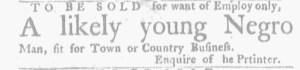
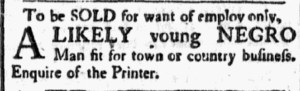
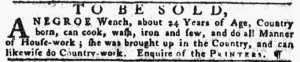
Slavery Advertisements Published July 18, 1771

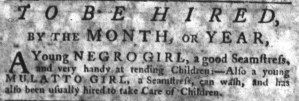
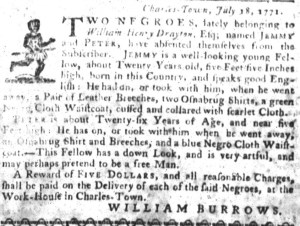
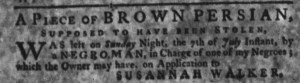
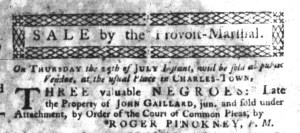
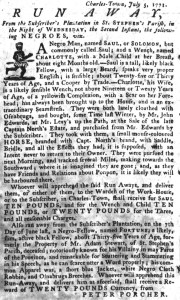
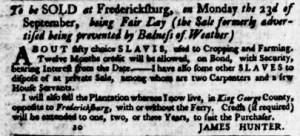
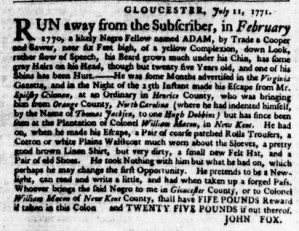
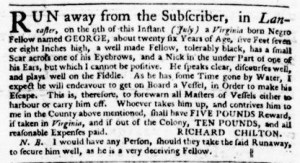
The Slavery Adverts 250 Project chronicles the role of newspaper advertising in perpetuating slavery in the era of the American Revolution. The project seeks to reveal the ubiquity of slavery in eighteenth-century life from New England to Georgia by republishing advertisements about enslaved people – for sale as individuals or in groups, wanted to purchase or for hire for short periods, runaways who liberated themselves, and those who were subsequently captured and confined in jails and workhouses – in daily digests on this site as well as in real time via the @SlaveAdverts250 Twitter feed, utilizing twenty-first-century media to stand in for the print media of the eighteenth century.

The project aims to provide modern audiences with a sense of just how often colonists encountered these advertisements in their daily lives. Enslaved men, women, and children appeared in print somewhere in the colonies almost every single day. Those advertisements served as a constant backdrop for social, cultural, economic, and political life in colonial and revolutionary America. Colonists who did not purport to own enslaved people were still confronted with slavery as well as invited to maintain the system by purchasing enslaved men, women, and children or assisting in the capture of so-called “runaways” who sought to free themselves from bondage. The frequency of these newspaper advertisements suggests just how embedded slavery was in colonial and revolutionary American culture in everyday interactions beyond the printed page.

These advertisements also testify to the experiences of enslaved men, women, and children, though readers must consider that those experiences have been remediated through descriptions offered by enslavers rather than enslaved people themselves. Often unnamed in the advertisements, enslaved men, women, and children were not invisible or unimportant in early America.

These advertisements appeared in colonial American newspapers 250 years ago today.
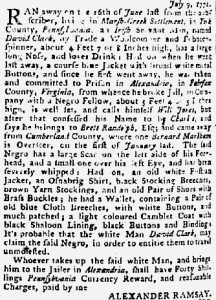
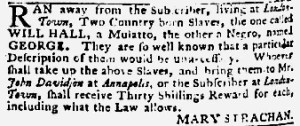
Maryland Gazette (July 18, 1771).

**********

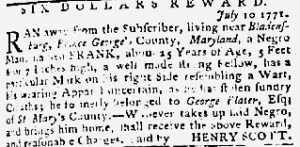
Maryland Gazette (July 18, 1771).

**********

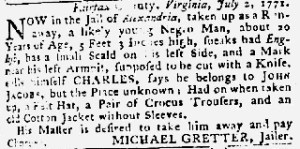
Maryland Gazette (July 18, 1771).

**********

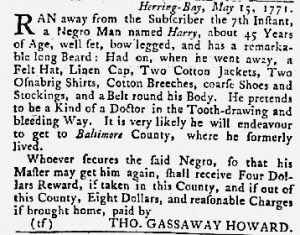
Maryland Gazette (July 18, 1771).

**********

Maryland Gazette (July 18, 1771).

**********

Maryland Gazette (July 18, 1771).

**********

Massachusetts Gazette and Boston Weekly News-Letter (July 18, 1771).

**********

Massachusetts Gazette and Boston Weekly News-Letter (July 18, 1771).

**********

Massachusetts Spy (July 18, 1771).

**********

Pennsylvania Gazette (July 18, 1771).

**********

Pennsylvania Journal (July 18, 1771).

**********

South-Carolina Gazette (July 18, 1771).

**********

South-Carolina Gazette (July 18, 1771).

**********

South-Carolina Gazette (July 18, 1771).

**********

South-Carolina Gazette (July 18, 1771).

**********

South-Carolina Gazette (July 18, 1771).

**********

South-Carolina Gazette (July 18, 1771).

**********

South-Carolina Gazette (July 18, 1771).

**********

South-Carolina Gazette (July 18, 1771).

**********

South-Carolina Gazette (July 18, 1771).

**********

Virginia Gazette [Purdie and Dixon] (July 18, 1771).

**********

Virginia Gazette [Purdie and Dixon] (July 18, 1771).

**********

Virginia Gazette [Purdie and Dixon] (July 18, 1771).

**********

Virginia Gazette [Purdie and Dixon] (July 18, 1771).

**********

Virginia Gazette [Purdie and Dixon] (July 18, 1771).

**********

Virginia Gazette [Purdie and Dixon] (July 18, 1771).

**********

Virginia Gazette [Purdie and Dixon] (July 18, 1771).

**********

Virginia Gazette [Purdie and Dixon] (July 18, 1771).

**********

Virginia Gazette [Purdie and Dixon] (July 18, 1771).

**********

Virginia Gazette [Purdie and Dixon] (July 18, 1771).

**********

Virginia Gazette [Rind] (July 18, 1771).

**********

Virginia Gazette [Rind] (July 18, 1771).

**********

Virginia Gazette [Rind] (July 18, 1771).

**********

Virginia Gazette [Rind] (July 18, 1771).

**********

Virginia Gazette [Rind] (July 18, 1771).

**********

Virginia Gazette [Rind] (July 18, 1771).

**********

Virginia Gazette [Rind] (July 18, 1771).

**********

Virginia Gazette [Rind] (July 18, 1771).

**********

Virginia Gazette [Rind] (July 18, 1771).

July 17

What was advertised in a colonial American newspaper 250 years ago this week?

Boston-Gazette (July 15, 1771).

“PROPOSALS For PRINTING by SUBSCRIPTION.”

In the summer of 1771, James Humphreys wished to publish an American edition of William Robertson’s History of Scotland during the Reigns of Queen Mary and of King James VI, perhaps inspired in part by Robert Bell’s efforts to publish an American edition of Robertson’s History of the Reign of Charles the Fifth, Emperor of Germany.  To that end, Humphreys adopted a method pursued by Bell and other printers and publishers when they wished to gauge interest and incite demand for a publication.  He distributed a subscription notice, calling on subscribers to reserve copies in advance.  The number of subscribers determined the viability of a publication.

Such endeavors depended on regional, rather than local, markets.  Humphreys promoted the project in his own city, Philadelphia, but he also placed “PROPOSALS For PRINTING by SUBSCRIPTION” in newspapers published elsewhere, including in the July 15, 1771, edition of the Boston-Gazette.  He listed the printers of that newspaper, Benjamin Edes and John Gill, as local agents who accepted subscriptions, but also noted that “the different Printers and Stationers on the continent” handled subscriptions in other places.  Such projects often depended on cultivating networks of local agents.

In the “CONDITIONS,” Humphreys specified that the two volumes of Robertson’s History would go to press “as soon as three hundred subscribers have given their names.”  To entice prospective buyers, he pledged that the “names of the subscribers [would] be printed in the beginning of the first volume.”  As a result, subscribers received more than just the books; they also received recognition as members of a learned community who simultaneously supported American publications as alternatives to imported books.  Humphreys charged one dollar per volume, two dollars total, as well as the “expense of sending them to distant places.”  Unlike some other subscription projects, however, he did not collect money in advance to secure the commitments made by subscribers and offset initial costs for producing the books.  Instead, he declared, “No money is expected but on delivery of the books.”  He likely hoped to attract more subscribers by not requiring a down payment.

Unfortunately for Humphreys, his marketing efforts apparently did not yield the necessary number of subscribers to move forward with the project.  He acknowledged Bell’s “lately published beautiful History of CHARLES V. Emperor of Germany” in the subscription notice.  Rather than creating an opening for another printer to publish an American edition of one of Robertson’s other works, Bell and his aggressive marketing campaign in newspapers throughout the colonies may have saturated the market.

July 16

What was advertised in a colonial American newspaper 250 years ago today?

Essex Gazette (July 16, 1771).

“He has got two Sorts of Chairs made by him which are called as neat as any that are made in Boston.”

When Joseph P. Goodwin set up shop in Salem in the summer of 1771, he placed an advertisement in the Essex Gazette“to inform all Gentlemen and others” that he “makes the best Sort of Mahogany Chairs, Couches and easy Chairs, Sofa’s, and any Thing in the Chair-making Business.”  To attract customers, especially those not yet familiar with his work, he deployed some of the appeals early American artisans most commonly incorporated into their newspaper advertisements.  “All Gentlemen and others that will favour him their Custom,” Goodwin proclaimed, “may depend upon having Work done in the neatest Manner.”  Such an assertion had multiple purposes, evoking both the quality of the chairs and other furniture and the skill of the chairmaker.  In addition, Goodwin promised good customer service, declaring that he attended to clients “with Fidelity and Dispatch.”

In addition to those standard appeals, Goodwin devoted a nota bene to favorable comparisons between the chairs he produced and those from workshops in Boston.  That he made his furniture from mahogany already testified to his understanding of quality and fashion in the eighteenth-century marketplace, but Goodwin embellished his advertisement with additional details.  He trumpeted that “Chairs made by him … are called as neat as any that are made in Boston.”  He did not, however, indicate who made that assessment, whether it was a pronouncement he made on his own or a recommendation made by former customers or others.  The wording suggested that others bestowed that designation on Goodwin’s chairs, but he did not offer further elaboration.  He may have considered it unnecessary, believing that his confidence in making such a statement would entice prospective customers to visit his shop to see his chairs and other furniture for themselves.  Like many merchants, shopkeepers, and artisans who advertised in the Essex Gazette, Goodwin refused to allow competitors in Boston to overshadow his workshop in Salem.  Boston was the bigger port, but that did not necessarily mean better merchandise than readers of the Essex Gazette could find in local stores and workshops.

Slavery Advertisements Published July 16, 1771

The Slavery Adverts 250 Project chronicles the role of newspaper advertising in perpetuating slavery in the era of the American Revolution. The project seeks to reveal the ubiquity of slavery in eighteenth-century life from New England to Georgia by republishing advertisements about enslaved people – for sale as individuals or in groups, wanted to purchase or for hire for short periods, runaways who liberated themselves, and those who were subsequently captured and confined in jails and workhouses – in daily digests on this site as well as in real time via the @SlaveAdverts250 Twitter feed, utilizing twenty-first-century media to stand in for the print media of the eighteenth century.

The project aims to provide modern audiences with a sense of just how often colonists encountered these advertisements in their daily lives. Enslaved men, women, and children appeared in print somewhere in the colonies almost every single day. Those advertisements served as a constant backdrop for social, cultural, economic, and political life in colonial and revolutionary America. Colonists who did not purport to own enslaved people were still confronted with slavery as well as invited to maintain the system by purchasing enslaved men, women, and children or assisting in the capture of so-called “runaways” who sought to free themselves from bondage. The frequency of these newspaper advertisements suggests just how embedded slavery was in colonial and revolutionary American culture in everyday interactions beyond the printed page.

These advertisements also testify to the experiences of enslaved men, women, and children, though readers must consider that those experiences have been remediated through descriptions offered by enslavers rather than enslaved people themselves. Often unnamed in the advertisements, enslaved men, women, and children were not invisible or unimportant in early America.

These advertisements appeared in colonial American newspapers 250 years ago today.

South-Carolina Gazette and Country Journal (July 16, 1771).

**********

South-Carolina Gazette and Country Journal (July 16, 1771).

**********

South-Carolina Gazette and Country Journal (July 16, 1771).

**********

South-Carolina Gazette and Country Journal (July 16, 1771).

**********

South-Carolina Gazette and Country Journal (July 16, 1771).

**********

South-Carolina Gazette and Country Journal (July 16, 1771).

**********

South-Carolina Gazette and Country Journal (July 16, 1771).

**********

South-Carolina Gazette and Country Journal (July 16, 1771).

**********

Supplement to the South-Carolina Gazette and Country Journal (July 16, 1771).

**********

Supplement to the South-Carolina Gazette and Country Journal (July 16, 1771).

**********

Supplement to the South-Carolina Gazette and Country Journal (July 16, 1771).

**********

Supplement to the South-Carolina Gazette and Country Journal (July 16, 1771).

**********

Supplement to the South-Carolina Gazette and Country Journal (July 16, 1771).

**********

Supplement to the South-Carolina Gazette and Country Journal (July 16, 1771).

**********

Supplement to the South-Carolina Gazette and Country Journal (July 16, 1771).

**********

Supplement to the South-Carolina Gazette and Country Journal (July 16, 1771).

**********

Supplement to the South-Carolina Gazette and Country Journal (July 16, 1771).

**********

Supplement to the South-Carolina Gazette and Country Journal (July 16, 1771).

July 15

What was advertised in a colonial American newspaper 250 years ago today?

Boston Evening-Post (July 15, 1771).

“Buy worth a Dollar, when you come, / And you may drink a Glass of Rum.”

Lydia Learned received some free advertising in the July 15, 1771, edition of the Boston Evening-Post.  She distributed a handbill that listed a variety of items available at her shop “Near the Sign of the Punch-Bowl” in Brookline.  Intrigued by the advertisement, Thomas Fleet and John Fleet, the printers of the Boston Evening-Post, inserted it in its entirety along with a note advising, “The following advertisement, copied from one in the Punch Bowl Tavern in Brookline, we publish for the Amusement of out Poetical Readers.”  Indeed, the poetry, not the assortment of goods offered for sale, attracted their attention.  Few advertisers attempted to transform their inventory into poetry in newspaper notices or on broadsides and handbills, helping to make Learned’s advertisement more memorable.

Her poetry featured three stanzas of four lines each, the second and fourth lines rhyming.  Learned devoted the first stanza entirely to her wares:  “FLOUR, Raisons, Rice, Molosses, Spice, / Good Indigo and Wire, / Knives[,] Combs, Fish-hooks, Verses and Books, / And Paper by the Quire.”  In the remaining stanzas, she used the final line to make appeals to prospective customers.  In the second, for instance, she listed “Sugar[,] Bisket and Chocolate, / Tinn, Glass and Earthen-ware, / Pins, Needles[,] Thread and Ginger-bread, / As good as any where.”  Her shop may have been humble compared to the larger enterprises operated by other entrepreneurs, but Learned assured prospective customers that the size of her business did not negatively affect the quality of her merchandise.  In the final stanza, she offered an additional incentive to shoppers.  “Salt, Allum, Coffee, Tea, and Snuff, / Crown-Soap and Candles, cheap enough / Buy worth a Dollar when you come, / And you may drink a glass of RUM.”  Perhaps the nip of alcohol as much as the poetry amused the Fleets and convinced them to reprint Learned’s handbill in their newspapers.

Learned was not the only entrepreneur to have the text from a trade card or billhead also printed in an eighteenth-century newspaper.  On May 5, 1768, Mary Symonds, a milliner in Philadelphia, ran a lengthy advertisement in the Pennsylvania Gazette.  In it, she listed dozens of items among her inventory.  She also distributed a trade card that reiterated, with minor variations, the text from the newspaper advertisement.  In October and November 1770, she recorded a receipted bill for items purchased by the Cadwalader family on the reverse, suggesting that Symonds kept her trade card in circulation for some time.

Symonds seems to have made a more intentional effort than Learned when it came to deploying advertisements in multiple formats.  All the same, Learned demonstrated creativity in devising a billhead that distinguished her business from her competitors.  If prospective customers did not appreciate the poetry, then the promise of a glass of rum offered as a premium for making a purchase may have convinced them to check out her merchandise.

Lydia Learned, Trade Card, ca. 1771. Courtesy American Antiquarian Society.

Slavery Advertisements Published July 15, 1771

The Slavery Adverts 250 Project chronicles the role of newspaper advertising in perpetuating slavery in the era of the American Revolution. The project seeks to reveal the ubiquity of slavery in eighteenth-century life from New England to Georgia by republishing advertisements about enslaved people – for sale as individuals or in groups, wanted to purchase or for hire for short periods, runaways who liberated themselves, and those who were subsequently captured and confined in jails and workhouses – in daily digests on this site as well as in real time via the @SlaveAdverts250 Twitter feed, utilizing twenty-first-century media to stand in for the print media of the eighteenth century.

The project aims to provide modern audiences with a sense of just how often colonists encountered these advertisements in their daily lives. Enslaved men, women, and children appeared in print somewhere in the colonies almost every single day. Those advertisements served as a constant backdrop for social, cultural, economic, and political life in colonial and revolutionary America. Colonists who did not purport to own enslaved people were still confronted with slavery as well as invited to maintain the system by purchasing enslaved men, women, and children or assisting in the capture of so-called “runaways” who sought to free themselves from bondage. The frequency of these newspaper advertisements suggests just how embedded slavery was in colonial and revolutionary American culture in everyday interactions beyond the printed page.

These advertisements also testify to the experiences of enslaved men, women, and children, though readers must consider that those experiences have been remediated through descriptions offered by enslavers rather than enslaved people themselves. Often unnamed in the advertisements, enslaved men, women, and children were not invisible or unimportant in early America.

These advertisements appeared in colonial American newspapers 250 years ago today.

Boston Evening-Post (July 15, 1771).

**********

Boston Evening-Post (July 15, 1771).

**********

Boston-Gazette (July 15, 1771).

**********

Boston-Gazette (July 15, 1771).

**********

New-York Gazette and Weekly Mercury (July 15, 1771).

**********

Supplement to the New-York Gazette and Weekly Mercury (July 15, 1771).

**********

Supplement to the New-York Gazette and Weekly Mercury (July 15, 1771).

**********

Supplement to the New-York Gazette and Weekly Mercury (July 15, 1771).

**********

Supplement to the New-York Gazette and Weekly Mercury (July 15, 1771).

**********

Pennsylvania Chronicle (July 15, 1771).

**********

South-Carolina and American General Gazette (July 15, 1771).

**********

South-Carolina and American General Gazette (July 15, 1771).

**********

South-Carolina and American General Gazette (July 15, 1771).

**********

South-Carolina and American General Gazette (July 15, 1771).

**********

South-Carolina and American General Gazette (July 15, 1771).

**********

South-Carolina and American General Gazette (July 15, 1771).

**********

South-Carolina and American General Gazette (July 15, 1771).

**********

South-Carolina and American General Gazette (July 15, 1771).

**********

South-Carolina and American General Gazette (July 15, 1771).

July 14

What was advertised in a colonial American newspaper 250 years ago this week?

Maryland Gazette (July 11, 1771).

“He further proposes to engage his Performance for One Year.”

In the summer of 1771, Thomas Morgan announced to “the Publick” that he “has opened a Shop” in Annapolis, “WHERE he intends to carry on the Business of Watch and Clock-making, in all its various Branches.”  In an advertisement that ran in the Maryland Gazette for five weeks, he assured “Gentlemen that will please to favour him with their Custom” that they would receive attentive and efficient service when they visited his shop.  Most artisans, as well as many other purveyors of goods and services, made similar promises about customer service in their newspaper advertisements.

In addition to making clocks and watches, Morgan also cleaned and repaired them.  To entice prospective patrons to give him a chance to demonstrate his skill, he proclaimed that he performed those services “in the best Manner.”  Furthermore, he offered a guarantee, a marketing strategy commonly adopted by watch- and clockmakers.  John Simnet, a watchmaker who set up shop in New Hampshire, in the late 1760s and migrated to New York in the early 1770s, declared in one of his advertisements that “Such Watches as have been repaired by me, if become foul, or require Alteration, may be clean’d, &c. gratis.”  Similarly, Morgan asserted that he would “engage his Performance for One Year, provided the Owner don’t abuse the same.”  Patrons who experienced difficulty could return their timepieces to his shop for additional repairs and cleaning free of charge, though Morgan assessed whether the problems originated with any sort of misuse on the part of owners.

While such guarantees protected the interests of clients, they also testified to the confidence watch- and clockmakers had in their abilities.  Artisans like Morgan and Simnet would not have offered guarantees if they anticipated that they would have to expend significant time and resources in fulfilling them.  Guarantees also communicated to customers that even though Morgan and Simnet would address any problems that arose, they strove to do the job right the first time.

July 13

What was advertised in a colonial American newspaper 250 years ago today?

Providence Gazette (July 13, 1771).

“Just arrived in the Tristram, Captain Shand, from London, a fine Assortment of Hard Ware and other GOODS.”

In the summer of 1771, the partnership of Nicholas, Joseph, and Moses Brown informed retailers in Providence and surrounding towns that they carried “a fine Assortment of Hard Ware and other GOODS, which they will sell on the lowest Terms, by Wholesale.”  The merchants also indicated that they imported their inventory from London aboard the Tristram, a ship that recently arrived in port.  In so doing, they followed a custom adopted by many other purveyors of goods who placed newspaper advertisements in the eighteenth century.

The two advertisements immediately above the Browns’ notice in the July 13, 1771, edition of the Providence Gazettealso made reference to the Tristram.  Edward Thurber proclaimed that he sold “A Good Assortment of HARD WARE and PIECE GOODS” imported from London “in the Snow Tristram, Captain Shand.”  Similarly, Joseph Russell and William Russell had in stock “A VERY large and neat Assortment of English Goods, Ironmongery, Brasiery, Cutlery, Haberdashery, [and] Stationary” that they received from London “in the Ship Providence, and in the Snow Tristram.”

In their advertisement, Lovett and Greene promoted “A NEAT Assortment of English, East and West India GOODS.”  They also declared that they “Just imported” their merchandise, but they did not list the vessels that transported the goods across the Atlantic.  Neither did Robert Nesbitt, who asserted that he sold “an Assortment of Goods … immediately imported from Ireland.”  Most advertisements ran for several weeks and some for several months, making it more difficult for prospective customers to assess what “Just imported” or “immediately imported” meant when not stated in connection with vessels that arrived from other ports.  Thurber, the Russells, and the “COMPANY” formed by the Browns, on the other hand, provided valuable information that readers could compare to either the shipping news that ran elsewhere in the newspaper or general knowledge about when vessels arrived in port.  A detail that may seem quaint by modern standards revealed important context for prospective customers in the eighteenth century.

July 12

What was advertised in a colonial American newspaper 250 years ago today?

“INN at Newbury-Port.”

New-Hampshire Gazette (July 12, 1771).

When Robert Calder became the proprietor of an inn in Newburyport, Massachusetts, in the early 1770s, he turned to the New-Hampshire Gazette to promote his new venture to travelers and other prospective patrons.  He hoped to benefit from the reputation achieved by the former proprietor, William Lambert.  Although Lambert operated a “noted INN,” Calder made improvements for the comfort of his guests, declaring that the establishment “is now further repair’d and furnish’d with convenient Accommodations for Travellers.”  In addition, the inn provided “good Stabling for Horses.”  Calder also promised “the best Entertainment” and “diligent Attendance” for patrons.

Calder did not indicate that he possessed prior experience serving “Travellers and others” at an inn, tavern, coffeehouse, or similar establishment (though he previously advertised a coffeehouse), but he prominently listed another credential intended to assure prospective patrons that he was prepared to attend to their needs.  He introduced himself as “late Servant to his Excellency GOVERNOR WENTWORTH,” suggesting that he previously earned the trust of the official who had served as governor of New Hampshire since 1767 (and would continue to do so until the colony became a state in 1775).  Having served the governor, Calder contended that he could competently run an inn.

Calder did not rely on the New-Hampshire Gazette alone when it came to promoting his inn in the public prints.  In early July 1771, he placed the same advertisement in the Essex Gazette, published in Salem, Massachusetts, and a slightly different version in the Massachusetts Gazette and Boston Weekly News-Letter.  In so doing, he pursued a regional marketing campaign, an appropriate strategy for an entrepreneur seeking to provide services to travelers.  He limited the scope to newspapers from towns nearest to the inn, figuring readers of those publications might have occasion to visit or pass through Newburyport.  Some may have already been aware of the inn formerly run by Lambert, but Calder aimed to give added incentive to eat, drink, and sleep at his place.

July 11

What was advertised in a colonial American newspaper 250 years ago today?

South-Carolina Gazette (July 11, 1771).

“THE Printer of this Paper … GIVES THIS EARLY NOTICE.”

Peter Timothy, printer of the South-Carolina Gazette, made it impossible for readers to ignore the notices that he ran in his newspaper for several weeks beginning in the summer of 1771.  He exercised his prerogative as printer in designing a format that made his notice the most visible item in the newspaper, running it immediately below the masthead and across all three columns on the first page.  Dated July 1, Timothy’s notice first appeared on July 4 and then in the next four issues before he inserted a revised version in subsequent editions.  The printer informed readers that he intended “to have all his Affairs settled by the First of January next, so that he may depart the Province by the Beginning of Aprilfollowing.”  To that end, he “GIVES THIS EARLY NOTICE thereof, to all Persons indebted to him, that they may prepare to make Payment to their Accompts … without giving him the unnecessary Trouble of calling again and again.”  In addition, for those “many Subscribers in the Country whom he does not know, he begs such will give their Factors or Agents proper Orders to settle with him.”

Advertising on the front page was not unusual in and off itself.  The South-Carolina Gazette regularly featured advertisements on the first page.  In the July 11 edition, Thomas Powell’s advertisement for “Dr. KEYSER’s famous PILLS” filled the entire first column, under a heading that labeled it a “New Advertisement,” making it the first item readers encountered below the masthead and Timothy’s notice.  News from London comprised most of the second column, before a heading for “New Advertisements” introduced two shorter notices, one seeking passengers and freight for a ship departing for Philadelphia and the other calling on colonists to settle accounts with Robert Dillon.  The third column contained a brief account of news from Charleston, a list of prices current of “South-Carolina Produce and Manufactures,” and “Timothy’s Marine List” (as the printer branded the shipping news from the customs house when he printed it in his newspaper).  Readers of the South-Carolina Gazette were accustomed to seeing a variety of items, including advertisements, on the front page.  Timothy could have made his notice the first item in the first column without altering the format of the page, complete with a “New Advertisement” heading, but that would have risked readers passing over it.  Instead, he created a distinctive format that demanded readers give their attention to his important notice.  Just as the incomplete “Marine List” on the front page included instructions to “[Turn to the last Page.]” for the remainder, the printer also deployed graphic design to guide readers in navigating the newspaper.