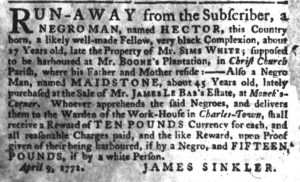
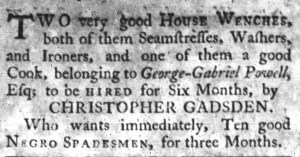
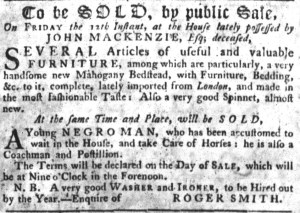
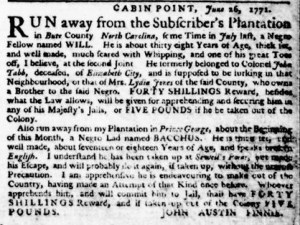
The Slavery Adverts 250 Project chronicles the role of newspaper advertising in perpetuating slavery in the era of the American Revolution. The project seeks to reveal the ubiquity of slavery in eighteenth-century life from New England to Georgia by republishing advertisements about enslaved people – for sale as individuals or in groups, wanted to purchase or for hire for short periods, runaways who liberated themselves, and those who were subsequently captured and confined in jails and workhouses – in daily digests on this site as well as in real time via the @SlaveAdverts250 Twitter feed, utilizing twenty-first-century media to stand in for the print media of the eighteenth century.
The project aims to provide modern audiences with a sense of just how often colonists encountered these advertisements in their daily lives. Enslaved men, women, and children appeared in print somewhere in the colonies almost every single day. Those advertisements served as a constant backdrop for social, cultural, economic, and political life in colonial and revolutionary America. Colonists who did not purport to own enslaved people were still confronted with slavery as well as invited to maintain the system by purchasing enslaved men, women, and children or assisting in the capture of so-called “runaways” who sought to free themselves from bondage. The frequency of these newspaper advertisements suggests just how embedded slavery was in colonial and revolutionary American culture in everyday interactions beyond the printed page.
These advertisements also testify to the experiences of enslaved men, women, and children, though readers must consider that those experiences have been remediated through descriptions offered by enslavers rather than enslaved people themselves. Often unnamed in the advertisements, enslaved men, women, and children were not invisible or unimportant in early America.
These advertisements appeared in colonial American newspapers 250 years ago today.
What was advertised in a colonial American newspaper 250 years ago this week?
Pennsylvania Chronicle (July 8, 1771).
“A small warehouse … in Baltimore.”
The Pennsylvania Chronicle, like other American newspapers published prior to the American Revolution, served a large region. Published in Philadelphia, it circulated in Pennsylvania, Delaware, New Jersey, Maryland, and New York. Some copies certainly made their way to even more distant places, but it was residents of those colonies that considered the Pennsylvania Chronicle a local newspaper in terms of subscribing and advertising.
Such was the case for James Clarke, a woolen manufacturer in Baltimore, when he wished to inform “all Merchants and Traders, that he has just imported … A NEAT assortment” of merchandise “which he purposes to dispose of by wholesale.” He invited “any merchant or tobacco planter” to contact him or visit his warehouse “at the sign of Pitt’s Head, in Baltimore.” When he placed his advertisement in the Pennsylvania Chronicle in July 1771, Baltimore did not yet have its own newspaper. Just over two years later, William Goddard, the printer of the Pennsylvania Chronicle, would commence publishing the Maryland Journal and Baltimore Advertiser, but for the time being Clarke and others in Baltimore read and advertised in newspapers published elsewhere. In addition to the Pennsylvania Chronicle, they had several options, including the Maryland Gazette published by Anne Catherine Green in Annapolis, the Pennsylvania Gazette published by David Hall and William Sellers in Philadelphia, and the Pennsylvania Journal published by William Bradford and Thomas Bradford in Philadelphia. Henry Miller also published a German-language newspaper, the Wochentliche Pennsylvanische Staatsbote, in Philadelphia. By the end of 1771, John Dunlap launched yet another newspaper in Philadelphia, the Pennsylvania Packet, giving Clarke and others in Baltimore another option for a regional newspaper in the absence of one printed locally.
Advertisements like those placed by Clarke testified to the regional character of the Pennsylvania Chronicle and other newspapers. Many of them included datelines that helped readers navigate the notices and determine which were most relevant to them, such as “Baltimore, July 1, 1771” at the top of Clarke’s advertisement. The woolen manufacturer understood that the publication circulated widely and expected that prospective customers in Baltimore and the surrounding area would see his notice among the greater number of advertisements placed by merchants, shopkeepers, artisans and others who ran businesses in Philadelphia.
What was advertised in a colonial American newspaper 250 years ago today?
Connecticut Courant (July 9, 1771).
“As cheap, and equal in goodness to any sold in New York.”
Purveyors of goods in Hartford and nearby towns frequently assured prospective customers that they had the same opportunities to participate in the marketplace as if they lived in bustling urban ports like Boston and New York. Such was the case in two advertisements that ran in the July 9, 1771, edition of the Connecticut Courant. In the first, Barzillai Hudson, a tobacconist, announced that he sold the “best pig tail and paper tobacco in small or large quantities as cheap, and equal in goodness to any sold in New York.” Like other advertisers in smaller towns, Hudson asserted that he offered the same bargains and the same quality that consumers enjoyed in colonial cities.
In another advertisement, Peter Verstille of Weathersfield demonstrated the vast array of choices he made available to consumers. Divided into two parts, that advertisement extended an entire column. The first portion listed a “fine assortment of GOODS” imported from London and Bristol and received via Boston and New London. Verstille enumerated various kinds of textiles, tableware, and housewares before concluding that portion of his notice with “&c. &c. &c.” Invoking the eighteenth-century abbreviation for et cetera three times underscored consumers could expect to discover many more choices when they visited his shop. That portion of the advertisement initially ran on its own, but Verstille later updated it with another litany of imported goods that arrived via Boston. In particular, he listed hardware items that did not appear in the original. That addition meant that his customers enjoyed one-stop-shopping for their various needs and desires. Verstille also promoted prices that matched those in Boston and New York.
The pages of the Connecticut Courant did not overflow with advertising for consumer goods and services like newspapers published in Boston, Charleston, New York, and Philadelphia. Ebenezer Watson did not need to publish advertising supplements. That did not mean, however, that readers of the Connecticut Courant in the countryside did not participate in the vibrant consumer culture taking place in urban ports. Entrepreneurs like Hudson and Verstille invited and made it possible for even colonists who resided in remote places to participate in the consumer revolution.
The Slavery Adverts 250 Project chronicles the role of newspaper advertising in perpetuating slavery in the era of the American Revolution. The project seeks to reveal the ubiquity of slavery in eighteenth-century life from New England to Georgia by republishing advertisements about enslaved people – for sale as individuals or in groups, wanted to purchase or for hire for short periods, runaways who liberated themselves, and those who were subsequently captured and confined in jails and workhouses – in daily digests on this site as well as in real time via the @SlaveAdverts250 Twitter feed, utilizing twenty-first-century media to stand in for the print media of the eighteenth century.
The project aims to provide modern audiences with a sense of just how often colonists encountered these advertisements in their daily lives. Enslaved men, women, and children appeared in print somewhere in the colonies almost every single day. Those advertisements served as a constant backdrop for social, cultural, economic, and political life in colonial and revolutionary America. Colonists who did not purport to own enslaved people were still confronted with slavery as well as invited to maintain the system by purchasing enslaved men, women, and children or assisting in the capture of so-called “runaways” who sought to free themselves from bondage. The frequency of these newspaper advertisements suggests just how embedded slavery was in colonial and revolutionary American culture in everyday interactions beyond the printed page.
These advertisements also testify to the experiences of enslaved men, women, and children, though readers must consider that those experiences have been remediated through descriptions offered by enslavers rather than enslaved people themselves. Often unnamed in the advertisements, enslaved men, women, and children were not invisible or unimportant in early America.
These advertisements appeared in colonial American newspapers 250 years ago today.
Connecticut Courant (July 9, 1771).
**********
Connecticut Courant (July 9, 1771).
**********
South-Carolina Gazette and Country Journal (July 9, 1771).
**********
South-Carolina Gazette and Country Journal (July 9, 1771).
**********
South-Carolina Gazette and Country Journal (July 9, 1771).
What was advertised in a colonial American newspaper 250 years ago today?
Pennsylvania Chronicle (July 8, 1771).
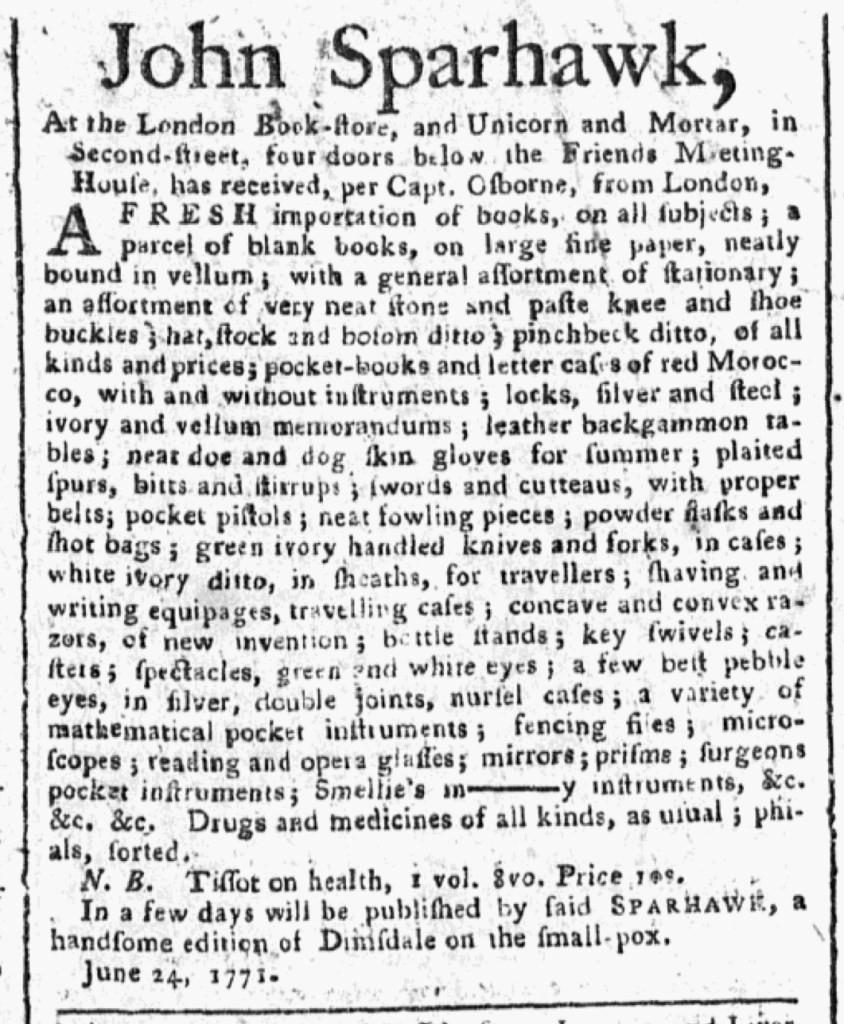
“In a few days will be published by said SPARHAWK, a handsome edition of Dimsdale on the small-pox.”
John Sparhawk cultivated a reputation as a bookseller with a particular interest in medicine. He did so in his advertisements and in choices he made in running “the London Book-store, and Unicorn and Mortar.” The dual name for his location on Second Street in Philadelphia testified to his overlapping business interests. Many booksellers sold patent medicines, but Sparhawk did more than just carry “Drugs and medicines of all kinds.” He also published American editions of medical treatises.
In March 1771, Sparhawk advertised the publication of Samuel-Auguste Tissot’s Advice to the People in General, with Regard to their Health. He continued advertising that volume for sale at his shop into the summer, but he and John Dunlap, the printer, also distributed copies to printers and booksellers in other cities. Thomas Fleet and John Fleet, printers of the Boston Evening-Post, advertised that they sold the book in the July 8 edition of their newspaper. Their notice reiterated a portion of the advertisement Sparhawk ran in the Pennsylvania Journal, asserting that “This Book has been generally approved by People of all Ranks, into whose Hands it has fell, and it’s Character is so well known that it is esteemed needless to add more in its Favor.” As the publisher whose name appeared on the title page of the American edition, Sparhawk aimed to associate himself with that esteem.
Within a few months, the bookseller-apothecary pursued the publication of another medical treatise. In an advertisement in the Pennsylvania Chronicle, he announced that “In a few days will be published by said SPARHAWK, a handsome edition of Dimsdale on the small-pox.” Like Tissot’s Advice to the People, Thomas Dimsdale’s Present Method of Inoculating for the Small-Pox (1767) was a popular book that quickly went into several editions in England. Its success likely made an American edition seem like a safe investment for Sparhawk, but he derived more than just revenues from its publication and sale. He demonstrated a commitment to medicine and public health that distinguished him from other booksellers who merely stocked patent medicines and sold imported medical treatises.
The Slavery Adverts 250 Project chronicles the role of newspaper advertising in perpetuating slavery in the era of the American Revolution. The project seeks to reveal the ubiquity of slavery in eighteenth-century life from New England to Georgia by republishing advertisements about enslaved people – for sale as individuals or in groups, wanted to purchase or for hire for short periods, runaways who liberated themselves, and those who were subsequently captured and confined in jails and workhouses – in daily digests on this site as well as in real time via the @SlaveAdverts250 Twitter feed, utilizing twenty-first-century media to stand in for the print media of the eighteenth century.
The project aims to provide modern audiences with a sense of just how often colonists encountered these advertisements in their daily lives. Enslaved men, women, and children appeared in print somewhere in the colonies almost every single day. Those advertisements served as a constant backdrop for social, cultural, economic, and political life in colonial and revolutionary America. Colonists who did not purport to own enslaved people were still confronted with slavery as well as invited to maintain the system by purchasing enslaved men, women, and children or assisting in the capture of so-called “runaways” who sought to free themselves from bondage. The frequency of these newspaper advertisements suggests just how embedded slavery was in colonial and revolutionary American culture in everyday interactions beyond the printed page.
These advertisements also testify to the experiences of enslaved men, women, and children, though readers must consider that those experiences have been remediated through descriptions offered by enslavers rather than enslaved people themselves. Often unnamed in the advertisements, enslaved men, women, and children were not invisible or unimportant in early America.
These advertisements appeared in colonial American newspapers 250 years ago today.
Boston Evening-Post (July 8, 1771).
**********
Boston-Gazette (July 8, 1771).
**********
Boston-Gazette (July 8, 1771).
**********
Boston-Gazette (July 8, 1771).
**********
New-York Gazette and Weekly Mercury (July 8, 1771).
**********
New-York Gazette and Weekly Mercury (July 8, 1771).
**********
New-York Gazette and Weekly Mercury (July 8, 1771).
**********
Supplement to the New-York Gazette and Weekly Mercury (July 8, 1771).
**********
Supplement to the New-York Gazette and Weekly Mercury (July 8, 1771).
**********
Supplement to the New-York Gazette and Weekly Mercury (July 8, 1771).
**********
Supplement to the New-York Gazette and Weekly Mercury (July 8, 1771).
**********
Supplement to the New-York Gazette and Weekly Mercury (July 8, 1771).
**********
South-Carolina and American General Gazette (July 8, 1771).
**********
South-Carolina and American General Gazette (July 8, 1771).
**********
South-Carolina and American General Gazette (July 8, 1771).
**********
South-Carolina and American General Gazette (July 8, 1771).
**********
South-Carolina and American General Gazette (July 8, 1771).
**********
South-Carolina and American General Gazette (July 8, 1771).
**********
South-Carolina and American General Gazette (July 8, 1771).
**********
South-Carolina and American General Gazette (July 8, 1771).
What was advertised in a colonial American newspaper 250 years ago this week?
Pennsylvania Journal (July 4, 1771).
“At the London Book-Store and Unicorn and Mortar.”
Like many booksellers, John Sparhawk also sold patent medicines. He did not, however, do so as a side venture but instead cultivated a specialization in health and medicine when marketing the merchandise available as his “London Book-Store” in Philadelphia in the early 1770s. To underscore that he carried “Drugs and Medicines of all kinds as usual,” he marked his location with a sign depicting a unicorn and mortar. In selecting an image associated with apothecaries, the bookseller suggested that he did not merely stock a variety of elixirs but also possessed greater expertise than most shopkeepers, booksellers, and others who listed patent medicines among the many items available at their shops.
Sparhawk further enhanced that reputation by publishing an American edition of “TISSOT’s ADVICE to the People, Respecting their HEALTH” in the spring of 1771. In describing the contents of the popular volume by Swiss physician Samuel-Auguste Tissot, first published in 1761, portions of the advertisement Sparhawk placed in the Pennsylvania Journalechoed the lengthy subtitle. “THIS book,” the advertisement explained, “is calculated particularly for those who may not incline, or live too far distant, to apply to a doctor on every occasion.” It included “a table of the cheapest, yet effectual remedies, and the plainest directions for preparing them readily.” Originally published in French at Lyon, Tissot’s Avis au Peuple sur sa Santé became one of the bestselling medical texts of the eighteenth century. By the time Sparhawk produced an American edition just ten years after the first publication of the book, it had already been through four editions in London. The title page noted, though Sparhawk’s advertisement did not, that the American edition included “all the notes in the former English editions” as well as “some further additional notes and prescriptions.”
Sparhawk also mentioned that he stocked “Burn’s Justice, Blackstone’s Commentaries, and a general assortment of Books, on all subjects,” but he made Tissot’s manual the centerpiece of his advertisement. Having invested in its publication, he certainly wanted the American edition to do well, but selling as many copies as possible was not his only goal. After all, he could have published American editions of any number of books, but he chose Advice to the People to buttress his image as a knowledgeable purveyor of both books and medicines. Publishing the book and associating it with “Unicorn and Mortar” was in itself a marketing strategy.
What was advertised in a colonial American newspaper 250 years ago today?
Providence Gazette (July 6, 1771).
“From the CAPE-FEAR MERCURY.”
Rather than examine an advertisement published in an American newspaper 250 years ago, I am devoting this entry to consideration of the many advertisements that will never appear in the Adverts 250 Project and the Slavery Adverts 250 Project because copies of the newspapers in which they appear have not been preserved.
Such is the case for the Cape-Fear Mercury, printed by Adam Boyd in Wilmington, North Carolina, from 1769 through 1775. John Carter, printer of the Providence Gazette, reprinted news from the June 5, 1771, edition of the Cape-Fear Mercury on July 6. No copies of that issue or any others published in 1771 or 1772 survive, according to Edward Connery Lathem’s Chronological Table of American Newspapers, 1690-1820. Sporadic issues from the rest of the newspaper’s run combined with letters in the Colonial Records of North Carolina allowed Clarence Brigham to piece together a publication history for his monumental History and Bibliography of American Newspapers, 1690-1820. Similarly, Lathem reports “no copies extant” for the Georgia Gazette for 1771 and “few numbers known (usually less than 25% of those issued)” for 1772 and 1773. James Johnston printed the Georgia Gazette in Savannah from 1763 through 1776. America’s Historical Newspapers includes digitized copies from the first issue published on April 7, 1763, through May 23, 1770, but no later issues.
That so few issues of the Cape-Fear Mercury and the Georgia Gazette survive today shapes the Adverts 250 Projectand, especially, the Slavery Adverts 250 Project. In selecting advertisements promoting consumer goods and services, as well as those placed for a variety of other purposes, I attempt to draw from newspapers published throughout the colonies. In his work on the consumer revolution in eighteenth-century America, T.H. Breen has argued that consumers experienced a standardization of both tastes and choices throughout the colonies. Participation in consumer culture in Boston, for instance, closely resembled participation in consumer culture in Charleston. The contents of newspaper advertisements, Breen asserts, did not much vary from place to place. The Adverts 250 Project draws from two dozen newspapers published in 1771 and subsequently digitized for greater access by scholars and other readers. The advertisements in those newspapers attest to Breen’s characterizations of the marketplace. Still, it would be nice to include advertisements from Georgia and North Carolina alongside those from the newspapers published in South Carolina.
This gap has a much more significant impact on the Slavery Adverts 250 Project and its mission to chronicle the role of newspaper advertising in perpetuating slavery in the era of the American Revolution. From September 2016 through May 2020, the Slavery Adverts 250 Project incorporated advertisements about enslaved men, women, and children that ran in the Georgia Gazette. Those advertisements often accounted for a sizable portion of all paid notices that appeared in the Georgia Gazette and funded the production and circulation of the news in that colony. The Slavery Adverts 250 Project has never included advertisements from North Carolina newspapers since none from the period under consideration survive. In terms of advertisements about enslaved people, the pages of the Cape-Fear Mercurypresumably resembled the pages of the South-Carolina Gazette, the South-Carolina Gazette and Country Journal, the South-Carolina and American General Gazette, and the Georgia Gazette. That those newspapers and advertisements are missing from the Slavery Adverts 250 Project skews the results and the intended reckoning with the role the early American press played in perpetuating slavery by considerably undercounting advertisements about enslaved men, women, and children published in the late 1760s and early 1770s. Given how many advertisements offering rewards for the capture and return of enslaved people who liberated themselves ran in other newspapers, this also means that many stories of Black resistance in the Cape-Fear Mercury and the Georgia Gazette remain obscured.
John Carter selected highlights from the Cape-Fear Mercury to reprint in the Providence Gazette, only a small portion of the news and none of the advertising from that publication. The eighteenth-century newspapers that have been preserved in research libraries and historical societies and then digitized for greater access collectively comprise a vast archive, but it is an incomplete archive shaped by countless decisions made by printers, archivists, librarian, collectors, and others over the course of more than two centuries. In addition to asking what eighteenth-century newspapers tell us about the founding of the nation we also need to interrogate what might be missing as a result of those decisions.
The Slavery Adverts 250 Project chronicles the role of newspaper advertising in perpetuating slavery in the era of the American Revolution. The project seeks to reveal the ubiquity of slavery in eighteenth-century life from New England to Georgia by republishing advertisements about enslaved people – for sale as individuals or in groups, wanted to purchase or for hire for short periods, runaways who liberated themselves, and those who were subsequently captured and confined in jails and workhouses – in daily digests on this site as well as in real time via the @SlaveAdverts250 Twitter feed, utilizing twenty-first-century media to stand in for the print media of the eighteenth century.
The project aims to provide modern audiences with a sense of just how often colonists encountered these advertisements in their daily lives. Enslaved men, women, and children appeared in print somewhere in the colonies almost every single day. Those advertisements served as a constant backdrop for social, cultural, economic, and political life in colonial and revolutionary America. Colonists who did not purport to own enslaved people were still confronted with slavery as well as invited to maintain the system by purchasing enslaved men, women, and children or assisting in the capture of so-called “runaways” who sought to free themselves from bondage. The frequency of these newspaper advertisements suggests just how embedded slavery was in colonial and revolutionary American culture in everyday interactions beyond the printed page.
These advertisements also testify to the experiences of enslaved men, women, and children, though readers must consider that those experiences have been remediated through descriptions offered by enslavers rather than enslaved people themselves. Often unnamed in the advertisements, enslaved men, women, and children were not invisible or unimportant in early America.
These advertisements appeared in colonial American newspapers 250 years ago today.
What was advertised in a colonial American newspaper 250 years ago today?
Connecticut Journal and New-Haven Post-Boy (July 5, 1771).
“William M’Crackan … hath to dispose of a general assortment of East-India and English Goods.”
When subscribers read the July 5, 1771, edition of the Connecticut Journal and New-Haven Post-Boy, they immediately encountered an advertisement placed by William McCrackan on the first page. Advertisements could appear anywhere in eighteenth-century newspapers. Thomas Green and Samuel Green, printers of the Connecticut Journal, filled most of the first page with news from Paris and London, reprinted from the July 1 edition of the New-York Gazette and Weekly Mercury. That coverage continued on the second page and onto the third. The Greens then inserted news from Salem, Hartford, and Boston before devoting half a column to local events in New Haven. Advertisements accounted for half of the third page. The final page consisted entirely of news from Williamsburg, Annapolis, Philadelphia, and New York, all of the items reprinted from other newspapers. Except for that half column of local news, McCrackan’s advertisement and the other notices comprised the only original content in the issue.
This configuration of news and advertising deviated from the format usually preferred by the Greens. They tended to place news on the first pages and reserve the final pages for advertising. Some of their counterparts in other cities and towns did the same, but others rarely did so. The larger the venture, the more likely advertisements appeared on the front page. Hugh Gaine, for instance, regularly filled the first and final pages of the New-York Gazette with advertising and ran the news on the second and third pages. Such was the case for the items from Paris and London in his July 1 edition that the Greens reprinted on July 5. The process for producing newspapers explains the different strategies. Printers created four-page issues by printing two pages on each side of a broadsheet and then folding it in half. With far more advertising in the New-York Gazette than the Connecticut Journal, Gaine got an early start on the first and fourth pages by printing advertisements, most of them already set in type because they repeated from previous issues. That meant breaking news ran on the second and third pages, the last part of the newspaper that went to press. A busy port, New York was much more of a communications hub than New Haven. Gaine ran news that arrived on vessels from throughout the British Atlantic world, including the news from Paris and London delivered on “the DUKE OF CUMBERLAND Packet, Capt.MARSHAM, in 6 Weeks and 4 Days from FALMOUTH.” The Greens in New Haven rarely received news from Europe or the Caribbean that had not already arrived in New York, Boston, and other major ports. They relied on reprinting news that first ran in other newspapers. A different means of compiling content resulted in a different distribution of news and advertising in most issues compared to the New-York Gazette and other newspapers published in the largest cities. On occasion, however, the Greens experimented with placing advertisements on the first page. That did not look strange to eighteenth-century readers because they did not necessarily expect to find the most significant news immediately below the masthead on the first page.