Slavery Advertisements Published April 2, 1772

GUEST CURATOR: Brian Looney

The Slavery Adverts 250 Project chronicles the role of newspaper advertising in perpetuating slavery in the era of the American Revolution. The project seeks to reveal the ubiquity of slavery in eighteenth-century life from New England to Georgia by republishing advertisements about enslaved people – for sale as individuals or in groups, wanted to purchase or for hire for short periods, runaways who liberated themselves, and those who were subsequently captured and confined in jails and workhouses – in daily digests on this site as well as in real time via the @SlaveAdverts250 Twitter feed, utilizing twenty-first-century media to stand in for the print media of the eighteenth century.

The project aims to provide modern audiences with a sense of just how often colonizers encountered these advertisements in their daily lives. Enslaved men, women, and children appeared in print somewhere in the colonies almost every single day. Those advertisements served as a constant backdrop for social, cultural, economic, and political life in colonial and revolutionary America. Colonizers who did not purport to own enslaved people were still confronted with slavery as well as invited to maintain the system by purchasing enslaved men, women, and children or assisting in the capture of so-called “runaways” who sought to free themselves from bondage. The frequency of these newspaper advertisements suggests just how embedded slavery was in colonial and revolutionary American culture in everyday interactions beyond the printed page.

These advertisements also testify to the experiences of enslaved men, women, and children, though readers must consider that those experiences have been remediated through descriptions offered by enslavers rather than enslaved people themselves. Often unnamed in the advertisements, enslaved men, women, and children were not invisible or unimportant in early America.

These advertisements appeared in colonial American newspapers 250 years ago today.

Maryland Gazette (April 2, 1772).

**********

Maryland Gazette (April 2, 1772).

**********

Maryland Gazette (April 2, 1772).

**********

New-York Journal (April 2, 1772).

**********

New-York Journal (April 2, 1772).

**********

South-Carolina Gazette (April 2, 1772).

**********

South-Carolina Gazette (April 2, 1772).

**********

South-Carolina Gazette (April 2, 1772).

**********

South-Carolina Gazette (April 2, 1772).

**********

Supplement to the South-Carolina Gazette (April 2, 1772).

**********

Supplement to the South-Carolina Gazette (April 2, 1772).

**********

Supplement to the South-Carolina Gazette (April 2, 1772).

**********

Supplement to the South-Carolina Gazette (April 2, 1772).

**********

Virginia Gazette [Purdie and Dixon] (April 2, 1772).

**********

Virginia Gazette [Purdie and Dixon] (April 2, 1772).

**********

Virginia Gazette [Purdie and Dixon] (April 2, 1772).

**********

Virginia Gazette [Purdie and Dixon] (April 2, 1772).

**********

Virginia Gazette [Purdie and Dixon] (April 2, 1772).

**********

Virginia Gazette [Purdie and Dixon] (April 2, 1772).

**********

Virginia Gazette [Purdie and Dixon] (April 2, 1772).

April 1

What was advertised in a colonial American newspaper 250 years ago this week?

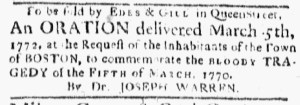
Boston Evening-Post (March 30, 1772).

“An ORATION … to commemorate the BLOODY TRAGEDY.”

On the second anniversary of the Boston Massacre, Dr. Joseph Warren delivered “An ORATION … at the Request of the Inhabitants of the Town of BOSTON, to commemorate the BLOODY TRAGEDY of the FIFTH of MARCH, 1770.”  Colonizers gathered to listen to the address, but attending that gathering was not their only means of participating in the commemoration of such a significant event.  Benjamin Edes and John Gill, printers of the Boston-Gazette, published Warren’s “ORATION” and marketed it widely in Massachusetts.

They placed their first advertisement in their own newspaper less than three weeks after Warren addressed “the Inhabitants of the Town.”  Their lengthy notice in the March 23, 1772, edition of the Boston-Gazette included an extensive excerpt about “the ruinous Consequences of standing Armies to free Communities.”  Edes and Gill also stated that they stocked “A few of Mr. LOVELL’S ORATIONS Deliver’d last April, on the same Occasion.”  Prospective customers had an opportunity to collect memorabilia related to the “FATAL FIFTH OF MARCH 1770.”  The following day, Samuel Hall, one of the printers of the Essex Gazette, informed readers that he sold copies of Warren’s address “published in Boston.”  His advertisement did not include an excerpt from the address, nor did subsequent advertisements that Edes and Gill placed in other newspapers in Boston.  They inserted a brief notice in the Massachusetts Gazette and Boston Weekly News-Letter on March 26 and then repeated it in the Boston Evening-Post on March 30.

Edes and Gill advertised widely.  That increased the chances that consumers would see their notices and contemplate purchasing copies of Warren’s “ORATION,” but those patriot printers likely aimed for more than generating sales.  Their advertisements in several newspapers contributed to a culture of commemoration of the American Revolution years before the skirmishes at Lexington and Concord.  Their work in the printing office, publishing newspapers and marketing pamphlets that commemorated the Boston Massacre, played an important role in shaping public opinion as colonizers considered current events and the possibility of declaring independence.